Table of Contents
1. Introduction to the Telefilm OTT Distribution Process
The Telefilm OTT Distribution Process has become an important route for independent producers who want to take finished television films to modern streaming audiences. Instead of depending only on traditional television broadcasts, producers can explore OTT platforms, digital distributors, aggregators, regional streaming services, and other content buyers.
However, getting a telefilm from a completed master to an actual streaming platform isn’t simply a matter of uploading a video. A professional OTT release requires several connected stages, including rights verification, technical preparation, metadata creation, buyer identification, submission, review, localization, quality control, licensing, delivery, and post-release reporting.
The good news is that the process can be organized into clear steps.
A telefilm that has a strong story, clean rights, professional technical quality, complete metadata, and a suitable distribution strategy is easier to present to potential buyers. At the same time, producers should understand that submission doesn’t automatically mean approval or streaming. Every OTT buyer has its own editorial, commercial, technical, and licensing requirements.
In this guide, we’ll explain the complete telefilm OTT distribution process from submission to streaming, including how to prepare your project, where to look for buyers, what documents you need, how agreements work, and how distribution partners can simplify the workflow.
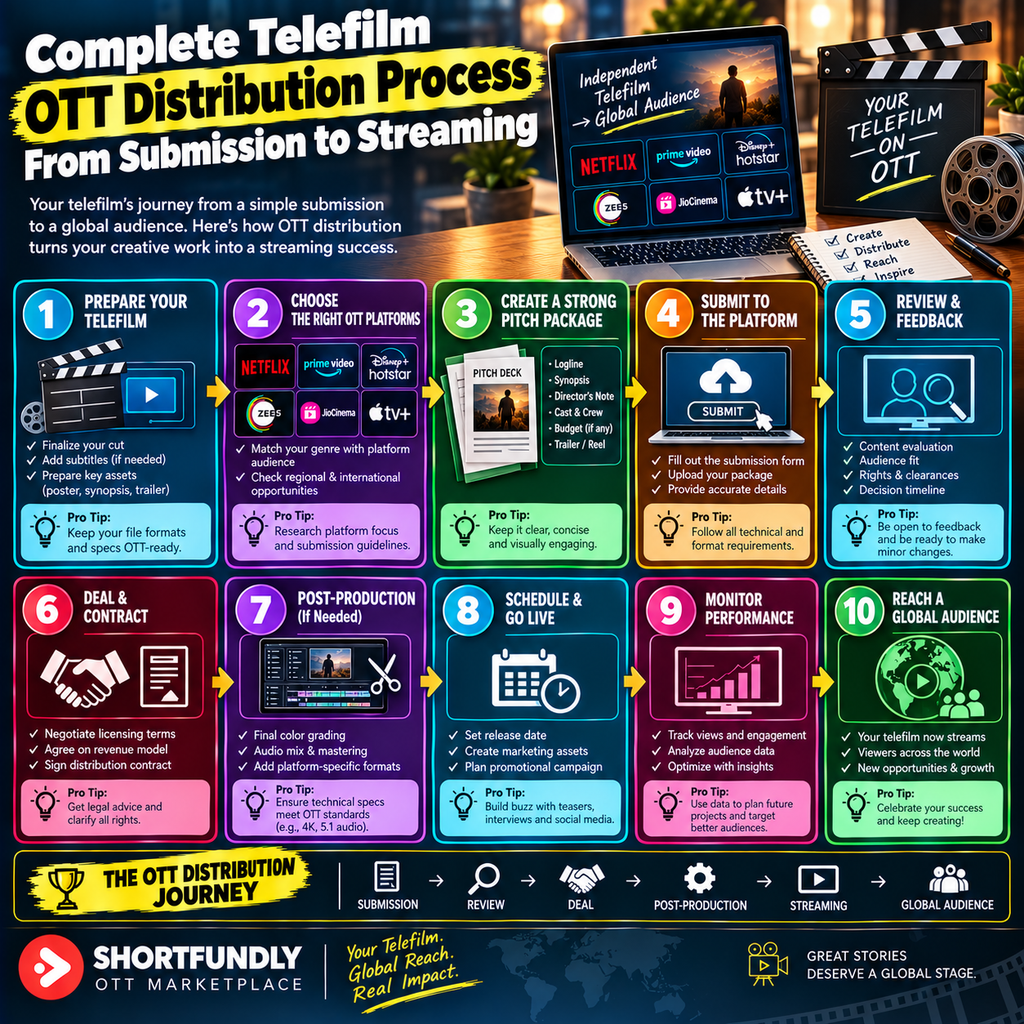
2. Understanding OTT Distribution for Telefilms
OTT distribution refers to delivering video content to audiences through internet-based streaming services rather than relying exclusively on conventional television broadcasting.
For a telefilm producer, OTT distribution can involve several different parties:
- OTT streaming platforms
- Digital content aggregators
- OTT distribution companies
- Sales agents
- Regional streaming services
- International content buyers
- TV and digital broadcasters
- Transactional video platforms
- Advertising-supported platforms
The exact route depends on your telefilm’s language, genre, duration, audience, territory, rights availability, and commercial potential.
For example, a regional-language telefilm may be particularly relevant to a regional OTT service, while a documentary-style telefilm may fit a niche international platform. A family drama could appeal to broader entertainment services, whereas a specialized subject might perform better with a focused content buyer.
The first principle is simple: don’t approach every OTT platform with the same pitch.
A buyer wants to understand why your telefilm belongs in its catalog. Therefore, your distribution strategy should connect the project’s characteristics with the platform’s audience.
The Indian Ministry of Information and Broadcasting maintains a public list of OTT platforms, which can be useful when researching the broader OTT ecosystem and identifying potential platform categories.
3. Step 1: Make Your Telefilm OTT-Ready
Before approaching any buyer, make sure the telefilm is genuinely ready for distribution.
This sounds obvious, but producers sometimes begin pitching while the project still has unfinished sound, incomplete subtitles, missing artwork, unresolved rights, or technical problems.
An OTT-ready telefilm should have:
- A final edited master
- Professional audio
- Completed color correction and grading
- Appropriate video resolution
- Clean opening and closing credits
- Proper subtitles where required
- Finalized title and synopsis
- Promotional artwork
- Trailer or teaser where applicable
- Copyright documentation
- Distribution rights
- Cast and crew information
- Music and footage clearances
- Contact information for the rights holder
Don’t overlook audio. A visually impressive telefilm can still create problems if dialogue is unclear, background noise is distracting, or music levels are inconsistent.
You should also watch the entire final master before submission. Check for black frames, unwanted graphics, missing scenes, incorrect subtitles, spelling mistakes, audio drops, and other delivery issues.
Think of your master as the product you’re presenting to a buyer. It should look finished.
4. Step 2: Secure Your Rights and Legal Documents
Rights management is one of the most important parts of the Telefilm OTT Distribution Process.
An OTT buyer or distributor needs confidence that the person offering the telefilm has the legal authority to distribute it.
Depending on your production, relevant documentation can include:
- Copyright ownership documents
- Producer agreements
- Writer agreements
- Director agreements
- Artist contracts
- Music licenses
- Location permissions
- Stock footage licenses
- Distribution authorization
- Chain-of-title documentation
- Trademark permissions
- Subtitle and dubbing rights
- Existing licensing agreements
Pay particular attention to music.
A producer may have permission to use a song in a film but not necessarily have every right required for worldwide digital streaming. Music licensing terms should therefore be reviewed carefully before entering an OTT agreement.
The same applies to archival footage, photographs, logos, artwork, and third-party material.
You should also know exactly which rights remain available.
For example:
| Right | Status to Verify |
|---|---|
| OTT Streaming | Available / Licensed |
| Television | Available / Licensed |
| Theatrical | Available / Licensed |
| Digital Download | Available / Licensed |
| TVOD | Available / Licensed |
| SVOD | Available / Licensed |
| AVOD | Available / Licensed |
| International | Available / Licensed |
| Regional | Available / Licensed |
| Dubbing | Available / Licensed |
| Remake | Available / Licensed |
Clear rights make negotiations easier and reduce the possibility of disputes later.
5. Step 3: Prepare Technical Delivery Materials
Once legal preparation is complete, focus on technical delivery.
Different OTT buyers can request different specifications, so don’t assume one master file will satisfy every platform.
Your technical package may include:
- High-quality video master
- Full HD or 4K version where appropriate
- Stereo or multichannel audio as requested
- Dialogue and music tracks
- Subtitle files
- Closed-caption files where required
- Trailer
- Teaser
- Poster
- Thumbnail
- Still images
- Clean title information
- Time-coded materials
- Technical specifications sheet
Technical requirements can change from platform to platform.
A distributor can sometimes help manage these delivery requirements, especially when the same title needs to reach multiple services.
For independent producers, this is one reason to consider an OTT distribution partner rather than trying to manage every technical delivery manually.
Shortfundly Distribution, for example, describes a workflow that includes submission, content review, release assets, distribution, and tracking for eligible content. Its current information also identifies telefilms among the supported content categories.
6. Step 4: Create Strong Metadata and Promotional Assets
Metadata may not be as exciting as filmmaking, but it plays a major role in digital distribution.
Your metadata tells a platform what your telefilm is about and helps its internal teams organize, search, categorize, promote, and display the title.
Prepare information such as:
- Title
- Alternate title
- Logline
- Short synopsis
- Long synopsis
- Genre
- Language
- Country of origin
- Release year
- Runtime
- Director
- Producer
- Lead cast
- Supporting cast
- Writer
- Music credits
- Keywords
- Age classification
- Subtitle languages
- Territory availability
Your synopsis should be clear and professional.
Avoid writing something like:
“This is a very emotional and exciting movie with lots of twists.”
Instead, explain the central conflict, protagonist, setting, and audience appeal without revealing unnecessary spoilers.
Your artwork matters too.
Prepare high-resolution posters and landscape promotional images where required. Make sure titles are readable and that artwork doesn’t contain unauthorized logos or promotional claims.
A buyer should be able to understand your project quickly from the pitch package.
7. Step 5: Identify the Right OTT Buyers
Finding the right buyer is often more important than simply finding a large platform.
Start by researching:
Major OTT Platforms
Large streaming services may acquire finished films through established industry relationships, production companies, sales agents, festivals, or other professional channels.
For example, Netflix states that it does not accept unsolicited submissions and explains that pitches generally need to come through established industry representatives or relationships.
That means producers shouldn’t simply send an unsolicited telefilm file to every major platform.
Regional OTT Platforms
Regional services can be valuable for telefilms made in languages such as:
- Tamil
- Telugu
- Malayalam
- Kannada
- Bengali
- Marathi
- Punjabi
- Gujarati
- Hindi
- Assamese
- Odia
Regional platforms often understand local audiences and language-specific viewing habits.
Aggregators and Distributors
Aggregators and distributors can provide another route to OTT platforms.
They may assist with:
- Buyer outreach
- Technical delivery
- Metadata
- Rights management
- Platform pitching
- Content packaging
- Reporting
- Revenue tracking
Niche Platforms
A telefilm with a specialized theme may find stronger relevance on a niche service than on a general entertainment platform.
The key is to research content fit.
8. Step 6: Choose Between Direct Submission and Distribution Partners
Producers generally have two broad approaches.
Direct Platform Submission
With direct submission, the producer communicates with the OTT platform or its authorized acquisition team.
Advantages can include:
- Direct communication
- Potentially fewer intermediaries
- Clear understanding of platform requirements
However, access may be limited because many major services don’t accept unsolicited submissions.
Distribution Partner
A distributor or aggregator can provide a structured route to multiple platforms.
Potential benefits include:
- Buyer relationships
- Submission assistance
- Technical delivery support
- Metadata management
- Rights administration
- Revenue reporting
- Multi-platform distribution
The right choice depends on your experience, network, rights strategy, budget, and target platforms.
Before signing with a distributor, ask:
- Which platforms do you currently work with?
- Is the agreement exclusive or non-exclusive?
- What territories are covered?
- What rights are being licensed?
- What are the fees?
- Is there a revenue share?
- How often are payments made?
- How is reporting provided?
- What happens if the title isn’t accepted?
- How can the agreement be terminated?
Never sign simply because a distributor promises “guaranteed OTT placement.”
Read the agreement.
9. Step 7: Submit Your Telefilm for Review
Once your buyer list and delivery package are ready, submit the telefilm through the appropriate channel.
A typical submission package may include:
| Material | Purpose |
|---|---|
| Master File | Main viewing asset |
| Trailer | Quick evaluation |
| Poster | Promotional presentation |
| Synopsis | Story overview |
| Metadata | Catalog information |
| Cast List | Talent information |
| Crew List | Production information |
| Rights Documents | Legal verification |
| Subtitle Files | Localization |
| Contact Details | Communication |
| Pricing/Terms | Commercial discussion |
Follow the buyer’s instructions carefully.
If the platform asks for a specific submission format, don’t send a random cloud-storage folder containing dozens of unrelated files.
Use professional file names.
For example:
Telefilm_Title_Master_4K.mov
is clearer than:
finalfinal2_new_REALFINAL.mov
Small details can make your workflow look much more professional.
Shortfundly Distribution also describes a structured submission process involving registration, content details, requirements review, agreement/payment steps where applicable, content submission, review, release assets, and distribution for eligible titles.
10. Step 8: Handle Content Review and Negotiation
After submission, the buyer or distributor may review the telefilm.
The review can cover several areas:
- Story quality
- Production quality
- Audience suitability
- Genre fit
- Language
- Runtime
- Technical quality
- Rights availability
- Commercial potential
- Platform strategy
- Existing licensing
- Content guidelines
A buyer may request additional information.
For example, they might ask for:
- A better synopsis
- Additional artwork
- Rights documents
- Subtitle files
- Censorship or classification information
- Technical specifications
- Talent details
- Previous performance data
Don’t take a request for additional information as a rejection. It may simply mean the buyer needs more material to complete its evaluation.
If the buyer is interested, commercial negotiations may begin.
Possible deal structures include:
- Fixed licensing fee
- Revenue share
- Minimum guarantee
- Hybrid licensing
- TVOD revenue share
- AVOD revenue share
- SVOD licensing
The agreement should clearly define what you’re receiving and what you’re giving.
11. Step 9: Complete Localization and Quality Control
Localization can significantly expand the potential audience for a telefilm.
Depending on your target market, you may need:
- Subtitles
- Closed captions
- Dubbing
- Translated metadata
- Localized artwork
- Regional promotional material
For example, a Tamil telefilm targeting international viewers might benefit from professionally prepared English subtitles.
Don’t rely solely on automatic translation for important commercial subtitles.
A poor translation can change character names, jokes, cultural meanings, or even the plot.
After localization, conduct another quality-control review.
Check:
- Subtitle timing
- Spelling
- Dialogue accuracy
- Formatting
- Audio synchronization
- Video quality
- Artwork dimensions
- Metadata accuracy
QC is not the place to cut corners.
A technical error discovered after platform delivery can cause unnecessary delays.
12. Step 10: Sign the Distribution Agreement
Before your telefilm goes live, make sure you understand the distribution agreement.
Important clauses include:
Rights
What rights are you licensing?
Territory
Is the agreement for India only, Asia, or worldwide?
Duration
How many years does the agreement remain active?
Exclusivity
Can you distribute the telefilm elsewhere?
Platforms
Which services can carry the title?
Revenue
How is revenue calculated?
Reporting
How frequently will you receive statements?
Payment
When and how will payments be made?
Removal
Under what conditions can the title be removed?
Renewal
What happens when the agreement expires?
For example, Shortfundly’s current published submission information describes a non-exclusive OTT agreement for five years in its stated requirements, while also noting that final streaming terms can depend on the applicable content license agreement.
Always review the actual agreement associated with your project rather than relying on general examples.
13. Step 11: Move From Delivery to Streaming
Once the agreement is complete, technical delivery and platform onboarding can move toward release.
The final stages may include:
- Master delivery
- Metadata delivery
- Artwork delivery
- Subtitle or dubbing delivery
- Technical QC
- Platform ingestion
- Catalog setup
- Release scheduling
- Promotional preparation
- Public streaming
At this point, your role doesn’t necessarily end.
Monitor the release.
Check whether:
- The title appears correctly
- The poster is correct
- The synopsis is accurate
- Subtitles work
- Audio is synchronized
- Credits display properly
- The release territory is correct
- The title is searchable
- Promotional materials are accurate
A successful release is more than simply seeing your telefilm online.
You should also monitor audience response and revenue wherever reporting is available.
14. Telefilm OTT Monetization Models
OTT distribution can use different monetization structures.
SVOD
Subscription Video on Demand allows viewers to access content through a subscription service.
The producer may receive a licensing fee, revenue share, or another negotiated arrangement.
TVOD
Transactional Video on Demand charges viewers for individual rentals or purchases.
This can be suitable for content where viewers are willing to pay directly for access.
AVOD
Advertising Video on Demand provides content without a direct viewer payment while monetizing through advertising.
Fixed Licensing
A platform or buyer pays an agreed amount for defined rights.
Revenue Share
The producer and distributor/platform divide eligible revenue according to the agreement.
Hybrid Model
Some deals combine an upfront payment with revenue participation.
There isn’t one model that works for every telefilm.
Your choice should depend on audience demand, territory, rights availability, platform type, and the commercial terms offered.
15. Common Mistakes That Delay OTT Distribution
Many OTT distribution problems are avoidable.
Mistake 1: Submitting Before the Film Is Finished
A rough master creates a poor first impression.
Mistake 2: Ignoring Rights
Unclear music or footage rights can stop a deal.
Mistake 3: Using Weak Metadata
A vague synopsis makes it harder for buyers to understand the project.
Mistake 4: Targeting Every Platform
More submissions don’t automatically mean better results.
Mistake 5: Ignoring Regional Buyers
A regional telefilm may have strong value within its language market.
Mistake 6: Accepting Every Contract
Read the rights, duration, territory, exclusivity, and revenue terms.
Mistake 7: Poor Subtitles
Translation quality affects the viewer experience.
Mistake 8: No Promotional Plan
OTT distribution and audience discovery are connected.
Mistake 9: Believing Guaranteed Placement Claims
A legitimate distribution process still involves platform eligibility, review, licensing, and availability.
Mistake 10: Forgetting Post-Release Analytics
Once the title is live, audience and revenue data can help guide future projects.
16. Pre-Submission Checklist for Telefilm Producers
Use this checklist before sending your telefilm to an OTT buyer.
Creative
- Final edit completed
- Color grading completed
- Audio mix completed
- Credits checked
- Trailer prepared
- Poster prepared
Legal
- Copyright ownership verified
- Music rights cleared
- Actor agreements available
- Writer agreements available
- Third-party footage cleared
- Distribution rights confirmed
- Existing licenses reviewed
Technical
- Master file exported correctly
- Audio checked
- Resolution confirmed
- Subtitle files prepared
- Caption requirements reviewed
- Artwork delivered in requested formats
Metadata
- Title
- Logline
- Short synopsis
- Long synopsis
- Genre
- Language
- Runtime
- Cast
- Crew
- Keywords
- Release year
Commercial
- Target buyers identified
- Rights availability documented
- Revenue expectations considered
- Territory strategy prepared
- Agreement terms reviewed
A checklist like this can save days of back-and-forth communication.
17. How Shortfundly Distribution Can Support Telefilm Distribution
For independent producers, managing the entire Telefilm OTT Distribution Process can be time-consuming.
Shortfundly Distribution provides a distribution route for eligible content and lists telefilms among its supported content categories. Its current distribution workflow includes content submission, review, release-asset preparation after approval, distribution through available partners, and tracking of content and earnings.
Shortfundly also describes a global network approach in which its sales team pitches eligible content to OTT and TV broadcast platforms. Its platform information highlights revenue tracking and monthly payout processes for creators under applicable arrangements.
This can be useful for producers who want a more structured distribution workflow instead of individually researching every possible outlet.
However, producers should always verify current platform availability, eligibility, fees, rights terms, revenue arrangements, and agreement conditions before submitting.
The distribution process can be explored through the official Shortfundly Distribution portal.
Shortfundly’s approach also emphasizes practical OTT preparation, including video and audio quality, copyright and distribution rights, subtitles, metadata, posters, thumbnails, promotion, and post-release analytics.
For an independent telefilm producer, having these materials ready before submission can make the process much smoother.
18. FAQs About Telefilm OTT Distribution
FAQ 1: What is the Telefilm OTT Distribution Process?
The Telefilm OTT Distribution Process is the series of steps used to move a completed telefilm from production and submission through buyer review, licensing, technical delivery, quality control, platform onboarding, and streaming.
FAQ 2: Can an independent producer distribute a telefilm on OTT platforms?
Yes. Independent producers can explore OTT distribution through eligible platforms, aggregators, distributors, and content acquisition channels. However, each platform has its own requirements, and submission does not guarantee acceptance.
FAQ 3: What documents are required for telefilm OTT distribution?
Common documents include copyright information, distribution rights, cast and crew agreements, music clearances, chain-of-title documents, technical specifications, metadata, subtitles, artwork, and other materials requested by the buyer.
FAQ 4: Can I submit my telefilm directly to Netflix?
Netflix states that it does not accept unsolicited submissions. Its official guidance says producers generally need to work through a licensed agent, producer, attorney, manager, or industry executive with an existing relationship with Netflix.
Therefore, sending an unsolicited telefilm directly to Netflix isn’t the standard submission route.
FAQ 5: Can Amazon Prime Video accept independent content?
Amazon’s Prime Video Direct service states that it supports studios, distributors, and independent filmmakers and provides tools for rights holders to manage eligible titles. Availability and commercial options can vary by territory and current program terms.
FAQ 6: How long does OTT distribution take?
There is no single timeline for every telefilm. The process depends on buyer response, rights verification, technical readiness, localization, QC, licensing, platform scheduling, and other factors.
A well-prepared project can reduce avoidable delays.
FAQ 7: Should I use an OTT distributor?
An OTT distributor can be useful when you need help with buyer outreach, technical delivery, metadata, rights administration, reporting, or multi-platform distribution. Compare the distributor’s services, fees, rights terms, exclusivity, territories, and reporting before signing.
FAQ 8: What video quality is required for OTT distribution?
Requirements vary by platform. Many OTT workflows require professional HD or 4K masters, properly mixed audio, subtitles or captions where applicable, and specific file formats. Always follow the buyer’s current technical delivery specifications.
FAQ 9: Can a regional-language telefilm be distributed internationally?
Yes, potentially. International distribution depends on rights, subtitles or dubbing, buyer interest, territory restrictions, content suitability, and platform availability. Strong localization can make a regional-language title easier to evaluate for international audiences.
FAQ 10: How can I improve my telefilm’s chances of approval?
Start with a strong finished product. Then prepare clean rights documentation, professional technical assets, accurate metadata, good subtitles, attractive artwork, and a focused buyer strategy. Most importantly, submit to buyers that fit the telefilm rather than sending the same package everywhere.
Also read: https://blog.shortfundly.com/ott/telefilm-ott-distribution-3/
19. Conclusion
The Telefilm OTT Distribution Process is much more than uploading a finished video to a streaming service. It is a structured business process that connects your creative work with the right audience, buyer, platform, and monetization model.
The most important stages include preparing an OTT-ready master, securing rights, creating technical and metadata packages, identifying suitable OTT buyers, submitting through the correct route, responding to content review, completing localization and QC, negotiating the agreement, delivering the final assets, and monitoring the release.
Independent producers should also remember that OTT distribution is not a one-size-fits-all process.
A regional drama may need a different strategy from a national Hindi telefilm. A family-oriented production may have different buyer requirements from a niche documentary-style project. Likewise, a producer targeting international audiences may need stronger subtitle and localization preparation.
The smartest approach is to prepare before approaching buyers.
Know your rights. Know your audience. Know your target platforms. Know your technical specifications. Know your commercial expectations. And read every distribution agreement carefully.
Whether you pursue direct platform opportunities, OTT aggregators, sales agents, or services such as Shortfundly Distribution, your goal should be the same: create a professional distribution package that makes your telefilm easy for buyers to evaluate and easy for platforms to deliver.
With the right preparation, a completed telefilm doesn’t have to remain on a hard drive waiting for an opportunity. A clear OTT strategy can turn that finished production into a structured digital distribution opportunity and help it reach viewers across relevant markets.