Table of Contents
The digital streaming industry is creating new opportunities for filmmakers, producers, media companies, and independent content owners to distribute their content to audiences worldwide. Among the emerging distribution models, FAST distribution (Free Ad-Supported Streaming TV) is gaining attention as a way to deliver entertainment without requiring viewers to pay subscription fees.
For content owners with films, documentaries, television series, short films, and other video assets, FAST distribution offers another avenue to explore audience reach, content licensing, and monetization. Instead of allowing valuable content libraries to remain underutilized, owners can investigate opportunities to make their content available through ad-supported streaming channels.
Understanding FAST distribution is essential for content owners who want to adapt to changing viewer preferences, explore digital distribution partnerships, and develop a long-term strategy for their intellectual property.
In this guide, we will explain how FAST distribution works, its potential benefits, the types of content suitable for FAST channels, and the essential steps content owners should take to prepare for distribution.
What Is FAST Distribution?
FAST stands for Free Ad-Supported Streaming Television. It is a streaming television model that allows audiences to watch content for free while advertising generates revenue for the platform.
FAST channels typically operate like traditional television channels, offering scheduled and curated programming through internet-connected televisions, streaming devices, mobile applications, and other digital platforms.
Unlike subscription-based streaming services, FAST channels generally do not require viewers to pay a monthly subscription. Instead, advertisements are shown during programming, and the platform monetizes viewer attention through advertising.
FAST distribution refers to the process of making content available through FAST channels or their distribution partners. This process may involve content licensing, technical preparation, rights verification, metadata creation, programming, content delivery, and commercial agreements.
For content owners, FAST distribution can provide another way to make content available to audiences while exploring the commercial potential of their existing film and television libraries.
Why FAST Distribution Matters for Content Owners
Content owners often invest significant resources in creating, acquiring, and maintaining films and video libraries. However, the value of content does not necessarily end after its initial release.
FAST distribution creates an opportunity to explore additional distribution windows and audience discovery options.
1. Unlock Additional Value From Existing Content Libraries
Many producers and content owners have catalogs of films, documentaries, series, and other content that may no longer be actively promoted.
FAST distribution can provide an opportunity to evaluate these assets for new licensing or programming opportunities.
Older films, previously released titles, independent productions, and niche content may be relevant to channels serving specific audiences.
Instead of treating a content library as a collection of completed projects, content owners can view it as a long-term digital asset with potential distribution value.
The availability of FAST opportunities depends on rights, content suitability, platform demand, territories, and licensing conditions.
2. Reach Audiences Without a Subscription Barrier
One of the most appealing characteristics of FAST channels is that viewers can watch without purchasing a subscription.
This free viewing model may help content reach audiences who prefer not to subscribe to multiple streaming services.
For content owners, free access can create an additional discovery environment for films and shows. Viewers browsing channels may discover content they would not actively search for on a video-on-demand platform.
Audience reach depends on the platform, channel distribution, programming, availability, and viewer behavior.
3. Explore Advertising-Based Monetization
FAST channels generate revenue through advertising. Commercials may appear before, during, or around content depending on the platform’s advertising structure.
Content owners may participate in monetization through licensing fees, revenue-sharing arrangements, or other negotiated commercial models.
However, FAST monetization is not automatically guaranteed for every title. The revenue model depends on the distributor, channel operator, content agreement, advertising performance, and applicable deductions.
Content owners should understand the financial terms before licensing their content.
4. Expand Distribution Beyond Traditional Platforms
Traditional film distribution often involves theatrical releases, television licensing, physical media, and subscription-based streaming.
FAST distribution offers another model to explore alongside these channels.
A content owner may consider FAST distribution as part of a broader strategy that includes:
- Theatrical distribution
- OTT streaming
- AVOD distribution
- TVOD platforms
- SVOD licensing
- FAST channels
- International content licensing
- Educational and institutional distribution
The objective is to identify the most suitable distribution channels for each content asset without creating unnecessary conflicts between rights, exclusivity, or release windows.
11 Powerful FAST Distribution Strategies for Content Owners
1. Evaluate Your Content Library for FAST Opportunities
Before approaching FAST distributors, review your existing content library and identify titles that may be suitable for ad-supported streaming.
Create a catalog that includes:
- Film and series titles
- Genre
- Runtime
- Release year
- Language
- Production country
- Synopsis
- Cast and director
- Available subtitles
- Video quality
- Rights availability
- Current distribution restrictions
This inventory helps you understand which titles are distribution-ready and which need additional preparation.
Content owners should evaluate each title individually. A movie that works well for a niche FAST channel may not be suitable for a general entertainment channel.
2. Verify Your Content Rights
Rights verification is a critical part of FAST distribution.
Before licensing your content, confirm that you own or control the necessary rights for the intended streaming, advertising-supported, and digital distribution uses.
Review the following:
- Film and television distribution rights
- Streaming rights
- FAST rights
- AVOD rights
- Territory rights
- Music licensing
- Performer agreements
- Third-party footage
- Artwork rights
- Exclusivity obligations
- Existing licensing contracts
If your content is already available on another platform, review the agreement to determine whether FAST distribution is permitted.
Rights may be limited by territory, language, platform type, release period, or exclusivity. Clear documentation can help prevent disputes and simplify the licensing process.
3. Identify the Right FAST Channels and Distribution Partners
Not every FAST channel serves the same audience.
Some channels focus on specific genres, including action, drama, comedy, documentaries, horror, lifestyle, family entertainment, classic movies, or regional programming.
Content owners should research channel positioning before approaching distributors or licensing partners.
Consider the following questions:
- What type of content does the channel feature?
- Does it acquire third-party content?
- Does it work with independent content owners?
- Does it accept international content?
- What genres are currently relevant?
- Does it work directly with producers or through aggregators?
- What territories are available?
- What are its content delivery requirements?
Finding a suitable channel or distribution partner is more important than sending your entire library to every available platform.
4. Prepare Professional Video Masters
Technical readiness can influence whether your content can be accepted and processed for distribution.
Content owners should maintain high-quality master files and prepare them according to the specifications provided by the relevant distributor or platform.
Technical requirements may include:
- Resolution, such as HD or 4K
- Supported file formats
- Video codecs
- Frame rate
- Aspect ratio
- Audio codec
- Audio channel configuration
- Subtitle formats
- Video quality standards
- Content quality control
Do not assume that one file format works across all platforms. Each partner may have different requirements.
Before delivery, check for technical issues such as audio clipping, poor synchronization, unwanted black frames, incorrect aspect ratios, damaged files, and subtitle errors.
A well-prepared master helps reduce delivery problems and supports a smoother distribution workflow.
5. Optimize Metadata for Content Discovery
Metadata is the descriptive information used to identify, organize, categorize, and present content across digital platforms.
Strong metadata helps distributors understand your content and may support catalog organization, channel programming, and audience discovery.
Your metadata package should include:
| Metadata Field | Description |
|---|---|
| Title | Official content title |
| Synopsis | Short overview of the story |
| Full description | Detailed content summary |
| Genre | Primary content category |
| Subgenre | More specific classification |
| Runtime | Total duration |
| Release year | Original release year |
| Language | Original language |
| Country | Production country |
| Cast | Principal performers |
| Director | Director’s name |
| Rating | Applicable age or content rating |
| Keywords | Themes and relevant search terms |
| Subtitle details | Available subtitle languages |
Avoid generic descriptions that do not explain the content. A strong synopsis should communicate the story, its central conflict, genre, and audience appeal.
6. Create High-Quality Artwork and Promotional Assets
Artwork plays an important role in presenting content to distributors, channel operators, and audiences.
Content owners should prepare a professional asset package containing:
- Film poster
- Landscape key art
- Portrait artwork where required
- Film stills
- Trailer
- Teaser
- Cast images, where permitted
- Director profile
- Promotional synopsis
- Social media creatives
Artwork requirements may vary across platforms. Some distributors require specific dimensions, aspect ratios, file formats, and image resolutions.
Use artwork that clearly represents the content and is legally cleared for distribution and promotion.
7. Localize Content for Different Markets
Localization can help content owners explore distribution opportunities beyond their original language markets.
Depending on the film and target territories, localization may include:
- English subtitles
- Regional-language subtitles
- International subtitles
- Dubbing
- Translated metadata
- Localized promotional descriptions
- Cultural adaptation of marketing materials
Subtitles should be accurate, properly synchronized, and easy to read.
Localization priorities should depend on the content, audience, rights availability, and potential distribution territories. Content owners do not need to prepare every language in advance if the distributor has specific requirements or recommendations.
8. Understand FAST Licensing and Distribution Agreements
FAST distribution agreements determine how your content may be used, where it may be available, and how the commercial relationship works.
Before signing an agreement, carefully review the important terms.
| Contract Term | What Content Owners Should Review |
|---|---|
| Rights | Which rights are being licensed |
| Territories | Where the content can be distributed |
| License duration | How long the agreement remains active |
| Exclusivity | Whether other distribution options are restricted |
| Revenue model | Licensing fee or revenue share |
| Revenue deductions | Costs deducted before payments |
| Reporting | What performance and revenue data is provided |
| Payment terms | Payment schedules and conditions |
| Renewal | Whether the license can be extended |
| Termination | How rights return or agreements end |
Content owners should never assume that all FAST distribution agreements are identical.
Understanding the agreement helps protect your content library and maintain flexibility for future distribution opportunities.
9. Explore Content Monetization Models
FAST distribution may provide several commercial possibilities depending on the partner and agreement.
Licensing Fee Model
A distributor or channel may pay a negotiated licensing fee to use content for a defined period, territory, or set of rights.
Revenue-Sharing Model
Content owners may receive a percentage of revenue according to the agreed terms and reporting structure.
Advertising-Based Revenue Participation
Some agreements may allow content owners to participate in advertising-generated revenue associated with their content.
Library Licensing
A collection of films or shows may be licensed as a package, subject to content suitability and commercial negotiations.
Each model has different financial implications. Content owners should review payment calculations, reporting, deductions, minimum guarantees if any, and other contractual conditions.
Do not assume a particular revenue model is available without confirming it with the distribution partner.
10. Build a Long-Term Distribution Strategy
FAST distribution should be considered as part of a long-term content strategy rather than a one-time submission.
Content owners can organize their library into different categories based on rights, genre, audience, release status, technical readiness, and distribution potential.
A strategic library approach may include:
- New releases
- Previously released films
- Festival films
- Documentaries
- Regional-language content
- Genre-focused collections
- Series and episodic programming
- Short-form content
- Catalog titles
A long-term strategy makes it easier to evaluate distribution opportunities when new channel requirements or licensing opportunities arise.
It also helps content owners understand which assets are available, which are already licensed, and which require further preparation.
11. Monitor Distribution Performance and Opportunities
After distribution, content owners should review available reports and updates.
Depending on the agreement and partner, reporting may include:
- Viewing hours
- Audience engagement
- Content performance
- Advertising revenue
- Territory-level information
- Platform availability
- Release status
- Licensing activity
Not every partner provides the same reporting information.
Use the data you receive to understand content performance, evaluate distribution partners, and improve future licensing decisions.
If a particular genre, language, or content format performs well, that information may help guide future content acquisition and distribution strategies.
What Types of Content Are Suitable for FAST Distribution?
FAST channels serve different audiences and programming interests. A wide range of content types may be considered, depending on the channel and licensing requirements.
| Content Type | Potential FAST Distribution Opportunity |
|---|---|
| Feature films | Genre-focused and movie channels |
| Short films | Curated short-film programming |
| Documentaries | Factual, social, cultural, and educational channels |
| Television series | Episodic and themed programming |
| Regional movies | Language-specific channels |
| Classic movies | Nostalgia and classic cinema programming |
| Lifestyle content | Lifestyle and interest-based channels |
| Family content | Family-oriented programming |
| Animation | Animation and children’s programming, subject to applicable standards |
| Reality content | Entertainment and reality-focused channels |
The suitability of content depends on the channel’s programming strategy, audience requirements, rights availability, technical quality, and commercial considerations.
FAST Distribution vs. OTT Distribution: What Content Owners Should Know
FAST and OTT are related but not identical concepts.
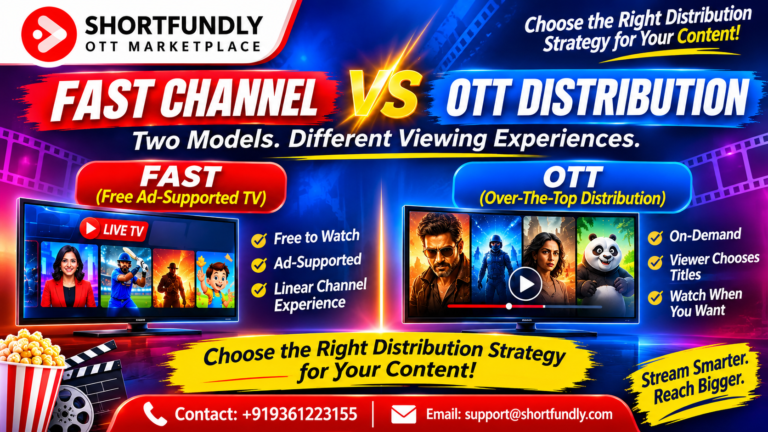
OTT, or Over-the-Top distribution, refers broadly to video content delivered over the internet. OTT can include subscription-based streaming, free streaming, rentals, purchases, and other digital video services.
FAST is a specific model of free, ad-supported streaming television, typically organized into linear channels with scheduled programming.
| Feature | FAST Distribution | General OTT Distribution |
|---|---|---|
| Viewer payment | Generally free | Free, subscription, rental, or purchase |
| Revenue model | Primarily advertising-supported | May include ads, subscriptions, rentals, or purchases |
| Viewing format | Often linear and scheduled | Linear, on-demand, or both |
| Content discovery | Channel browsing and scheduled programming | Search, recommendations, catalogs, and channel options |
| Audience access | No subscription required for FAST viewing | Depends on platform model |
| Content licensing | Depends on channel and partner | Depends on service and agreement |
For content owners, understanding these differences is important when selecting distribution partners.
A distributor may offer OTT distribution services without offering FAST channel placement. Confirm whether the service includes FAST-specific distribution before licensing your content.
FAST Distribution Checklist for Content Owners
Before approaching a distribution partner, use this checklist to assess your content readiness.
<text color=”success” weight=”medium”>Content readiness checklist</text>
- Content ownership and distribution rights verified
- FAST and streaming rights confirmed
- Territory rights documented
- Music and third-party assets cleared
- Master video file prepared
- Audio quality checked
- Subtitles reviewed
- Film synopsis completed
- Metadata sheet prepared
- Film poster and artwork available
- Trailer prepared
- Promotional stills organized
- Genre and audience identified
- Licensing terms reviewed
- Distribution partner researched
- Technical delivery requirements confirmed
Preparing these materials in advance can make your distribution submission more organized and reduce avoidable delays.
Common Challenges in FAST Distribution
While FAST distribution offers opportunities, content owners should also understand the challenges.
Content Selection and Competition
FAST channels may receive large amounts of content from studios, distributors, and independent producers. A title must meet the channel’s programming, quality, rights, and commercial requirements.
Rights and Licensing Complexity
Content may have existing agreements that restrict its availability on FAST channels, in specific territories, or during certain release windows.
Technical Delivery Requirements
A content owner may need to prepare new masters, subtitles, artwork, metadata, and other delivery assets.
Uncertain Monetization
Advertising revenue and licensing outcomes vary. Content owners should not assume that every distributed title will generate significant income.
Platform Availability
Distribution opportunities change over time. Channel partners, territories, platform requirements, and content acquisition priorities may evolve.
A realistic approach helps content owners make informed decisions and evaluate distribution offers carefully.
How Shortfundly Distribution Can Help Content Owners Explore OTT Distribution
Content owners looking to distribute their films and video libraries can explore distribution services through Shortfundly Distribution.
Shortfundly Distribution supports eligible filmmakers and content owners through its OTT distribution workflow, which includes content evaluation, rights and technical review, preparation, metadata assistance, platform submissions, and coordination.
Content owners can explore distribution opportunities for eligible content such as:
- Feature films
- Short films
- Documentaries
- Web series
- Regional-language content
- Other eligible video formats
Shortfundly’s distribution process includes project submission, content and rights evaluation, technical preparation, platform submission coordination, and updates regarding submission status and next steps.
If you are exploring FAST distribution, it is important to confirm whether FAST-specific services and channel opportunities are currently available for your title. OTT distribution does not automatically include FAST placement, and submission does not guarantee acceptance or release on any particular platform.
To learn more about content distribution services and submit your project for consideration, visit:
Shortfundly Distribution – Explore OTT Distribution Services
Content owners can review the current services, requirements, process, and applicable terms before deciding whether to proceed.
Frequently Asked Questions About FAST Distribution for Content Owners
1. What is FAST distribution for content owners?
FAST distribution allows content owners to explore licensing and distribution opportunities for their movies, series, and other video content through free ad-supported streaming television channels. These channels generate advertising revenue rather than charging viewers a subscription fee.
2. How can content owners get their films on FAST channels?
Content owners can prepare their films, verify rights, organize technical assets, and approach FAST channel operators or distributors that handle FAST-specific content licensing and submissions. Acceptance depends on content requirements, programming needs, and available distribution opportunities.
3. Can content owners monetize their film libraries through FAST channels?
Potentially. Monetization may be available through licensing fees, revenue sharing, or other commercial arrangements. The exact model depends on the channel, distributor, territory, advertising structure, and agreement.
4. Is FAST distribution suitable for independent filmmakers?
FAST distribution may be suitable for independent filmmakers with completed films, documentaries, series, and other eligible content. Film quality, rights, technical readiness, programming fit, and distribution availability influence the opportunities.
5. Does FAST distribution require exclusive rights?
Not always. Some agreements may be exclusive, while others may be non-exclusive. Content owners should carefully review the rights, territories, license duration, and restrictions before signing.
6. What technical requirements are needed for FAST distribution?
Requirements may include high-quality video masters, supported file formats, audio specifications, subtitles, metadata, artwork, and promotional assets. The exact specifications vary by distributor and channel.
7. Can older content be distributed through FAST channels?
Older films and television content may be considered if the content owner has the necessary rights, the technical quality is acceptable, and the title matches the channel’s programming needs.
8. Does OTT distribution include FAST distribution?
No. OTT distribution is a broad category of internet-based video distribution. FAST is a specific free, ad-supported linear television model. A distribution partner may offer OTT services without offering FAST-specific placement.
9. How do content owners choose a FAST distribution partner?
Content owners should evaluate distribution experience, current FAST capabilities, channel opportunities, territories, fees, revenue models, rights requirements, reporting, technical support, communication, and contract terms.
10. Does submitting content guarantee FAST channel placement?
No. Submission is generally subject to content review, licensing, platform requirements, programming availability, partner evaluation, and commercial considerations. Distribution cannot be guaranteed merely by submitting content.
Also read: https://blog.shortfundly.com/ott/content-fast-distribution/
Conclusion: Make Your Content Library Ready for the FAST Era
FAST distribution offers content owners another opportunity to explore digital licensing, audience discovery, and advertising-supported streaming. With the growing diversity of streaming audiences and programming models, films, documentaries, series, and other video content may have additional distribution opportunities beyond their original release.
The key to a successful FAST distribution strategy is preparation. Content owners should organize their libraries, verify rights, prepare high-quality masters, create accurate metadata, develop professional artwork, research relevant distribution partners, and understand licensing and monetization agreements.
FAST should be considered as part of a broader content distribution strategy that includes OTT, AVOD, SVOD, TVOD, television licensing, and other relevant channels. A well-planned strategy can help content owners protect their intellectual property while exploring suitable opportunities for their content.
If you are a filmmaker, producer, or content owner looking to explore digital distribution, visit Shortfundly Distribution to review its current OTT distribution services and submission process.
Take the time to understand your content’s rights, distribution potential, and partner requirements. With the right preparation and a strategic approach, you can make your content library better positioned to explore the evolving streaming distribution landscape.