Table of Contents
1. Introduction to Professional Telefilm OTT Distribution
The growth of streaming has changed how audiences discover films and television content. For telefilm producers, this creates an opportunity to reach viewers beyond traditional television channels. However, simply putting a completed telefilm online doesn’t automatically create revenue.
This is where professional Telefilm OTT Distribution Services can become valuable.
A professional distribution service can help producers organize the process of preparing, submitting, delivering, licensing, and monetizing a telefilm across suitable digital channels. Instead of spending all your time searching for platforms, formatting assets, preparing metadata, checking rights, and communicating with different parties, you can use a structured distribution workflow.
Revenue doesn’t come from distribution alone. It comes from connecting the right content with the right audience, platform, territory, rights model, and monetization strategy.
For example, one telefilm may work through a licensing arrangement, while another may generate revenue through advertising, rentals, purchases, subscriptions, or revenue sharing. The commercial structure depends on the platform and agreement.
Professional distribution can therefore improve the commercial readiness of a telefilm.
It’s important to keep expectations realistic. No legitimate distributor can guarantee that every title will be accepted by every OTT platform or generate a specific amount of money. Platform selection, audience demand, content quality, rights, pricing, availability, and marketing all influence the final result.
Still, a structured approach can remove many avoidable problems.
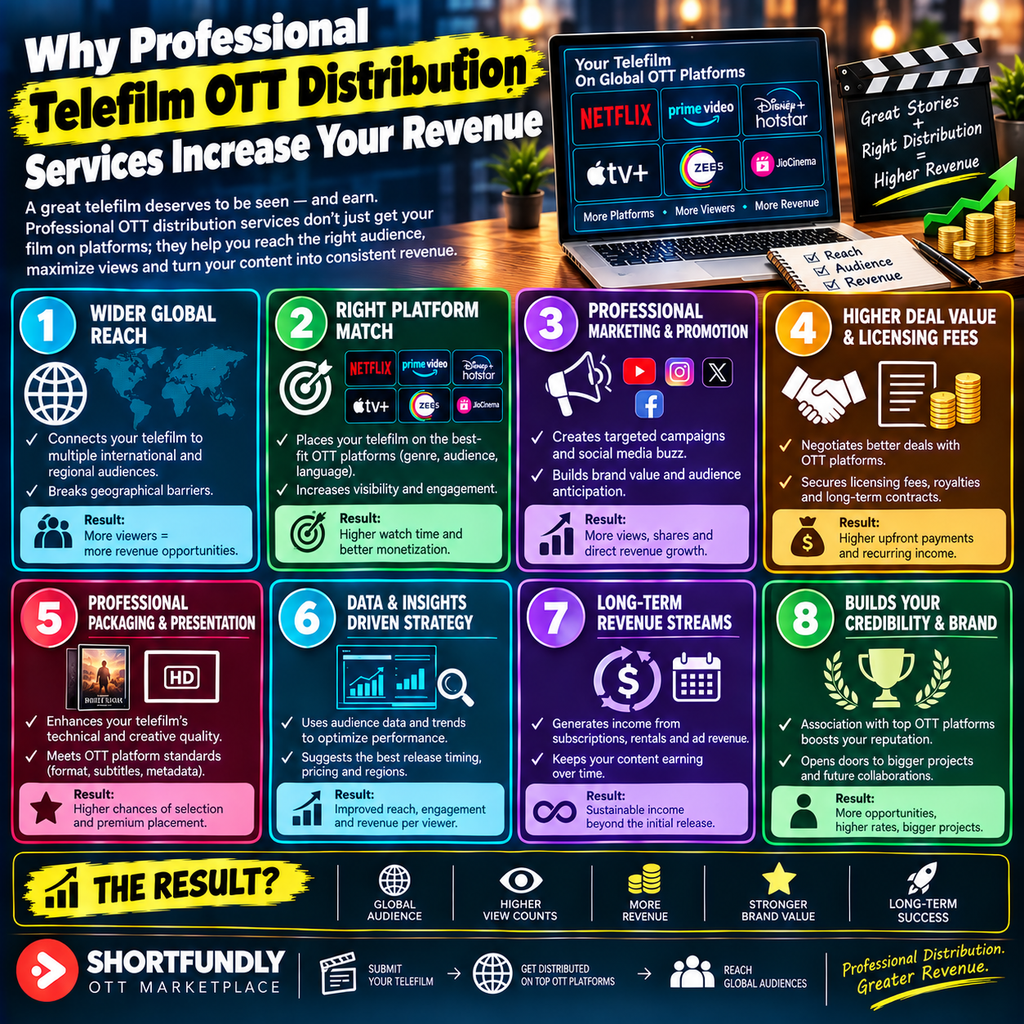
In this guide, we’ll explore 11 powerful ways professional telefilm distribution services can support revenue growth, along with practical advice for choosing a distribution partner and preparing your project for the OTT market.
2. What Are Telefilm OTT Distribution Services?
Telefilm OTT Distribution Services are professional services that help rights holders deliver telefilms to streaming and digital distribution channels.
Depending on the provider, services may include:
- Content submission
- Platform pitching
- OTT buyer outreach
- Rights administration
- Metadata preparation
- Technical delivery
- Subtitle coordination
- Localization
- Content quality control
- Release management
- Revenue reporting
- Performance tracking
The exact service package varies from company to company.
Some distributors operate primarily as aggregators. Others focus on sales and licensing. Some provide technology for direct submission and tracking. Others combine several functions.
For producers, the important question isn’t simply, “Does this company distribute films?”
The better question is:
“What part of my distribution workflow will this company actually handle?”
Before signing an agreement, ask for clear information about platforms, territories, rights, fees, revenue sharing, exclusivity, agreement duration, reporting, payment schedules, and removal procedures.
For example, Shortfundly Distribution currently lists telefilms among its supported content types and describes a workflow that includes submission, content review, release assets, distribution through available partners, and earnings tracking. Its published requirements also emphasize technical quality, rights, metadata, subtitles, and promotional preparation.
That kind of structured workflow can be useful for independent producers who don’t want to manage every distribution task manually.
3. Why OTT Distribution Matters for Telefilm Producers
Traditional distribution can limit a telefilm to specific broadcast schedules, territories, or licensing relationships.
OTT distribution changes the equation by giving content a digital route to audiences.
A telefilm can potentially reach viewers through:
- Subscription platforms
- Transactional platforms
- Advertising-supported services
- Regional OTT services
- Digital marketplaces
- Aggregators
- International streaming services
- Connected-TV environments
This doesn’t mean every telefilm belongs everywhere.
Actually, trying to place a title on every possible platform can create unnecessary work and conflicting rights arrangements.
The goal is targeted distribution.
Consider these factors:
| Factor | Why It Matters |
|---|---|
| Genre | Determines audience and platform fit |
| Language | Helps identify regional markets |
| Runtime | May affect platform eligibility |
| Audience | Influences monetization potential |
| Territory | Determines where rights can be sold |
| Rights | Defines what can legally be licensed |
| Quality | Affects buyer confidence |
| Metadata | Helps platforms understand the title |
| Localization | Opens additional markets |
| Commercial Model | Determines how revenue is generated |
A professional distributor can help organize these factors into a practical strategy.
4. Benefit 1: Wider Audience Reach
The first major advantage of professional distribution is audience expansion.
A telefilm sitting on a producer’s computer has no opportunity to generate streaming revenue. A telefilm properly delivered to relevant platforms has a chance to be discovered and watched.
Distribution can help move content from a single release channel toward multiple potential audiences.
For example, a regional-language telefilm may initially appeal to viewers in its home market. With suitable subtitles, metadata, and platform access, it may also reach audiences in other regions.
This is particularly useful for:
- Tamil telefilms
- Telugu telefilms
- Malayalam telefilms
- Kannada telefilms
- Bengali telefilms
- Marathi telefilms
- Hindi telefilms
- Punjabi telefilms
- Gujarati telefilms
- Other regional productions
However, reach should be measured intelligently.
More platforms don’t always mean more revenue.
A title on ten poorly matched services may generate less value than the same title on two platforms with strong audience alignment.
Professional distribution should therefore focus on relevant reach, not just maximum reach.
5. Benefit 2: Access to Multiple OTT Platforms
Building relationships with streaming platforms can take considerable time.
Independent producers may not know:
- Which platforms are accepting content
- Who handles acquisitions
- What technical specifications are required
- What rights are needed
- How to submit
- What commercial model applies
- Whether the platform accepts unsolicited submissions
This is where an established distribution service can provide practical value.
A distributor may already have relationships or submission workflows for several content outlets.
Shortfundly Distribution, for instance, states that its sales team pitches eligible content to a global network of OTT and TV broadcast platforms. Its current platform information also says that available partners can vary according to content, duration, eligibility, licensing, and distribution availability.
That distinction is important.
A professional service can provide access to a distribution network, but that doesn’t mean every title will automatically appear on every platform.
Platform selection remains dependent on eligibility and buyer decisions.
For comparison, some major platforms use highly controlled acquisition processes. Netflix’s official guidance says it doesn’t accept unsolicited materials and that pitches generally need to come through authorized industry representatives with an existing relationship.
On the other hand, Prime Video Direct currently describes a route for rights holders including independent filmmakers, distributors, and studios, with supported distribution options and performance metrics.
The lesson is straightforward: know the submission route before approaching a platform.
6. Benefit 3: Better Revenue Opportunities
Professional distribution can increase revenue opportunities by opening more than one monetization path.
Common OTT revenue models include:
Fixed Licensing
A platform pays an agreed amount for specified rights and a defined period.
Revenue Sharing
The rights holder receives an agreed percentage of eligible revenue.
TVOD
Viewers pay to rent or purchase the telefilm.
SVOD
The telefilm becomes part of a subscription-based streaming service.
AVOD
Advertising supports the viewing experience.
Hybrid Models
Some agreements combine fixed payments with performance-based revenue.
The right model depends on the telefilm.
For example, a niche telefilm with a strong dedicated audience might perform differently from a broad family drama. A regional title may have stronger value in a particular language market than in a general global catalog.
Professional distribution can help producers evaluate these possibilities rather than assuming every title should use the same model.
Still, producers should carefully distinguish revenue opportunity from guaranteed revenue.
Distribution increases access and can improve the commercial process, but audience demand ultimately affects performance.
7. Benefit 4: Professional Buyer and Platform Outreach
Approaching OTT buyers requires more than sending an email saying, “I have a film.”
Buyers need a clear package.
A professional pitch may include:
- Title
- Genre
- Logline
- Synopsis
- Runtime
- Language
- Target audience
- Director
- Producer
- Cast
- Trailer
- Poster
- Streaming master
- Rights information
- Territory availability
- Commercial expectations
The pitch should quickly answer three questions:
- What is the telefilm?
- Who will watch it?
- Why is it relevant to this platform?
A distribution company may help organize this information and approach appropriate buyers.
That saves time and makes the project look more professional.
It can also reduce a common problem: sending the same generic pitch to every platform.
A children’s telefilm should not be pitched in exactly the same way as a crime drama. Likewise, a Tamil-language family story may require a different market strategy from an English-language international production.
Professional outreach is about fit.
8. Benefit 5: Better Metadata and Content Packaging
Metadata may sound technical, but it directly affects how a telefilm is presented.
A streaming service may need information such as:
- Title
- Alternate title
- Synopsis
- Short description
- Genre
- Language
- Country
- Runtime
- Release year
- Cast
- Director
- Producer
- Keywords
- Age classification
- Subtitle languages
Good metadata helps buyers understand the content quickly.
It can also support discovery once the title becomes available.
Imagine two telefilms:
Film A:
“An emotional story about a family.”
Film B:
“A Tamil family drama about a widowed mother who risks losing her ancestral home when her estranged son returns with plans to sell the property.”
Film B immediately gives a buyer more information.
Good metadata is specific without becoming overloaded with spoilers.
Professional distribution services may also help standardize metadata across delivery packages.
This matters when a telefilm is being prepared for multiple platforms with different data requirements.
9. Benefit 6: Technical Delivery and Quality Control
Technical problems can delay distribution.
A producer may have a great telefilm, but the delivery package could still contain:
- Incorrect resolution
- Poor audio
- Missing subtitles
- Wrong aspect ratio
- Damaged files
- Incorrect poster dimensions
- Missing credits
- Incorrect metadata
- Subtitle synchronization problems
These issues can create unnecessary delays.
Professional distribution workflows often include technical checks and delivery preparation.
Before submission, your telefilm should be reviewed from beginning to end.
Check:
- Dialogue clarity
- Audio levels
- Picture quality
- Color consistency
- Subtitle timing
- Spelling
- Credits
- Scene transitions
- Black frames
- File integrity
Shortfundly’s current published OTT requirements specify Full HD or 4K video, proper dubbing and DI, and an interesting screenplay, while noting that additional delivery specifications may apply during submission.
The exact technical specification should always come from the destination platform or distributor.
A technically clean master doesn’t guarantee acceptance, but it prevents avoidable technical rejection.
10. Benefit 7: Localization and Regional Expansion
Localization can turn one market opportunity into several.
Suppose your telefilm is produced in Tamil.
You might prepare:
- English subtitles
- Hindi subtitles
- Other regional subtitles
- Dubbed versions
- Translated metadata
This can make the content more accessible to viewers outside the original language market.
Localization isn’t simply translating words.
Good localization preserves:
- Meaning
- Cultural context
- Humor
- Character names
- Tone
- Emotional intent
Poor subtitles can make an otherwise strong telefilm difficult to watch.
Professional distribution services may help coordinate localization requirements, depending on their scope.
The key is to identify the target market before spending money on localization.
Don’t translate into ten languages simply because you can.
Start with markets where your content has a reasonable audience or buyer opportunity.
11. Benefit 8: Rights and Licensing Management
Rights are central to revenue.
A producer can’t sell rights that they don’t control.
Before distribution, review:
- Copyright
- Music rights
- Actor agreements
- Writer agreements
- Director agreements
- Location permissions
- Stock footage
- Archival material
- Artwork
- Brand usage
- Subtitle rights
- Dubbing rights
- Digital rights
- International rights
Then define what you’re actually licensing.
For example:
| Rights Category | Question |
|---|---|
| OTT | Can the title stream digitally? |
| Territory | Which countries are covered? |
| Duration | How long is the deal? |
| Exclusivity | Can another service carry it? |
| TV | Is television included? |
| Download | Is offline access included? |
| Dubbing | Can the buyer create dubbed versions? |
| Subtitles | Can the buyer translate the title? |
| Promotional | Can clips be used for marketing? |
| Remake | Is remake rights excluded? |
Read the agreement carefully.
A higher upfront payment isn’t necessarily better if you’re giving away rights you need for future opportunities.
Likewise, a lower initial payment could be attractive if the deal preserves useful rights and includes a reasonable revenue-share structure.
The commercial value depends on the complete agreement.
12. Benefit 9: Data, Analytics, and Revenue Tracking
Once your telefilm is live, you need to understand what is happening.
Useful performance information can include:
- Views
- Watch time
- Audience geography
- Revenue
- Rentals
- Purchases
- Subscription engagement
- Completion rates
- Platform performance
- Promotional response
Analytics can help answer practical questions.
Which market is watching the telefilm?
Which platform generates the strongest engagement?
Is the audience finishing the film?
Does a particular promotional campaign increase viewing?
This information can influence future decisions.
For example, if a producer discovers that a regional telefilm is receiving strong international viewing from English-subtitled audiences, the producer might prioritize international localization for the next project.
Shortfundly currently describes personalized tracking for distribution revenue and creator payout tools for eligible content.
The principle is simple: don’t distribute and forget.
Treat performance data as a business asset.
13. Benefit 10: Marketing and Promotional Support
Distribution and marketing are different, but they work together.
A telefilm needs to be available before audiences can watch it. However, availability alone doesn’t guarantee discovery.
Useful promotional assets include:
- Trailer
- Teaser
- Poster
- Social media clips
- Behind-the-scenes content
- Interviews
- Director messages
- Cast promotions
- Press releases
- Watch-party campaigns
A distributor may offer some marketing or promotional support, but producers should verify exactly what is included.
Ask:
- Is promotion included?
- Which channels are used?
- Is social media promotion available?
- Are press activities included?
- Are promotional assets created?
- Is paid advertising included?
- Who pays for campaigns?
Shortfundly’s current OTT distribution guidance recommends promotional preparation such as trailers, teasers, social media activity, influencer or PR outreach, live sessions, Q&As, and launch events.
Marketing doesn’t guarantee revenue, but it can help create awareness around a release.
14. Benefit 11: Long-Term OTT Monetization
One of the biggest advantages of professional distribution is the ability to think beyond the first release.
A telefilm can potentially create value over an extended period through:
- Multiple territories
- Regional licensing
- Subtitles
- Dubbing
- Different monetization models
- Catalog licensing
- Renewals
- TV rights
- Digital rights
- Promotional partnerships
The long-term strategy should begin before signing the first agreement.
For example, if you grant worldwide exclusive rights for several years, you may limit your ability to license the title elsewhere during that period.
On the other hand, a non-exclusive arrangement may allow broader distribution, depending on the contract and platform requirements.
This is why professional distribution isn’t just about getting a telefilm online.
It’s about managing the title as a digital asset.
A good distributor should help you understand the commercial implications of your rights and release strategy.
15. How to Choose a Telefilm OTT Distribution Service
Choosing a distributor requires more than looking at promotional claims.
Use this evaluation framework:
| Factor | What to Check |
|---|---|
| Platform Network | Which platforms and partners are currently available? |
| Content Fit | Do they handle telefilms similar to yours? |
| Territories | Which markets are covered? |
| Fees | What do you pay upfront? |
| Revenue Share | How is revenue divided? |
| Exclusivity | Is the deal exclusive? |
| Duration | How long is the agreement? |
| Reporting | How are results reported? |
| Payments | When are creators paid? |
| Rights | What rights are licensed? |
| Removal | What happens if you request removal? |
| Support | Who handles technical and submission issues? |
Don’t choose a service solely because it lists many platforms.
Platform availability can change.
Instead, ask the distributor to explain the current route for your specific title.
Also ask for the complete agreement before making a payment or transferring rights.
16. Costs and Revenue Models to Understand
Distribution can involve different costs.
Some services charge:
- Upfront processing fees
- Delivery fees
- Technical preparation fees
- Marketing fees
- Revenue shares
- Licensing commissions
Others may use combinations of these models.
Shortfundly currently states that its OTT distribution fees vary according to content type and duration and that applicable GST is shown in its pricing calculation. The current submission flow should be checked for the fee applicable to a particular telefilm.
Don’t judge a distribution service based only on the upfront cost.
Instead, calculate the potential economics.
For example:
Potential Net Revenue = Gross Revenue − Distribution Fees − Revenue Share − Applicable Costs
Then consider the value of the rights being licensed.
A service that costs more but provides meaningful buyer access and reporting could have a different commercial value from a cheaper service that offers fewer distribution functions.
17. Common Mistakes That Reduce OTT Revenue
Even professional distribution can’t fix every preparation problem.
Here are common mistakes to avoid.
1. Poor Technical Quality
A strong story needs a professional master.
2. Weak Metadata
A vague description can make the title harder to evaluate.
3. Unclear Rights
Missing documentation can delay negotiations.
4. Poor Subtitles
Translation errors damage the viewing experience.
5. Wrong Platform Targeting
Don’t pitch a telefilm to buyers that don’t fit its genre or audience.
6. Ignoring Regional Markets
Regional audiences can be valuable.
7. Signing Without Reading
Understand exclusivity, territory, duration, and revenue clauses.
8. Expecting Guaranteed Revenue
No legitimate distribution service can guarantee audience demand.
9. No Marketing
A release still needs discovery.
10. Ignoring Analytics
Performance data can guide future distribution decisions.
11. Failing to Protect Future Rights
Don’t give away more rights than necessary without understanding the consequences.
18. How Shortfundly Distribution Can Help
For independent filmmakers, managing every stage of OTT distribution can become a full-time task.
Shortfundly Distribution currently supports several content categories, including telefilms, and describes a process that covers submission, review, release assets, distribution through available partners, and tracking.
Its current distribution information also highlights:
- OTT and TV distribution outreach
- Content submission
- Rights and technical preparation
- Metadata
- Subtitles
- Posters and thumbnails
- Promotional planning
- Revenue tracking
- Creator payout tools
The company states that its sales team pitches eligible content to a global network of OTT and TV broadcast platforms. It also describes a personalized dashboard for tracking distribution revenue and automated monthly payouts under applicable arrangements.
For producers, this can create a more organized workflow.
However, producers should still verify the current platform list, eligibility requirements, fees, rights terms, revenue-sharing conditions, agreement duration, and payout rules before submitting.
Shortfundly’s published information states that submission does not guarantee selection or streaming, and that distribution depends on factors including eligibility, licensing, and currently available partners.
That’s an important distinction.
Professional distribution should be viewed as a pathway to market access and monetization—not as a promise of automatic placement or guaranteed earnings.
19. Telefilm OTT Distribution Checklist
Before choosing a distribution service, prepare the following checklist.
Content
- Final telefilm master
- Professional audio
- Color correction completed
- Final credits
- Trailer
- Poster
- Promotional stills
Rights
- Copyright verified
- Music rights cleared
- Cast agreements completed
- Writer rights confirmed
- Third-party footage cleared
- Digital rights available
- Territory rights documented
Metadata
- Title
- Synopsis
- Logline
- Genre
- Runtime
- Language
- Cast
- Crew
- Keywords
- Release year
Localization
- English subtitles
- Regional subtitles where appropriate
- Dubbing requirements reviewed
- Translated metadata
Commercial
- Distribution fee understood
- Revenue share understood
- Territory confirmed
- Exclusivity confirmed
- Agreement duration confirmed
- Payment schedule confirmed
- Reporting process confirmed
- Removal terms understood
This checklist can save a lot of headaches later.
20. FAQs About Telefilm OTT Distribution Services
FAQ 1: What are Telefilm OTT Distribution Services?
Telefilm OTT Distribution Services help producers and rights holders prepare, submit, deliver, license, and distribute telefilms through digital streaming and OTT channels.
The exact services depend on the distributor and may include platform outreach, metadata, technical delivery, localization, rights administration, reporting, and revenue tracking.
FAQ 2: Can professional OTT distribution increase telefilm revenue?
It can create additional revenue opportunities by expanding platform access, reaching new audiences, supporting different monetization models, and improving the efficiency of the distribution process.
However, revenue isn’t guaranteed. Audience demand, platform selection, licensing terms, content quality, and marketing all influence actual performance.
FAQ 3: Do I need an OTT distributor to release a telefilm?
Not always.
Some platforms provide direct submission or self-service distribution routes for eligible rights holders, while others use controlled acquisition channels.
For example, Netflix states that it doesn’t accept unsolicited submissions and requires appropriate industry relationships for pitches.
A distributor can therefore be useful when a producer needs buyer outreach, technical support, multi-platform delivery, or rights administration.
FAQ 4: What revenue models can telefilms use on OTT platforms?
Possible models include SVOD, AVOD, TVOD, fixed licensing, revenue sharing, and hybrid arrangements.
The appropriate model depends on the platform, audience, territory, rights, and commercial agreement.
FAQ 5: Is OTT distribution expensive?
Costs vary widely.
Some services use upfront processing or delivery fees. Others may rely primarily on revenue sharing or licensing commissions. Producers should compare the complete commercial arrangement rather than looking only at the initial fee.
FAQ 6: Can a regional telefilm reach international viewers?
Yes, potentially.
Professional subtitles, localized metadata, dubbing, appropriate rights, and international platform access can help regional telefilms reach viewers outside their original market.
But international distribution depends on buyer demand, platform availability, licensing, and territory rights.
FAQ 7: What should I check before signing with an OTT distributor?
Review:
- Fees
- Revenue share
- Rights
- Territory
- Duration
- Exclusivity
- Platforms
- Reporting
- Payment schedule
- Removal terms
- Marketing responsibilities
If any important clause is unclear, get professional legal advice before signing.
FAQ 8: Does distribution guarantee OTT placement?
No.
A distributor may provide a submission or pitching route, but platform selection depends on eligibility, content review, licensing, commercial considerations, and platform availability.
Shortfundly’s current information specifically states that submission doesn’t guarantee selection or streaming.
FAQ 9: How important are subtitles for OTT distribution?
Subtitles can be extremely useful, particularly when targeting audiences outside the original language market.
They can improve accessibility and create additional opportunities for international and regional distribution.
FAQ 10: How can I maximize my telefilm’s OTT revenue?
Start by creating a strong finished product. Then secure your rights, prepare professional metadata and technical assets, identify suitable buyers, select appropriate monetization models, negotiate carefully, promote the release, and monitor performance data.
Revenue growth is usually the result of several connected decisions rather than one distribution step.
Also read: https://blog.shortfundly.com/ott/telefilm-ott-distribution-4/
21. Conclusion
Professional Telefilm OTT Distribution Services can create meaningful commercial opportunities for producers by organizing the complex journey from completed film to streaming audience.
The strongest benefits include wider audience access, platform outreach, better content packaging, technical delivery, localization, rights management, analytics, promotional support, and long-term monetization planning.
But distribution should never be treated as a magic button.
A distributor can’t replace a strong story, professional production quality, clean rights, suitable pricing, or audience demand. Instead, professional distribution can help turn those assets into a more organized commercial opportunity.
The most important step is to choose a distribution partner carefully.
Understand its current platform network. Review the agreement. Check fees. Understand revenue sharing. Confirm territories. Ask about exclusivity. Verify reporting. Know how payments work.
For eligible producers, services such as Shortfundly Distribution can provide a structured submission and distribution workflow, including content review, release-asset preparation, distribution through available partners, and earnings tracking.
Ultimately, the goal isn’t simply to get a telefilm online.
The goal is to build a sustainable distribution strategy that connects your content with relevant viewers and creates multiple opportunities for legitimate monetization.
When content quality, rights, platform fit, localization, marketing, and commercial terms work together, OTT distribution can become an important part of a telefilm producer’s long-term revenue strategy.