Table of Contents
Taiwan OTT Distribution vs Film Festivals: An Overview
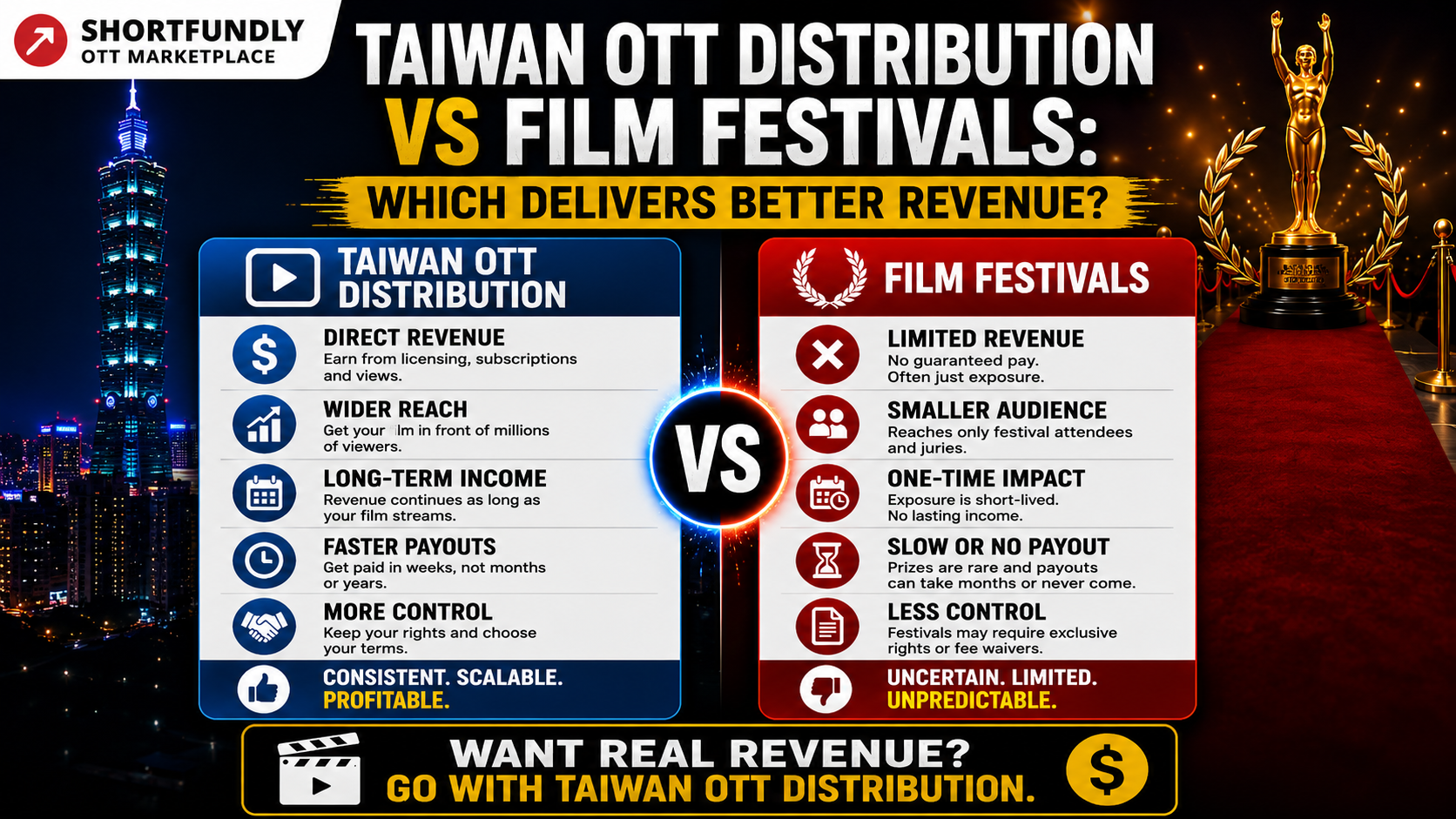
For independent filmmakers, choosing between Taiwan OTT distribution and film festivals can shape both revenue and long-term career opportunities. Film festivals can provide prestige, reviews, awards, networking, and valuable industry exposure. However, OTT distribution can create a more direct path toward audience access, licensing opportunities, and recurring digital revenue.
The right strategy depends on the film, target audience, rights availability, and commercial goals. Instead of treating festivals and OTT platforms as competing options, filmmakers can use both as parts of a broader distribution plan.
For filmmakers seeking international digital distribution, Shortfundly Distribution can be considered as one potential distribution route for independent content.
What Is Taiwan OTT Distribution?
OTT distribution delivers films directly to audiences through internet-based streaming services. Viewers don’t need traditional television broadcasting or cinema screenings to access the content.
Taiwan has a mature digital media environment, making online distribution an attractive option for filmmakers targeting Taiwanese audiences. Depending on the agreement, a distributor or platform may handle areas such as:
- Content delivery
- Platform placement
- Metadata preparation
- Localization
- Subtitles
- Marketing support
- Licensing
- Audience access
- Revenue reporting
The commercial structure can vary significantly. Some arrangements involve licensing fees, while others may use revenue sharing, advertising revenue, transactional purchases, subscriptions, or hybrid models.
Therefore, filmmakers should evaluate the complete distribution agreement, rather than focusing only on the headline payment.
How Film Festivals Generate Value
Film festivals operate differently from OTT platforms. Their primary value isn’t always direct film revenue.
A festival screening can help filmmakers build:
- Industry credibility
- Audience recognition
- Press coverage
- Awards and nominations
- Producer relationships
- Sales-agent connections
- Distributor interest
- International networking opportunities
Some festivals offer awards with monetary prizes. Others may provide screening fees or travel support. However, many festivals don’t provide meaningful direct income.
The bigger benefit may come later. A successful festival run can strengthen a film’s pitch when approaching distributors, broadcasters, OTT platforms, or sales agents.
Taiwan OTT Distribution vs Film Festivals: Revenue Comparison
The financial difference becomes clearer when we compare the two models.
| Factor | Taiwan OTT Distribution | Film Festivals |
|---|---|---|
| Direct revenue | Potentially recurring | Often limited |
| Audience reach | Potentially broad | Usually event-based |
| Revenue duration | Can continue after release | Limited screening window |
| Awards | Usually not primary focus | Major benefit |
| Industry networking | Moderate to strong | Strong |
| Discoverability | Digital and searchable | Festival-dependent |
| Localization | Often important | Depends on festival |
| Revenue reporting | Usually contractual | Varies |
| Long-term monetization | Potentially strong | Usually indirect |
| Brand credibility | Depends on platform | Can be significant |
This comparison shows why OTT distribution can have stronger direct monetization potential, while festivals can offer greater professional visibility.
When Film Festivals Can Be More Valuable
A festival may be the better first step when a film has strong artistic qualities and award potential.
For example, a filmmaker producing a socially important documentary may gain more value from festival recognition than from immediate streaming revenue.
Festival success can create a chain of opportunities:
Festival Selection → Reviews → Awards → Industry Attention → Distributor Interest → OTT Licensing
This pathway can increase the commercial value of the film later.
However, festival participation doesn’t guarantee a distribution deal. Filmmakers should avoid assuming that a festival selection automatically leads to OTT acquisition.
When Taiwan OTT Distribution Can Be More Profitable
OTT becomes especially attractive when the primary objective is audience access and monetization.
A film with strong commercial appeal can potentially reach viewers beyond a single screening event. Once the film is available digitally, audiences may discover it over an extended period.
This can be particularly useful for:
- Short films
- Independent features
- Documentaries
- Vertical dramas
- Micro dramas
- Regional-language films
- Genre productions
- Student films with commercial potential
The key advantage is scalability. A festival has a limited number of screenings, while digital distribution can potentially reach viewers across multiple locations.
Understanding OTT Revenue Models
Not every OTT deal pays filmmakers in the same way.
AVOD: Advertising-Based Video on Demand
With AVOD, viewers watch content without paying directly, while advertising generates revenue.
Filmmakers may receive a percentage of advertising revenue under the distribution agreement.
This model can work well for content that attracts large viewing volumes.
SVOD: Subscription Video on Demand
SVOD platforms earn revenue through subscriptions.
Depending on the contract, filmmakers may receive a licensing payment, revenue share, or another agreed compensation structure.
The value of an SVOD deal depends heavily on the platform’s audience, territory, exclusivity, and contract terms.
TVOD: Transactional Video on Demand
TVOD allows viewers to rent or purchase content.
This model can create direct revenue from individual transactions. However, the film must provide enough perceived value for audiences to pay for access.
Hybrid OTT Models
Some distributors combine multiple monetization methods.
For example, a film could have:
- Subscription access
- Rental access
- Advertising-supported viewing
- International licensing
- Promotional distribution
A hybrid approach may provide more flexibility than relying on one revenue stream.
What Determines OTT Revenue?
The amount an independent filmmaker earns isn’t determined simply by the number of viewers.
Several commercial factors matter.
Territory
A Taiwan-only agreement may have different value from a multi-territory international license.
Exclusivity
Exclusive rights can increase the value of a deal, but they also restrict where the filmmaker can distribute the film.
License Duration
A three-month license and a five-year license have very different commercial implications.
Rights Granted
Contracts may cover:
- Streaming rights
- Download rights
- Mobile rights
- Television rights
- Promotional rights
- International rights
- Language rights
- Remake rights
Filmmakers should understand exactly what rights they are transferring.
Audience Demand
Genre, language, cast, subject matter, production quality, and current audience trends can influence commercial interest.
Why Localization Matters in Taiwan
International filmmakers should pay close attention to localization when entering the Taiwan market.
Professional subtitles can improve accessibility and viewer retention. Metadata should also clearly communicate the film’s genre, story, language, duration, and audience appeal.
Marketing assets may include:
- Chinese subtitles
- Localized synopsis
- Poster artwork
- Trailer
- Thumbnail
- Cast information
- Director biography
- Genre classification
Poor localization can make an otherwise strong film harder for audiences to discover.
Film Festivals and OTT Distribution Can Work Together
The strongest strategy isn’t always an either-or decision.
A filmmaker can begin with a carefully selected festival strategy and later move into OTT distribution.
For example:
Stage 1: Complete the film and prepare professional deliverables.
Stage 2: Submit to relevant Taiwan and international festivals.
Stage 3: Build reviews, selections, awards, and audience feedback.
Stage 4: Prepare an OTT sales package.
Stage 5: Approach distributors and platforms.
Stage 6: Negotiate territory, term, exclusivity, and revenue terms.
Stage 7: Launch the film digitally.
This approach allows festivals to function as a credibility-building stage before commercial distribution.
How to Decide Between Festivals and OTT
We can use a simple decision framework.
| Goal | Recommended Priority |
| Win awards | Film festivals |
| Build filmmaker reputation | Film festivals |
| Reach online viewers | OTT |
| Generate recurring digital revenue | OTT |
| Attract industry contacts | Festivals |
| Test international audience demand | OTT |
| Build critical recognition | Festivals |
| Monetize an existing audience | OTT |
| Create a hybrid release strategy | Both |
The important point is to match the distribution channel with the film’s business objective.
What Filmmakers Should Check Before Signing an OTT Deal
A promising distribution offer should never be judged only by its upfront payment.
Before signing, filmmakers should examine:
- Revenue-sharing percentage
- Minimum guarantee
- License period
- Territories
- Exclusivity
- Platform availability
- Marketing obligations
- Reporting frequency
- Payment schedule
- Termination conditions
- Rights reversion
- Sub-licensing provisions
A smaller upfront payment with transparent reporting and favorable rights terms can sometimes be more valuable than a larger payment attached to broad, long-term exclusivity.
How to Prepare a Film for OTT Distribution
Professional preparation can improve the chances of successful distribution.
We should prepare a complete delivery package containing:
- High-quality master file
- Trailer
- Poster
- Landscape artwork
- Portrait artwork when required
- Subtitles
- Synopsis
- Logline
- Cast information
- Crew information
- Director biography
- Production stills
- Copyright documentation
- Music licenses
- Talent releases
- Dialogue lists when required
Metadata should remain consistent across every document and asset.
Common Mistakes in Taiwan Film Distribution
Several mistakes can reduce a film’s commercial potential.
Giving Away Too Many Rights
Broad rights grants can limit future opportunities.
Ignoring Contract Duration
A long license can prevent filmmakers from pursuing better offers later.
Using Poor Subtitles
Translation quality directly affects the viewer experience.
Focusing Only on Upfront Money
The long-term value of revenue sharing can sometimes exceed an initial payment.
Skipping Festival Strategy
Some films benefit significantly from festival recognition before commercial distribution.
Uploading Without a Distribution Plan
Simply putting a film online doesn’t guarantee discovery or revenue.
The Best Revenue Strategy for Independent Filmmakers
For many independent projects, the most effective approach is a combined festival and OTT strategy.
We can use festivals to build credibility and audience interest. Then, we can use OTT distribution to extend the film’s commercial life.
A successful release might therefore look like:
Production → Festival Premiere → Reviews and Awards → Audience Building → OTT Distribution → International Licensing → Long-Term Monetization
This approach also gives filmmakers more time to understand audience response before entering major distribution negotiations.
Frequently Asked Questions
Is Taiwan OTT distribution better than film festivals?
Neither option is universally better. OTT distribution generally offers stronger direct monetization potential, while festivals can provide awards, credibility, networking, and industry exposure.
Can a short film earn money through OTT platforms?
Yes. Depending on the distribution agreement, revenue can come through licensing, advertising, subscriptions, transactions, or revenue-sharing arrangements.
Should we submit a film to festivals before OTT distribution?
Often, this can be useful. Festival recognition may strengthen the film’s marketing story and increase industry credibility.
Does festival selection guarantee OTT distribution?
No. Festival selection can create exposure, but an OTT acquisition still depends on commercial demand, rights availability, content quality, and platform requirements.
What should we negotiate in an OTT distribution agreement?
We should carefully review territory, term, exclusivity, revenue share, reporting, payment schedules, marketing responsibilities, sublicensing, and rights reversion.
Can we use both festivals and OTT platforms?
Yes. A hybrid strategy can allow a film to gain festival recognition before expanding its audience through digital distribution.
Is revenue sharing better than a fixed OTT payment?
It depends on the contract and expected audience. A fixed payment provides predictable income, while revenue sharing may offer greater upside if the film performs strongly.
Also read: https://blog.shortfundly.com/ott/find-ott-buyers-pilot-films/
Conclusion: OTT for Revenue, Festivals for Recognition
The comparison between Taiwan OTT distribution and film festivals isn’t simply about choosing one winner. Each channel serves a different purpose.
Film festivals can create prestige, credibility, awards, reviews, and valuable industry connections. OTT distribution can provide broader digital reach, longer availability, and stronger opportunities for direct monetization.
For many independent filmmakers, the most effective approach is to use both. A strategic festival run can establish the film’s reputation, while OTT distribution can turn that attention into a larger audience and potential revenue.
By preparing strong deliverables, protecting valuable rights, negotiating carefully, and choosing the right distribution partner, independent filmmakers can build a release strategy that balances visibility with commercial opportunity.