Table of Contents
Introduction: How to Launch a FAST Channel Successfully
Launching a FAST channel can create new opportunities for filmmakers, content owners, production companies, and media businesses seeking to reach streaming audiences. FAST stands for Free Ad-Supported Streaming Television. It combines the familiar experience of scheduled television with internet-based delivery, allowing viewers to watch content without paying a subscription fee. Advertising supports the service, while viewers access programming through compatible streaming platforms and connected devices.
However, launching a successful FAST channel involves more than collecting videos and placing them into a playlist. We need a clear audience, a properly prepared content library, accurate metadata, an engaging programming schedule, reliable streaming infrastructure, a monetization plan, and a distribution strategy. We must also measure performance and continuously improve the channel.
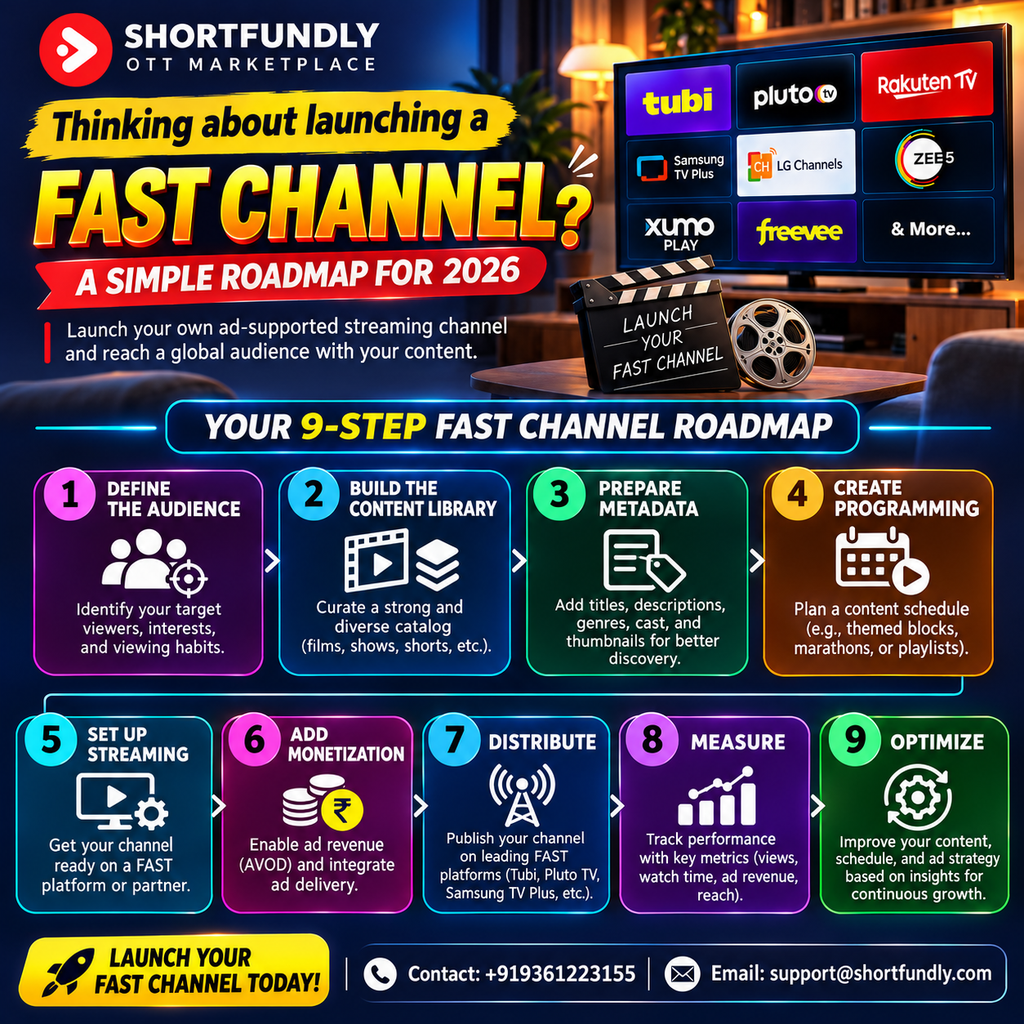
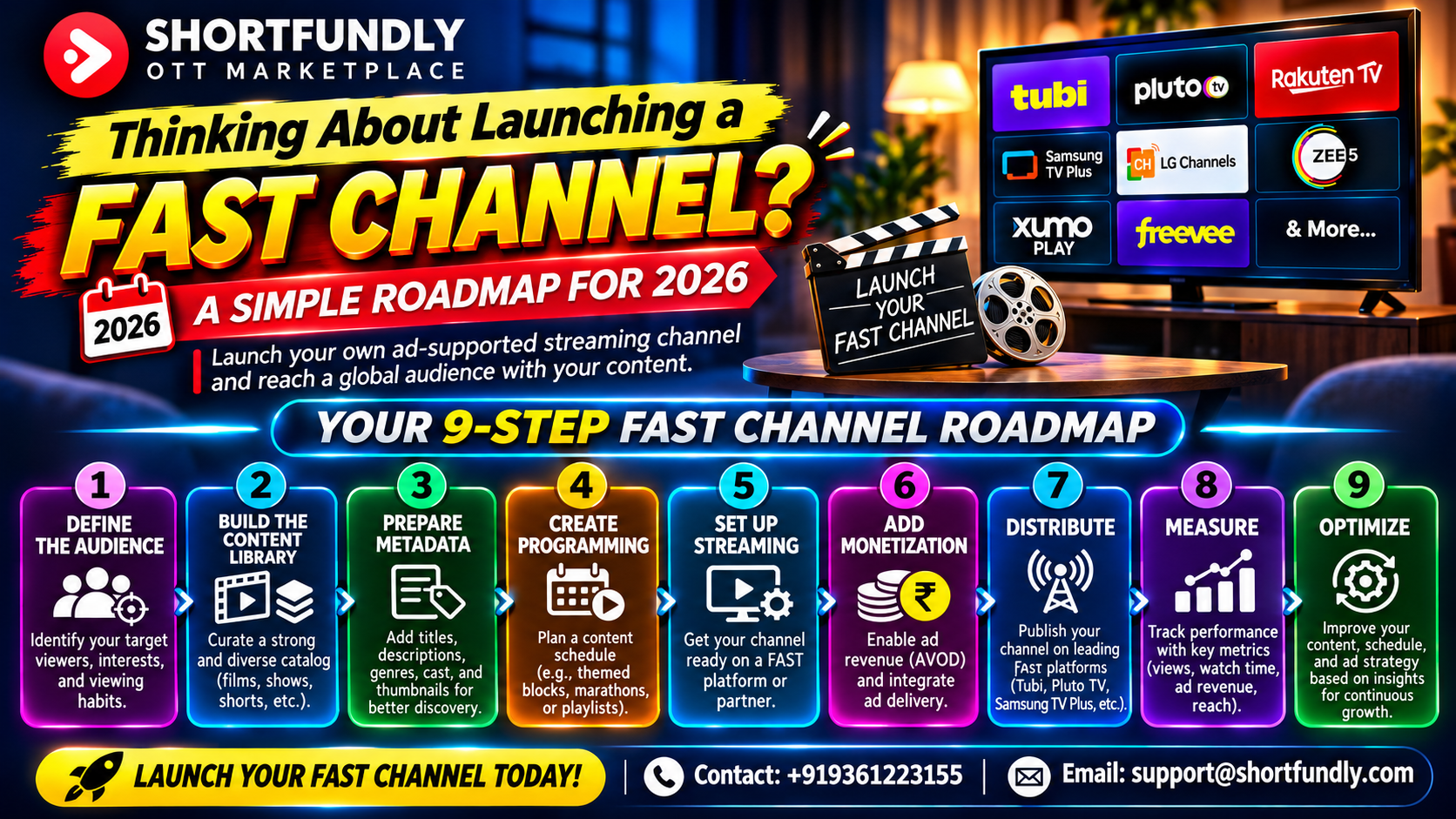
A practical launch process can be organized into nine steps:
- Define the audience.
- Build the content library.
- Prepare metadata.
- Create programming.
- Set up streaming.
- Add monetization.
- Distribute the channel.
- Measure performance.
- Optimize continuously.
This roadmap explains how we can approach each stage, avoid common mistakes, and prepare a FAST channel for long-term growth.
1. Define the Audience Before Building the FAST Channel
The first step in launching a FAST channel is identifying the audience we want to serve. A channel designed for everyone may struggle to establish a recognizable identity. A channel with a clear audience and programming purpose can give viewers a stronger reason to return.
We should begin by identifying the interests, viewing habits, age groups, language preferences, and content expectations of our intended audience. For example, a channel could focus on independent cinema, regional films, classic movies, documentaries, horror, animation, lifestyle programming, or short-form entertainment.
Choose a Clear Channel Niche
A focused programming concept helps establish the channel’s identity. Rather than combining unrelated content, we can build a consistent experience around a particular genre, subject, language, or audience interest.
Potential FAST channel concepts include:
- Independent Film Channel: Independent films, emerging filmmakers, and festival selections.
- Regional Cinema Channel: Movies and programmes in a particular language or from a specific region.
- Documentary Channel: History, science, culture, nature, and real-life stories.
- Horror Channel: Horror films, supernatural stories, thrillers, and suspense programming.
- Classic Cinema Channel: Older films and memorable titles from selected periods.
- Short-Form Entertainment Channel: Micro dramas, short films, and compact episodic content.
We should select a niche that matches the content we can legally access and maintain. A channel concept must be supported by a sufficiently deep library, not just a handful of attractive titles.
Research Audience Demand and Competition
Before investing in production, licensing, or technology, we should examine existing channels and streaming catalogues. We can identify which genres are already well represented, which audiences appear underserved, and what programming gaps may exist.
Useful research questions include:
- Which genres are attracting the audience we want to reach?
- What languages and regional interests should we consider?
- Are viewers more likely to watch films, series, short-form content, or a combination?
- What competing channels offer similar programming?
- What makes our proposed channel different?
- Can we secure enough suitable content to maintain a consistent schedule?
The objective is to define a channel proposition that is specific, sustainable, and recognizable.
2. Build a Strong and Rights-Cleared Content Library
The content library is the foundation of a FAST channel. Without enough suitable programming, we cannot maintain a dependable schedule or give viewers a reason to keep watching.
We should create a content acquisition plan based on the channel’s niche and expected programming hours. The library may include feature films, short films, television episodes, documentaries, interviews, animation, trailers, and other video formats that fit the channel’s identity.
Calculate the Content Required
We should estimate how many hours of programming are needed before scheduling the channel. A small library can create repetition that viewers notice quickly. A deeper library gives us more flexibility to create themed blocks, rotate titles, and refresh the schedule.
For example, a channel that runs continuously needs enough programming to support its daily schedule. We should account for repeat frequency, programme duration, seasonal collections, and the time required to replace or refresh titles.
A content inventory can include:
| Content information | Purpose |
|---|---|
| Title | Identifies each programme |
| Format | Film, series, documentary, short film, or other format |
| Genre | Supports channel positioning and discovery |
| Runtime | Helps build accurate schedules |
| Language | Supports audience targeting |
| Release year | Provides catalogue information |
| Rights status | Confirms whether distribution is permitted |
| Territory | Defines where the content may be shown |
| Availability period | Identifies rights start and end dates |
| Technical status | Tracks whether the file is ready for delivery |
Verify Distribution Rights
Rights management is essential. We must confirm that every title is authorized for the intended distribution model and territory.
A rights review should consider:
- FAST and ad-supported streaming rights
- Territory and language restrictions
- Exclusivity obligations
- Start and end dates
- Music and soundtrack clearances
- Underlying literary or other adaptation rights
- Talent, performer, and contributor agreements
- Promotional clip and artwork permissions
- Advertising and sponsorship restrictions, where applicable
A film’s availability on one platform does not automatically mean it can be distributed through every other platform. We should maintain clear documentation and seek legal advice when rights or contractual terms are uncertain.
Organize Content for Efficient Operations
We should maintain a centralized content inventory with consistent naming conventions and clear file versions. This makes it easier to locate assets, track rights, update metadata, and prepare programmes for scheduling.
A well-organized library also supports future expansion. When we add new titles, we can process them using the same quality-control and delivery procedures.
3. Prepare Accurate Metadata for Every Title
Metadata is the information that describes each programme. It helps viewers understand what they are watching and helps platforms organize, categorize, and display content.
Even a high-quality film can be difficult to discover if its title, synopsis, genre, language, or artwork is missing or inaccurate. Therefore, metadata preparation should be treated as a core part of the FAST channel launch process.
Essential FAST Channel Metadata
For each title, we should prepare:
- Title: The official programme name.
- Description: A clear and engaging synopsis.
- Genre: The primary category and relevant subcategories.
- Language: Original language and available audio languages.
- Subtitles: Available subtitle languages.
- Runtime: Accurate duration.
- Release year: Original release year.
- Cast and crew: Relevant contributors.
- Age rating: Appropriate classification information.
- Artwork: Platform-compatible posters, thumbnails, and promotional images.
- Content identifier: A consistent internal ID.
- Rights information: Territories and availability dates.
We should follow the technical and editorial specifications of each distribution partner. Different platforms may request different image dimensions, metadata fields, file formats, or delivery methods.
Write Descriptions That Help Viewers Choose
A synopsis should explain the central premise without becoming unnecessarily complicated. We should avoid vague descriptions that could apply to almost any film.
For example, instead of writing:
“An interesting movie about life and relationships.”
We could write:
“When a family returns to its hometown after years apart, an unexpected discovery forces them to confront a secret that changed their lives.”
The second description gives viewers a clearer sense of the story while avoiding unnecessary spoilers.
Maintain Metadata Consistency
We should use consistent genre labels, capitalization, language names, and title formats across the catalogue. Duplicate or conflicting metadata can create operational problems and make the channel appear less professional.
A metadata checklist should be completed before each title enters the programming workflow.
4. Create an Engaging FAST Channel Programming Schedule
FAST channels offer a linear viewing experience. Viewers can tune in and watch what is currently scheduled instead of selecting every title individually. This makes programming a central part of the channel experience.
A strong schedule should feel intentional. It should give viewers a reason to stay, discover new titles, and return at familiar times.
Build Programming Blocks Around Viewer Interests
We can organize content into recurring blocks based on genre, theme, format, or audience preference.
For example, an independent cinema channel might use this structure:
| Time block | Programming concept |
|---|---|
| Morning | Short films and light entertainment |
| Late morning | Documentaries and factual programmes |
| Afternoon | Independent feature films |
| Early evening | Regional cinema |
| Prime time | Featured films and curated collections |
| Late night | Thrillers, horror, and experimental cinema |
This is an illustrative schedule. We should adapt programme times to the target audience, local viewing habits, content rights, and platform requirements.
Use Themed Programming to Build Habit
Recurring themes make the schedule easier to understand. We might create a weekly documentary evening, a regional cinema weekend, a short-film showcase, or a monthly filmmaker collection.
Themed programming can also support marketing. Instead of promoting a large catalogue without a clear message, we can highlight a recognizable event or collection.
Balance Familiar Titles and New Discoveries
A channel needs a balance between recognizable content and fresh discoveries. Familiar titles can make the schedule approachable, while lesser-known films can introduce viewers to new filmmakers and stories.
We should monitor how different programme blocks perform and adjust their placement based on viewing data. A schedule should be structured, but it should not remain unchanged when audience behaviour indicates a better approach.
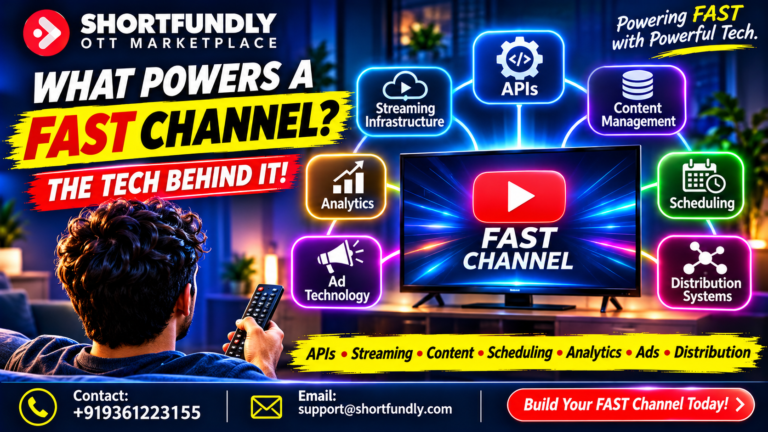
5. Set Up Reliable Streaming Infrastructure
Streaming infrastructure enables us to deliver video content to viewers across compatible devices and networks. A FAST channel must provide a stable playback experience, accurate programme information, and dependable delivery.
We should identify the technical requirements before selecting a technology provider or distribution partner.
Understand the Main Streaming Components
A typical FAST workflow may include:
- Content ingestion: Receiving and organizing video files.
- Transcoding: Preparing video into suitable formats and bitrates.
- Quality control: Checking picture, sound, subtitles, and file integrity.
- Playout: Delivering the scheduled programme stream.
- Packaging: Preparing streams for supported playback protocols.
- Content delivery network: Distributing video efficiently to viewers.
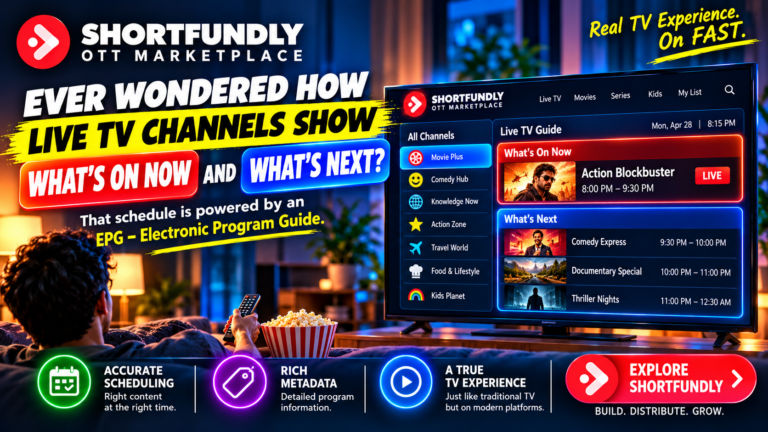
- Electronic programme guide: Displaying channel schedules and programme information.
- Monitoring: Tracking stream availability, playback errors, and service performance.
The exact architecture depends on the provider, platform requirements, audience geography, and expected viewing volume.
Prioritize Video and Audio Quality
We should check resolution, frame rate, aspect ratio, audio levels, subtitle synchronization, and encoding quality. Technical specifications must match the requirements of the intended platforms.
A title should not be considered ready simply because it plays on one computer. We should test it through the actual delivery workflow and, where possible, on representative devices.
Plan for Scalability and Reliability
The infrastructure should support expected audience demand and allow room for growth. We should understand how the provider handles traffic spikes, outages, stream monitoring, content replacement, and technical support.
A reliable service should also offer clear reporting about operational performance. We need to know how issues are identified, escalated, and resolved.
6. Add a Monetization Strategy Through Advertising
FAST channels are generally supported by advertising rather than mandatory viewer subscriptions. Advertising can create revenue opportunities for channel owners and content partners, but the commercial model must be planned carefully.
Understand Advertising Opportunities
Depending on the platform and commercial arrangement, advertising may include:
- Pre-roll ads: Advertisements shown before a programme begins.
- Mid-roll ads: Advertisements inserted during suitable programme breaks.
- Post-roll ads: Advertisements shown after a programme.
- Sponsorships: Brand support for a programme block or collection.
- Promotional placements: Campaigns that promote relevant content or services.
Not every platform supports every advertising format. We should confirm the available options and technical requirements with the relevant platform or monetization provider.
Understand the Advertising Technology Workflow
Advertising technology can help manage ad requests, campaign delivery, and reporting. Depending on the setup, the workflow may involve an ad server, an advertising decision system, a supply-side platform, or other ad-tech services.
We should clarify:
- Who sells and manages advertising inventory?
- Who controls ad placement and frequency?
- How are ad impressions measured?
- What reporting is available?
- How is revenue calculated and shared?
- What deductions, fees, or minimum thresholds apply?
- How are invalid traffic and measurement discrepancies handled?
These details should be documented in the commercial agreement.
Protect the Viewer Experience
Advertising should be balanced with programme continuity. Excessive or poorly timed interruptions can make viewers leave.
We should consider programme length, natural break points, advertising frequency, and the expectations of the audience. A sustainable monetization plan must support both commercial performance and viewer satisfaction.
7. Distribute the FAST Channel Through Suitable Platforms
Distribution connects the channel with viewers. We may have a strong content library and a reliable stream, but the channel still needs access to platforms where the intended audience watches streaming television.
Potential distribution routes include connected TV environments, streaming applications, FAST aggregators, and other compatible digital services. Availability, eligibility, commercial terms, and technical requirements vary by provider and territory.
Evaluate Distribution Partners Carefully
Before selecting a partner, we should examine:
- Supported countries and territories
- Device and platform availability
- Content and channel eligibility
- Technical delivery specifications
- Metadata and artwork requirements
- Advertising and monetization arrangements
- Reporting and analytics access
- Rights and exclusivity requirements
- Revenue share and payment terms
- Support and operational responsibilities
We should not assume that one distribution agreement automatically provides access to every streaming platform. Each partner may have its own onboarding process and requirements.
Prepare a Professional Channel Package
A channel package may include:
- Channel name and description
- Brand logo and visual identity
- Programming concept
- Content catalogue
- Rights documentation
- Metadata and artwork
- Technical stream details
- Programming schedule
- Contact and operational information
Preparing these materials in advance can make partner evaluation and onboarding more efficient.
Explore Shortfundly Distribution
For filmmakers and content owners exploring digital distribution opportunities, Shortfundly Distribution is a relevant place to review.
We should examine its current services, submission requirements, supported content types, platform relationships, territory coverage, rights conditions, and commercial terms directly before deciding whether it fits our distribution plan.
A distribution partner should be selected based on the actual needs of the catalogue and channel. We should confirm the scope of every service rather than assume that all platforms, territories, or monetization options are included.
8. Measure FAST Channel Performance With Useful Analytics
After launch, we need reliable information about how the channel performs. Analytics help us understand audience behaviour, programming effectiveness, technical quality, and monetization.
We should define the key performance indicators before launch so that we can evaluate progress consistently.
Important FAST Channel Metrics
| Metric | What it helps us understand |
|---|---|
| Total viewing hours | Overall time spent watching |
| Average viewing duration | How long viewers remain engaged |
| Unique viewers | Approximate audience reach |
| Concurrent viewers | Number of viewers watching at the same time |
| Programme completion | Whether viewers finish selected content |
| Channel tune-ins | How often viewers start watching |
| Ad impressions | Number of reported advertising opportunities or deliveries |
| Ad fill rate | Proportion of eligible ad opportunities filled |
| Playback errors | Technical problems affecting viewing |
| Buffering rate | Frequency of playback interruptions |
We should use the definitions supplied by each platform or analytics provider because measurement methods can differ.
Connect Programming Data With Audience Behaviour
Analytics become more useful when we compare performance across programmes, genres, time slots, and audience segments where such information is available.
For example, if documentary blocks consistently attract longer viewing sessions, we can investigate whether the schedule should include more documentary programming. If viewers leave shortly after a particular programme begins, we can review the content, metadata, stream quality, or placement.
We should avoid making decisions based on one isolated result. Patterns across multiple days or weeks provide a more dependable basis for programming changes.
Review Technical and Commercial Performance Together
A channel may attract viewers but experience playback issues. Another may deliver stable streams but struggle to retain viewers. We need to examine technical, audience, and monetization metrics together to understand the full picture.
Regular reporting helps us identify problems early and prioritize improvements.
9. Optimize the FAST Channel Continuously
Launching the channel is the beginning of an ongoing process. Audience preferences, platform requirements, content availability, and advertising opportunities can change. We should establish a regular review cycle rather than treating launch as the final milestone.
Refresh the Content Library
We should periodically add new titles, replace expired content, and remove programmes that are no longer available. A refreshed catalogue helps maintain variety and gives viewers new reasons to return.
Content updates must always follow rights and availability conditions. We should track expiry dates and schedule replacements before a title becomes unavailable.
Improve Metadata and Discoverability
We can review descriptions, genre assignments, artwork, and programme titles to ensure they accurately represent the content. Where platforms provide performance information, we can identify whether certain titles or collections need clearer descriptions or stronger promotional assets.
Test Programming Changes
We should make controlled changes to programme placement, themed blocks, and content rotation. When possible, we should compare results over similar time periods and account for other factors that may influence viewing.
A structured optimization process could include:
- Identify a performance issue or opportunity.
- Review the relevant analytics.
- Form a specific improvement hypothesis.
- Make one manageable change.
- Monitor the results.
- Record what worked and what did not.
- Apply the learning to future programming decisions.
Maintain a Regular Channel Review
A weekly operational review can cover playback quality, schedule accuracy, content availability, and major audience changes. A monthly strategic review can examine catalogue performance, distribution progress, advertising results, and future investment priorities.
This approach helps us improve the channel without making frequent changes based on incomplete information.
A Practical FAST Channel Launch Checklist
Before going live, we should confirm that each major area is ready.
| Launch area | Checklist |
|---|---|
| Audience | Target audience and channel niche are defined |
| Content | Sufficient content is available for the planned schedule |
| Rights | Distribution rights and territories are verified |
| Metadata | Titles, descriptions, genres, and languages are prepared |
| Artwork | Logos, posters, and thumbnails meet specifications |
| Programming | Schedule and programme blocks are created |
| Streaming | Encoding, playout, delivery, and monitoring are tested |
| Monetization | Advertising responsibilities and revenue terms are understood |
| Distribution | Platform requirements and onboarding steps are confirmed |
| Analytics | Reporting access and key metrics are defined |
| Operations | Support contacts and issue-resolution procedures are established |
| Optimization | Review schedule and improvement process are in place |
We should complete these checks before announcing a launch date. Any unresolved rights, technical, or partner requirements should be addressed first.
Common Mistakes to Avoid When Launching a FAST Channel
A well-planned launch can still face challenges if important operational details are overlooked. We should pay particular attention to the following mistakes:
Launching Without a Defined Audience
A channel without a clear identity can struggle to attract a consistent audience. We should define the niche and programming promise before building the catalogue.
Using a Content Library Without Sufficient Rights
Content availability does not guarantee distribution permission. We must verify the relevant rights, territories, dates, and advertising permissions for every title.
Ignoring Metadata Quality
Incomplete or inconsistent metadata can weaken presentation and discovery. We should treat metadata as part of content preparation, not as an optional task.
Repeating Too Much Content
A limited library can cause excessive repetition. We should plan content depth and rotation before launch and communicate recurring programme themes clearly.
Choosing Technology Without Understanding Platform Requirements
A streaming setup that works in one environment may not satisfy another platform’s delivery requirements. We should confirm specifications before committing to a workflow.
Treating Monetization as an Afterthought
Advertising arrangements affect technology, scheduling, reporting, and commercial planning. We should understand the monetization model before launch.
Failing to Review Performance
Without regular analytics reviews, we may miss technical problems or programming opportunities. We should use measurable indicators to guide improvements.
Frequently Asked Questions About Launching a FAST Channel
1. What is a FAST channel?
A FAST channel is a free, ad-supported streaming television channel. It delivers scheduled programming over the internet, allowing viewers to watch without paying a subscription fee. Advertising generally supports the service.
2. How do we launch a FAST channel?
We can follow a nine-step process: define the audience, build a rights-cleared content library, prepare metadata, create a programming schedule, set up streaming infrastructure, plan monetization, secure distribution, measure performance, and optimize the channel.
3. Do we need our own content to launch a FAST channel?
Not necessarily. We may own content, license it from rights holders, or work with content partners. In every case, we must confirm that the relevant rights permit the intended FAST distribution, territories, and monetization model.
4. How much content is needed for a FAST channel?
The required amount depends on the channel’s schedule, programme duration, repeat frequency, and content refresh plan. We should calculate the programming hours needed to provide a consistent viewing experience and avoid excessive repetition.
5. How do FAST channels make money?
FAST channels commonly generate revenue through advertising. Depending on the platform and agreement, monetization may involve pre-roll, mid-roll, or other advertising placements, as well as sponsorship opportunities. Revenue arrangements vary by provider and contract.
6. What technology is required for a FAST channel?
A typical setup may require content ingestion, transcoding, quality control, playout, stream packaging, content delivery, programme guide integration, monitoring, and analytics. The exact requirements depend on the chosen technology provider and distribution platforms.
7. What is metadata, and why is it important?
Metadata is descriptive information about a programme, including its title, synopsis, genre, language, runtime, release year, and artwork. Accurate metadata helps platforms organize content and gives viewers useful information when choosing what to watch.
8. Can we distribute a FAST channel internationally?
International distribution may be possible, but it depends on content rights, platform availability, territory restrictions, language support, technical requirements, and commercial agreements. We should verify each market before making content available.
9. How do we know whether our FAST channel is successful?
We should review viewing hours, average viewing duration, unique viewers, programme performance, advertising metrics, playback errors, and other available platform reports. Success should be evaluated against the channel’s audience and business objectives.
10. How can Shortfundly Distribution support our distribution research?
We can visit Shortfundly Distribution to review its current distribution information and determine whether its services are suitable for our content. We should confirm supported platforms, content eligibility, territories, rights requirements, submission procedures, and commercial terms directly.
Also read: https://blog.shortfundly.com/ott/fast-channel-technology-2/
Conclusion: Follow a Clear Roadmap to Launch a FAST Channel
Launching a FAST channel requires a coordinated approach to content, metadata, programming, streaming technology, advertising, and distribution. We should begin by defining the audience and channel identity, then build a rights-cleared content library that can support a consistent schedule.
Accurate metadata and thoughtful programming help create a recognizable viewing experience. Reliable streaming infrastructure supports playback, while a clear monetization plan connects the channel with advertising opportunities. Distribution partners can help make the channel available to audiences, and analytics show where improvements are needed.
The nine-step roadmap gives us a practical structure:
Define the audience → Build the content library → Prepare metadata → Create programming → Set up streaming → Add monetization → Distribute → Measure → Optimize.
By treating each step as part of one connected workflow, we can prepare a FAST channel for launch and establish a process for improving it over time. The strongest foundation is a clear channel concept, properly managed content rights, dependable operations, and a programming strategy built around the viewers we intend to serve.