Table of Contents
Finding OTT buyers looking for pilot films in 2026 requires more than sending a film link to every streaming platform. Independent filmmakers need a focused approach that identifies suitable buyers, prepares professional pitch materials, protects distribution rights, and presents the project according to current digital-content expectations.
For creators seeking a structured route into digital distribution, Shortfundly Distribution can be explored as part of an OTT distribution strategy. The right distribution partner can help independent filmmakers understand delivery requirements and identify potential opportunities for their content.
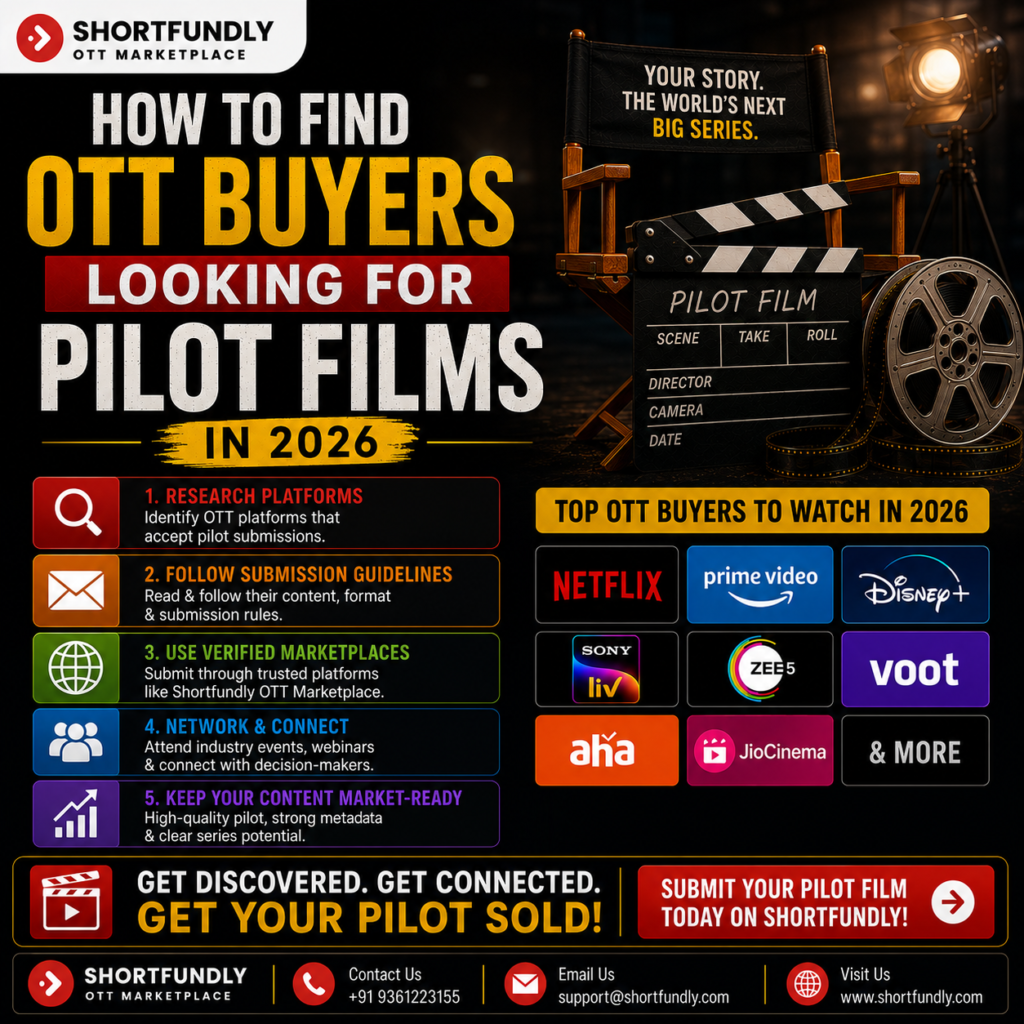
What Are OTT Buyers Looking for in Pilot Films?
OTT buyers generally evaluate whether a project fits their audience, programming strategy, genre preferences, language requirements, and commercial objectives.
A pilot film can attract attention when it clearly demonstrates the potential of a larger series or franchise.
Before approaching buyers, we should understand the basic components they may assess:
- Story concept
- Target audience
- Genre
- Language
- Production quality
- Episode potential
- Cast
- Director
- Marketability
- Rights availability
- Technical readiness
- Distribution potential
A strong pilot doesn’t need to imitate a major studio production. Instead, it needs a clear creative identity and professional execution.
Why 2026 Is an Important Year for Independent OTT Creators
The streaming market continues to evolve rapidly. Audiences consume content across smart TVs, smartphones, tablets, and computers.
At the same time, short-form and vertical storytelling have created additional formats for digital creators.
This means independent filmmakers can explore several paths rather than relying on one traditional OTT route.
Potential opportunities may include:
- Regional OTT platforms
- Independent streaming services
- Digital distributors
- Content aggregators
- Short-form platforms
- Mobile-first services
- International niche platforms
- Genre-focused services
- Regional-language streaming channels
The key is matching the project with the appropriate buyer.
1. Identify OTT Buyers by Genre
One of the most effective ways to find potential buyers is to start with genre.
A thriller pilot should be presented to buyers interested in thriller, crime, mystery, or suspense programming.
Similarly, a romance project may fit services with strong romance and relationship audiences.
We can create a simple buyer map:
| Pilot Genre | Potential Buyer Category |
|---|---|
| Thriller | Crime and suspense platforms |
| Romance | Romance-focused services |
| Comedy | General entertainment platforms |
| Horror | Genre streaming services |
| Family Drama | Regional and family platforms |
| Documentary | Documentary-focused services |
| Youth Drama | Youth-oriented platforms |
| Vertical Micro Drama | Mobile-first content distributors |
This approach prevents wasted submissions.
Instead of contacting hundreds of unrelated companies, we can focus on buyers with a realistic content fit.
2. Research Regional OTT Platforms
Regional OTT platforms can be particularly relevant for independent filmmakers.
A project created in Tamil, Telugu, Malayalam, Kannada, Bengali, Marathi, Punjabi, Gujarati, or another regional language may have a natural audience within its language market.
Regional buyers may look for:
- Local stories
- Regional stars
- Familiar cultural settings
- Local-language originals
- Family entertainment
- Regional crime stories
- Romantic dramas
- Comedy
- Short-form series
However, we should verify current acquisition policies before submitting.
Some platforms accept submissions through distributors. Others may work primarily with production companies or established content suppliers.
Therefore, finding the correct route matters as much as finding the platform itself.
3. Work With an OTT Distribution Partner
Independent filmmakers often struggle to identify the correct decision-makers.
This is where a distribution partner can become useful.
Shortfundly Distribution can be investigated by filmmakers who want to explore professional OTT distribution options.
A distribution service may help producers with areas such as:
- Content preparation
- Distribution planning
- Platform outreach
- Metadata
- Technical delivery
- Rights coordination
- Content packaging
The exact services and commercial terms should always be reviewed before entering an agreement.
A distributor can also provide a more structured alternative to sending unsolicited emails to unrelated OTT platforms.
4. Build a Professional OTT Buyer Pitch
Finding a buyer is only half the process.
The next challenge is getting the buyer interested.
A professional pitch package should be concise and easy to evaluate.
We should consider including:
Logline
A one- or two-sentence description of the central story.
Short Synopsis
A concise explanation of the pilot’s main conflict and characters.
Series Overview
If the pilot is intended to become a series, explain the broader concept.
Episode Plan
Include the expected number of episodes and approximate duration.
Character Profiles
Introduce the major characters and their motivations.
Target Audience
Explain who is most likely to watch the project.
Creator Information
Include relevant information about the producer, director, writer, and key cast.
Trailer
A short trailer can communicate the project’s tone and production quality quickly.
Pilot Film
Provide the finished pilot through an appropriate viewing or delivery method.
5. Search for Content Acquisition Contacts
OTT buyers aren’t always listed publicly.
Instead, decision-makers may have titles such as:
- Head of Content
- Content Acquisition Manager
- Acquisitions Executive
- Programming Director
- Original Content Head
- Content Partnerships Manager
- Development Executive
Professional networking can help identify the appropriate department.
We should avoid mass-emailing generic addresses with large attachments.
A concise introduction followed by a professional pitch is usually more appropriate.
6. Use Film Markets and Industry Events
Film markets, media conferences, content festivals, and industry events can create opportunities to meet buyers and distributors.
These events can be particularly useful because filmmakers can communicate directly with industry professionals.
A prepared pitch should answer three questions quickly:
What is the project?
Who is it for?
Why should the buyer care?
We should also have a private screener or professional viewing link available.
Networking becomes much more effective when the project is ready to present immediately.
7. Prepare a Strong OTT Submission Package
Before contacting potential buyers, we should complete the distribution package.
A useful checklist includes:
- Final pilot
- Trailer
- Poster
- Logline
- Synopsis
- Series bible
- Episode list
- Cast information
- Crew information
- Director profile
- Producer profile
- Subtitle files
- Technical master
- Metadata
- Copyright documentation
- Music licenses
- Talent agreements
- Contact information
Having these materials ready signals professionalism.
It also reduces delays when a buyer requests additional information.
How to Make Your Pilot Attractive to OTT Buyers
Focus on a Strong Opening
The first few minutes should establish the story quickly.
A pilot should introduce its central question, protagonist, or conflict without unnecessary delay.
Strong pacing can be particularly important for mobile-first and short-form content.
Create a Clear Series Hook
A pilot should answer an important question:
Why would audiences return for another episode?
The story needs enough unresolved tension, character development, or narrative curiosity to support continued viewing.
Demonstrate Production Quality
Production quality doesn’t mean spending millions.
Instead, it means delivering:
- Clean sound
- Controlled lighting
- Good framing
- Consistent editing
- Strong performances
- Appropriate music
- Professional color treatment
A modest budget can still produce a polished pilot when resources are used carefully.
How OTT Buyers Evaluate Commercial Potential
Creative quality matters, but commercial considerations also influence acquisition decisions.
A buyer may consider:
- Audience size
- Genre demand
- Language
- Territory
- Cast recognition
- Social-media traction
- Production cost
- Series potential
- Licensing terms
- Exclusivity
- Revenue opportunities
Therefore, we should present the project as both a creative property and a marketable piece of content.
Rights You Should Control Before Approaching OTT Buyers
Rights management should happen before pitching.
We should confirm ownership or permission for:
- Screenplay
- Story
- Music
- Performances
- Stock footage
- Photographs
- Artwork
- Locations
- Brand appearances
- Archival material
A buyer may hesitate if ownership is unclear.
A clean chain of title can make negotiations smoother.
Exclusive vs Non-Exclusive OTT Distribution
Distribution agreements can differ significantly.
An exclusive agreement may prevent the producer from licensing the content elsewhere during the contract period.
A non-exclusive agreement may allow additional distribution, subject to contractual limitations.
Before signing, we should examine:
| Clause | Question to Ask |
| Territory | Where can the content be distributed? |
| Term | How long do rights remain licensed? |
| Exclusivity | Can the producer use other platforms? |
| Languages | Which language versions are covered? |
| Rights | What specific rights are transferred? |
| Payment | How is the producer compensated? |
| Reporting | How often are statements provided? |
| Termination | How can the agreement end? |
Never assume that a distribution agreement is standard.
Every clause can affect the project’s future value.
How Revenue Sharing Works in OTT Distribution
Some arrangements use revenue sharing instead of a fixed licensing fee.
Under a revenue-sharing arrangement, the producer may receive an agreed percentage of defined revenue.
The contract should explain how that revenue is calculated.
We should look for details about:
- Gross revenue
- Net revenue
- Platform deductions
- Distributor fees
- Marketing deductions
- Taxes
- Reporting periods
- Payment schedules
The percentage alone doesn’t tell the full story.
A smaller percentage with fewer deductions could potentially be more attractive than a larger percentage applied after substantial deductions.
How to Avoid OTT Distribution Scams
Independent filmmakers should perform basic due diligence before paying fees or signing agreements.
Warning signs can include:
- Guaranteed placement without evaluation
- Guaranteed millions of viewers
- Unclear company identity
- No written agreement
- Pressure to sign immediately
- Unexplained fees
- Unclear rights ownership
- No transparent reporting
- Promises that sound too good to be true
A legitimate commercial arrangement should provide clear terms.
We should verify the company’s identity, services, agreement, payment structure, and distribution claims before committing.
Shortfundly Distribution for Independent Filmmakers
For filmmakers exploring ways to reach digital audiences, Shortfundly Distribution can be considered as one potential distribution route.
The most useful approach is to review the service carefully and determine whether its distribution model matches the project’s goals.
Before entering any arrangement, producers should understand:
- What services are included
- Which platforms or territories are targeted
- Whether distribution is exclusive
- What rights are required
- What fees apply
- How revenue is handled
- What delivery materials are needed
- How reporting works
This allows filmmakers to make an informed distribution decision.
How to Follow Up With OTT Buyers
Following up is part of professional pitching.
However, repeated messages can become counterproductive.
A concise follow-up can confirm that the pitch was received and ask whether additional materials are required.
If there is no response after reasonable follow-ups, we can move to other potential buyers.
The goal isn’t to chase one company indefinitely.
Instead, we should maintain a structured buyer pipeline.
Create an OTT Buyer Pipeline
A spreadsheet can make the process much easier.
Useful columns include:
| Buyer | Genre | Language | Contact | Submission Date | Status | Follow-Up | Notes |
| Buyer A | Thriller | Tamil | Content Team | August 2026 | Submitted | September | Awaiting response |
| Buyer B | Romance | Telugu | Acquisitions | August 2026 | Research | — | Submission route needed |
| Buyer C | Drama | Hindi | Distributor | August 2026 | Contacted | September | Requested screener |
This prevents missed opportunities.
It also allows producers to compare responses and improve future pitches.
OTT Distribution Strategy for Pilot Films in 2026
A practical strategy can follow this sequence:
Step 1: Complete the pilot.
Step 2: Confirm all rights.
Step 3: Prepare the trailer and artwork.
Step 4: Create professional metadata.
Step 5: Identify the target audience.
Step 6: Research suitable OTT buyers.
Step 7: Identify distributors and acquisition contacts.
Step 8: Prepare a concise pitch.
Step 9: Submit through the appropriate channel.
Step 10: Track submissions.
Step 11: Follow up professionally.
Step 12: Review offers carefully.
This process gives independent filmmakers a repeatable system instead of relying on random outreach.
Frequently Asked Questions
How can we find OTT buyers for a pilot film?
We can research platforms by genre, language, territory, and format. Industry events and professional distributors can also provide potential routes to buyers.
Do OTT platforms accept unsolicited pilot films?
Policies vary. Some platforms may not accept unsolicited submissions. In such cases, producers may need a distributor, agent, production company, or established industry contact.
Can a distributor help us reach OTT buyers?
Potentially. Distribution companies may provide content packaging, platform outreach, delivery, and other services. The exact scope depends on the agreement.
Is a pilot film enough to sell a series?
A pilot can demonstrate the concept, but buyers may also request a series bible, episode plan, budget information, cast details, and additional development materials.
Should we target regional OTT platforms?
Regional platforms can be worth considering when the pilot has strong language, cultural, or audience relevance.
How important are subtitles for OTT distribution?
Subtitles can expand accessibility and help content reach viewers outside its original language market. Professional translation is recommended.
What should we check before signing with an OTT distributor?
We should review rights, territories, exclusivity, contract duration, fees, revenue sharing, reporting, termination provisions, and delivery obligations.
Also read: https://blog.shortfundly.com/ott/pilot-film-metadata-ott/
Conclusion
Finding OTT buyers looking for pilot films in 2026 requires a targeted distribution strategy. Instead of sending the same pitch everywhere, independent filmmakers should identify buyers according to genre, language, territory, format, and audience.
A professional pilot should be supported by strong artwork, a trailer, metadata, subtitles, rights documentation, and a clear series concept.
Regional OTT services, digital distributors, industry events, and professional content networks can all form part of the search process.
For creators evaluating professional distribution options, Shortfundly Distribution is one route worth researching alongside other suitable distribution channels.
Most importantly, every distribution agreement should be reviewed carefully before signing. With the right preparation, a well-made pilot can become more than a standalone film. It can become the foundation for a larger OTT series, a regional content property, or a broader digital distribution opportunity.