Table of Contents
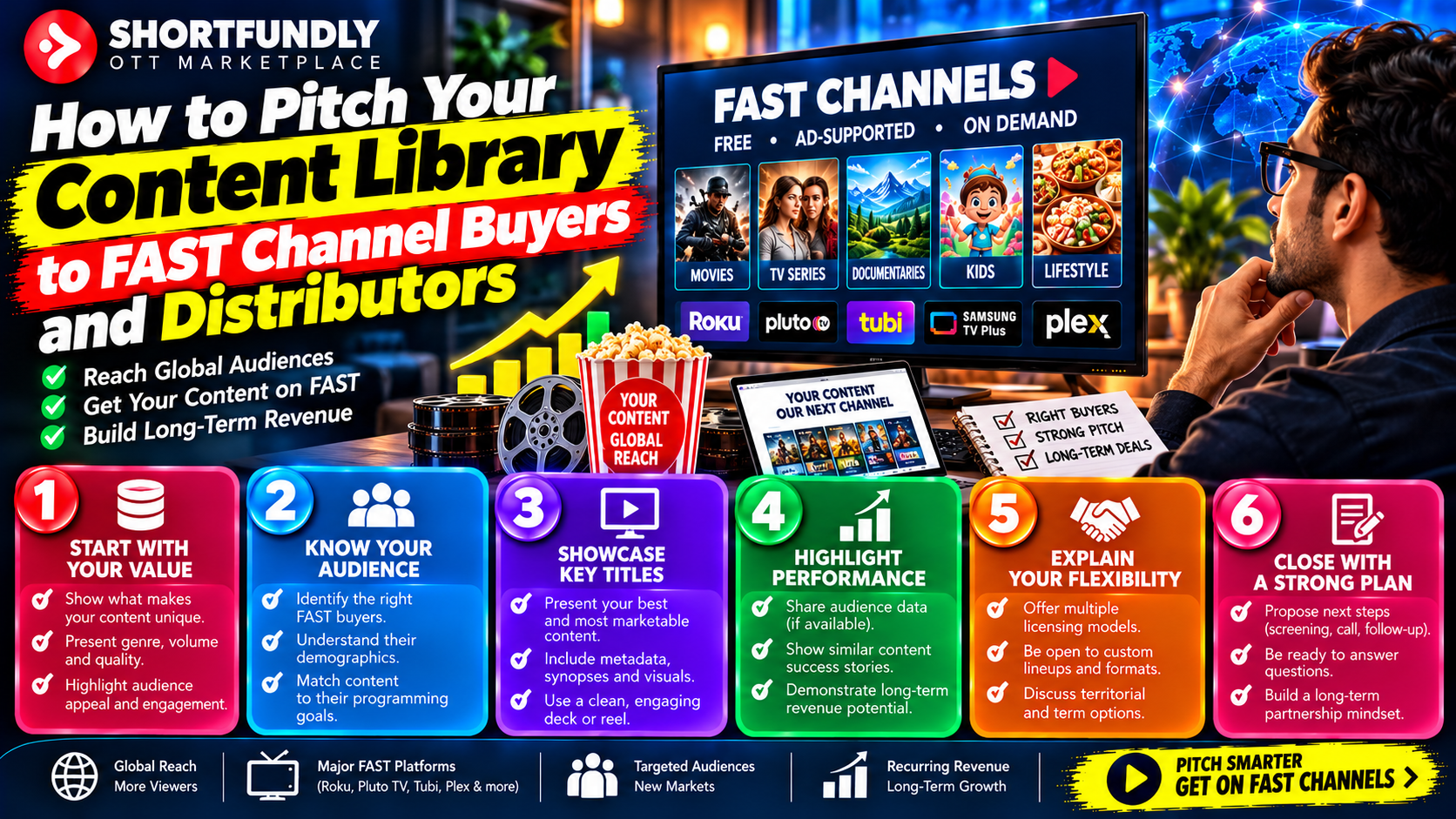
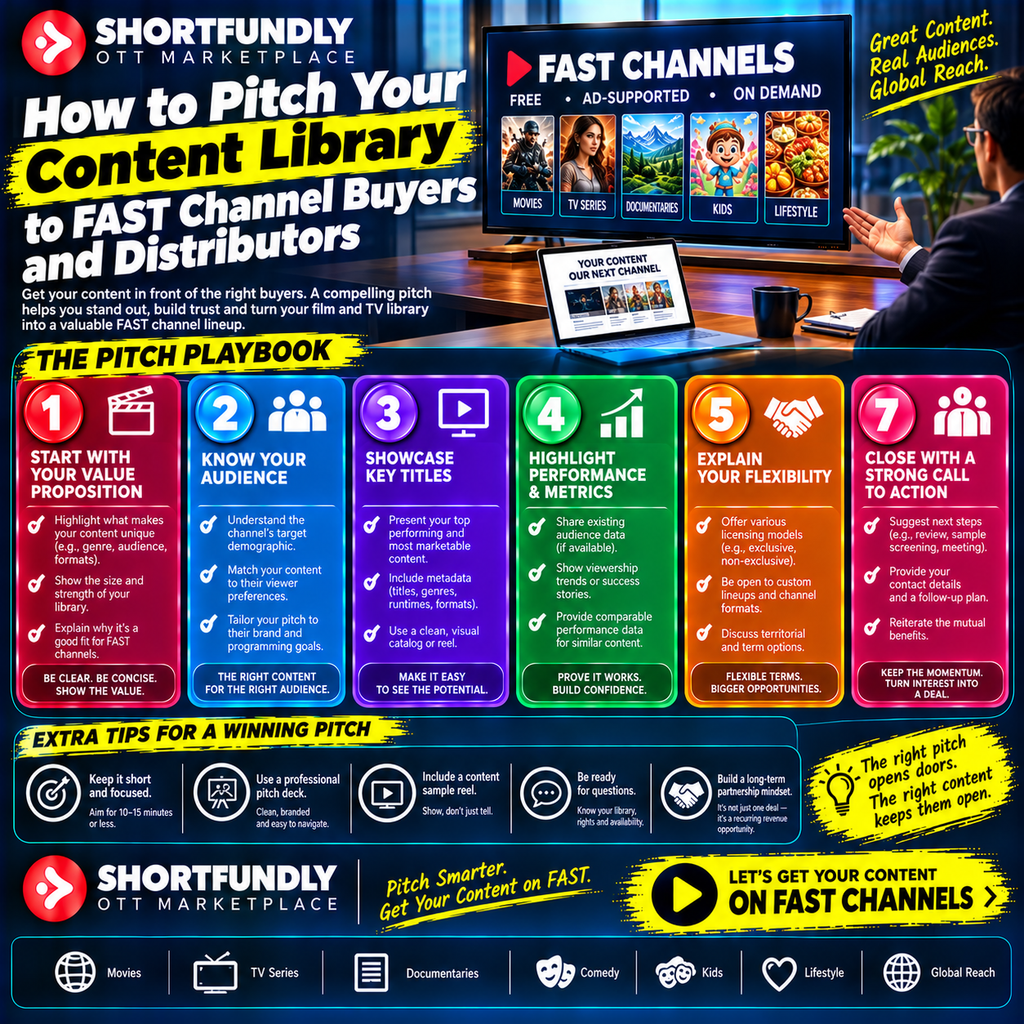
Pitching a content library to FAST channel buyers and distributors requires more than presenting a list of films or television programmes. We need to demonstrate the commercial value of our catalogue, explain why its content suits a particular audience, confirm that the necessary distribution rights are available, and provide the technical materials buyers need to evaluate our titles efficiently.
The growth of Free Ad-Supported Streaming Television (FAST) has created opportunities for content owners to explore new ways of licensing and distributing films, documentaries, television series, and other video programming. FAST services typically offer free viewing supported by advertising, often through scheduled linear channels. For distributors and content owners, the opportunity depends on catalogue quality, audience relevance, rights availability, technical readiness, and the commercial terms of each deal.
Whether we represent an independent film catalogue, a production company, a library of documentaries, or a collection of television episodes, a structured pitch can help buyers understand what we offer and why it may fit their programming strategy.
In this guide, we explain how to prepare a professional FAST content library pitch, identify relevant buyers and distributors, organize rights information, build an effective catalogue presentation, and follow up with potential partners.
1. Understand What FAST Channel Buyers and Distributors Want
Before contacting potential buyers, we should understand their business models and acquisition priorities. A FAST channel buyer may be looking for content that fits an existing channel, fills a programming gap, attracts a particular audience, or supports a recognizable genre. A distributor or aggregator may be evaluating whether our catalogue is suitable for delivery to its current platform partners.
These are related but different objectives. A channel operator may want programming for a specific audience, while a distributor may focus on rights availability, delivery requirements, catalogue scale, and potential licensing opportunities across multiple services.
Our pitch should explain how the content supports the recipient’s needs instead of simply describing how much content we own.
Identify the type of buyer we are approaching
Potential contacts include:
- FAST channel operators seeking programmes for existing or planned channels.
- Content acquisition teams evaluating films, series, and documentaries for streaming services.
- Distributors and sales agents representing content to platform buyers.
- Content aggregators preparing and delivering eligible titles to distribution partners.
- Channel service providers offering scheduling, technical operations, or channel management.
- Specialist genre buyers focused on areas such as action, comedy, family entertainment, factual programming, or regional cinema.
We should research each company’s current activities and confirm whether it accepts third-party content submissions. A buyer’s presence in the streaming industry does not automatically mean it is actively acquiring content from independent rights holders.
2. Organize Your Content Library Before Pitching
A well-organized catalogue makes it easier for buyers to assess our inventory. Before sending an email, we should prepare a master content list containing accurate, consistent information for every title.
Our catalogue should make it possible to answer three fundamental questions: What content do we have? Which rights can we offer? How easily can the content be delivered?
Create a professional content catalogue
For each title, include the following information where applicable:
| Catalogue field | Information to provide |
|---|---|
| Title | Official title and any alternate titles |
| Content type | Feature film, short film, series, documentary, or other format |
| Genre | Primary genre and relevant subgenres |
| Runtime | Total duration or episode length |
| Release year | Original release or production year |
| Language | Original language and available dubbed versions |
| Subtitles | Available subtitle and caption languages |
| Synopsis | Concise, accurate description of the content |
| Production details | Director, producer, cast, or studio |
| Technical status | Master format and delivery readiness |
| Rights availability | Territories, platforms, languages, exclusivity, and term |
| Supporting assets | Trailer, poster, stills, and metadata |
| Existing restrictions | Current licences, holdbacks, or other commitments |
We should avoid incomplete rights information or inconsistent metadata. If a title is already licensed in a particular territory, that restriction should be recorded before the pitch is sent.
A catalogue spreadsheet is useful for internal management, while a concise presentation or digital catalogue can provide a more polished introduction to buyers.
3. Build a Clear and Compelling Content Library Pitch Deck
A FAST distribution pitch deck should be concise enough to review quickly while providing sufficient information for a serious evaluation. Its purpose is not to replace the complete catalogue. Instead, it should introduce our content, explain its potential fit, establish our rights position, and make the next step clear.
We can structure the deck around the following sections.
Slide 1: Company and Catalogue Overview
Introduce our company, production label, or content library. Explain what types of programming we represent and the general focus of the catalogue.
For example, a library may specialize in independent feature films, regional-language cinema, documentaries, family programming, or television series. We should describe our actual catalogue rather than attempting to appear suitable for every possible channel.
Slide 2: Catalogue Highlights
Showcase a selected group of titles that best demonstrate the library’s range and strengths. Include key artwork, genre, runtime, language, release year, and a short synopsis.
The selection should reflect the recipient’s programming interests. A documentary-focused buyer, for example, should receive a different selection from a channel operator seeking action films.
Slide 3: Audience and Programming Fit
Explain the audiences and programming categories the catalogue may serve. We can group content by genre, language, age suitability, theme, or format.
We should distinguish between verified audience information and our own assessment. If we have reliable viewing data, ratings, festival recognition, or previous licensing history, we can present it with appropriate context. We should not invent audience figures or claim proven performance where no evidence exists.
Slide 4: Rights and Territory Availability
Show which rights are available for discussion and where. Buyers need to know whether the titles can legally be licensed for their intended platforms and territories.
A rights summary should identify exclusivity, current restrictions, language limitations, existing agreements, and the period for which rights can be offered. We should confirm these details before representing them as available.
Slide 5: Technical Readiness
Explain which video masters, audio tracks, subtitles, captions, artwork, and metadata are available. If the buyer has its own delivery specifications, we should be prepared to check our assets against those requirements.
Slide 6: Commercial Discussion and Next Steps
We can state that licensing terms are available for discussion, subject to rights, territories, platforms, and the proposed deal structure. If we have an established commercial proposal, we may summarize it without making unsupported promises about revenue or placement.
Finish with a clear contact method and an invitation to request the catalogue, screeners, or detailed rights information.
4. Select the Right Titles for Each FAST Buyer
One of the most common pitching mistakes is sending the same catalogue to every potential partner. A large library may contain hundreds of titles, but only a small portion may match a particular buyer’s programming strategy.
We should create targeted selections based on the recipient’s channel identity, genre, language, audience, format, and acquisition needs.
Use genre and programming categories
Useful categories may include:
- Action and thriller films
- Comedy and romantic comedy
- Drama and independent cinema
- Documentaries and factual programming
- Family and children’s content
- Classic films and archive programming
- Regional-language films
- Television series and episodic content
- Short films and niche programming
These categories should reflect the actual content available and the rights we can grant.
We should also consider how a title fits into the recipient’s programming schedule. A channel operator may be interested in a collection of related films, while a specialist distributor may prefer a broader catalogue that can be evaluated title by title.
The strongest pitch connects specific titles to a buyer’s real programming needs.
5. Explain the Value of Your Library, Not Just Its Size
The total number of titles in our catalogue is only one part of the commercial picture. Buyers may also consider content quality, rights availability, consistency of metadata, genre concentration, technical readiness, language coverage, and the effort required to onboard the collection.
A catalogue of carefully curated, rights-cleared titles may be easier to evaluate than a larger library with incomplete documentation or uncertain ownership.
Highlight genuine catalogue strengths
We can explain the value of our library through evidence such as:
- A consistent collection within a commercially relevant genre.
- Multiple titles with clear and available distribution rights.
- Regional-language content with accurate language and subtitle information.
- Documentaries covering a coherent subject area.
- Series with complete episode information and known runtimes.
- Available high-quality masters and delivery-ready assets.
- Verified previous distribution, awards, or audience performance where relevant.
We should connect each strength to the buyer’s potential requirements without guaranteeing audience performance or advertising revenue.
For example, a collection of regional-language films may be relevant to a service looking for programming in that language. However, the actual commercial value will depend on the buyer’s strategy, platform availability, rights, and evaluation process.
6. Prepare a Rights Matrix Before Contacting Distributors
A content rights matrix helps us establish which titles can be offered and under what conditions. This is essential because FAST distribution may involve different rights from theatrical, broadcast, transactional, or subscription streaming agreements.
We should never assume that owning a film automatically gives us the right to grant every form of streaming distribution. The underlying contracts must support the proposed exploitation.
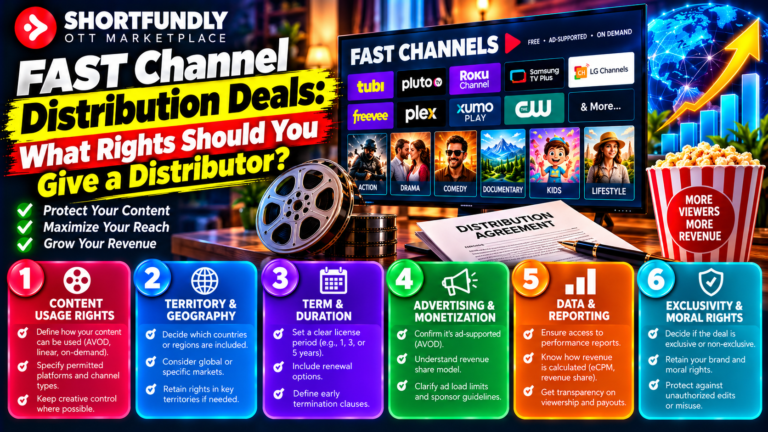
Our rights matrix should identify:
- Title-level ownership: Who owns the relevant rights?
- Territories: Which countries or regions are available?
- Platforms: Are FAST rights available, and are other OTT rights included or restricted?
- Exclusivity: Can we offer the same rights to another partner?
- Languages: Which original, dubbed, or subtitled versions can be licensed?
- Term: How long can the rights be granted?
- Existing agreements: Are there current licences, holdbacks, or restrictions?
- Sublicensing: Can the proposed partner license the content to other services?
- Rights expiry: When do current obligations end?
If we do not control a particular right, we should not include it as available in the pitch. We should also seek legal advice where rights ownership or contractual language is unclear.
This preparation helps reduce avoidable delays during negotiations and demonstrates that we understand the requirements of professional content licensing.
7. Make Your Content Technically Ready for Evaluation
A buyer may be interested in a title but unable to proceed until the content meets its technical requirements. Delivery specifications differ by platform, so we should request the current requirements rather than assuming that one file format works everywhere.
Prepare a delivery-ready asset package
Depending on the recipient’s specifications, the package may include:
- High-quality video masters.
- Correctly formatted audio tracks.
- Subtitles and closed captions.
- Title metadata and detailed synopses.
- Poster artwork and promotional stills.
- Trailers or preview clips.
- Credits, cast details, and production information.
- Ratings and content advisories where required.
- Music and other rights-clearance documentation.
- Technical quality-control reports where requested.
We should maintain a clear naming system and version history for every file. This makes it easier to replace a master, update metadata, or deliver the same title to different partners.
We should also prepare secure preview links or screeners where appropriate. Access should be controlled, and the materials should be shared according to the recipient’s submission process.
Technical readiness improves the professionalism of our pitch, but it does not guarantee acceptance. The buyer still determines whether the content fits its requirements.
8. Write a Professional Email to FAST Channel Buyers
Our introductory email should be concise, relevant, and easy to act on. Buyers may receive numerous submissions, so we should quickly explain who we are, what kind of content we represent, why it may be relevant, and how the recipient can review it.
We should avoid attaching very large files or sending a long catalogue without context. Instead, we can introduce a selected group of titles and offer the complete catalogue or screeners when requested.
Sample FAST content library pitch email
Subject: Content Library for FAST Distribution Consideration – [Genre or Language]
Dear Content Acquisition Team,
We are reaching out to introduce our content library of [number] titles, comprising [content types or genres] in [languages].
Our catalogue includes [brief description of the content], with rights availability across [confirmed territories or rights scope, if known]. We believe selected titles may be relevant to your programming strategy, particularly in the areas of [relevant genres or audience categories].
We can provide a catalogue overview, title metadata, available screeners, technical specifications, and a rights summary for your evaluation.
Please let us know whether you are currently reviewing third-party content for FAST channel distribution or licensing. We would be pleased to share the most relevant titles and discuss the submission process and commercial terms.
Thank you for your time and consideration.
This template should be customized for every recipient. We should only include verified title counts, territories, and rights information, and we should follow any published submission instructions.
9. Understand the Commercial Models Used in FAST Distribution
Before entering negotiations, we should understand the potential commercial arrangements. Different distributors, buyers, and channel operators may offer different structures depending on the rights, content, territories, and services involved.
Possible arrangements include:
| Commercial model | How it may work | What we should clarify |
|---|---|---|
| Content licence fee | A buyer pays an agreed fee for defined rights | Amount, term, territories, platforms, and payment schedule |
| Revenue share | The content owner receives a contractual share of defined revenue | Revenue definition, deductions, reporting, and payment timing |
| Minimum guarantee | A contract specifies a minimum payment, subject to its conditions | Recoupment, rights scope, and payment obligations |
| Catalogue deal | Multiple titles are licensed under a shared agreement | Title selection, individual rights, valuation, and reporting |
| Channel services agreement | A provider performs defined channel or technical services | Service fees, deliverables, advertising responsibilities, and ownership |
These models may be combined, and the actual terms vary by deal. We should never assume that a FAST distributor will pay a minimum guarantee or offer a particular revenue share.
We should request written commercial terms, identify permitted deductions, establish reporting requirements, and clarify how revenue from sublicensing or platform arrangements will be treated.
10. Choose the Right Distribution Partner for Your Content Library
A distribution partner should offer services that match our actual needs. If we own a collection of films and want to explore licensing opportunities, we may need a distributor or sales agent with relevant buyer relationships. If we want to build and operate a complete FAST channel, we may need a specialist that can provide scheduling, technical delivery, and channel operations.
We should evaluate prospective partners using consistent criteria rather than relying only on marketing claims.
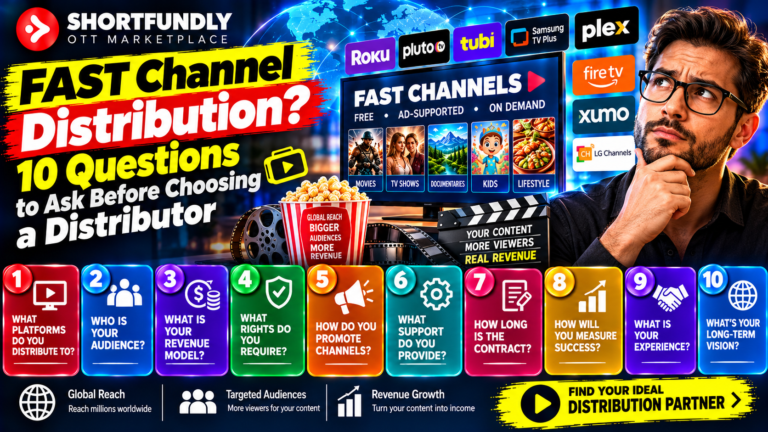
Questions to ask prospective distributors
- Do you currently handle FAST-specific distribution or only general OTT distribution?
- Which platforms and territories are available through your current arrangements?
- Do you accept individual titles, complete catalogues, or full channel projects?
- What rights, exclusivity, and contract duration do you require?
- How are licence fees or revenue shares calculated?
- What upfront and ongoing costs apply?
- What technical assets and metadata must we provide?
- What performance reports and payment schedules are available?
- How are rights clearance and platform compliance handled?
- What happens when the agreement expires or is terminated?
We should ask for a clear written response and review the contract carefully. We should also distinguish between a distributor’s ability to deliver a title and a platform’s decision to accept it.
11. Consider Shortfundly Distribution for Your Digital Distribution Journey
For filmmakers, producers, and content owners exploring distribution options, Shortfundly Distribution provides an official portal where we can review its current services, submission process, and content requirements.
Before submitting a catalogue, we should evaluate whether the available services align with our objectives. We should prepare accurate title information, confirm that the necessary rights are available, and review the applicable fees and agreement terms.
It is particularly important to distinguish general OTT distribution from FAST-specific distribution. A service that supports distribution to OTT platforms does not automatically guarantee placement on a FAST service or inclusion in a scheduled linear channel.
We should contact Shortfundly directly to confirm whether FAST-specific opportunities are currently available for our content category, what platforms or partners may be relevant, and what rights, technical materials, and commercial arrangements are required.
Before proceeding, we should confirm:
- Whether our films, documentaries, series, or other content are eligible.
- Which distribution services are currently available.
- Whether the service includes FAST-specific delivery or other OTT distribution options.
- Which territories, platforms, and rights may be covered.
- What submission fees and technical requirements apply.
- Whether individual titles or complete catalogues can be considered.
- How platform acceptance, reporting, and payments are handled.
We should use the current information on the official portal and obtain clarification directly wherever the service scope is unclear. This helps us decide whether the provider is appropriate for our catalogue and distribution strategy.
12. Follow Up Professionally and Manage Buyer Relationships
A successful pitch process requires organized follow-up. Buyers may need time to review a catalogue, discuss programming needs internally, or assess rights and technical materials. We should keep a record of each contact and avoid repeatedly sending the same information without a meaningful reason.
A simple buyer-tracking spreadsheet can include the company name, contact person, submission date, titles offered, rights summary sent, response status, follow-up date, and next action.
A practical follow-up process
- Initial contact: Send a short, tailored introduction and selected catalogue highlights.
- First follow-up: If no response arrives, send a polite reminder after a reasonable interval, following any stated submission policy.
- Additional information: Provide requested screeners, rights documentation, or technical specifications promptly.
- Negotiation: Confirm title selection, territories, platforms, term, fees, and reporting in writing.
- Contract review: Check all rights and commercial clauses before signing.
- Delivery: Submit approved assets according to the buyer’s technical specifications.
- Post-delivery tracking: Record delivery status, acceptance, launch information where available, and reporting obligations.
We should respect buyers’ stated timelines and submission rules. A professional, well-documented process helps us maintain credibility even when a particular pitch does not result in a deal.
Common Mistakes to Avoid When Pitching a FAST Content Library
Even a strong catalogue can be difficult to evaluate if the pitch is poorly prepared. We should avoid these common mistakes:
Sending an unfiltered catalogue: A long list without relevant highlights makes it harder for buyers to identify suitable titles.
Making unsupported audience claims: We should use verified performance data and clearly distinguish facts from projections.
Offering rights we do not control: Rights availability must be checked title by title and territory by territory.
Ignoring technical requirements: Missing assets, inconsistent metadata, and poor-quality masters can delay evaluation.
Confusing OTT with FAST: We should confirm the exact distribution service instead of assuming that all internet-delivered video opportunities are equivalent.
Expecting guaranteed placement: Buyers and platforms may reject content after review, even when it has been delivered through a distributor.
Leaving commercial terms unclear: Revenue calculations, deductions, payment schedules, and rights reversion should be documented.
Avoiding these mistakes makes our pitch more credible and helps buyers evaluate the catalogue with less uncertainty.
Also read: https://blog.shortfundly.com/ott/film-library-fast-channels/
Conclusion: Build a Buyer-Ready Pitch for Your FAST Content Library
Pitching a content library to FAST channel buyers and distributors is a structured business process. We need to present a catalogue that is easy to understand, identify the most relevant titles for each buyer, confirm rights availability, prepare technical assets, and explain the value of the content using accurate information.
A professional pitch deck, organized catalogue spreadsheet, detailed rights matrix, and concise introduction email can help buyers evaluate our offering efficiently. We should also research each prospective partner, clarify the distribution model, understand the commercial terms, and follow up consistently.
For content owners exploring digital distribution, Shortfundly Distribution is one option to review through its official portal. We should confirm the current service scope directly, particularly if our objective is specifically to secure FAST distribution rather than general OTT distribution.
Our goal is to make it straightforward for a buyer to understand what we own, why the content may fit, which rights are available, and what practical steps are required to move from a pitch to a distribution agreement.