Table of Contents
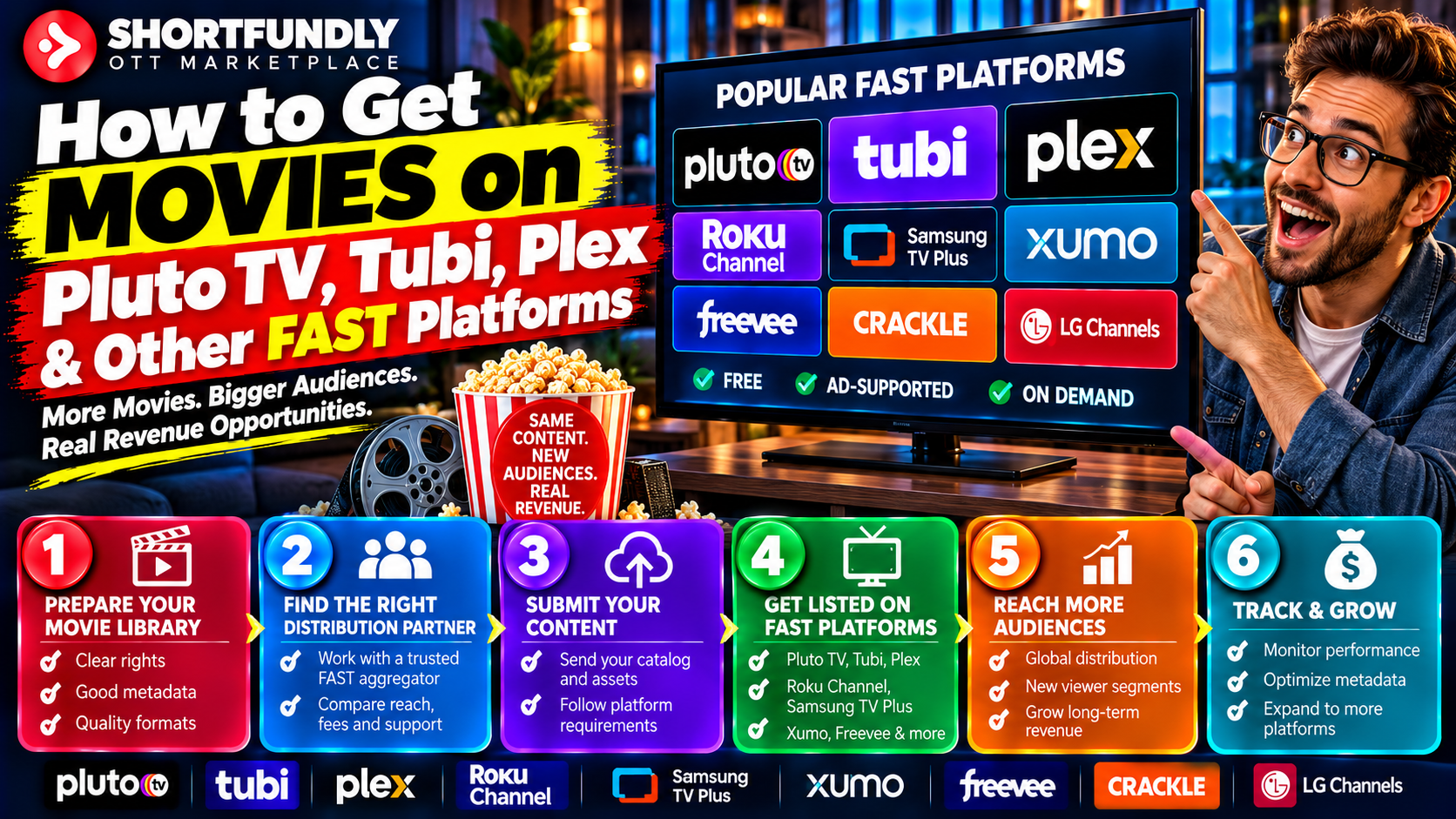
Learn how to get movies on Pluto TV, Tubi, Plex, and other FAST platforms. Discover distribution options, delivery requirements, licensing, and revenue strategies.
Independent filmmakers and movie producers have more opportunities than ever to reach audiences through digital streaming. Instead of relying only on theatrical releases, television deals, or subscription streaming services, content owners can explore free streaming platforms that connect films with viewers through advertising-supported entertainment.
Platforms such as Pluto TV, Tubi, and Plex have helped make free streaming a familiar option for audiences. For filmmakers, these services may offer new ways to distribute feature films, short films, documentaries, independent productions, and library titles. However, getting a movie accepted requires more than uploading a video file. Content owners must understand platform eligibility, distribution partnerships, licensing rights, technical specifications, and commercial terms.
This guide explains how to get movies on Pluto TV, Tubi, Plex, and other FAST platforms, what materials to prepare, how distribution partners can help, and how to build a practical strategy for long-term streaming distribution.
If you own or control the rights to films and want to explore digital distribution opportunities, services such as Shortfundly Distribution can be a starting point for understanding available distribution pathways. Remember that platform acceptance, placement, territories, and revenue depend on individual agreements and each platform’s requirements.
1. What Are FAST Platforms?
FAST stands for Free Ad-Supported Streaming Television. These services allow viewers to watch content without paying a traditional subscription fee, while advertising helps fund the service.
FAST services commonly feature linear channels that play scheduled programming, on-demand movie libraries, or a combination of both. The exact viewing experience differs by platform.
It is also useful to understand the difference between FAST and AVOD. FAST generally refers to free, ad-supported television-style viewing, while AVOD means advertising-supported video on demand. The terms overlap in the streaming industry, and some services offer both types of viewing.
How FAST Distribution Works
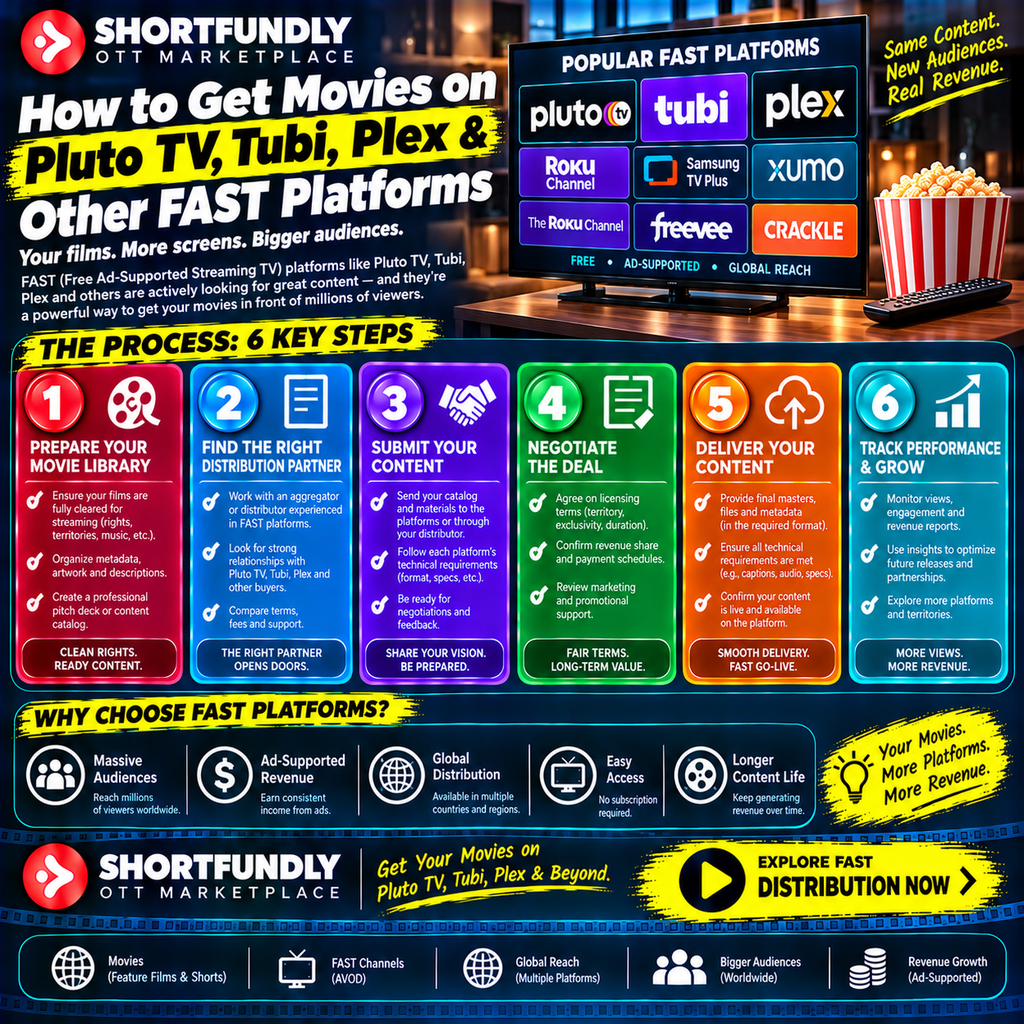
A simplified distribution process looks like this:
- A filmmaker or rights holder prepares a film and its supporting materials.
- The content owner approaches a platform or an eligible distribution partner.
- The platform or partner reviews the film, rights, metadata, and technical quality.
- If the film is approved and a deal is agreed, the required assets are delivered.
- The film becomes available under the agreed terms, which may include specific territories, time periods, and monetization arrangements.
- Performance and revenue are tracked according to the reporting provisions of the agreement.
Not every platform accepts direct submissions from every type of filmmaker. Some work primarily through established distributors, aggregators, studios, or licensing partners.
2. Why Filmmakers Should Consider FAST Distribution
FAST distribution can help filmmakers explore audiences beyond conventional release channels. It is especially worth considering for films that have completed their initial release cycle or are ready for broader digital distribution.
Reach Audiences Who Prefer Free Streaming
Many viewers prefer free entertainment supported by advertising instead of another monthly subscription. A film available through an established free streaming service may become discoverable to people who would not otherwise encounter the production.
Availability does not guarantee views, but a suitable platform can create another opportunity for audience discovery.
Extend the Life of Your Movie
A film’s commercial life does not necessarily end after a festival run, theatrical release, or initial digital launch. With the right rights and licensing strategy, a title may find new distribution opportunities later.
Library films, independent dramas, documentaries, thrillers, family films, and niche-genre productions may all be worth evaluating for suitable streaming outlets.
Explore Advertising-Based Revenue
FAST and AVOD services may generate revenue through advertising. Depending on the contract, a rights holder might receive a licensing fee, a share of revenue, a minimum guarantee, or another agreed payment structure.
Do not assume every deal pays in the same way. Review the actual commercial terms before agreeing to distribute a film.
3. How to Get Movies on Pluto TV
Pluto TV is a free streaming service that features television-style channels and on-demand entertainment. It has an established content-partner ecosystem and provides a formal partner route for rights holders interested in working with the service.
Start with the official Pluto TV Partners page to understand its partnership options. Pluto TV’s content delivery requirements also explain why professional technical preparation is important. See the official Pluto TV content delivery guidelines.
Step 1: Check Whether Your Film Is Suitable
Prepare a concise presentation of your film, including:
- Title, genre, language, and runtime
- Release year and country of production
- Synopsis and intended audience
- Cast, director, and production company
- Available rights and territories
- Existing distribution history, if relevant
A strong catalogue presentation makes it easier for a potential partner to evaluate your title.
Step 2: Approach the Appropriate Partner Route
Review Pluto TV’s official partner information and follow the current contact or inquiry process provided there. If you are working through a distributor, ask whether the distributor has a relevant delivery route and whether it is authorized to offer your film for consideration.
Do not assume that sending a file to a general customer-support address is the same as submitting a professional licensing proposal.
Step 3: Prepare Technical Delivery Materials
Pluto TV publishes specific content delivery guidelines covering technical and operational requirements. Depending on the deal and asset type, requested materials may include high-quality video masters, properly synchronized captions, metadata, artwork, music cue sheets, and documentation establishing rights ownership.
Follow the exact specifications supplied for your agreement. A film that plays correctly on a laptop may still need adjustments before it meets a streaming service’s delivery standards.
Step 4: Review the Deal Before Delivery
Before handing over the film, confirm the territories, term, exclusivity, payment structure, reporting provisions, and rights being licensed. Ask which assets are required and when the content is expected to be reviewed or delivered.
Important: A completed submission is not a guarantee of acceptance or a release date. Pluto TV decides which content it licenses and how accepted content is scheduled or presented.
4. How to Get Movies on Tubi
Tubi is a free, advertising-supported streaming service with a large on-demand library. Its catalogue includes films and television content licensed from established rights holders and distribution partners.
For filmmakers, the practical route is to determine how the film can be presented to Tubi’s content acquisition team through an appropriate licensing or distribution relationship.
Step 1: Evaluate Your Film Catalogue
Prepare the details that a distributor or acquisition contact may need to evaluate the film:
- Genre and target audience
- Language and subtitle availability
- Runtime and release date
- Synopsis and key cast details
- Poster, stills, and trailer
- Ownership and territorial rights
- Current availability on other platforms
A single film may be considered, but a catalogue with several suitable titles can sometimes provide a more compelling distribution proposal. The value depends on the content, rights, and buyer’s needs.
Step 2: Identify a Legitimate Distribution Route
Research distributors and aggregators that can demonstrate a relevant route to Tubi or other free streaming services. Ask them to explain their relationship with the platform, submission process, fees, and contractual responsibilities.
Do not confuse a viewer suggestion form with a professional licensing submission. Tubi’s Help Center article on suggesting movies describes a way for viewers to recommend titles; it is not a guarantee that a filmmaker can submit a film directly for licensing through that route.
Step 3: Make the Film Ready for Review
Check picture and sound quality, subtitle accuracy, rights documentation, artwork, and metadata before submitting the film through the agreed channel.
Be prepared to provide additional information if a distributor or platform requests it. Missing music clearances, incomplete credits, or unclear ownership can slow down the review process.
Step 4: Understand Availability and Monetization
Ask how the film will be licensed, which territories are included, how revenue is calculated, and how often statements are provided. If the distributor proposes a revenue share, ask what deductions apply and whether there are any delivery or administration charges.
Tubi availability is not automatic just because a distributor accepts your film. Final selection and terms depend on the relevant acquisition and licensing process.
5. How to Get Movies on Plex
Plex offers a range of media experiences, including free streaming content. Its ecosystem includes content supplied through partnerships with rights holders and distributors.
The best route depends on whether your objective is to license a movie for Plex’s free streaming catalogue or to make use of another distribution arrangement supported by the service.
Step 1: Review Plex’s Content Partnership Information
Start with the Plex partners page and investigate the appropriate contact route for content partnerships. The page provides context about Plex’s partner ecosystem, but it should not be treated as a universal direct-submission form for independent films.
Step 2: Prepare a Professional Proposal
Your proposal should make the film’s value clear without overwhelming the recipient. Include the film’s title, genre, language, runtime, logline, synopsis, release year, available territories, rights status, and links to approved preview materials.
For a larger catalogue, include a clean title list and indicate which rights are available for each film.
Step 3: Confirm the Delivery Requirements
If the film progresses to a licensing discussion, request the current technical specifications and asset checklist. Requirements can vary depending on the distribution route and agreement.
Do not upload private screeners or deliver full-resolution master files to an unverified contact. Use a secure, agreed delivery process.
Step 4: Keep Your Rights and Platform Plans Organized
If the film is already licensed elsewhere, check whether the existing agreement allows additional streaming distribution. A film may be available in one territory but restricted in another, or licensed for one viewing model but not another.
Keep a record of each agreement’s term, territory, rights, exclusivity, and renewal dates.
6. Other FAST and Free Streaming Platforms to Explore
Pluto TV, Tubi, and Plex are not the only services worth researching. The right platform depends on your genre, audience, territories, language, catalogue, and rights availability.
Potential services and distribution ecosystems to investigate include:
- The Roku Channel: Free streaming content and channel-based viewing experiences.
- Samsung TV Plus: A FAST service available on supported Samsung devices and in selected markets.
- LG Channels: A channel-based streaming service available on supported LG devices and in selected markets.
- Xumo Play: A free streaming service with television-style channels and on-demand experiences.
- Amazon’s free streaming offerings: Availability and licensing routes vary by service and region.
- Regional FAST services: Local broadcasters, connected-TV manufacturers, and streaming operators may offer opportunities for language-specific or regional content.
- Other AVOD services: On-demand platforms may be suitable even if they do not offer a traditional linear FAST channel.
These are research targets, not a promise that every service is accepting independent film submissions. Check each service’s current partner process, supported territories, and content requirements before committing to a distributor.
How to Choose the Right Platform
Compare potential platforms against practical criteria:
| Factor | What to Check |
|---|---|
| Audience | Does the platform serve viewers interested in your genre? |
| Territory | Can it distribute the film in the countries you are targeting? |
| Language | Does it support your film’s language and available subtitles? |
| Rights | Are the rights you control sufficient for the proposed deal? |
| Monetization | Is payment based on licensing fees, revenue share, or another model? |
| Delivery | Can you meet its video, audio, caption, and metadata specifications? |
| Reporting | What viewing and revenue information will be provided? |
| Exclusivity | Will the agreement restrict other distribution opportunities? |
A platform’s name recognition is only one factor. A smaller or more regionally focused outlet may be a better match for a particular film.
7. Prepare Your Movie for FAST Distribution
One of the most useful things a filmmaker can do before contacting distributors is prepare a complete delivery package. This reduces avoidable back-and-forth and helps partners assess the film professionally.
Essential Video and Audio Assets
Prepare a high-quality master file that meets the specifications of the intended distributor or platform. Do not assume that one format or codec is accepted everywhere.
Depending on the project and agreement, you may need:
- A high-quality video master
- Separate audio tracks or alternate mixes
- A clean version without unauthorized platform branding or promotional overlays
- Closed captions or subtitle files
- Additional language versions, if available
- A trailer or approved promotional clips
For example, Pluto TV’s published additional delivery guidelines address technical delivery, caption synchronization, and supporting rights materials. Use the current requirements provided for your deal rather than relying on a generic checklist alone. Read Pluto TV’s additional delivery guidelines.
Create Accurate Metadata
Metadata helps distributors understand, classify, and present your film. It may also help viewers find it through search and browsing.
Prepare:
- Official title and alternate title, if applicable
- Short logline
- Concise synopsis and longer synopsis
- Genre and subgenre
- Runtime
- Release year
- Country of origin
- Original language and subtitle languages
- Cast, director, producer, and production company
- Content ratings or advisories, where applicable
- Relevant keywords
Use accurate descriptions. Do not add misleading genre labels or claim awards, cast members, or distribution history that the film does not have.
Prepare Artwork and Promotional Materials
A professional poster and clean still images help create a consistent presentation. Follow the specific image dimensions, file formats, and safe-area requirements provided by your distributor.
Avoid putting excessive text on artwork. The title should remain legible at small sizes, and images should represent the actual film.
Organize Your Rights Documents
Prepare the documents that establish your right to license the film. Depending on the production, these may include:
- Copyright or ownership information
- Producer or rights-holder authorization
- Cast and crew agreements
- Music licenses and cue sheets
- Script, adaptation, or underlying-material rights
- Archive-footage and stock-footage permissions
- Location or artwork permissions where required
- Chain-of-title documentation
Requirements vary by film and territory. If there are gaps in your documentation, address them before promising rights to a distributor.
8. Understand Movie Licensing and Distribution Rights
A film can be technically ready but still be unsuitable for distribution if the rights are unclear. Content owners should understand precisely what they control before agreeing to a platform deal.
Confirm Which Rights You Own
Ask whether you control the film’s streaming rights in the proposed territories and whether any earlier contract has already licensed those rights to another company.
If you are a director or producer but do not own the distribution rights, you may need written authorization from the rights holder before submitting the film.
Review Territory and Language
A distributor may offer a deal covering one country, a region, or multiple territories. Language rights, subtitle rights, and dubbing rights may also matter.
Maintain a rights matrix for every title so you can identify what is available and avoid overlapping commitments.
Understand Exclusivity and Contract Duration
Some agreements may be exclusive for specific rights, territories, or periods. Others may permit the film to be licensed to multiple services.
Before signing, clarify:
- The exact rights being granted
- The territories and languages covered
- The contract start and end dates
- Whether the agreement is exclusive
- Whether renewals are automatic
- How termination and takedown requests work
- What happens to unpaid revenue after the agreement ends
Get legal advice when the contract is unclear or the commercial commitment is significant.
9. How FAST Movie Monetization Works
FAST and AVOD distribution can create advertising-based revenue opportunities, but earnings are not guaranteed. The payment model depends on the platform, distributor, licensing agreement, viewing performance, and applicable deductions.
Revenue Share
Under a revenue-share arrangement, the rights holder may receive an agreed percentage of defined revenue. The contract should explain how revenue is calculated, which costs or fees can be deducted, and when statements and payments are issued.
Ask for clear definitions rather than relying on broad phrases such as “share of streaming revenue.”
Licensing Fees or Minimum Guarantees
Some licensing agreements may offer a fixed fee or a minimum guarantee, depending on the buyer, title, territory, and rights package. Such arrangements are negotiated, not universal.
Compare the proposed payment with the rights being granted and the length of the commitment.
Factors That Can Influence Revenue
Potential factors include:
- How many viewers watch the film
- How long viewers continue watching
- Advertising demand and fill
- Platform availability by territory
- The distributor’s fee and revenue-share structure
- The length of the licensing term
- The popularity and suitability of the title
Do not rely on a promised earnings figure without understanding the assumptions behind it. Ask how reporting works and what performance data you will actually receive.
10. How a Distribution Partner Can Help
A distribution partner may help independent filmmakers navigate platform relationships and organize the practical steps involved in licensing a film.
Depending on the provider and its agreements, support may include catalogue evaluation, rights checks, metadata preparation, technical delivery coordination, submission management, and revenue reporting.
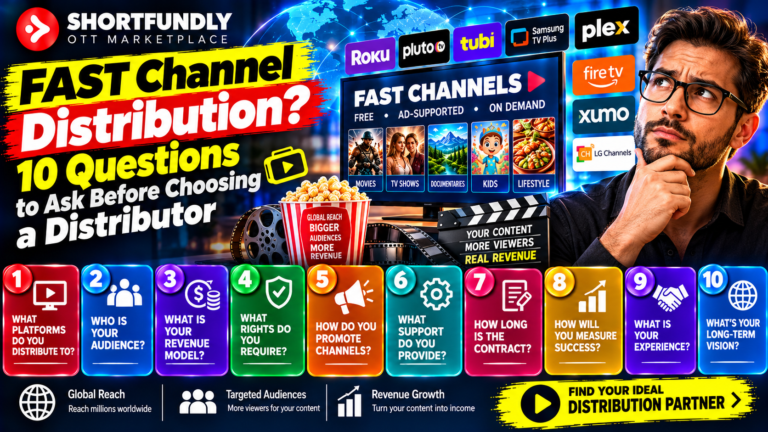
Questions to Ask Before Choosing a Distributor
Before signing with any company, ask:
- Which platforms can you currently submit to or distribute through?
- Are you an authorized partner, an aggregator, or an intermediary?
- Which types of films and territories do you support?
- What upfront, delivery, administration, or annual fees apply?
- How are revenue shares and deductions calculated?
- How frequently will I receive performance and payment reports?
- Who retains the underlying film rights?
- Is the agreement exclusive, and for how long?
- Can I review the contract before providing master files?
- What happens if the film is rejected or never licensed?
Request written answers to material commercial questions. Verify claims about platform access and do not treat a company’s general distribution service as proof that every title will reach every platform.
11. Explore Shortfundly Distribution for Your Film
Filmmakers looking for a structured way to explore digital distribution can learn more through Shortfundly Distribution.
When evaluating Shortfundly or any other distribution service, start by identifying your goals. You might want to explore free streaming services, expand the reach of an existing catalogue, distribute short films, or understand which rights and delivery materials are needed before approaching streaming partners.
What to Prepare Before Contacting Shortfundly
Organize the following information so your project can be assessed efficiently:
- A list of films you own or are authorized to distribute
- Genre, runtime, language, and release year for each title
- A short synopsis and logline
- Poster, stills, and trailer links
- Available territories and languages
- Rights ownership and any existing licensing commitments
- Technical delivery status
- Your preferred distribution goals and timeline
What to Clarify During the Discussion
Ask which services and territories may be relevant to your catalogue, what the submission process involves, which fees apply, and how licensing and revenue reporting work.
Confirm whether the service provides a direct platform relationship or works through third-party distribution partners. Ask for written terms explaining the rights you grant and the circumstances under which your film may be submitted, licensed, or released.
Important: Contacting Shortfundly Distribution does not guarantee placement on Pluto TV, Tubi, Plex, or any other platform. Availability depends on the distribution route, content eligibility, platform decisions, and the terms of any licensing agreement.
12. Common Mistakes to Avoid When Submitting Movies
Even a good film can face delays when its submission package is incomplete or its rights are unclear. Avoid these common mistakes.
Sending Low-Quality or Incomplete Files
A compressed preview is useful for initial evaluation, but it may not meet delivery requirements. Confirm which file is required at each stage and use the agreed secure delivery method.
Ignoring Captions and Subtitles
Incorrect timing, poor translation, or missing caption files can create accessibility and delivery problems. Check subtitle accuracy and ensure that files match the final edit.
Using Inaccurate Metadata
Wrong runtime, inconsistent titles, spelling mistakes, and exaggerated descriptions make a catalogue look less professional. Keep metadata consistent across your proposal, rights records, artwork, and final delivery package.
Assuming One Distributor Guarantees Every Platform
A company may distribute to selected services but not others. Confirm the actual distribution route for each target platform rather than relying on general marketing language.
Overlooking Rights Restrictions
A film may contain music, archive footage, or third-party material that is cleared for one use but not another. Verify the rights needed for the proposed distribution and territories.
Agreeing to Unclear Payment Terms
Never assume that “monetization” means a particular payment amount. Understand the revenue formula, fees, reporting schedule, payment threshold, and applicable deductions.
Failing to Track Existing Agreements
Keep a central record of platform, territory, rights, contract term, exclusivity, renewal dates, and takedown conditions. This helps prevent accidental rights conflicts when exploring additional outlets.
13. Build a Long-Term FAST Distribution Strategy
A strong distribution strategy is not simply about placing one movie on one platform. It is about managing a catalogue, understanding rights, and making informed decisions over time.
Start with a Catalogue Audit
List every film and record its ownership status, language, genre, runtime, delivery readiness, current availability, and rights restrictions. This will help you identify which titles are ready to submit and which require additional work.
Prioritize Suitable Titles
Choose titles that fit the audiences and genres of the services you are researching. Consider whether a film has a clear genre identity, a professional presentation, and rights that are available in the target territories.
Do not submit the entire catalogue indiscriminately. A focused, well-documented proposal can be easier for a distributor to evaluate.
Maintain Multiple Distribution Options
Subject to your contracts, you may be able to explore different services for different territories or release windows. A film might be licensed to one service in a particular region while remaining available for other rights elsewhere.
Do not assume all deals can be combined. Check exclusivity, windowing, and territorial restrictions before committing.
Monitor Performance and Learn
Where reports are available, track the information you receive, such as viewing activity, revenue, territory performance, and licensing status. Use this information to inform future decisions, but avoid drawing conclusions from incomplete or incomparable reports.
Over time, you can use your catalogue history to refine your platform priorities, improve metadata, and identify which types of content appear to perform best for your goals.
14. Frequently Asked Questions
1. How can I get my movie on Pluto TV?
Begin with Pluto TV’s official partner information and identify the appropriate content partnership route. Prepare your film details, rights documentation, metadata, artwork, and technical materials. A distributor may be able to help with submission and delivery, but final selection rests with the relevant parties.
2. Can independent filmmakers submit movies to Tubi?
Independent filmmakers can explore licensing opportunities, often through distributors, aggregators, or other relevant industry relationships. The available route depends on Tubi’s current acquisition process and the film’s eligibility. A viewer suggestion form should not be treated as a guaranteed professional submission channel.
3. How do I get a movie on Plex?
Review Plex’s partner information and determine the appropriate route for a content partnership or licensing proposal. Prepare a professional film package and verify any distributor’s relationship with Plex before providing materials or signing an agreement.
4. Do FAST platforms pay filmmakers?
Some FAST and AVOD distribution arrangements provide revenue through advertising-based shares, licensing fees, minimum guarantees, or other negotiated terms. The actual payment structure varies. Review the agreement carefully and do not assume that every platform or title will generate revenue.
5. What types of movies can be distributed on FAST platforms?
Potentially suitable content can include independent feature films, short films, documentaries, classic titles, genre films, and other productions. Suitability depends on each platform’s acquisition priorities, technical requirements, audience, territories, and rights availability.
6. Do I need a distributor to get my movie on FAST platforms?
Not always, but some platforms primarily work through established distribution partners or licensing relationships. A distributor may help with access, delivery, metadata, rights checks, and reporting. Confirm its actual platform relationships and terms before proceeding.
7. What files are required for FAST distribution?
Requirements vary, but may include a high-quality video master, approved audio tracks, captions, subtitles, poster artwork, stills, metadata, trailer, music cue sheets, and chain-of-title documentation. Always use the current specifications supplied by the platform or distributor.
8. Can I put the same movie on Pluto TV, Tubi, and Plex?
Potentially, if your rights and agreements allow it. Check exclusivity, territory, release-window, and other contractual restrictions before licensing the same film to multiple services.
9. How long does it take to get a movie accepted?
There is no universal timeline. Review, rights verification, contract negotiations, technical delivery, scheduling, and platform availability can all affect the process. Ask your distribution partner for an estimated timeline, but do not treat an estimate as a guarantee.
10. Is Shortfundly Distribution an option for independent filmmakers?
You can explore Shortfundly Distribution to learn about its distribution services and determine whether they fit your project. Before proceeding, ask about supported platforms, eligibility, fees, rights, territories, and reporting. Confirm any specific platform access and commercial terms in writing.
Also read: https://blog.shortfundly.com/ott/pitch-content-fast-channel/
Conclusion: Take the Next Step Toward FAST Distribution
Getting movies on Pluto TV, Tubi, Plex, and other FAST platforms begins with preparation. Filmmakers need to understand their rights, create a professional delivery package, identify legitimate distribution routes, and review licensing terms carefully.
Start by auditing your catalogue, checking which rights are available, and preparing accurate metadata, artwork, captions, and high-quality masters. Research the relevant platform partnership processes, compare distributors, and ask clear questions about fees, exclusivity, revenue, territories, and reporting.
If you are exploring ways to distribute your films digitally, visit Shortfundly Distribution to learn more about the available options. Approach every opportunity with clear expectations: a distribution submission can open a door, but platform approval, release timing, audience reach, and revenue depend on the relevant agreements and decisions.
With a well-prepared catalogue and a thoughtful distribution strategy, filmmakers can make more informed choices about where and how their stories reach streaming audiences.