Table of Contents
1. What Is FAST Channel Technology?
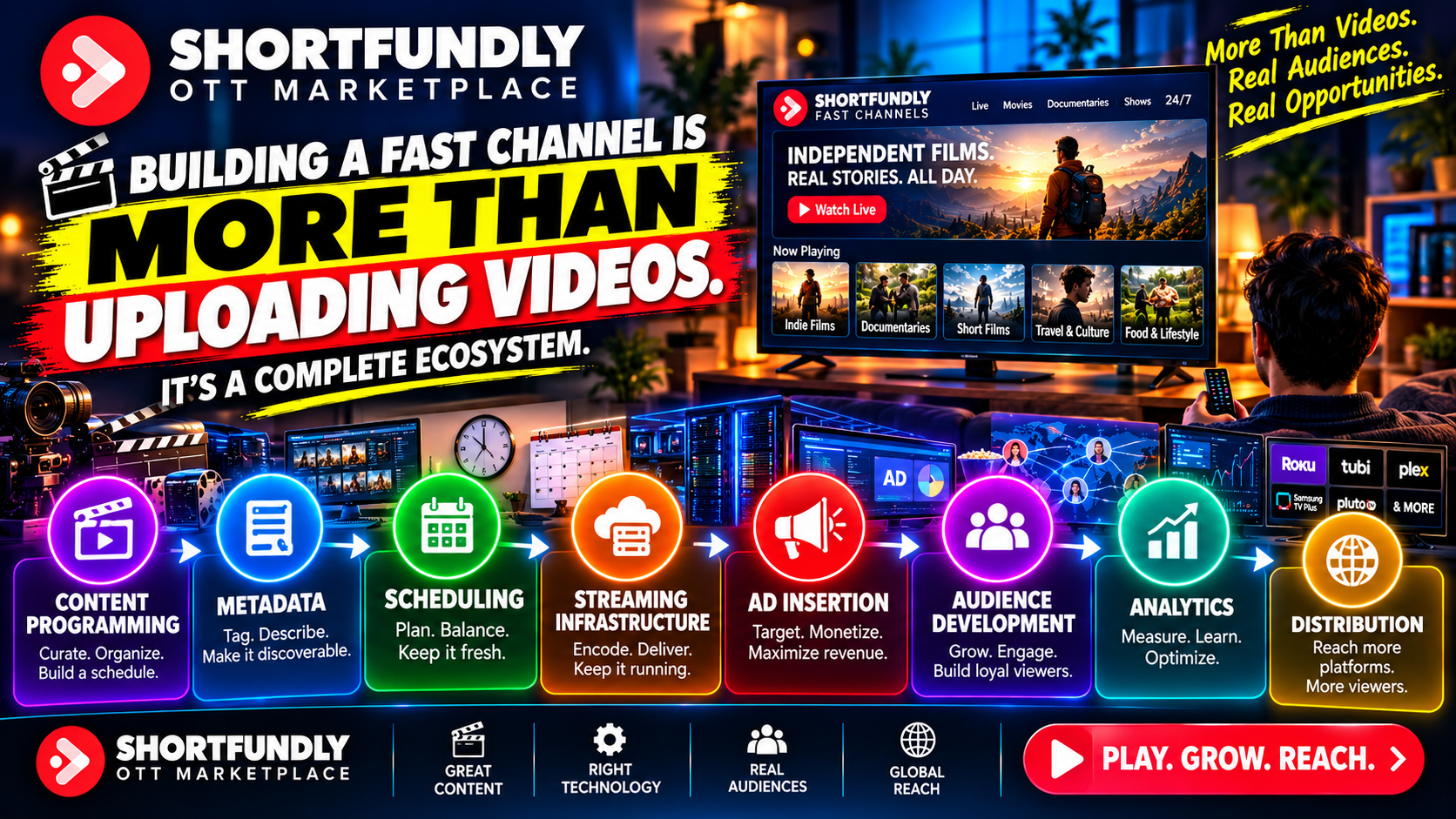
FAST channel technology refers to the systems and tools used to operate free ad-supported streaming television channels. These systems help content owners and streaming businesses organize video, create continuous programming, deliver streams, insert advertisements, distribute channels, and measure performance.
FAST stands for Free Ad-Supported Streaming Television. Unlike subscription services that generally charge viewers a recurring fee, FAST services typically let viewers watch programmed channels for free, with advertising supporting the business model.
At first glance, the experience appears simple. A viewer opens a streaming application, selects a channel, and starts watching. Behind the scenes, however, several systems must work together to make that experience possible.
A typical FAST technology stack may include:
- Content management systems for organizing video assets.
- Metadata management tools for storing titles, descriptions, genres, and artwork.
- Scheduling and playout systems for creating continuous channel programming.
- Video processing systems for encoding and packaging content.
- Streaming infrastructure for delivering video to viewers.
- Advertising technology for selecting and inserting advertisements.
- Distribution integrations for delivering channels to supported platforms.
- Analytics tools for measuring viewing and advertising performance.
These components may come from one technology provider or several specialized vendors. The right setup depends on the channel’s size, content library, target audience, budget, and distribution strategy.
Understanding Free Ad-Supported Streaming TV
FAST channels combine the scheduled programming of traditional television with internet-based video delivery.
A channel might broadcast independent films, documentaries, classic movies, regional cinema, lifestyle programming, or other content throughout the day. Viewers can tune in without choosing each title individually.
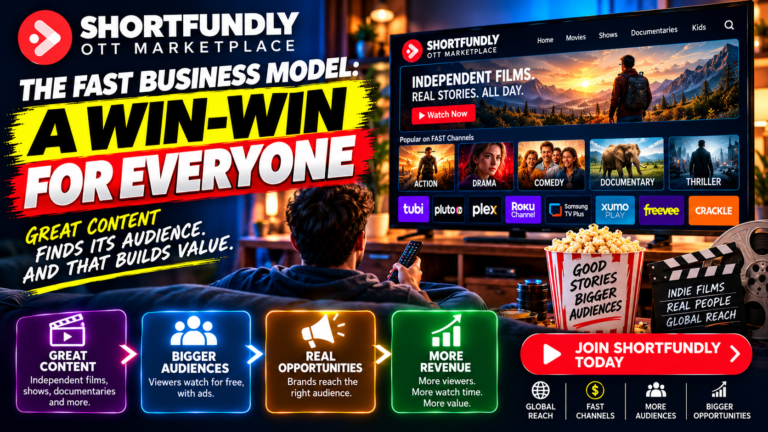
Advertising creates the primary revenue opportunity for many FAST services. When viewers watch a channel, the service may deliver advertisements during designated breaks. Revenue can help cover technology, content licensing, distribution, marketing, and operating expenses.
However, simply launching a channel doesn’t guarantee advertising revenue. The business must attract viewers, retain their attention, maintain appropriate advertising inventory, and establish commercial relationships.
Technology supports this process by connecting programming, streaming, advertising, and measurement.
FAST Channels vs. On-Demand Streaming
FAST channels and video-on-demand services use overlapping technologies, but their viewing experiences differ.
| Feature | FAST Channel | Video-on-Demand Service |
|---|---|---|
| Viewing format | Continuous, scheduled programming | Individually selected titles |
| Viewer experience | Tune in and watch | Search, select, and play |
| Content discovery | Channel browsing and programmed schedules | Search, recommendations, and categories |
| Scheduling system | Usually essential | Not always required |
| Advertising | Commonly built into the model | Depends on the service |
| Metadata | Supports listings and discovery | Supports search and recommendations |
| Streaming delivery | Required | Required |
| Typical technology focus | Playout, scheduling, ad insertion, distribution | Catalog management, playback, recommendations |
Some businesses operate both FAST channels and on-demand libraries. They can use a shared content management system while maintaining different workflows for programming and delivery.
The key takeaway: FAST channel technology connects multiple systems to create a continuous, reliable, and potentially monetizable streaming experience.
2. Content Programming and Management
Content is the foundation of every FAST channel. Without a suitable library of films, shows, or other programming, the technology stack has nothing to deliver.
Yet managing a channel’s content involves much more than storing video files. The operator must acquire appropriate rights, prepare assets, maintain accurate information, and organize programming so that viewers receive a consistent experience.
Content Acquisition and Rights Management
Before a film or program can be included in a FAST channel, the operator must confirm that it has the necessary permissions.
A content agreement may specify:
- Which platforms can carry the content.
- Which countries or territories are covered.
- How long the license lasts.
- Whether the rights are exclusive or non-exclusive.
- Whether advertising-supported streaming is permitted.
- Which languages, subtitles, or dubbed versions are available.
- Whether promotional clips and still images can be used.
- How compensation and reporting will work.
These details matter because rights granted for one type of distribution don’t automatically cover every other use.
For example, a filmmaker might have permission to screen a movie at a festival but not the right to license it to an advertising-supported streaming channel.
A rights management system can help operators record license dates, restrictions, permitted territories, and renewal requirements. Automated alerts may also help teams identify licenses that are approaching expiration.
A clear rights workflow reduces the risk of scheduling content that the channel isn’t authorized to show.
Content Preparation and Quality Control
Once the necessary rights are confirmed, the content must be prepared for delivery.
A channel may receive files in different formats, resolutions, frame rates, audio configurations, and subtitle formats. These assets often need to be checked and processed before they can enter the playout system.
Content preparation may include:
- Reviewing the source video and audio.
- Checking the aspect ratio and frame rate.
- Encoding or transcoding the file into supported formats.
- Confirming that dialogue and sound levels are acceptable.
- Preparing captions or subtitles.
- Checking the beginning and ending of the program.
- Verifying artwork and metadata.
- Recording technical and rights information.
Technical requirements vary by platform. Operators should follow the delivery specifications provided by their technology vendors and distribution partners rather than relying on one universal format.
Quality control is particularly important for independent film libraries, where source materials may come from many production teams.
One film might have a high-quality digital master, while another might require additional processing or subtitle preparation. A consistent workflow helps the channel maintain a professional viewing experience.
Building an Organized Content Library
A well-organized content library makes programming easier.
Each asset should have a unique identifier and a clear record containing its title, version, runtime, language, rights status, and technical information.
For example, a film may have several versions: an original-language master, a subtitled version, a shorter edit, and a version intended for a particular territory.
Without careful organization, teams may accidentally schedule the wrong version or deliver an asset that doesn’t meet platform requirements.
A content management system can centralize these records and help connect the content library with scheduling, metadata, and distribution workflows.
Best practice: Treat content management as an ongoing operational process, not a one-time upload task.
3. Metadata and Content Discovery
Metadata is the information that describes a film or program. It helps systems identify content, display useful information to viewers, organize programming, and support discovery.
In FAST channel technology, metadata is especially important because the same title may appear in a schedule, an electronic program guide, a platform listing, and a promotional collection.
If the information is incomplete or inconsistent, the viewing experience can suffer.
Essential Metadata Fields
A content record may include the following fields:
| Metadata Field | Purpose |
|---|---|
| Title | Identifies the film or program |
| Synopsis | Explains what the content is about |
| Genre | Groups content by category |
| Runtime | Supports scheduling and program listings |
| Language | Identifies the original or available audio languages |
| Subtitle information | Shows which subtitle options are available |
| Release year | Provides context about the title |
| Cast and crew | Identifies the people involved |
| Content rating | Supports appropriate audience information |
| Poster or artwork | Helps viewers recognize the program |
| Rights information | Records permitted distribution and restrictions |
| Asset identifier | Links the record to the correct video file |
The exact fields required vary by service and platform.
Metadata should also be accurate. A film with the wrong runtime may disrupt a schedule, while a misleading synopsis can create a poor experience for viewers.
How Metadata Supports Discovery
Good metadata helps viewers understand what they’re about to watch.
A clear title, concise synopsis, accurate genre, and appropriate artwork can make a program more appealing and easier to identify.
Metadata may also help a platform organize titles into categories such as independent drama, documentary, comedy, regional cinema, or short films.
For independent filmmakers, these details are particularly useful. A compelling film can be overlooked if its description is incomplete, its genre is inaccurate, or its artwork doesn’t communicate the story effectively.
However, metadata alone doesn’t guarantee discovery. Audience interest, programming decisions, platform placement, recommendations, and promotion also influence viewing.
Metadata Quality and Automation
For larger libraries, manual metadata entry can become time-consuming and inconsistent.
A metadata management system may provide validation rules, standardized genre lists, duplicate detection, and automated delivery to supported platforms.
For example, a system might flag a program that has no runtime or a license record that lacks an expiration date.
Automation can reduce repetitive work, but human review remains important. Descriptions should accurately represent the film, and sensitive or restricted information must be handled appropriately.
The goal: Make every content asset easy to identify, schedule, distribute, and present accurately.
4. Scheduling and Channel Playout
A FAST channel must turn a collection of individual videos into a continuous viewing experience. This is where scheduling and playout systems become essential.
A scheduling system defines what should play and when. A playout system executes that schedule, moving from one program or commercial break to the next.
Together, these systems help maintain the channel’s intended programming throughout the day.
How FAST Channel Scheduling Works
A programming team might build a daily schedule containing films, short-form content, promotional segments, and advertising breaks.
The system needs to account for each program’s runtime, the timing of commercial breaks, any required transitions, and the channel’s scheduling rules.
For example, a channel focused on independent cinema could schedule short films in the afternoon and feature films during the evening.
The schedule must be realistic. If the operator places several programs into a time block without accounting for their actual durations, the lineup may drift away from the published schedule.
A reliable scheduling workflow should include:
- Accurate runtimes.
- Defined program start times.
- Approved commercial break positions.
- Clear content identifiers.
- Rules for replacing unavailable assets.
- Monitoring for playback failures.
- A process for updating the schedule.
Scheduling requirements depend on the service. Some channels follow a fixed schedule, while others may use dynamic programming systems that adjust content according to specific rules.
Electronic Program Guides
An electronic program guide (EPG) shows viewers what’s playing now and what is scheduled next.
It can display program titles, descriptions, start times, and other relevant details.
An EPG helps viewers decide whether to continue watching or return later for a particular program. It also supports a familiar television-style experience on streaming platforms.
For an EPG to remain accurate, it must receive consistent scheduling information. If a program starts late or the schedule changes, the guide may need to be updated according to the platform’s capabilities.
Metadata and scheduling therefore need to work together.
Automation and Playout Reliability
Automated playout can reduce the need for manual intervention during continuous broadcasting.
A system may automatically start the next program, trigger commercial breaks, or switch to backup content when an asset is unavailable.
However, automation still requires monitoring. Incorrect playlists, missing files, incompatible media, or configuration problems can interrupt playback.
A well-designed operation should include alerts, fallback procedures, and clear responsibility for resolving problems.
Best practice: Test complete programming blocks before launch, including program transitions, commercial breaks, metadata updates, and failure recovery.
5. Streaming Infrastructure and Video Delivery
Streaming infrastructure moves video from the channel’s systems to the viewer’s device.
This part of the FAST technology stack affects playback quality, startup time, buffering, compatibility, and reliability.
A channel may have excellent programming and advertising partnerships, but poor video delivery can still discourage viewers from returning.
Encoding, Transcoding, and Packaging
Video encoding compresses media into a format suitable for delivery. Transcoding converts video from one format or configuration into another.
These processes help prepare content for different devices, bandwidth conditions, and platform requirements.
A streaming workflow may create multiple quality levels so that a compatible player can select an appropriate stream based on the viewer’s network conditions.
Packaging organizes encoded video and related information into a delivery format that the player can use.
Common streaming technologies include HTTP Live Streaming (HLS) and MPEG-DASH, although supported formats depend on the device and platform.
The operator should follow the technical specifications of the intended distribution service.
Adaptive Bitrate Streaming
Adaptive bitrate streaming allows compatible players to switch between available video quality levels as network conditions change.
For example, a viewer with a strong internet connection may receive a higher-resolution stream. If the connection becomes weaker, the player may switch to a lower bitrate to help maintain playback.
This process can reduce buffering, although it can’t eliminate every network or device problem.
The quality levels must be encoded and configured correctly. If the available renditions are poorly prepared, viewers may experience unnecessary quality changes or playback errors.
Content Delivery Networks
A content delivery network (CDN) distributes video delivery infrastructure across multiple locations.
Instead of requiring every viewer to retrieve content from a single origin server, a CDN can serve media through a network designed to deliver content efficiently.
CDNs can help manage traffic spikes, reduce latency, and support viewers in different geographic regions.
The actual benefits depend on the provider’s network, configuration, geographic coverage, and the channel’s traffic patterns.
For a FAST service, delivery planning should account for the possibility that many viewers may tune in at the same time, particularly during popular programs or promotional events.
Monitoring Playback Quality
Streaming teams should monitor technical performance using suitable tools and service-level indicators.
Useful measurements may include:
- Stream availability.
- Playback startup time.
- Buffering frequency.
- Playback error rates.
- Video quality changes.
- Delivery latency.
- Device and platform compatibility.
The exact measurements available depend on the streaming architecture.
A monitoring process should also define what happens when performance falls outside acceptable limits. Alerts are useful only when the team can investigate and resolve the underlying issue.
The goal: Deliver a reliable stream that makes it easy for viewers to keep watching.
6. Advertising Technology and Ad Insertion
Advertising is a core part of many FAST channel business models. Advertising technology manages the process of selecting, delivering, and measuring commercials within a streaming experience.
A complete workflow may involve advertising inventory, ad decisioning, insertion, campaign rules, and reporting.
The specific design depends on the channel’s distribution platform and commercial agreements.
Server-Side Ad Insertion
Server-side ad insertion (SSAI) integrates advertising into the streaming delivery process on the server side.
Instead of relying entirely on the playback device to insert advertisements, the service prepares a stream that includes program content and advertising segments.
SSAI can support a more continuous viewing experience across compatible devices. It may also help manage advertising delivery in environments where client-side ad insertion is difficult to implement consistently.
However, SSAI isn’t a complete advertising solution by itself. The service still needs compatible ad decisioning, campaign management, measurement, and platform integration.
Client-Side Ad Insertion
With client-side ad insertion (CSAI), the playback application requests and plays advertisements separately from the main content stream.
The player coordinates the transition between the program and the advertisement.
Both SSAI and CSAI have advantages and limitations. The appropriate approach depends on platform requirements, measurement needs, available technology, and the desired viewing experience.
A FAST channel may use one approach or a combination of approaches across different distribution environments.
Ad Decisioning and Campaign Management
Ad decisioning determines which advertisement should be delivered for a particular opportunity, according to the applicable rules.
These rules may consider campaign availability, audience eligibility, frequency limits, geographic restrictions, and other permitted criteria.
Campaign management tools help operators define advertising requirements and monitor delivery.
A well-configured system should also handle situations where no suitable advertisement is available. Depending on the architecture, it may use a fallback ad, another approved placement, or a different response defined by the service.
Advertising Measurement
Advertisers need reporting to understand whether their campaigns were delivered as agreed.
Measurement may include eligible impressions, completed views where applicable, campaign pacing, and other metrics defined by the commercial arrangement.
Operators should distinguish between an advertisement being requested, delivered, started, and completed. These events aren’t necessarily equivalent, and the exact definitions depend on the measurement system.
Accurate reporting supports trust between channel operators, advertising partners, and advertisers.
Balancing Revenue and Viewer Experience
More advertisements don’t automatically create a better business.
Excessive interruptions can frustrate viewers and reduce their willingness to keep watching. Conversely, too little advertising may limit revenue opportunities.
Operators should follow platform rules, applicable advertising requirements, and their commercial agreements while monitoring audience response.
The objective: Build an advertising workflow that delivers measurable commercial value without compromising the viewing experience.
7. Distribution Across Streaming Platforms
A FAST channel needs a way to reach viewers. Depending on the strategy, it may be distributed through connected television applications, streaming services, web-based players, or other supported platforms.
Distribution isn’t simply a matter of sending a video file to every destination. Platforms may have different technical requirements, metadata standards, advertising systems, and content policies.
Platform Integration and Certification
A distribution platform may require specific video formats, stream configurations, metadata fields, artwork dimensions, and advertising integrations.
Some services also have technical testing or certification processes before a channel can launch.
The operator should understand these requirements early. Doing so can reduce rework and help prevent delays during onboarding.
A distribution checklist may include:
- Confirming the platform’s eligibility requirements.
- Reviewing content and rights restrictions.
- Preparing the channel’s video delivery configuration.
- Mapping metadata to the required fields.
- Testing playback on supported devices.
- Verifying advertising integration.
- Reviewing EPG and scheduling information.
- Completing required platform checks.
- Monitoring performance after launch.
Not every FAST platform accepts every channel, and access to a distribution service shouldn’t be assumed.
Device Compatibility
Viewers may watch on televisions, streaming devices, computers, tablets, and smartphones.
The channel’s delivery architecture should support the devices and applications included in its distribution plan.
Compatibility testing can reveal problems with playback controls, subtitles, aspect ratios, audio, and advertising transitions.
The channel should prioritize the devices and platforms that matter most to its intended audience instead of assuming that every possible environment can be supported immediately.
Managing Multiple Distribution Destinations
As a channel expands, it may need to manage several platform integrations at once.
Each destination can have different metadata requirements, scheduling rules, reporting systems, and technical constraints.
A centralized content management system can help maintain consistent information, while platform-specific workflows handle differences between destinations.
The team should also track where each title is available and whether geographic or licensing restrictions apply.
Best practice: Design distribution around verified platform requirements and the channel’s audience goals, not simply the number of destinations available.
8. Analytics and Performance Monitoring
Analytics help channel operators understand what happens after a FAST channel launches.
Without reliable measurement, it can be difficult to determine whether programming attracts viewers, whether advertisements deliver as expected, or whether technical problems are affecting engagement.
Audience Analytics
Audience analytics may include total viewing time, viewing sessions, average watch duration, audience retention, and repeat viewing.
These metrics can help identify which programming blocks attract attention and where viewers tend to stop watching.
For example, a channel may discover that viewers frequently leave during a particular programming block. That pattern could justify reviewing the content selection, schedule, transitions, or playback quality.
However, the data alone may not reveal the reason. Additional analysis may be needed before making changes.
Advertising Analytics
Advertising analytics measure the delivery and performance of commercial inventory.
Depending on the platform and agreement, useful metrics may include eligible ad impressions, fill rate, realized CPM, campaign pacing, and revenue.
Operators should understand how each metric is defined and which party is responsible for reporting it.
Gross advertising value should also be distinguished from net revenue retained by the channel after applicable fees and revenue shares.
Technical Analytics
Technical analytics track the health of the streaming service.
They may help identify buffering, failed playback sessions, delivery interruptions, or device-specific errors.
Combining technical and audience data can reveal relationships that would otherwise be difficult to see.
For example, a drop in viewing time might reflect weak programming, but it could also coincide with playback failures. Investigating the technical data helps avoid making editorial decisions based on an incorrect assumption.
Turning Data Into Action
Analytics are most useful when they inform clear decisions.
A channel might adjust its schedule, improve metadata, investigate playback problems, or review its advertising configuration based on the evidence.
Changes should be measured over time, and operators should avoid assuming that a single short-term fluctuation proves a particular strategy works.
The takeaway: Combine audience, advertising, and technical analytics to develop a clearer view of channel performance.
9. Audience Development and Channel Growth
Technology can make a FAST channel available, but audience development helps people discover it and gives them reasons to return.
A channel should have a clear identity that communicates what viewers can expect. This identity can be based on a genre, language, region, subject, or style of programming.
For example, a channel dedicated to independent films might focus on emerging directors, regional stories, documentaries, and curated film collections.
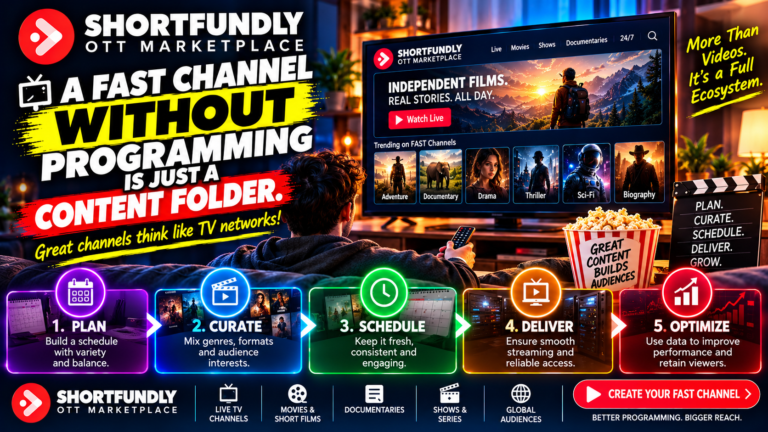
Build a Recognizable Programming Identity
Consistency helps audiences understand why a channel is worth watching.
Recurring programming blocks, clear descriptions, and reliable schedules can make the channel easier to recognize.
However, consistency shouldn’t mean repeating the same content indefinitely. The programming team needs to maintain variety while preserving the channel’s central purpose.
Use Content Promotion Effectively
Promotional activity may include trailers, social media clips, filmmaker interviews, newsletters, program announcements, and partnerships with relevant communities.
All promotional materials should be used with the necessary permissions.
The channel can also provide accurate schedules and program descriptions through its website or other available channels.
These activities support discovery, but results should be evaluated using suitable measurements rather than assumed.
Learn From Audience Behavior
Audience data can help operators identify popular genres, effective time slots, and programming that encourages longer viewing sessions.
The team can use these findings to refine its schedule and promotional strategy.
Nevertheless, audience data shouldn’t be the only guide. A channel that wants to support emerging filmmakers may deliberately include less familiar work alongside established audience favorites.
Keep the Viewing Experience Simple
Viewers should be able to understand what the channel offers and start watching without unnecessary friction.
Clear branding, accurate metadata, reliable playback, and a useful program guide all contribute to the experience.
Audience growth is a shared result of content quality, discoverability, reliable technology, and consistent promotion.
10. How Film Distribution Partners Fit Into FAST
Film distribution connects content owners with potential platforms, channels, and audiences.
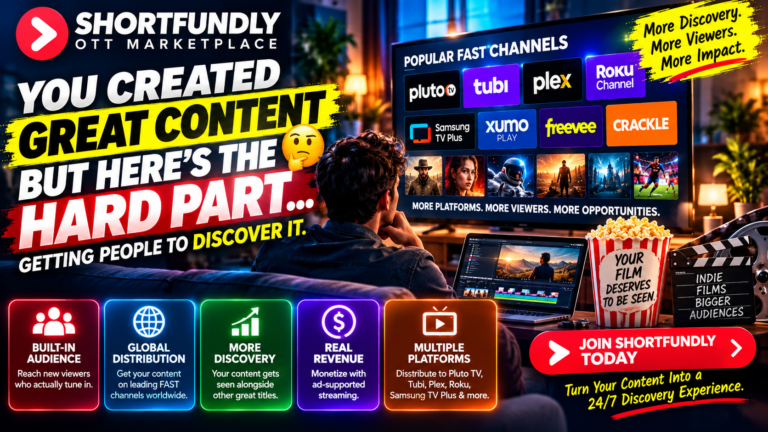
For independent filmmakers, distribution planning can be challenging because a finished film doesn’t automatically have access to every streaming service or FAST channel.
A distribution partner may help filmmakers explore opportunities, understand submission requirements, or navigate aspects of the distribution process, depending on the services it provides.
Exploring Shortfundly Distribution
Filmmakers can visit Shortfundly Distribution to explore the service and learn more about its current distribution offerings.
When considering any distribution partner, filmmakers should verify the services available, eligibility criteria, supported platforms, geographic coverage, fees, and contractual arrangements directly with the provider.
It’s also important to understand the rights being granted. An agreement may cover specific territories, platforms, languages, or periods. Some agreements are exclusive, while others may allow distribution through multiple channels.
Before proceeding, filmmakers should prepare the relevant materials, confirm that they control the necessary rights, and review payment and reporting terms.
Prepare Your Film for Distribution
Depending on the requirements of the service, useful materials may include:
- A high-quality film master.
- A trailer or teaser.
- A short and long synopsis.
- A poster and approved promotional images.
- Cast and crew information.
- Subtitle files, where applicable.
- Accurate runtime and language details.
- Rights documentation.
- Information about existing licenses.
A well-prepared submission can help reduce avoidable delays.
However, filmmakers should follow the actual requirements of the distribution service rather than assuming that every provider uses the same process.
Why Distribution and Technology Must Work Together
A film can be technically excellent but difficult to distribute if its rights are unclear or its metadata is incomplete.
Likewise, a distribution agreement may not deliver the intended result if the asset fails technical checks or the destination platform doesn’t support the required format.
A reliable workflow connects rights management, content preparation, metadata, and platform delivery.
For filmmakers, distribution is not simply about uploading a film. It’s about ensuring that the project is eligible, properly prepared, and suited to the intended distribution opportunity.
11. Common FAST Technology Challenges
A FAST channel combines many systems, so technical and operational problems can occur at different stages.
Inconsistent Metadata
Incomplete descriptions, incorrect runtimes, missing artwork, and mismatched identifiers can affect scheduling and discovery.
A central metadata workflow with validation checks can help reduce these problems.
Playback Interruptions
Incorrect encoding, missing assets, delivery issues, or configuration errors may interrupt playback.
Operators should test the full streaming workflow and establish monitoring and recovery procedures.
Advertising Integration Problems
Ad insertion may fail if the stream, player, advertising system, or platform configuration isn’t compatible.
Testing should cover normal playback, commercial breaks, fallback behavior, and reporting.
Unclear Content Rights
A channel may accidentally schedule content that it isn’t authorized to distribute.
Maintaining accurate rights records and checking permissions before scheduling are essential safeguards.
Rising Operating Costs
Technology, licensing, distribution, and marketing expenses can increase as a channel grows.
Operators should review the cost structure regularly and avoid expanding faster than their budget and operational capabilities allow.
Difficulty Measuring Results
Different vendors may use different definitions for viewing time, impressions, and other metrics.
A channel should document how important measurements are calculated and compare data only when the definitions are compatible.
The most effective approach is to combine reliable technology with clear workflows, regular testing, and accountable operational processes.
12. Building a FAST Channel Technology Stack: A Practical Roadmap
Launching a FAST channel is easier to manage when the work is divided into clear stages.
Step 1: Define the Channel’s Purpose
Decide what the channel will offer, who it is intended for, and how its programming will differ from other services.
This decision guides content acquisition, branding, scheduling, and distribution.
Step 2: Confirm Content Rights
Identify which films and programs are available for the intended distribution model.
Record licensing terms, permitted territories, expiration dates, and any restrictions.
Step 3: Prepare the Content Library
Collect the approved master files, verify technical quality, prepare subtitles where required, and organize assets using consistent identifiers.
Step 4: Build the Metadata Workflow
Create accurate records for each title and validate the fields required by the scheduling and distribution systems.
Step 5: Configure Scheduling and Playout
Create the initial programming schedule, confirm runtimes, plan commercial breaks where applicable, and test transitions between programs.
Step 6: Establish Streaming Delivery
Select an appropriate encoding, packaging, and delivery workflow based on platform requirements and audience needs.
Step 7: Integrate Advertising
Determine how advertisements will be selected, inserted, and measured. Confirm the relevant technical and commercial requirements.
Step 8: Prepare Distribution Integrations
Review platform eligibility, metadata requirements, playback specifications, and testing procedures.
Step 9: Test the Complete Channel
Run end-to-end tests covering content playback, scheduling, advertisements, metadata, and monitoring.
Step 10: Launch, Measure, and Improve
Monitor audience behavior, advertising delivery, technical reliability, and operating costs. Use the results to improve programming and system performance.
FAST Channel Technology Checklist
| Component | Essential Question |
|---|---|
| Content management | Can we identify and manage every asset? |
| Rights management | Are the necessary permissions documented? |
| Metadata | Is the program information accurate and complete? |
| Scheduling | Can the system maintain the intended lineup? |
| Playout | Can it move reliably between programs and breaks? |
| Video processing | Are assets compatible with delivery requirements? |
| Streaming delivery | Can viewers access the channel reliably? |
| Advertising | Can advertisements be inserted and measured correctly? |
| Distribution | Does each destination support the channel’s configuration? |
| Analytics | Can we measure audience, advertising, and technical performance? |
| Operations | Are monitoring and recovery responsibilities clear? |
| Budget | Can the business support its expected costs? |
A successful implementation doesn’t require every possible feature on day one. The technology stack should match the channel’s actual needs, with room to expand as audience demand and operational requirements develop.
Frequently Asked Questions (FAQs)
1. What Is FAST Channel Technology?
FAST channel technology is the collection of systems used to manage, schedule, stream, monetize, and distribute free ad-supported television channels. It may include content management, metadata, playout, streaming delivery, advertising insertion, platform integrations, and analytics.
2. What Technology Is Needed to Launch a FAST Channel?
A typical setup may require a content management system, scheduling and playout software, video processing, streaming infrastructure, advertising technology, platform distribution integrations, and analytics. The exact requirements depend on the channel’s size, delivery model, and intended platforms.
3. How Does a FAST Channel Stream Videos 24/7?
A scheduling system organizes programs into a continuous playlist, and a playout system executes that schedule. Streaming infrastructure then delivers the video to compatible players. Monitoring and fallback procedures help the operator respond to technical problems.
4. What Is Server-Side Ad Insertion in FAST TV?
Server-side ad insertion, or SSAI, integrates advertising into the streaming delivery process on the server side. It can support a more continuous viewing experience, although successful implementation also depends on compatible advertising, measurement, and distribution systems.
5. Why Is Metadata Important for FAST Channels?
Metadata provides essential information about each title, including its name, description, genre, runtime, language, and artwork. Accurate metadata supports scheduling, program guides, platform listings, and content discovery.
6. What Is the Difference Between FAST and OTT?
OTT, or over-the-top delivery, broadly refers to distributing video over the internet rather than through traditional managed television delivery. FAST is a particular streaming model that provides free, scheduled programming supported by advertising. FAST services are therefore one type of internet-delivered video service.
7. How Do FAST Channels Generate Revenue?
FAST channels commonly generate revenue through advertising. Depending on the business model, additional opportunities may include sponsorships or other commercial arrangements. Actual profitability depends on viewing time, eligible ad impressions, advertising rates, operating costs, and revenue-sharing agreements.
8. Can Independent Films Be Distributed Through FAST Channels?
Potentially, yes. Independent films may be suitable for FAST channels if the rights holder can grant the required permissions and the content meets the channel’s technical and editorial requirements. Availability depends on the platform and the specific licensing agreement.
9. How Can Shortfundly Distribution Help Filmmakers?
Filmmakers can explore Shortfundly Distribution to learn more about its current distribution services. They should confirm supported platforms, eligibility requirements, territories, fees, and contract terms directly with the provider before proceeding.
10. How Much Does It Cost to Build a FAST Channel?
There isn’t one universal price. Costs depend on the technology stack, content licensing, distribution arrangements, advertising requirements, staffing, and operating scale. A channel using managed services may have a different cost structure from one building and maintaining much of its own infrastructure.
11. What Is the Most Important Part of a FAST Technology Stack?
There isn’t a single component that guarantees success. Reliable content rights, accurate metadata, scheduling, video delivery, advertising integration, and analytics all serve important roles. The appropriate priorities depend on the channel’s goals and operating model.
Also read: https://blog.shortfundly.com/ott/fast-channels-free-streaming/
Conclusion: Build a FAST Channel That Can Grow
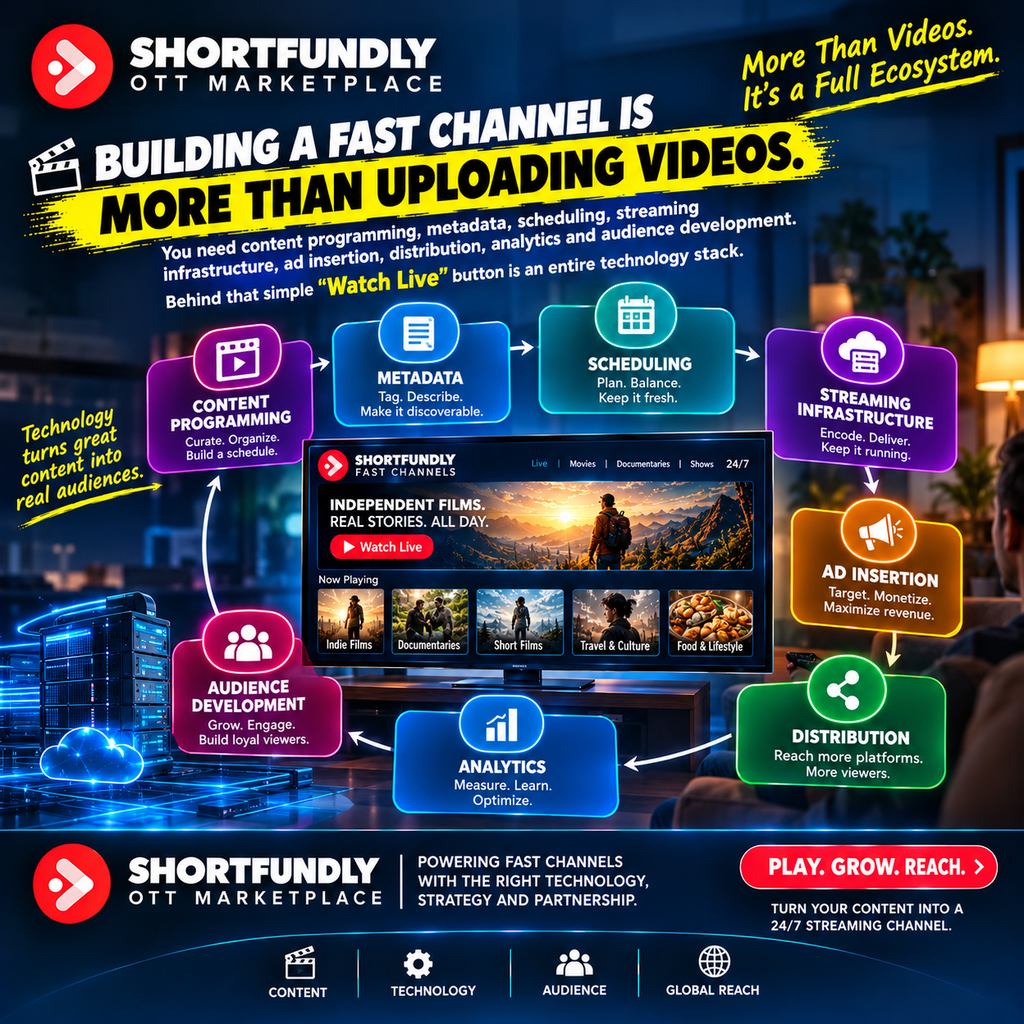
FAST channel technology brings together content management, metadata, scheduling, video delivery, advertising, distribution, and analytics to create a continuous streaming experience.
The “Watch Live” button may look simple, but the systems behind it must work together reliably. Content needs to be authorized and prepared, schedules must run correctly, streams must reach viewers, advertisements must be delivered as agreed, and analytics must provide useful information.
For independent film channels, the technology stack also needs to support effective content discovery and distribution. Accurate metadata, careful programming, and reliable delivery can help create a better experience for audiences while supporting the channel’s business objectives.
Filmmakers exploring distribution opportunities can visit Shortfundly Distribution to review its current offerings and determine whether they align with their projects.
Ultimately, a successful FAST channel isn’t built by technology alone. It combines compelling content, dependable infrastructure, clear rights, effective distribution, and a thoughtful audience strategy. When those elements work together, a channel has a stronger foundation for delivering value to viewers, advertisers, and content owners.