Table of Contents
Introduction
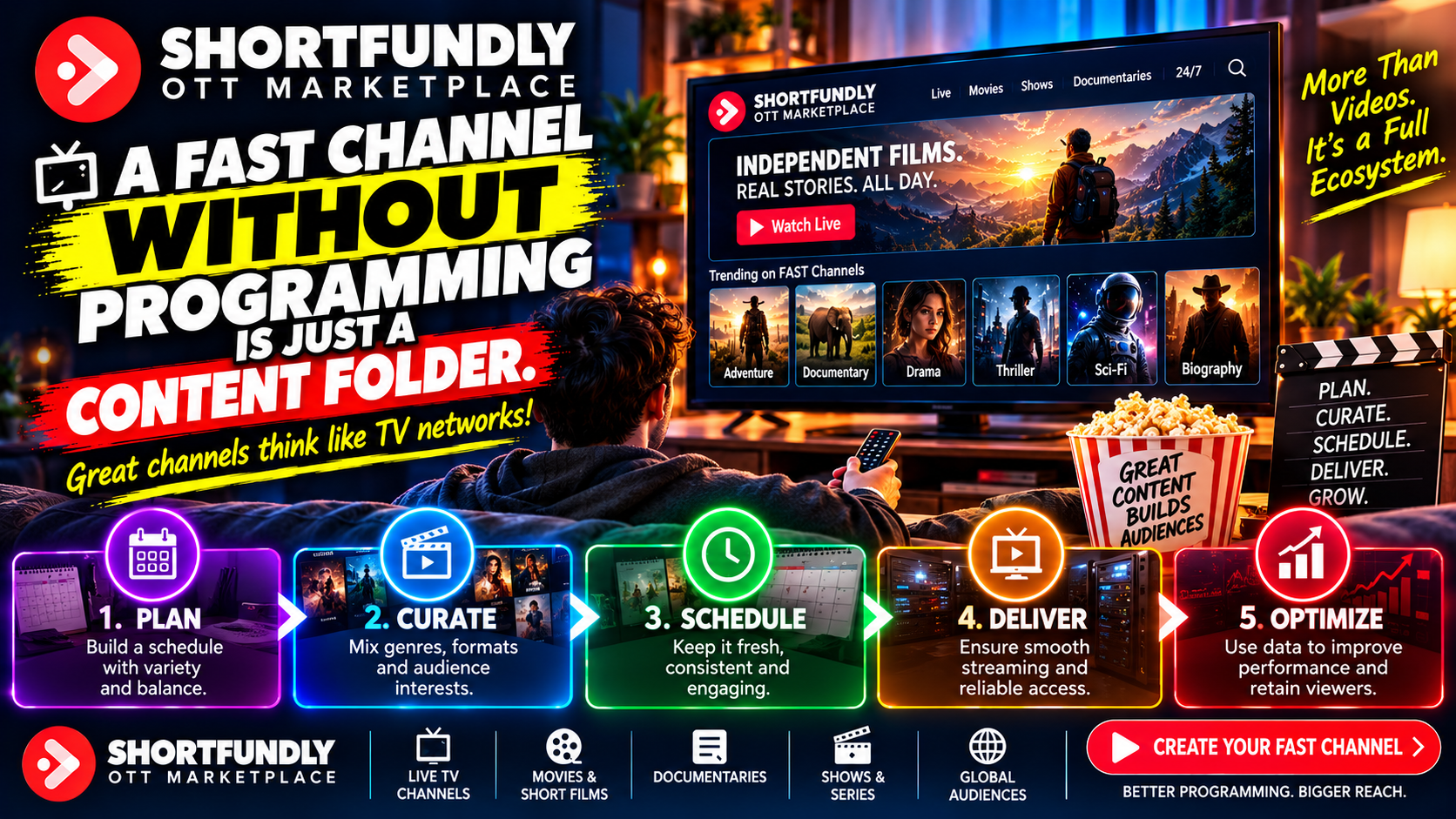
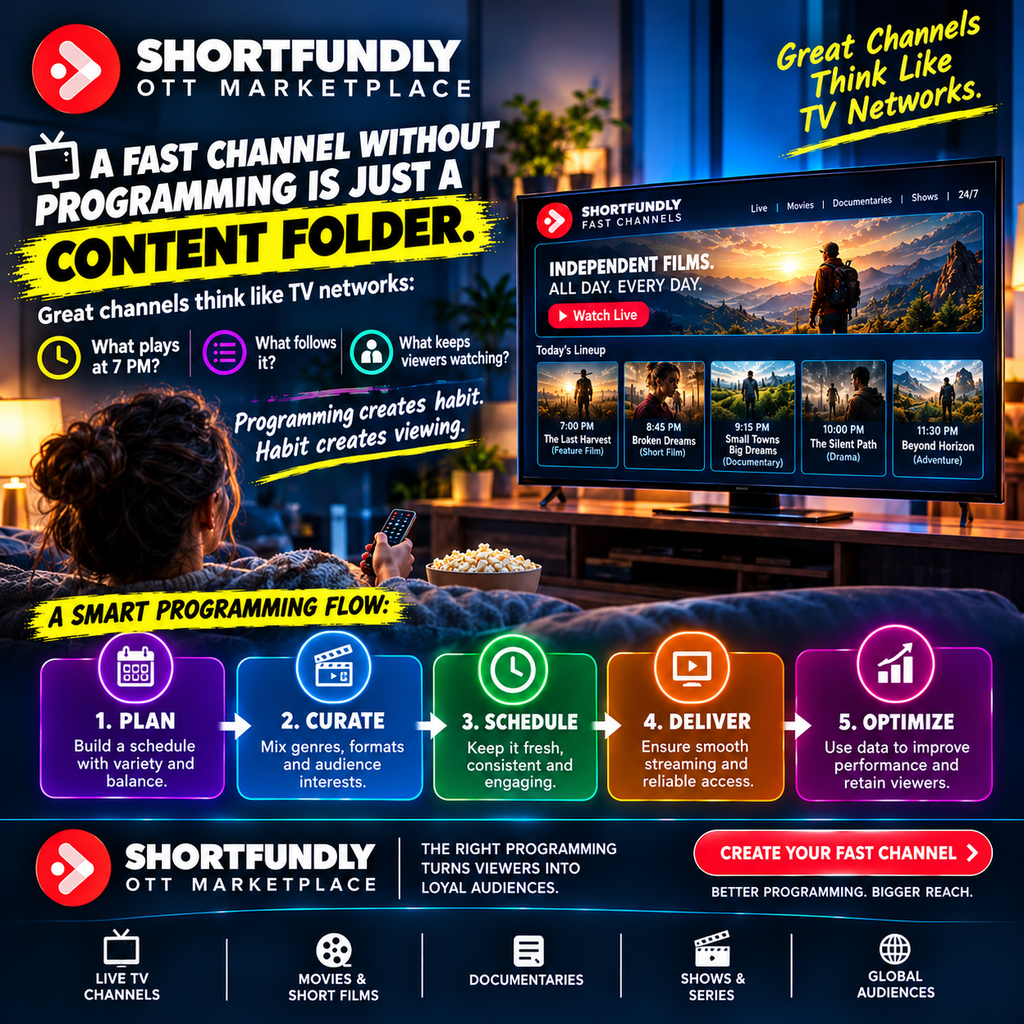
A FAST channel without programming is just a content folder. 📺 Great channels think like traditional television networks: What plays at 7 PM? What follows it? Which program keeps viewers watching? And what gives them a reason to return tomorrow?
Programming is the foundation of a successful FAST channel. It transforms a collection of films, television episodes, documentaries, and other video content into a continuous viewing experience. Instead of asking viewers to search through a library and choose what to watch, a well-programmed channel offers a curated lineup that makes discovering content simple and enjoyable.
Free Ad-Supported Streaming Television (FAST) combines the familiar experience of scheduled television with the accessibility of internet-based streaming. Viewers can tune in for free, while advertising provides a potential revenue stream for channel operators and content owners.
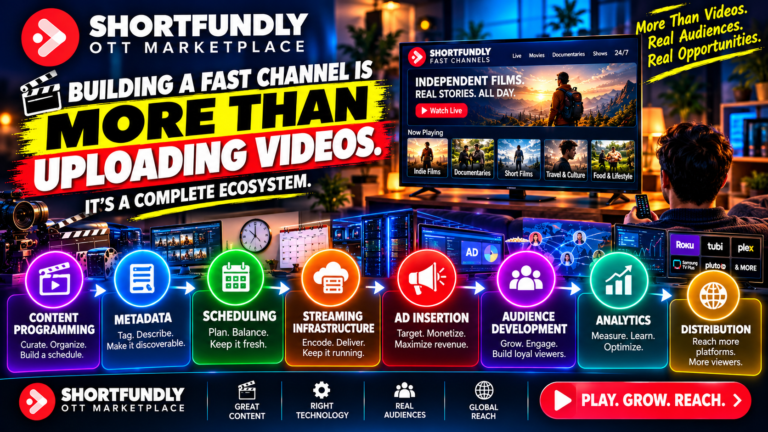
However, launching a FAST channel involves more than uploading videos. Content needs a clear identity, programs need to appear at the right times, transitions should feel natural, and the overall schedule should give viewers a reason to stay.
In this guide, we explore nine powerful FAST channel programming strategies, explain how scheduling can build viewing habits, and examine how content owners can approach distribution with resources such as Shortfundly Distribution.
What Is FAST Channel Programming?
FAST channel programming is the process of selecting, organizing, scheduling, and presenting content in a continuous linear streaming format.
Unlike an on-demand library, where viewers choose individual titles whenever they want, a FAST channel follows a planned schedule. Viewers can join at any time and watch whatever is currently playing.
A FAST channel might feature independent films, classic cinema, documentaries, animation, regional-language entertainment, television series, lifestyle programs, or a combination of related formats.
Programming determines how these titles work together.
For example, a channel dedicated to independent cinema could schedule short films during an early-evening discovery block, feature a full-length independent film during prime time, and present filmmaker interviews or behind-the-scenes content later in the evening.
The objective is to create a recognizable viewing experience rather than simply rotate videos at random.
Effective programming considers:
- Audience identity: Who is the channel designed for?
- Content selection: Which titles fit the channel’s theme?
- Scheduling: When should each program appear?
- Content sequencing: What should play before and after each title?
- Viewer retention: What encourages viewers to keep watching?
- Advertising opportunities: Where can suitable ad breaks be incorporated?
- Performance analysis: Which programs and time slots attract viewers?
When these elements work together, a content library can become a more coherent and engaging streaming channel.
1. Define a Clear FAST Channel Identity
Before creating a programming schedule, define what the channel represents.
A channel that attempts to serve every possible audience may struggle to establish a recognizable identity. A focused channel gives viewers a clearer reason to tune in.
For example, a channel could specialize in:
- Independent and emerging cinema
- Horror and thriller films
- Classic movies
- Regional-language entertainment
- Documentary storytelling
- Family-friendly programming
- Short films and experimental cinema
- Music and cultural content
Each focus creates different programming possibilities.
An independent-film channel, for instance, could build its identity around original storytelling, emerging filmmakers, festival selections, and overlooked cinematic works. A classic-movie channel might focus on nostalgia, genre collections, and films from particular eras.
The channel identity should influence every programming decision, including the titles selected, the order in which they appear, the promotional messages used, and the audience the channel aims to reach.
How to Create a Strong Channel Positioning Statement
A useful positioning statement answers three questions:
- What type of content does the channel offer?
- Who is most likely to enjoy it?
- Why should viewers choose this channel over other options?
For example:
“A free streaming destination for independent films, emerging filmmakers, and distinctive stories from around the world.”
This statement establishes a clear direction for content acquisition and scheduling.
SEO tip: Use relevant terms such as FAST channel programming, FAST TV, free ad-supported streaming, and film distribution naturally in channel descriptions and supporting website content.
2. Build a Content Library That Supports Continuous Viewing
A programming schedule is only as strong as the content available to fill it.
Before launching a FAST channel, evaluate the size, variety, quality, and suitability of the available library. A channel needs enough content to maintain its planned schedule while allowing programs to repeat at appropriate intervals.
A small collection of excellent films may be suitable for a limited programming block, but it may not support a diverse, round-the-clock schedule without frequent repetition.
Content planning should therefore begin with an inventory.
Organize Content Into Useful Categories
Group titles according to characteristics that can support programming decisions.
| Content category | Example programming use |
|---|---|
| Feature films | Prime-time movie blocks |
| Short films | Short-form discovery sessions |
| Documentaries | Educational or factual programming |
| Television episodes | Recurring series blocks |
| Genre collections | Horror, comedy, drama, or thriller nights |
| Regional-language films | Language-focused programming |
| Interviews and bonus content | Supporting segments around selected titles |
These categories make it easier to identify gaps and create a balanced schedule.
For example, if the channel has many feature films but very few short-form titles, the operator may need additional content to support a planned short-film block.
Check Content Rights Before Scheduling
Having a video file does not automatically mean that the channel has permission to stream it.
Content owners and operators should verify the applicable rights, territories, permitted platforms, license periods, language restrictions, advertising permissions, and any other contractual requirements before including a title in the schedule.
A rights-management system can help prevent expired or unauthorized content from being scheduled.
The result is a content library that supports both creative programming and operational reliability.
3. Design a Schedule Around Viewer Habits
One of the most important FAST channel programming principles is to make the schedule understandable and predictable.
Traditional television networks have long used scheduled blocks to give audiences a reason to tune in at particular times. FAST channels can apply the same principle while using streaming analytics to refine their schedules.
The goal is not to assume that every viewer follows a strict daily routine. Instead, it is to establish useful patterns that make the channel easier to understand.
For example, an independent-film channel could create a schedule like this:
| Time slot | Programming block | Purpose |
|---|---|---|
| 6 AM–9 AM | Short films and lighter entertainment | Accessible morning viewing |
| 9 AM–12 PM | Documentaries and factual stories | Daytime discovery |
| 12 PM–3 PM | Drama and independent cinema | Midday entertainment |
| 3 PM–6 PM | Short films and filmmaker features | Content discovery |
| 6 PM–9 PM | Featured independent films | Evening appointment viewing |
| 9 PM–12 AM | Thrillers and genre cinema | Late-evening entertainment |
| 12 AM–6 AM | Selected films and repeat programming | Overnight continuity |
This is an illustrative schedule, not a universal formula. Actual programming should reflect the channel’s content rights, audience data, territories, and available inventory.
Why Consistency Matters
When viewers understand what a channel offers at different times, they can make faster viewing decisions.
A recurring Friday-night thriller block, for example, gives fans a clear reason to return. A daily short-film showcase can introduce viewers to new creators. A weekly documentary feature can establish a recognizable editorial identity.
Consistency also makes promotion easier. A channel can communicate its programming through schedules, platform descriptions, social media posts, newsletters, and trailers.
Programming creates expectations. Meeting those expectations can encourage repeat viewing.
4. Create Programming Blocks Instead of Random Playlists
A playlist simply places titles in an order. A programming block gives that sequence a purpose.
This distinction is important because a FAST channel competes for viewer attention. A coherent block can help viewers understand what they are watching and why the next program belongs there.
Consider a channel that schedules an independent drama followed by a filmmaker interview and then another film exploring a related theme.
The sequence can feel more deliberate than a collection of unrelated titles.
Examples of FAST Channel Programming Blocks
Indie Film Spotlight
A recurring block featuring selected independent films, emerging directors, or distinctive storytelling.
Short Film Express
A sequence of short films that offers viewers multiple stories within a limited period.
Documentary Discovery
A collection of factual programs organized around subjects such as culture, history, nature, or society.
Genre Nights
A scheduled evening dedicated to horror, comedy, romance, science fiction, or another recognizable category.
Behind the Story
A block that combines selected films with available interviews, production features, or filmmaker discussions.
Weekend Movie Marathon
A themed sequence of films designed to provide continuous viewing around a particular genre, director, topic, or era.
These blocks can help create a recognizable channel personality without requiring every program to be a new release.
Connect Programs Through Themes
Programming does not always need to connect titles through genre alone.
Films can be grouped by themes, visual styles, cultural backgrounds, historical periods, or storytelling approaches. A channel might feature stories about friendship in one block and independent films from a particular region in another.
The important point is to make the connection meaningful to the intended audience.
5. Use Smart Content Sequencing to Keep Viewers Watching
The order of programs can influence whether viewers continue watching or leave the channel.
Content sequencing means deciding what plays before, during, and after a particular title. It involves balancing familiarity, discovery, duration, mood, and audience expectations.
For example, a channel might place a recognizable title before a less familiar independent film. Viewers who stay for the first movie may discover the second title while already watching.
This does not guarantee that they will remain on the channel, but it creates an opportunity for discovery.
Apply the Lead-In and Lead-Out Approach
A lead-in is the program or segment shown before a featured title. A lead-out follows it.
A useful sequence might look like this:
- A short promotional segment introduces the evening’s theme.
- A selected film attracts viewers interested in that theme.
- A related interview or brief feature adds context, if available.
- Another film continues the programming theme.
This structure gives the schedule a sense of continuity.
Balance Familiarity With Discovery
A schedule made entirely of unfamiliar content may make it harder for new viewers to decide whether to stay. A schedule made entirely of repetitive titles may offer too little discovery.
A thoughtful mix can include recognizable genres, carefully selected films, new discoveries, and recurring themed blocks.
For independent-film channels, this approach can create opportunities for emerging filmmakers without abandoning the channel’s broader audience promise.
Avoid Abrupt Programming Changes
A channel should consider how one program transitions into the next. Moving directly from a family-friendly film into graphic horror, for example, may conflict with viewer expectations and the channel’s intended positioning.
Content sequencing should take account of genre, audience suitability, content ratings, tone, and the promises made in the channel’s description.
6. Plan Prime-Time Programming Strategically
Prime time is often treated as a valuable scheduling window because viewers may have more opportunities to watch entertainment during the evening. However, the most valuable time slot for a particular FAST channel depends on its audience, geography, and actual viewing data.
A channel should not automatically assume that a schedule designed for one market will work equally well in another.
Identify the Right Time Zone
If a channel serves viewers across several countries, scheduling decisions become more complicated.
A 7 PM premiere in one territory may fall outside the evening viewing period in another. Operators should understand the intended market and decide whether to use a primary time zone, create market-specific schedules, or rely on other scheduling approaches supported by their streaming technology.
Time-zone planning is particularly relevant to channels targeting regional-language audiences or international film fans.
Give Prime Time a Clear Identity
Rather than scheduling unrelated content every evening, operators can establish recognizable programming patterns.
Examples include:
- Monday: Independent drama
- Tuesday: Documentary stories
- Wednesday: Short-film showcase
- Thursday: International cinema
- Friday: Thriller night
- Saturday: Featured movie marathon
- Sunday: Audience favorites
This is an example of a weekly schedule, not a recommendation that every channel use these exact categories.
A recurring schedule makes promotion easier and helps viewers understand what to expect.
Measure Before Making Major Changes
Prime-time decisions should be supported by performance data where available.
Relevant measures include concurrent viewers, average viewing duration, audience retention, channel tune-in patterns, and performance by title or time slot. Advertising metrics may also be useful where they are available and accurately defined.
Operators can compare similar programming blocks across different periods to understand which scheduling decisions are associated with better results.
7. Integrate Advertising Without Disrupting the Experience
Advertising is central to the FAST business model. FAST channels allow viewers to watch content without a subscription fee, while advertising can generate revenue for operators and rights holders under their commercial arrangements.
However, advertising should be planned alongside programming rather than added as an afterthought.
Build Ad Breaks Into the Schedule
Operators should identify suitable ad-break opportunities and ensure that the streaming system can handle them.
Depending on the platform and technology, ad insertion may be managed through server-side ad insertion, client-side ad insertion, or another supported workflow.
Ad breaks should be implemented according to the content’s rights, platform requirements, advertising agreements, and technical capabilities.
Consider the Viewing Experience
Poorly timed or excessive interruptions can frustrate viewers.
Programming teams should coordinate with technical teams to ensure that ad breaks occur at appropriate points and that the channel returns to the program correctly.
For feature films, this may involve planning breaks around suitable transitions where the content and delivery system support them. For episodic or short-form content, the approach may differ.
Track Advertising Performance
Where reporting is available, operators can monitor:
- Ad opportunities
- Ad impressions
- Ad completion rates
- Fill rates
- Advertising revenue
- Viewer drop-off around ad breaks
These measurements should be interpreted carefully. An increase in impressions does not automatically mean that the viewing experience or overall channel performance has improved.
The best strategy balances monetization with viewer satisfaction and long-term channel development.
8. Use Metadata to Make Programming Accurate and Discoverable
Metadata is the information associated with each title. It helps platforms identify, describe, categorize, and display content correctly.
Although metadata may appear administrative, it directly supports programming operations.
Imagine scheduling a film without knowing its runtime, language, genre, rating, or available artwork. The programming team may struggle to place it in the right block or provide accurate information to the streaming platform.
Essential Metadata for FAST Channels
Depending on the platform’s requirements, useful metadata may include:
- Title and alternate title
- Synopsis
- Genre and subgenre
- Runtime
- Original language
- Available audio languages
- Subtitle information
- Release year
- Cast and crew
- Content rating
- Poster and landscape artwork
- Territory and rights information
- License start and end dates
- Asset identifiers
- Technical file specifications
Metadata requirements vary by platform, so content owners should confirm the exact fields and formats needed for delivery.
Improve Metadata Consistency
A channel with hundreds or thousands of titles needs a consistent catalog structure.
For example, the same genre should not appear under several slightly different labels unless the platform’s taxonomy requires it. Runtime values should use a consistent format, and titles should match the approved content records.
A metadata checklist and a centralized catalog can reduce avoidable errors.
Why Metadata Matters for Programming
Accurate metadata makes it easier to filter content, plan themed blocks, avoid scheduling conflicts, and provide correct information to viewers.
It can also support content discovery when distribution platforms use metadata to organize and recommend titles.
For a FAST channel, metadata is not simply paperwork. It is part of the infrastructure that helps programming work as intended.
9. Use Analytics to Improve the Schedule Over Time
A programming schedule should not remain unchanged simply because it worked at launch.
Viewer preferences can vary by time, genre, territory, platform, and season. Analytics can help operators understand what is working and where adjustments may be useful.
Key FAST Channel Programming Metrics
Average Viewing Duration
How long viewers watch, measured according to the platform’s reporting methodology.
Audience Retention
How the audience changes during a program or viewing session.
Concurrent Viewers
The number of viewers watching at the same time.
Tune-In Patterns
When viewers start watching the channel and how those patterns change.
Program-Level Performance
How individual titles or programming blocks perform against relevant measures.
Ad Performance
Available advertising measures, such as impressions and completion rates.
No single metric explains the full viewer experience. A program with a smaller audience may still be important because it strengthens the channel’s identity or attracts a valuable niche audience.
Test Different Programming Approaches
Operators can compare alternative approaches, such as:
- Moving a genre block to another time slot
- Changing the order of two related programs
- Introducing a recurring weekly feature
- Reducing repetition within a defined viewing window
- Pairing a familiar title with a new discovery
- Adjusting the length of a programming block
Where possible, compare similar periods and account for changes in promotion, distribution, available content, and audience size.
Turn Insights Into Programming Decisions
Analytics is useful only when it informs action.
If a particular block consistently attracts viewers, the team might explore additional titles in the same category. If viewers frequently leave during a particular sequence, the team could investigate whether the programming order, content suitability, technical delivery, or advertising experience contributes to the pattern.
Avoid drawing strong conclusions from a single data point. Use repeat observations and platform reports where available.
FAST Channel Programming Workflow: From Content Library to Live Schedule
Building a structured workflow helps ensure that content moves from acquisition to broadcast without unnecessary confusion.
| Stage | Main activity | Key outcome |
|---|---|---|
| 1. Content acquisition | Source titles and confirm permissions | Approved content inventory |
| 2. Rights verification | Review territories, terms, and license periods | Rights-cleared programming pool |
| 3. Content organization | Group titles by genre, format, language, or theme | Structured catalog |
| 4. Metadata preparation | Complete required title information | Consistent metadata |
| 5. Schedule design | Plan daily and weekly programming blocks | Broadcast schedule |
| 6. Asset preparation | Validate files and technical requirements | Delivery-ready media |
| 7. Playout configuration | Configure the supported scheduling and playback system | Continuous channel output |
| 8. Distribution setup | Prepare delivery for supported platforms | Distribution-ready channel |
| 9. Quality assurance | Check playback, transitions, audio, video, and ads | Tested channel experience |
| 10. Performance review | Analyze viewing and operational reports | Informed schedule improvements |
The precise workflow will depend on the channel’s business model, technology provider, content library, and distribution arrangements.
Why Quality Assurance Matters
Before a schedule goes live, teams should check that:
- Every scheduled title has an approved asset.
- Runtime information is accurate.
- Content rights cover the intended use.
- Metadata is complete.
- Videos play correctly.
- Audio and subtitles work as expected.
- Program transitions are correct.
- Ad breaks behave as configured.
- The schedule follows the intended time zone.
- Backup procedures exist for playback or delivery failures.
A channel can have excellent programming ideas and still disappoint viewers if the technical execution is unreliable.
Common FAST Channel Programming Mistakes to Avoid
Even well-funded streaming projects can struggle when programming decisions are made without a clear plan.
1. Treating the Channel Like a Video Folder
Uploading a large number of videos does not automatically create a compelling channel. Titles need to be organized into a coherent schedule that reflects the channel’s identity.
2. Repeating the Same Titles Too Frequently
Repetition is a normal part of linear television, but the schedule should account for how often viewers encounter the same program.
A rotation plan can help balance the use of available content with the need for variety.
3. Ignoring the Target Audience
A channel built around independent cinema should not schedule content randomly without considering its audience and editorial promise.
Programming should consistently reflect the reason viewers would choose the channel.
4. Overlooking Rights and License Periods
A title should not remain in the schedule after its permitted use ends. Rights information should be integrated into content management and scheduling workflows.
5. Neglecting Metadata
Incomplete descriptions, incorrect runtimes, missing artwork, or inconsistent categories can create operational problems and weaken content presentation.
6. Ignoring Viewer Analytics
A schedule that never changes may miss opportunities to improve viewing. Performance reports can help the team identify useful adjustments.
7. Prioritizing Ads Over the Viewing Experience
Advertising supports the FAST model, but ad implementation should account for technical reliability, viewer experience, and the terms of relevant commercial agreements.
8. Launching Without a Content Plan
Before launch, operators should understand how much content is available, how often titles will repeat, and how future content will be acquired.
A sustainable programming strategy considers both the initial launch and the channel’s ongoing content needs.
How Shortfundly Distribution Fits Into the FAST Channel Journey
A strong programming strategy depends on having suitable content available for distribution. For filmmakers and content owners, reaching potential audiences can involve understanding distribution opportunities, preparing assets, and identifying suitable platforms or partners.
Shortfundly Distribution is a relevant resource for filmmakers and content owners exploring film distribution opportunities.
When considering any distribution partner or service, content owners should review its current offerings and determine whether they align with their goals.
For a FAST channel project, useful questions include:
- What types of films or content are eligible?
- Which territories and platforms are covered?
- What distribution rights are required?
- How are licensing terms and revenue arrangements defined?
- What technical assets and metadata must be supplied?
- How are content performance and reporting handled?
- What are the contract duration and termination terms?
These questions help filmmakers and channel operators assess whether a distribution arrangement suits their particular needs.
Why Distribution and Programming Should Work Together
Distribution and programming are related, but they serve different purposes.
Distribution concerns how content is licensed, delivered, and made available through appropriate channels or platforms.
Programming concerns how that content is selected, organized, scheduled, and presented to viewers.
A title may be suitable for distribution but not fit a particular channel’s schedule. Conversely, a channel may want a specific type of film but need to secure the appropriate rights before scheduling it.
Coordinating these activities helps content owners and operators make better use of their libraries while respecting licensing requirements.
For independent filmmakers, the combination of suitable distribution opportunities and thoughtful channel programming can create more ways for audiences to discover their work. Actual availability and commercial outcomes depend on the relevant rights, agreements, platforms, and audience response.
The Future of FAST Channel Programming
FAST channels are part of the evolving streaming landscape, where viewers can access free, advertising-supported content through internet-connected devices and participating platforms.
As the sector develops, programming teams can explore better scheduling tools, more detailed analytics, improved metadata workflows, and content strategies tailored to specific audiences.
More Personalized Programming Decisions
Even though a FAST channel follows a linear schedule, operators can use audience insights to refine content choices, scheduling blocks, and promotional activities.
Some platforms may also support localized or audience-specific channel experiences, depending on their technology and distribution arrangements.
Greater Focus on Niche Audiences
Channels built around particular genres, languages, communities, or interests can offer a focused alternative to broad entertainment catalogs.
Independent cinema is one example. A well-defined channel can bring related films together and give viewers an easier way to discover stories that match their interests.
Better Coordination Between Content and Technology
Programming teams need accurate content information, reliable playback, appropriate ad integration, and consistent delivery.
As channel operations become more sophisticated, collaboration between editorial, rights, technical, advertising, and distribution teams remains essential.
The strongest strategy is not simply to add more technology. It is to use the right tools to deliver a clear, dependable, and engaging viewing experience.
Frequently Asked Questions About FAST Channel Programming
1. What is FAST channel programming?
FAST channel programming is the process of selecting, organizing, and scheduling content for a continuous free ad-supported streaming channel. It determines what viewers watch, when programs appear, and how titles are arranged into a coherent viewing experience.
2. Why is programming important for a FAST channel?
Programming gives a channel structure and identity. A thoughtful schedule can make content easier to discover, create recognizable viewing patterns, and encourage viewers to return. It also helps operators coordinate advertising, rights management, and content delivery.
3. How is FAST programming different from video-on-demand?
A FAST channel presents content according to a scheduled linear stream. Video-on-demand allows viewers to select individual titles and watch them at a time of their choosing. FAST offers a more traditional channel experience, while on-demand emphasizes individual choice.
4. How do you create a FAST channel schedule?
Start by defining the target audience and channel identity. Organize the available content, verify rights, prepare metadata, create daily and weekly programming blocks, configure the supported scheduling system, and test the complete stream before launch.
5. What types of content work for FAST channels?
Depending on the channel’s positioning and rights, suitable content may include feature films, short films, television episodes, documentaries, animation, classic cinema, regional-language entertainment, and lifestyle programming. The best selection depends on audience needs and the channel’s identity.
6. How often should content repeat on a FAST channel?
There is no universal repetition frequency. It depends on the size of the content library, program duration, audience behavior, scheduling strategy, and rights restrictions. Operators should plan rotation carefully and use performance data to refine it.
7. What is a programming block?
A programming block is a group of related programs scheduled together around a theme, genre, format, or audience interest. Examples include a documentary block, short-film showcase, thriller night, or weekend movie marathon.
8. How does metadata help FAST channel programming?
Metadata provides information such as title, synopsis, genre, runtime, language, artwork, and rights details. Accurate metadata helps programming teams organize content, prepare schedules, manage assets, and deliver correct information to supported platforms.
9. How can analytics improve FAST channel programming?
Analytics can help operators understand viewing duration, audience retention, tune-in patterns, concurrent viewers, and program-level performance. These insights can inform decisions about time slots, content selection, programming blocks, and scheduling changes.
10. How do FAST channels generate revenue?
FAST channels commonly use advertising-supported business models. Depending on the commercial arrangement, revenue may come from advertisements delivered during programming. Actual revenue depends on factors such as audience size, advertising demand, fill rates, platform terms, and revenue-sharing agreements.
11. What should filmmakers consider before distributing content to a FAST channel?
Filmmakers should review content rights, permitted territories, platform coverage, licensing duration, advertising permissions, revenue terms, technical specifications, metadata requirements, and reporting arrangements. They should confirm that any distribution agreement matches their goals and grants only the rights intended.
12. Can Shortfundly Distribution help filmmakers explore distribution opportunities?
Filmmakers can visit Shortfundly Distribution to explore its current distribution offerings. They should verify eligibility, supported platforms, territories, contractual terms, and available services directly before making a decision.
13. What is the biggest mistake in FAST channel programming?
One common mistake is treating the channel as a collection of videos instead of a planned viewing experience. Without a clear identity, thoughtful sequencing, accurate metadata, and a consistent schedule, a channel may struggle to differentiate itself and encourage repeat viewing.
14. Can a small content library support a FAST channel?
A small library may support a limited channel or programming block, but continuous operation requires careful planning around runtimes, repeats, rights, and audience expectations. Operators should assess the library and content acquisition plan before committing to a full schedule.
Also read: https://blog.shortfundly.com/ott/fast-channels-free-streaming/
Conclusion: Programming Turns Content Into a Channel
A successful FAST channel is more than a collection of videos playing one after another. It is a planned viewing experience built around content selection, scheduling, sequencing, metadata, advertising, and reliable delivery.
The most effective FAST channel programming strategies begin with a clear audience and channel identity. They use meaningful programming blocks, schedule content thoughtfully, balance familiar titles with discovery, and use analytics to improve decisions over time.
For filmmakers and content owners, distribution is another important part of the journey. Resources such as Shortfundly Distribution can be explored when researching distribution opportunities, with current services and terms verified directly.
Ultimately, programming creates expectations, consistency encourages viewing habits, and a well-organized channel gives audiences a reason to return. Build the schedule with purpose, connect the content with care, and treat every time slot as an opportunity to deliver a better viewing experience.
A FAST channel without programming is just a content folder. A channel with a clear identity and a thoughtful schedule can become a destination viewers recognize and choose again.