Table of Contents
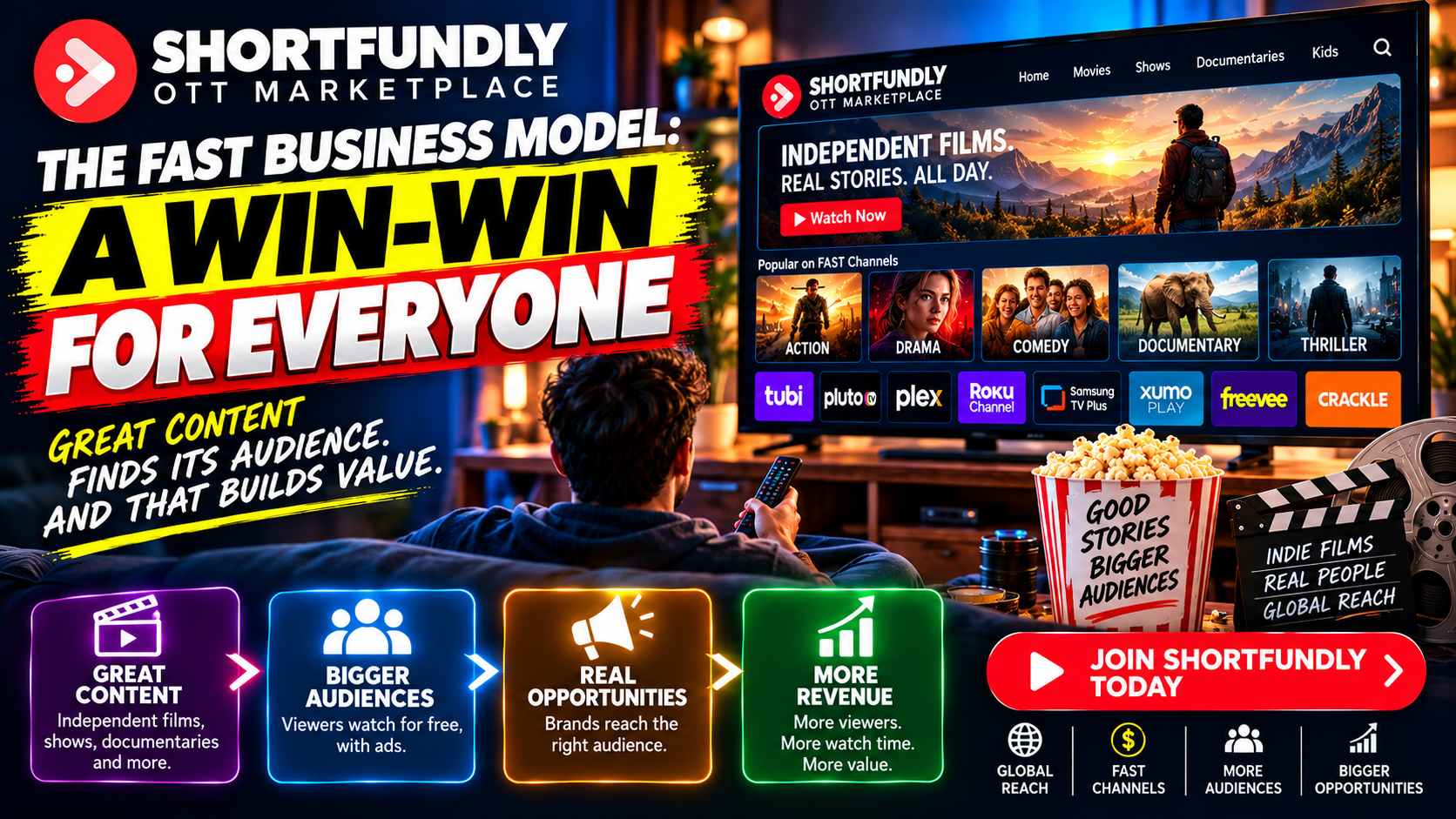
The FAST business model, which stands for Free Ad-Supported Streaming Television, is changing how audiences watch entertainment and how streaming businesses generate revenue. Instead of requiring viewers to pay a monthly subscription, FAST services provide free, scheduled television programming supported by advertising. Viewers gain access to entertainment without a traditional subscription fee, advertisers reach relevant audiences, and streaming platforms generate revenue by delivering advertising opportunities around the content.
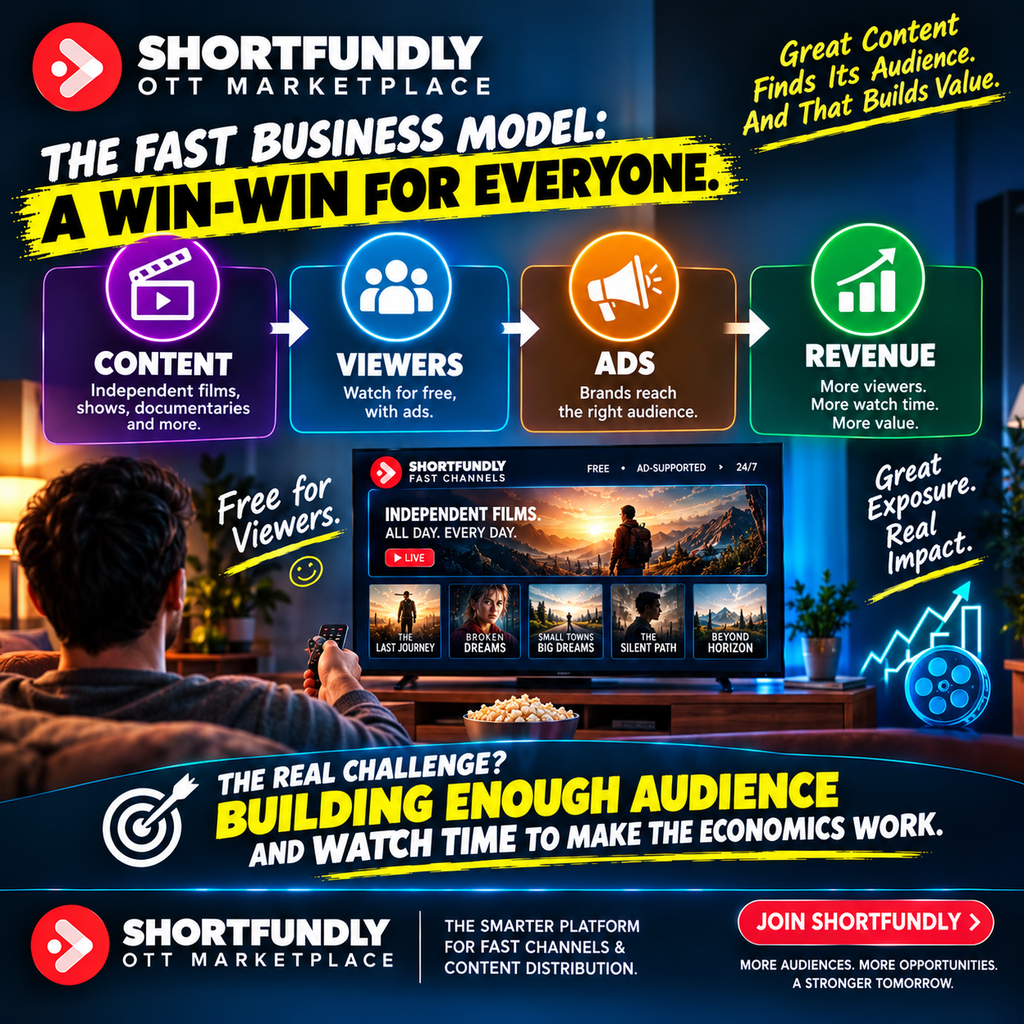
The business model follows a straightforward cycle: content attracts viewers, viewers create advertising opportunities, advertisements generate revenue, and revenue supports the streaming service. However, making this cycle profitable requires more than uploading films and inserting commercials. A successful FAST channel needs engaging programming, reliable distribution, effective audience development, appropriate advertising technology, and a sustainable content strategy.
For independent filmmakers and distributors, FAST television also introduces another way to explore content distribution. Films that might otherwise struggle to attract attention in crowded on-demand libraries may have opportunities to reach audiences through curated, continuously programmed channels. Companies such as Shortfundly Distribution provide a relevant starting point for filmmakers exploring distribution opportunities and considering how their content might reach new viewers.
What Is the FAST Business Model?
The FAST business model provides television-style programming through internet-connected devices without charging viewers a traditional subscription fee for the channel itself. Advertising generally funds the service, although the precise commercial arrangements vary by platform and distribution partner.
Unlike subscription video-on-demand services, which typically generate recurring revenue from subscribers, FAST channels rely heavily on advertising inventory and audience engagement. Their programming can include movies, television series, documentaries, news, lifestyle content, sports-related programming, and specialized entertainment channels.
FAST services combine elements of traditional television and digital streaming. Like conventional television, they offer scheduled programming that viewers can join without choosing every individual title. Like digital streaming platforms, they deliver content over the internet and may provide audience analytics that help advertising partners evaluate campaign performance.
This combination creates several potential advantages. Viewers can discover content without paying for an additional subscription, advertisers gain opportunities to reach streaming audiences, and platform operators can build channels around particular genres or interests.
However, the model depends on the ability to attract and retain viewers. A channel with limited viewing time generally offers fewer opportunities to deliver advertisements than a channel with a larger, more engaged audience.
How the FAST Revenue Model Works
The basic FAST revenue cycle can be represented as:
Content → Viewers → Advertising → Revenue → Content Investment
Each stage supports the next, but each also introduces operational challenges.
1. Content Attracts Viewers
Content is the foundation of every FAST channel. Without films, shows, and other programming that people want to watch, the channel has little opportunity to build a meaningful audience.
A channel may specialize in independent films, classic movies, documentaries, regional cinema, comedy, or another category. A clear programming identity helps viewers understand what the service offers and gives advertisers a better idea of the audience they may reach.
Content selection should reflect audience preferences, programming quality, rights availability, and the channel’s commercial goals. A large library can provide scheduling flexibility, but a smaller collection of well-matched titles may be more valuable than a large library with little relevance to the target audience.
2. Viewers Generate Advertising Opportunities
When viewers watch a FAST channel, the service may have opportunities to show advertisements during designated commercial breaks or other permitted advertising placements.
The number of advertising opportunities depends on factors such as total viewing time, the length and frequency of ad breaks, platform policies, and the channel’s programming structure.
Audience engagement matters because advertisers generally want to reach people who are likely to notice and respond to their messages. A channel that attracts viewers but loses their attention quickly may struggle to deliver the same commercial value as a channel that encourages longer viewing sessions.
Consequently, programming decisions and advertising strategy should work together without making the viewing experience unnecessarily disruptive.
3. Advertising Generates Revenue
Advertisers pay to reach audiences through available advertising inventory. Depending on the arrangement, revenue may be calculated using impressions, campaign pricing, negotiated rates, sponsorship agreements, or other commercial terms.
One common advertising metric is CPM, or cost per thousand impressions. CPM represents the amount an advertiser pays for every thousand eligible ad impressions under the applicable pricing arrangement.
For example, if a campaign delivers 100,000 billable impressions at a CPM of $10, its gross advertising value would be:
100,000 ÷ 1,000 × $10 = $1,000
This is an illustrative calculation, not a prediction of actual FAST channel earnings. Real revenue depends on the campaign agreement, whether impressions qualify for billing, advertising demand, fees, revenue sharing, and other factors.
4. Revenue Supports the Streaming Business
Advertising revenue can help cover content licensing, technology, distribution, marketing, staffing, and other operating costs.
A sustainable channel needs to understand the relationship between revenue and expenditure. Even a channel with a substantial audience may struggle financially if its content licensing fees, infrastructure costs, or distribution expenses are too high.
Operators should therefore monitor both audience performance and financial performance. Useful indicators may include viewing hours, ad impressions, fill rate, realized CPM, content costs, and revenue per viewing hour.
The objective is not simply to maximize the number of advertisements. It is to build a service that delivers a satisfactory viewing experience while generating enough revenue to support its operations.
FAST TV vs. Subscription Streaming: Understanding the Difference
FAST television and subscription streaming can serve overlapping audiences, but their business models differ.
| Feature | FAST Television | Subscription Streaming |
|---|---|---|
| Viewer payment | Generally free to watch the channel | Usually requires a subscription |
| Primary revenue model | Advertising-supported | Subscription fees, sometimes advertising |
| Viewing experience | Scheduled, continuous programming | Primarily on-demand selection, depending on the service |
| Content discovery | Channel browsing and programmed schedules | Search, recommendations, and title selection |
| Advertising | Central to the business model | Depends on the subscription tier and service |
| Audience growth | Depends on distribution, programming, and discovery | Depends on acquisition, retention, pricing, and content |
| Main commercial challenge | Monetizing viewing and advertising inventory | Acquiring and retaining paying subscribers |
The distinction is important for content owners. A film that performs well in an on-demand environment may have different audience potential when included in a programmed channel. Similarly, a FAST channel may generate viewing opportunities for titles that are not receiving much attention through individual searches.
Neither model guarantees better performance. The right approach depends on the content, audience, rights, financial arrangements, and distribution strategy.
How FAST Channels Make Money
FAST channels can use several advertising and commercial approaches. The available options depend on the platform, audience size, technology, and business agreement.
Advertising Revenue
Advertising is the primary revenue source for many FAST services. Advertisements may appear between programs, during designated breaks, or in other permitted placements.
The value of the advertising inventory depends on the number of eligible impressions delivered, the rates advertisers are willing to pay, and the proportion of available inventory that can be sold.
A channel’s advertising performance may also depend on audience geography, content category, campaign targeting, and measurement capabilities.
Program Sponsorships
Some channels may offer sponsorship opportunities associated with particular programming blocks, curated collections, or special events.
For example, an advertiser might sponsor a documentary showcase or an independent film weekend, subject to the platform’s policies and the agreement between the parties.
Sponsorships can complement traditional advertising, but they require clear disclosure and appropriate separation between editorial decisions and commercial arrangements.
Advertising Partnerships
A channel operator may work with an advertising sales partner, ad network, or technology provider to access advertisers and manage available inventory.
These arrangements can help a channel participate in the advertising market without building every sales and technical capability internally. However, the channel operator should understand the associated fees, responsibilities, reporting standards, and revenue-sharing terms.
Distribution and Licensing Arrangements
Content owners may also participate in FAST distribution through licensing agreements. Depending on the contract, a rights holder might receive a licensing fee, a revenue share, or another form of compensation.
These arrangements are separate from the channel’s overall advertising revenue model. A platform may earn advertising revenue while paying content owners under terms defined by their individual agreements.
Filmmakers should review those terms carefully, including rights granted, territory, duration, exclusivity, reporting, and payment conditions.
What Determines FAST Channel Profitability?
A FAST channel’s financial performance depends on several connected variables. Audience size matters, but it is only one part of the equation.
Audience Size and Viewing Hours
A channel needs viewers to generate advertising opportunities. Total viewing hours provide useful context because they measure how much time audiences spend watching the programming.
Two channels with similar audience reach may generate different advertising opportunities if viewers watch for different lengths of time.
However, total viewing hours alone do not establish profitability. Advertising demand, eligible inventory, realized rates, and costs must also be considered.
Advertising Fill Rate
The fill rate represents the share of available advertising inventory that is filled, according to the specific measurement method used.
If a channel has advertising opportunities but cannot sell or fill a large portion of them, its actual revenue may fall below its potential.
Improving fill rates can involve better advertising partnerships, more suitable inventory, stronger demand, or technical improvements. Nevertheless, a higher fill rate does not automatically mean higher profit if the advertising rates are too low or operating costs are too high.
Realized CPM
The realized CPM reflects the effective amount earned per thousand impressions under the relevant revenue calculation.
Advertising rates can vary substantially. A channel should avoid relying on a single headline CPM when estimating future revenue. Instead, it should use realistic assumptions based on available sales data, geographic markets, content categories, and contractual arrangements.
Content and Operating Costs
Expenses can include content licensing, platform distribution, encoding, hosting, advertising technology, staffing, marketing, and administration.
Some costs may increase as the channel grows. Others may be fixed or contractually committed.
Understanding these expenses is essential because high viewing figures do not guarantee that the business will cover its costs.
Audience Retention
Audience retention measures how effectively programming keeps viewers engaged.
A channel can improve retention by offering a consistent identity, well-paced schedules, reliable playback, appropriate content variety, and clear program information.
Retention should be evaluated alongside viewer satisfaction. Increasing ad frequency at the expense of the viewing experience could reduce engagement and harm the channel’s long-term value.
How Independent Films Fit Into the FAST Business Model
Independent films can provide valuable programming for FAST channels because they offer a wide range of genres, storytelling styles, languages, and cultural perspectives.
A channel focused on independent cinema might feature short films, documentaries, regional productions, emerging directors, or themed film collections. This specialization can help create a recognizable identity and attract viewers who are interested in discovering stories outside mainstream releases.
For filmmakers, FAST distribution may represent one possible route to additional exposure. A film could reach viewers through scheduled programming rather than depending entirely on individual searches or recommendations.
However, availability depends on the rights holder, distribution agreement, platform requirements, and the channel’s content selection process. Not every independent film will qualify for every FAST service.
Why Distribution Strategy Matters
Filmmakers should approach distribution as a planned process rather than assuming that uploading a film will automatically create an audience.
A useful strategy includes identifying the film’s target audience, understanding available rights, preparing delivery materials, researching suitable distribution opportunities, and reviewing licensing terms.
Before granting rights, filmmakers should determine whether an agreement is exclusive or non-exclusive, which territories it covers, how long it lasts, and what compensation may apply.
They should also clarify whether the agreement permits advertising-supported streaming and whether other distribution windows remain available.
Exploring Shortfundly Distribution
Filmmakers seeking to understand their distribution options can explore Shortfundly Distribution.
The service is a relevant resource for filmmakers researching distribution opportunities and considering how their projects might reach audiences.
Before entering into an agreement, content owners should verify the provider’s current services, eligibility criteria, supported platforms, geographic coverage, fees, revenue arrangements, and contractual requirements directly with the provider.
A distribution decision should reflect the film’s rights position, intended audience, release history, and long-term objectives. No distribution service can guarantee audience growth or revenue simply by accepting a film.
Key Metrics for Evaluating FAST Channel Performance
Reliable measurement helps channel operators understand whether their programming and commercial strategy are working.
The following metrics can support performance analysis:
| Metric | What It Measures | Why It Matters |
|---|---|---|
| Viewing hours | Total time spent watching | Helps assess overall audience engagement |
| Average watch duration | Average time watched per session or viewer, depending on the definition | Indicates how long viewers remain engaged |
| Ad impressions | Number of qualifying ad displays | Helps quantify advertising delivery |
| Fill rate | Share of available ad inventory filled | Indicates how effectively inventory is monetized |
| Realized CPM | Effective revenue per thousand impressions | Helps evaluate advertising yield |
| Revenue per viewing hour | Revenue relative to viewing time | Connects monetization with audience engagement |
| Content cost | Cost of licensing or acquiring programming | Helps evaluate the economics of the library |
| Distribution cost | Expenses associated with delivering the channel | Supports financial planning |
| Audience retention | How effectively the service keeps viewers watching or returning | Helps evaluate programming effectiveness |
Metrics should be defined consistently. For example, a platform’s definition of a viewing session or eligible ad impression may differ from another platform’s definition.
Operators should also distinguish gross advertising value from the amount the channel actually retains after applicable fees and revenue shares.
Common Mistakes in the FAST Business Model
Treating Every Viewer as Equally Valuable
Audience size is important, but the commercial value of an audience depends on several factors, including geography, viewing behavior, advertising demand, and available measurement.
Operators should use the metrics relevant to their actual agreements rather than assuming that every viewer generates the same revenue.
Ignoring Content Licensing Costs
A channel can attract viewers and still struggle financially if content costs are too high.
Before acquiring programming, operators should assess licensing fees, expected audience interest, rights restrictions, and the content’s role in the overall schedule.
Overloading the Channel With Advertisements
Advertising is necessary for many FAST business models, but excessive commercial interruptions can frustrate viewers.
A channel should balance its monetization strategy with a satisfactory viewing experience and comply with applicable platform requirements.
Assuming Distribution Guarantees Discovery
Making a film available on a platform does not guarantee that viewers will find or watch it.
Discovery depends on factors such as programming, promotion, platform navigation, audience preferences, and competition for attention.
Failing to Review Contracts
Unclear agreements can create disputes over licensing rights, payments, exclusivity, territories, and reporting.
Content owners and channel operators should document their responsibilities and review contractual terms before distribution begins.
The Future of FAST TV and Advertising-Supported Streaming
FAST television offers a different approach to streaming by combining scheduled programming with advertising-supported access.
Its long-term opportunities depend on whether services can provide compelling content, reach appropriate audiences, deliver advertising effectively, and manage costs.
For viewers, focused channels may offer an alternative to subscription-heavy entertainment and endless browsing. For advertisers, they may provide additional opportunities to reach streaming audiences. For content owners, they can create potential distribution windows for films and other programming.
Independent cinema may be particularly suited to focused channels that organize content around genre, language, region, or creative perspective. Such channels can offer a curated environment for films that might otherwise receive limited attention.
Still, a sustainable FAST business requires disciplined planning. Content rights must be clear, audience engagement must be measured, advertising relationships must be managed, and revenue assumptions must be grounded in actual performance.
Also read: https://blog.shortfundly.com/ott/fast-channel-film-distribution/
Conclusion: Building a Sustainable FAST Business Model
The FAST business model connects free streaming access with advertising-supported revenue. Content attracts viewers, viewing creates opportunities to deliver advertisements, and advertising revenue helps support the platform and its programming.
Yet the simplicity of this cycle should not hide the operational work required to make it sustainable. Channel operators need engaging content, reliable distribution, effective advertising sales, careful rights management, and a realistic understanding of costs.
For independent filmmakers, FAST television may provide another opportunity to bring films to audiences through scheduled programming. Exploring distribution services such as Shortfundly Distribution can be one step in researching possible routes to market, provided filmmakers verify the available services and carefully review the relevant terms.
Ultimately, the strongest FAST strategies align content quality, audience engagement, advertising performance, and financial discipline. When those elements work together, free streaming can create value for viewers, advertisers, distributors, and content owners.