Table of Contents
The Indian OTT market has created new opportunities for producers who want to distribute telefilms, feature films, web series, short films, documentaries, and independent productions beyond traditional television and theatrical channels. For many producers, however, approaching every streaming platform individually can be difficult. This is where an OTT aggregator for telefilm distribution in India can become an important part of the release strategy.
An OTT aggregator works as an intermediary between content owners and digital platforms. Depending on the agreement and service structure, an aggregator may assist with platform pitching, rights management, metadata preparation, localization, technical delivery, quality control, content onboarding, reporting, and revenue collection.
For telefilm producers, choosing the right aggregator requires more than looking at a list of platforms. We need to examine the aggregator’s distribution network, rights policies, pricing, revenue model, content requirements, delivery process, reporting system, and ability to reach relevant OTT buyers.
Among the distribution services available to independent creators, Shortfundly Distribution is worth considering for telefilm and other digital content distribution opportunities. Its distribution portal can be explored at Shortfundly Distribution.
What Is an OTT Aggregator for Telefilm Distribution?
An OTT aggregator connects content producers with one or more streaming and digital distribution outlets.
Instead of requiring a producer to negotiate separately with multiple platforms, an aggregator may consolidate parts of the process into a single distribution relationship.
For a telefilm producer, this can include:
- OTT platform pitching
- Content submission
- Rights documentation
- Metadata preparation
- Poster and artwork delivery
- Subtitle and caption coordination
- Technical quality checks
- Master-file delivery
- Platform onboarding
- Release coordination
- Revenue reporting
- Payment administration
- Post-release analytics
The exact services vary significantly between companies. Therefore, we should always confirm what is actually included in the agreement before granting distribution rights.
Why Telefilm Producers Use OTT Aggregators in India
A producer may have a completed telefilm but lack direct access to OTT acquisition teams. The challenge is not necessarily producing the content; it is getting the project in front of the right digital buyers.
An aggregator can potentially simplify this process.
1. Wider Distribution Access
An aggregator may maintain relationships with multiple digital platforms, creating opportunities to present content to more than one outlet.
2. Centralized Delivery
Instead of preparing separate delivery packages for every platform, producers may receive assistance with standardized metadata and technical requirements.
3. Rights Administration
A professional distribution arrangement can make it easier to track which rights have been licensed, for which territory, and for what period.
4. Revenue Tracking
Depending on the service, producers may receive statements or dashboard-based reporting covering content performance and revenue.
5. International Opportunities
Some aggregators operate across multiple territories, which can make international OTT distribution possible for Indian-language telefilms.
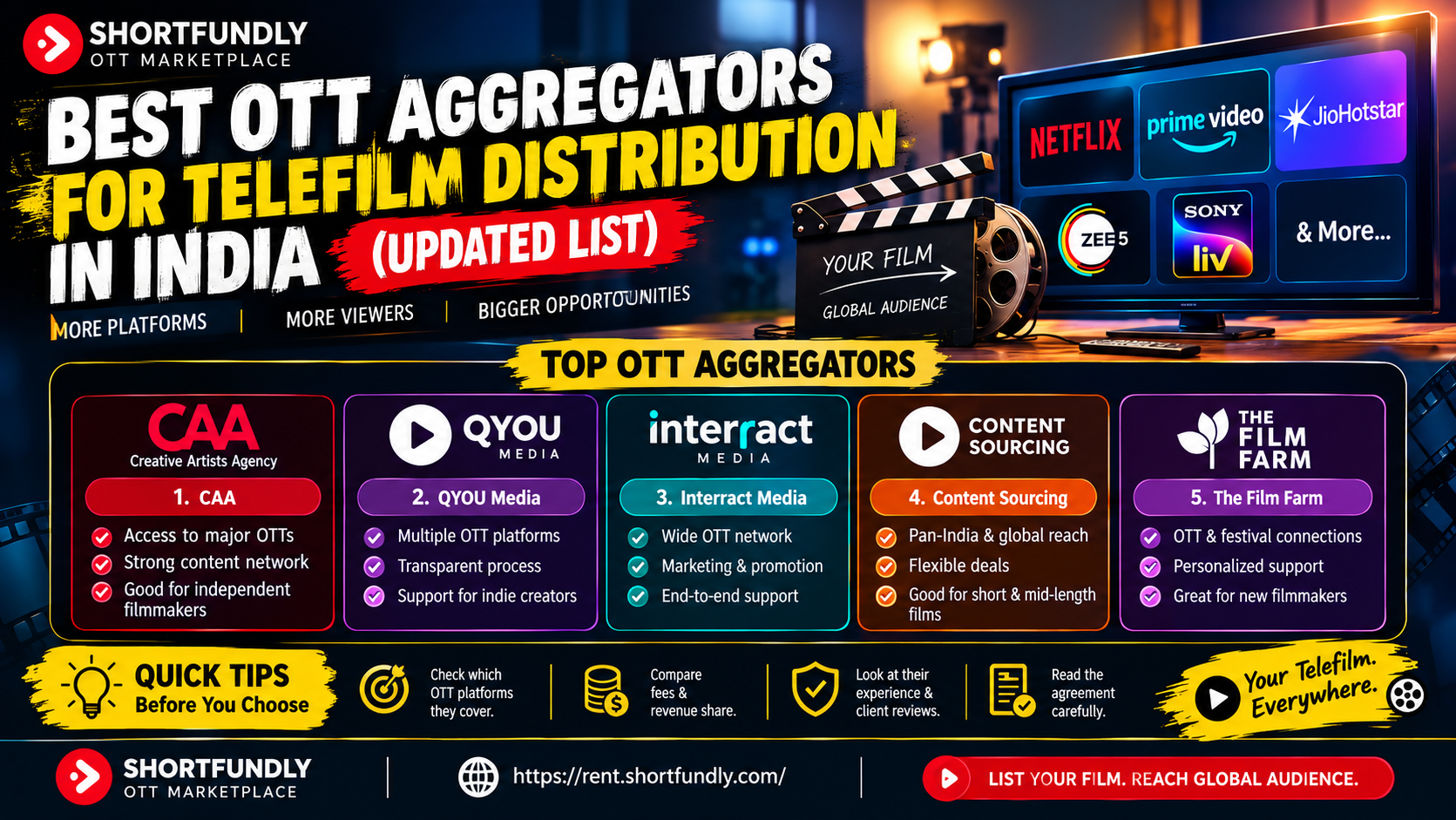
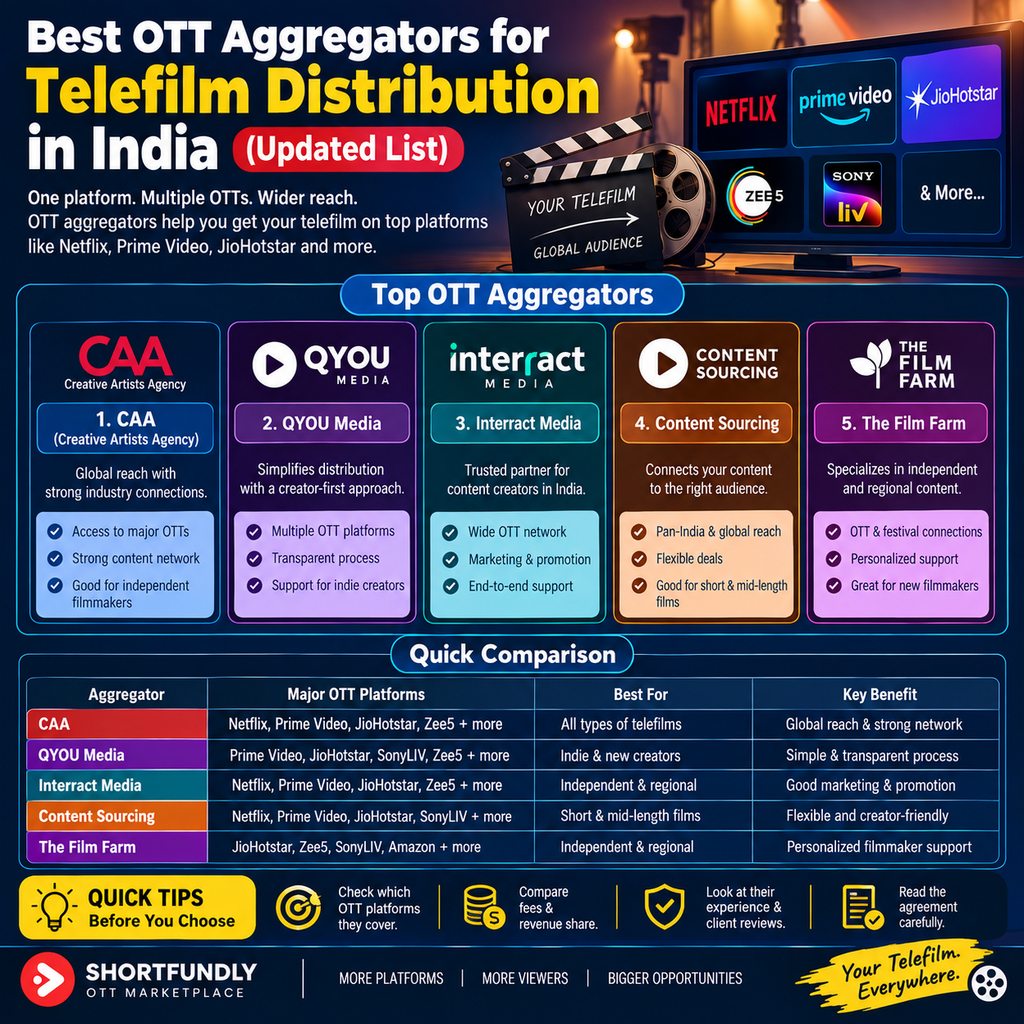
Best OTT Aggregators for Telefilm Distribution in India
There is no single aggregator that is ideal for every telefilm. The best choice depends on the project’s language, genre, runtime, budget, rights availability, audience, territory, and monetization strategy.
Below are important categories and services producers can evaluate.
1. Shortfundly Distribution
Shortfundly Distribution focuses on digital and OTT distribution opportunities for independent content creators and producers.
Its distribution service covers content categories including short films, web series, movies, documentaries, telefilms, pilot films, and other digital formats, depending on project suitability.
For a telefilm producer, the service can be considered when the goal is to obtain distribution support rather than independently contacting every potential digital outlet.
Visit Shortfundly Distribution
Potential Advantages
- OTT-focused distribution support
- Content submission and pitching
- Support for independent creators
- Digital distribution opportunities
- Revenue tracking
- Centralized distribution process
Before signing, we should verify the current platform network, territories, rights requested, fees, exclusivity, revenue share, and release commitments for the specific telefilm.
2. Global OTT Aggregators
Some international aggregators work with multiple digital platforms across different countries.
These services can be relevant when a telefilm has international distribution potential.
International aggregators may specialize in:
- TVOD
- AVOD
- FAST
- SVOD
- Connected TV
- Digital storefronts
- International streaming platforms
However, international distribution usually requires additional materials such as English subtitles, localized metadata, artwork, captions, trailers, and legally cleared music and footage.
We should therefore evaluate the total delivery cost rather than the aggregation fee alone.
3. Specialist Film and Independent Content Distributors
Some companies specialize in independent cinema, documentaries, regional productions, or niche programming.
These can be valuable when a telefilm does not fit the acquisition strategy of mainstream OTT services.
For example, a telefilm with a strong regional identity may have greater value on a platform targeting a specific language audience than on a generalized international service.
The producer should evaluate audience-platform fit before choosing a distributor.
How to Compare OTT Aggregators for Telefilm Distribution
A comparison should go beyond the number of OTT platforms listed on a company’s website.
We should evaluate the following criteria.
| Evaluation Factor | What to Check |
|---|---|
| Platform Network | Which OTT services can receive the content? |
| Territory | India, international, or worldwide? |
| Rights | Streaming, TVOD, AVOD, SVOD, FAST, etc. |
| Exclusivity | Exclusive or non-exclusive? |
| Contract Term | How long are rights licensed? |
| Fees | Upfront, delivery, annual, or other charges? |
| Revenue Share | How is revenue divided? |
| Minimum Guarantee | Is any payment guaranteed? |
| Metadata | Is preparation included? |
| Localization | Are subtitles/dubbing supported? |
| QC | Is technical quality control included? |
| Reporting | How often are statements provided? |
| Payment | What is the payment schedule? |
| Rights Reversion | What happens after expiry? |
This approach provides a more realistic comparison than simply ranking aggregators by the number of platforms they mention.
OTT Aggregator Pricing for Telefilms in India
There is no universal OTT aggregation price for telefilms.
Pricing can depend on:
- Runtime
- Production quality
- Territory
- Number of platforms
- Distribution term
- Exclusivity
- Localization
- Technical preparation
- Marketing requirements
- Content category
- Monetization model
An aggregator may charge a fixed distribution fee, take a percentage of revenue, or combine both.
One-Time Distribution Fee
Under this model, the producer pays a specified amount for distribution services.
The advantage is cost predictability.
However, we should determine exactly what the fee covers.
For example:
- Submission
- Metadata
- Technical delivery
- Platform pitching
- Localization
- Release management
- Reporting
A low initial price may not necessarily be the cheapest overall option if additional charges are introduced later.
Revenue-Share Model
Under revenue sharing, the distributor receives an agreed percentage of revenue generated by the content.
This can reduce upfront financial pressure, but we must carefully examine the revenue definition, deductions, reporting, payment schedule, and contract term.
Hybrid Model
Some arrangements may combine an initial fee with revenue participation.
When evaluating a hybrid agreement, we should calculate the expected total cost under different revenue scenarios.
Exclusive vs Non-Exclusive OTT Aggregation
One of the most important questions to ask an OTT aggregator is whether the distribution agreement is exclusive.
Exclusive Distribution
An exclusive agreement can restrict the producer from licensing specified rights to competing platforms during the contract term.
Exclusivity should be justified by meaningful commercial value.
Before accepting it, we should establish:
- Territory
- Rights category
- Duration
- Platforms covered
- Minimum performance expectations
- Termination conditions
- Rights reversion
Non-Exclusive Distribution
A non-exclusive agreement allows the producer to maintain greater flexibility, subject to the precise contract.
This can be attractive for telefilms where the producer wants to pursue multiple distribution channels.
Rights You Should Control Before Approaching an OTT Aggregator
A producer should prepare a detailed rights matrix before signing a distribution agreement.
Possible rights include:
- OTT streaming
- Television
- Theatrical
- Mobile
- AVOD
- SVOD
- TVOD
- FAST
- Download
- International streaming
- Regional streaming
- Dubbed-language rights
- Subtitle rights
- Remake rights
- Sequel rights
- Promotional rights
An aggregator should receive only the rights necessary for the intended distribution arrangement unless a broader transfer has been deliberately negotiated.
Documents Required for Telefilm OTT Distribution
Professional documentation can significantly simplify the onboarding process.
We should prepare:
Chain of Title
Documentation demonstrating ownership or authorized control of the telefilm and underlying intellectual property.
Cast and Crew Agreements
Contracts should establish the relevant rights granted by performers and production personnel.
Music Clearance
Every song, score, recording, and third-party musical element should have appropriate licensing or ownership documentation.
Location Permissions
Where applicable, location agreements and permissions should be retained.
Artwork Rights
Posters, photographs, illustrations, fonts, and other third-party assets should be cleared.
Distribution History
Any previous distribution agreements should be disclosed where relevant.
Technical Requirements for OTT Telefilm Distribution
A telefilm may be commercially attractive but still fail technical review if its master file or supporting assets do not meet platform specifications.
Typical delivery components can include:
- High-quality video master
- Professional audio
- Subtitle files
- Closed captions
- Trailer
- Poster
- Key art
- Thumbnail
- Synopsis
- Logline
- Cast and crew information
- Genre
- Runtime
- Language
- Release year
- Content rating
- Copyright information
Exact specifications vary by platform and aggregator.
We should never assume that one technical specification applies to every OTT service.
Metadata Requirements for Telefilm OTT Distribution
OTT metadata directly affects how content is presented, categorized, searched, and discovered.
A professional metadata package should include:
- Accurate title
- Alternate title
- Original language
- Subtitle languages
- Genre
- Runtime
- Synopsis
- Short description
- Long description
- Cast
- Director
- Producer
- Production company
- Release year
- Country of origin
- Keywords
- Content classification
- Artwork
The synopsis should accurately represent the story without misleading claims.
Metadata should also remain consistent across every delivery document.
Localization for Indian Telefilms
India is a multilingual market. A telefilm produced in one language can potentially reach a wider audience through appropriate localization.
Depending on the target platform, we may consider:
- English subtitles
- Hindi subtitles
- Regional-language subtitles
- Dubbed audio
- Localized synopsis
- Localized artwork
- Caption files
Localization decisions should be based on audience demand and platform requirements rather than adding languages without a clear distribution strategy.
How to Submit a Telefilm to an OTT Aggregator
The submission process generally follows a structured workflow.
Step 1: Prepare the Telefilm
Complete editing, sound mixing, color correction, subtitles, and final quality checks.
Step 2: Confirm Rights
Verify copyright, chain of title, music, talent, artwork, and distribution rights.
Step 3: Prepare Metadata
Create accurate descriptions, credits, genres, keywords, and technical information.
Step 4: Prepare Artwork
Create professional posters, thumbnails, key art, and promotional materials.
Step 5: Select Distribution Territories
Decide whether the project is intended for India only or international markets.
Step 6: Submit the Project
Provide the requested screener, documents, metadata, and supporting materials.
Step 7: Review the Distribution Agreement
Examine fees, revenue share, exclusivity, rights, term, territory, reporting, and termination clauses.
Step 8: Deliver Final Masters
Once approved, provide the required technical assets.
Step 9: Complete Platform Onboarding
The aggregator coordinates or supports delivery to the applicable digital outlets.
Step 10: Monitor Performance
After release, we should track views, transactions, revenue, territory performance, and platform-level results where reporting is available.
Questions to Ask an OTT Aggregator Before Signing
Before agreeing to a telefilm distribution contract, we should ask:
- Which OTT platforms can receive our telefilm?
- Which territories are included?
- Is the agreement exclusive?
- What exact rights are being licensed?
- How long is the contract?
- Are there setup or delivery fees?
- What percentage of revenue is retained?
- How is net revenue calculated?
- Are platform fees deducted before revenue sharing?
- How frequently are statements provided?
- When are payments made?
- Are audit rights available?
- Who handles subtitles and localization?
- Who owns localized versions?
- Can the distributor sublicense the content?
- What promotional rights are granted?
- What happens when the contract expires?
- How can either party terminate the agreement?
- How are rights returned to the producer?
- What happens if a platform rejects the content?
Clear answers to these questions can prevent significant problems later.
How to Choose the Best OTT Aggregator for Your Telefilm
The right aggregator should match the project’s commercial objectives.
We can evaluate an aggregator using five major categories.
Distribution Reach
Does the company have access to platforms relevant to the telefilm’s audience?
Commercial Terms
Are the fees, revenue share, minimum guarantees, and deductions commercially reasonable?
Rights Protection
Does the agreement clearly define territory, term, exclusivity, sublicensing, and rights reversion?
Technical Support
Can the aggregator help with metadata, subtitles, masters, artwork, QC, and delivery?
Reporting Transparency
Can the producer clearly understand where the telefilm is available and how revenue is being calculated?
OTT Aggregator vs Direct OTT Submission
Both approaches can work, but they serve different situations.
| Direct Submission | OTT Aggregator |
|---|---|
| Producer contacts platforms independently | Aggregator handles or supports multiple submissions |
| More direct communication | Centralized distribution relationship |
| Producer manages documentation | Aggregator may assist with delivery |
| Potentially lower intermediary costs | May involve fees or revenue share |
| Requires platform-by-platform research | Can simplify multi-platform distribution |
| Greater direct control | Requires careful contract review |
A producer with established OTT relationships may prefer direct licensing. A producer without those relationships may benefit from an experienced distribution intermediary.
How to Increase the Commercial Value of a Telefilm
A telefilm becomes easier to market when the underlying rights and content package are professionally prepared.
We should focus on:
- Strong storytelling
- Professional production quality
- Clear genre positioning
- Compelling poster artwork
- Accurate metadata
- Professional subtitles
- Clean audio
- Legal rights clearance
- Audience data
- Trailer and promotional assets
- Clear rights availability
- Flexible distribution strategy
A strong OTT package allows acquisition teams to understand the project without repeatedly requesting missing information.
OTT Distribution Checklist for Indian Telefilm Producers
Before approaching an aggregator, we should confirm that the following are ready:
Legal
- Copyright ownership
- Chain of title
- Talent agreements
- Music clearances
- Location permissions
- Artwork clearances
- Previous distribution contracts
Content
- Final telefilm master
- Trailer
- Poster
- Key artwork
- Thumbnail
- Subtitle files
- Caption files where applicable
Metadata
- Title
- Logline
- Synopsis
- Genre
- Runtime
- Language
- Cast
- Crew
- Producer
- Director
- Release year
- Keywords
Commercial
- Available territories
- Available rights
- Exclusive/non-exclusive preference
- Desired licensing term
- Revenue expectations
- Distribution budget
Contract
- Rights granted
- Territory
- Term
- Exclusivity
- Revenue share
- Fees
- Payment schedule
- Reporting
- Audit
- Termination
- Rights reversion
Final Verdict: Choosing an OTT Aggregator for Telefilm Distribution in India
The best OTT aggregator for telefilm distribution in India is not necessarily the company with the longest platform list or the lowest advertised price. The strongest choice is the distribution partner whose platform access, commercial model, rights structure, technical support, reporting, and territory strategy match the telefilm.
For independent producers, Shortfundly Distribution can be evaluated as one potential distribution route for telefilms and other digital content. We should review its current terms and confirm platform availability, rights requirements, pricing, and revenue arrangements for the specific project before entering into an agreement.
Most importantly, we should never sign an OTT distribution contract without understanding exactly which rights are being granted, where those rights can be exercised, how long they remain active, how revenue is calculated, and when the rights return to the producer.
A telefilm represents valuable intellectual property. With proper rights management, professional delivery materials, accurate metadata, suitable localization, and a carefully selected OTT distribution partner, we can turn a completed production into a scalable digital distribution asset for Indian and international audiences.
Also read: https://blog.shortfundly.com/ott/taiwan-ott-distribution/