Table of Contents
Telefilm OTT distribution revenue model decisions can determine how a finished production earns money after its release. A producer may choose subscription streaming, advertising-supported streaming, transactional viewing, or a combination of these models. Each approach has different revenue mechanics, audience expectations, rights requirements, and commercial risks.
For independent producers, understanding AVOD vs SVOD vs TVOD is especially important because the same telefilm can have very different earning potential depending on how it is licensed and monetized. A strong production isn’t automatically a strong OTT business asset. We need to match the content, audience, territory, rights, and monetization model carefully.
OTT distribution can also involve an aggregator or distribution partner. Shortfundly Distribution is one service that producers can evaluate when exploring digital and OTT distribution opportunities. Its distribution portal is available at Shortfundly Distribution.
This guide explains the major telefilm OTT revenue models, how they work, how producers can compare them, and what to check before signing a distribution agreement.
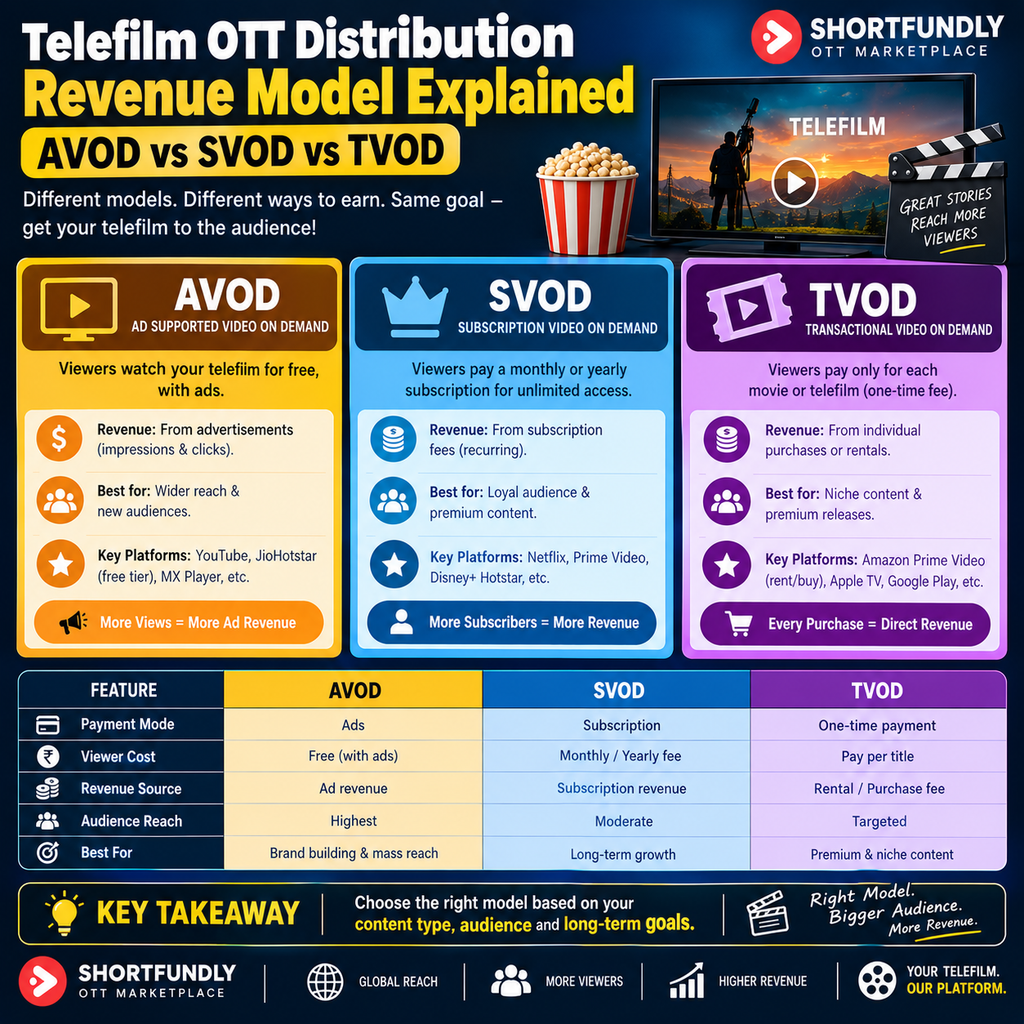
Telefilm OTT Distribution Revenue Model: What Does It Mean?
A telefilm OTT distribution revenue model describes the way money is generated when a telefilm is made available through internet-based streaming services.
The three major models are:
- AVOD — Advertising Video on Demand
- SVOD — Subscription Video on Demand
- TVOD — Transactional Video on Demand
There are also hybrid approaches, including:
- FAST channels
- Premium video-on-demand
- Rental plus purchase
- Subscription plus advertising
- Minimum-guarantee licensing
- Fixed-fee licensing
- Revenue-share agreements
The model isn’t simply a technical choice. It affects how viewers access the telefilm, how the platform earns money, how the producer may be compensated, and how rights should be negotiated.
For example, a telefilm offered through AVOD may be free for viewers but monetized through advertising. A telefilm offered through SVOD may be included within a paid subscription. Under TVOD, viewers generally pay for an individual rental or purchase.
Comprehensive Article Outline
| Section | Topic Covered |
|---|---|
| 1 | Telefilm OTT distribution revenue model |
| 2 | How OTT monetization works |
| 3 | AVOD explained |
| 4 | SVOD explained |
| 5 | TVOD explained |
| 6 | AVOD vs SVOD vs TVOD comparison |
| 7 | Revenue potential by model |
| 8 | Fixed-fee licensing |
| 9 | Revenue-sharing agreements |
| 10 | Minimum guarantees |
| 11 | Choosing the right model |
| 12 | Rights and territories |
| 13 | OTT aggregator considerations |
| 14 | Metadata and localization |
| 15 | Contract terms |
| 16 | Revenue reporting |
| 17 | Common mistakes |
| 18 | Practical monetization strategy |
| 19 | FAQs |
| 20 | Conclusion |
How OTT Telefilm Monetization Works
OTT monetization starts with the relationship between content ownership, distribution rights, audience access, and revenue generation.
A producer owns or controls certain rights in the telefilm. Those rights can then be licensed to an OTT platform, distributor, aggregator, broadcaster, or other digital service.
The commercial arrangement determines how the producer gets paid.
In a simple example, we might have:
Producer → Distributor/Aggregator → OTT Platform → Viewer
The money can move in the opposite direction:
Viewer/Advertiser → OTT Platform → Distributor → Producer
However, not every agreement uses this structure. Some platforms license content directly from producers. Others work through aggregators or distributors. Some deals involve a fixed licensing payment rather than audience-based revenue.
This is why we shouldn’t evaluate a distribution proposal solely by asking, “How much will we earn per view?”
The more important questions are:
- What rights are being licensed?
- For how long?
- In which territory?
- Is the deal exclusive?
- How is revenue calculated?
- What deductions are permitted?
- Who pays for localization?
- Who controls pricing?
- How frequently are statements provided?
- When are payments made?
These details can dramatically change the economic value of an OTT agreement.
AVOD for Telefilms: Advertising Video on Demand Explained
AVOD stands for Advertising Video on Demand.
Under an AVOD model, viewers can generally access content without paying a direct subscription fee for every title. Instead, advertising helps fund the service.
The platform can generate advertising revenue through:
- Pre-roll advertisements
- Mid-roll advertisements
- Post-roll advertisements
- Display advertising
- Sponsored placements
- Branded content
- Programmatic advertising
The producer’s compensation depends on the agreement.
A telefilm might earn money through a negotiated revenue share, licensing payment, minimum guarantee, or another commercial arrangement.
Why AVOD Can Work Well for Telefilms
AVOD can be attractive for telefilms that need broad audience reach.
If viewers don’t need to purchase the telefilm separately or maintain a paid subscription, the barrier to viewing can be lower.
This can be particularly useful when:
- The telefilm has mass-market appeal.
- The content is suitable for broad audiences.
- The producer wants discovery and reach.
- The title has strong advertising potential.
- The platform has significant viewer traffic.
- The telefilm can attract viewers from multiple territories.
The trade-off is that the producer may not receive a large payment from each individual viewer.
Instead, the commercial value comes from audience scale and advertising monetization.
AVOD Revenue Considerations
When negotiating AVOD rights, we should determine how advertising revenue is calculated.
For example, the contract should clarify whether the producer receives a percentage of:
- Gross advertising revenue
- Net advertising revenue
- Allocated platform revenue
- Revenue after advertising sales costs
- Revenue after platform deductions
We should also understand whether the platform controls the advertising inventory.
A contract that says “revenue share” without defining the underlying revenue can create unnecessary confusion.
SVOD for Telefilms: Subscription Video on Demand Explained
SVOD means Subscription Video on Demand.
Under this model, viewers pay a recurring subscription to access a library of content.
The subscription could be monthly, quarterly, annual, or structured through another billing arrangement.
The producer isn’t necessarily paid directly by each subscriber who watches the telefilm.
Instead, compensation can be structured as:
- Fixed licensing fee
- Minimum guarantee
- Revenue share
- Performance-based compensation
- Hybrid licensing arrangement
Why SVOD Can Be Attractive
SVOD can be a strong model when a telefilm fits a platform’s programming strategy.
Platforms use exclusive and non-exclusive content to attract and retain subscribers. A compelling telefilm may therefore have value beyond the number of times it is individually rented.
SVOD can be especially interesting when the telefilm offers:
- Strong storytelling
- Recognizable talent
- A defined target audience
- Regional-language appeal
- Franchise potential
- High production quality
- Strong promotional potential
The producer should understand that subscription revenue is often pooled rather than assigned in a simple one-view-equals-one-payment structure.
SVOD Licensing Questions
Before licensing a telefilm to an SVOD platform, we should ask:
- Is the deal exclusive?
- What territory is covered?
- What is the license term?
- Is there a minimum guarantee?
- Is compensation fixed or performance-based?
- How is performance measured?
- Are viewing reports provided?
- Can the platform sublicense the content?
- What promotional rights are included?
- What happens after the license expires?
TVOD for Telefilms: Transactional Video on Demand Explained
TVOD stands for Transactional Video on Demand.
Instead of paying for an entire streaming subscription, viewers pay for access to an individual title.
TVOD commonly includes two commercial approaches:
Rental
The viewer pays for temporary access.
Purchase
The viewer pays for longer-term or permanent digital access, depending on the service’s terms.
TVOD can work well when a telefilm has high perceived individual-title value.
For example, viewers may be willing to pay for a new release, premium production, popular performer, or highly targeted film.
How TVOD Revenue Can Work
Suppose a telefilm is rented for a specific price.
The platform may retain an agreed portion, while the remaining amount is allocated according to the contractual arrangement.
The producer should determine:
- Consumer price
- Platform share
- Distributor share
- Producer share
- Taxes
- Payment-processing deductions
- Refund treatment
- Promotional discounts
Discounting is especially important.
If a platform offers the telefilm at a reduced rental price, the contract should establish how revenue is calculated.
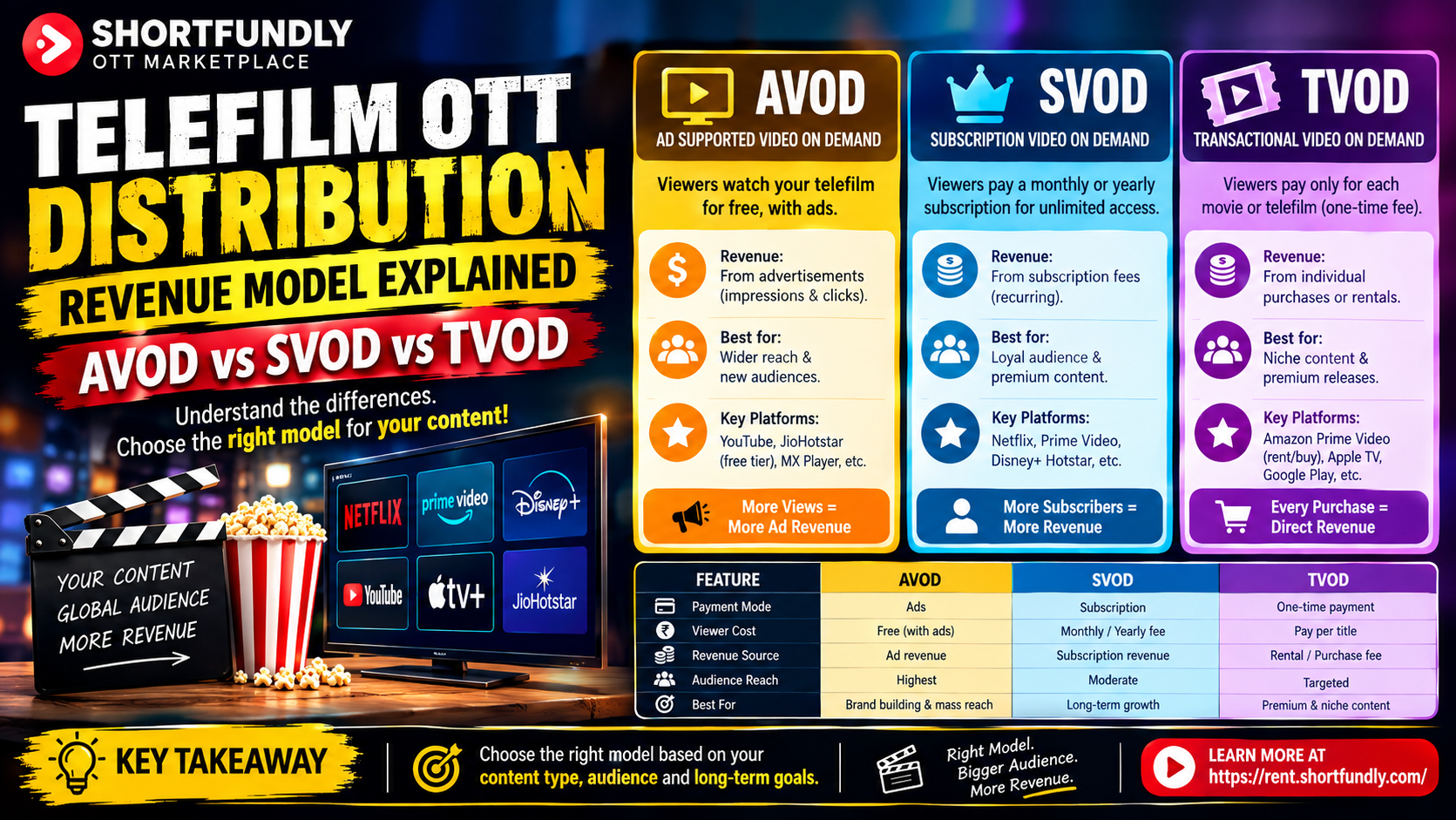
AVOD vs SVOD vs TVOD: Key Differences
The fundamental difference is how the viewer pays—or doesn’t pay—for access.
| Feature | AVOD | SVOD | TVOD |
|---|---|---|---|
| Viewer Payment | Usually no direct title payment | Subscription | Individual transaction |
| Main Revenue Source | Advertising | Subscriptions | Rentals/purchases |
| Audience Barrier | Low | Medium | Higher |
| Revenue Driver | Views + ad inventory | Subscribers + platform economics | Transactions |
| Best Strength | Reach | Library value | Premium title value |
| Typical Strategy | Mass discovery | Long-term platform library | Premium or transactional release |
| Producer Payment | Share/license/hybrid | License/share/hybrid | Transaction share/license |
| Content Discovery | Often broad | Platform-driven | Title-driven |
| Exclusivity | Possible | Common in some deals | Possible |
There isn’t one universal winner.
The best model depends on the telefilm and its commercial position.
Which OTT Revenue Model Is Best for a Telefilm?
The right choice depends on several factors.
Choose AVOD When Reach Is the Priority
AVOD can be attractive when we want to maximize audience exposure and the content is suitable for advertising-supported viewing.
A telefilm with broad appeal may benefit from a large free audience.
Choose SVOD When Platform Licensing Is Strong
SVOD can work well when the telefilm fits the content strategy of a subscription service.
The producer may value a guaranteed license fee or minimum guarantee more than uncertain advertising income.
Choose TVOD When the Title Has Direct Consumer Value
TVOD can make sense when viewers have a strong reason to pay for the individual title.
New releases, premium productions, and titles with established audiences can sometimes be suitable for transactional distribution.
Telefilm OTT Distribution Revenue: Fixed Licensing Fee
A fixed licensing fee provides an agreed payment for specified rights.
For example, a producer might license streaming rights for:
- One territory
- A defined term
- One platform
- One language
- A specified business model
The platform pays the agreed amount regardless of how many viewers watch, subject to the contract.
Advantages
- Predictable income
- Easier financial planning
- Less dependence on audience performance
- Simpler accounting in some arrangements
Limitations
- Upside may be limited
- Producer may not participate in exceptional performance
- Exclusive rights can restrict future opportunities
We should therefore compare a fixed fee against the potential value of retaining revenue participation.
OTT Revenue Share for Telefilms
A revenue-sharing agreement allows the producer to participate in revenue generated by the telefilm.
This can create greater upside, but the contract must be extremely clear.
A producer should understand:
Gross Revenue → Permitted Deductions → Net Revenue → Distributor/Platform Share → Producer Share
The exact calculation should appear in the agreement.
Terms such as “net revenue” should not be left vague.
What Deductions Should We Check?
Possible deductions can include:
- Platform fees
- Payment-processing charges
- Taxes
- Refunds
- Advertising costs
- Distribution expenses
- Localization expenses
- Marketing expenses
Not every deduction is necessarily appropriate.
We should negotiate which deductions are permitted and whether they require supporting documentation.
Minimum Guarantee in Telefilm OTT Distribution
A minimum guarantee, often called an MG, provides a contractual minimum payment.
It can be useful because it gives the producer a baseline level of financial certainty.
For example, an agreement could provide:
- Minimum guaranteed payment
- Plus additional revenue participation after a defined threshold
This creates a hybrid structure.
The producer gets some predictable income while retaining potential upside.
However, we should understand whether the minimum guarantee is:
- Recoupable
- Non-recoupable
- An advance against future revenue
- Territory-specific
- Platform-specific
The wording matters.
Hybrid OTT Monetization Models for Telefilms
Modern digital distribution doesn’t always fit into one category.
A telefilm may be distributed using a hybrid OTT revenue model.
For example:
Phase 1: TVOD premium release
Phase 2: SVOD licensing
Phase 3: AVOD release
This strategy can potentially extract different types of value from the same intellectual property over time.
However, the strategy requires careful rights management.
We need to ensure that the first agreement doesn’t unintentionally block later monetization opportunities.
OTT Rights: The Foundation of Telefilm Revenue
Revenue is closely connected to the rights we control.
A telefilm may contain separate rights for:
- OTT
- Television
- Theatrical
- Mobile
- AVOD
- SVOD
- TVOD
- FAST
- International distribution
- Regional distribution
- Dubbed versions
- Subtitle versions
- Promotional clips
- Remake rights
We shouldn’t grant all rights simply because an OTT buyer requests “digital rights.”
The agreement should specify exactly what is included.
Territory and Language in OTT Licensing
Territory determines where the buyer can exploit the telefilm.
Possible structures include:
- India
- A particular Indian state or regional market
- South Asia
- Asia-Pacific
- North America
- Europe
- Worldwide
Language rights should also be considered.
A producer may license the original-language version while retaining rights for dubbed versions.
For example, an agreement could potentially separate:
- Original-language streaming
- Hindi-dubbed rights
- English-dubbed rights
- Regional-language dubbed rights
- Subtitle rights
This level of detail can protect future monetization opportunities.
OTT Aggregators and Telefilm Distribution Revenue
An OTT aggregator can simplify distribution by helping producers reach multiple digital outlets through a centralized process.
For producers without established relationships with OTT acquisition teams, aggregation may be useful for:
- Platform pitching
- Content delivery
- Metadata preparation
- Technical coordination
- Rights administration
- Distribution management
- Revenue tracking
Shortfundly Distribution is one distribution service that producers can evaluate for telefilm and digital content opportunities.
Explore Shortfundly Distribution
Before entering any aggregation agreement, we should confirm the current platform network, territories, fees, revenue share, exclusivity, contract term, rights granted, and reporting arrangements for the particular project.
OTT Distribution Fees vs Revenue Share
Producers often compare two basic structures:
Fee-Based Distribution
The producer pays a distribution fee.
Revenue-Share Distribution
The distributor earns a percentage of revenue.
There can also be hybrid arrangements.
| Model | Upfront Cost | Revenue Participation | Producer Risk |
|---|---|---|---|
| Fixed Fee | Higher or defined | Usually lower | Upfront financial risk |
| Revenue Share | Lower | Higher | Performance risk |
| Hybrid | Moderate | Yes | Mixed |
| Minimum Guarantee | Negotiated | Possible | Reduced downside |
We should compare the total expected economics, not simply the initial fee.
OTT Metadata and Localization Can Affect Revenue
A telefilm doesn’t exist commercially as a video file alone.
Its OTT package may include:
- Title
- Synopsis
- Logline
- Genre
- Cast
- Crew
- Keywords
- Runtime
- Language
- Subtitles
- Captions
- Poster
- Thumbnail
- Trailer
- Content rating
- Technical specifications
Strong metadata makes it easier for platforms to position and categorize the title.
Localization can also expand the potential audience.
Depending on the market, we may consider:
- English subtitles
- Hindi subtitles
- Regional-language subtitles
- Dubbed audio
- Localized descriptions
- Localized artwork
The additional rights and costs should be addressed before delivery.
OTT Contract Terms That Affect Telefilm Revenue
A revenue model can look attractive but become less valuable because of unfavorable contract terms.
We should review:
License Term
How long can the platform exploit the rights?
Territory
Where can the content be streamed?
Exclusivity
Can the producer license the same rights elsewhere?
Revenue Definition
What exactly counts as revenue?
Deductions
Which costs can be deducted?
Payment Schedule
When does the producer receive payment?
Reporting
How often are statements provided?
Audit Rights
Can the producer verify reported revenue?
Sublicensing
Can the platform license the content to another service?
Rights Reversion
What happens when the contract expires?
These clauses can be just as important as the headline payment.
How OTT Revenue Reporting Should Work
A professional revenue report should provide enough information for the producer to understand performance.
Depending on the business model, useful data may include:
- Viewing period
- Territory
- Platform
- Number of transactions
- Views or streams
- Advertising revenue
- Gross revenue
- Deductions
- Net revenue
- Producer share
- Payment amount
For revenue-share agreements, transparency is particularly important.
We should avoid agreements where the producer receives a percentage but has little visibility into the calculation.
Common Telefilm OTT Monetization Mistakes
1. Focusing Only on the Highest Upfront Payment
A larger initial payment isn’t automatically the best deal if it requires broad rights and long exclusivity.
2. Ignoring Revenue Definitions
“50% revenue share” sounds attractive until we discover what gets deducted before that percentage is calculated.
3. Granting Worldwide Rights Too Easily
A buyer may only need one territory. Granting worldwide rights without sufficient compensation can limit future income.
4. Accepting Long Exclusivity Without a Strong Reason
Long exclusive terms can prevent additional licensing opportunities.
5. Forgetting Rights Reversion
We should establish what happens when the agreement ends.
6. Ignoring Localization Costs
Subtitling and dubbing can affect the economics of international distribution.
7. Failing to Clear Music Rights
Uncleared music can create serious distribution problems.
8. Using Weak Metadata
Poor descriptions, artwork, and categorization can reduce the commercial presentation of a telefilm.
7 Powerful Strategies to Improve Telefilm OTT Revenue
1. Segment Rights
Instead of treating all digital rights as one package, we can evaluate them separately.
2. Negotiate Territory Carefully
Retaining rights in territories where a buyer has no meaningful presence can preserve future opportunities.
3. Compare Guaranteed Income With Upside
A fixed license may be safer, while revenue sharing can provide greater upside.
4. Protect Non-Granted Rights
Clearly state which rights remain with the producer.
5. Build a Professional Delivery Package
Clean masters, subtitles, metadata, artwork, and legal documentation make the project easier to distribute.
6. Track Revenue
Require meaningful statements and payment records.
7. Review Contracts Before Signing
A qualified entertainment lawyer can help identify rights and contractual risks specific to the transaction and jurisdiction.
Practical Telefilm OTT Revenue Strategy
A practical strategy can begin with the following workflow:
Stage 1: Rights Audit
Confirm ownership and identify available rights.
Stage 2: Audience Analysis
Determine the strongest audience and territories.
Stage 3: Monetization Selection
Compare AVOD, SVOD, TVOD, fixed licensing, revenue share, and hybrid models.
Stage 4: Buyer Research
Identify platforms and distributors that match the telefilm.
Stage 5: Commercial Negotiation
Compare payment, rights, term, territory, exclusivity, and revenue terms.
Stage 6: Technical Preparation
Complete masters, subtitles, artwork, metadata, and QC.
Stage 7: Distribution
Deliver the approved assets according to the platform’s requirements.
Stage 8: Revenue Monitoring
Track statements, audience performance, payments, and rights expiry.
Telefilm OTT Distribution Revenue Model Checklist
Before finalizing an OTT deal, we should check:
- Telefilm ownership is documented
- Chain of title is complete
- Music rights are cleared
- Talent rights are documented
- OTT rights are available
- Territory is defined
- Language rights are defined
- License term is clear
- Exclusivity is understood
- AVOD/SVOD/TVOD model is identified
- Revenue definition is written
- Deductions are specified
- Payment dates are defined
- Reporting obligations are included
- Audit provisions are considered
- Sublicensing is controlled
- Localization rights are addressed
- Promotional rights are defined
- Termination provisions are clear
- Rights reversion is included
Frequently Asked Questions About Telefilm OTT Distribution Revenue
1. What is the best OTT revenue model for a telefilm?
There isn’t one model that works for every telefilm. AVOD can prioritize audience reach, SVOD can work well for subscription-based platform licensing, and TVOD can be useful when viewers have a strong reason to pay for an individual title. We should compare the audience, genre, territory, platform, rights, and commercial offer before choosing.
2. What is the difference between AVOD, SVOD, and TVOD?
AVOD is primarily funded by advertising, SVOD uses recurring subscriptions, and TVOD charges viewers for individual rentals or purchases. Each model creates a different revenue structure for the platform and rights holder.
3. Can a telefilm use more than one OTT revenue model?
Yes. A telefilm can potentially move through different monetization windows, such as TVOD followed by SVOD and later AVOD, provided the rights agreements permit that strategy.
4. Is revenue share better than a fixed OTT licensing fee?
Not automatically. A fixed fee provides greater predictability, while revenue sharing may provide more upside if the title performs strongly. We should compare the expected value of both structures and carefully examine deductions.
5. What is a minimum guarantee in OTT distribution?
A minimum guarantee is a contractual minimum payment offered by a buyer or distributor under agreed conditions. Depending on the agreement, it may operate as an advance against future revenue or as a separate guaranteed payment.
6. What rights should we check before selling telefilm OTT rights?
We should check territory, term, platform, streaming model, exclusivity, language, subtitle and dubbing rights, promotional rights, sublicensing, and rights reversion. Underlying copyright, music, talent, and adaptation rights should also be properly documented.
7. Can an OTT aggregator distribute a telefilm to multiple platforms?
Depending on its service and contractual arrangements, an aggregator may help distribute content across multiple digital outlets. The producer should verify the aggregator’s current platform network, territories, fees, rights requirements, and distribution terms before signing.
8. Does a telefilm need subtitles for OTT distribution?
Subtitle requirements vary by platform and territory. However, professional subtitles can improve accessibility and may expand the potential audience, particularly for regional-language or international distribution.
9. How long should telefilm OTT rights be licensed?
The appropriate term depends on the commercial agreement. Producers should consider the value of the payment, exclusivity, territory, expected performance, and future licensing opportunities. The contract should clearly establish the beginning and end of the license.
10. Should we give an OTT platform worldwide exclusive rights?
Only when the commercial value justifies it. Worldwide exclusivity can restrict future licensing opportunities across multiple markets, so territory and exclusivity should be negotiated deliberately.
11. How is AVOD revenue calculated?
It depends on the agreement. Revenue may be calculated using advertising income, allocated platform revenue, or another defined formula. The contract should clearly establish permitted deductions and the producer’s percentage.
12. How does an SVOD producer get paid?
Payment can take the form of a fixed licensing fee, minimum guarantee, revenue share, performance-based compensation, or a hybrid arrangement. The specific structure depends on the platform and negotiated agreement.
13. How does TVOD generate money for a telefilm?
TVOD generates revenue when viewers pay for individual access, typically through a rental or purchase. The producer’s share depends on the platform and distribution agreement after applicable contractual deductions.
14. What should be included in an OTT revenue report?
A useful report can include the reporting period, territory, platform, views or transactions, gross revenue, permitted deductions, net revenue, producer share, and payment amount. The exact reporting obligations should be included in the contract.
Also read: https://blog.shortfundly.com/ott/best-ott-aggregators-telefilm/
Final Conclusion: Choosing the Right Telefilm OTT Revenue Model
Understanding the telefilm OTT distribution revenue model is essential before signing a digital licensing agreement. AVOD, SVOD, and TVOD each offer different paths to monetization, and the best option depends on the telefilm’s audience, commercial value, territory, platform strategy, and available rights.
AVOD can be powerful for reach and advertising-supported discovery. SVOD can provide valuable subscription-library exposure and licensing opportunities. TVOD can work particularly well when audiences have a strong reason to pay for individual access.
Beyond these models, producers should evaluate fixed licensing fees, revenue sharing, minimum guarantees, and hybrid structures.
The most important principle is to look beyond the headline payment. A strong OTT agreement should clearly define rights, territory, term, exclusivity, revenue, deductions, reporting, payment schedules, localization, sublicensing, termination, and rights reversion.
For producers considering aggregation, Shortfundly Distribution can be evaluated as one potential route for telefilm and digital content distribution. The current commercial terms and platform availability should always be confirmed for the specific project before rights are granted.
When we combine a strong telefilm with clear rights ownership, professional metadata, high-quality delivery materials, suitable localization, and a carefully selected monetization model, OTT distribution becomes more than a release channel—it becomes a structured opportunity to generate long-term value from the intellectual property.
The smartest approach is straightforward: protect the rights, understand the revenue model, negotiate the contract, choose the right audience, and measure the results.