Table of Contents
Best telefilm OTT distribution packages help independent producers reach streaming audiences, manage rights, control costs, and build long-term revenue opportunities.
Independent producers have more opportunities than ever to bring telefilms to streaming audiences. However, choosing the right telefilm OTT distribution package can be difficult when different distributors offer different pricing structures, rights terms, platform access, technical services, and revenue models.
A good distribution package isn’t simply about getting a telefilm onto an OTT platform. It should help us prepare the project, deliver it correctly, reach suitable streaming partners, protect our rights, and create a sustainable path toward monetization.
For independent producers, this distinction matters. A low-cost package may look attractive initially but may provide limited services. A more comprehensive package may cost more but include metadata preparation, localization, platform pitching, quality control, reporting, and post-release support.
This guide explains 11 powerful telefilm OTT distribution package options and structures that independent producers can consider. We will also examine pricing models, rights, revenue sharing, technical delivery, localization, platform selection, common mistakes, and ways to evaluate a distribution partner.
Also read: https://blog.shortfundly.com/ott/telefilm-ott-monetization/
Comprehensive Outline
| Section | What We Cover |
|---|---|
| Introduction | Why telefilm OTT distribution packages matter |
| Telefilm OTT Distribution | How the modern distribution process works |
| Package Types | 11 package structures for independent producers |
| Pricing | Fixed-fee, revenue-share, hybrid, and licensing models |
| Rights | Territory, exclusivity, duration, and content rights |
| Technical Delivery | Video, audio, subtitles, artwork, and metadata |
| Platform Strategy | How to match a telefilm with suitable OTT outlets |
| Localization | Subtitles, dubbing, metadata, and regional audiences |
| Revenue | SVOD, AVOD, TVOD, and licensing opportunities |
| Shortfundly Distribution | How a distribution service can support producers |
| Selection Checklist | How to compare distribution packages |
| Mistakes | Common problems to avoid |
| FAQs | Frequently asked questions about OTT packages |
| Conclusion | A practical distribution strategy |
1. Understanding Telefilm OTT Distribution Packages
A telefilm OTT distribution package is a collection of services, commercial terms, and distribution support offered to help producers release a telefilm through streaming channels.
Depending on the distributor, a package may include:
- Content submission and review
- OTT platform pitching
- Rights management
- Technical quality control
- Metadata preparation
- Poster and artwork delivery
- Subtitle or localization support
- Content delivery
- Platform coordination
- Revenue reporting
- Payment processing
- Marketing support
- Performance analytics
Not every package includes all these services.
That’s why we shouldn’t compare packages only by their upfront price. We should compare what we actually receive for that price.
For example, Package A might charge a smaller processing fee but require the producer to prepare every delivery asset. Package B might charge more but provide technical preparation, metadata assistance, localization coordination, and platform pitching.
The right choice depends on the telefilm, target audience, rights position, budget, and distribution goals.
Why Independent Producers Need Structured Packages
Independent producers often operate with limited teams. We may have a director, producer, editor, cinematographer, and a few marketing professionals, but not a dedicated OTT delivery department.
A structured distribution package can reduce that operational burden.
Instead of contacting platforms separately, preparing different technical files, negotiating every delivery requirement, and tracking multiple reports manually, producers can use a distribution partner to centralize several parts of the process.
This doesn’t remove the producer’s responsibility. We still need to own or control the appropriate rights, maintain accurate documentation, and approve commercial agreements.
However, a professional distribution workflow can make the process more organized.
What a Good Package Should Accomplish
A useful package should ideally address four major areas:
- Preparation – getting the telefilm technically and commercially ready.
- Access – presenting the title to relevant OTT or distribution partners.
- Monetization – establishing an appropriate revenue or licensing model.
- Reporting – allowing the producer to understand performance and payments.
The goal isn’t simply to achieve a streaming release. The goal is to build a distribution pathway that makes commercial and operational sense.
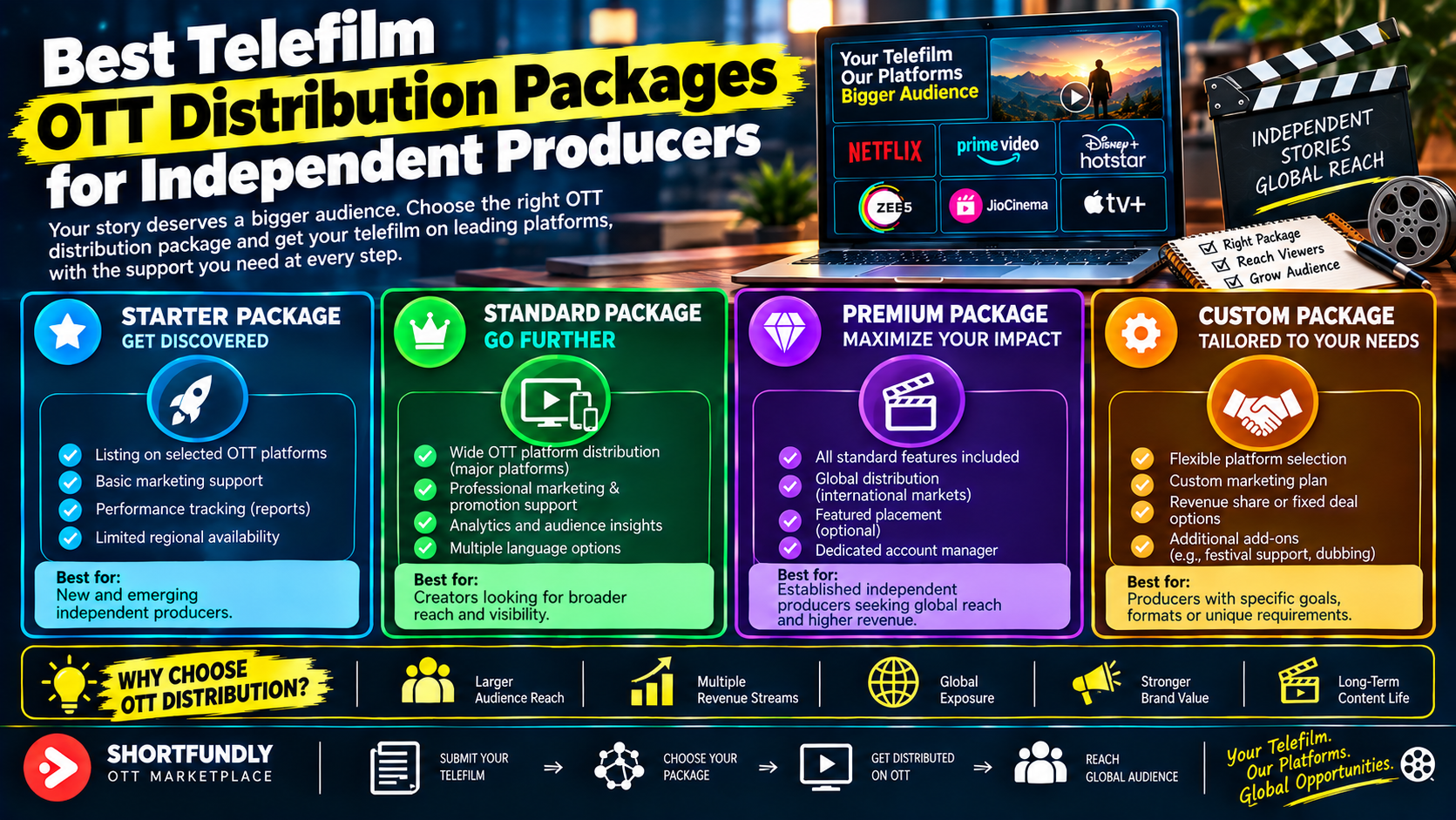
2. 11 Powerful Telefilm OTT Distribution Package Options
There isn’t one universal package that works for every independent producer. Instead, we can think of distribution packages as different service structures.
Package 1: Basic OTT Submission Package
This is generally designed for producers who already have a fully prepared telefilm.
A basic package may include:
- Submission processing
- Content review
- Basic technical verification
- Metadata submission
- Platform delivery
- Distribution coordination
This structure can work when the producer already has professional artwork, subtitles, metadata, legal documents, and technical masters.
The main advantage is simplicity.
However, producers should check whether platform pitching, localization, marketing, and post-release reporting are included or charged separately.
Package 2: OTT Aggregation Package
An aggregation package focuses on delivering content to multiple streaming outlets through one distribution relationship.
Instead of negotiating individually with numerous platforms, the producer works through an aggregator or distributor.
Potential services include:
- Multi-platform delivery
- Content ingestion
- Metadata management
- Platform communication
- Rights administration
- Reporting
This can be useful for producers seeking broader reach.
However, “multi-platform” doesn’t automatically mean guaranteed placement on every major OTT service. Platform availability depends on licensing, eligibility, content fit, territory, and current partner relationships.
Package 3: Revenue-Share Package
Under a revenue-share distribution package, the distributor and producer share eligible revenue according to their agreement.
Possible revenue sources include:
- Subscription-related revenue
- Advertising revenue
- Transactional purchases
- Licensing income
- Other agreed monetization channels
This model can reduce or eliminate a large upfront distribution cost in some arrangements.
But we must carefully define net revenue, deductions, commissions, taxes, payment schedules, reporting periods, and eligible expenses.
A percentage alone doesn’t tell us how much the producer will actually receive.
Package 4: Fixed-Fee Distribution Package
A fixed-fee package charges an agreed distribution or processing amount.
This model can make budgeting easier because the initial cost is known.
Before signing, producers should determine:
- What the fee covers
- Whether taxes are additional
- Whether platform delivery is included
- Whether localization costs extra
- Whether marketing is included
- Whether there are renewal charges
- Whether additional territories require new fees
Fixed pricing can be straightforward, but we shouldn’t assume that paying a fee guarantees OTT acceptance.
Package 5: Hybrid Distribution Package
A hybrid package combines an upfront fee with a revenue-share arrangement.
For example, a distributor may charge for technical processing and then participate in revenue generated from the title.
This model can make sense when the distributor is providing substantial services while also sharing some commercial risk.
The contract should clearly identify:
Upfront Fee + Revenue Share + Deductible Costs + Payment Schedule + Reporting Requirements
Without this clarity, producers may struggle to calculate their actual earnings.
Package 6: Premium OTT Release Package
A premium package can include broader support around the complete release process.
It may cover:
- Technical QC
- Metadata optimization
- Artwork specifications
- Subtitle coordination
- Trailer delivery
- Platform pitching
- Release planning
- Promotional support
- Analytics
This type of package can be suitable for producers who want a more managed experience.
However, premium services should be evaluated based on actual deliverables rather than marketing language.
Package 7: Regional Language OTT Package
Regional-language telefilms require additional attention to localization and audience positioning.
A regional package may support:
- Native-language metadata
- Traditional or regional-language subtitles
- Dubbing coordination
- Local artwork
- Regional platform targeting
- Territory-specific promotion
For example, a Tamil, Telugu, Malayalam, Kannada, Bengali, Marathi, Punjabi, or Gujarati telefilm may require a different platform strategy from a Hindi-language production.
Language isn’t merely a subtitle issue. It can influence audience discovery, artwork, search metadata, promotional messaging, and platform suitability.
Package 8: International OTT Distribution Package
Independent producers may also seek audiences outside their home market.
An international package can focus on:
- Territory licensing
- International platform pitching
- English subtitles
- Regional subtitles
- International metadata
- Rights documentation
- Multi-territory reporting
The contract should specify exactly which countries are covered.
“Worldwide” should never be treated as a vague marketing phrase. We should identify the actual territories granted to the distributor.
Package 9: Localization-Focused Package
Localization can make a telefilm more accessible to audiences who don’t speak the original language.
A localization package may include:
- Subtitle creation
- Subtitle synchronization
- Translation review
- Dubbing coordination
- Localized metadata
- Localized synopsis
- Artwork adaptation
Quality matters here.
Poor subtitles can reduce viewer engagement, while inaccurate translations can change the meaning of dialogue and potentially create cultural problems.
Package 10: TVOD and Direct Monetization Package
Some distribution strategies focus on direct transactions rather than only subscription services.
A TVOD model can involve viewers paying to:
- Rent a telefilm
- Purchase access
- Buy a digital viewing ticket
This model can be useful for specific audiences and event-driven releases.
A distributor should explain transaction fees, payment processing deductions, refunds, taxes, reporting, and revenue-sharing terms.
Package 11: End-to-End OTT Distribution Package
An end-to-end package aims to cover the complete lifecycle of the release.
This can include:
- Project assessment
- Rights verification
- Technical QC
- Metadata preparation
- Subtitle and localization support
- Platform pitching
- Content delivery
- Release coordination
- Revenue tracking
- Performance reporting
For independent producers without a dedicated distribution team, this can be an attractive structure.
Still, we should verify each promised service in writing.
3. How to Compare Telefilm OTT Distribution Package Pricing
Price is one of the first things producers look at, but it shouldn’t be the only factor.
OTT distribution pricing can be structured in several ways.
| Pricing Model | Producer Pays Upfront | Revenue Share | Typical Consideration |
|---|---|---|---|
| Fixed Fee | Yes | May not apply | Predictable initial cost |
| Revenue Share | Low/No | Yes | Distributor participates in earnings |
| Hybrid | Yes | Yes | Combines both approaches |
| Licensing | Usually negotiated | Depends | Rights are licensed for a defined term |
| Premium Service | Yes | Optional | Includes additional services |
The important question is not simply “How much does distribution cost?”
Instead, ask:
“What am I receiving for the total cost, and what rights am I giving away?”
Watch the Definition of Net Revenue
Suppose a contract says the producer receives 70% of net revenue.
That sounds attractive until we discover that net revenue is calculated after platform fees, payment processing, taxes, marketing expenses, distributor commissions, localization costs, and other deductions.
The producer should therefore request a written revenue waterfall.
For example:
Gross Revenue → Platform Deductions → Taxes → Approved Expenses → Distributor Share → Producer Share
The exact structure will vary by contract.
Look for Hidden Charges
Additional charges may include:
- Subtitle fees
- Dubbing fees
- Artwork charges
- QC charges
- Encoding charges
- Delivery charges
- Territory expansion fees
- Renewal fees
- Marketing expenses
A transparent package should make these costs easy to understand.
4. Rights and Contract Terms Every Producer Should Review
Distribution is fundamentally a rights transaction.
Before selecting a package, producers should confirm what rights are being licensed.
Distribution Territory
Territory determines where the distributor can exploit the telefilm.
Possible structures include:
- India
- South Asia
- Asia-Pacific
- Selected countries
- Worldwide
A worldwide grant can be commercially significant, so it deserves careful review.
Exclusive vs Non-Exclusive Rights
An exclusive agreement may prevent the producer from licensing the same rights to another party during the contract term.
A non-exclusive agreement may allow additional distribution opportunities, subject to the agreement.
Neither structure should be accepted automatically.
We should examine what commercial opportunities each arrangement creates or restricts.
Contract Duration
A distribution agreement may last for a specific period.
Important questions include:
- When does the term begin?
- Does it automatically renew?
- How can either party terminate?
- What happens after termination?
- Do rights automatically return to the producer?
Platform Rights
The agreement should identify whether rights cover:
- OTT streaming
- TV broadcasting
- Mobile streaming
- Download
- Rental
- Advertising
- Subscription
- Promotional clips
- Social media
- International distribution
Don’t assume that “OTT rights” means only one form of streaming.
5. Technical Delivery Requirements for OTT Telefilms
A telefilm may be creatively complete but still fail technical review.
OTT platforms commonly require detailed delivery specifications.
Video Master
Depending on the platform and distributor, requirements may cover:
- Resolution
- Frame rate
- Aspect ratio
- Codec
- Bitrate
- File format
- Color space
- Audio channels
A producer should always obtain the current delivery specification before final export.
Audio Requirements
Audio may require:
- Clean dialogue
- Correct channel configuration
- Broadcast-safe levels
- Separate language tracks
- Music and effects tracks
- Proper synchronization
A technically excellent image can’t compensate for poor audio.
Metadata
Metadata is one of the most overlooked elements of OTT distribution.
It can include:
- Title
- Logline
- Synopsis
- Genre
- Language
- Cast
- Director
- Producer
- Keywords
- Runtime
- Release year
- Age rating
- Country of origin
Accurate metadata helps platforms organize and present content.
Artwork
Depending on the platform, producers may need:
- Poster
- Key art
- Thumbnail
- Landscape artwork
- Portrait artwork
- Character artwork
- Background images
The correct dimensions should be confirmed before delivery.
6. Regional Language and Localization Strategy
A regional-language telefilm can have a valuable audience beyond its original territory.
However, we need to make it accessible.
Subtitles
English subtitles can open a regional telefilm to broader Indian and international audiences.
Additional subtitles may be considered according to target territories.
Dubbing
Dubbing can expand reach further, especially where audiences prefer consuming content in their native language.
But dubbing costs should be compared against expected market opportunities.
Localized Metadata
A regional-language title should not rely entirely on a single-language synopsis.
Localized metadata can help audiences understand:
- What the story is about
- Who the characters are
- What genre it belongs to
- Which language it uses
- Why it may be relevant to them
Localization is therefore part of both accessibility and discoverability.
7. Choosing OTT Platforms for a Telefilm
There is no universal list of platforms that accepts every telefilm.
Platform suitability depends on factors such as:
- Language
- Genre
- Runtime
- Production quality
- Territory
- Audience
- Rights
- Commercial terms
- Platform strategy
India has a broad OTT ecosystem, including large national services and regional-focused platforms.
For international expansion, producers can also investigate markets with strong local streaming ecosystems.
For example, Taiwan’s communications regulator identifies domestic OTT services such as friDay Video, Hami Video, myVideo, LiTV, CATCHPLAY, KKTV, and others alongside international services.
This illustrates why a regional distribution strategy can extend beyond the producer’s home market.
Don’t Chase Platform Names Alone
A common mistake is saying:
“I only want Platform X.”
A more flexible strategy is:
“I want platforms where my telefilm has a relevant audience and commercially suitable rights terms.”
The second approach gives distributors more room to develop opportunities.
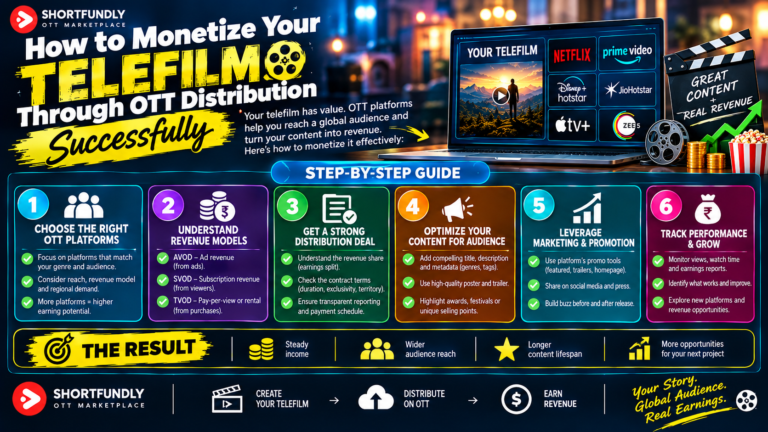
8. Monetization Models for Independent Telefilms
OTT distribution can generate revenue through different models.
SVOD
Subscription Video on Demand allows audiences to access content through a subscription service.
Producers may receive revenue through:
- Licensing
- Revenue sharing
- Minimum guarantees
- Negotiated content fees
AVOD
Advertising Video on Demand allows audiences to watch content supported by advertising.
Revenue can depend on:
- Views
- Advertising inventory
- Audience location
- Engagement
- Platform advertising rates
TVOD
Transactional Video on Demand allows viewers to pay for specific content.
The audience may rent or purchase access.
Fixed Licensing
A platform or distributor may pay a fixed licensing amount for defined rights.
This provides greater revenue predictability but may limit future upside.
Hybrid Monetization
A deal can sometimes combine licensing and revenue participation.
The exact model should always be defined in the agreement.
9. Shortfundly Distribution for Independent Producers
Independent producers can also consider specialized OTT distribution services when they need assistance with submission, delivery, and distribution workflows.
Shortfundly Distribution states that it supports content types including telefilms, short films, web series, movies, documentaries, pilot films, songs, and micro dramas. Its current distribution information also describes content review, release-asset preparation, distribution through currently available partners, and creator tracking tools.
The service also describes support around metadata, subtitles, artwork, technical preparation, OTT strategy, revenue tracking, and payouts.
Producers should still review the current terms applicable to their particular telefilm because platform availability, eligibility, pricing, and licensing conditions can change.
A distribution service should be evaluated based on:
- Current partner availability
- Applicable fees
- Contract duration
- Exclusivity
- Territories
- Revenue terms
- Technical requirements
- Reporting
- Removal provisions
The current Shortfundly submission guidance notes that approval and streaming aren’t guaranteed simply because content is submitted.
This is an important principle for all OTT distribution arrangements.
10. How to Select the Right Distribution Package
Before signing anything, independent producers should create a simple comparison sheet.
| Evaluation Area | Questions to Ask |
|---|---|
| Cost | What is the complete cost? |
| Rights | Which rights are being granted? |
| Territory | Which countries are covered? |
| Duration | How long does the agreement last? |
| Exclusivity | Is the agreement exclusive? |
| Platforms | Which current distribution partners are relevant? |
| Localization | Are subtitles or dubbing included? |
| Marketing | What promotional support is provided? |
| Revenue | How is producer revenue calculated? |
| Reporting | How often are statements provided? |
| Payments | When and how are payouts made? |
| Termination | How can the agreement end? |
| Rights Reversion | When do rights return to the producer? |
Calculate the Total Distribution Cost
Don’t compare only the headline price.
Use:
Total Cost = Upfront Fee + Localization + QC + Artwork + Delivery + Marketing + Other Approved Costs
This gives us a much clearer picture.
Evaluate the Distributor’s Actual Role
Ask what the distributor actually does after receiving the telefilm.
Does it:
- Pitch the content?
- Deliver it?
- Handle platform communication?
- Manage localization?
- Provide reports?
- Track revenue?
- Handle rights administration?
A package should be judged by its deliverables.
11. Common Mistakes Independent Producers Should Avoid
Mistake 1: Choosing the Cheapest Package
The cheapest package may not provide the services we need.
Mistake 2: Ignoring Rights Terms
A low fee isn’t useful if the contract grants broader rights than intended.
Mistake 3: Assuming Platform Placement Is Guaranteed
Distribution submission and platform acceptance aren’t the same thing.
Mistake 4: Forgetting Localization
Regional content can benefit significantly from well-produced subtitles and localized metadata.
Mistake 5: Not Checking Revenue Definitions
Always understand gross revenue, net revenue, deductions, commissions, and payment timing.
Mistake 6: Delivering Poor Technical Masters
Technical rejection can delay an otherwise successful release.
Mistake 7: Giving Vague Worldwide Rights
Territories should be clearly defined.
Mistake 8: Ignoring Post-Termination Rights
We should know what happens when the contract ends.
Mistake 9: Failing to Keep Chain-of-Title Documents
Ownership documentation can become essential during platform review.
Mistake 10: Expecting Distribution Alone to Create an Audience
A distributor can provide access and infrastructure, but producers should also support the release through appropriate promotion.
12. Pre-Submission Checklist for Independent Producers
Before selecting a telefilm OTT distribution package, we should prepare the following:
Legal Documents
- Ownership documents
- Chain of title
- Music rights
- Actor agreements
- Writer agreements
- Distribution authorization
- Required certificates or declarations
Content Assets
- Final video master
- Clean audio
- Trailer
- Poster
- Thumbnail
- Synopsis
- Logline
- Cast information
- Crew information
- Genre
- Runtime
Localization
- English subtitles
- Regional subtitles where relevant
- Subtitle files
- Localized synopsis
- Dubbing tracks if available
Commercial Information
- Rights available
- Territories
- Preferred term
- Exclusive/non-exclusive preference
- Licensing expectations
- Revenue-share expectations
Being prepared can make the distribution process much smoother.
13. Building a Long-Term OTT Distribution Strategy
A telefilm shouldn’t be treated as a one-time upload.
We should think about the title as a long-term intellectual property asset.
That means considering:
- Domestic OTT
- Regional OTT
- International OTT
- TV licensing
- TVOD
- AVOD
- Educational licensing where appropriate
- Promotional clips
- Festival exposure
- Future catalog licensing
The rights strategy should support these possibilities without creating unnecessary conflicts.
Build a Distribution Window
Some producers may prefer to release domestically first and expand internationally later.
Others may seek simultaneous distribution.
The right approach depends on:
- Audience
- Genre
- Market demand
- Contract restrictions
- Marketing resources
- Licensing opportunities
A well-planned release window can help producers avoid accidental rights conflicts.
14. FAQs About Telefilm OTT Distribution Packages
1. What is a telefilm OTT distribution package?
A telefilm OTT distribution package is a collection of services and commercial terms used to prepare, submit, deliver, monetize, and manage a telefilm across streaming or distribution platforms.
2. How much does telefilm OTT distribution cost?
There is no single standard price. Costs can depend on the distributor, runtime, content type, services, territories, localization, technical requirements, and commercial structure. Producers should compare the complete cost rather than only the advertised fee.
3. Does paying for distribution guarantee OTT placement?
No. A submission or distribution-processing fee does not automatically guarantee platform approval or streaming. Platform availability depends on eligibility, licensing, review, content suitability, and current partner arrangements. Shortfundly’s current guidance also explicitly states that submission does not guarantee selection or streaming.
4. Should I choose a fixed-fee or revenue-share package?
It depends on the producer’s objectives and contract terms. A fixed fee can provide greater cost predictability, while revenue sharing can align the distributor’s compensation with earnings. The producer should compare deductions and total expected economics.
5. Are subtitles important for regional-language telefilms?
Yes. Subtitles can make regional content accessible to audiences outside the original language market. English and other territory-specific subtitles may also support international distribution.
6. What rights should I check before signing?
Check territory, platform rights, exclusivity, duration, renewal, revenue rights, promotional rights, localization rights, TV rights, digital rights, termination, and rights reversion.
7. Can independent producers distribute telefilms without a major production house?
Yes. Independent producers can work with OTT distributors, aggregators, direct platforms, licensing representatives, or other distribution partners, provided they meet the applicable requirements and have the necessary rights.
8. Can a telefilm be distributed internationally?
Potentially, yes. International distribution depends on rights availability, platform demand, localization, technical requirements, territory restrictions, and commercial agreements.
9. What technical files are normally required?
Requirements vary by platform. They can include a high-quality video master, audio tracks, subtitles, metadata, artwork, trailer, and other delivery assets.
10. How can I compare two OTT distribution packages?
Compare total cost, services, rights, territories, exclusivity, duration, platform access, localization, revenue share, reporting, payment terms, marketing support, termination provisions, and rights reversion.
11. Is a premium distribution package always better?
Not necessarily. A premium package may include more services, but producers should pay for services that match their actual needs. The right package is the one that fits the telefilm’s distribution objectives, budget, rights, and target audience.
15. Final Takeaways for Independent Producers
The best telefilm OTT distribution packages for independent producers aren’t necessarily the cheapest or the most expensive. They are the packages that provide a clear and practical path from finished production to appropriate streaming opportunities.
Before committing, we should evaluate five major areas:
- Rights
- Cost
- Platform access
- Technical and localization support
- Revenue and reporting
We should also remember that OTT distribution is a process, not a guarantee of acceptance.
A strong telefilm still needs the right technical master, compelling metadata, accurate rights documentation, professional artwork, suitable subtitles, and a commercially sensible release strategy.
For independent producers, the biggest opportunity comes from thinking beyond a single platform. A regional-language telefilm can potentially reach domestic audiences, diaspora communities, international viewers, and specialized streaming markets when the rights and localization strategy are planned correctly.
A professional distribution partner can help simplify that journey, but the producer should remain involved in every important commercial decision.
Ultimately, a powerful OTT distribution strategy combines content quality, rights management, platform targeting, localization, transparent commercial terms, and long-term audience development.
That approach gives independent producers a stronger foundation for turning completed telefilms into valuable digital content assets.