Table of Contents
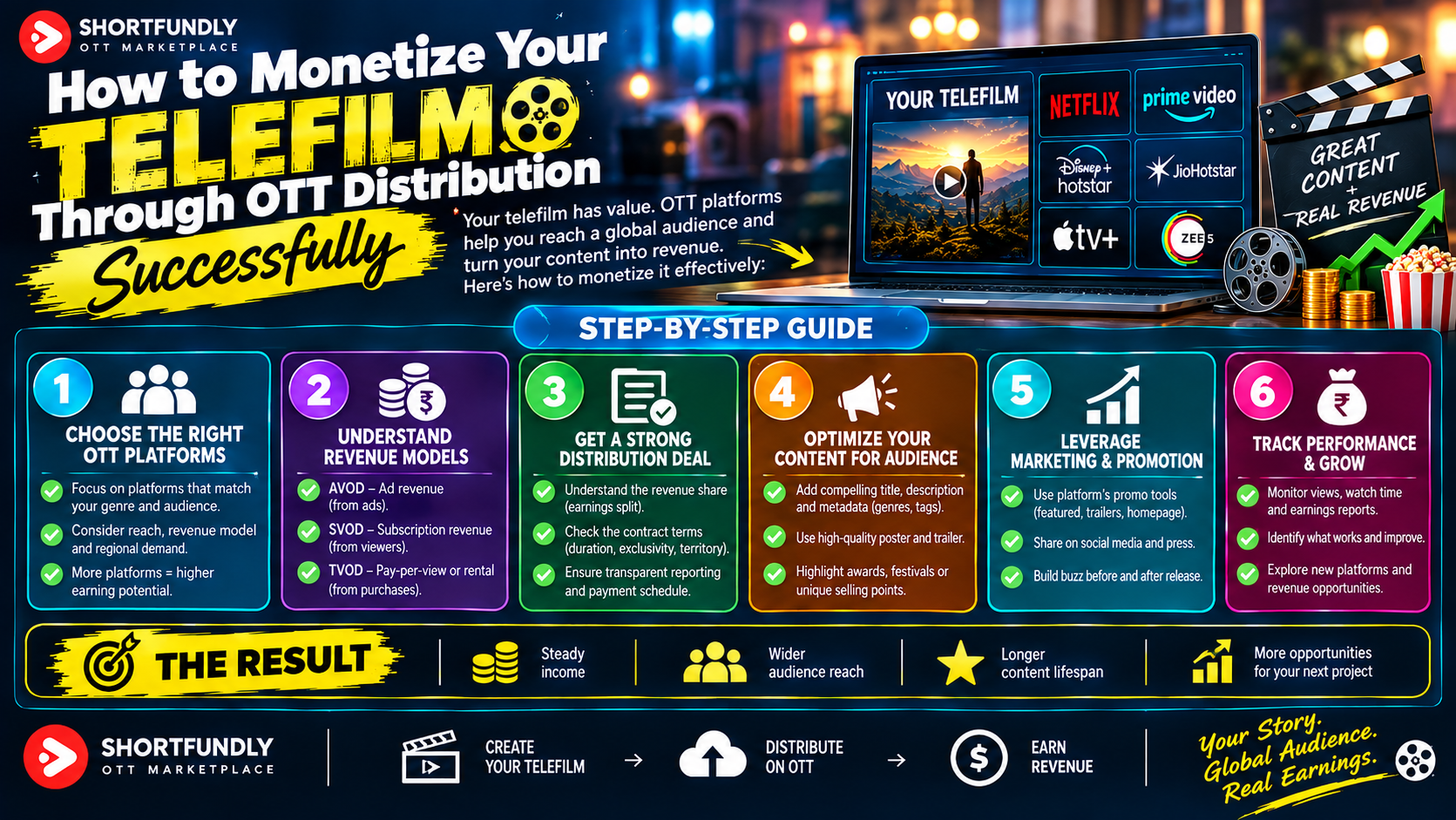
Creating a telefilm requires time, money, creativity, and careful planning. But finishing the production is only one part of the journey. The next challenge is turning the completed project into a sustainable source of income. This is where telefilm OTT monetization becomes important.
OTT distribution allows filmmakers and rights holders to make their content available to audiences through internet-based streaming services. Depending on the project, monetization can come from subscriptions, advertising, rentals, purchases, licensing fees, revenue sharing, or combinations of these models.
The good news is that filmmakers don’t always need a massive theatrical release or an established television network to explore digital monetization. With the right rights package, technical delivery, metadata, marketing strategy, and distribution agreement, an independent telefilm can be positioned for multiple digital opportunities.
However, OTT monetization isn’t simply about uploading a video and waiting for money to arrive. We need to understand the business model behind the platform, the rights being licensed, the costs being deducted, and the audience we’re trying to reach.
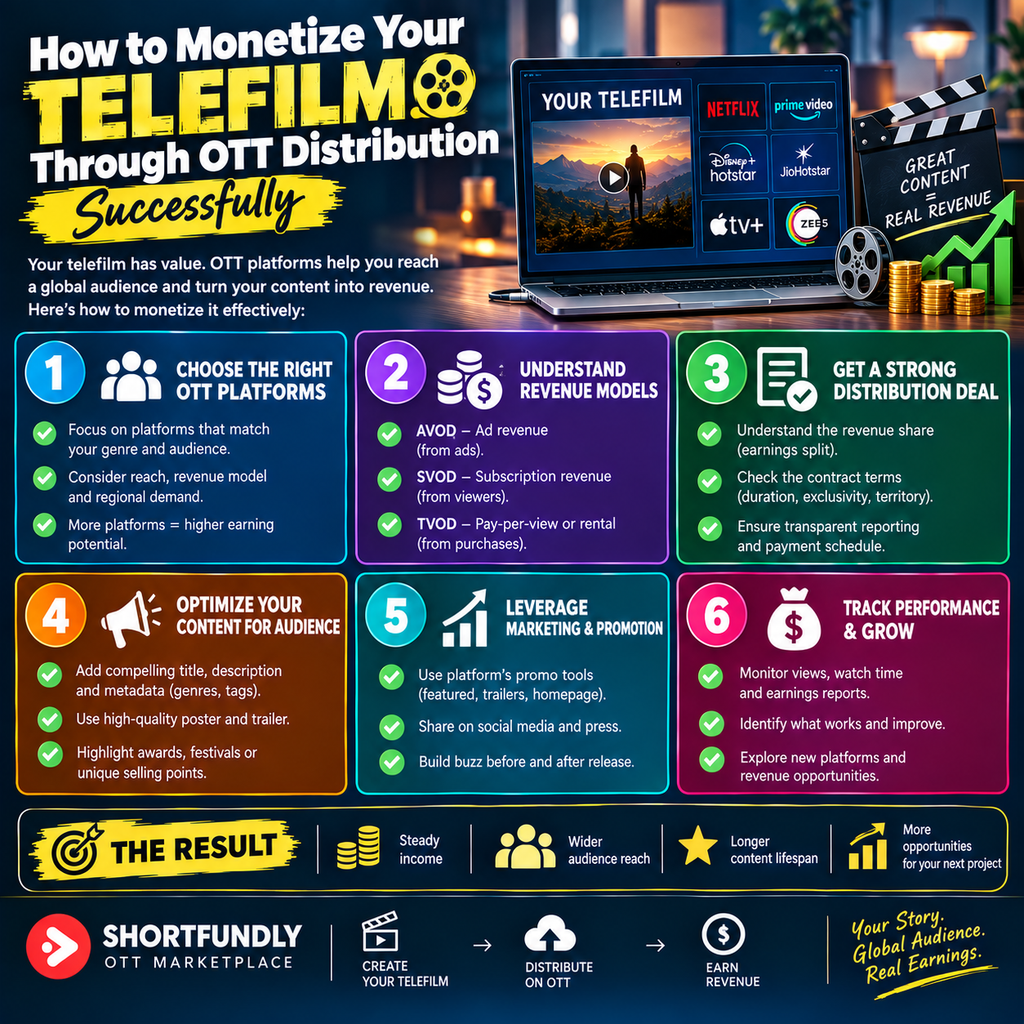
This guide explains how to monetize your telefilm through OTT distribution successfully, with practical strategies that can help filmmakers understand the process before entering a distribution deal.
What Does Telefilm OTT Monetization Mean?
Telefilm OTT monetization means generating revenue from a telefilm through internet-based distribution and streaming channels.
Instead of depending only on theatrical tickets, television broadcasts, or physical media, the rights holder can explore digital revenue opportunities.
Common monetization methods include:
- SVOD — Subscription Video on Demand
- AVOD — Advertising Video on Demand
- TVOD — Transactional Video on Demand
- Fixed licensing fees
- Minimum guarantees
- Revenue-sharing agreements
- Hybrid distribution arrangements
- International licensing
- Digital rental
- Digital purchase
Each model works differently.
For example, under an SVOD model, viewers generally access content as part of a subscription service. Under AVOD, advertising can generate revenue around or during content consumption. TVOD usually involves viewers paying for individual rentals or purchases.
A distributor may also license a telefilm to a platform for a negotiated fee rather than relying entirely on advertising or subscription-based revenue.
The right approach depends on the telefilm’s genre, audience, language, territory, production quality, rights availability, commercial demand, and distribution strategy.
Why OTT Distribution Can Create Monetization Opportunities
OTT platforms have changed the way audiences discover and consume films and other video content. Viewers can watch content on smart TVs, mobile phones, tablets, computers, and connected devices.
For filmmakers, this creates a wider potential audience.
A telefilm can potentially reach:
- Local viewers
- Regional audiences
- Diaspora communities
- International viewers
- Genre-specific audiences
- Language-specific audiences
- Niche streaming audiences
However, reach alone doesn’t guarantee revenue.
A successful monetization strategy connects content + audience + platform + rights + business model.
We should therefore avoid choosing a platform only because it has a large audience. The platform’s audience should make sense for our telefilm.
For example, a regional-language telefilm may have a stronger commercial opportunity with audiences who actively seek that language than with a general platform where the title receives little visibility.
This is why audience-platform fit is one of the most important concepts in OTT distribution.
Understand the Main OTT Revenue Models
Before signing a distribution agreement, we should understand how money can be generated.
SVOD: Subscription Video on Demand
SVOD platforms earn revenue primarily through subscriptions.
A viewer pays a recurring fee to access a catalog of content. The platform then decides how content owners or distributors are compensated according to the applicable commercial agreement.
A telefilm may be licensed under a fixed fee, revenue-sharing arrangement, or another negotiated structure.
SVOD can be useful for content that fits the platform’s subscriber interests.
However, producers should not assume that more views automatically mean more direct revenue. The agreement determines how compensation is calculated.
AVOD: Advertising Video on Demand
AVOD allows audiences to watch content while advertisements generate revenue.
Depending on the arrangement, advertising revenue may be shared between the platform, distributor, and rights holder.
AVOD can make content accessible to audiences who don’t want to pay a subscription or rental fee.
This model may work particularly well when a telefilm has broad audience appeal and can attract significant viewing activity.
TVOD: Transactional Video on Demand
TVOD allows viewers to pay for individual content.
The payment may be structured as a rental or purchase.
For example, a viewer could pay a specific amount to access a telefilm for a limited period or purchase access under the platform’s terms.
TVOD can work well for special releases, premium content, event-driven films, and audiences willing to pay directly for specific titles.
Fixed Licensing Fee
Under a fixed licensing arrangement, the distributor or platform pays an agreed amount for specified rights.
This approach can provide greater revenue certainty because payment isn’t entirely dependent on future viewership.
However, the rights holder should carefully examine:
- License duration
- Territory
- Exclusivity
- Rights granted
- Renewal
- Platform scope
- Payment schedule
A higher upfront payment isn’t automatically better if the agreement grants broader rights for a very long period.
Minimum Guarantee
A minimum guarantee, where offered, establishes a minimum payment under specified contractual conditions.
The exact structure varies by deal.
Before signing, we should understand whether the minimum guarantee is:
- Recoupable
- Non-recoupable
- Offset against future revenue
- Conditional
- Territory-specific
- Platform-specific
The contract should define these terms clearly.
Revenue Sharing: How It Works
Revenue sharing is one of the most important areas in telefilm OTT monetization.
Under a revenue-sharing arrangement, the rights holder receives an agreed portion of qualifying revenue.
A simplified example might look like:
Platform Revenue → Approved Deductions → Distributor Share → Rights Holder Share
The actual structure can be more complicated.
For this reason, never rely solely on a percentage mentioned during a sales conversation.
We should ask:
- What does gross revenue mean?
- What deductions are permitted?
- Is the distributor’s commission calculated before or after expenses?
- Who pays payment-processing costs?
- Are taxes deducted?
- Are marketing expenses deductible?
- Are localization costs deductible?
- How often are statements issued?
- When are payments made?
- Can the producer audit the accounts?
Consider a hypothetical example.
Suppose a telefilm generates ₹100,000 in qualifying revenue. If the contract permits ₹20,000 in specified deductions and then applies a distribution commission, the rights holder’s actual payment may be significantly different from simply receiving a percentage of ₹100,000.
That’s why the definition of revenue can matter more than the headline percentage.
Read the OTT Distribution Agreement Before Signing
A telefilm distribution agreement can determine how successfully the project is monetized.
Important clauses include:
Rights
Identify every right being granted.
These may include:
- Streaming
- VOD
- Television
- Mobile
- Digital
- Promotional
- International
- Dubbed versions
- Subtitled versions
Territory
Does the distributor receive rights for:
- India?
- Specific countries?
- Asia?
- Worldwide?
Term
Check exactly how long the rights remain with the distributor.
Exclusivity
Determine whether the arrangement is exclusive or non-exclusive.
Revenue
Understand the calculation method, not just the percentage.
Fees
Identify all upfront and recurring charges.
Reporting
Check how frequently financial statements are provided.
Termination
Understand what happens if either party ends the agreement.
Rights Reversion
Confirm when the rights return to the producer or rights holder.
This is particularly important when planning future distribution opportunities.
Prepare Your Telefilm Before Monetization
A strong monetization strategy begins before distribution.
We should make the telefilm as commercially and technically ready as possible.
1. Secure Your Rights
Confirm that you control the necessary rights.
This includes rights related to:
- Story
- Screenplay
- Direction
- Performers
- Music
- Lyrics
- Sound recordings
- Locations
- Artwork
- Third-party materials
2. Prepare a Professional Master
Use a high-quality final master that meets the distributor’s delivery specifications.
Poor video or audio quality can create technical delays.
3. Create Accurate Metadata
Prepare:
- Title
- Logline
- Synopsis
- Genre
- Language
- Runtime
- Cast
- Crew
- Production year
- Keywords
- Credits
Accurate metadata helps distributors and platforms understand the content.
4. Prepare Subtitles
Subtitles can expand the potential audience.
For international distribution, localization can be especially valuable.
5. Create Professional Artwork
Prepare:
- Poster
- Thumbnail
- Landscape artwork
- Promotional stills
- Trailer artwork
6. Prepare a Trailer
A concise trailer can help buyers and audiences understand the telefilm quickly.
Choose the Right Distribution Partner
Choosing a distributor should be based on the actual services and contractual terms rather than marketing claims alone.
We should compare:
| Factor | Questions to Ask |
|---|---|
| Platform reach | Which platforms can receive the content? |
| Territory | Where can the content be distributed? |
| Fees | What charges apply? |
| Commission | What percentage is retained? |
| Rights | Which rights are requested? |
| Exclusivity | Is the deal exclusive? |
| Reporting | How often are statements issued? |
| Marketing | What promotional support is included? |
| Localization | Who pays for subtitles or dubbing? |
| Term | How long does the agreement last? |
| Termination | How can the agreement end? |
| Payments | When will revenue be paid? |
A distributor should be evaluated according to the actual agreement and services available for the particular project.
Explore Shortfundly Distribution
For filmmakers researching telefilm OTT distribution, Shortfundly Distribution is one option to explore.
The service provides a distribution route for different categories of video content and can help rights holders pursue OTT distribution opportunities.
Before submitting a project, filmmakers should review the current requirements, commercial terms, content eligibility, and distribution process applicable to their telefilm.
When considering any distribution service, we recommend reviewing the agreement carefully and confirming exactly which rights are granted, what fees apply, how revenue is calculated, and what happens after the agreement ends.
Distribution availability can vary by project, territory, platform, and commercial arrangement, so creators shouldn’t assume that every telefilm will receive identical platform coverage.
Don’t Ignore International Monetization
One of the most useful ways to expand a telefilm’s earning potential is to consider international audiences.
A telefilm may have potential audiences among:
- Indian diaspora communities
- Regional-language audiences overseas
- South Asian viewers
- Genre communities
- Language-learning audiences
- International independent-film viewers
International monetization requires careful rights planning.
We should consider whether the agreement covers:
- Worldwide streaming
- Specific international territories
- Foreign-language subtitles
- Dubbing
- International advertising
- International licensing
- TV rights
- Mobile rights
A distributor may also propose licensing the telefilm separately across different territories.
However, international rights should not be granted casually. If the producer expects to pursue separate territorial licensing opportunities later, broad worldwide exclusivity could limit those options.
Improve Monetization Through Localization
Localization isn’t limited to translating subtitles.
It can include:
- Traditional or simplified Chinese subtitles
- English subtitles
- Spanish subtitles
- Arabic subtitles
- Regional-language subtitles
- Dubbing
- Localized metadata
- Localized promotional artwork
The appropriate localization depends on the target audience.
We shouldn’t spend heavily on every possible language without first identifying a realistic audience or distribution opportunity.
A targeted localization strategy is usually more practical.
Build an Audience Before Release
OTT monetization becomes easier to understand when we think beyond distribution.
Audience development can begin before the release.
Useful promotional assets include:
- Teaser
- Trailer
- Poster
- Character introduction
- Behind-the-scenes clips
- Director interview
- Cast interviews
- Short social-media videos
- Production stories
- Release announcements
The objective isn’t simply to generate likes.
The objective is to create awareness among people who are likely to watch the telefilm.
A small but relevant audience can be valuable, especially for niche or regional content.
Use Multiple Monetization Channels Carefully
A telefilm doesn’t always have to depend on one source of income.
Subject to the rights granted under existing agreements, a project may potentially generate revenue through:
- OTT licensing
- AVOD
- SVOD
- TVOD
- Television licensing
- International licensing
- Promotional partnerships
- Digital rentals
- Other authorized digital exploitation
However, we need to avoid double-selling the same exclusive rights.
If a distributor receives exclusive worldwide OTT rights, for example, the producer may not be able to independently license the same rights elsewhere during the contract term.
This is why rights management and monetization strategy must work together.
Common Telefilm OTT Monetization Mistakes
Even a strong telefilm can face commercial difficulties if the distribution strategy isn’t planned carefully.
Mistake 1: Focusing Only on the Platform Name
A famous platform doesn’t automatically mean a suitable commercial deal.
Mistake 2: Ignoring Revenue Definitions
A percentage is meaningless if we don’t understand what the percentage is applied to.
Mistake 3: Accepting Long Exclusivity Without Review
Long exclusive terms can restrict future opportunities.
Mistake 4: Forgetting International Rights
Creators sometimes grant worldwide rights without considering future territorial licensing.
Mistake 5: Underestimating Marketing
Publishing content doesn’t automatically create an audience.
Mistake 6: Ignoring Localization
A lack of subtitles can restrict discoverability among audiences who don’t speak the original language.
Mistake 7: Not Checking Deductions
Marketing, platform, localization, tax, and other deductions can affect the final payment.
Mistake 8: Assuming Guaranteed Revenue
OTT performance varies. Unless the agreement contains a guaranteed payment, future earnings shouldn’t be treated as guaranteed.
Mistake 9: Poor Rights Documentation
Unclear music, screenplay, performer, or third-party rights can delay distribution.
Mistake 10: Signing Without Understanding Termination
Always know how the agreement ends and how rights return.
A Step-by-Step Telefilm OTT Monetization Strategy
We can organize the process into eleven practical steps.
Step 1: Establish Ownership
Confirm that all required rights are controlled.
Step 2: Complete the Master
Prepare the required video and audio files.
Step 3: Build the Legal Package
Organize contracts, licenses, releases, and copyright documentation.
Step 4: Create Metadata
Prepare professional and consistent information.
Step 5: Prepare Subtitles
Create accurate subtitle files for the intended audience.
Step 6: Develop Artwork
Create platform-ready promotional assets.
Step 7: Identify Target Audiences
Determine who is most likely to watch the telefilm.
Step 8: Research Distribution Options
Compare relevant distributors and platforms.
Step 9: Compare Commercial Terms
Review fees, revenue share, licensing fees, term, territory, and exclusivity.
Step 10: Negotiate Carefully
Clarify uncertain clauses before signing.
Step 11: Track Performance
After release, review revenue statements, audience data, platform availability, and marketing performance where such information is provided under the agreement.
How to Estimate Potential OTT Earnings
We should avoid assuming that a telefilm has a fixed OTT value.
Potential earnings depend on multiple variables, including:
- Genre
- Audience demand
- Production quality
- Cast
- Language
- Territory
- Platform
- Rights package
- Exclusivity
- Contract duration
- Revenue model
- Marketing
- Viewing activity
A simple financial planning framework is:
Estimated Revenue = Platform/License Revenue − Contractually Permitted Deductions − Applicable Distribution Fees
The exact calculation should always follow the signed agreement.
For revenue-sharing deals, we should also examine the timing of payments.
A telefilm may generate revenue in one month but receive payment later because platforms and distributors often operate according to settlement and reporting cycles.
Pre-Release Monetization Checklist
Before submitting your telefilm, confirm the following:
Rights
- Story rights secured
- Screenplay rights secured
- Music rights secured
- Performer agreements completed
- Location permissions completed
- Third-party materials cleared
Technical
- Final master completed
- Audio checked
- Subtitle files prepared
- Trailer prepared
- Poster prepared
- Thumbnail prepared
Metadata
- Title confirmed
- Synopsis written
- Logline prepared
- Cast information verified
- Crew information verified
- Runtime confirmed
- Genre confirmed
- Language confirmed
Commercial
- Revenue model understood
- Distribution fee checked
- Revenue share checked
- Deductions identified
- Payment schedule understood
- Territory reviewed
- Exclusivity reviewed
- Contract term reviewed
- Termination clause reviewed
- Rights reversion reviewed
Frequently Asked Questions
1. Can an independent filmmaker monetize a telefilm through OTT distribution?
Yes. Independent filmmakers can explore OTT monetization when they have the required rights, suitable technical materials, and a distribution opportunity that fits the project. Platform acceptance and commercial terms vary.
2. What is the most common OTT monetization model?
There isn’t one universal model. SVOD, AVOD, TVOD, fixed licensing, minimum guarantees, and revenue sharing are all used in different arrangements.
3. Is revenue sharing better than a fixed licensing fee?
These structures work differently and should be evaluated according to the project’s goals and the contract. A fixed fee can provide greater certainty, while revenue sharing may connect earnings to future performance. The agreement’s definitions and deductions are important in either case.
4. How can I increase my telefilm’s OTT earning potential?
Focus on professional production quality, clear rights, accurate metadata, strong artwork, subtitles, appropriate platform selection, audience development, and careful negotiation of distribution terms.
5. Should I give worldwide OTT rights?
That depends on the project and agreement. Worldwide rights can simplify distribution, but they can also restrict separate territorial opportunities if granted exclusively. Review territory, term, exclusivity, and rights reversion carefully.
6. Can subtitles increase OTT monetization opportunities?
Subtitles can make content accessible to additional audiences and may be required by particular platforms. The commercial benefit depends on the target audience and distribution opportunity.
7. Does OTT distribution guarantee revenue?
No. Unless the agreement provides a guaranteed payment, OTT distribution shouldn’t be treated as guaranteed income. Revenue can depend on licensing terms, viewing activity, advertising, subscriptions, transactions, or other commercial conditions.
8. What should I check in a revenue-sharing agreement?
Check the definition of gross and net revenue, deductions, distributor commissions, taxes, reporting frequency, payment timing, audit provisions, and any minimum payment requirements.
9. Can I distribute my telefilm on multiple OTT platforms?
Potentially, depending on your rights arrangement. A non-exclusive agreement may permit multiple distribution opportunities, while an exclusive agreement may restrict them. Always check the contract before granting additional rights.
10. Is a distributor necessary for OTT monetization?
Not always. Some platforms accept direct submissions or licensing proposals, while distributors and aggregators can provide additional services and access to distribution networks. The appropriate route depends on the project and available opportunities.
11. How does Shortfundly Distribution help filmmakers?
Shortfundly Distribution provides a route for creators and rights holders to explore OTT distribution for eligible content. Current services, platform coverage, pricing, and requirements should be checked directly with the distributor for the specific project.
Also read: https://blog.shortfundly.com/ott/telefilm-ott-technical-specs/
Conclusion
Telefilm OTT monetization requires more than simply finding a streaming platform. We need to combine strong content, clean rights, professional delivery materials, suitable distribution partners, audience targeting, and a carefully reviewed commercial agreement.
The main revenue options include SVOD, AVOD, TVOD, fixed licensing fees, minimum guarantees, and revenue sharing. Each has different financial characteristics, and none should be selected without considering the telefilm’s audience, rights position, territory, and long-term goals.
Before signing a distribution agreement, pay close attention to revenue definitions, deductions, fees, exclusivity, territory, contract duration, reporting, termination, and rights reversion.
We should also prepare the telefilm professionally before approaching distributors. A strong master, accurate metadata, subtitles, artwork, trailer, and complete rights documentation can make the project easier to evaluate and deliver.
For creators considering an OTT distribution route, Shortfundly Distribution can be explored as one potential distribution option. However, the current commercial terms and distribution opportunities should always be reviewed for the specific telefilm.
Ultimately, successful OTT monetization comes from treating the telefilm as both a creative work and a digital business asset. When we understand our rights, audience, revenue model, and distribution agreement, we can make better-informed decisions about how to take the telefilm from completed production to sustainable digital distribution.