Table of Contents
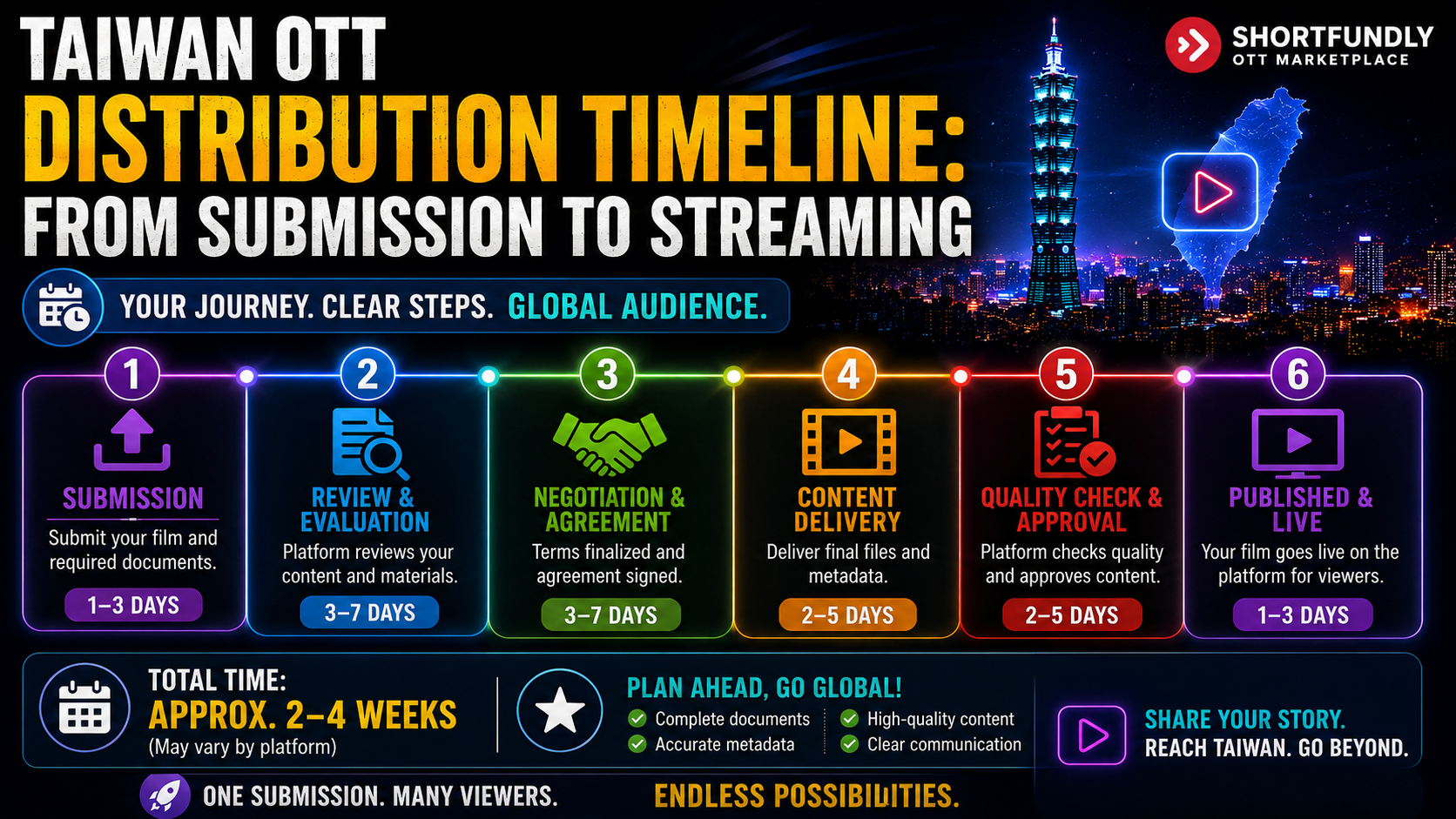
Taiwan OTT distribution timeline, from film submission and rights review to localization, technical delivery, platform approval, and final streaming release.
Getting an independent film onto a Taiwan OTT platform is a process rather than a single submission. We need to prepare the film, confirm rights, create professional metadata, complete localization, pass technical checks, and coordinate the final release.
The exact timeline varies by distributor, platform, content type, territory, and contract. However, understanding each stage helps us plan a realistic release schedule and avoid preventable delays.
For filmmakers exploring international OTT distribution, Shortfundly Distribution – Distribute Your Short Film on Top OTTs offers a distribution route for short films, documentaries, web series, pilot films, and other independent content. Its distribution portal states that its team pitches content to a global network of OTT and television platforms and provides revenue tracking and payouts.
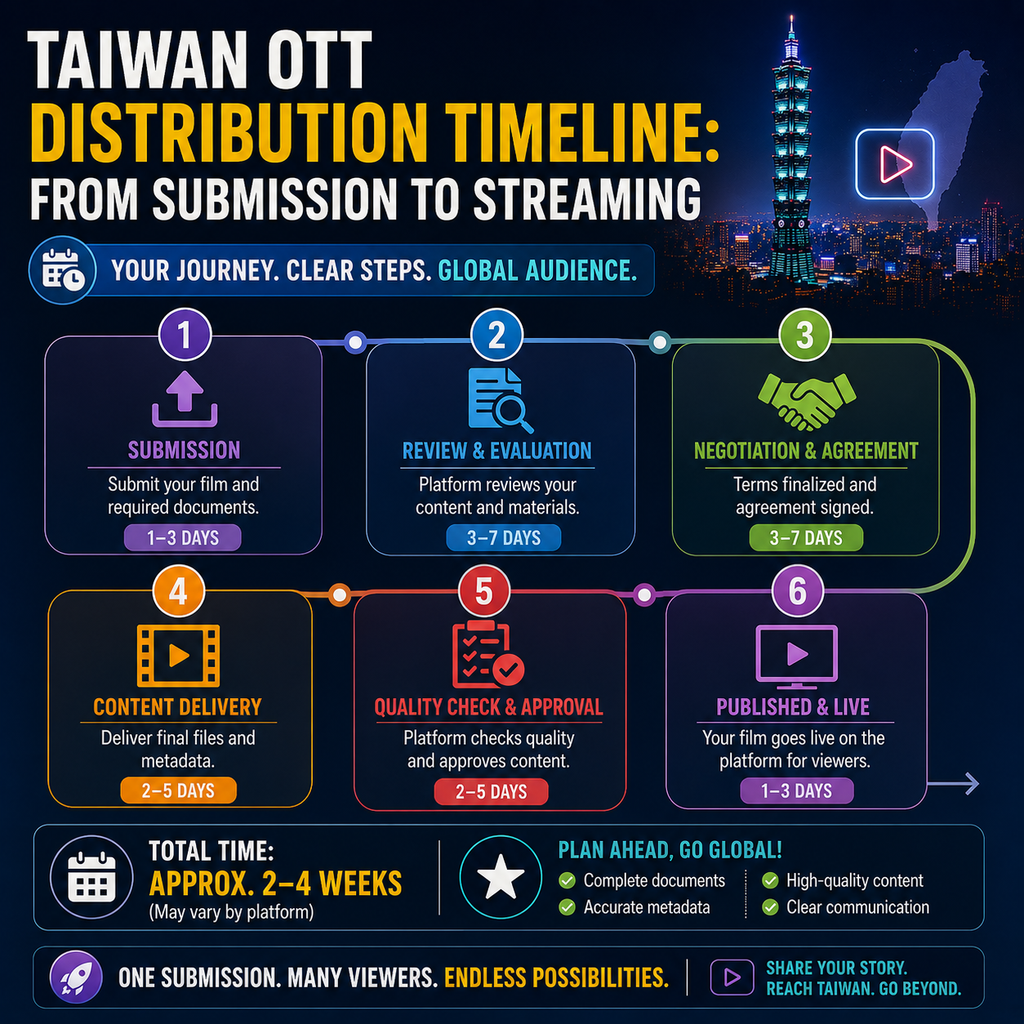
Taiwan OTT Distribution Timeline at a Glance
A typical workflow can be divided into these stages:
| Stage | Main Activity | Typical Planning Window |
|---|---|---|
| 1 | Project preparation | 1–2 weeks |
| 2 | Submission | 1–3 days |
| 3 | Initial review | Several days to a few weeks |
| 4 | Rights verification | 1–3 weeks |
| 5 | Buyer pitching | 2–8+ weeks |
| 6 | Commercial negotiation | 1–4 weeks |
| 7 | Localization | 1–4 weeks |
| 8 | Technical delivery | Several days to 2 weeks |
| 9 | Platform QC | 1–3 weeks |
| 10 | Scheduling | 1–4 weeks |
| 11 | Streaming launch | Release date |
These are planning estimates, not guaranteed platform timelines. Some titles move faster, while others take considerably longer.
1. Prepare Your Film Before Taiwan OTT Submission
The timeline starts before we send the film anywhere.
A distributor or OTT buyer needs a project that is commercially and technically ready for evaluation.
We should prepare:
- Final film master
- Trailer
- Poster
- Film stills
- Logline
- Short synopsis
- Long synopsis
- Cast and crew details
- Director biography
- Production information
- Genre
- Runtime
- Original language
- Subtitle files
- Awards and festival information
- Rights documentation
Shortfundly’s distribution materials similarly recommend preparing high-quality video and audio, copyright and distribution rights, subtitles, metadata, posters, and thumbnails before distribution.
Why Preparation Affects the Timeline
Incomplete submissions create unnecessary back-and-forth.
For example, if a distributor requests a subtitle file and we don’t have one, the project may pause while localization is completed.
Therefore, the fastest OTT release is usually the one that begins with a complete delivery package.
2. Submit the Film to the Distribution Partner
Once the project is ready, we submit the film and its basic information.
The distributor may request a private screener rather than the final master during the initial evaluation.
At this stage, we should provide:
- Film title
- Screener link
- Trailer
- Synopsis
- Genre
- Runtime
- Language
- Country
- Cast and crew
- Festival history
- Contact details
- Rights information
Some distributors have their own submission workflows.
For example, Shortfundly’s published materials describe an internal review process for submitted films and say that accepted projects can then be matched with suitable distribution platforms.
3. Initial Creative and Legal Review
After submission, the project may undergo an internal review.
The review can cover both creative suitability and rights ownership.
A distributor may examine:
- Story quality
- Production quality
- Audience suitability
- Runtime
- Genre
- Technical quality
- Copyright ownership
- Music rights
- Performer permissions
- Existing distribution agreements
This is an important stage because a technically excellent film can still face problems if the rights aren’t properly documented.
Shortfundly states that its internal review includes creative and legal considerations and that its published process has historically taken around 7–10 business days for that review.
However, we should always confirm the current processing time directly with the distributor.
4. Rights Verification for Taiwan
Once the content passes initial evaluation, territory rights become particularly important.
We should be able to answer:
Who owns the Taiwan digital rights?
The distributor or buyer may need confirmation that the filmmaker has authority to license:
- OTT rights
- Streaming rights
- Download rights
- Mobile rights
- TV rights
- Subtitle rights
- Promotional rights
We should also identify existing licenses.
For example, if another company already holds exclusive Taiwan OTT rights, a new distributor may not be able to license the film.
Rights Documentation Can Include
- Copyright registration
- Chain-of-title documents
- Producer agreement
- Music licenses
- Actor releases
- Location releases
- Distribution agreements
- Previous licensing contracts
Getting these documents ready early can save significant time.
5. Taiwan OTT Buyer Pitching
After approval, the distribution partner may pitch the film to relevant platforms.
This is where the timeline can become less predictable.
A distributor may need to identify:
- Suitable OTT buyers
- Genre-specific platforms
- Regional services
- Short-form services
- Documentary platforms
- Mobile-first platforms
- International services operating in Taiwan
There isn’t necessarily a fixed response time.
A buyer may respond quickly, request additional information, or decide that the project isn’t suitable for its current programming strategy.
Therefore, submission approval by a distributor doesn’t necessarily mean immediate OTT placement.
6. Commercial Negotiation and Licensing
If an OTT buyer is interested, commercial discussions can begin.
The parties may negotiate:
- License fee
- Revenue share
- Minimum guarantee
- Territory
- Exclusivity
- License period
- Platform rights
- Language rights
- Marketing rights
- Release window
This stage can take days or several weeks.
We should never judge a deal solely by its headline payment.
A contract with a higher upfront amount may include broader rights or longer exclusivity.
Conversely, a revenue-share arrangement may provide continuing income but less predictable short-term revenue.
7. Traditional Chinese Localization
For Taiwan-focused distribution, localization can become a major timeline component.
Depending on the buyer’s requirements, we may need:
- Traditional Chinese subtitles
- Traditional Chinese title
- Localized synopsis
- Localized metadata
- Subtitle quality control
- Promotional copy
Translation should be reviewed carefully.
A literal translation may not communicate the intended meaning of dialogue, humor, cultural references, or film terminology.
Localization Timeline
A simple subtitle project can move quickly when a clean dialogue list and high-quality source material are available.
More complex projects can take longer when:
- Dialogue is unclear
- Multiple languages are spoken
- Technical terminology is extensive
- Subtitle timing needs extensive correction
- Additional QC is required
Therefore, localization should begin as soon as the requirements are known.
8. Prepare Taiwan OTT Metadata
Metadata is another important part of delivery.
We should prepare:
- Original title
- Traditional Chinese title
- Logline
- Short synopsis
- Long synopsis
- Genre
- Keywords
- Runtime
- Country
- Language
- Cast
- Crew
- Director
- Production year
- Awards
- Subtitle languages
The metadata should match the actual film.
Inconsistent titles or incorrect runtime information can create additional QC questions.
Metadata Quality Checklist
Before delivery, we should verify:
- Title spelling
- Localized title
- Synopsis accuracy
- Genre
- Runtime
- Cast names
- Crew names
- Language
- Country
- Keywords
- Age classification
- Awards
- Rights information
9. Technical Master Delivery
Once the commercial and metadata requirements are settled, the platform may request the final master.
The required specifications vary by platform.
Potential requirements include:
- Video resolution
- Frame rate
- Codec
- Container
- Audio configuration
- Subtitle format
- Closed captions
- Aspect ratio
- Loudness requirements
- Artwork dimensions
We should never assume that one technical specification works for every OTT service.
The buyer’s latest delivery specification should take priority.
10. OTT Quality Control
After delivery, the platform or distributor may conduct technical QC.
This can identify problems such as:
- Audio synchronization
- Missing subtitles
- Subtitle timing errors
- Incorrect aspect ratio
- Video artifacts
- Audio distortion
- Missing scenes
- Incorrect metadata
- Artwork problems
- Encoding issues
If a problem is discovered, the master may need to be corrected and delivered again.
This is one reason we shouldn’t schedule an OTT premiere immediately after sending the master.
11. Platform Approval and Release Scheduling
Once QC is complete, the platform can schedule the title.
The release date may depend on:
- Platform programming calendar
- Marketing plans
- Content category
- Regional campaigns
- Licensing window
- Promotional events
- Availability of artwork
- Subtitle completion
A platform may approve the title but still schedule its release weeks later.
Therefore, approval and streaming availability are two different milestones.
12. Marketing and Promotional Preparation
Before launch, promotional materials should be ready.
We can prepare:
- Trailer
- Teaser
- Social media clips
- Poster
- Thumbnail
- Director interview
- Cast interview
- Behind-the-scenes content
- Press release
- Festival laurels
The goal is to create awareness before viewers can stream the title.
A distributor may provide some promotional services, but these should be confirmed in writing.
Shortfundly’s current distribution materials describe promotional and audience-engagement services as part of its broader filmmaker ecosystem.
13. Final Streaming Launch
The project reaches its final stage when the title becomes available to viewers.
At launch, we should verify:
- Film title
- Artwork
- Synopsis
- Subtitles
- Runtime
- Audio
- Territory availability
- Trailer
- Age classification
We should also check the title from an ordinary viewer’s perspective.
If the film is difficult to find, incorrectly categorized, or displayed with incorrect metadata, we should report the issue through the appropriate distributor or platform channel.
14. Post-Release Revenue and Reporting
OTT distribution doesn’t necessarily end when the film goes live.
Depending on the commercial model, we may receive information about:
- Views
- Transactions
- Advertising revenue
- Subscription allocation
- Licensing income
- Territory performance
- Revenue share
The exact reporting schedule depends on the contract.
Shortfundly’s distribution portal currently describes revenue tracking through a personalized dashboard and monthly payouts, while an older published distribution FAQ describes quarterly revenue reporting for a particular agreement.
This illustrates an important point:
We should rely on the current agreement and current commercial terms rather than assuming an old published schedule applies to every new deal.
How Long Does Taiwan OTT Distribution Take?
There is no universal timeline.
A simple project with complete rights, subtitles, metadata, and technical assets may progress relatively quickly.
A project requiring localization, rights clarification, buyer negotiations, and multiple rounds of technical QC can take substantially longer.
A practical planning range is:
Fast Scenario
4–8 weeks
Possible when the film is complete, rights are clear, localization is ready, and the buyer responds quickly.
Typical Scenario
2–4 months
This provides more realistic planning space for review, pitching, negotiation, localization, delivery, QC, and scheduling.
Complex Scenario
4–6+ months
This can occur when several buyers are involved, rights need clarification, localization is extensive, or the platform has a longer programming cycle.
These are planning ranges rather than guaranteed delivery times.
How to Make Taiwan OTT Distribution Faster
We can reduce avoidable delays by following a simple strategy.
Create an OTT Master Folder
Keep everything organized in one location.
Suggested folders:
01_Film_Master
02_Trailer
03_Poster
04_Stills
05_Metadata
06_Subtitles
07_Legal
08_Cast_Crew
09_Festival_Awards
10_Technical_Specifications
This makes delivery faster when the distributor requests additional assets.
Prepare Traditional Chinese Assets Early
Don’t wait until the platform has already requested localization.
If Taiwan is a priority territory, preparing localization resources early can shorten the final delivery stage.
Keep Rights Documentation Ready
Rights problems can cause more serious delays than technical problems.
We should therefore maintain a complete chain-of-title package.
Build a Flexible Release Window
Instead of announcing a precise premiere date before the platform approves the title, we should create a realistic release window.
This gives the distributor and buyer room to complete QC and scheduling.
Taiwan OTT Distribution Timeline Checklist
Before submission:
- Final film completed
- Master checked
- Trailer completed
- Poster completed
- Metadata completed
- Traditional Chinese localization planned
- Rights confirmed
- Music licenses confirmed
- Cast releases confirmed
- Festival information documented
During distribution:
- Initial review completed
- Rights verification completed
- Taiwan buyer identified
- Pitch submitted
- Commercial terms negotiated
- Agreement signed
- Localization completed
- Technical master delivered
- QC completed
- Release date confirmed
After release:
- Platform listing checked
- Audience response monitored
- Revenue reports reviewed
- Payments tracked
- Rights window monitored
Frequently Asked Questions
How quickly can a film get onto Taiwan OTT platforms?
There is no fixed timeline. A well-prepared project can potentially move within several weeks, while complex licensing and localization can take several months.
Does distributor approval mean the film is guaranteed to stream in Taiwan?
No. Distributor acceptance and OTT platform acquisition are separate steps. A distributor may evaluate and pitch a project, while the final platform decision depends on the buyer.
Do we need Traditional Chinese subtitles?
Requirements vary by platform. However, Traditional Chinese subtitles can be important when targeting Taiwanese audiences and should be planned early.
Can a short film be distributed to Taiwan OTT platforms?
Yes, depending on the distributor and platform. Short films, documentaries, pilots, and other independent formats may be considered by suitable services.
What causes the biggest OTT distribution delays?
Common causes include incomplete rights documentation, missing subtitles, technical problems, incomplete metadata, slow commercial negotiations, and platform scheduling.
Can we submit a film to festivals while pursuing OTT distribution?
Potentially, but the answer depends on the distribution agreement and the rights granted. We should check exclusivity and festival-related clauses before committing.
Does Shortfundly distribute films internationally?
Shortfundly’s current distribution portal says its sales team pitches content to a global network of OTT and TV broadcast platforms. Specific Taiwan availability should be confirmed for the individual project.
Also read: https://blog.shortfundly.com/ott/pilot-film-metadata-ott/
Conclusion
The Taiwan OTT distribution timeline is best understood as a sequence of stages: preparation, submission, review, rights verification, buyer pitching, negotiation, localization, technical delivery, QC, scheduling, and streaming.
The most effective way to reduce delays is to prepare everything before the first submission. A complete master, accurate metadata, clear rights documents, professional artwork, and localization-ready assets can make the process much smoother.
For filmmakers considering an international distribution route, Shortfundly Distribution can be evaluated alongside other distribution options. Its current portal describes OTT pitching, revenue tracking, and creator payouts, but the applicable terms, platform availability, and timeline should always be confirmed for the specific project.
The key is simple: don’t plan your Taiwan OTT premiere around the day you submit your film. Plan backward from your desired release window and leave enough time for every stage between submission and streaming.