Table of Contents
Learn how Taiwan OTT distribution for independent filmmakers works in 2026, including platform strategy, rights, localization, metadata, pricing, delivery, revenue models, and distribution partners such as Shortfundly Distribution.
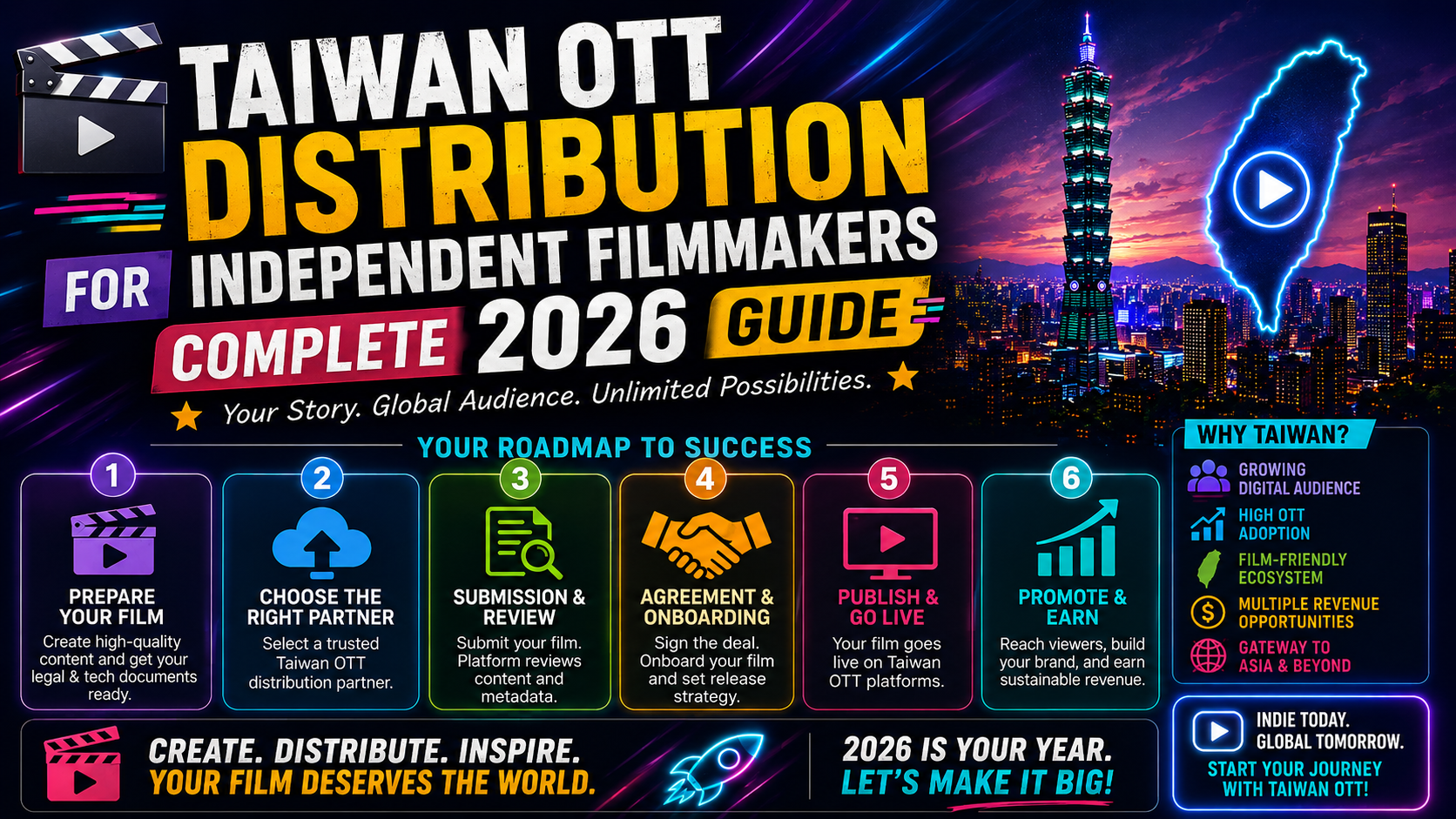
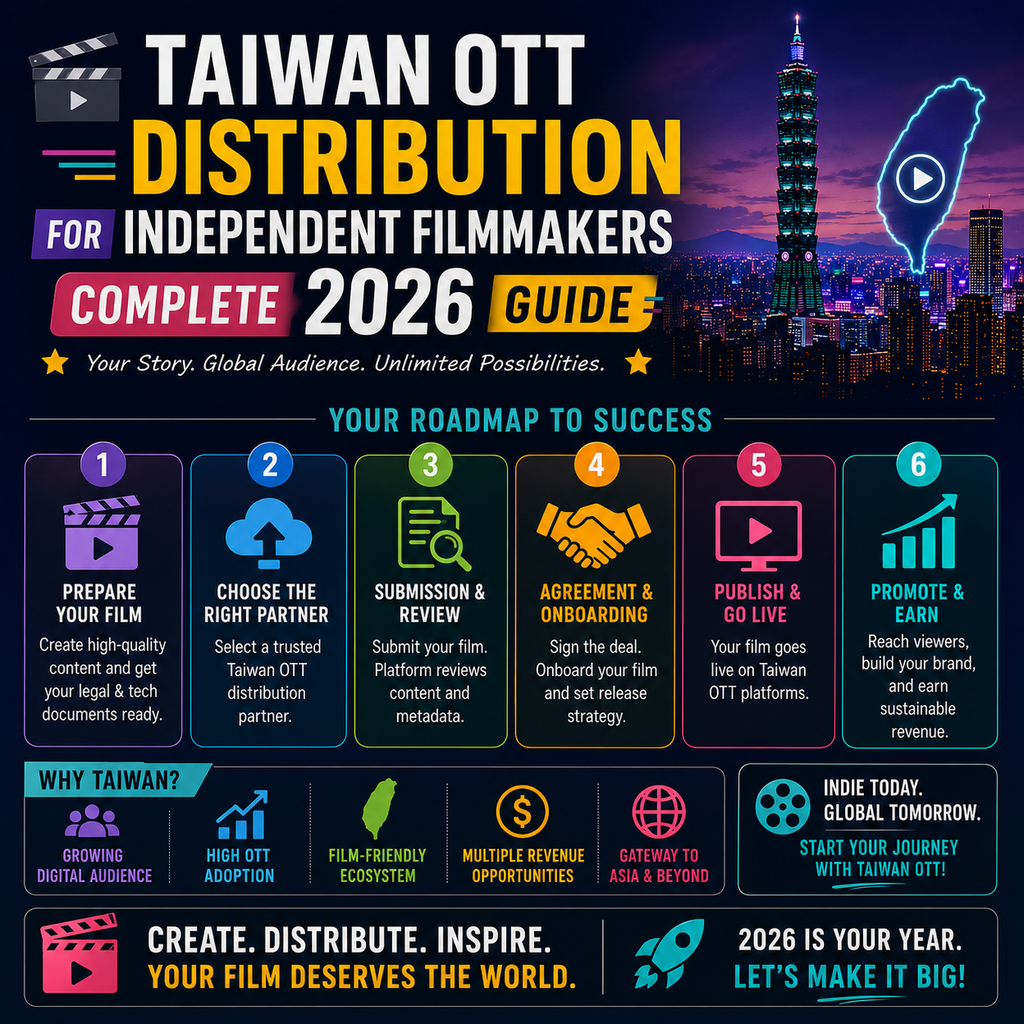
Independent filmmaking no longer ends when production wraps. In 2026, the next challenge is getting the finished film in front of the right streaming audience. Taiwan OTT distribution offers independent filmmakers a practical route into a mature digital entertainment market, especially for short films, documentaries, pilot films, micro dramas, and independent series.
Taiwan has a diverse streaming ecosystem that includes international subscription platforms, domestic OTT services, advertising-supported video, transactional viewing, and broadcaster-linked digital services. For independent producers, this creates multiple potential routes to market.
However, simply uploading a film isn’t enough. We need to approach distribution as a commercial process involving rights clearance, localization, metadata, technical delivery, platform selection, marketing, licensing, and revenue management.
Shortfundly Distribution is one potential distribution route for independent creators seeking assistance with OTT and digital distribution.
This guide explains how to prepare a project, identify suitable buyers, structure a Taiwan distribution strategy, and protect the commercial value of the film.
Why Taiwan Is an Attractive OTT Market for Independent Filmmakers
Taiwan is a highly connected media market with established streaming habits. Audiences can access international services alongside local platforms, creating several possible entry points for independent productions.
For filmmakers, this matters because a project doesn’t necessarily need to compete for one single buyer.
Instead, we can develop a multi-platform distribution strategy based on genre, audience, language, rights, and commercial positioning.
Potential content categories include:
- Short films
- Pilot films
- Independent feature films
- Documentaries
- Micro dramas
- Web series
- Animation
- Regional-language productions
- Student films with commercial potential
- Genre films
- Cultural and travel documentaries
The key is matching the project with the appropriate audience.
A romance pilot may need a different strategy from a documentary. Likewise, a five-minute short film shouldn’t necessarily be presented to buyers in exactly the same way as a forty-minute independent drama.
Taiwan OTT Distribution vs Traditional Film Festivals
Film festivals and OTT platforms serve different purposes.
Festivals can provide:
- Awards
- Reviews
- Industry recognition
- Networking
- Press coverage
- Audience feedback
- Premiere opportunities
OTT distribution can provide:
- Longer availability
- Wider geographic reach
- Viewer access
- Potential licensing revenue
- Streaming data
- Catalog value
- International discoverability
The two approaches don’t have to compete.
A filmmaker can use festivals to build credibility and then use OTT distribution to extend the film’s commercial life.
A Practical Release Sequence
A project might follow this sequence:
Production → Festival Premiere → Awards/Publicity → OTT Pitching → Licensing → Streaming → Revenue Reporting
The exact order depends on premiere requirements and contractual restrictions.
Before accepting an OTT deal, we should check whether it conflicts with existing festival, broadcaster, or digital rights agreements.
What Types of Independent Films Can Be Distributed in Taiwan?
There isn’t one universal content category for OTT buyers.
Instead, buyers may evaluate projects based on audience potential, production quality, originality, rights availability, and catalog fit.
Short Films
Short films can work particularly well as discovery content.
A strong short should have:
- A clear story.
- Professional sound.
- Strong visuals.
- A compelling opening.
- Accurate subtitles.
- Clean metadata.
- Suitable promotional artwork.
Pilot Films
A pilot can serve two commercial purposes.
First, it can be distributed as a standalone piece of content.
Second, it can demonstrate the potential of a larger series.
Therefore, the pitch should explain both the pilot itself and the broader concept.
Documentaries
Documentaries can have strong international appeal when they cover:
- Culture
- Food
- Travel
- History
- Social issues
- Technology
- Human-interest stories
- Arts
- Regional communities
For Taiwan distribution, subtitles and cultural context become especially important.
Micro Dramas and Vertical Series
Short-form vertical storytelling continues to create new opportunities for independent producers.
A vertical series can be positioned around:
- Episodes
- Character arcs
- Romance
- Comedy
- Thriller
- Family drama
- Youth stories
The pitch should clearly identify the intended viewing format.
Understanding Taiwan OTT Platform Categories
Rather than focusing immediately on individual companies, we can divide the market into several categories.
| Platform Category | Typical Revenue Model | Potential Fit |
|---|---|---|
| Subscription OTT | SVOD | Premium films and series |
| Advertising OTT | AVOD | Broad-audience content |
| Transactional platforms | TVOD | Premium or event content |
| Broadcaster OTT | Mixed | Local and regional content |
| FAST services | Advertising | Catalog and genre content |
| Niche services | Subscription/transaction | Specialized audiences |
This classification helps us choose the right pitch.
The same film can potentially have different commercial value across these categories.
Taiwan OTT Revenue Models Explained
Understanding the revenue model is essential before signing a distribution agreement.
SVOD
Subscription Video on Demand generates revenue through subscriptions.
The rights holder may receive:
- Fixed licensing fees.
- Minimum guarantees.
- Revenue participation.
- Hybrid compensation.
The contract determines the actual economics.
AVOD
Advertising Video on Demand allows viewers to watch content while advertisements generate revenue.
This model can provide substantial reach when a project appeals to a broad audience.
TVOD
Transactional Video on Demand charges viewers for rentals or purchases.
This model can work particularly well for films with:
- Strong fan communities.
- Festival recognition.
- Popular talent.
- Niche audiences.
- Premium positioning.
How to Choose the Right Taiwan OTT Distribution Model
We should begin with the project’s commercial objective.
| Goal | Potential Model |
|---|---|
| Maximum reach | AVOD |
| Premium catalog placement | SVOD |
| Direct viewer payments | TVOD |
| Long-tail catalog revenue | AVOD |
| Established fan base | TVOD |
| Series development | SVOD |
| Niche premium audience | TVOD |
These are starting points rather than fixed rules.
A strong contract can make a less obvious model more attractive.
Taiwan OTT Distribution Rights Every Filmmaker Should Check
Rights are the foundation of every distribution agreement.
Before pitching, we should establish exactly what rights we control.
Important rights include:
- Streaming rights
- Digital rights
- Television rights
- Mobile rights
- Download rights
- Rental rights
- Advertising rights
- International rights
- Regional rights
- Language rights
- Remake rights
- Promotional rights
We should also determine whether any rights have already been licensed.
For example, a previous YouTube release might affect certain exclusivity requirements.
Territory Definitions Matter
A contract should identify the territory precisely.
Possible definitions include:
- Taiwan only
- Taiwan and Hong Kong
- Greater China
- Asia-Pacific
- Worldwide
These are commercially different rights packages.
A worldwide license should never be treated as equivalent to a Taiwan-only license.
Taiwan OTT Localization Requirements
Localization can make an international film easier for Taiwanese audiences to understand.
The most important localization element is usually Traditional Chinese subtitles.
We should also consider:
- Traditional Chinese synopsis
- Localized title
- Genre terminology
- Cast information
- Director information
- Trailer subtitles
- Poster text
- Content warnings
- Age classification information
- Search keywords
Why Traditional Chinese Matters
Taiwan uses Traditional Chinese as its standard written form.
Therefore, a film intended for Taiwan should not rely solely on Simplified Chinese materials.
Subtitles should also be professionally translated.
Literal machine translation can produce awkward dialogue, incorrect names, or culturally unsuitable expressions.
For narrative films, subtitle quality directly affects the viewer’s experience.
OTT Metadata Preparation for Taiwan
Metadata is part of the delivery package.
A professional metadata sheet can include:
| Metadata Field | Recommended Information |
|---|---|
| Title | Official localized title |
| Original title | Original production title |
| Synopsis | Short and long versions |
| Genre | Primary and secondary genres |
| Runtime | Exact duration |
| Release year | Official year |
| Country | Country of production |
| Language | Original language |
| Subtitles | Available languages |
| Director | Full name |
| Cast | Principal cast |
| Producer | Production entity |
| Rating | Applicable classification |
| Keywords | Relevant discovery terms |
Metadata should remain accurate.
Overloading descriptions with keywords can make them difficult to read.
The strongest approach is clear, useful, audience-focused metadata.
OTT Artwork and Poster Requirements
Artwork is often the first visual contact between a viewer and a film.
We should prepare multiple assets instead of relying on one poster.
Potential deliverables include:
- Main poster
- Landscape artwork
- Portrait artwork
- Thumbnail
- Character artwork
- Background artwork
- Trailer thumbnail
- Social media graphics
The exact technical specifications depend on the platform.
Therefore, we should request current delivery specifications before creating the final package.
Trailer Preparation for OTT Distribution
A trailer should communicate the project’s strongest selling point quickly.
For a pilot, the trailer should answer three questions:
- What is the story?
- Why should viewers care?
- What makes the project distinctive?
A strong trailer usually avoids explaining the entire plot.
Instead, it creates curiosity.
We should prepare subtitle-ready versions when targeting international or Taiwanese audiences.
Technical Delivery Checklist
Before submission, we should inspect the master file carefully.
The checklist should cover:
- Video resolution
- Frame rate
- Aspect ratio
- Audio channels
- Dialogue levels
- Subtitle synchronization
- Caption files
- Color consistency
- Black frames
- Missing shots
- Audio pops
- Encoding errors
- File naming
A technically clean master reduces avoidable delivery problems.
Music and Copyright Clearance
One of the biggest risks in OTT distribution is incomplete rights clearance.
Before licensing, we should verify rights for:
- Original music
- Licensed music
- Stock footage
- Archive footage
- Photographs
- Artwork
- Performances
- Voice recordings
- Locations
- Logos
- Third-party clips
Music licenses deserve particular attention.
A song that is cleared for a local theatrical screening may not automatically be cleared for worldwide streaming.
We should verify the media, territory, term, and platform coverage of every relevant license.
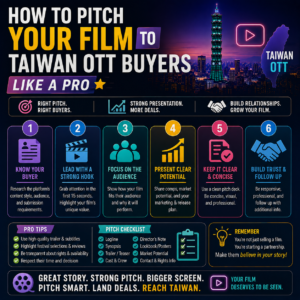
How to Pitch a Film to Taiwan OTT Buyers
A good pitch should be concise.
The buyer needs enough information to decide whether the project deserves further consideration.
A professional pitch package can contain:
1. Logline
One or two sentences explaining the core story.
2. Synopsis
A concise description of the narrative.
3. Director’s Statement
Explain the creative vision without becoming overly technical.
4. Audience Profile
Identify the intended viewer.
5. Genre
Use clear industry categories.
6. Technical Details
Include runtime, resolution, language, and subtitles.
7. Rights Information
Clearly state available territories and rights.
8. Promotional Assets
Include poster, trailer, stills, and key artwork.
9. Performance Information
If available, include:
- Festival selections
- Awards
- Audience numbers
- Existing streaming performance
- Social engagement
- Press coverage
Evidence strengthens the commercial pitch.
What OTT Buyers Look For
OTT buyers generally need to answer several practical questions.
Does the content fit the platform?
Can the platform legally exploit it?
Is the technical package ready?
Does the title have audience potential?
Can the platform market it effectively?
Are the economics commercially reasonable?
A filmmaker can improve the pitch by answering these questions before the buyer asks.
OTT Distribution Agreement: Important Clauses
Before signing, we should examine the agreement carefully.
Important provisions include:
- License term
- Territory
- Exclusivity
- Revenue share
- Minimum guarantee
- Payment schedule
- Reporting
- Accounting
- Audit rights
- Marketing obligations
- Localization responsibility
- Delivery costs
- Taxes
- Renewal
- Termination
- Content removal
- Rights reversion
Revenue Share Example
Suppose a platform generates ₹100,000 in eligible revenue.
If the agreed creator share is 60%, the creator’s contractual share would be ₹60,000 before any separately permitted deductions.
However, the actual calculation depends on the agreement.
We should therefore identify the definition of net revenue.
A percentage sounds attractive until unexpected deductions reduce the underlying amount.
Exclusive vs Non-Exclusive OTT Distribution
An exclusive agreement gives one distributor or platform defined exclusive rights.
A non-exclusive agreement allows the rights holder to work with multiple outlets, subject to contractual restrictions.
Exclusive Distribution
Potential benefits:
- Focused marketing.
- Simplified administration.
- Stronger platform commitment.
Potential disadvantages:
- Reduced flexibility.
- Fewer simultaneous outlets.
- Opportunity cost.
Non-Exclusive Distribution
Potential benefits:
- Multiple revenue channels.
- Greater market flexibility.
- Wider availability.
Potential disadvantages:
- More administration.
- Possible platform conflicts.
- More complicated rights management.
For an emerging filmmaker, flexibility can be valuable.
How to Calculate the Commercial Value of a Taiwan OTT Deal
We should consider more than the upfront payment.
A useful evaluation includes:
Total Expected Value = Upfront Fee + Expected Revenue Share + Catalog Value + Audience Value − Distribution Costs
This isn’t a formal accounting formula.
It’s a decision-making framework.
For example, a smaller upfront payment may be attractive if the agreement offers strong revenue participation and broad exposure.
Conversely, a high upfront payment may become less attractive if it requires a long exclusive license.
Distribution Costs to Watch
Possible expenses include:
- Localization
- Subtitle creation
- Captioning
- Encoding
- Artwork
- Metadata
- Quality control
- Platform delivery
- Marketing
- Legal review
- Transaction fees
- Currency conversion
We should ask who pays each cost.
The agreement should state whether expenses are:
- Paid by the filmmaker.
- Paid by the distributor.
- Deducted from revenue.
- Shared between the parties.
Using a Distribution Partner
Independent filmmakers don’t always have direct relationships with OTT acquisition teams.
A distribution partner can potentially help with:
- Content preparation
- Metadata
- Localization
- Platform submissions
- Rights administration
- Delivery
- Revenue reporting
Shortfundly Distribution provides information about distributing independent films and related content through OTT and digital channels.
The precise services, territories, platform coverage, fees, and revenue arrangements should be confirmed directly before entering an agreement.
Common Taiwan OTT Distribution Mistakes
Mistake 1: Submitting Without Rights Documentation
Buyers may require proof of ownership.
Mistake 2: Using Poor Subtitles
Bad subtitles can damage viewer experience.
Mistake 3: Ignoring Metadata
Weak metadata can make content harder to discover and evaluate.
Mistake 4: Signing Without Understanding Exclusivity
An exclusive deal can restrict future opportunities.
Mistake 5: Accepting an Unclear Revenue Definition
We should know exactly how revenue is calculated.
Mistake 6: Sending the Wrong Technical Format
Delivery specifications vary.
Mistake 7: Using One Generic Pitch
Different platforms serve different audiences.
A 30-Day Taiwan OTT Distribution Preparation Plan
Week 1: Rights and Content Audit
Confirm:
- Ownership.
- Music rights.
- Talent releases.
- Existing licenses.
- Territory availability.
Week 2: Localization
Prepare:
- Traditional Chinese subtitles.
- Localized synopsis.
- Localized title options.
- Trailer subtitles.
Week 3: Marketing Package
Finalize:
- Poster.
- Trailer.
- Stills.
- Metadata.
- Press kit.
- Pitch deck.
Week 4: Buyer Outreach
Create a targeted list based on:
- Genre.
- Audience.
- Runtime.
- Content format.
- Business model.
- Territory.
Then submit according to each buyer’s requirements.
Taiwan OTT Distribution Checklist
Before submitting a project, we can use this checklist:
- Master video completed
- Audio checked
- Subtitles completed
- Traditional Chinese subtitles prepared
- Poster completed
- Trailer completed
- Metadata completed
- Synopsis prepared
- Cast information prepared
- Director information prepared
- Copyright documents organized
- Music rights confirmed
- Territory rights confirmed
- Existing licenses reviewed
- Revenue expectations defined
- Distribution agreement reviewed
- Payment terms confirmed
FAQs About Taiwan OTT Distribution
Can independent filmmakers distribute films in Taiwan?
Yes. Independent productions can pursue Taiwan distribution through direct platform submissions, licensing relationships, aggregators, distributors, and other digital-content channels.
Do we need Traditional Chinese subtitles?
For Taiwan-focused distribution, Traditional Chinese subtitles are strongly recommended. The exact localization requirements depend on the platform and agreement.
Is AVOD or SVOD better for an independent film?
Neither is automatically better. AVOD can prioritize reach, while SVOD can offer stronger premium positioning. The commercial agreement ultimately determines the financial outcome.
Can a short film be distributed through OTT platforms?
Yes. Short films can be suitable for digital catalogs, niche platforms, curated services, and other OTT channels. The film’s runtime and format should match the buyer’s requirements.
Should we sign an exclusive Taiwan distribution agreement?
It depends on the deal. We should compare the payment, license duration, territory, exclusivity, marketing support, and future opportunities before signing.
How important is metadata?
Metadata is extremely important for professional distribution. Accurate titles, descriptions, genres, credits, subtitles, and keywords help buyers and platforms understand the content.
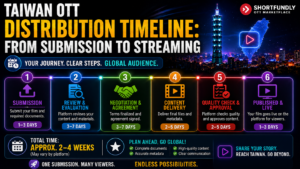
How long does Taiwan OTT distribution take?
There is no universal timeline. The process can vary based on platform review, rights verification, technical quality control, localization, contract negotiation, and scheduling.
Can we distribute through multiple OTT platforms?
Potentially. A non-exclusive strategy can provide broader exposure, but rights conflicts must be avoided. Existing agreements should always be reviewed first.
Also read: https://blog.shortfundly.com/ott/taiwan-ott-distribution-time/
Final Thoughts
Taiwan OTT distribution for independent filmmakers offers an opportunity to extend the life of short films, documentaries, pilot films, micro dramas, and independent series beyond traditional festival circuits.
Success begins before the pitch.
A professionally prepared project has:
Clear rights + strong localization + accurate metadata + polished artwork + reliable technical delivery + targeted buyer outreach + a carefully reviewed agreement.
The most effective strategy isn’t simply to get a film onto the largest possible number of platforms.
Instead, we should focus on finding the right audience, the right platform category, and the right commercial structure.
For independent filmmakers, that approach can turn OTT distribution from a simple upload process into a long-term international distribution strategy.