Table of Contents
Meta Description: Learn the best metadata format for faster pilot film OTT distribution approval, including titles, descriptions, genres, keywords, cast details, artwork, technical data, and Shortfundly Distribution requirements.
Getting a pilot film ready for OTT distribution involves more than delivering a finished video. Strong metadata helps platforms understand, organize, search, and present your content correctly. A clear metadata package can also reduce avoidable delivery questions and make your project easier for distribution teams to review.
For independent filmmakers, this step matters even more. A pilot may have a strong story and polished production, but incomplete metadata can create unnecessary delays. With a structured approach, we can prepare every required field before submitting the project.
For filmmakers exploring distribution options, Shortfundly Distribution can be included in the OTT distribution workflow alongside a complete title, synopsis, cast, artwork, technical, and rights package.
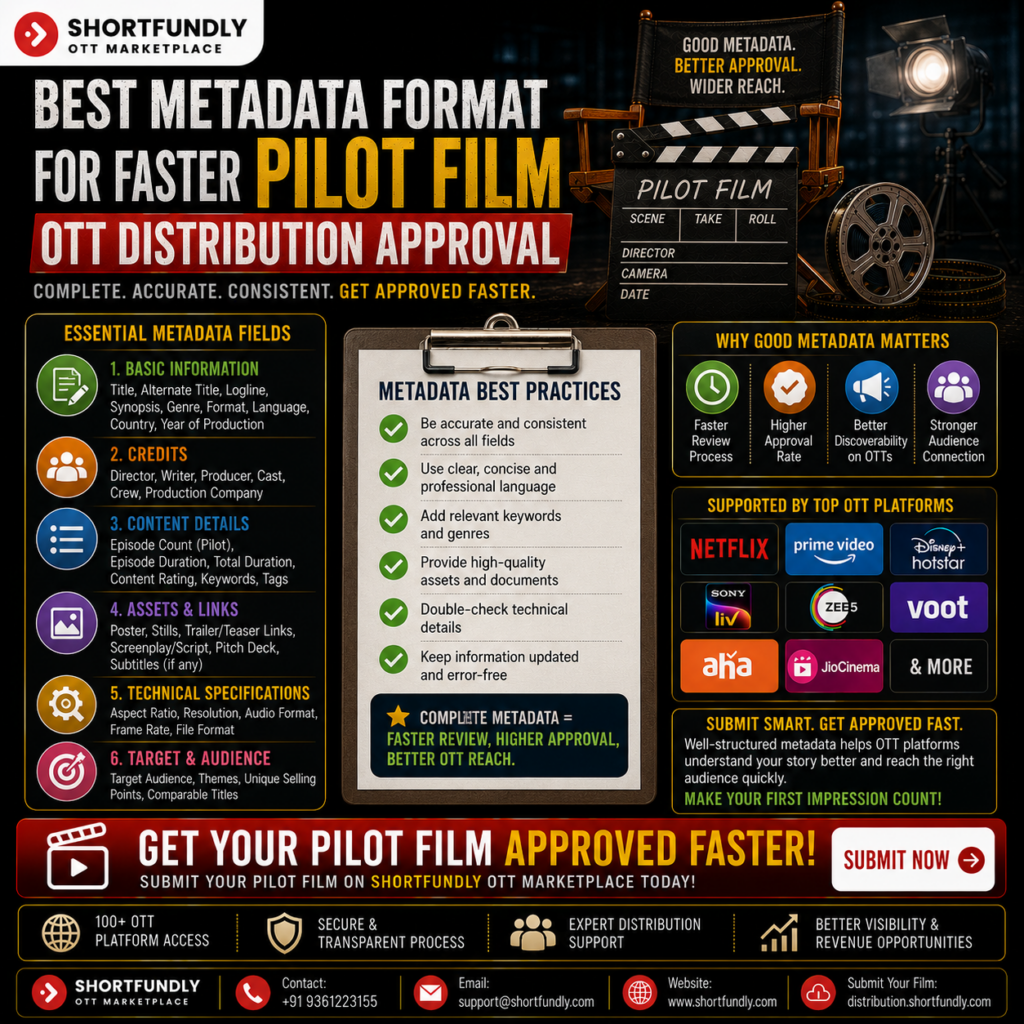
What Is OTT Metadata?
OTT metadata is the structured information attached to a film or series during digital distribution. It tells platforms what the content is, who created it, what genre it belongs to, where it can be released, and how it should appear to viewers.
Common metadata fields include:
- Film title
- Alternate title
- Logline
- Short synopsis
- Long synopsis
- Genre
- Subgenre
- Language
- Country of origin
- Release year
- Runtime
- Director
- Producer
- Cast
- Writers
- Production company
- Keywords
- Ratings information
- Subtitle information
- Audio information
- Artwork specifications
- Rights information
Metadata isn’t simply administrative information. It becomes part of the content’s digital identity.
Why Metadata Matters for Pilot Film OTT Distribution
A professional metadata package gives distributors a consistent source of information. It also helps prevent conflicting details across different delivery documents.
For example, suppose a film’s title appears as “The Last Train” in one document and “Last Train” in another. That small difference can create confusion during ingestion.
Therefore, we should establish one approved metadata record before submission.
A strong metadata package should be:
- Accurate
- Consistent
- Concise
- Search-friendly
- Platform-ready
- Rights-aware
- Easy to verify
The Recommended Pilot Film Metadata Structure
A practical metadata sheet can follow this structure:
| Field | Recommended Information |
|---|---|
| Primary Title | Official release title |
| Alternate Title | Approved alternate title |
| Format | Pilot film, short film, series pilot |
| Genre | Primary genre |
| Subgenre | More specific category |
| Logline | One-sentence story hook |
| Short Synopsis | Approximately 50–100 words |
| Long Synopsis | Approximately 150–300 words |
| Runtime | Exact final duration |
| Language | Original language |
| Subtitle Languages | Available subtitle tracks |
| Director | Full credited name |
| Producer | Full credited name |
| Cast | Principal cast |
| Release Year | Official release year |
| Country | Country of production |
| Keywords | Relevant discovery terms |
| Rights | Territory and media rights |
| Master File | Final approved video |
| Artwork | Platform-ready poster and key art |
This structure creates a reliable foundation for OTT delivery.
1. Create a Clear and Consistent Title
The title should be identical across the metadata sheet, master file, poster, subtitle files, contracts, and delivery folders.
Avoid unnecessary symbols, promotional claims, or keyword stuffing.
For example:
Preferred: The Silent Room
Avoid: The Silent Room | Best Thriller Film | Must Watch 2026
The second version looks promotional rather than editorial.
If an alternate title exists, list it separately. Don’t replace the official title with a marketing phrase.
Handling Titles With Numbers or Special Characters
If your title contains numbers, punctuation, or unusual capitalization, establish one official format.
For example:
24 Hours
should not randomly become:
24 Hrs
or:
Twenty Four Hours
unless those are approved alternate titles.
Consistency makes delivery cleaner.
2. Write a Strong OTT Logline
The logline should communicate the central story quickly.
A useful structure is:
Main character + objective + conflict + stakes.
For example:
A struggling journalist investigates a missing artist, only to uncover a secret that threatens her own family.
This works because it identifies the protagonist, action, conflict, and stakes.
The logline shouldn’t reveal the entire ending. Instead, it should create enough curiosity to encourage further viewing.
What Makes a Strong Logline?
A good logline should:
- Explain the central premise.
- Identify the main character.
- Introduce the primary conflict.
- Create curiosity.
- Avoid unnecessary details.
- Use natural language.
We should also avoid exaggerated claims such as “the greatest thriller ever made.”
Metadata should describe the content rather than advertise it.
3. Prepare Short and Long Synopses
A pilot film should ideally have multiple synopsis versions.
The short synopsis works well for compact platform fields. The long synopsis provides additional context for editorial review and catalog information.
Short Synopsis
Aim for approximately 50–100 words unless the delivery specification requires another limit.
The short version should focus on the core story.
Long Synopsis
The long version can provide:
- Character context
- Story setup
- Central conflict
- Major themes
- Setting
- Narrative direction
However, avoid turning the synopsis into a complete scene-by-scene recap.
Spoiler Control in OTT Metadata
Different platforms have different editorial preferences.
Some catalog descriptions can reveal significant plot developments. Others work better when they preserve suspense.
Therefore, we should create an approved synopsis and confirm whether spoilers are acceptable before delivery.
4. Select Accurate Genres and Subgenres
Genre classification affects how viewers discover content.
A pilot may fit several categories, but selecting every possible genre can weaken the classification.
For example, a project could be:
Primary genre: Thriller
Secondary genre: Mystery
Theme: Crime investigation
This is more useful than listing ten unrelated genres.
Common Film and OTT Genres
Depending on platform requirements, categories may include:
- Drama
- Comedy
- Romance
- Thriller
- Mystery
- Crime
- Horror
- Action
- Adventure
- Documentary
- Science fiction
- Fantasy
- Family
- Animation
- Biography
Always use the platform’s approved taxonomy when one is provided.
5. Build a Natural Keyword List
Keywords can help describe a film’s themes, story, characters, and setting.
However, keyword stuffing can make metadata look unnatural.
For a crime thriller, relevant terms might include:
- crime thriller
- detective story
- missing person investigation
- urban mystery
- police investigation
- psychological thriller
The keywords should accurately describe the project.
They shouldn’t include unrelated popular search terms simply to increase visibility.
LSI and Related Content Terms
A strong metadata package can naturally include related concepts such as:
OTT distribution, digital film distribution, pilot film, independent filmmaker, streaming platform, film licensing, content delivery, video-on-demand, film catalog, and digital rights.
These terms provide useful context without forcing repetitive phrases.
6. Include Complete Cast and Crew Information
Names should match official credits and contractual documents.
For principal cast, provide:
- Full credited name
- Character name
- Billing order where required
For crew, commonly requested fields include:
- Director
- Producer
- Writer
- Executive producer
- Cinematographer
- Editor
- Composer
- Production company
We should avoid abbreviations unless they’re part of the person’s official professional credit.
Check Spelling Carefully
A single spelling error can spread across multiple platform records.
Before submission, compare names against:
- End credits
- Contracts
- Talent releases
- Official press materials
- Distributor documentation
This is a small quality-control step with significant value.
7. Add Accurate Technical Metadata
Technical metadata describes the actual delivered master.
Typical fields include:
| Technical Field | Example |
| Resolution | 1920 × 1080 |
| Aspect Ratio | 16:9 |
| Frame Rate | 24 fps |
| Audio | Stereo |
| Audio Sample Rate | 48 kHz |
| Video Codec | Platform-specific |
| Audio Codec | Platform-specific |
| Runtime | Exact duration |
| Subtitle Format | Platform-specific |
These values should come from the final approved master.
We shouldn’t guess technical specifications based on what the project was originally shot in.
Runtime Must Match
The runtime in metadata should correspond with the final delivered video.
If the metadata says 28:30 but the master runs 29:02, the discrepancy should be investigated before delivery.
Small mismatches can trigger delivery questions.
8. Prepare Subtitle and Language Metadata
Language information is increasingly important for OTT content.
Identify:
- Original audio language
- Subtitle languages
- Dubbed languages
- Caption availability
- Audio description availability
For example:
Original Language: English
Subtitles: Hindi, Tamil, Telugu
Audio Description: Available
Don’t list a language unless the corresponding asset actually exists.
Subtitle File Naming
Keep subtitle filenames consistent with the master.
For example:
Film_Title_EN.srt
Film_Title_HI.srt
The exact naming convention should follow the distributor’s delivery instructions.
9. Prepare Artwork Metadata
Artwork is part of the OTT content package.
Typical artwork may include:
- Main poster
- Landscape key art
- Thumbnail
- Background image
- Character artwork
- Promotional stills
Artwork specifications vary between platforms.
Therefore, we should never assume that one image size works everywhere.
Artwork Checklist
Before delivery, confirm:
- Correct title spelling
- Correct dimensions
- Correct aspect ratio
- High-resolution source
- No unauthorized logos
- No misleading claims
- No accidental watermarks
- No outdated release information
The artwork should also represent the actual tone and genre of the film.
10. Connect Metadata With Rights Information
Metadata should never be separated from rights verification.
Before submitting a pilot film, we should confirm ownership or authorization for:
- Film rights
- Music
- Performances
- Screenplay
- Stock footage
- Images
- Locations where applicable
- Third-party trademarks where relevant
Territory information is especially important.
For example, rights may cover:
India only
or:
Worldwide excluding specific territories
The metadata and licensing agreement should tell the same story.
Rights Metadata for International Distribution
If a project has international ambitions, we should document:
- Available territories
- Start date
- End date
- Language restrictions
- Platform restrictions
- Exclusive rights
- Non-exclusive rights
- TV rights
- Digital rights
- Mobile rights
Clear documentation reduces ambiguity during licensing discussions.
11. Use a Master Metadata Spreadsheet
A spreadsheet can become the central source of truth.
Suggested columns include:
| Category | Field | Final Value | Verified |
| Content | Title | Official title | Yes |
| Content | Runtime | Final runtime | Yes |
| Editorial | Synopsis | Approved copy | Yes |
| Editorial | Genre | Primary genre | Yes |
| Talent | Director | Legal credited name | Yes |
| Rights | Territory | Approved territory | Yes |
| Technical | Resolution | Master specification | Yes |
| Localization | Subtitles | Available languages | Yes |
| Artwork | Poster | Final artwork | Yes |
This approach makes revisions easier.
If one detail changes, we can update the master record and then regenerate delivery materials.
12. Avoid Common Metadata Mistakes
Several avoidable mistakes appear repeatedly in independent film deliveries.
Mistake 1: Using Different Titles
The poster, metadata sheet, and video should use the same approved title.
Mistake 2: Writing Overly Long Descriptions
A synopsis should communicate the story quickly.
Mistake 3: Keyword Stuffing
Metadata should sound like professional editorial copy.
Mistake 4: Guessing Technical Data
Always verify technical specifications from the final master.
Mistake 5: Ignoring Rights Documentation
A finished film isn’t automatically ready for every territory.
Mistake 6: Missing Localization Information
Subtitle and audio details should be documented clearly.
Mistake 7: Submitting Unapproved Artwork
Use final artwork rather than draft promotional materials.
13. Metadata Quality Control Before OTT Submission
A final quality-control review should happen before the project enters the distribution pipeline.
We can divide the review into four stages.
Stage One: Editorial Review
Check:
- Title
- Logline
- Synopsis
- Genre
- Keywords
- Cast
- Crew
Stage Two: Technical Review
Check:
- Runtime
- Resolution
- Frame rate
- Audio
- Master file
- Subtitle files
Stage Three: Rights Review
Check:
- Ownership
- Licenses
- Territory
- Exclusivity
- Contract dates
Stage Four: Asset Review
Check:
- Poster
- Key art
- Stills
- Trailers
- Captions
- Subtitles
This four-stage process catches problems before final delivery.
14. How Shortfundly Distribution Fits Into the Workflow
Shortfundly Distribution can be positioned as part of an independent creator’s digital distribution strategy.
A filmmaker preparing for distribution should have the project organized before approaching a distributor.
A useful submission package can contain:
- Final film master
- Metadata spreadsheet
- Poster artwork
- Trailer
- Stills
- Subtitle files
- Cast and crew information
- Synopsis
- Rights documentation
- Contact information
For more information about the distribution service, filmmakers can review the official Shortfundly Distribution website: Shortfundly Distribution
The key principle remains simple: distribution becomes easier when the content package is complete, accurate, and professionally organized.
15. Create a Professional OTT Delivery Folder
A logical folder structure can make the delivery process much smoother.
For example:
PROJECT_NAME/
├── MASTER/
├── METADATA/
├── ARTWORK/
├── TRAILER/
├── SUBTITLES/
├── STILLS/
├── RIGHTS/
└── DOCUMENTS/
Inside the metadata folder:
PROJECT_METADATA.xlsx
PROJECT_SYNOPSIS.docx
PROJECT_CAST_CREW.xlsx
Inside the artwork folder:
PROJECT_POSTER.jpg
PROJECT_KEYART.jpg
PROJECT_STILL_01.jpg
PROJECT_STILL_02.jpg
This organization helps everyone find the correct file quickly.
16. Metadata Checklist Before Final Submission
Use this checklist before sending the project.
Editorial
- Official title confirmed
- Logline approved
- Short synopsis approved
- Long synopsis approved
- Genre confirmed
- Keywords reviewed
- Cast verified
- Crew verified
Technical
- Final master confirmed
- Runtime verified
- Resolution verified
- Frame rate verified
- Audio verified
- Subtitle files checked
Rights
- Ownership confirmed
- Music rights confirmed
- Talent releases available
- Territory rights confirmed
- Licensing restrictions documented
Artwork
- Poster finalized
- Key art finalized
- Required dimensions confirmed
- Title spelling checked
- No unauthorized material included
Distribution
- Distributor requirements reviewed
- Metadata spreadsheet completed
- Delivery folder organized
- Contact information included
- Final quality check completed
17. How to Make Metadata Easier for OTT Buyers
OTT buyers and distribution teams need information they can verify quickly.
Therefore, metadata should answer important questions without forcing the reviewer to search through multiple documents.
A professional package should make these details immediately visible:
What is the title?
What is the story?
Who made it?
What language is it in?
How long is it?
Where can it be distributed?
Who owns the rights?
What assets are available?
What technical format is being delivered?
The easier these questions are to answer, the more professional the project appears.
18. Final Metadata Strategy for Faster OTT Approval
Metadata won’t replace a strong film, but it can eliminate avoidable friction during delivery.
The strongest approach is to treat metadata as part of production planning rather than an afterthought.
We should build the metadata sheet while preparing the final delivery package. Then, we should verify it against the finished master and rights documents.
Most importantly, every major asset should tell the same story.
The title should match. The runtime should match. The credits should match. The rights information should match. Artwork should represent the same project.
That consistency creates confidence.
For independent filmmakers, Shortfundly Distribution can be considered alongside other OTT distribution routes when preparing a professional delivery package. A well-organized metadata record, complete media assets, and clear rights documentation give a pilot film a stronger foundation for digital distribution.
Frequently Asked Questions
What metadata does an OTT platform need for a pilot film?
Common requirements include the title, synopsis, genre, runtime, language, cast, crew, artwork, technical specifications, subtitle information, and rights details.
Does metadata affect OTT distribution approval?
Accurate metadata can reduce avoidable delivery problems. However, approval also depends on the platform, content, rights, technical quality, and commercial requirements.
How long should an OTT film synopsis be?
There isn’t one universal length. A short synopsis can be around 50–100 words, while a long synopsis may contain 150–300 words.
Should we use keywords in OTT metadata?
Yes, when the distributor or platform accepts keywords. They should remain relevant and natural rather than repetitive.
What technical details should we include?
Common details include resolution, frame rate, aspect ratio, audio format, codec, runtime, and subtitle format. Exact requirements vary by delivery specification.
Why should the runtime match the master file?
A runtime mismatch can create uncertainty during content ingestion. The metadata should reflect the exact approved final master.
Do independent filmmakers need rights documentation?
Yes. Filmmakers should maintain documentation supporting their ownership or authorization for the rights being licensed.
Can Shortfundly Distribution help with OTT distribution?
Shortfundly Distribution provides a distribution route for filmmakers and content creators. Current services, requirements, territories, and commercial terms should be confirmed directly with the distributor.
Also read: https://blog.shortfundly.com/ott/pilot-film-distribution-deal/
Conclusion
A strong pilot film OTT distribution package starts with accurate metadata. The best metadata format is clear, consistent, searchable, and connected to the final media and rights documents.
Before submission, we should verify every title, synopsis, credit, runtime, language, technical specification, artwork file, subtitle, and rights detail.
When the project is packaged professionally, distribution teams can review the content with less friction. For independent creators, that preparation can make the difference between a confusing delivery package and a polished OTT-ready submission.
Shortfundly Distribution can be included in the distribution strategy, while a complete metadata and asset package provides the foundation for a smoother professional delivery process.