Table of Contents
Introduction: Choosing the Right OTT Distribution Model for a Pilot Film
For independent filmmakers, getting a pilot film onto OTT platforms can open the door to new audiences, licensing opportunities, and long-term revenue. However, choosing the right monetization model is just as important as finding distribution.
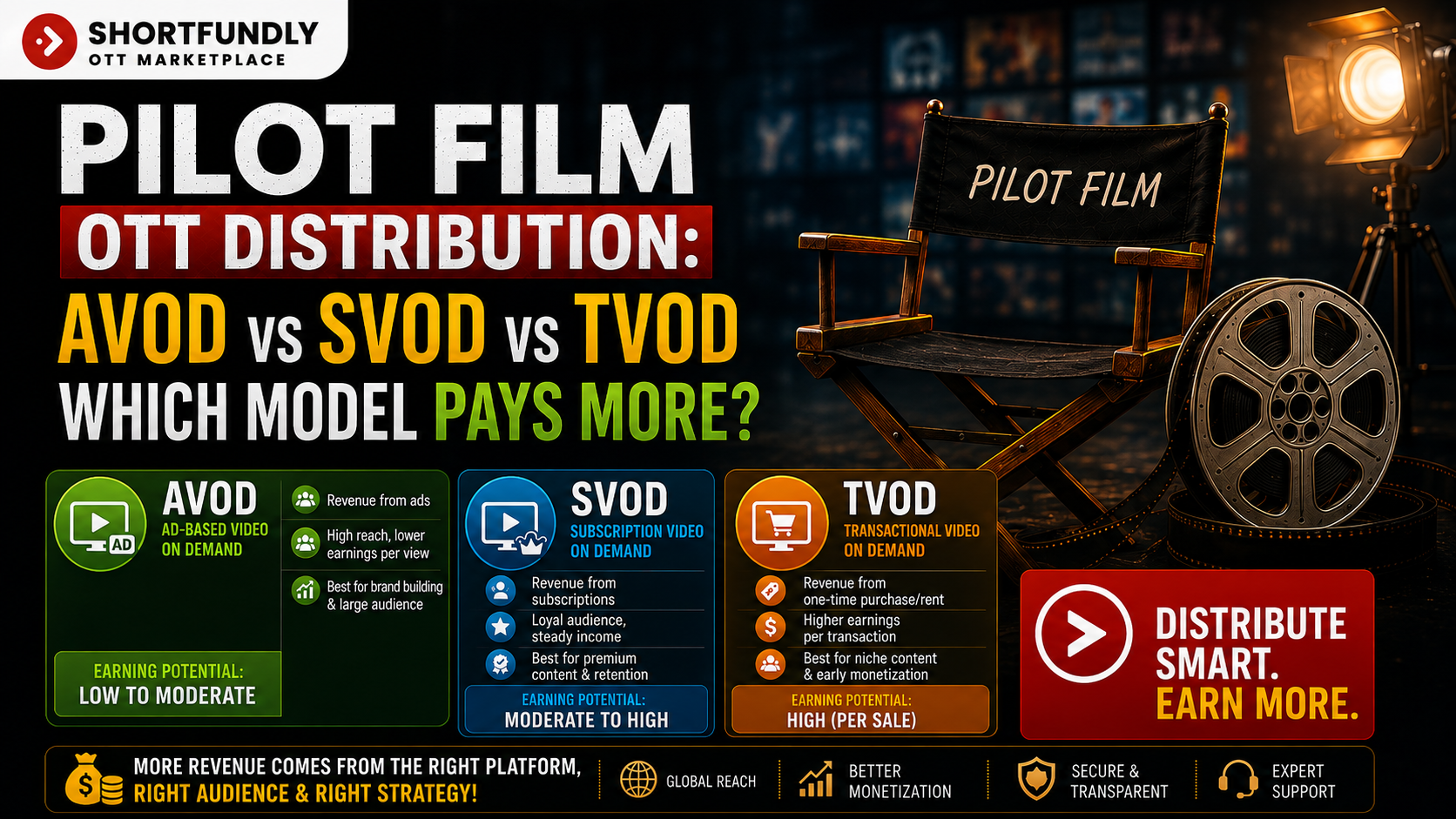
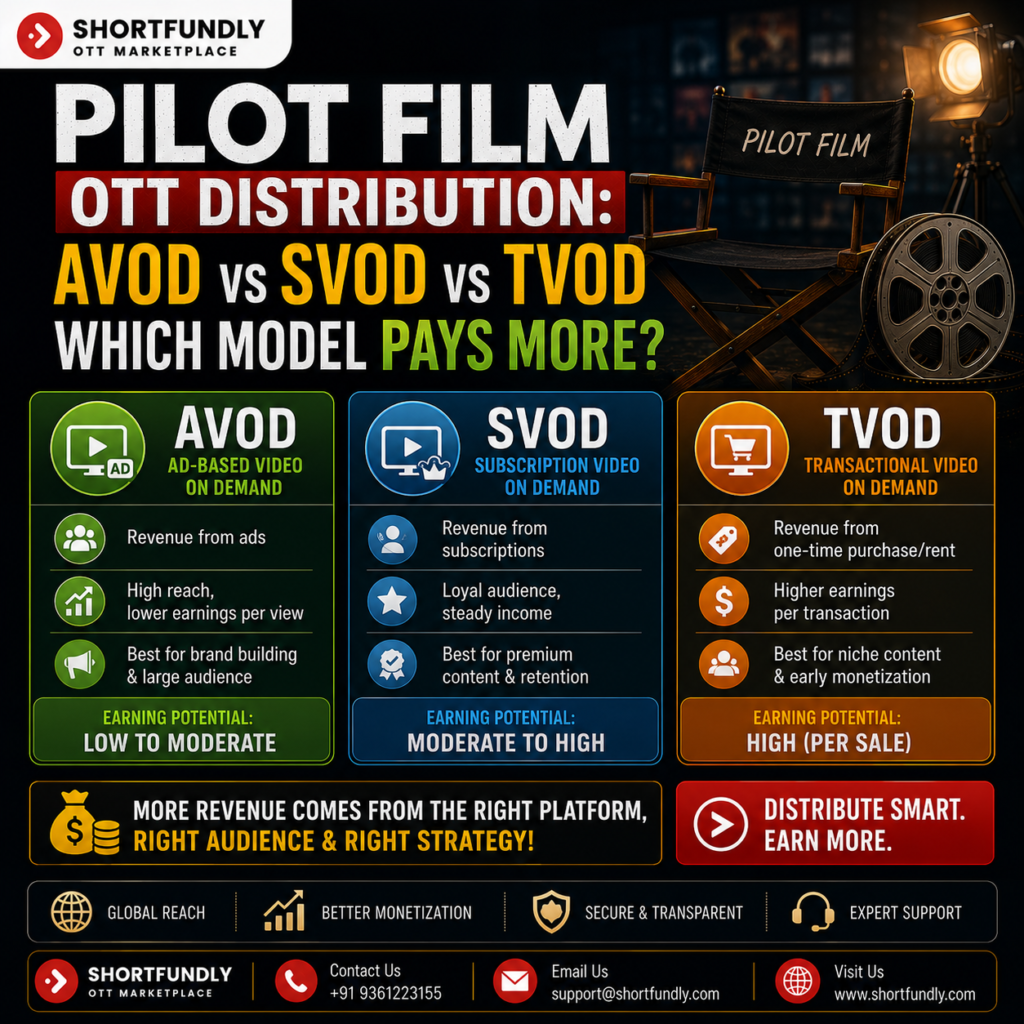
The three major OTT models are AVOD, SVOD, and TVOD. AVOD earns revenue through advertising. SVOD relies on subscriptions. TVOD charges viewers for individual access to content.
Each model offers different advantages. Therefore, producers should evaluate audience demand, licensing terms, content genre, territory, exclusivity, and expected viewing volume before signing a distribution agreement.
For independent creators exploring professional OTT distribution, Shortfundly Distribution can be considered as part of a broader distribution strategy.
What Is Pilot Film OTT Distribution?
Pilot film OTT distribution is the process of making a pilot, short-form project, or proof-of-concept film available through online streaming platforms.
A pilot can demonstrate the creative direction of a larger project. It can also help producers attract viewers, investors, production partners, and OTT buyers.
Unlike traditional theatrical distribution, OTT distribution focuses on digital delivery. The content may reach viewers through connected TVs, smartphones, tablets, computers, or streaming applications.
Before distribution begins, producers usually prepare:
- Final master video files
- Subtitles and captions
- Poster artwork
- Trailer
- Synopsis
- Metadata
- Cast and crew information
- Promotional images
- Rights documentation
- Music and footage clearances
- Content ratings where applicable
A complete delivery package can make the distribution process much smoother.
Understanding AVOD, SVOD, and TVOD
The OTT market uses several monetization structures.
| Model | Meaning | Viewer Payment | Primary Revenue Source |
|---|---|---|---|
| AVOD | Advertising Video on Demand | Usually free | Advertising |
| SVOD | Subscription Video on Demand | Recurring subscription | Subscription fees |
| TVOD | Transactional Video on Demand | Pay per title | Individual transactions |
| FAST | Free Ad-Supported Streaming TV | Usually free | Advertising |
The best model depends on the commercial potential of the pilot.
AVOD for Pilot Films: How Advertising-Based Distribution Works
AVOD, or Advertising Video on Demand, allows audiences to watch content without paying directly for the film.
Instead, advertisements are shown before, during, or around the viewing experience.
For independent filmmakers, this model can be attractive because removing a direct paywall may increase potential audience reach.
How AVOD Revenue Works
A typical AVOD structure may generate revenue through advertising impressions.
Revenue can depend on factors such as:
- Number of viewers
- Total watch time
- Geographic audience
- Advertiser demand
- Ad completion rates
- Viewer demographics
- Platform policies
- Revenue-sharing terms
The exact payment structure varies by platform and agreement.
Advantages of AVOD
AVOD can provide several benefits for pilot films.
First, it reduces viewer friction. Audiences don’t need to make a purchase before watching.
Second, it can support discovery. Free access can encourage viewers to sample an unfamiliar independent project.
Third, it can work well for niche content. A pilot with strong audience interest may accumulate significant viewing time even without a large marketing budget.
Limitations of AVOD
Advertising revenue generally depends on scale.
A pilot with limited viewing volume may generate modest revenue. Therefore, AVOD often works better when the objective includes audience growth and discovery, rather than immediate high revenue from each viewer.
SVOD for Pilot Films: Subscription-Based OTT Distribution
SVOD, or Subscription Video on Demand, is one of the most recognized OTT business models.
Viewers pay a recurring subscription to access a platform’s catalog.
For producers, SVOD distribution generally involves licensing or revenue arrangements with a streaming service.
How SVOD Deals Can Work
There isn’t one universal SVOD payment structure.
A platform may offer:
- Fixed licensing fees
- Minimum guarantees
- Revenue-sharing arrangements
- Performance-based payments
- Hybrid licensing structures
- Territory-specific agreements
The contract determines how and when the producer receives compensation.
Why SVOD Can Be Attractive
SVOD platforms already have established subscriber bases.
Therefore, a pilot can benefit from the platform’s existing audience ecosystem.
A strong pilot may also serve as a proof of audience demand for a larger series.
For example, a pilot could demonstrate:
- Viewer interest
- Completion rates
- Genre demand
- Geographic popularity
- Audience demographics
- Engagement levels
These signals may become valuable during future licensing discussions.
TVOD for Pilot Films: Pay-Per-View Distribution
TVOD, or Transactional Video on Demand, requires viewers to pay for individual access.
The transaction may involve:
- Rental
- Digital purchase
- Premium access
- Limited-time viewing
TVOD can provide a higher potential revenue amount per transaction than advertising-based models.
However, viewers must be willing to pay.
When TVOD Makes Sense
TVOD can work particularly well when a pilot has:
- A recognizable cast
- A strong existing fan base
- Festival recognition
- Awards
- Media coverage
- A distinctive niche audience
- Strong promotional support
The producer must create enough perceived value to encourage individual purchases.
AVOD vs SVOD vs TVOD: Which OTT Model Pays More?
There is no universal winner.
The model producing the most revenue depends on audience size, contract terms, viewing behavior, content positioning, and distribution territory.
| Factor | AVOD | SVOD | TVOD |
| Viewer Cost | Free | Subscription | Individual payment |
| Discovery | High potential | High | Moderate |
| Revenue Per Viewer | Usually lower | Variable | Potentially higher |
| Scale Required | High | Moderate to high | Lower |
| Best For | Broad reach | Catalog exposure | Premium transactions |
| Main Challenge | Advertising scale | Licensing terms | Viewer willingness to pay |
A producer shouldn’t select a distribution model solely because its headline revenue appears higher.
Instead, we should compare net revenue potential.
Revenue Share vs Fixed Licensing Fees
OTT distribution agreements may use either fixed payments, revenue sharing, or hybrid arrangements.
A fixed licensing fee provides greater payment certainty.
Revenue sharing offers potentially greater upside if the content performs strongly.
For example, a producer receiving a fixed fee knows the contracted payment before distribution.
Under a revenue-sharing model, earnings can increase if the film generates substantial commercial activity.
However, revenue-share agreements require careful review.
We should examine:
- Gross revenue definition
- Net revenue definition
- Platform deductions
- Distribution fees
- Marketing costs
- Taxes
- Payment schedules
- Accounting statements
- Audit rights
- Contract duration
- Territory restrictions
A percentage alone doesn’t tell the complete financial story.
What OTT Distribution Fees Should Producers Watch?
OTT distribution can involve several costs.
Potential expenses include:
Delivery fees: Costs associated with preparing and delivering technical assets.
Localization: Subtitles, dubbing, captions, and translated metadata.
Quality control: Technical checking of video and audio assets.
Artwork preparation: Posters, thumbnails, banners, and promotional materials.
Marketing: Campaigns, trailers, social media promotion, and promotional placement.
Platform commissions: Contractual deductions from revenue.
These expenses should be clearly identified before signing an agreement.
How Audience Size Changes the Best OTT Model
Audience scale is one of the biggest factors affecting monetization.
A small but highly engaged audience can sometimes support TVOD.
A large general audience may be more suitable for AVOD.
Meanwhile, a pilot targeting subscribers of an established streaming service may fit an SVOD strategy.
We should therefore define the audience before selecting the monetization model.
Important audience questions include:
- Who is most likely to watch the pilot?
- Where does this audience live?
- What languages do they prefer?
- Which devices do they use?
- Are they accustomed to paying for content?
- Does the audience already follow the filmmakers or actors?
- Is the content suitable for repeat viewing?
These answers can shape the distribution strategy.
How Genre Influences OTT Monetization
Genre can also affect OTT performance.
A comedy pilot may benefit from broad AVOD exposure.
A niche documentary may find stronger value through targeted SVOD licensing.
A highly anticipated genre project may support TVOD if audiences are willing to pay for early access.
Therefore, the distribution model should match audience behavior, not simply industry trends.
Why Metadata Matters in OTT Distribution
Good metadata helps streaming platforms understand and organize content.
Important metadata includes:
- Title
- Logline
- Synopsis
- Genre
- Subgenre
- Language
- Country
- Release year
- Runtime
- Cast
- Director
- Producer
- Keywords
- Content rating
Poor metadata can make a strong pilot harder to discover.
Consequently, producers should treat metadata as part of the distribution package rather than an afterthought.
Artwork and Trailer Requirements for OTT Platforms
Visual presentation affects first impressions.
A professional OTT package should normally include high-quality artwork that works across different screen sizes.
The poster should clearly communicate:
- Title
- Genre
- Main characters
- Visual tone
- Brand identity
The trailer should quickly communicate the story’s central hook.
For short-form pilots, the opening seconds are particularly important.
Rights and Legal Documents for OTT Distribution
Before submitting a pilot, producers should organize their rights documentation.
This may include:
- Copyright ownership records
- Actor agreements
- Music licenses
- Location permissions
- Artwork licenses
- Stock footage licenses
- Composer agreements
- Writer agreements
- Producer agreements
If third-party material appears in the film, the producer should verify that appropriate rights have been secured.
OTT buyers need confidence that the content can legally be distributed in the proposed territories.
How Shortfundly Distribution Can Fit Into an OTT Strategy
Independent filmmakers often need distribution support beyond simply uploading a video.
A distribution service can potentially help creators prepare content for digital platforms, manage delivery requirements, and explore opportunities for OTT exposure.
Shortfundly Distribution can be evaluated by producers as one potential route when planning an OTT release.
Explore Shortfundly Distribution
Before entering any distribution agreement, producers should review the current commercial terms, territories, platform access, delivery requirements, revenue structure, and contractual obligations.
How to Choose Between AVOD, SVOD, and TVOD
A practical decision framework can simplify the process.
Choose AVOD When Reach Is the Priority
AVOD can make sense when the primary goal is audience growth.
It can also work when viewers are unlikely to pay directly.
Choose SVOD When Licensing and Subscriber Reach Matter
SVOD can be attractive when an established streaming service provides access to a relevant subscriber base.
It may also support broader catalog positioning.
Choose TVOD When the Content Has Strong Purchase Value
TVOD can work when the pilot has a compelling reason for audiences to pay.
A strong fan base can make this model more practical.
OTT Distribution Contract Checklist
Before signing, producers should review the agreement carefully.
| Contract Item | Questions to Ask |
| Territory | Which countries are covered? |
| Term | How long does the agreement last? |
| Exclusivity | Is the deal exclusive? |
| Revenue | How is revenue calculated? |
| Deductions | Which costs are deducted first? |
| Payment | When are payments made? |
| Reporting | Will viewing and revenue reports be provided? |
| Rights | Which rights are being licensed? |
| Renewal | Can the contract automatically renew? |
| Termination | How can either party end the agreement? |
Clear answers can prevent unpleasant surprises later.
How to Increase OTT Revenue From a Pilot Film
Distribution alone doesn’t guarantee strong earnings.
A producer can improve commercial potential by building demand before release.
Useful strategies include:
- Creating a strong trailer
- Building social media anticipation
- Publishing behind-the-scenes material
- Developing an email audience
- Working with niche communities
- Using festival recognition
- Collaborating with relevant creators
- Collecting audience feedback
- Creating localized promotional assets
A strong marketing strategy can improve both discovery and viewing.
Common OTT Distribution Mistakes to Avoid
Independent filmmakers often focus heavily on getting a platform deal.
However, the contract itself deserves equal attention.
Common mistakes include:
- Accepting unclear revenue calculations.
- Ignoring exclusivity clauses.
- Providing incomplete rights documentation.
- Using low-quality artwork.
- Submitting incorrect metadata.
- Overlooking subtitle requirements.
- Failing to clarify payment schedules.
- Assuming platform availability guarantees revenue.
- Ignoring territory restrictions.
- Signing without understanding termination terms.
Avoiding these mistakes can make the distribution process much more efficient.
Frequently Asked Questions About Pilot Film OTT Distribution
1. Can an independent filmmaker distribute a pilot film through OTT?
Yes. Independent filmmakers can explore OTT distribution through platforms, aggregators, distributors, and licensing partners.
However, eligibility requirements vary by service.
2. Is AVOD better than SVOD for independent films?
Not always. AVOD may prioritize audience reach, while SVOD can provide access to paying subscribers.
The better option depends on the project’s audience and commercial strategy.
3. Does TVOD pay more than AVOD?
TVOD can generate more revenue per transaction because viewers pay directly.
However, fewer viewers may be willing to purchase the film.
4. Can a pilot film generate recurring OTT revenue?
It can, depending on the distribution agreement and monetization model.
Revenue-sharing arrangements may generate payments based on continuing performance.
5. What documents are needed for OTT distribution?
Typical requirements include ownership documentation, music clearances, talent agreements, metadata, artwork, subtitles, and technical masters.
Exact requirements vary by distributor and platform.
6. Should OTT distribution be exclusive?
Exclusivity can provide greater value in some licensing situations.
However, it can also limit distribution opportunities elsewhere.
The decision should depend on the commercial value offered by the agreement.
7. How should producers compare OTT distribution offers?
Producers should compare the complete financial and legal structure.
That includes fees, revenue splits, deductions, territories, duration, exclusivity, reporting, and rights.
8. Is OTT distribution suitable for short films and pilots?
Yes. Short-form content can find audiences through several digital distribution models.
The strongest approach depends on genre, audience, runtime, and commercial positioning.
Also read: https://blog.shortfundly.com/ott/ott-distribution-artwork-guide/
Final Takeaway: Selecting the Right OTT Revenue Model
AVOD, SVOD, and TVOD each provide a different path to OTT monetization.
AVOD emphasizes accessibility and advertising.
SVOD focuses on subscription ecosystems and licensing.
TVOD focuses on direct transactions.
For an independent pilot film, the best strategy isn’t necessarily the model with the highest advertised revenue. Instead, we should select the model that aligns with audience behavior, content value, distribution rights, contract terms, and long-term goals.
A well-prepared pilot can become more than a standalone film. It can demonstrate audience demand, establish a creative brand, and create opportunities for a larger series or future productions.
By preparing strong technical assets, accurate metadata, clear rights documentation, professional marketing materials, and a carefully reviewed distribution agreement, independent creators can approach OTT distribution with greater confidence.
For creators exploring professional distribution options, Shortfundly Distribution can be evaluated alongside other available routes.