Table of Contents
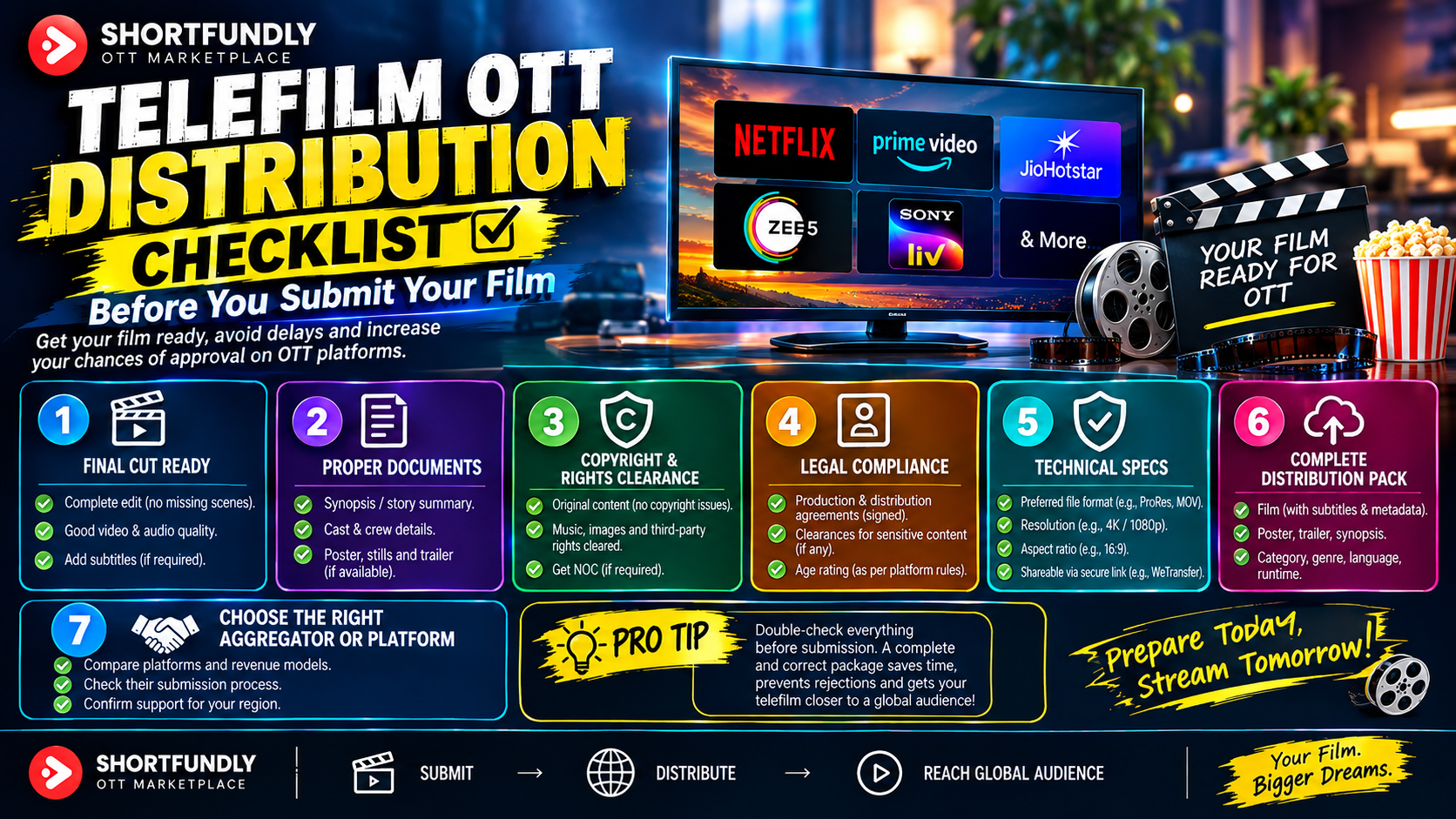
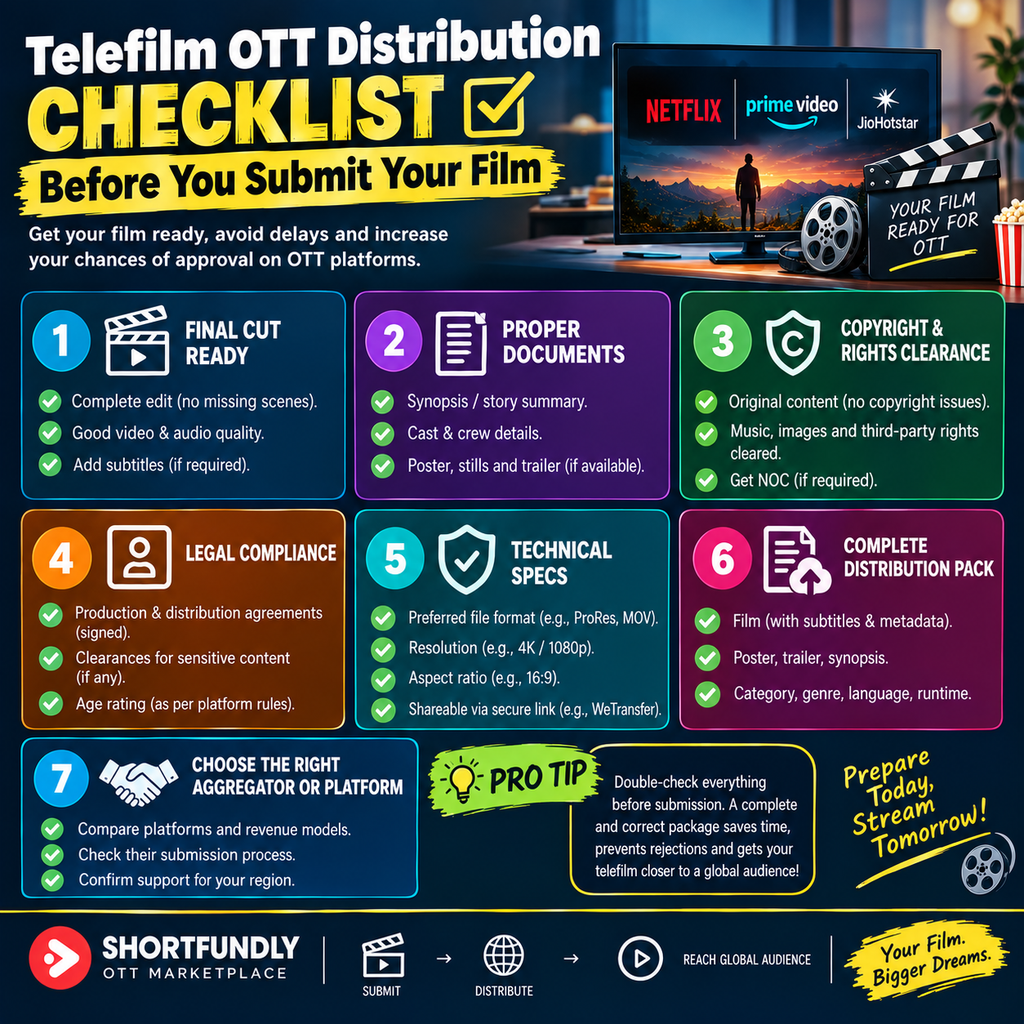
Telefilm OTT distribution checklist is an essential resource for every filmmaker preparing to submit a telefilm to streaming platforms. Before we send a project to an OTT platform, distributor, or aggregator, we need to make sure the film is legally cleared, technically ready, professionally packaged, and commercially suitable.
A good telefilm can still face delays if its OTT distribution documents, subtitles, metadata, artwork, rights agreements, or master files aren’t ready. On the other hand, a well-prepared submission gives distributors and OTT buyers a clear view of the project and reduces avoidable back-and-forth.
For independent producers and filmmakers, the preparation stage is especially important. We may not have a large production company handling distribution, so the responsibility for checking rights, assets, technical quality, and delivery materials often falls directly on the production team.
This complete telefilm OTT distribution checklist walks through the major steps we should complete before submitting a telefilm. It also explains how to prepare a professional OTT package, review distribution rights, select a suitable distributor, and avoid common submission mistakes.
Shortfundly Distribution is one distribution service that filmmakers can evaluate when exploring OTT opportunities for telefilms and other supported content formats. Its distribution offering includes content submission and distribution-related services for creators and producers. Current eligibility, platform availability, pricing, and commercial terms should be verified before submission.
Telefilm OTT Distribution Checklist: Complete Outline
| Section | What We Cover |
|---|---|
| 1 | Telefilm OTT distribution fundamentals |
| 2 | Copyright and ownership verification |
| 3 | Chain-of-title documentation |
| 4 | Music and third-party rights |
| 5 | OTT master video preparation |
| 6 | Audio quality and technical QC |
| 7 | Subtitles and localization |
| 8 | Metadata preparation |
| 9 | Poster, thumbnail, and artwork |
| 10 | Trailer and promotional assets |
| 11 | Cast and crew information |
| 12 | Content rating and compliance |
| 13 | Choosing an OTT distributor |
| 14 | Revenue and licensing terms |
| 15 | Final submission checklist |
| 16 | Common mistakes |
| 17 | Post-submission process |
| 18 | FAQs |
| 19 | Conclusion |
1. Understand What OTT Distribution Requires
Before submitting a telefilm, we should understand that OTT distribution involves much more than uploading a video file.
A streaming platform needs a complete content package that can be reviewed, processed, published, promoted, and monetized.
Depending on the platform or distributor, we may need to provide:
- Final telefilm master
- Trailer
- Poster
- Thumbnail
- Synopsis
- Metadata
- Cast and crew details
- Subtitles
- Closed captions
- Music documentation
- Copyright documentation
- Distribution authorization
- Content rating information
- Promotional stills
- Technical specifications
- Contracts and agreements
Every OTT service can have its own delivery requirements. Therefore, we shouldn’t assume that a file accepted by one service will automatically meet another service’s specifications.
The safest approach is to maintain a master OTT delivery package and then create platform-specific versions when necessary.
Why Preparation Matters Before Submission
A distributor or acquisition team needs enough information to understand the project quickly.
If the submission contains missing documents, unclear ownership, incomplete metadata, or technical problems, the project may require additional review.
That doesn’t necessarily mean the telefilm has poor quality. It simply means the distribution package isn’t ready.
A professional submission demonstrates that we understand both the creative and commercial sides of film distribution.
2. Verify Copyright Ownership Before OTT Submission
The first major item on our telefilm OTT distribution checklist should be copyright ownership.
We need to establish who owns the film and who has the authority to grant OTT distribution rights.
This is particularly important for independent productions involving several writers, producers, directors, musicians, actors, investors, and production companies.
We should verify rights associated with:
- Story
- Screenplay
- Dialogue
- Direction
- Film footage
- Music
- Lyrics
- Background score
- Performances
- Artwork
- Stock footage
- Photographs
- Archival material
- Third-party intellectual property
If another person or company owns any of these elements, appropriate permission or licensing documentation should be available.
Keep Copyright Records Organized
Rather than searching for documents after a distributor requests them, we should create a dedicated digital rights folder.
A useful structure might include:
Telefilm OTT Distribution
├── Copyright
├── Script Rights
├── Music Rights
├── Artist Agreements
├── Location Permissions
├── Master Files
├── Subtitles
├── Artwork
├── Metadata
└── Distribution Agreements
This simple structure can save considerable time during OTT onboarding.
3. Prepare Chain-of-Title Documents
Chain of title refers to the documentation that establishes the ownership and rights history of a film.
The exact documents required depend on the production and distributor, but they can include agreements relating to:
- Screenwriter
- Story creator
- Producer
- Director
- Composer
- Lyricist
- Performers
- Production company
- Third-party content
A distributor may need to verify that the person submitting the telefilm actually has the authority to license it.
If ownership is unclear, the project may face delays.
Why Chain of Title Matters
Imagine that a telefilm uses a screenplay written by another person, music composed by an external artist, and archival footage licensed from a third party.
We need documentation showing that each component has been cleared for the intended distribution.
Without that documentation, an OTT deal can become difficult even if the film itself is professionally produced.
4. Check Music and Third-Party Content Rights
Music is one of the most frequently overlooked areas in film distribution.
Before submitting the telefilm, we should check every song, score, sound recording, image, video clip, stock asset, and third-party element used in the production.
Our checklist should include:
- Original songs
- Licensed songs
- Background score
- Composer agreements
- Music-library licenses
- Stock footage
- Stock photographs
- Archival clips
- Brand assets
- Artwork
- Logos
The important question is simple:
Do we have the right to distribute this material through the OTT channels covered by the proposed agreement?
If the answer isn’t clear, the rights should be reviewed before submission.
Don’t Assume Online Availability Means Distribution Rights
A song or image being available on the internet doesn’t mean we have permission to use it commercially.
Likewise, permission to use music in a film may not always cover every territory or distribution method.
The rights granted should match the intended OTT distribution scope.
5. Prepare a Professional OTT Master File
The telefilm master is one of the most important technical assets.
We should preserve a high-quality master and avoid relying solely on a compressed social-media or messaging-app version.
Depending on the platform, specifications can cover:
- Resolution
- Codec
- Bitrate
- Frame rate
- Aspect ratio
- Audio channels
- File format
- Loudness
- Color space
- Subtitle delivery
- Caption delivery
The exact specifications should always come from the platform or distributor.
Keep Multiple Versions Where Necessary
It can be useful to maintain:
- High-quality archival master
- OTT delivery master
- Subtitle version
- Caption version
- Trailer master
- Promotional clips
This makes future distribution easier.
If another OTT service requests a different format, we can generate the required version without compromising the original master.
6. Check Audio Quality Before Submission
A technically good picture can’t compensate for consistently poor audio.
We should carefully review:
- Dialogue clarity
- Background noise
- Music levels
- Sound effects
- Channel configuration
- Audio synchronization
- Clipping
- Distortion
- Sudden volume changes
- Silence between scenes
A complete QC review should be performed from beginning to end.
We shouldn’t only watch selected scenes. Technical problems can appear anywhere in the film.
Perform a Full Quality-Control Review
A practical QC process can include:
- Watching the entire film
- Listening through headphones
- Checking dialogue
- Checking subtitles against dialogue
- Checking beginning and end credits
- Checking scene transitions
- Checking frame errors
- Checking audio sync
- Checking color consistency
This is a small investment of time compared with discovering a major issue after platform delivery.
7. Create Accurate Subtitles and Captions
Telefilm subtitles for OTT distribution are increasingly important because audiences can come from different language groups and many viewers watch content with sound turned down or off.
We should prepare accurate subtitle files according to the requirements of the target platform.
Subtitles should be checked for:
- Spelling
- Grammar
- Timing
- Speaker identification where needed
- Reading speed
- Character limits
- Scene synchronization
- Names
- Technical terminology
Poor subtitles can affect the viewing experience and reduce the professional quality of the submission.
Consider Localization
If the telefilm has international or multilingual potential, we can also consider:
- English subtitles
- Regional-language subtitles
- International-language subtitles
- Dubbing
- Closed captions
Localization should preserve the meaning and tone of the original dialogue rather than relying on awkward word-for-word translation.
8. Build Complete OTT Metadata
Metadata tells the platform what the telefilm is and helps audiences discover it.
Our OTT metadata checklist should include:
- Title
- Alternate title
- Language
- Genre
- Subgenre
- Runtime
- Release year
- Country
- Director
- Producer
- Main cast
- Supporting cast
- Crew
- Synopsis
- Short description
- Long description
- Keywords
- Content rating
- Subtitle information
Write a Strong Synopsis
The synopsis should quickly communicate the story.
A strong synopsis usually identifies:
Who is the protagonist?
What problem do they face?
What is at stake?
What makes the story interesting?
We should avoid writing a synopsis that simply lists events.
Instead, the description should communicate the central story hook without revealing unnecessary spoilers.
9. Prepare Professional Poster and Artwork
Artwork is an important part of an OTT content package.
We should prepare high-resolution artwork that accurately represents the telefilm.
Useful assets can include:
- Main poster
- Landscape artwork
- Portrait artwork
- Thumbnail
- Character posters
- Promotional stills
- Background artwork
The exact dimensions and formats should be confirmed with the distributor or platform.
What Makes Good OTT Artwork?
Effective artwork should:
- Be readable at small sizes
- Clearly display the title
- Reflect the genre
- Use strong visual hierarchy
- Avoid unnecessary text
- Represent the actual film
- Look professional
A crowded poster can become difficult to read on mobile devices and OTT interfaces.
10. Prepare a Professional Trailer
A trailer can help distributors understand the telefilm quickly.
We should prepare a trailer that communicates:
- Genre
- Story premise
- Main characters
- Emotional tone
- Conflict
- Production quality
The trailer shouldn’t reveal the entire story.
Instead, it should create curiosity.
We can also prepare shorter promotional versions for social media.
Useful promotional assets include:
- 30-second clips
- 15-second clips
- Character videos
- Behind-the-scenes content
- Cast interviews
- Director messages
- Teaser clips
These assets can support the OTT launch campaign.
11. Create a Complete Cast and Crew Sheet
A professional telefilm OTT submission package should include accurate cast and crew information.
We should prepare:
| Information | Details |
|---|---|
| Film Title | Official title |
| Director | Full name |
| Producer | Full name/company |
| Writer | Full name |
| Main Cast | Actor names and roles |
| Cinematography | Name |
| Editor | Name |
| Music | Composer |
| Production | Company |
| Language | Original language |
| Runtime | Final duration |
| Release Year | Year |
Names should be spelled consistently across the poster, metadata, credits, and distribution documents.
This matters because inconsistent metadata can create confusion across platform listings.
12. Check Content Rating and Compliance
Depending on the platform and territory, the telefilm may need content classification or other compliance information.
We should review potentially sensitive material, including:
- Violence
- Sexual content
- Strong language
- Drug references
- Self-harm references
- Disturbing imagery
- Child-related sensitive content
The appropriate classification requirements can vary by platform and market.
We shouldn’t assume that one rating automatically applies everywhere.
If a platform or distributor requests specific compliance information, it should be supplied accurately.
13. Choose the Right OTT Distributor or Aggregator
Choosing an OTT distributor for telefilm distribution requires more than checking the number of platforms a company claims to reach.
We should evaluate:
- Platform network
- Distribution territories
- Supported content types
- Fees
- Revenue sharing
- Licensing structure
- Rights requested
- Exclusivity
- Contract duration
- Reporting
- Payment terms
- Content support
- Technical support
- Promotional support
A distributor should provide clear information about what it actually does.
Evaluate Shortfundly Distribution
Shortfundly Distribution is one option that filmmakers can evaluate when preparing a telefilm for OTT distribution.
Its distribution portal describes services for creators and producers and lists multiple supported content categories, including telefilms and other digital formats.
Before submitting, we should verify the current eligibility requirements, pricing, available OTT partners, rights structure, distribution territories, payment terms, and other commercial conditions directly through the current service.
Shortfundly Distribution Official Portal
A distribution partner should be selected based on the actual requirements of our project rather than marketing claims alone.
14. Review OTT Licensing and Revenue Terms
Before signing a distribution agreement, we should understand exactly how the telefilm will generate revenue.
Possible OTT revenue structures include:
- Fixed licensing fee
- Revenue share
- Minimum guarantee
- AVOD
- SVOD
- TVOD
- Hybrid arrangements
Understand the Revenue Definition
If an agreement offers revenue sharing, we should determine whether the percentage applies to:
- Gross revenue
- Net revenue
- Revenue after platform fees
- Revenue after taxes
- Revenue after approved expenses
These definitions can materially affect the final amount received.
Review Rights Carefully
We should also check:
- Territory
- Term
- Exclusivity
- Platform
- Language
- Streaming rights
- Download rights
- Advertising rights
- Promotional rights
- Renewal
- Termination
- Rights reversion
A seemingly attractive agreement can become restrictive if it grants broader rights than we intended.
15. Complete the Final Telefilm OTT Distribution Checklist
Before clicking “submit,” we should complete a final review.
Legal Checklist
- Copyright ownership confirmed
- Story rights cleared
- Screenplay rights cleared
- Music rights cleared
- Artist agreements completed
- Location permissions completed
- Third-party content cleared
- Distribution authority confirmed
Technical Checklist
- Final master completed
- Video QC completed
- Audio QC completed
- Color reviewed
- Credits checked
- Subtitle files completed
- Caption files prepared where required
- Trailer exported
- Artwork prepared
Metadata Checklist
- Official title confirmed
- Synopsis written
- Genre selected
- Runtime confirmed
- Language confirmed
- Cast information completed
- Crew information completed
- Keywords prepared
- Rating information prepared
Commercial Checklist
- Distributor evaluated
- Fees reviewed
- Revenue share understood
- Territory checked
- Term checked
- Exclusivity checked
- Payment schedule understood
- Reporting process understood
- Termination terms reviewed
16. Common Telefilm OTT Submission Mistakes
Even a strong telefilm can face distribution problems because of simple preparation mistakes.
Submitting Before Rights Are Cleared
We shouldn’t submit first and search for rights documents later.
Using Unlicensed Music
Music licensing should be confirmed before distribution.
Sending a Low-Quality Master
Social-media exports shouldn’t automatically be treated as OTT masters.
Missing Subtitles
If subtitles are required and aren’t ready, the delivery process can slow down.
Poor Metadata
A vague synopsis or incomplete cast information makes the content package less professional.
Inconsistent Names
The director’s name, actor names, title, and production company should be consistent across all materials.
Ignoring Contract Terms
We shouldn’t focus only on the licensing fee.
Rights, term, exclusivity, territory, reporting, and termination can be equally important.
Assuming Submission Guarantees Distribution
Submission is not the same as acceptance.
A platform or distributor may review the project and decide whether it fits its current content strategy.
17. What Happens After You Submit Your Telefilm?
Once the submission is complete, the process may involve several stages.
A typical workflow can include:
Submission → Initial Review → Rights Verification → Commercial Discussion → Technical QC → Contract → Delivery → Scheduling → OTT Release
The exact process varies.
During review, the distributor or platform may ask for:
- Additional rights documents
- Revised metadata
- New artwork
- Subtitle corrections
- Technical revisions
- Trailer changes
- Additional content information
We should respond promptly and keep all communication organized.
Keep a Submission Tracker
A simple spreadsheet can track:
| Item | Status |
|---|---|
| Distributor | Submitted |
| Rights Documents | Complete |
| Master | Delivered |
| Metadata | Approved |
| Artwork | Approved |
| Subtitles | Approved |
| QC | Pending/Passed |
| Agreement | Pending/Signed |
| Release Date | Confirmed |
This becomes especially useful when the same telefilm is being considered for multiple OTT platforms.
18. How to Make Your Telefilm More OTT-Ready
A distribution checklist is useful, but the content itself should also be prepared with an audience in mind.
We should consider:
Strong Opening
The first few minutes should establish the story and create interest.
Consistent Pacing
Scenes should serve a clear narrative purpose.
Clear Audio
Dialogue should remain understandable.
Professional Editing
Transitions and cuts should support the story rather than distract from it.
Appropriate Runtime
Runtime should fit the content format and target platform.
Strong Genre Positioning
A distributor should quickly understand whether the project is a drama, thriller, romance, comedy, documentary-style telefilm, family story, or another format.
Clear positioning makes platform matching easier.
19. Why First-Time Producers Should Use a Pre-Submission Audit
Before sending the final package, we can perform a telefilm OTT pre-submission audit.
This is essentially a final inspection from the perspective of a distributor.
Ask:
- Is ownership completely documented?
- Are all music rights cleared?
- Is the master technically clean?
- Are subtitles accurate?
- Is the poster professional?
- Is the trailer ready?
- Is the synopsis compelling?
- Is metadata complete?
- Are cast and crew details accurate?
- Do we understand the distribution agreement?
- Are the rights being granted clearly defined?
- Is the revenue model understood?
- Are payment terms clear?
- Is the intended territory clear?
- Is the telefilm ready for commercial release?
If the answer to every question is yes, the submission is much better prepared.
Frequently Asked Questions
1. What should be included in a telefilm OTT distribution checklist?
A complete checklist should cover legal rights, copyright documents, master video, audio quality, subtitles, metadata, artwork, trailer, cast and crew details, content information, distribution terms, revenue terms, and final QC.
2. Do we need copyright documents for OTT distribution?
Yes, rights documentation is commonly important because the distributor or platform needs confidence that the person submitting the film has the authority to grant the relevant distribution rights.
3. Are subtitles necessary for telefilm OTT distribution?
Requirements vary by platform, but subtitles can be highly valuable for accessibility, regional audiences, and international distribution. We should prepare them according to the target platform’s requirements.
4. What video quality is required for OTT distribution?
There is no single universal specification. Platforms can have different requirements for resolution, codec, bitrate, frame rate, audio, and file format. We should always follow the current delivery specifications provided by the platform or distributor.
5. Can an independent filmmaker distribute a telefilm through an OTT aggregator?
Yes. An OTT aggregator or distribution company can potentially help independent filmmakers with platform submissions, delivery, rights administration, and other distribution activities, depending on its service model.
6. Can Shortfundly Distribution help with telefilm OTT distribution?
Shortfundly Distribution is one service that filmmakers can evaluate for telefilm and other supported content distribution. Its current distribution portal provides information about submission and distribution services. Eligibility, platform availability, pricing, and commercial terms should be confirmed directly before proceeding.
7. How much does telefilm OTT distribution cost?
There isn’t one universal price. Costs can depend on the distributor, platform, content type, duration, technical services, licensing arrangement, and revenue model. We should review the current commercial terms before signing.
8. Should we submit our telefilm to multiple OTT platforms?
It depends on the rights arrangement. A non-exclusive strategy may allow distribution through multiple platforms, while an exclusive agreement can restrict additional distribution. The contract should be reviewed carefully before submission.
9. What metadata is required for OTT distribution?
Common metadata includes title, synopsis, genre, language, runtime, release year, cast, crew, director, producer, keywords, content rating, and other platform-specific information.
10. Does OTT submission guarantee that a telefilm will be released?
No. Submission doesn’t automatically guarantee acceptance, licensing, publication, audience reach, or revenue. Platforms and distributors can apply their own review and acquisition criteria.
11. Can a low-budget telefilm get OTT distribution?
Potentially, yes. Budget alone doesn’t determine distribution suitability. A professionally produced film with clear rights, strong storytelling, technical quality, appropriate metadata, and audience fit can be considered through relevant OTT distribution channels.
12. What should we check in an OTT distribution agreement?
We should check rights, territory, term, exclusivity, platform scope, language, revenue model, deductions, payment schedule, reporting, renewal, termination, and rights reversion.
13. Do film festival awards help with OTT distribution?
Festival selections and awards can strengthen a project’s professional profile, but they don’t guarantee OTT acquisition. The distributor or platform may still evaluate the content, rights, technical quality, audience fit, and commercial potential.
14. How early should we prepare the OTT delivery package?
Ideally, preparation should begin before the film is completely finished. Rights documentation, metadata, artwork, subtitles, and promotional assets can be prepared while final post-production is underway.
Also read: https://blog.shortfundly.com/ott/ott-distribution-first-time/
Conclusion
A telefilm OTT distribution checklist gives filmmakers a practical way to identify problems before submitting a project to streaming platforms or distribution partners.
The strongest submissions combine clear legal rights, professional technical quality, accurate metadata, polished artwork, subtitles, a strong trailer, complete documentation, and carefully reviewed commercial terms.
We should never treat OTT distribution as a simple upload. The telefilm needs to be packaged as a complete digital content product that can pass legal review, technical QC, metadata processing, licensing discussions, and platform onboarding.
Before submission, we should confirm every important component:
Rights. Master. Audio. Subtitles. Metadata. Artwork. Trailer. Contracts. Revenue. Release strategy.
A structured preparation process can save time and reduce avoidable distribution problems.
For independent filmmakers and producers considering a distribution partner, Shortfundly Distribution can be evaluated alongside other OTT distribution options. The current service information and commercial terms should always be reviewed directly so that the selected distribution route matches the telefilm’s rights, target audience, language, territory, and monetization objectives.
Ultimately, the goal isn’t simply to get a telefilm submitted. The goal is to submit a complete, legally cleared, technically polished, professionally presented, and commercially understandable telefilm package.
When every item on the checklist has been reviewed, we can approach OTT distribution with greater confidence and a much more organized release strategy.