Table of Contents
Learn how to pitch your film to Taiwan OTT buyers with a professional pitch deck, localized materials, rights documentation, metadata, trailer, and distribution strategy. Explore practical Taiwan OTT distribution options, including Shortfundly Distribution.
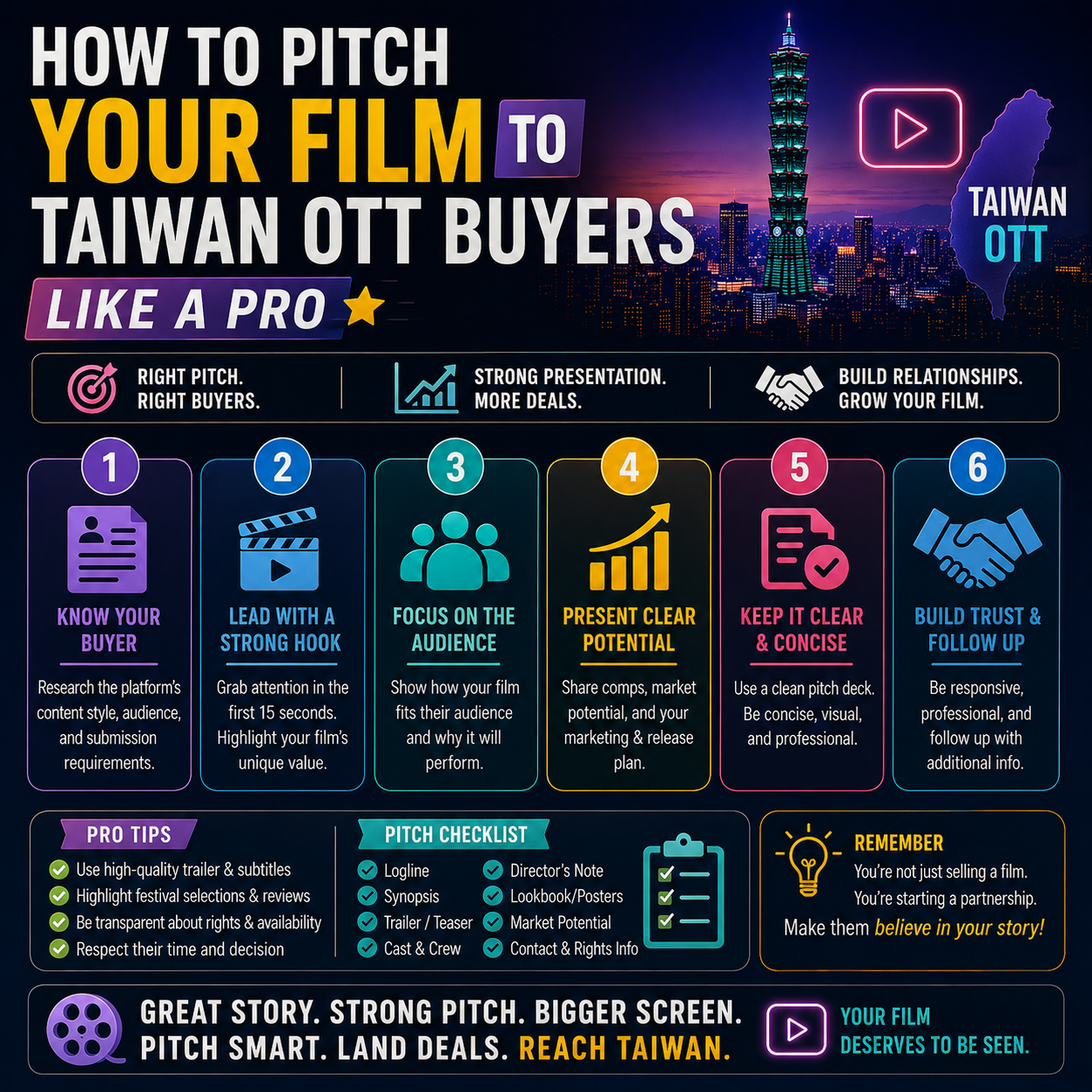
Getting a film in front of a Taiwan OTT buyer requires more than sending a streaming link and a short synopsis. In a competitive content market, we need to present the project as a commercially ready, technically reliable, and clearly positioned title.
Taiwan’s streaming landscape offers opportunities for independent filmmakers across short films, documentaries, feature films, pilot films, micro dramas, animation, and independent series. However, buyers need a reason to consider each project. A strong pitch makes that reason immediately clear.
For creators exploring professional distribution routes, Shortfundly Distribution can be considered as part of a broader OTT distribution strategy.
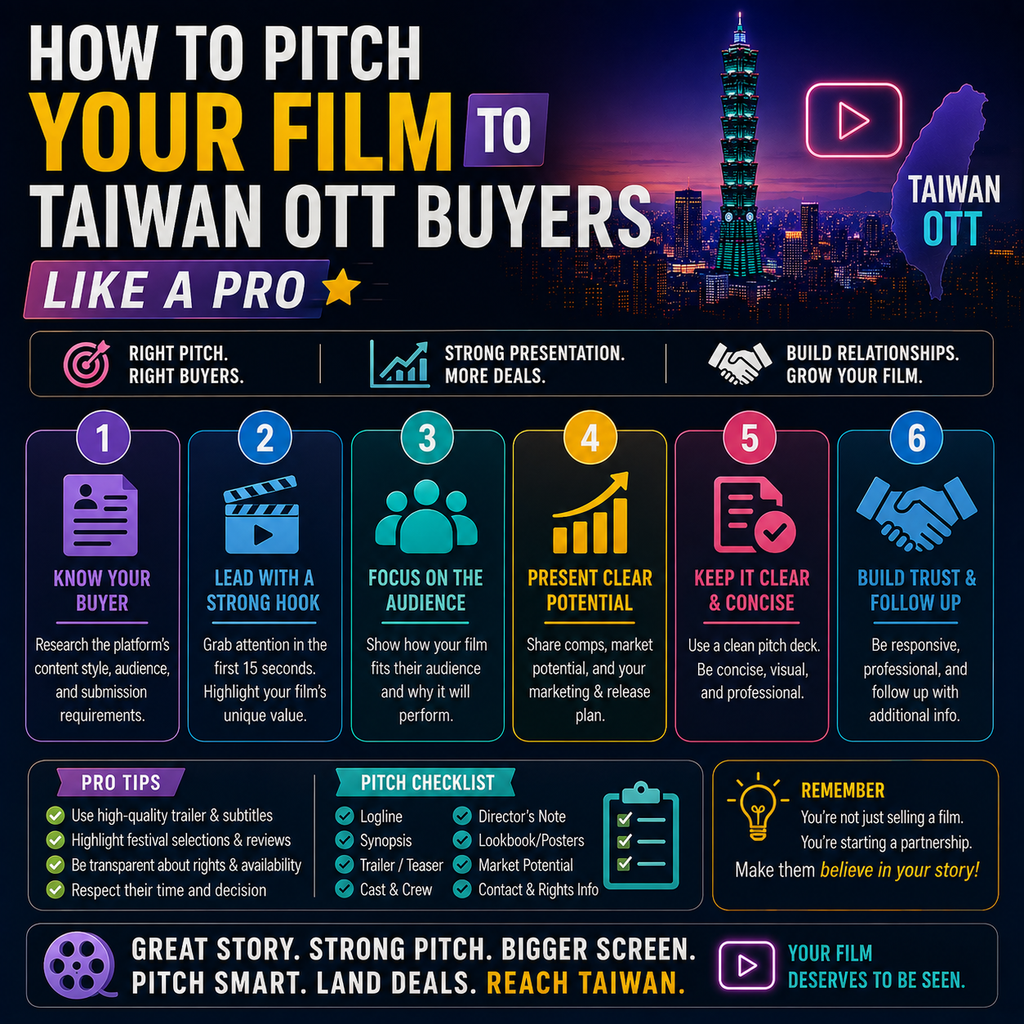
This guide explains how we can prepare, position, and pitch an independent film for Taiwan OTT distribution.
Why Taiwan OTT Buyers Need a Different Pitch
A generic international pitch may not communicate the project’s value effectively to a Taiwan-based buyer.
We should consider the target audience, language, genre, runtime, cultural context, and commercial positioning before approaching a platform or distributor.
For example, a documentary about Indian food could have international appeal. Yet the pitch becomes stronger when it explains its Taiwan audience relevance, available subtitles, cultural accessibility, and potential viewer profile.
Likewise, a thriller should highlight its hook rather than burying the concept beneath production details.
A buyer should understand the project within minutes.
Define Your Film’s OTT Positioning
Before creating the pitch, we should define exactly what we’re selling.
Consider these questions:
- What genre does the film belong to?
- Who is the intended audience?
- What makes the story distinctive?
- What is the runtime?
- Is it a standalone film or pilot?
- Which languages are available?
- Are Traditional Chinese subtitles available?
- Which territories are available?
- Are the rights exclusive or non-exclusive?
- Has the film received festival recognition?
- Does it have existing audience data?
The answers create the foundation for the pitch.
Build a One-Sentence Positioning Statement
A useful positioning statement combines the story and audience.
For example:
A character-driven psychological thriller designed for young adult audiences, combining mystery, family conflict, and a fast-paced narrative.
This gives a buyer immediate context.
Create a Strong OTT Logline
The logline is one of the most important parts of the pitch.
A good logline should explain:
Character + Goal + Conflict + Stakes
Instead of writing a vague description, we should communicate the central dramatic question.
Weak:
A young man experiences many challenges while trying to change his life.
Stronger:
After discovering a hidden family secret, a young journalist risks his career to uncover the truth before someone silences him.
The second version creates curiosity.
Prepare a Professional Film Synopsis
The synopsis should provide enough information without becoming a screenplay summary.
We can prepare two versions:
Short Synopsis
Around 50–100 words.
Use this for:
- Email pitches
- Metadata
- Platform listings
- Catalog sheets
Long Synopsis
Around 150–300 words.
Use this for:
- Pitch decks
- Buyer submissions
- Distribution proposals
The synopsis should remain factual and polished.
Avoid unnecessary production history unless it strengthens the commercial case.
Identify the Right Taiwan OTT Buyer
Not every platform is appropriate for every film.
We should first categorize the project.
| Film Type | Potential Buyer Profile |
|---|---|
| Short film | Curated digital services |
| Feature film | SVOD, TVOD, AVOD |
| Documentary | Documentary and factual catalogs |
| Micro drama | Short-form and mobile audiences |
| Pilot | Series-focused buyers |
| Animation | Family or specialist platforms |
| Genre film | Niche and genre catalogs |
This prevents a common mistake: sending the same pitch to every platform.
Research Before You Pitch
A buyer should never receive a pitch that feels mass-produced.
Before contacting a company, we should research:
- Content categories
- Existing catalog
- Target demographics
- Languages
- Geographic focus
- Release strategy
- Submission process
- Licensing approach
- Content formats
Then we can adapt the pitch.
Study the Existing Catalog
Suppose a platform already carries several Asian independent films.
That information can help shape our positioning.
We might emphasize:
- Regional storytelling
- Cross-cultural themes
- Festival recognition
- Asian audience relevance
- Subtitle availability
The goal isn’t to imitate existing titles.
The goal is to demonstrate catalog fit.
Build a Professional OTT Pitch Deck
A pitch deck should be visually clean and easy to scan.
A useful structure includes:
- Cover page
- Logline
- Film overview
- Synopsis
- Genre and format
- Target audience
- Director profile
- Cast
- Production information
- Festival history
- Audience data
- Trailer
- Localization
- Rights availability
- Distribution proposal
- Contact information
We should avoid overcrowding every slide.
A buyer should be able to understand the project without reading a wall of text.
Highlight the Film’s Commercial Hook
Creative quality matters, but buyers also need a commercial reason to consider the project.
The commercial hook could be:
- Recognized talent
- Strong genre
- Festival awards
- Existing fan base
- Social media traction
- Timely subject
- Regional relevance
- Unique visual style
- Proven short-form performance
We should present evidence whenever possible.
For example:
Selected at 8 international festivals
is stronger than:
The film has received excellent feedback.
Specific evidence creates credibility.
Prepare Traditional Chinese Localization
For Taiwan distribution, localization should be part of the pitch rather than an afterthought.
We should consider preparing:
- Traditional Chinese title
- Traditional Chinese synopsis
- Traditional Chinese subtitles
- Subtitle-ready trailer
- Localized poster
- Localized metadata
The exact requirements vary by platform and distributor.
Traditional Chinese localization also signals that the project is being prepared seriously for the market.
Don’t Ignore Film Metadata
Metadata allows buyers and platforms to understand and organize the title.
A professional metadata sheet should include:
| Field | Example |
|---|---|
| Title | Official film title |
| Localized title | Traditional Chinese title |
| Genre | Drama / Thriller |
| Runtime | Exact duration |
| Release year | Year of completion |
| Country | Production country |
| Language | Original language |
| Subtitles | Available languages |
| Director | Full name |
| Cast | Principal cast |
| Producer | Production company |
| Synopsis | Short and long |
| Keywords | Relevant discovery terms |
| Rights | Available territories |
Accuracy is essential.
Incorrect credits or inconsistent titles can create unnecessary delivery issues.
Prepare the Trailer Before Contacting Buyers
A trailer gives the buyer a quick sense of production quality.
We should prepare a concise, professionally edited trailer that communicates:
- Genre
- Tone
- Main conflict
- Visual quality
- Character appeal
- Story hook
Avoid revealing every major plot point.
The trailer should create enough curiosity to encourage further review.
Trailer Localization
For Taiwan-focused outreach, we should consider a version with Traditional Chinese subtitles.
The subtitle style should remain readable on mobile screens and television displays.
Prepare OTT Artwork
Artwork can influence how a title is perceived.
At minimum, we should prepare a professional key visual.
Potential assets include:
- Main poster
- Landscape artwork
- Portrait artwork
- Thumbnail
- Trailer thumbnail
- Character images
- Film stills
The exact dimensions and technical requirements should be confirmed with the receiving platform or distributor.
Organize Rights Documentation
A strong film pitch can still fail if rights aren’t clear.
Before approaching buyers, we should organize documentation covering:
- Copyright ownership
- Producer rights
- Director agreements
- Actor releases
- Music licenses
- Stock footage licenses
- Archive footage permissions
- Location releases
- Artwork permissions
- Existing distribution agreements
We should also confirm the territories available for licensing.
Understand Taiwan Territory Rights
A buyer may ask whether Taiwan rights are available.
The answer should be precise.
For example:
Taiwan digital streaming rights: available
is clearer than:
International rights available.
We should define whether the rights cover:
- Taiwan only
- Asia-Pacific
- Worldwide
- Specific language markets
Territory definitions should match the actual agreement.
Know Your Exclusivity Position
Buyers may ask for exclusive rights.
Before negotiating, we should understand the difference between:
Exclusive Taiwan OTT rights
and
Non-exclusive Taiwan OTT rights.
An exclusive agreement can provide stronger commercial commitment.
However, it can also restrict future licensing opportunities.
The contract should clearly state the term, territory, platforms, and rights covered.
Prepare a Revenue Strategy
OTT distribution can involve different commercial models.
SVOD
Subscription-based services may license content through:
- Fixed fees
- Minimum guarantees
- Revenue shares
- Hybrid agreements
AVOD
Advertising-supported distribution can generate revenue from advertising around content.
TVOD
Transactional services can generate revenue through rentals or purchases.
The best model depends on the film, audience, platform, rights package, and negotiated terms.
Don’t Focus Only on the Highest Upfront Fee
A larger upfront payment isn’t automatically the best deal.
We should evaluate:
- License duration
- Territory
- Exclusivity
- Revenue share
- Marketing
- Reporting
- Payment schedule
- Rights reversion
- Localization costs
A smaller deal with broader rights flexibility may sometimes create greater long-term value.
How to Write the Initial Buyer Email
The initial email should be short.
A buyer doesn’t need the entire history of the production.
We should provide:
Subject → One-line hook → Film details → Commercial relevance → Materials → Rights → Contact
For example, the email can identify the title, genre, runtime, language, synopsis, available territory, and link to the pitch materials.
Avoid sending extremely large attachments unless requested.
Follow Up Without Spamming
No response doesn’t always mean rejection.
Buyer inboxes can be busy.
A professional follow-up can be sent after a reasonable period.
The follow-up should add clarity rather than pressure.
For example, we can mention:
- Updated festival selection
- New audience numbers
- New localization
- Additional territory availability
- Revised trailer
New information gives the follow-up a purpose.
Common OTT Pitching Mistakes
1. Sending a Generic Email
A mass email rarely demonstrates catalog fit.
2. Using a Weak Logline
If the story isn’t clear, the buyer may stop reading.
3. Ignoring Localization
Taiwan-focused pitching benefits from Traditional Chinese materials.
4. Hiding Rights Information
Buyers need to know whether the project is actually licensable.
5. Overloading the Pitch Deck
Too much text reduces readability.
6. Sending an Unfinished Master
Technical problems create unnecessary friction.
7. Making Unsupported Claims
Statements such as “guaranteed hit” don’t demonstrate commercial value.
Evidence is more persuasive.
Build a Buyer-Ready Film Package
A professional package might contain:
Film Master
Trailer
Poster
Film Stills
Metadata Sheet
Pitch Deck
Synopsis
Cast and Crew Information
Subtitle Files
Rights Documentation
Press Kit
Keeping these materials organized saves time during negotiations.
Taiwan OTT Pitching Checklist
Before contacting buyers, we can review the following:
- Film master is final
- Trailer is complete
- Poster is professional
- Metadata is accurate
- Synopsis is polished
- Logline is compelling
- Traditional Chinese localization is prepared
- Rights are documented
- Music is cleared
- Talent releases are available
- Territory rights are confirmed
- Existing agreements are reviewed
- Pitch deck is complete
- Audience data is documented
- Festival achievements are listed
- Revenue expectations are realistic
When to Use an OTT Distribution Partner
Direct pitching isn’t the only route.
An independent filmmaker can also explore a distribution partner that may assist with content preparation, submissions, platform relationships, localization, delivery, and rights administration.
Shortfundly Distribution is one option independent creators can investigate when planning OTT distribution.
Before signing, we should confirm the distributor’s:
- Platform coverage
- Geographic coverage
- Revenue model
- Fees
- Contract duration
- Exclusivity
- Delivery requirements
- Reporting process
- Payment schedule
- Rights policies
The written agreement should match the commercial terms discussed during negotiations.
How to Stand Out From Other Independent Films
Competition is inevitable.
Therefore, we should make the pitch easy to evaluate.
A strong package communicates five things quickly:
1. Strong Story
The buyer understands the narrative.
2. Clear Audience
The buyer knows who may watch.
3. Professional Delivery
The film is technically ready.
4. Clean Rights
The project can be legally licensed.
5. Commercial Logic
The proposed deal makes sense.
When these elements work together, the film becomes easier to assess.
A Practical 30-Day Taiwan OTT Pitch Plan
Days 1–7: Content Audit
Review:
- Master
- Trailer
- Artwork
- Metadata
- Rights
Fix missing elements.
Days 8–14: Localization
Prepare:
- Traditional Chinese subtitles
- Localized synopsis
- Localized title
- Subtitle-ready trailer
Days 15–21: Buyer Research
Build a list of suitable buyers.
Rank them by:
- Genre fit
- Audience fit
- Platform model
- Territory
- Content requirements
Days 22–30: Outreach
Send customized pitches.
Track:
- Submission date
- Contact
- Response
- Follow-up date
- Requested materials
- Negotiation status
This simple workflow keeps the process organized.
How to Negotiate After a Buyer Shows Interest
The pitch is only the beginning.
Once a buyer expresses interest, we should clarify the commercial terms.
Key questions include:
- What rights are being licensed?
- What territory is covered?
- Is the agreement exclusive?
- How long is the license?
- What is the payment structure?
- Is there a revenue share?
- How is revenue calculated?
- Who pays localization costs?
- What marketing support is included?
- When do rights return to the filmmaker?
These questions should be answered in writing.
Protect Your Long-Term Catalog Value
A film can continue generating value after its initial release.
Therefore, we should avoid unnecessarily broad contracts.
A short license with clear rights may preserve future opportunities.
Likewise, a Taiwan-only agreement can preserve rights in other territories.
The strongest strategy often treats each territory as part of a larger international distribution plan.
Frequently Asked Questions
Can an independent filmmaker pitch directly to Taiwan OTT platforms?
Potentially, yes. Some platforms and content businesses accept direct approaches, while others work through established distributors, aggregators, producers, or licensing partners.
Do we need Traditional Chinese subtitles?
For Taiwan-focused distribution, Traditional Chinese subtitles are highly useful. Specific subtitle and localization requirements depend on the platform and contract.
Can short films be pitched to OTT buyers?
Yes. Short films can fit curated catalogs, niche services, short-form platforms, and other digital channels. The project should be positioned according to its audience and format.
Should we include the entire film in the first email?
Not necessarily. A concise pitch, trailer, synopsis, and professional screener link can be more appropriate unless the buyer specifically requests the full master.
What should an OTT pitch deck contain?
A strong deck can include the logline, synopsis, genre, audience, director, cast, production details, festival history, audience data, trailer, localization, and rights information.
How important are film rights?
Rights are critical. Buyers need confidence that the person licensing the film has the authority to grant the requested rights.
Should we offer exclusive rights?
Only after evaluating the commercial value of exclusivity. We should compare the payment, territory, duration, marketing support, and restrictions against a non-exclusive strategy.
How can we make our film attractive to Taiwan audiences?
Strong storytelling remains central. However, professional Traditional Chinese localization, relevant metadata, suitable artwork, and clear audience positioning can make the project easier to market and discover.
How long does OTT pitching take?
There is no universal timeline. Review periods vary according to the buyer, content volume, rights situation, technical requirements, and negotiation process.
Also read: https://blog.shortfundly.com/ott/taiwan-ott-distribution-time/
Final Takeaway
To pitch your film to Taiwan OTT buyers like a pro, we need to think beyond the film itself.
The buyer is evaluating an entire package:
Story + Audience + Rights + Localization + Technical Quality + Commercial Potential.
A compelling logline gets attention. A polished pitch deck builds interest. Strong localization improves market readiness. Clean rights documentation reduces uncertainty. Accurate metadata supports professional delivery.
Most importantly, the pitch should make the buyer’s decision easier.
Instead of simply saying that a film is good, we should demonstrate who will watch it, why it fits the catalog, what rights are available, and how the project can be commercially positioned.
For independent filmmakers entering Taiwan OTT distribution in 2026, preparation is the difference between an informal submission and a professional licensing opportunity.