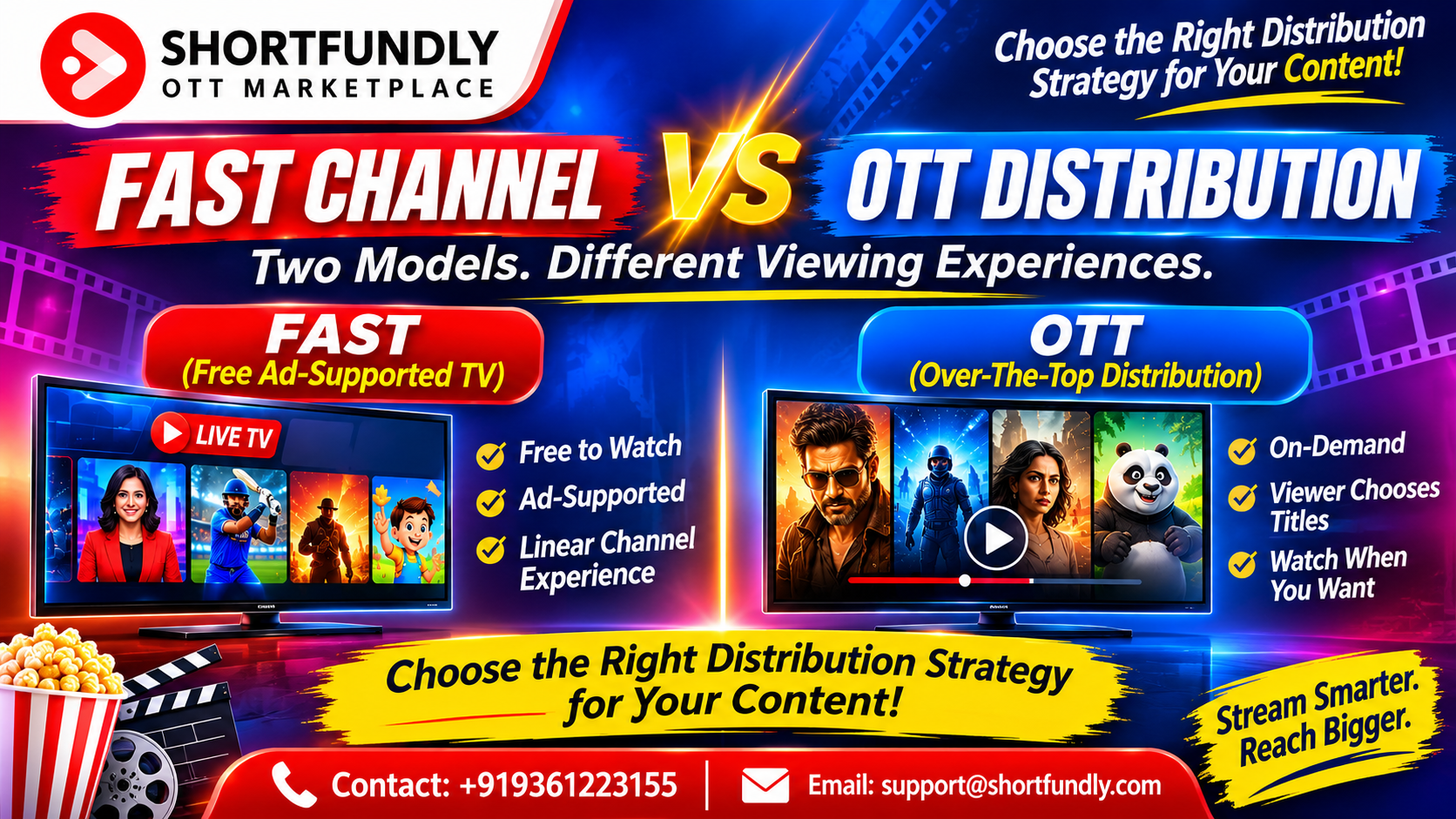
Table of Contents
Introduction: FAST Channel vs OTT Distribution
The video streaming industry has transformed how filmmakers, production companies, studios, and content owners deliver entertainment to audiences. Among the most important distribution models are FAST channel distribution and OTT distribution. Both enable content to reach viewers through internet-connected devices, but they differ in viewing experience, monetization, programming structure, audience behavior, and commercial strategy.
Understanding FAST channel vs OTT distribution is essential for content owners looking to maximize the value of their film libraries, expand audience reach, and build sustainable revenue opportunities. Choosing the right distribution model can influence how viewers discover content, how programming is presented, and how rights holders earn from their productions.
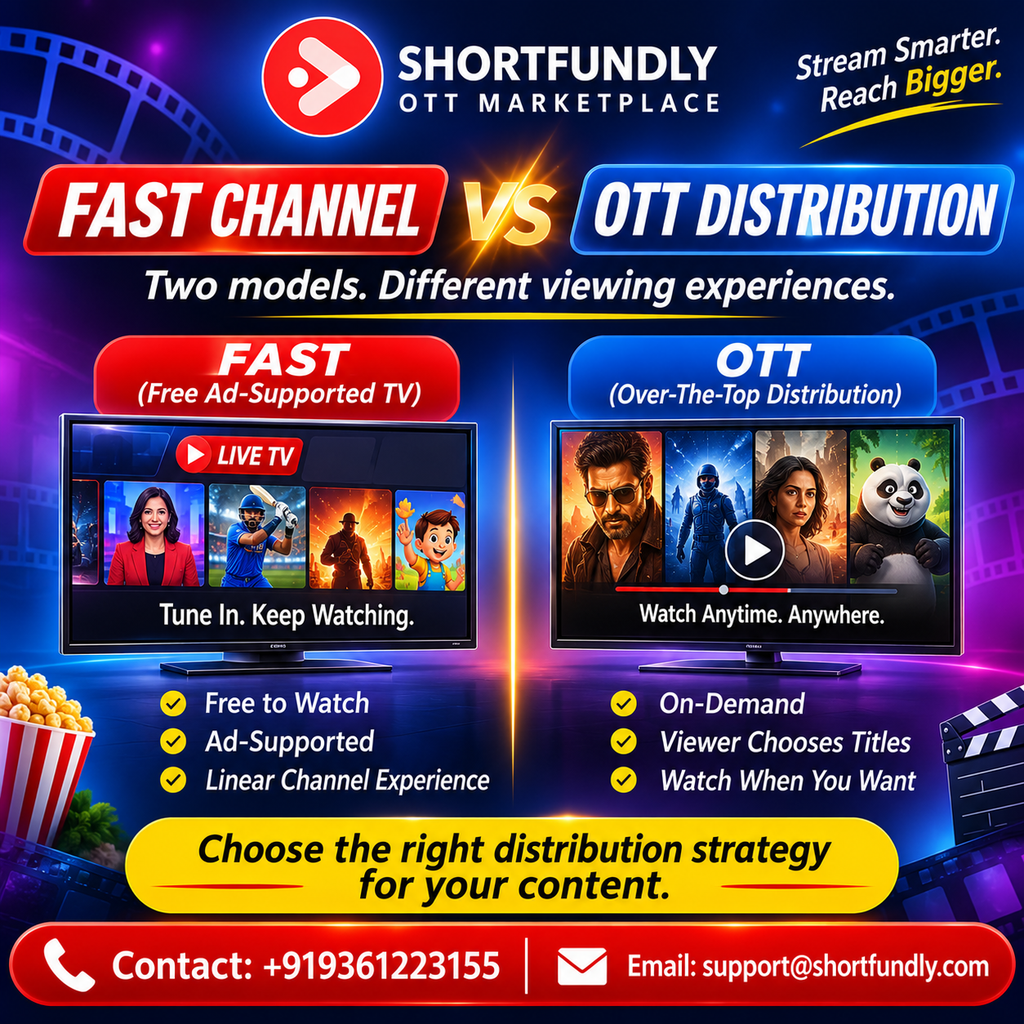
FAST (Free Ad-Supported Streaming Television) provides a television-like experience through internet streaming, allowing audiences to watch scheduled programming without a subscription. OTT (Over-the-Top) is a broader delivery model that distributes video content over the internet, often through subscription, advertising, rental, purchase, or free streaming services.
While FAST is part of the broader OTT ecosystem, the two are not interchangeable. Each offers different advantages, and the best choice depends on the content library, target audience, licensing rights, monetization objectives, and distribution strategy.
In this guide, we explore the key differences between FAST channel distribution and OTT distribution, how their revenue models work, their advantages and limitations, and how content owners can choose the most suitable strategy for their content.
What Is FAST Channel Distribution?
Amazon Fire TV | Watch Pluto TV on Smart TV – Where to Watch | Pluto TV
7
FAST channel distribution refers to delivering television-style channels over the internet, where viewers can watch programming for free and advertising supports the service. FAST stands for Free Ad-Supported Streaming Television.
FAST platforms typically offer a linear viewing experience with scheduled programming. Instead of searching for and selecting every film or episode individually, viewers can browse channels and join programmes that are already playing, similar to traditional television.
FAST channels may focus on:
- Movies and entertainment
- Action and thriller films
- Regional cinema
- Classic television
- Documentaries and educational content
- Lifestyle and travel
- Kids and family programming
- Sports-related entertainment
- Language-specific content
- Niche genres and audience communities
For content owners, FAST distribution creates opportunities to monetize existing film and television libraries through advertising-supported streaming. It can also help introduce content to viewers who may not actively search for individual titles.
How FAST Channels Generate Revenue
FAST services primarily rely on advertising. Advertisements may appear before programmes, during scheduled breaks, or in other placements supported by the platform.
Revenue opportunities may depend on:
- Total viewing hours
- Advertising impressions
- Audience geography
- Advertiser demand
- Ad fill rates
- Effective CPM
- Channel performance
- Distribution agreements
- Platform and distributor revenue shares
Content owners may receive revenue through licensing agreements, advertising revenue shares, or other commercial arrangements depending on their distribution partner.
What Is OTT Distribution?
Disney Plus review | Tom’s Guide
Sling Freestream Is the Latest FAST Service on the Market – PRIMETIMER
8
OTT distribution (Over-the-Top distribution) is the delivery of video content directly over the internet without requiring viewers to access it through traditional cable or satellite television services.
OTT is a broad category that includes different streaming business models, content formats, and viewing experiences. OTT platforms can provide films, television series, documentaries, short films, live broadcasts, original productions, and other video content through smart TVs, mobile applications, websites, connected devices, and streaming media players.
OTT distribution can operate through several models:
- SVOD (Subscription Video on Demand): Viewers pay a recurring subscription fee to access a content library.
- AVOD (Advertising Video on Demand): Viewers watch free content supported by advertisements.
- TVOD (Transactional Video on Demand): Viewers rent or purchase individual films or programmes.
- FVOD (Free Video on Demand): Viewers access free on-demand content, which may or may not be supported by advertising.
- Hybrid OTT: Platforms combine subscriptions, advertising, rentals, purchases, or free viewing options.
OTT distribution gives viewers flexibility to select what they want to watch and when they want to watch it. Unlike traditional linear programming, on-demand services generally allow users to browse a catalogue and start a title at their preferred time.
For content owners, OTT distribution can provide opportunities to license titles, reach digital audiences, introduce original productions, and build content-based commercial relationships.
FAST Channel vs OTT Distribution: 9 Key Differences
Although FAST channels are technically part of the OTT ecosystem, their viewing experience and monetization structures are distinct. Understanding these differences helps content owners identify where their content may perform best.
Comparison of FAST and OTT Distribution
| Feature | FAST Channel Distribution | OTT Distribution |
|---|---|---|
| Viewing experience | Scheduled, linear channels | Primarily on-demand, though some services also offer live or linear content |
| Subscription | Generally free to viewers | Free, subscription, rental, purchase, or hybrid |
| Monetization | Primarily advertising | Subscription, advertising, transaction, or hybrid |
| Content discovery | Channel surfing and programme schedules | Search, recommendations, categories, and catalogue browsing |
| Viewer control | Viewers join programmes in progress | Viewers usually choose titles and playback time |
| Programming structure | Continuous channel schedule | Individual titles, episodes, playlists, or live streams |
| Audience behavior | Lean-back, television-style viewing | Intentional title selection and flexible viewing |
| Content requirements | Suitable library for scheduling and repeat programming | Individual titles can be distributed separately |
| Revenue strategy | Advertising monetization and licensing arrangements | Subscriptions, advertising, rentals, purchases, and licensing |
These differences influence how content owners package their libraries, negotiate rights, select partners, and evaluate distribution performance.
1. Viewing Experience: Linear Channels vs On-Demand Content
The viewing experience is one of the most noticeable differences between FAST and OTT distribution.
FAST channels offer a linear television experience. Viewers select a channel and watch the programme currently being broadcast. They may discover films and series without searching for specific titles.
OTT platforms, particularly on-demand services, give viewers greater control. They can browse catalogues, choose films, pause playback, resume watching, and select episodes according to their preferences and the platform’s functionality.
FAST works well for viewers who enjoy passive discovery and continuous entertainment. OTT on-demand services are often better suited to viewers who want to watch a specific film or programme at a particular time.
2. Monetization: Advertising vs Multiple Revenue Models
FAST channels generally monetize content through advertising. This makes the model attractive to audiences who prefer free entertainment and to advertisers seeking video inventory.
OTT platforms may use several commercial models, including:
- Monthly or annual subscriptions
- Advertising-supported viewing
- Rental fees
- Individual content purchases
- Premium memberships
- Bundled entertainment offerings
For content owners, OTT distribution may provide more commercial flexibility, depending on the platform and licensing agreement. FAST distribution offers an advertising-focused model that can help monetize titles without requiring viewers to pay for each film or subscribe to a service.
The actual revenue received by rights holders depends on the agreement, audience performance, platform economics, and distribution costs.
3. Audience Engagement and Content Discovery
FAST channel audiences may discover content through programme schedules, channel browsing, genre selections, featured channels, and recommendations. The linear format encourages viewers to stay with a channel and watch content they might not have actively searched for.
OTT audiences typically discover titles through search, personalized recommendations, collections, categories, featured placements, and watchlists.
A film that is difficult to discover in a large on-demand catalogue may benefit from being programmed into a well-curated FAST channel. Meanwhile, a title with a strong search-driven audience, established fan base, or specific viewing demand may benefit from on-demand availability.
The content’s genre, audience profile, language, and viewing habits should influence the distribution decision.
4. Content Programming and Library Requirements
FAST channels require thoughtful programming. A channel needs a recognizable theme, a schedule, and enough content to support continuous viewing. Depending on the channel’s strategy, programming may include films, episodes, themed blocks, seasonal content, and repeated schedules.
OTT on-demand distribution does not necessarily require an entire channel schedule. A single film, documentary, series, or collection may be licensed and presented as an individual title.
This difference can influence the value of a content library.
For example, a producer with 100 action films may be able to create a focused action channel if the rights, programming, technical assets, and distribution requirements are suitable. The same titles may also be licensed individually to an on-demand service.
FAST is often particularly relevant when a content owner has a substantial library that can be organized into consistent programming. OTT on-demand can be useful for individual titles, selected collections, and content with a specific audience.
5. Revenue Potential and Commercial Agreements
FAST and OTT distribution can generate revenue through different commercial structures, but neither model guarantees earnings.
FAST commercial agreements may involve:
- Advertising revenue shares
- Licensing fees
- Minimum guarantees, where negotiated
- Channel distribution arrangements
- Content licensing agreements
OTT commercial arrangements may include:
- Fixed licensing fees
- Subscription-based licensing
- Revenue shares
- Rental and purchase royalties
- Hybrid licensing agreements
- Minimum guarantees, where negotiated
The content owner’s earnings depend on factors such as content performance, territories, rights granted, exclusivity, distribution costs, advertising demand, and contractual terms.
When evaluating a FAST or OTT opportunity, we should understand the payment structure, reporting methodology, permitted deductions, payment frequency, licence duration, and any exclusivity restrictions.
6. Distribution Reach and Platform Availability
FAST services and OTT platforms may reach audiences across smart TVs, streaming devices, mobile applications, and web-based players. However, their availability differs according to geography, device compatibility, licensing agreements, and platform operations.
FAST platforms can offer access to audiences who regularly watch free television-style streaming channels. OTT services can reach audiences who actively browse or search for specific entertainment.
Content owners should not assume that every platform operates worldwide. Distribution opportunities must be evaluated based on confirmed territories, available rights, platform acceptance criteria, and audience relevance.
A strategic approach can prioritize territories where the content has suitable rights, language support, potential audience demand, and a viable distribution route.
7. Content Rights and Licensing Requirements
Rights management is essential for both FAST and OTT distribution.
Content owners should confirm that they control the rights required for the intended platform, territories, languages, monetization model, and licence period.
A title may be available for OTT distribution but not FAST distribution, or vice versa. Agreements can restrict distribution by platform type, territory, release window, exclusivity, or advertising-supported use.
Before signing an agreement, we should carefully review:
- FAST rights
- OTT and VOD rights
- AVOD rights
- SVOD rights
- TVOD rights
- Linear streaming rights
- Territorial restrictions
- Language and subtitle rights
- Exclusivity
- Licence period
- Music and third-party clearances
Clear rights documentation helps prevent conflicts and makes it easier to identify suitable distribution opportunities.
8. Technical Requirements and Content Preparation
FAST channel distribution often requires additional operational preparation because channels may need scheduling, programming management, metadata, channel branding, and continuous streaming workflows.
OTT on-demand distribution typically requires title-level delivery, including video masters, audio, subtitles, artwork, metadata, and technical quality control.
The exact requirements depend on the distribution partner.
| Technical requirement | FAST channel | OTT on-demand |
|---|---|---|
| Video masters | Required | Required |
| Audio tracks | Required | Required |
| Metadata | Title and programme information, scheduling data where applicable | Title-level metadata and catalogue information |
| Subtitles | Depending on platform and target market | Depending on platform and target market |
| Artwork | Channel branding and title assets | Title posters, thumbnails, and promotional assets |
| Programming schedule | Usually central to linear channels | Generally not required for on-demand catalogues |
| Content management | Channel scheduling and asset management | Catalogue and title management |
Preparing a professional content package can reduce delivery issues, improve catalogue organization, and help distribution partners evaluate the library.
9. Long-Term Content Strategy and Library Value
FAST and OTT distribution can complement each other as part of a broader content monetization strategy.
OTT distribution can help content owners license individual titles, reach specific audiences, and take advantage of subscription, advertising, rental, or purchase opportunities. FAST distribution can provide another route for curated programming and advertising-supported viewing.
A content library does not need to be limited to one distribution model. Where rights permit, a producer may explore different models across territories, platforms, and licence windows.
However, distribution strategies must be carefully coordinated. We should avoid conflicting rights grants, unauthorized overlapping licences, and contractual restrictions that prevent the content from being used in another distribution model.
The objective is not simply to place content everywhere. It is to identify appropriate opportunities that balance reach, revenue, audience experience, rights availability, and long-term value.
FAST Channel vs OTT Distribution: Advantages and Disadvantages
Understanding the advantages and limitations of both distribution models can help us make more informed decisions when planning a content release.
Advantages of FAST Channel Distribution
- Free audience access: Viewers can watch content without paying a subscription fee.
- Passive content discovery: Audiences can discover films and programmes while browsing channels.
- Advertising monetization: Content may generate income through advertising-supported viewing arrangements.
- Library monetization: Older films and catalogue content can receive additional distribution opportunities.
- Television-style viewing: Scheduled programming appeals to viewers who enjoy a traditional channel experience.
- Genre-based programming: Content libraries can be organized into focused entertainment channels.
- Additional distribution windows: FAST may complement other licensing arrangements when rights permit.
Limitations of FAST Channel Distribution
- Content owners may need a sufficiently large library for continuous programming.
- Revenue can vary depending on advertising demand and audience performance.
- Channel scheduling and programming management may require additional operational resources.
- Platform availability and territorial rights can limit distribution reach.
- Content owners may have less control over individual viewing decisions than in on-demand services.
- Acceptance, placement, and commercial arrangements depend on the distribution partner.
Advantages of OTT Distribution
- Viewers can select individual films and programmes.
- Content can be presented through searchable catalogues and personalized recommendations.
- Several monetization models may be available.
- Individual titles can be distributed without building a complete linear channel.
- OTT can accommodate different content categories and audience segments.
- Rights holders can explore licensing opportunities across different service types.
Limitations of OTT Distribution
- Competition within large content catalogues can make discovery difficult.
- Subscription-based services may require viewers to commit financially.
- Revenue depends on platform models, licence terms, and audience performance.
- Catalogue availability can be restricted by territory and exclusivity.
- Content owners may not receive detailed performance data from every platform.
When Should We Choose FAST Channel Distribution?
FAST channel distribution can be particularly suitable when our content library supports a continuous programming experience and we want to explore advertising-supported viewing.
We should consider FAST when:
- We own a substantial film or television library.
- Our content fits a specific genre or audience category.
- We want to explore advertising-supported monetization.
- Our titles can be organized into coherent programming blocks.
- We want to reach viewers who prefer free television-style entertainment.
- We have suitable rights for FAST distribution.
- We can prepare the technical and promotional assets required by the distribution partner.
For example, a producer with a library of regional movies may explore a regional-language FAST channel. A documentary distributor could organize nature, history, science, or travel programming into a dedicated channel. A film studio with a collection of classic movies could develop a themed programming strategy.
The success of such an approach depends on content quality, programming consistency, distribution availability, audience demand, and commercial terms.
When Should We Choose OTT Distribution?
OTT distribution is often suitable when we want viewers to select individual titles according to their interests and schedules.
We should consider OTT when:
- We have individual films or series suitable for catalogue licensing.
- Our content has a defined audience that may actively search for it.
- We want to explore subscription, advertising, rental, or purchase-based models.
- Our library does not support a continuous linear schedule.
- We want to distribute selected titles rather than an entire channel.
- We have suitable digital distribution rights.
- Our content is prepared for the technical and metadata requirements of the platform.
For example, an independent filmmaker with a feature film may prioritize on-demand licensing opportunities. A documentary producer may distribute individual documentaries to platforms with relevant audience interests. A television production company may license selected series or seasons through OTT services.
Can We Use FAST and OTT Distribution Together?
Best 75 inch TVs under $1000 for Movie Nights & Gaming – Grand Goldman
Best Android TVs For Streaming Netflix, Youtube, and OTT in 2025
Every NZ Streaming App That Works on KONKA Smart TVs
7
Yes. FAST and OTT distribution can complement each other when the rights, licence windows, commercial agreements, and platform requirements allow it.
A combined distribution strategy can help content owners approach audiences through different viewing habits. Some viewers prefer scheduled programming and channel surfing, while others want to search for a specific film and watch it immediately.
A coordinated strategy may include:
| Distribution approach | Strategic purpose |
|---|---|
| FAST channel | Reach viewers through scheduled, advertising-supported programming |
| AVOD | Make titles available on-demand with advertising |
| SVOD | License content to subscription-based services |
| TVOD | Offer films for rental or purchase |
| Direct OTT service | Build a branded viewing experience and audience relationship |
We should evaluate the rights associated with each model separately. A title licensed exclusively to one platform may not be available for simultaneous distribution elsewhere. Licence windows, territory restrictions, and exclusivity provisions must be reviewed before expanding distribution.
A well-planned multi-platform strategy can improve content exposure while preserving the commercial value of each title.
How to Select the Right Distribution Partner for FAST or OTT
The right distribution partner can make a significant difference in the process of preparing, licensing, delivering, and monetizing content.
We should evaluate potential partners using the following criteria.
Platform Reach and Territory Coverage
Confirm which platforms the partner works with, the countries covered, and whether the proposed distribution opportunity is available for our content category.
Content Eligibility
Review whether the partner accepts our genres, formats, languages, content library size, and rights package. We should understand the selection process before preparing an extensive delivery package.
Technical Capabilities
Assess whether the partner supports video delivery, metadata preparation, asset management, quality control, localization, and other services required for the proposed distribution model.
Revenue Transparency
Review the commercial structure, including licensing fees, revenue shares, commissions, deductions, payment schedules, and reporting.
Rights Management
Ensure that the partner clearly explains the rights required, licence periods, territories, exclusivity, and permitted distribution models.
Communication and Reporting
Reliable communication and useful reporting can help content owners understand performance and manage their libraries more effectively.
Content owners evaluating distribution services can explore Shortfundly Distribution to learn about its distribution offering and assess whether it aligns with their content and commercial objectives. We should confirm the current services, platform availability, FAST-specific capabilities, eligibility requirements, fees, rights terms, and reporting directly before proceeding.
For a practical content preparation overview, we can also review How to Distribute Content to FAST Channels: A Complete Guide for Content Owners, which outlines content preparation, rights, platform selection, distribution partners, and performance monitoring.
Frequently Asked Questions (FAQs)
1. What is the main difference between FAST channel distribution and OTT distribution?
The main difference is the viewing experience and distribution structure. FAST provides scheduled, linear, advertising-supported channels that viewers can watch for free. OTT is the broader internet-based video delivery model and includes on-demand, subscription, advertising-supported, rental, purchase, and live streaming services.
2. Is FAST a type of OTT?
Yes. FAST is generally considered part of the broader OTT ecosystem because it delivers television programming over the internet. However, FAST uses a linear, scheduled channel format, while OTT also includes on-demand and other streaming experiences.
3. Which is better for independent filmmakers: FAST or OTT?
Neither is universally better. FAST may suit filmmakers with suitable libraries, genre-based content, or films that can be included in scheduled programming. OTT on-demand distribution may suit individual films, documentaries, and titles that audiences want to select directly.
The best option depends on the content, rights, target audience, distribution availability, and commercial terms.
4. Does FAST distribution generate more revenue than OTT?
Not necessarily. Revenue depends on audience engagement, advertising demand, licensing arrangements, platform performance, distribution costs, and territorial availability.
FAST may generate advertising-supported revenue, while OTT services may provide subscriptions, advertising, rentals, purchases, or licensing fees. We should compare actual commercial proposals rather than assume one model is more profitable.
5. Can we distribute the same movie on FAST and OTT platforms?
Potentially, yes. A movie can be distributed through FAST and OTT platforms if the rights holder controls the required rights and the licensing agreements permit the intended distribution.
We must review territorial restrictions, exclusivity, licence windows, platform restrictions, and existing contracts before distributing the same title across multiple services.
6. Does OTT distribution always require a subscription?
No. OTT platforms may offer subscription-based, advertising-supported, transactional, hybrid, or free viewing models. Subscription-based OTT is only one category within the broader OTT ecosystem.
7. What types of content are suitable for FAST channels?
FAST channels can feature movies, documentaries, television series, animation, regional cinema, lifestyle programming, classic entertainment, and other content categories. Suitability depends on the channel’s programming strategy, audience, rights, and platform requirements.
8. What rights are required for FAST distribution?
Content owners generally need the rights required for free, advertising-supported streaming and the relevant channel or linear streaming model. The agreement may also require territorial, language, promotional, and other rights depending on the service.
FAST rights should not be assumed to be included in an existing OTT, SVOD, TVOD, or general digital distribution agreement.
9. Can older movies earn revenue through FAST channels?
Yes, older films may be suitable for FAST channels if the rights are available and the titles meet the platform’s content requirements. Catalogue films can be organized into genre-based, language-based, regional, or thematic programming.
Revenue is not guaranteed and depends on viewing performance, advertising demand, commercial arrangements, and distribution availability.
10. Is FAST distribution more suitable for large film libraries?
A large library can be beneficial because it provides more programming options and helps support continuous schedules. However, smaller collections may also be suitable for specific channel concepts, curated programming, or licensing arrangements, depending on the distribution partner.
11. How can content owners prepare for FAST and OTT distribution?
We should begin with a rights audit, catalogue inventory, technical quality control, metadata preparation, artwork, subtitles, and audience evaluation. We should then identify suitable partners, confirm delivery specifications, and review the commercial agreement before submitting content.
12. Can FAST and OTT distribution help monetize older content?
Yes. Both models can provide additional distribution opportunities for older films, television series, and documentaries. FAST can offer scheduled programming, while OTT on-demand services can present titles through searchable catalogues.
The availability of these opportunities depends on rights, platform requirements, content quality, and commercial agreements.
Also read: https://blog.shortfundly.com/ott/pitch-content-to-fast-channels/
Conclusion: FAST Channel vs OTT Distribution—Which Strategy Is Right for Us?
The comparison between FAST channel vs OTT distribution is not simply a choice between two competing technologies. It is a strategic decision about how content should be presented, discovered, licensed, and monetized.
FAST channel distribution offers a television-style viewing experience supported primarily by advertising. It can be an attractive option for content libraries that support scheduled programming, genre-based channels, and continuous entertainment.
OTT distribution provides a broader range of streaming possibilities, including on-demand viewing, subscriptions, advertising, rentals, purchases, and hybrid models. It offers flexibility for individual films, series, documentaries, and content that audiences want to select directly.
For filmmakers, studios, and content owners, the strongest strategy begins with understanding the library, rights, audience, and commercial objectives. We can then identify the distribution model that best supports the content’s value and long-term potential.
By evaluating FAST and OTT opportunities carefully, preparing professional content assets, choosing reliable partners, and managing rights effectively, we can create a more sustainable distribution strategy and reach audiences through the streaming experiences they prefer.
Explore Shortfundly Distribution to review distribution services and determine whether they align with your content distribution goals. A well-planned distribution approach can help us discover new opportunities, expand content reach, and make our film and television libraries more valuable across the evolving streaming landscape.