Table of Contents
How to get independent songs on OTT platforms without a record label: learn 11 powerful steps for music distribution, rights, metadata, submission, and promotion.
Getting your music onto digital platforms no longer requires you to wait for a traditional record label to discover you. Independent songs on OTT platforms can reach audiences through digital distribution services, provided the artist has the necessary rights, properly prepared content, accurate metadata, and a suitable distribution strategy.
For independent singers, composers, producers, bands, and music creators, this change has created a much more accessible path to releasing music. You can create your own music, control your release schedule, prepare your digital assets, and work with a distribution partner that fits your goals.
However, getting a song online isn’t simply a matter of uploading an MP3 file. You’ll need to think about copyright, master ownership, composition rights, artwork, metadata, technical quality, release timing, distribution agreements, and promotion.
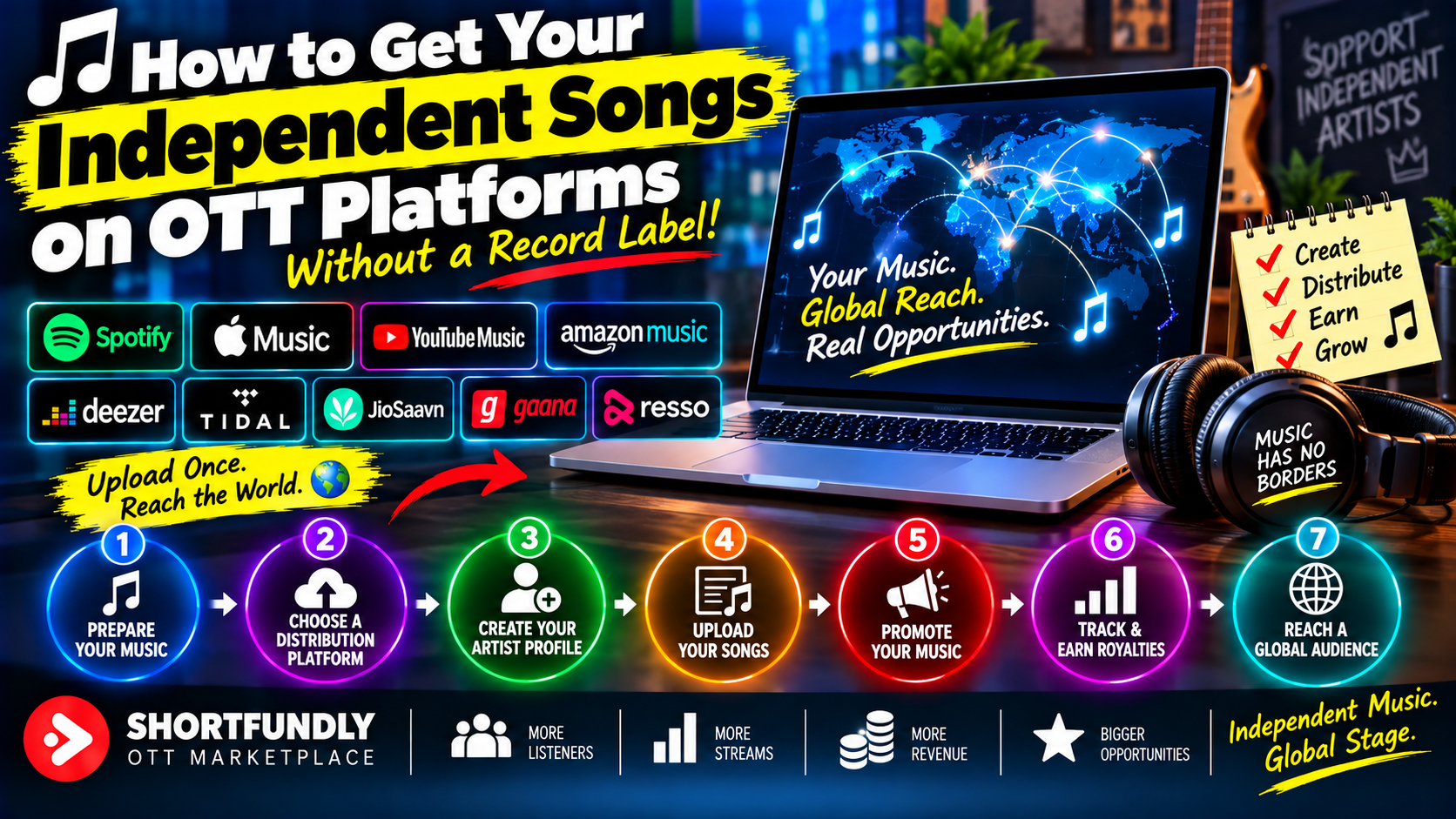
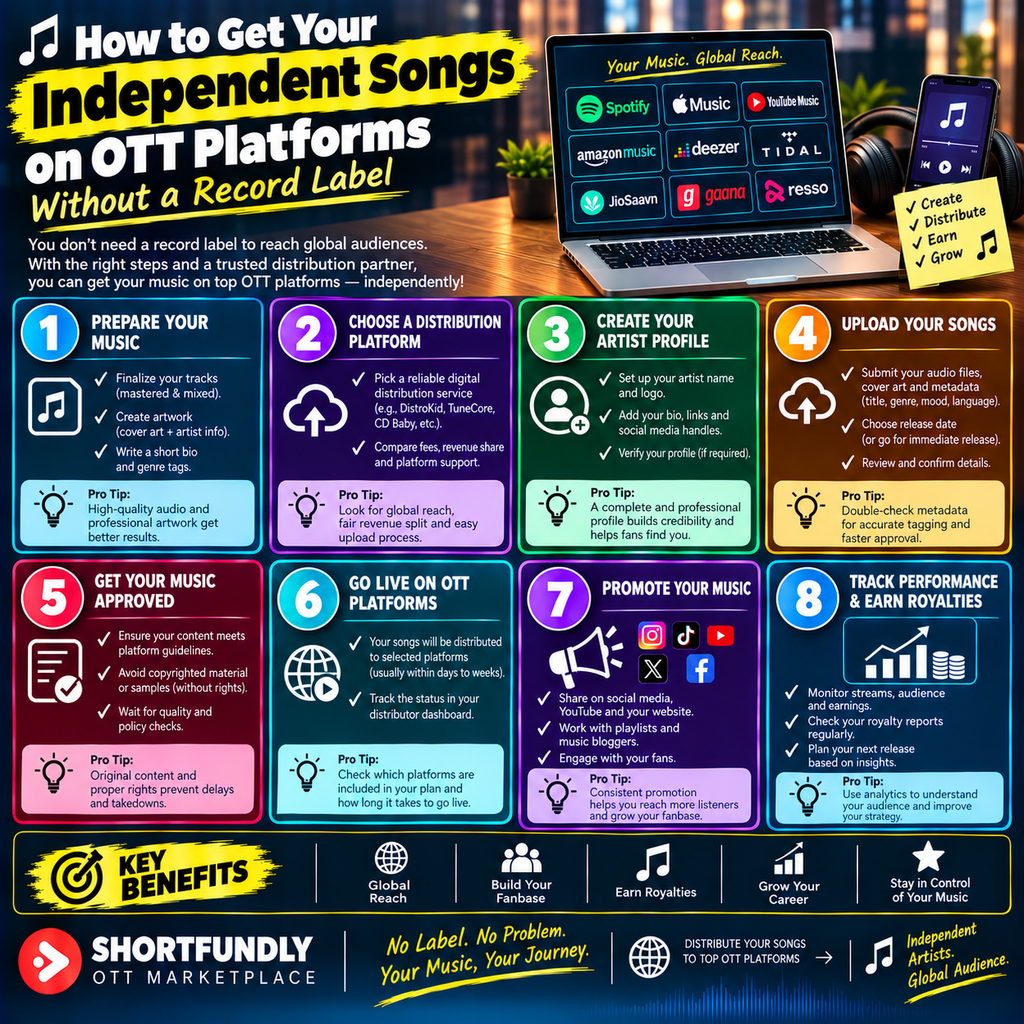
In this guide, we’ll explain 11 powerful steps for getting your independent songs onto OTT and digital distribution channels without depending on a traditional record label. We’ll also explain how Shortfundly Distribution can be considered as one distribution option for eligible songs and video songs.
Comprehensive Outline
| Section | Topic |
|---|---|
| 1 | Can independent artists distribute songs without a record label? |
| 2 | Understanding OTT and digital music distribution |
| 3 | Step 1: Create a release-ready song |
| 4 | Step 2: Secure your music rights |
| 5 | Step 3: Understand master and publishing rights |
| 6 | Step 4: Prepare professional artwork |
| 7 | Step 5: Build accurate music metadata |
| 8 | Step 6: Choose the right distribution partner |
| 9 | Step 7: Consider Shortfundly Distribution |
| 10 | Step 8: Plan your release date |
| 11 | Step 9: Submit your music correctly |
| 12 | Step 10: Promote your independent song |
| 13 | Step 11: Monitor revenue and performance |
| 14 | Distribution costs and revenue models |
| 15 | Common mistakes independent artists make |
| 16 | Label vs independent distribution |
| 17 | Long-term independent music strategy |
| 18 | Pre-submission checklist |
| 19 | FAQs |
| 20 | Conclusion |
Can Independent Artists Distribute Songs Without a Record Label?
Yes, independent artists can pursue digital distribution without signing a traditional record-label deal.
The modern music ecosystem gives creators several ways to make their work available to audiences. Depending on the content and service, artists can work with digital music distributors, aggregators, OTT distribution companies, and other specialized services.
This means you don’t necessarily need to hand over ownership of your music simply to get it distributed.
However, there’s an important distinction between distribution and record-label representation.
A traditional record label may provide some combination of:
- Recording investment
- Artist development
- Marketing
- Distribution
- Public relations
- Playlist strategy
- Publishing support
- Tour support
- Business management
A distribution company, by contrast, primarily focuses on getting eligible content delivered to digital destinations and handling the related submission, technical, metadata, and reporting processes.
As an independent artist, you may need to handle many activities yourself.
That’s not necessarily a bad thing. It means you can build your own music business around your catalog.
The Independent Advantage
When you remain independent, you may have greater control over:
- Release dates
- Music ownership
- Creative decisions
- Collaboration
- Distribution choices
- Marketing style
- Catalog strategy
Of course, the exact rights you retain depend on the agreements you sign.
That’s why reading every distribution agreement carefully is essential.
Understanding OTT and Digital Music Distribution
Before choosing a distribution service, it’s useful to understand what OTT distribution actually means.
OTT stands for over-the-top and generally describes the delivery of digital content through internet-based services rather than traditional broadcast systems.
In music, digital distribution can involve delivering songs or music-related audiovisual content to eligible digital services and streaming destinations.
Depending on the distributor and content type, this can include:
- Audio songs
- Video songs
- Music videos
- Singles
- EPs
- Albums
- Other eligible audiovisual content
The exact platforms available aren’t necessarily the same for every distributor.
This is why artists should check a distributor’s current destination list rather than assuming that every distributor delivers to every service.
Distribution Is a Delivery System
Think of distribution as the bridge between your finished content and digital platforms.
You create the song.
You own or control the appropriate rights.
You prepare the digital assets.
The distributor then handles the applicable delivery workflow.
After that, the platform processes the content according to its own systems and policies.
That’s why distribution is only one part of a successful music release.
Step 1: Create a Release-Ready Song
The first step is obvious but extremely important: make sure your song is ready for commercial distribution.
Don’t rush to upload a song just because you’re excited about releasing it.
Your final master should be professionally prepared and carefully checked.
Your Audio Should Be
- Properly mixed
- Professionally mastered
- Free from unwanted noise
- Free from unintended clipping
- Exported according to applicable specifications
- The final approved version
Listen to the master on different systems.
Try:
- Headphones
- Earbuds
- Smartphone speakers
- Computer speakers
- Car audio
- Bluetooth speakers
You don’t need expensive equipment to perform a basic quality check.
What matters is catching obvious problems before submission.
Why Master Quality Matters
Digital platforms may process audio using their own technical systems.
A weak master won’t suddenly become professional because it’s uploaded to a streaming service.
If the recording sounds distorted, unbalanced, excessively compressed, or unfinished, listeners may notice.
Therefore, professional mixing and mastering should be part of your release budget.
Step 2: Secure Your Music Rights Before Distribution
One of the most important parts of independent music distribution is rights clearance.
Before you submit your song, make sure you have the necessary authority to distribute every component.
This can include rights relating to:
- Master recording
- Composition
- Lyrics
- Beat
- Samples
- Artwork
- Featured performances
- Music video
- Third-party material
If you wrote and produced everything yourself, the rights situation may be relatively straightforward.
But collaborations can make things more complicated.
Suppose you worked with:
- A composer
- A lyricist
- A producer
- A featured singer
- A session musician
You should have a clear understanding of who owns what.
Put Agreements in Writing
A verbal agreement may seem sufficient when you’re working with friends.
However, commercial distribution can create disagreements later.
A written agreement can clarify:
- Ownership
- Revenue splits
- Distribution authority
- Credit
- Territory
- Licensing
- Term
- Takedown rights
It may not be the most exciting part of making music, but it can save a lot of trouble later.
Step 3: Understand Master and Publishing Rights
Many new artists use the words “copyright” and “music rights” as though they mean one thing.
They don’t.
A song can involve multiple separate rights.
Master Rights
The master recording is the specific recorded version of a song.
For example, your finished studio recording has its own master rights.
Composition Rights
The underlying musical work can involve:
- Melody
- Lyrics
- Musical arrangement
These rights can belong to different people.
Publishing Rights
Publishing generally relates to the exploitation and administration of the underlying composition.
This distinction becomes important when revenue is generated.
For example, an artist could own the master while another party owns part of the composition.
That’s why independent artists should document ownership before entering distribution agreements.
Step 4: Prepare Professional Cover Artwork
Your song needs a professional visual identity.
Cover artwork is often one of the first things an audience sees.
It should accurately represent the release and follow the current requirements of your distributor and destination platforms.
Avoid Common Artwork Problems
Don’t use:
- Copyrighted photographs without permission
- Random images from search engines
- Low-resolution artwork
- Incorrect artist names
- Incorrect song titles
- Misleading promotional claims
- Unnecessary platform logos
- Excessive text
Your artwork should also be consistent with your artist identity.
Build a Recognizable Brand
If you’re planning multiple releases, think beyond one song.
Try to create a consistent visual identity across:
- Singles
- EPs
- Albums
- Social media
- Music videos
- Artist profiles
A recognizable identity can make it easier for listeners to remember your work.
Step 5: Build Accurate Music Metadata
Music metadata is the information that describes your release.
It may include:
- Song title
- Artist name
- Featured artist
- Composer
- Lyricist
- Producer
- Genre
- Language
- Release date
- Version
- Copyright information
- Label information
- Identifiers
Metadata may seem boring, but it’s a major part of digital distribution.
Why Metadata Matters
Imagine releasing several songs under different spellings of your artist name:
Arun Music
ArunMusic
Arun Music Official
ArunMusic India
This can create confusion across digital services.
Use a consistent artist name wherever possible.
Also make sure your song title is consistent across:
- Audio master
- Artwork
- Metadata
- Promotional materials
- Music video
Check Every Field
Before submitting, proofread the metadata carefully.
A simple spelling mistake can become a repeated error across multiple platforms.
Step 6: Choose the Right Distribution Partner
Now comes one of the most important decisions.
You need a distribution partner that matches your content and goals.
Don’t simply search for the company with the biggest advertising claim.
Compare the actual service.
Important Questions to Ask
Which platforms are supported?
Check the current destinations.
What content is accepted?
Does the service support:
- Songs?
- Video songs?
- Albums?
- EPs?
- Music videos?
What does distribution cost?
Check whether pricing involves:
- One-time fees
- Subscription
- Revenue sharing
- Project fees
- Additional charges
Who owns the rights?
Read the agreement carefully.
Is the agreement exclusive?
Never assume that a distribution agreement is non-exclusive.
What territories are covered?
Check whether your release is distributed locally, internationally, or according to selected territories.
How are earnings reported?
Understand how you can track performance and payouts.
Step 7: Consider Shortfundly Distribution for Eligible Songs
Shortfundly Distribution is one platform independent creators can consider when exploring a structured distribution route for eligible content, including songs and video songs.
Shortfundly’s current official distribution resource lists songs/video songs among supported content types, alongside formats such as short films, web series, movies, documentaries, telefilms, pilot films, and micro dramas.
Its current submission workflow includes steps such as checking applicable pricing, registering or signing in, adding content details, reviewing requirements, completing the applicable payment and agreement, submitting content for review, uploading release assets if approved, and tracking content and earnings.
This can make Shortfundly Distribution worth considering for creators who want a structured submission process rather than managing every distribution step independently.
However, artists should pay attention to an important point: submission does not guarantee selection, approval, or streaming. Distribution depends on eligibility, licensing, review, and the partners currently available for the relevant content.
What Should You Check?
Before submitting a song, review the current:
- Pricing
- Eligibility
- Technical requirements
- Distribution partners
- Agreement terms
- Rights requirements
- Revenue conditions
- Submission workflow
Pricing can vary according to content type and duration, so artists should use the current pricing system for their particular project rather than relying on old estimates.
For the current submission process, creators can visit the official Shortfundly Distribution platform.
Step 8: Plan Your Release Date Carefully
Don’t submit your song on the morning you want it to go live.
Digital distribution involves multiple stages.
A typical workflow may include:
- Content preparation
- Upload
- Metadata review
- Technical validation
- Rights review
- Corrections
- Distribution
- Platform processing
- Release
The exact processing time varies.
Therefore, give yourself enough time.
A Practical Release Schedule
| Stage | Activity |
|---|---|
| 4–6 weeks before | Finalize recording |
| 3–4 weeks before | Finalize artwork |
| 3–4 weeks before | Verify rights |
| 2–4 weeks before | Prepare metadata |
| Before release | Submit distribution package |
| Pre-release | Begin promotional campaign |
| Release day | Publish launch content |
| Post-release | Monitor performance |
The exact timeline should be adjusted according to your distributor’s current processing requirements.
Step 9: Submit Your Music Correctly
Once your assets are ready, complete the submission carefully.
Don’t rush through the form.
You may need to provide:
- Artist name
- Song title
- Release type
- Language
- Genre
- Release date
- Contributors
- Copyright information
- Artwork
- Audio
- Video, if applicable
- Rights information
- Other project details
Review Before You Submit
Use a simple three-part check.
Audio: Is this the final master?
Metadata: Is every field accurate?
Rights: Can I legally distribute every component?
If the answer to all three is yes, you’re in a much stronger position to submit.
Step 10: Promote Your Independent Song
Distribution gets your song into the digital ecosystem.
Promotion helps people discover it.
Don’t expect distribution alone to create an audience.
Build a Pre-Release Campaign
Start promotion before release day.
You can create:
- Teaser videos
- Lyric snippets
- Behind-the-scenes clips
- Studio footage
- Artist interviews
- Countdown posts
- Short performance videos
Use Short-Form Content
Create multiple short clips from the song.
For example:
Clip 1: Chorus
Clip 2: Opening line
Clip 3: Behind-the-scenes recording
Clip 4: Acoustic performance
Clip 5: Story behind the song
This gives your release more than one promotional opportunity.
Step 11: Monitor Revenue and Performance
Once your song is distributed, your job isn’t finished.
Track how the release performs.
Depending on the services available to you, useful information can include:
- Streams
- Listeners
- Audience locations
- Engagement
- Revenue
- Release performance
- Catalog performance
Don’t Obsess Over One Number
A song with fewer streams can still teach you something valuable.
For example, perhaps most listeners come from one city.
Or perhaps your audience responds particularly well to acoustic content.
Or maybe one regional-language song performs better than your English releases.
Use the information to guide future decisions.
How Much Does It Cost to Distribute Independent Songs?
There isn’t one universal price.
Distribution pricing can depend on:
- Distributor
- Content type
- Duration
- Number of releases
- Distribution destinations
- Territory
- Revenue model
- Services included
Common pricing structures include:
| Model | How It Works |
|---|---|
| Upfront fee | Pay a specified amount for distribution |
| Subscription | Pay monthly or annually |
| Revenue share | Distributor receives an agreed percentage |
| Project pricing | Price depends on the specific release |
| Hybrid | Combination of fees and revenue terms |
Before choosing a distributor, calculate the total cost of distribution, not simply the advertised starting price.
Also remember that music distribution is only one part of your release budget.
You may also spend on:
- Recording
- Mixing
- Mastering
- Artwork
- Video production
- Promotion
- PR
- Copyright licensing
How Do Independent Artists Make Money From OTT and Music Distribution?
Music revenue doesn’t come from one universal source.
Depending on the content and agreements involved, revenue may relate to:
- Streaming
- Advertising
- Licensing
- Digital sales
- Video monetization
- Publishing
- Performance rights
- Other commercial uses
The amount an artist ultimately receives can depend on:
- Platform
- Territory
- Audience activity
- Rights ownership
- Distributor agreement
- Label agreement
- Publishing arrangements
- Applicable deductions
Don’t Rely on a Fixed Per-Stream Number
It’s tempting to calculate:
Streams × fixed amount = earnings
But real-world royalty systems can be more complicated.
Different platforms use different commercial models, and the money flowing through a release may be divided among multiple rights holders.
That’s why understanding your agreement matters more than relying on an internet royalty calculator.
Can You Keep Ownership of Your Music Without a Record Label?
You may be able to retain ownership when working independently, but it depends on the contracts you sign.
A distribution agreement can grant specific rights to a distributor without necessarily transferring ownership of the underlying music.
However, every agreement is different.
Before signing, check:
- Ownership
- Distribution rights
- License duration
- Territory
- Exclusivity
- Revenue share
- Takedown provisions
- Renewal terms
Don’t sign simply because the platform promises reach.
Read the agreement.
If you don’t understand a major legal clause, consider getting professional legal advice.
Independent Distribution vs Traditional Record Label
The choice between independence and a traditional label depends on the artist’s goals.
| Factor | Independent Distribution | Traditional Label |
|---|---|---|
| Creative control | Often greater | Depends on agreement |
| Release control | Often greater | May be label-managed |
| Ownership | May remain with creator | Depends on contract |
| Upfront support | Usually limited | May be available |
| Marketing | Artist-managed or separately funded | Label may provide support |
| Distribution | Third-party distributor | Label-managed or outsourced |
| Artist development | Mostly self-managed | May be provided |
| Decision-making | More direct | Shared or label-led |
Neither route automatically guarantees success.
The important question is which structure matches your career goals.
Why Independent Music Distribution Is Becoming More Accessible
Digital tools have lowered some of the barriers that previously existed in music distribution.
An artist can now:
- Record music independently
- Create artwork
- Build an artist profile
- Prepare metadata
- Select a distributor
- Schedule releases
- Promote through social media
- Analyze performance
This doesn’t mean the music industry is easy.
Competition is intense.
Millions of songs compete for listeners’ attention.
But independent creators have more tools than ever before.
The challenge has shifted from simply getting music released to building a sustainable audience around the music.
Regional Music and Independent Artists
Independent music isn’t limited to English-language releases.
India’s regional music ecosystem creates opportunities for artists working in languages such as:
- Tamil
- Telugu
- Hindi
- Malayalam
- Kannada
- Bengali
- Marathi
- Punjabi
- Gujarati
- Odia
A regional song can have a highly targeted audience.
Instead of trying to appeal to everyone, an artist can build a focused community around:
- Language
- Culture
- Genre
- Location
- Musical tradition
- Lifestyle
Regional Promotion Ideas
For regional music, consider:
- Language-specific social media content
- Regional influencers
- Local music communities
- Language-specific YouTube channels
- Regional media
- Cultural events
- Local collaborations
A focused audience can become the foundation for a much larger catalog.
Common Mistakes Independent Artists Should Avoid
Mistake 1: Releasing Before the Song Is Ready
Don’t sacrifice quality just to meet a date.
Mistake 2: Ignoring Rights
Copyright problems can become expensive.
Mistake 3: Using Inconsistent Metadata
Keep your artist identity consistent.
Mistake 4: Uploading Poor Artwork
Your visual identity matters.
Mistake 5: Submitting Too Late
Allow time for review and platform processing.
Mistake 6: Choosing a Distributor Without Reading the Agreement
Understand rights, fees, territories, and duration.
Mistake 7: Expecting Distribution to Create an Audience
Distribution is delivery, not automatic marketing.
Mistake 8: Ignoring Promotion
Give your audience reasons to discover the song.
Mistake 9: Spending the Entire Budget on Production
Reserve some budget for distribution and promotion.
Mistake 10: Focusing Only on One Release
Build a catalog over time.
Independent Song Distribution Checklist
Before submitting your next song, use this checklist.
Music
- Final master completed
- Professional mixing completed
- Mastering completed
- Audio quality checked
- Final version confirmed
Rights
- Master ownership confirmed
- Composition ownership confirmed
- Lyrics ownership confirmed
- Beat license checked
- Samples cleared
- Featured artist permissions documented
- Artwork rights confirmed
Metadata
- Artist name confirmed
- Song title confirmed
- Featured artist entered correctly
- Composer listed
- Lyricist listed
- Producer listed
- Genre selected
- Language selected
- Release date confirmed
- Copyright information confirmed
Artwork
- High-quality image prepared
- Correct title
- Correct artist name
- Required specifications checked
- No unauthorized images
- No misleading claims
Distribution
- Distributor selected
- Pricing checked
- Revenue terms checked
- Rights agreement reviewed
- Territory confirmed
- Content eligibility confirmed
- Submission deadline planned
Promotion
- Teaser created
- Social media posts prepared
- Short-form videos prepared
- Release announcement prepared
- Post-release content planned
How to Build a Long-Term Independent Music Career
Getting one song onto an OTT or digital platform is only the beginning.
A sustainable independent music career usually requires consistency.
Think about your catalog as a long-term asset.
Instead of asking:
“How do I make this one song successful?”
also ask:
“How do I build an audience that wants to hear my next song?”
That change in thinking can make a major difference.
Build a Release Calendar
Plan your releases several months ahead.
For example:
January: Single
March: Single
May: Collaboration
July: Single
September: EP
December: Special release
The schedule should fit your creative capacity.
There’s no need to release music constantly if doing so lowers quality.
Build a Catalog
Every good release can contribute to your long-term catalog.
Over time, your catalog can support:
- Streaming
- Licensing
- Video content
- Live performance
- Brand collaborations
- Publishing opportunities
- Audience growth
The goal isn’t just one viral moment.
It’s building an asset that continues to have value.
How Shortfundly Distribution Fits Into an Independent Release Plan
For creators looking for a structured distribution route, Shortfundly Distribution can be considered as part of an independent release strategy.
Its current official information includes songs/video songs among supported content types. The submission flow covers pricing calculation, registration, content details, requirement review, payment and agreement, content submission, review, release assets after approval, distribution through currently available partners, and tracking.
That makes it particularly relevant to creators who want to explore a centralized workflow rather than approaching every possible distribution destination independently.
However, artists should still do their homework.
Before submitting, check the current:
- Content eligibility
- Applicable price
- Technical requirements
- Agreement
- Rights terms
- Available partners
- Distribution territories
- Reporting and payout conditions
Shortfundly’s official resource also makes clear that submission does not guarantee selection or streaming, so creators should treat distribution as an application and delivery process rather than a promise of platform placement.
For the latest requirements and submission options, creators can use the official Shortfundly Distribution platform.
Frequently Asked Questions
1. Can I put my song on OTT platforms without a record label?
Yes. Independent artists can use eligible digital distribution services to submit their music without necessarily signing a traditional record-label agreement. The available route depends on the content, distributor, rights, and platform requirements.
2. Do I need a record label to distribute an independent song?
No. A record label isn’t the only way to distribute music digitally. Independent creators can explore distributors and aggregators that accept independent content.
3. What do I need to distribute my song?
You generally need a final master, professional artwork, accurate metadata, release information, and the necessary rights or licenses. Additional requirements vary by distributor and content type.
4. Can I keep ownership of my music?
You may be able to retain ownership when working with an independent distributor, but this depends on the agreement. Always check the ownership, licensing, exclusivity, and term clauses.
5. Is Shortfundly Distribution suitable for independent songs?
Shortfundly Distribution is one platform creators can consider for eligible content, including songs and video songs. Its current official information lists these content types and provides a structured submission and review process.
6. Does Shortfundly guarantee that my song will appear on OTT platforms?
No. Shortfundly’s current information states that submission does not guarantee selection, approval, or streaming. Availability depends on eligibility, licensing, review, and currently available distribution partners.
7. How much does independent song distribution cost?
There is no single price. Costs vary according to the distributor, content type, duration, distribution model, territories, and services included. Check the current pricing for your specific project.
8. Can I distribute regional-language songs?
Yes, eligible regional-language songs can be distributed through appropriate digital channels, subject to the distributor’s requirements and current platform availability.
9. How early should I submit my song?
Submit early enough to allow for technical review, metadata corrections, content review, delivery, and platform processing. The exact lead time varies by distributor.
10. Does distribution guarantee streams?
No. Distribution makes eligible content available through selected channels. It doesn’t guarantee streams, listeners, playlist placement, or revenue.
11. Can I distribute a song with a purchased beat?
Potentially. Check the beat license carefully and make sure it permits commercial distribution, monetization, and the other uses you intend.
12. What is the difference between distribution and promotion?
Distribution helps deliver your content to digital platforms. Promotion helps audiences discover and engage with the content. You generally need both for a strong release strategy.
13. Should I release singles or an album?
That depends on your goals, catalog, budget, and audience. Singles can create several promotional moments, while albums provide a larger body of work at once.
14. How do independent artists earn money from songs?
Potential revenue sources can include streaming, licensing, publishing, video monetization, and other commercial uses. Actual earnings depend on rights, platforms, territories, agreements, and audience activity.
Also read: https://blog.shortfundly.com/ott/submit-songs-ott-distribution/
Final Conclusion
Getting independent songs on OTT platforms without a record label is more accessible than it once was, but successful distribution still requires careful preparation.
The process begins with a professional recording.
Then you need to secure your rights, prepare your artwork, organize your metadata, choose a suitable distributor, submit correctly, plan your release, promote the music, and monitor performance.
The biggest mistake is to think that uploading a song is the entire job.
It isn’t.
Your music needs a complete digital release strategy.
As an independent artist, you have the opportunity to build that strategy yourself. You can control your release calendar, develop your brand, build your catalog, and choose distribution partners that fit your goals.
Shortfundly Distribution is one option worth considering for eligible songs and video songs. Its current official resources provide a structured submission process, while also making clear that acceptance and streaming aren’t guaranteed.
The key is to approach distribution professionally.
Prepare your music.
Protect your rights.
Check the agreement.
Verify your metadata.
Submit early.
Promote consistently.
Study your results.
Then use what you learn to make your next release stronger.
Independent music isn’t about doing everything alone. It’s about having enough knowledge and control to choose the right tools, partners, and strategy for your career.
With the right preparation, your next song can move from a private studio project into a professionally managed digital release—and potentially reach listeners far beyond your immediate audience.