Table of Contents
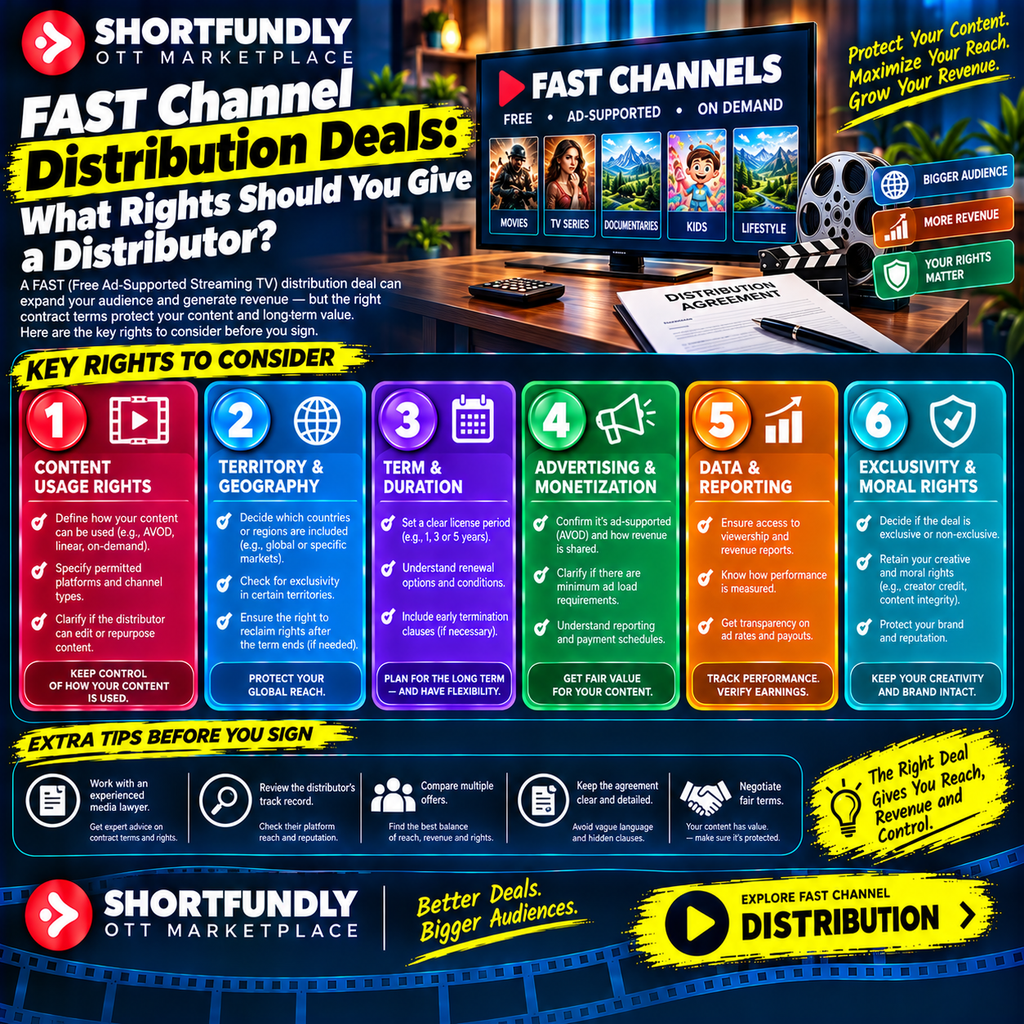
The growth of Free Ad-Supported Streaming TV (FAST) is creating new opportunities for filmmakers, production companies, studios, and independent content owners to reach streaming audiences. FAST channels provide scheduled, television-style programming over the internet, allowing viewers to watch content without paying a traditional subscription fee.
For content owners, these platforms can create opportunities to license films, documentaries, television series, and other video content. However, signing a FAST channel distribution deal involves more than agreeing on a payment or revenue-sharing percentage. You must also decide which rights to grant, where the distributor can use your content, how long the agreement will last, and whether you can continue licensing the same content elsewhere.
Giving a distributor too many rights can limit your future opportunities, while granting too few may make the deal commercially unattractive. The goal is to create an agreement that gives the distributor the rights needed to perform its services without unnecessarily restricting your control over your intellectual property.
This guide explains the most important rights to review before signing a FAST channel distribution deal, including streaming rights, territories, exclusivity, sublicensing, advertising, promotional use, and rights reversion. It also covers contract red flags, negotiation strategies, and how to evaluate distribution options such as Shortfundly Distribution.
This article provides general information, not legal advice. Distribution agreements vary, so consider consulting an entertainment lawyer before signing a significant or exclusive rights agreement.
What Is a FAST Channel Distribution Deal?
A FAST channel distribution deal is an agreement that allows a distributor, channel operator, aggregator, or another authorized partner to distribute specified content through free, ad-supported streaming television services.
Depending on the arrangement, the distributor may acquire rights to individual titles, an entire catalogue, a television series, or a collection of programmes.
The distributor may be responsible for activities such as:
- Pitching content to FAST platforms
- Delivering video files and technical assets
- Managing metadata and artwork
- Coordinating subtitles and localization
- Arranging licensing or sublicensing
- Supporting channel programming
- Managing reporting and revenue collection
Not every distributor provides all these services. Some primarily introduce content to buyers, while others manage technical delivery, rights administration, and commercial reporting.
The agreement should explain what the distributor is authorized to do and which services it is expected to provide.
FAST Distribution Is Not the Same as General OTT Distribution
FAST distribution focuses on scheduled, linear, ad-supported streaming channels. OTT distribution is a broader category that can include subscription video on demand, transactional streaming, AVOD, and other internet-delivered content services.
A general OTT distribution agreement does not automatically include FAST rights, and a FAST agreement does not necessarily grant rights for every other streaming model.
Before signing, identify the exact distribution formats covered by the agreement.
1. Understand the Different Rights You Can Grant
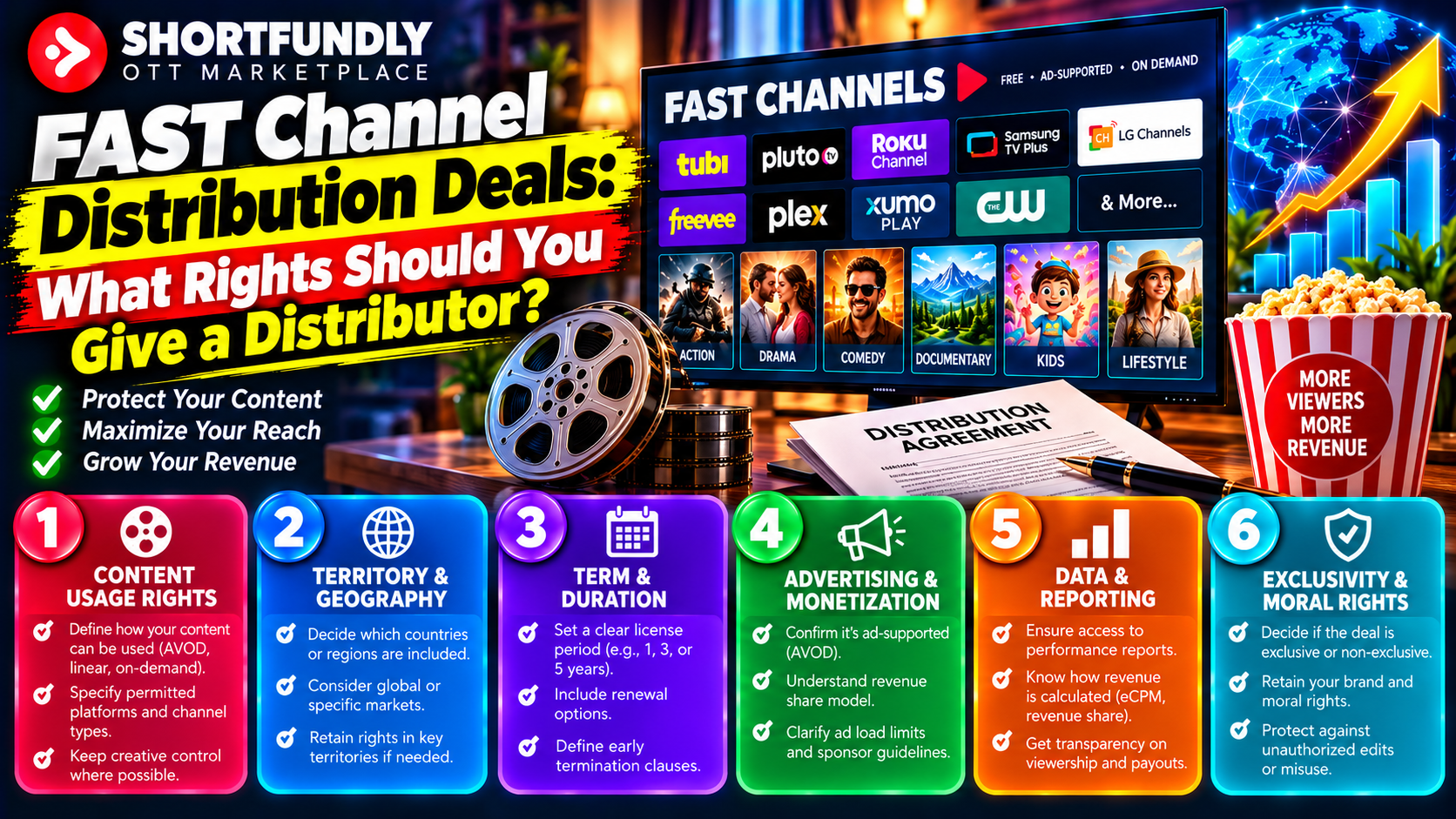
The first step is to separate the different rights associated with your content. You do not necessarily need to grant every available right to one distributor.
FAST Streaming Rights
These rights allow your content to be shown through specified FAST channels or services.
The agreement should clarify whether the rights cover particular channels, platforms, operators, or a defined category of FAST services. It should also explain whether the distributor can sublicense the content to third parties.
Avoid vague wording that gives the distributor unrestricted rights across every possible streaming service when the intended deal concerns only FAST channels.
AVOD Rights
Advertising-Based Video on Demand allows viewers to select content from an on-demand library while advertisements support the service.
FAST and AVOD are related but different formats. Some services offer both, so a distributor may request both rights.
If you are negotiating a FAST-only deal, do not assume that AVOD rights are automatically included or necessary. Grant them only when they are part of the agreed commercial opportunity.
SVOD Rights
Subscription Video on Demand allows viewers to access content through a subscription service.
These rights may have separate commercial value. If you are considering a FAST agreement, determine whether the distributor actually needs SVOD rights.
Granting subscription rights unnecessarily could limit your ability to negotiate a separate deal with a subscription platform.
TVOD Rights
Transactional Video on Demand allows viewers to rent or purchase individual titles.
These rights can support a different monetization strategy from advertising-supported streaming. If your content is available through digital rental or purchase services, check whether the proposed FAST agreement would interfere with those arrangements.
Traditional Television and Other Rights
A distribution agreement may also refer to broadcast television, cable, satellite, educational, airline, theatrical, or other rights.
Do not grant these rights merely because they appear in a standard contract template. Make sure the rights match the services the distributor will actually provide.
Practical tip: Ask the distributor to list every licensed right in a schedule attached to the agreement. Clearly identify the rights that are granted, retained, excluded, or subject to a separate negotiation.
2. Decide Whether to Grant Exclusive or Non-Exclusive Rights
Exclusivity is one of the most important decisions in a FAST distribution agreement.
What Is an Exclusive Distribution Deal?
An exclusive agreement restricts the content owner’s ability to grant the same rights to other parties within the agreed scope.
For example, a distributor might receive exclusive FAST rights for a specified film in a particular territory for a defined period.
During that period, you may be prohibited from licensing the same rights to another FAST operator in that territory.
Exclusivity can be commercially reasonable when the distributor offers meaningful value, such as a substantial license fee, a minimum guarantee, committed marketing, or a credible distribution plan.
However, exclusivity can also limit your flexibility.
What Is a Non-Exclusive Distribution Deal?
A non-exclusive agreement generally allows you to license the same rights to other parties, subject to any restrictions in the contract.
This may suit content owners who want to explore multiple distribution partners or preserve opportunities in different markets.
However, non-exclusive does not mean unrestricted. The agreement may still include platform-specific restrictions, technical limitations, holdbacks, or other obligations.
Which Option Is Better?
Neither structure is automatically better. The right choice depends on the commercial offer, the content’s value, the distributor’s capabilities, and your long-term plans.
| Consideration | Exclusive deal | Non-exclusive deal |
|---|---|---|
| Ability to license the same rights elsewhere | Restricted within the agreed scope | Generally retained, subject to contract terms |
| Commercial commitment | May support a stronger offer | May offer greater flexibility |
| Distribution flexibility | Lower during the exclusivity period | Potentially higher |
| Potential risk | Rights may be tied up with one partner | Multiple deals may create scheduling or rights conflicts |
| Best negotiation focus | Value received for exclusivity | Clear coordination and rights boundaries |
If a distributor requests exclusivity, negotiate its scope carefully. You may be able to limit it by territory, language, platform type, title, or duration.
3. Define the Territory Clearly
Territorial rights determine where the distributor can exploit your content.
A distributor may request worldwide rights, rights for selected countries, or rights within a particular region.
Do not assume that a distributor needs worldwide rights simply because it works with international streaming services.
Questions to Ask About Territory
Before signing, establish:
- Which countries are included?
- Which countries are excluded?
- Can the distributor add new territories later?
- Does the distributor need your written approval for new territories?
- Can it sublicense content to third-party platforms?
- How will territory-specific revenue be reported?
- What happens if another distributor already controls rights in a country?
A territory schedule can help prevent misunderstandings.
| Territory | Rights status | Action before signing |
|---|---|---|
| United States | Available or restricted | Confirm existing agreements |
| United Kingdom | Available or restricted | Review platform and language rights |
| India | Available or restricted | Check current distribution commitments |
| Europe | Country-specific status may apply | Identify included countries |
| Worldwide | Requires careful review | Confirm all relevant rights and exclusions |
These are illustrative examples. Your actual agreement should identify the territories that apply to your content.
Avoid granting broad worldwide rights without understanding the distributor’s planned use of them. If the distributor can only access certain markets, negotiate rights that reflect the opportunity where possible.
4. Limit the Agreement Duration
The agreement’s term determines how long the distributor can exercise the licensed rights.
Some agreements specify a fixed period, while others include automatic renewal provisions or extensions tied to performance.
A long agreement is not necessarily bad, but the duration should reflect the value offered and the scope of rights granted.
What to Review
Check the following provisions:
- Start date and end date
- Whether the term begins at signing, delivery, acceptance, or first release
- Renewal conditions
- Notice periods for non-renewal
- Automatic renewal provisions
- Termination rights
- Rights reversion after expiry
- Treatment of existing sublicenses
If the distributor receives exclusive rights, consider whether the agreement includes a reasonable way to recover those rights when the distributor fails to meet agreed obligations.
Consider Performance-Based Protections
Where commercially appropriate, negotiate measurable obligations or review points.
For example, you might request that the distributor provide a progress report within an agreed period, demonstrate that the content has been pitched to relevant buyers, or meet specific delivery milestones.
Be careful with vague promises such as “best efforts” if the agreement does not explain what the distributor must actually do.
Not every deal will support guaranteed release dates or minimum performance levels, so negotiate realistic obligations.
5. Understand Sublicensing Rights
Sublicensing allows a distributor to grant certain rights to another company, such as a FAST platform or channel operator.
This can be essential when a distributor acts as an intermediary rather than operating the streaming service itself.
However, the sublicensing clause should not give the distributor unlimited authority without appropriate boundaries.
Questions to Ask
- Which types of third parties may receive sublicenses?
- Can the distributor sublicense worldwide?
- Must you approve the proposed platforms?
- Can sublicenses extend beyond the main agreement’s term?
- What reporting must the distributor provide?
- Is the distributor responsible for payments and compliance by its sublicensees?
- What happens to sublicenses when the main agreement expires?
A well-defined sublicensing clause helps the distributor perform its role while preserving your understanding of where and how your content can be used.
Where appropriate, require sublicenses to remain within the main agreement’s scope and ensure the distributor remains accountable for its contractual obligations.
6. Protect Your Intellectual Property Ownership
Licensing distribution rights should not automatically transfer ownership of your film, series, or other intellectual property.
The agreement should clearly state that you retain ownership except for any rights expressly transferred under a separate, intentional arrangement.
Review any clauses that refer to:
- Copyright ownership
- Assignment of intellectual property
- Ownership of derivative works
- Remakes and adaptations
- Sequel and prequel rights
- Characters and story elements
- Promotional materials
- Localized versions
- New edits or modifications
For example, permission to distribute a film should not automatically be interpreted as permission to create a remake or adaptation.
Likewise, a right to create subtitles or localized metadata is different from ownership of the underlying film.
If the distributor needs permission to make technical edits, create trailers, or adapt promotional materials, define the permitted activities and approval process.
7. Define Advertising and Monetization Rights
FAST channels commonly generate revenue through advertising, but the commercial structure varies by agreement.
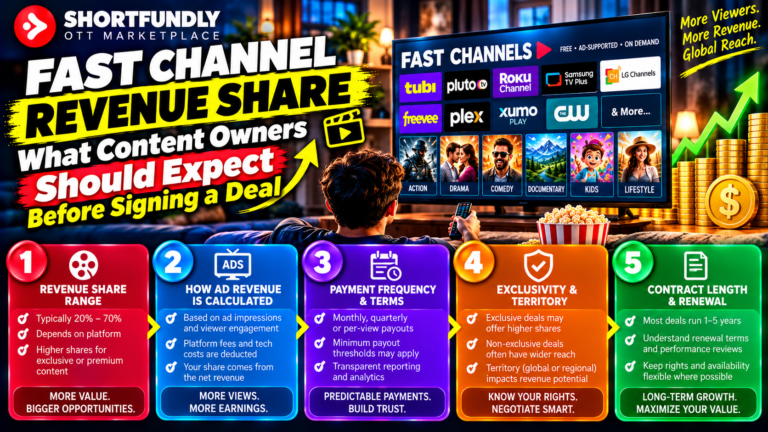
Some content owners receive an agreed share of eligible advertising revenue. Others receive a fixed licensing fee or participate in a hybrid arrangement.
Before granting advertising-related rights, determine exactly what the distributor is allowed to do.
Clarify the Revenue Model
The agreement should identify:
- Whether payment is a license fee, revenue share, minimum guarantee, or combination
- Whether revenue share is based on gross or net receipts
- Which deductions are permitted
- How title-level or channel-level revenue is allocated
- How frequently statements are provided
- When payments are due
- Whether minimum payout thresholds apply
- How adjustments and disputed amounts are handled
Do not rely only on a quoted revenue-sharing percentage.
For example, 50% of a defined net revenue amount may produce a different payment from 50% of gross advertising receipts. The contract’s definitions determine the result.
Avoid Guaranteed-Earnings Assumptions
A distributor may be able to offer access to a platform, but that does not guarantee a particular audience size or advertising return.
Revenue depends on factors such as viewing activity, advertising demand, platform availability, monetized impressions, and the applicable commercial arrangement.
Ask for realistic explanations of the model and reporting process rather than relying on unsupported income projections.
8. Control Promotional and Marketing Rights
Distributors often need permission to use approved materials to promote content to platforms, buyers, and audiences.
These rights may cover:
- Film posters and key art
- Stills and promotional images
- Trailers and clips
- Titles and synopses
- Cast and crew information
- Approved logos
- Localized descriptions
Grant only the promotional rights needed for the agreed distribution activity.
The agreement should explain whether the distributor can edit trailers, create localized marketing materials, use your production-company logo, or publish content-related announcements.
Where appropriate, retain approval rights over material changes that could misrepresent your work or damage your brand.
Also consider whether promotional rights continue after the distribution agreement expires. A distributor may need to retain limited records of previous releases, but ongoing commercial use should be clearly addressed.
9. Review Technical Delivery and Localization Rights
FAST distribution may require technical preparation beyond supplying the original video file.
The distributor may need to create or commission approved encodes, subtitles, captions, artwork, and metadata.
The contract should establish who is responsible for these activities and who pays the associated costs.
Technical Delivery
Clarify requirements for:
- Video format and resolution
- Audio specifications
- File delivery and storage
- Quality control
- Subtitle and caption formats
- Artwork dimensions
- Metadata standards
- Corrections and resubmissions
Localization
If the distributor wants to translate titles, create subtitles, or dub content, confirm that the agreement authorizes the required activities.
Establish who approves translations, who owns newly commissioned assets, and who pays for localization.
If the distributor commissions new versions, determine whether you can use those versions with another partner after the agreement ends. Ownership and reuse rights should not be left ambiguous.
10. Establish Reporting, Audit, and Payment Rights
A distribution agreement should explain how you will monitor the use of your content and verify payments.
The exact reporting available depends on the distributor and platform, but the contract should identify the reports you will receive and how often they will be delivered.
Useful Reporting Information
Where available and relevant, reports may include:
- Release status by title
- Platforms or channels carrying the content
- Territory and language availability
- Viewing activity
- Viewing hours
- Advertising impressions
- Eligible revenue
- Permitted deductions
- Amount payable
- Payment history
Do not assume every platform provides all these metrics to every distributor. Confirm what the partner can actually report.
Audit Rights
For revenue-sharing agreements, consider whether you can request supporting records or audit relevant calculations.
The contract should explain how an audit can be requested, which records are available, how discrepancies are resolved, and who pays the audit costs.
Payment Terms
Check payment frequency, currency, transfer fees, taxes, minimum payout thresholds, and the treatment of balances below the threshold.
Clear reporting and payment provisions can help prevent disputes later.
11. Include Clear Termination and Rights-Reversion Clauses
Termination and rights reversion determine what happens when the agreement ends.
This is particularly important when a distributor receives exclusive rights or has permission to sublicense your content to multiple platforms.
The agreement should address:
- Termination for material breach
- Notice and cure periods
- Termination for non-payment
- Insolvency or business closure
- Expiry and non-renewal
- Content removal requests
- Rights returning to the owner
- Outstanding payments
- Continuing sublicenses
- Removal of promotional materials
Do not assume that rights automatically return in a practical sense the moment a contract expires. Existing platform arrangements may require a transition period, and the agreement should explain how those situations are handled.
Where possible, ensure the distributor has a clear obligation to cooperate with content removal and rights reversion after termination.
12. Watch for These FAST Distribution Contract Red Flags
Before signing, pay attention to clauses that could limit your rights or create unexpected obligations.
Unrestricted worldwide exclusivity: The distributor receives broad exclusive rights without a clear distribution plan or sufficient commercial value.
Undefined revenue deductions: The agreement allows fees or expenses to be deducted without explaining the categories or calculation method.
Unrestricted sublicensing: The distributor can grant rights to third parties without clear territorial, temporal, or platform boundaries.
Automatic renewal without reasonable notice: The agreement renews unless you meet a strict notice deadline.
No meaningful reporting: You cannot determine where your content is available or how revenue is calculated.
Broad intellectual property assignment: The contract transfers ownership or adaptation rights when the intended transaction is only a distribution license.
Unclear termination provisions: The agreement does not explain how rights return or content is removed.
Guaranteed placement without contractual support: Verbal assurances are not reflected in the agreement or backed by clear obligations.
Unexplained upfront fees: The distributor requests payment without clearly describing the services, deliverables, and refund conditions, where applicable.
If a clause is unclear, ask for a written explanation and have the agreement reviewed before signing.
13. How to Negotiate a Better FAST Distribution Deal
A good negotiation begins before you receive the contract.
Prepare Your Rights Information
Create a clear record of ownership, existing licenses, territories, language rights, and any restrictions.
This allows you to identify which rights are available and prevents you from granting rights you do not control.
Match Rights to the Distributor’s Role
A distributor focused on FAST placement may not need theatrical, remake, sequel, or unrelated digital rights.
Ask why each requested right is necessary and whether the scope can be narrowed.
Negotiate Exclusivity Carefully
If the distributor requests exclusivity, consider limiting it by territory, platform type, language, or duration.
Where suitable, discuss performance obligations, release milestones, or rights reversion if the distributor does not proceed as agreed.
Compare the Complete Commercial Offer
Evaluate the revenue model, fees, rights scope, reporting, marketing commitments, and contract duration together.
A high revenue-share percentage is not necessarily the best deal if the distributor has limited reach or broad deductions.
Put Every Important Promise in Writing
If a distributor promises specific services, delivery milestones, reporting, or marketing support, confirm which obligations will appear in the signed agreement.
Avoid relying on informal statements that are not reflected in the contract.
14. How Shortfundly Distribution Fits Into Your Distribution Strategy
For independent filmmakers, producers, and content owners, Shortfundly Distribution is one option to explore when seeking OTT distribution for eligible content.
The official portal provides information about its content submission process, applicable requirements and fees, agreement steps, review, and distribution through currently available partners.
You can visit the official website here:
Before submitting your film or series, prepare your content details, rights documentation, technical masters, metadata, subtitles, and artwork as required. Review the current eligibility criteria, applicable fees, agreement terms, and available distribution options.
It is important to distinguish general OTT distribution from a specific FAST channel distribution deal. Submitting content through an OTT distribution service does not automatically guarantee FAST channel placement or a particular revenue-sharing arrangement.
If your main objective is FAST distribution, confirm whether a specific FAST opportunity is available for your content. Ask which rights are required, what territories may be covered, whether exclusivity applies, how revenue is calculated, and what reporting you will receive.
Evaluate the actual offer and signed agreement before making assumptions about distribution or earnings.
FAST Channel Distribution Rights Checklist
Use this checklist before signing a deal:
- The licensed rights are clearly identified.
- FAST rights are distinguished from AVOD, SVOD, and TVOD rights.
- Exclusive and non-exclusive rights are defined.
- Territories and languages are specified.
- The agreement has a clear start date and end date.
- Renewal and termination conditions are understood.
- Sublicensing rights are appropriately limited.
- Intellectual property ownership remains clear.
- Promotional and localization rights are defined.
- Revenue calculations and deductions are transparent.
- Reporting and payment schedules are documented.
- Audit or dispute-resolution provisions are addressed.
- Content removal and rights reversion are covered.
- All important promises are included in the signed agreement.
- Legal advice has been considered for complex or exclusive deals.
Frequently Asked Questions
1. What rights should I give a FAST distributor?
Grant only the rights necessary for the agreed distribution services. Specify the formats, territories, languages, platforms, term, exclusivity, sublicensing permissions, and commercial terms. Avoid granting unrelated rights unless there is a clear business reason.
2. Should I give a FAST distributor exclusive rights?
Not automatically. Exclusivity may be appropriate when the distributor offers meaningful commercial value, but it can restrict your ability to license the content elsewhere. Consider limiting exclusivity by territory, platform type, or duration.
3. Does a FAST distribution deal include AVOD rights?
Not necessarily. FAST and AVOD are different distribution formats, even though some services offer both. The agreement should identify whether on-demand advertising-supported rights are included.
4. Can a distributor obtain worldwide rights?
A distributor may request worldwide rights, but you should assess whether that scope is necessary and commercially justified. Check existing licenses and consider granting rights only in territories where the distributor can realistically exploit them.
5. Who owns the film after signing a distribution deal?
In a licensing arrangement, the content owner generally retains ownership while granting specified rights to the distributor. However, the contract controls the actual legal position, so review any assignment, ownership, or intellectual property transfer clauses carefully.
6. What is sublicensing in FAST distribution?
Sublicensing allows a distributor to grant certain rights to another company, such as a FAST channel operator. The agreement should specify which third parties may receive rights, the permitted scope, and the reporting and payment obligations.
7. How does a FAST distributor pay content owners?
Payment structures may include advertising revenue sharing, fixed licensing fees, minimum guarantees, or hybrid arrangements. The actual model and payment schedule depend on the agreement.
8. What happens when a FAST distribution agreement expires?
Rights should be handled according to the contract’s expiry and rights-reversion provisions. Review content removal requirements, continuing sublicenses, outstanding payments, and any transition period.
9. Does Shortfundly Distribution guarantee FAST channel placement?
Do not assume that general OTT distribution guarantees FAST placement. Confirm whether a specific FAST opportunity is available for your content and review the applicable rights and commercial terms.
10. Should I have a lawyer review a FAST distribution contract?
Legal review is particularly valuable when a contract grants exclusive or worldwide rights, contains complex revenue provisions, allows broad sublicensing, or runs for an extended period. An entertainment lawyer can help identify risks and negotiate suitable protections.
Also read: https://blog.shortfundly.com/ott/fast-channel-revenue-share/
Conclusion
A FAST channel distribution deal can help content owners reach new audiences and explore additional streaming revenue opportunities. However, the rights you grant can affect your ability to license the same content through other channels, territories, and formats.
Before signing, review the exact rights, exclusivity, territory, contract duration, sublicensing, advertising permissions, revenue model, reporting, termination, and rights-reversion provisions.
Services such as Shortfundly Distribution may be worth exploring for eligible content owners seeking OTT distribution. If your goal is FAST channel placement, confirm that the specific opportunity is available and evaluate the actual agreement rather than assuming that every OTT distribution route includes FAST.
The right distribution deal should give your partner the rights needed to deliver the agreed service while protecting your long-term ownership, flexibility, and commercial opportunities.