Table of Contents
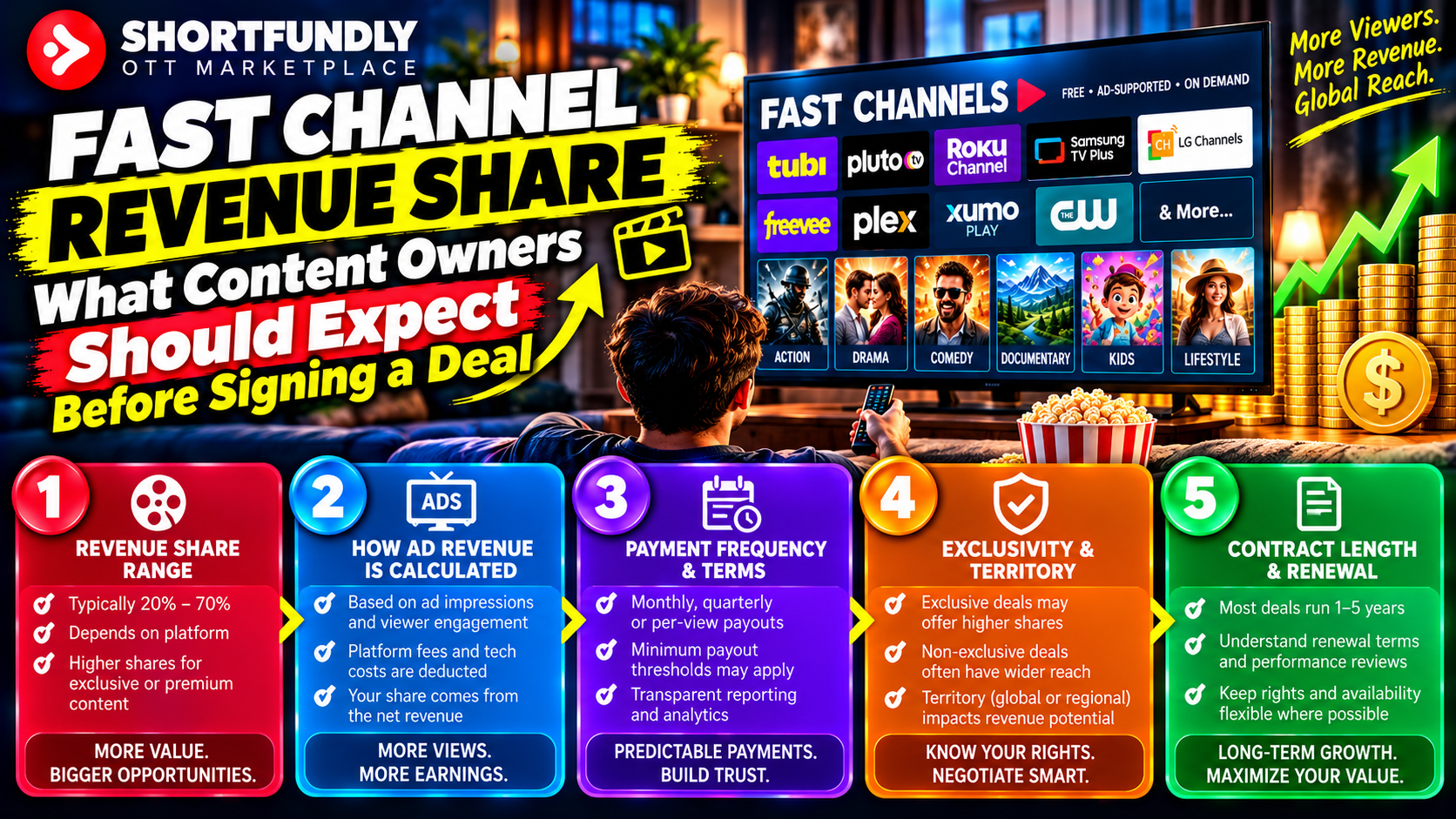
The growth of Free Ad-Supported Streaming TV (FAST) has created new distribution opportunities for filmmakers, independent producers, studios, and content owners. Instead of relying only on traditional television licensing, paid streaming subscriptions, or transactional sales, rights holders can explore commercial agreements that connect their content with free, ad-supported streaming audiences.
However, one of the most important questions arises before signing a distribution deal: How much revenue will the content owner actually receive?
FAST channel revenue-sharing agreements can look attractive at first glance, but the headline percentage rarely tells the whole story. The final amount you receive may depend on advertising performance, platform fees, distribution commissions, eligible revenue, permitted deductions, territory, and the way viewing or advertising revenue is allocated to your content.
For independent filmmakers and smaller production companies, understanding these details is essential. A deal offering a high percentage may produce little income if the channel attracts limited viewers. Conversely, a lower percentage from a platform with strong audience reach and transparent reporting may deliver better commercial results.
This guide explains how FAST channel revenue share works, the payment structures content owners may encounter, the contract terms to review, and the questions to ask before granting distribution rights. It also explains how to evaluate distribution options, including Shortfundly Distribution, without confusing general OTT distribution with confirmed FAST channel placement.
What Is FAST Channel Revenue Share?
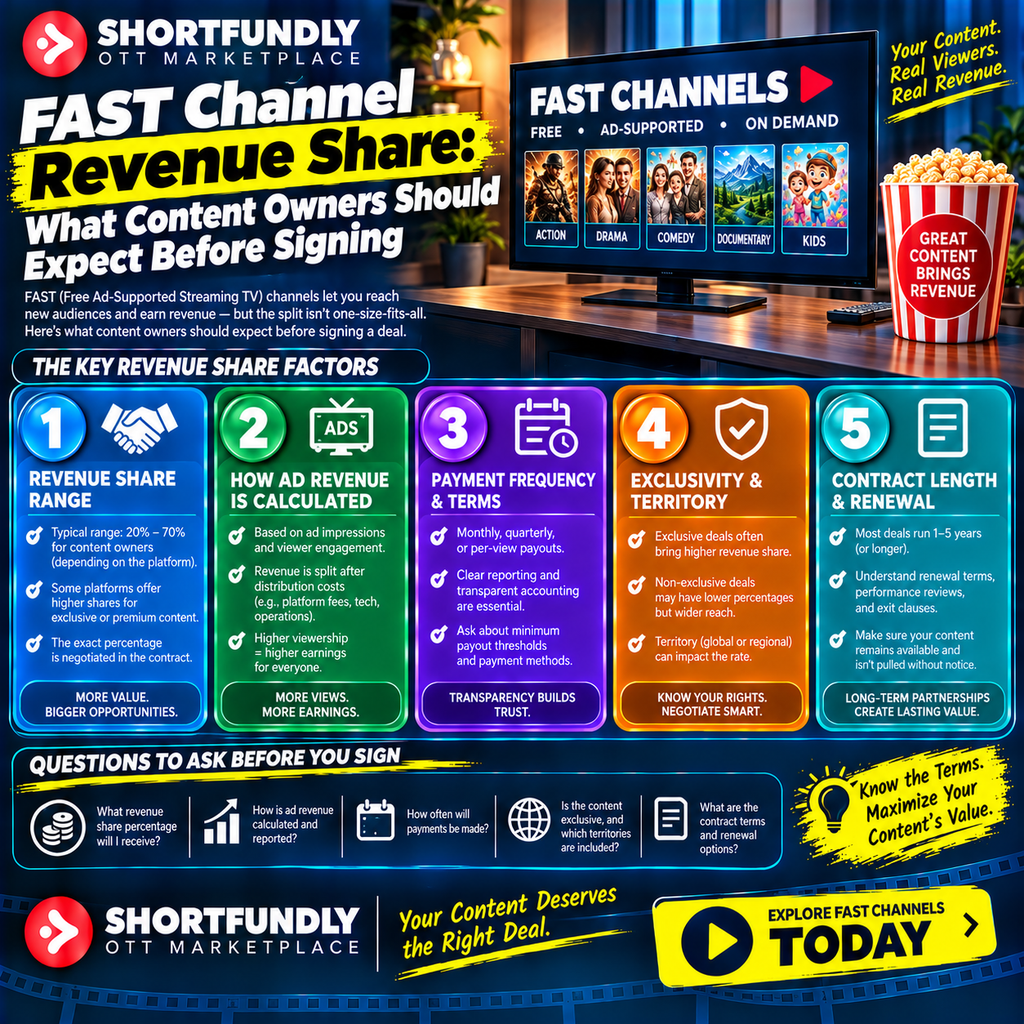
FAST channel revenue share is a commercial arrangement in which two or more parties divide revenue generated through an agreed streaming activity.
FAST stands for Free Ad-Supported Streaming TV. These channels provide scheduled, linear programming over the internet, allowing viewers to watch without paying a conventional subscription fee. Advertising supports the service.
Depending on the agreement, a content owner may receive a portion of the advertising revenue generated by a channel, revenue attributed to specific titles, licensing receipts, or another defined revenue pool.
The parties involved may include:
- The content owner or rights holder
- The FAST channel operator
- A streaming platform or connected-TV service
- A content aggregator or distributor
- An advertising sales partner
- An ad-tech or streaming technology provider
Not every deal involves all these parties. Some companies manage several functions themselves, while other arrangements involve multiple intermediaries.
The most important point is that there is no universal revenue-sharing percentage for every FAST distribution deal. The applicable rate and payment calculation must be confirmed in the actual agreement.
How Does FAST Channel Revenue Sharing Work?
FAST channels generally generate advertising revenue by selling commercial opportunities during their programming. Advertisers pay to reach audiences, and the resulting revenue is allocated according to the agreements between the relevant parties.
A simplified process looks like this:
- A content owner licenses a film, series, or catalogue for FAST distribution.
- The channel operator schedules the content and makes it available on supported platforms.
- The platform and its advertising partners sell or serve eligible advertising.
- Advertising revenue is recorded and calculated according to the applicable commercial arrangement.
- Permitted commissions, fees, or other deductions are applied where the contract allows them.
- The agreed share is calculated for each party.
- The content owner receives a statement and payment according to the contract’s reporting and payment schedule.
The calculation can vary significantly between deals.
For example, a content owner may receive a share of gross advertising revenue, net advertising revenue, or a defined amount attributed to a particular title. These terms are not interchangeable.
A contract should explain the calculation clearly enough that you can understand how reported activity becomes the amount payable to you.
Common FAST Distribution Payment Models
Before comparing percentages, identify the type of commercial arrangement being offered. Different models distribute risk and potential earnings differently.
1. Advertising Revenue Share
Under this arrangement, the content owner receives an agreed percentage of advertising revenue generated by the content or the channel, as defined in the contract.
Potential advantage: Earnings can increase if advertising performance improves.
Potential disadvantage: Income may be low or unpredictable when viewership, advertising demand, or ad fill rates are weak.
Revenue sharing can suit rights holders who want to explore ongoing monetization without relying exclusively on an upfront licensing payment.
However, the contract should specify whether the share applies to gross receipts, net receipts, title-level advertising revenue, or channel-level revenue.
2. Fixed Licensing Fee
A platform, distributor, or channel operator pays an agreed fee for specified rights during a defined period.
Potential advantage: The payment may be more predictable than advertising-based earnings.
Potential disadvantage: The content owner may not participate in additional advertising revenue unless the contract includes a separate payment mechanism.
A fixed fee can be worth considering when certainty matters more than the possibility of higher future revenue. Its value depends on the fee, rights granted, territory, duration, exclusivity, and the content’s other commercial opportunities.
3. Minimum Guarantee Plus Revenue Share
Some agreements combine an agreed minimum payment with a share of eligible revenue.
The contract must explain whether the minimum guarantee is recoupable, whether it is an advance against future earnings, and when additional revenue-share payments begin.
For example, a hypothetical agreement might provide a $2,000 minimum guarantee against the content owner’s future share of eligible revenue. If the agreement makes that guarantee recoupable, the rights holder may not receive additional revenue-share payments until the applicable share exceeds the amount already paid.
This is only an illustration. Actual guarantees, recoupment rules, and payment obligations are negotiated separately.
4. Channel-Level Revenue Share
In a channel-level arrangement, the content owner participates in a share of revenue generated by a channel containing multiple titles or programmes.
This can be useful when a producer contributes a substantial library or a collection of episodes.
However, the agreement needs a clear allocation method. The parties may use agreed measurements such as viewing hours, advertising impressions, minutes aired, or another defined formula.
Without a transparent allocation method, it can be difficult to determine how much of the channel’s performance is attributable to a particular catalogue.
5. Hybrid Commercial Agreements
A hybrid agreement combines two or more commercial structures, such as a fixed licensing payment, a minimum guarantee, and a share of eligible revenue.
Hybrid arrangements may offer a balance between payment certainty and potential upside. They can also become difficult to evaluate if the contract contains complicated deductions or recoupment provisions.
Ask for a worked example showing how payments would be calculated under different performance scenarios.
What Revenue Share Percentage Should Content Owners Expect?
There is no single percentage that every content owner should expect. Revenue-sharing terms vary according to the content, platform, territory, distribution route, advertising arrangements, bargaining power, and services provided by each party.
A direct licensing arrangement may have different economics from a deal involving an aggregator, channel operator, and separate advertising technology provider.
Rather than assuming that one percentage is standard, assess the offer against the following factors:
| Factor | Why it matters |
|---|---|
| Revenue definition | Determines which money is included in the calculation |
| Permitted deductions | Affects the amount remaining before your share is calculated |
| Platform reach | Influences potential audience access, but does not guarantee viewing |
| Advertising demand | Affects how much eligible advertising may be sold |
| Distribution commission | May reduce the amount payable to the rights holder |
| Content performance | Can influence title-level or usage-based allocations |
| Territory | Determines where the content may be monetized |
| Exclusivity | May restrict other licensing opportunities |
| Reporting quality | Helps you verify performance and payments |
| Contract duration | Determines how long the partner controls the licensed rights |
Ask prospective partners to explain their proposed commercial model and provide an illustrative calculation. If they quote a percentage, establish exactly what that percentage applies to.
A share of gross advertising revenue can produce a different payment from the same percentage of net revenue after permitted deductions. The difference matters more than the headline figure alone.
Gross Revenue vs. Net Revenue: Understand the Difference
One of the most important clauses in a FAST distribution agreement defines the revenue base used to calculate your share.
Gross revenue
Gross revenue generally refers to revenue before the deductions specified in the contract. However, the agreement must still define which receipts count as gross revenue and whether taxes, refunds, agency commissions, or other adjustments are excluded.
Net revenue
Net revenue generally refers to revenue remaining after specified deductions. The precise meaning varies between contracts.
Potential deductions may include:
- Advertising sales commissions
- Platform or distribution fees
- Ad-serving and technology costs
- Encoding or content-delivery expenses
- Approved third-party costs
- Taxes or other expressly permitted adjustments
Not every deduction is appropriate for every agreement. Do not assume a partner can deduct every item listed above. The contract should identify which costs are deductible, how they are calculated, and whether they require your approval.
A simple revenue-share example
Suppose a FAST distribution agreement defines $10,000 in eligible advertising receipts for a reporting period. The contract permits $2,000 in deductions before the revenue share is calculated. The resulting defined net revenue is $8,000.
If the content owner’s agreed share is 50% of that net revenue, the calculation would be:
| Calculation | Amount |
|---|---|
| Eligible advertising receipts | $10,000 |
| Permitted deductions | $2,000 |
| Defined net revenue | $8,000 |
| Content owner’s share at 50% | $4,000 |
This is a hypothetical example, not an industry benchmark or earnings forecast. The actual payment depends on the definition of revenue and deductions in the signed agreement.
Before signing, ask the distributor to provide a similar calculation based on its proposed terms.
What Affects FAST Channel Earnings?
A revenue-share agreement creates a method for dividing income; it does not guarantee that substantial income will be generated.
Several factors influence the amount a content owner may earn.
1. Audience Reach and Viewing Time
A channel needs viewers for its content to have an opportunity to generate advertising revenue. Actual performance depends on distribution availability, audience interest, programming, promotion, and viewer retention.
A platform’s total audience is not the same as the audience that will watch your specific title.
2. Advertising Fill Rate
A channel may have advertising opportunities that are not all filled with paid advertisements. The fill rate, advertiser demand, and available inventory can influence realized revenue.
A high number of viewing sessions does not necessarily translate into an equivalent number of monetized ad impressions.
3. Advertising Rates and Audience Geography
Advertisers may value audiences differently depending on factors such as geography, campaign objectives, audience composition, seasonality, and advertiser demand.
As a result, two titles with similar viewing activity can generate different advertising revenue.
4. Content Genre and Audience Fit
Content that fits a channel’s audience and programming strategy may have a better chance of attracting relevant viewers. Genre alone, however, does not guarantee performance.
Consider whether your title complements the channel’s existing schedule and audience expectations.
5. Rights and Territory
A deal covering several territories may offer broader distribution opportunities than a more limited agreement, but the actual value depends on where the platform is available and whether your content performs there.
Make sure the agreement does not grant rights in territories where you have already committed them to another partner.
6. Advertising and Distribution Costs
Ad technology, sales commissions, distribution services, and operational expenses can affect the revenue pool used for payment calculations.
This is why it is essential to review both the percentage and the cost structure.
Ten Contract Terms to Review Before Signing
A revenue-share percentage is only one part of a distribution agreement. Review the following terms carefully.
1. Licensed Rights
Confirm exactly which rights you are granting. FAST linear streaming rights are different from on-demand rights, subscription streaming rights, transactional rights, and traditional television rights.
If the agreement includes multiple forms of distribution, make sure each one is explicitly identified.
2. Territory
Identify every country or region covered by the agreement. Ask whether the distributor can sublicense your content to other services and whether those services operate within the agreed territory.
3. Exclusivity
Determine whether the deal is exclusive or non-exclusive.
An exclusive agreement may prevent you from licensing the same rights to other partners during the term. If exclusivity is requested, consider limiting it by territory, platform type, language, or duration where commercially appropriate.
4. Contract Term and Renewal
Confirm the start date, end date, renewal process, and notice period. Check whether the agreement renews automatically and what steps are needed to prevent unwanted renewal.
5. Revenue Calculation
Define gross revenue, net revenue, eligible receipts, deductions, commissions, and any title-level or channel-level allocation method.
Avoid vague terms that leave the calculation entirely to the distributor’s discretion.
6. Reporting and Payment
Establish how frequently statements are issued, when payments are due, which currencies are used, and whether minimum payment thresholds apply.
Ask what happens if an amount is below the payout threshold and whether it carries forward to the next reporting period.
7. Audit Rights
Consider whether you can request supporting documentation or audit relevant records if the statements appear inconsistent.
The contract should explain how audit requests work, what records are available, and who bears the audit cost in different circumstances.
8. Content Delivery and Costs
Identify who is responsible for encoding, quality control, subtitles, metadata, artwork, delivery, and technical corrections.
Clarify whether these services are included or charged separately. Ask whether any setup or recurring fees can be deducted from revenue.
9. Content Removal and Termination
Understand how either party can terminate the agreement and what happens if the content breaches a warranty, loses necessary rights, or becomes unavailable.
Confirm the time frame for removing content after termination or expiry and how outstanding payments will be handled.
10. Rights Reversion
When the contract ends, the relevant rights should return or become available according to the agreement’s terms.
Check whether any continuing sublicenses, platform delays, or other obligations could affect your ability to license the content elsewhere.
For complex, exclusive, or high-value agreements, consider obtaining advice from an entertainment lawyer before signing.
Red Flags Content Owners Should Not Ignore
Be cautious if a prospective partner:
- Promises guaranteed earnings without explaining the business model.
- Quotes a revenue percentage but refuses to define gross or net revenue.
- Will not identify permitted deductions.
- Offers vague claims about distribution reach without naming relevant destinations where disclosure is possible.
- Requests broad, long-term exclusivity without a clear commercial justification.
- Refuses to provide written reporting and payment terms.
- Charges unexplained fees before clarifying the services provided.
- Claims that submission guarantees acceptance or placement.
- Cannot explain how title-level or channel-level revenue is allocated.
- Provides unclear termination or rights-reversion provisions.
A credible partner should be able to explain its process, commercial structure, and reporting approach in a way you can evaluate.
How to Negotiate a Better FAST Revenue-Share Deal
Content owners can strengthen their negotiating position by preparing before approaching a distributor.
Prepare a Rights and Content Inventory
List your titles, runtimes, formats, languages, rights status, and available territories. This helps you answer buyer questions quickly and reduces the risk of offering rights you do not control.
Present Your Catalogue Professionally
Provide accurate metadata, strong artwork, trailers or screeners, and a concise catalogue overview. If you have verified viewing figures, audience information, awards, or previous distribution results, include relevant evidence.
Compare Multiple Offers
Where possible, evaluate more than one potential partner. Compare the complete commercial structure, not just the percentage.
A useful comparison includes revenue definitions, fees, reach, rights, reporting, contract length, and payment timing.
Negotiate Deductions and Transparency
Ask whether certain costs can be capped, excluded, or charged only with prior approval. Request clear statements and a practical way to resolve discrepancies.
Keep Rights Flexible Where Possible
If your content has several potential distribution routes, consider whether a non-exclusive agreement or a limited license would better support your long-term goals.
The appropriate structure depends on the content’s value, the partner’s offer, and your distribution strategy.
How to Evaluate Distribution Options, Including Shortfundly Distribution
Content owners may explore several routes to reach streaming platforms, including direct licensing, content aggregators, sales agents, and OTT distribution services.
Shortfundly Distribution is one option content owners can consider when exploring OTT distribution for eligible films and other supported video content.
Visit the official portal: Shortfundly Distribution.
Before submitting a project, review the current eligibility criteria, applicable fees, submission requirements, agreement terms, and available distribution partners. Prepare your rights documentation and technical assets so you can evaluate whether the service suits your project.
It is important to distinguish OTT distribution from confirmed FAST channel distribution. A general OTT submission or distribution service should not be assumed to guarantee placement on a particular FAST channel or to provide a specific advertising revenue-share arrangement.
If your main objective is FAST monetization, ask whether a specific FAST or AVOD opportunity is available for your content. Confirm which rights are covered, which platforms or territories may be included, how payment is calculated, and whether the agreement provides advertising revenue sharing, a licensing fee, or another commercial model.
Review the final agreement rather than relying solely on general descriptions of a distribution service.
FAST Revenue-Share Evaluation Checklist
Use this checklist before signing any deal.
- I have confirmed ownership or authority to license the content.
- The agreement clearly defines FAST, AVOD, and any other licensed rights.
- Territories and language rights are specified.
- Exclusivity and competing distribution restrictions are understood.
- The contract defines gross revenue, net revenue, and permitted deductions.
- The revenue allocation method is explained.
- Fees and other costs are disclosed.
- Reporting frequency and payment dates are specified.
- Audit or dispute-resolution procedures are clear.
- Contract term, renewal, termination, and rights reversion are covered.
- I have compared the offer with other relevant options where possible.
- I have obtained legal advice if the rights grant or financial commitment warrants it.
Frequently Asked Questions
1. What is a FAST channel revenue-share agreement?
It is an agreement that defines how eligible revenue generated through FAST distribution is divided between parties, such as content owners, channel operators, distributors, and other service providers.
2. Is there a standard FAST channel revenue-share percentage?
No single percentage applies to all deals. Terms vary according to the rights granted, the parties involved, advertising arrangements, distribution services, territory, and the contract’s revenue definition.
3. Is revenue share better than a fixed licensing fee?
It depends on your goals and the offer. A fixed fee may provide more predictable compensation, while revenue share may allow you to participate in future advertising income. Compare the potential benefits and risks of both structures.
4. What is the difference between gross and net advertising revenue?
Gross revenue generally refers to revenue before defined deductions, while net revenue generally refers to the amount remaining after specified deductions. The contract must define both terms clearly.
5. Can a FAST distributor guarantee my earnings?
Do not assume earnings are guaranteed simply because a distributor offers FAST distribution. Advertising performance varies. Any minimum guarantee or fixed payment should be explicitly stated in the agreement.
6. How often do content owners receive payments?
Payment frequency depends on the contract. Statements and payments may be monthly, quarterly, or follow another agreed schedule. Confirm the reporting period, payment deadline, minimum payout threshold, and treatment of unpaid balances.
7. Can I license my film to multiple FAST channels?
Potentially, if your rights and existing agreements permit it. Review exclusivity, territory, platform, and language restrictions before licensing the same content to another partner.
8. What should a revenue statement include?
Where available and relevant to the agreement, it should show the applicable reporting period, eligible revenue, permitted deductions, allocation method, revenue share, adjustments, and final amount payable. Ask for sufficient detail to verify the calculation.
9. Does OTT distribution guarantee FAST placement?
No. OTT distribution does not automatically include placement on a FAST channel. Confirm the exact distribution service, destination platforms, eligibility requirements, and commercial terms.
10. What should independent filmmakers do before signing?
Confirm rights, prepare technical assets and metadata, compare offers, understand all deductions, review payment and reporting terms, and check exclusivity and termination clauses. Consider legal advice before granting broad or long-term rights.
Also read:https://blog.shortfundly.com/ott/fast-channel-monetization/
Conclusion
FAST channel revenue sharing can create new monetization opportunities for independent filmmakers, studios, and content owners. However, the value of a distribution deal depends on more than the percentage printed in the contract.
Understand how revenue is calculated, which costs can be deducted, how the content will be distributed, and what reporting you will receive. Compare revenue sharing with fixed licensing fees and hybrid agreements, and make sure the licensed rights match your commercial goals.
When evaluating services such as Shortfundly Distribution, review the current submission process and applicable terms, and confirm whether a specific FAST or AVOD opportunity is available for your content.
The best agreement is not necessarily the one with the highest revenue-share percentage. It is the one with clear terms, credible distribution opportunities, transparent reporting, and a rights structure that supports your long-term strategy.