Table of Contents
Introduction to EPG for FAST Channels
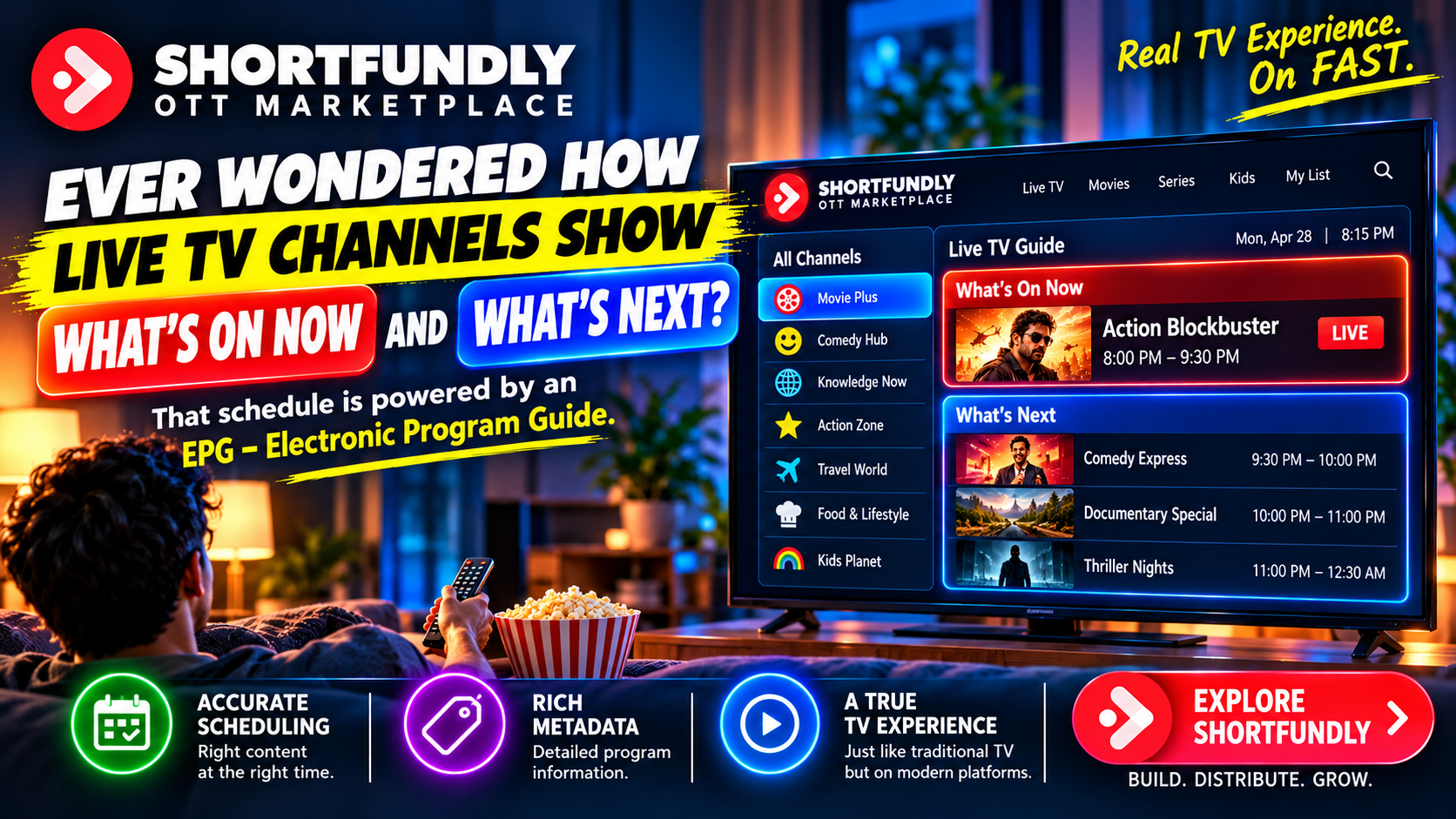
EPG for FAST channels plays an important role in creating a familiar television experience for modern streaming audiences. When viewers open a traditional television service, they expect to see what is playing now, what comes next, and which programs will be available later. Free Ad-Supported Streaming Television (FAST) channels need to provide the same clarity.
An Electronic Program Guide (EPG) organizes scheduled programming into a structured guide. It typically displays program titles, descriptions, start times, end times, and other details that help viewers decide what to watch. For FAST operators, this information connects the channel’s programming schedule with the interface that viewers use to explore content.
However, an EPG is more than a digital timetable. It depends on accurate metadata, reliable scheduling, clear program descriptions, and consistent communication between content management systems, playout systems, and streaming distribution partners.
Even a well-curated channel can deliver a confusing experience if its program guide shows the wrong title, displays incorrect timings, or lists a program that isn’t actually playing. These issues can weaken viewer confidence and make content harder to discover.
We can avoid many of these problems by treating EPG management as a core part of FAST channel operations. With a clear workflow, consistent metadata standards, and regular quality checks, channel operators can improve scheduling accuracy and provide a smoother viewing experience.
This guide explores seven powerful EPG strategies, explains essential metadata fields, and outlines practical methods for managing electronic program guides throughout the FAST channel distribution process.
What Is an Electronic Program Guide?
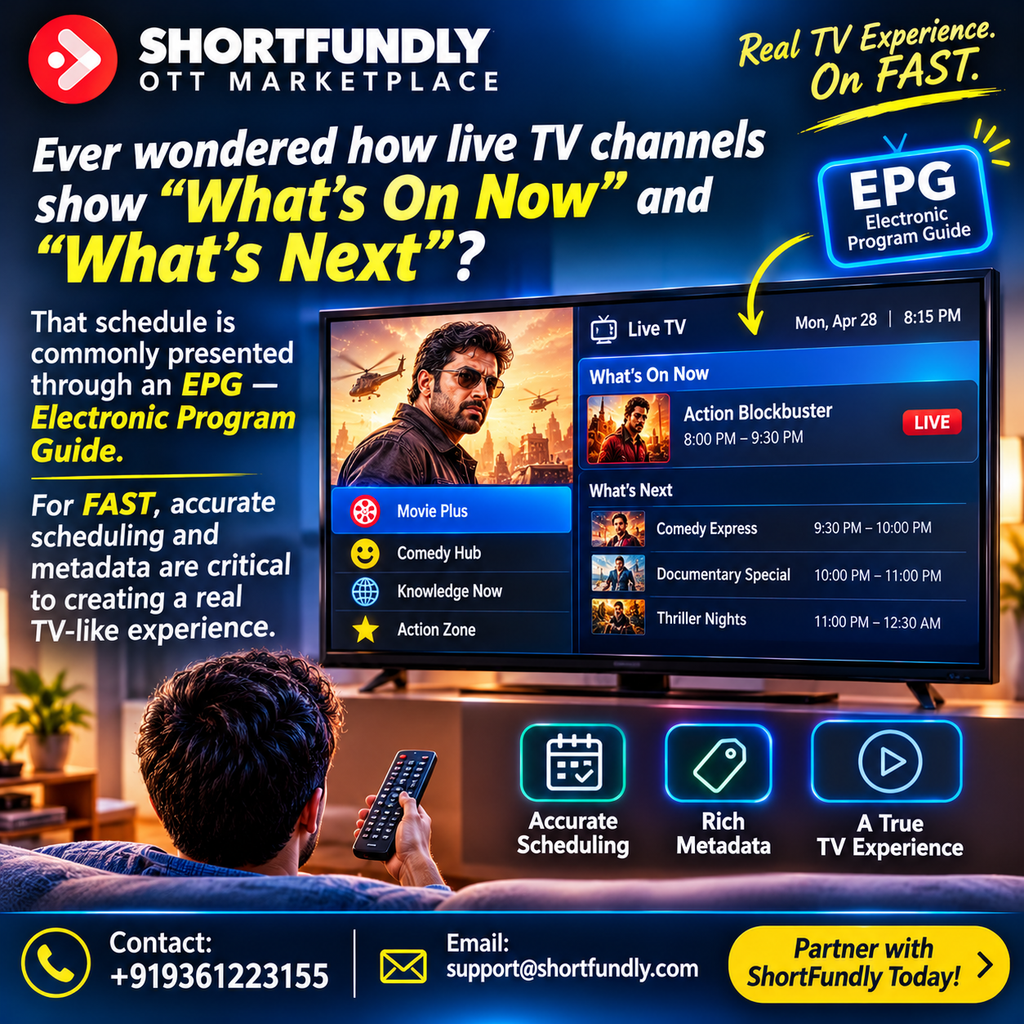
An Electronic Program Guide is a digital interface that displays scheduled television programming and related information. It helps viewers understand a channel’s lineup without having to guess which program is playing or when the next program will begin.
In a FAST environment, the EPG often serves as a connection between a linear channel’s schedule and the platform interface where viewers browse channels and programs.
Depending on the platform, viewers may see:
- The current program.
- The next scheduled program.
- Upcoming programs.
- Program start and end times.
- Titles and short descriptions.
- Genres and content classifications.
- Program artwork or other visual assets.
- Language, subtitles, or accessibility details where supported.
The exact information displayed depends on the streaming platform and its technical capabilities.
How an EPG Works
An EPG relies on structured scheduling and program information. The channel operator or its service provider prepares a schedule, associates the relevant metadata with each program, and delivers the information in a format supported by the distribution platform.
The platform then uses that information to display the program guide.
A typical workflow includes these steps:
- Content preparation: The operator identifies programs that are cleared for the intended distribution.
- Metadata creation: The team prepares titles, descriptions, genres, and other required information.
- Schedule creation: Programs are arranged into a linear sequence with planned start and end times.
- Schedule validation: The team checks timing, program order, rights windows, and metadata.
- EPG delivery: The schedule and metadata are supplied to the platform or guide service.
- Playout execution: The channel’s playout system runs the scheduled content.
- Monitoring: The operator checks whether the published guide remains aligned with the actual stream.
These steps may be managed through one integrated system or several connected tools.
The key principle is straightforward: the EPG, schedule, and actual channel output must remain aligned.
EPG vs. Traditional TV Guides
Traditional television guides and streaming EPGs serve a similar purpose, but their technical environments may differ.
| Feature | Traditional TV Guide | FAST Channel EPG |
|---|---|---|
| Primary purpose | Display scheduled television programming | Display scheduled streaming channel programming |
| Content delivery | Broadcast or cable infrastructure | Internet-based streaming infrastructure |
| Schedule information | Program titles and timings | Program titles, timings, and supported metadata |
| Updates | Depends on the broadcast and guide system | Depends on platform integrations and update processes |
| Distribution requirements | Broadcaster and television provider specifications | Streaming platform and distribution partner specifications |
| Viewer experience | Helps viewers navigate scheduled channels | Helps viewers discover and navigate FAST programming |
Both models depend on reliable schedule information. However, FAST operators must also account for streaming platform requirements, metadata delivery formats, and the relationship between digital scheduling systems and online playout infrastructure.
Why EPG Is Essential for FAST Channels
FAST channels combine scheduled programming with free, advertising-supported viewing. Unlike many on-demand services, which let viewers select an individual title from a library, linear FAST channels present programs in a continuous sequence.
The EPG makes that sequence easier to understand.
Helping Viewers Find Programs
A viewer may open a platform looking for a particular genre, film, or type of entertainment. A useful EPG gives the viewer enough information to decide whether to continue watching or explore another program.
For example, a viewer browsing a classic movie channel may want to know whether a historical drama is playing now or whether a comedy will begin later. Accurate program titles and timings make that decision easier.
Clear descriptions also help distinguish between programs with similar titles or themes.
The EPG doesn’t replace the platform’s search and recommendation tools, but it provides another important route to content discovery.
Creating a Traditional TV-Like Experience
One of the strengths of linear television is its simplicity. Viewers can open a channel, see what’s playing, and continue watching without choosing every title themselves.
A well-maintained EPG supports that experience in a streaming environment.
When the guide accurately reflects the channel schedule, viewers can move between programs with a better understanding of the lineup. When the information is inconsistent, the experience can feel unreliable.
For channel operators, the lesson is clear: programming quality and scheduling accuracy should be managed together.
Supporting Channel Operations
EPG data is useful for more than viewer navigation. It can also support internal planning, schedule reviews, metadata management, and communication with distribution partners.
A structured guide helps teams identify program transitions, verify scheduling information, and review the content planned for particular periods.
Depending on the systems involved, EPG data may also be used by downstream services that support program discovery, listings, and related platform features.
Accurate data can therefore improve both the viewer-facing experience and the operational process behind the channel.
7 Powerful EPG Strategies for FAST Channel Scheduling
A reliable EPG requires a repeatable process. The following seven strategies help channel operators manage schedules, maintain metadata quality, and reduce avoidable errors.
1. Maintain Accurate Scheduling Data
Scheduling accuracy is the foundation of a useful EPG.
Every program should have a planned start time and end time that match the channel’s scheduling plan. If the guide lists a movie at 8:00 p.m. but the playout system starts it at 8:15 p.m., viewers may see incorrect information about the current and upcoming programs.
We should establish one authoritative schedule that serves as the reference for guide preparation and playout operations.
The workflow should account for:
- Program duration.
- Start and end times.
- Time zones.
- Program order.
- Scheduled breaks.
- Changes to the lineup.
- Daylight saving time where relevant.
- Rights availability and expiration.
- The schedule’s publication deadline.
Time zones deserve particular attention when a channel is distributed across different markets. A schedule prepared in one time zone must be converted or represented correctly for the systems that consume it.
We should also avoid assuming that every program’s final duration will always match its nominal runtime. Depending on the channel format, advertising breaks, transitions, bumpers, and other elements may affect the actual schedule.
Practical recommendation: Validate the complete schedule before publishing the EPG, and compare planned timings with the playout system’s output during operation.
2. Build Consistent Metadata for Every Program
Metadata describes a program and helps systems organize, display, and identify it.
An EPG with accurate timing but incomplete program information still creates a limited viewing experience. Missing titles, vague descriptions, inconsistent genre labels, and incorrect release years can make it harder for viewers to understand the content.
We should create a standard metadata template and apply it consistently across the library.
A useful template may include:
- Official program title.
- Short description.
- Extended synopsis where supported.
- Genre or category.
- Release year.
- Language.
- Runtime.
- Cast and crew information where required.
- Content rating or classification where applicable.
- Program artwork.
- Internal content identifier.
- Rights and availability information for operational use.
Not every field will be displayed in every EPG. Nevertheless, maintaining a structured master record can make it easier to deliver the fields required by different partners.
We should also establish rules for capitalization, punctuation, abbreviations, title variants, and genre naming. For example, a team shouldn’t classify the same type of content as “Sci-Fi,” “Science Fiction,” and “SF” without a clear reason.
Consistent naming makes metadata easier to review and reduces unnecessary confusion during delivery.
3. Synchronize the EPG With the Playout System
The EPG should reflect the programs that the channel is scheduled to broadcast.
This requires a clear relationship between the schedule, playout system, and guide delivery process.
If the schedule changes in one system but not another, the EPG may continue showing outdated information. A last-minute title replacement, for example, can create a mismatch between the published guide and the actual stream.
We should define which system controls the authoritative schedule and how changes are communicated to connected systems.
A reliable workflow should include:
- Creating or updating the approved schedule.
- Validating the program order and timings.
- Delivering the schedule to the relevant systems.
- Confirming that the playout system has received the intended version.
- Updating the EPG when required.
- Checking the published information against the actual output.
Where integrations support automated updates, we can reduce manual work. However, automation should be supported by monitoring and clear error-handling procedures.
If a system rejects a schedule update, the team should know how to identify the problem, correct the data, and verify the result.
4. Use Clear and Useful Program Descriptions
Program descriptions help viewers understand what they’re about to watch.
A title alone may not provide enough information, particularly when the film is unfamiliar or has a general name. A concise description can communicate the subject, genre, or central premise without revealing unnecessary plot details.
For example, a vague description such as “A film about life and relationships” provides little guidance.
A more useful description might explain that the story follows two siblings who reconnect while dealing with a family challenge. The wording gives viewers a clearer sense of the premise without making unsupported claims.
We should ensure that descriptions are:
- Accurate to the actual program.
- Easy to read.
- Concise enough for the platform interface.
- Consistent with the intended audience.
- Free from misleading promotional claims.
- Suitable for the program’s language and market.
Different platforms may impose different character limits or formatting rules. We should follow each partner’s requirements rather than assume one description length will work everywhere.
Descriptions should also avoid unnecessary repetition. If every film is described as “an exciting and unforgettable story,” the text doesn’t help viewers distinguish between programs.
5. Plan for Schedule Changes and Contingencies
Even carefully prepared schedules can change.
A title may become unavailable, a technical issue may interrupt playout, or the programming team may need to replace a scheduled film. When that happens, the EPG should be updated through a defined process.
We should establish a schedule-change policy that identifies who can approve changes, who updates the guide, and how the team confirms that the changes have reached the relevant platform.
A practical policy should cover:
- Last-minute program replacements.
- Changes to start or end times.
- Missing or unavailable media.
- Playout failures.
- Delayed schedule updates.
- Incorrect metadata discovered after publication.
- Communication with distribution partners.
The team should prioritize changes according to their effect on the viewer experience and the applicable platform requirements.
Where supported, automated alerts can help identify schedule differences. For example, a system may flag a missing program record or an unexpected timing gap.
However, alerts are only useful when someone is responsible for reviewing and resolving them.
We should also maintain a documented fallback process. If the primary scheduling workflow fails, the operations team needs a clear method for keeping the channel and its guide as accurate as possible.
6. Follow Platform-Specific EPG Requirements
FAST platforms may have different technical and editorial requirements for program guide data.
These requirements can cover field names, date and time formats, program identifiers, artwork specifications, description lengths, accepted genre values, and update procedures.
A guide that works for one platform may require adjustments before it can be accepted by another.
We should maintain a platform-specific delivery checklist that includes:
| Requirement | What to Verify |
|---|---|
| Data format | Whether the schedule follows the required schema |
| Time format | Whether dates, times, and time zones are represented correctly |
| Program identifiers | Whether each record uses the required unique identifier |
| Required fields | Whether all mandatory metadata is present |
| Artwork | Whether images meet the required dimensions and formats |
| Schedule coverage | Whether the guide covers the required time period |
| Update process | Whether changes can be submitted and confirmed correctly |
| Validation | Whether the delivered data passes the partner’s checks |
We should use the current technical documentation provided by each platform or distribution partner. Requirements can change, so old specifications shouldn’t be treated as permanently valid.
Before a launch or major schedule update, we should validate the guide against the relevant requirements and resolve any reported issues.
7. Monitor EPG Quality and Performance
EPG quality should be reviewed continuously rather than checked only during launch preparation.
A guide may be accurate at the time of submission but become outdated after schedule changes or metadata revisions. Regular monitoring helps identify these issues before they become recurring operational problems.
We should monitor several categories of quality.
Schedule accuracy: Do the guide’s start and end times match the approved schedule and actual playout?
Metadata completeness: Are required titles, descriptions, genres, and identifiers present?
Update reliability: Are schedule changes reaching the systems and platforms that need them?
Data consistency: Are program names, identifiers, and categories used consistently?
Delivery quality: Is the EPG accepted by the intended partner without unresolved validation errors?
Where reporting is available, we can also investigate whether viewers use the guide to discover programs or whether particular metadata improvements are associated with changes in viewing behavior.
We should avoid treating every change in viewing as proof that the EPG caused it. Content popularity, promotions, platform placement, seasonality, and other factors may influence performance.
Instead, we should use EPG quality checks to improve operational reliability and use audience data to test broader discovery hypotheses.
Essential EPG Metadata Fields for FAST Channels
A structured metadata record makes the program guide easier to manage and helps the channel meet different platform requirements.
The following table describes common fields. Exact requirements depend on the distribution platform and its data specification.
| Metadata Field | Purpose | Example |
|---|---|---|
| Program title | Identifies the program | The Last Journey |
| Short description | Summarizes the program | A family begins a journey that changes their lives. |
| Genre | Identifies the content category | Drama |
| Start time | Shows when the program is scheduled to begin | 20:00 |
| End time | Shows when the program is scheduled to end | 21:45 |
| Runtime | Records the program’s duration | 105 minutes |
| Release year | Identifies the release year | 2024 |
| Language | Identifies the program’s language | English |
| Content rating | Communicates the applicable classification | As assigned by the relevant rating system |
| Program identifier | Connects the record to the correct content asset | FILM-00125 |
| Artwork | Provides a visual representation of the program | Approved program image |
| Channel identifier | Connects the schedule to the relevant channel | CHANNEL-01 |
Why Unique Program Identifiers Matter
Program identifiers help distinguish content records and connect metadata with the correct media assets.
Titles alone aren’t always reliable identifiers. Different films can share the same name, and one film may have multiple title variants across languages or territories.
A stable internal identifier can help teams connect the schedule, media file, rights record, artwork, and metadata.
We should define how identifiers are created and maintained. If an identifier changes unexpectedly, the team may have difficulty determining whether the record represents the same program or a different asset.
How to Maintain a Reliable Metadata Master
We should maintain an authoritative metadata record for every title in the library.
This master record can be used to prepare EPG data for multiple distribution partners while allowing the team to map fields to each partner’s specific requirements.
The workflow should include clear ownership, revision tracking, validation rules, and a process for correcting inaccurate information.
For example, if a film’s official title changes in the master record, the team should know which downstream systems require an update and how to confirm that the correction has been applied.
This approach reduces the need to maintain unrelated spreadsheets and lowers the risk of inconsistent data across platforms.
How EPG Scheduling Works in a FAST Channel
An effective EPG workflow connects content planning, rights management, scheduling, playout, and distribution.
Although the exact tools differ, the process generally follows a predictable sequence.
Step 1: Confirm Content Availability
Before scheduling a program, we should confirm that the title is available for the intended channel, platform, territory, and time period.
The team should review the applicable license terms and any restrictions that affect when or where the content can be used.
Step 2: Prepare the Programming Schedule
The programming team arranges the available titles into a linear sequence.
Each entry should include the information needed to determine its place in the schedule, including runtime and planned start time.
The team should account for any additional scheduled elements that affect timing.
Step 3: Validate Program Information
The metadata team checks the titles, descriptions, genres, identifiers, and other required fields.
Any missing or inconsistent information should be resolved before the guide is published.
Step 4: Deliver the Schedule and EPG Data
The approved schedule and metadata are delivered through the appropriate workflow.
This may involve a content management system, a scheduling tool, an EPG provider, a distribution partner, or a direct platform integration.
The important requirement is that the receiving system accepts the intended schedule version.
Step 5: Verify Playout and Guide Alignment
The operations team checks that the channel’s actual output matches the published schedule.
Any discrepancy should be investigated and corrected through the established change process.
Step 6: Monitor and Update
The team continues monitoring the schedule and metadata throughout the operating period.
Updates should be recorded, validated, and delivered according to the requirements of the relevant platform.
This workflow helps keep the EPG reliable while providing a clear process for handling changes.
Common EPG Mistakes to Avoid
Even experienced channel operators can encounter EPG problems when scheduling and metadata workflows lack clear ownership.
Incorrect Program Start Times
Incorrect start times can cause the guide to display the wrong current or upcoming program.
We should validate timing data and confirm that the EPG follows the approved schedule.
Missing or Duplicate Program Records
Missing entries leave gaps in the guide, while duplicate entries can confuse viewers and downstream systems.
A validation process should identify missing required fields and records that appear to represent the same scheduled program.
Inconsistent Titles and Descriptions
Different versions of a title or description can make the same program appear inconsistent across platforms.
We should use an authoritative metadata master and establish clear editorial standards.
Failure to Update Schedule Changes
A schedule replacement may be reflected in the playout system but not in the EPG.
We should define a single change-management workflow and verify that updates reach all required systems.
Ignoring Time Zones
Time zone errors can create schedule mismatches when a channel is delivered to markets with different local times.
We should document the time zone used by each system and validate any conversion process.
Overlooking Rights Restrictions
A title may be technically ready for playout but unavailable for the intended distribution period.
Rights checks should be part of schedule validation, not a separate activity performed only during content acquisition.
Relying Entirely on Manual Checks
Manual reviews are useful, but they can become inconsistent when schedules are large or changes are frequent.
Where possible, we should use automated validation for missing fields, timing conflicts, duplicate records, and other predictable errors. Human review should remain available for issues that require editorial judgment.
EPG and FAST Channel Distribution
EPG readiness is an important part of preparing a FAST channel for distribution.
A channel may have strong programming and a clear brand, but the operational process still needs to support accurate schedules, consistent metadata, and platform-compatible delivery.
Prepare a Distribution-Ready EPG Package
Before submitting a channel or schedule to a distribution partner, we should confirm that the required assets and information are complete.
A preparation checklist may include:
- Approved channel name and description.
- Channel logo and required artwork.
- Validated program schedule.
- Required program metadata.
- Unique program identifiers.
- Correct date and time formats.
- Rights and availability records.
- Platform-specific delivery files.
- Schedule update procedures.
- A process for resolving validation errors.
The precise package will depend on the partner’s requirements.
Evaluate Distribution Support
Content owners and channel operators should understand which parts of the distribution process a potential partner supports.
Depending on the arrangement, relevant questions may include whether the partner assists with content delivery, metadata preparation, technical validation, platform submissions, rights documentation, or other distribution activities.
We should verify the actual scope of each service rather than assume that every partner handles all parts of FAST channel operations.
Shortfundly Distribution is a resource that filmmakers and content owners can explore when evaluating distribution options. Review its current offerings, eligibility requirements, platform coverage, commercial terms, and operational responsibilities to determine whether it fits the project’s needs.
Maintain Clear Responsibilities
Distribution workflows often involve multiple teams or organizations. One team may manage content rights, another may prepare the schedule, and another may deliver the data to a platform.
We should document who is responsible for creating, approving, delivering, and updating EPG information.
Clear ownership reduces delays and makes it easier to identify the right person when an error occurs.
Treat EPG Quality as an Ongoing Process
Distribution readiness doesn’t end when a channel launches.
Content libraries change, rights expire, schedules are updated, and platform specifications may evolve. The EPG workflow should be designed to accommodate these changes.
Regular reviews, documented procedures, and consistent quality checks can help maintain reliable guide information as the channel grows.
How to Measure EPG Quality
We should use clear indicators to evaluate whether the EPG process is operating as intended.
The most useful indicators are those that relate directly to data quality, scheduling accuracy, and delivery reliability.
| Indicator | What It Measures | How to Use It |
|---|---|---|
| Schedule accuracy | Alignment between the guide and approved schedule | Investigate discrepancies in program timing |
| Metadata completeness | Presence of required fields | Identify missing information before delivery |
| Validation error rate | Frequency of detected data errors | Prioritize recurring technical problems |
| Update success rate | Whether schedule changes are delivered successfully | Review failed or delayed updates |
| Program record consistency | Agreement between master records and delivered data | Identify title and identifier mismatches |
| Correction time | Time required to resolve an EPG issue | Improve escalation and correction workflows |
| Viewer discovery indicators | Available evidence of guide-related content discovery | Investigate whether improvements support the viewing experience |
We should establish a baseline before making major changes. This helps us determine whether the process is improving over time.
For example, if the team introduces automated metadata validation, it can compare the number of errors detected before and after implementation. The results should be interpreted carefully, because better detection may initially increase the number of reported errors even when the process is improving.
Viewer-facing indicators should also be treated with care. A change in viewing behavior may have several causes, and EPG improvements should not be credited with outcomes that haven’t been demonstrated.
The goal is to combine operational measures with appropriate audience data to create a reliable improvement process.
Frequently Asked Questions About EPG for FAST Channels
1. What Does EPG Stand for in Streaming?
EPG stands for Electronic Program Guide. It displays scheduled programs and related information, such as titles, descriptions, and start times, helping viewers navigate linear streaming channels.
2. Why Is an EPG Important for FAST Channels?
An EPG helps viewers understand what’s playing now and what’s coming next. It also supports program discovery and gives a FAST channel a more familiar television-style viewing experience.
3. What Information Should a FAST Channel EPG Include?
Common fields include program titles, descriptions, start and end times, genres, identifiers, and other metadata required by the platform. Additional fields may include release year, language, content classification, and artwork.
4. How Do We Keep EPG Data Accurate?
We should maintain an authoritative schedule, validate metadata before delivery, synchronize updates with the playout system, and monitor the published guide. Clear ownership and documented correction procedures are also important.
5. What Causes EPG Scheduling Errors?
Common causes include incorrect runtimes, time zone mistakes, missing program records, outdated schedules, inconsistent metadata, and failed updates between connected systems.
6. Can One EPG Format Work Across All FAST Platforms?
Not necessarily. Different platforms may have different data schemas, required fields, time formats, artwork specifications, and update procedures. We should validate EPG data against each partner’s current technical requirements.
7. How Often Should We Update EPG Information?
We should update EPG information whenever an approved schedule or relevant program detail changes. The exact update timing depends on the platform’s requirements, the channel’s workflow, and the urgency of the change.
8. What Is the Difference Between EPG Data and Program Metadata?
Program metadata describes a title, including its name, synopsis, genre, and other attributes. EPG data uses program information within a scheduled lineup, adding details such as start and end times and the channel on which the program is expected to appear.
9. How Does EPG Quality Affect Content Discovery?
Accurate titles, descriptions, genres, and timings help viewers understand the available programming. Poor data can create confusion or make it harder to identify a relevant program. The exact effect on viewing depends on the platform and audience.
10. What Should We Check Before Delivering an EPG to a Distribution Partner?
We should verify schedule accuracy, required metadata, program identifiers, date and time formats, artwork, rights availability, data formatting, and the partner’s current technical specifications. We should also confirm how future schedule changes will be submitted and validated.
Also read: https://blog.shortfundly.com/ott/fast-channel-ideas/
Conclusion: Build a More Reliable FAST Channel Experience With Accurate EPG Data
A reliable EPG for FAST channels helps connect programming schedules with the information viewers use to discover and navigate content. It supports a familiar television-style experience while helping channel operators maintain consistency across scheduling, metadata, playout, and distribution workflows.
The seven strategies in this guide provide a practical foundation: maintain accurate scheduling data, standardize metadata, synchronize the EPG with playout, write useful program descriptions, prepare for schedule changes, follow platform-specific requirements, and monitor quality over time.
We should also treat rights verification and distribution readiness as essential parts of the process. A schedule is only dependable when its programs are available for the intended use and its data can be delivered correctly to the required platforms.
By establishing clear responsibilities, using structured metadata, validating schedules, and correcting problems quickly, we can reduce avoidable errors and improve the overall channel experience.
For content owners and filmmakers evaluating distribution opportunities, Shortfundly Distribution is worth reviewing alongside other options. The right approach will depend on the services offered, the applicable terms, and the channel’s operational requirements.
Ultimately, an EPG is not just a list of programs. It’s an important part of how a FAST channel communicates its schedule, supports discovery, and delivers a reliable viewing experience. Accurate guide data, consistent programming, and a well-managed distribution workflow help create a stronger foundation for long-term channel operations.