Table of Contents
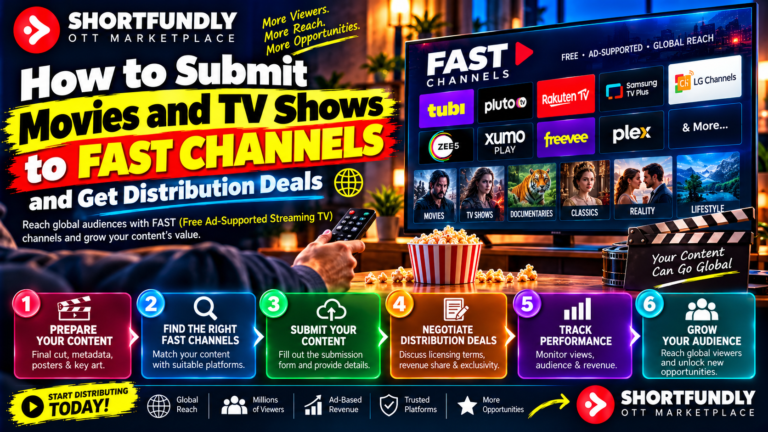
Getting an independent film onto television used to require a traditional broadcaster, cable network, television sales agent, or a major distribution company. Today, the landscape is changing. FAST channel distribution gives independent filmmakers another path to reach audiences through connected TVs, smart-TV applications, streaming devices, and digital television platforms.
FAST means Free Ad-Supported Streaming Television. Instead of requiring viewers to buy a traditional pay-TV subscription for every channel, FAST services typically provide linear-style programming supported by advertising.
For independent filmmakers, this creates an exciting opportunity. We can take films that have already been completed and explore additional distribution windows without waiting for a traditional TV network to offer a deal.
However, getting an independent film onto a FAST channel isn’t as simple as uploading a movie and pressing publish. We need the right film rights, technical masters, metadata, subtitles, artwork, distribution strategy, and commercial proposition.
The good news is that filmmakers have more options than they once did.
We can approach OTT distributors, FAST channel operators, content aggregators, technology-enabled distribution companies, and specialist film distribution services. We can also build a catalogue strategy rather than trying to sell every film as a standalone title.
For creators considering Shortfundly Distribution, the same principle applies: professional preparation can make the submission and distribution process much easier. A current Shortfundly distribution workflow supports eligible categories including short films, web series, movies, documentaries, telefilms, pilot films, micro dramas, and songs or video songs, subject to its requirements, review, licensing, and available distribution partners.
The real opportunity is to think beyond the question, “How do we get our movie on TV?”
1. Understand How FAST Channel Distribution Works
Before approaching a distributor, we need to understand the basic FAST channel distribution model.
A FAST channel works more like traditional linear television than a standard video-on-demand library. Viewers can open a channel and watch whatever is currently scheduled. The channel continues playing even when an individual viewer joins halfway through a program.
This creates a different opportunity for independent films.
Instead of asking a viewer to search specifically for our movie, the film can potentially become part of a programmed entertainment experience.
For example, imagine a FAST channel focused on independent cinema.
Its schedule might include:
- Independent feature films
- Short films
- Documentaries
- Regional cinema
- Film-festival selections
- Classic independent productions
- Genre-focused movies
- Emerging filmmaker showcases
Our movie could become one component of that larger programming strategy.
FAST Is More Than Streaming
FAST combines several elements:
Content + linear programming + connected TV + advertising + distribution + audience discovery.
This is why filmmakers need to think like content suppliers rather than simply video uploaders.
A distributor may need:
- High-quality master files
- Accurate metadata
- Closed captions
- Subtitles
- Artwork
- Trailers
- Rights information
- Content ratings
- Territory information
- Promotional materials
The better prepared the package, the easier it is for a potential partner to evaluate it.
2. Why Independent Films Can Fit the FAST Ecosystem
FAST platforms need programming.
That basic fact creates an opportunity for independent filmmakers.
Traditional television networks have historically relied on large programming budgets, established studios, broadcasters, and recognizable brands. FAST channels can support a broader variety of programming concepts, including niche genres and specialized audiences.
That doesn’t mean every independent film will automatically be accepted.
It means independent content can have a place in the wider ecosystem when it fits the audience, genre, rights, quality, and programming requirements of a distributor or platform.
Niche Content Can Become Valuable
A film doesn’t necessarily need to appeal to everyone.
A documentary about independent filmmaking might be highly relevant to a niche audience.
A regional-language movie might appeal strongly to viewers who want culturally relevant entertainment.
A collection of horror films could become part of a genre-focused channel.
A library of independent short films could support a curated cinema concept.
This is where independent filmmakers can think creatively.
Instead of asking:
“Is my film big enough for television?”
we can ask:
“Which audience is most likely to value this film, and which distribution environment serves that audience?”
That change in thinking can open new possibilities.
3. FAST Channels vs Traditional TV Deals
A traditional television deal and a FAST distribution arrangement are not the same thing.
Traditional TV distribution may involve:
- Broadcaster negotiations
- Cable carriage
- Satellite distribution
- Broadcast schedules
- Television licensing
- Regional rights
- Network acquisitions
FAST distribution typically involves:
- Internet delivery
- Connected TVs
- Streaming devices
- Smart-TV applications
- Digital channel programming
- Advertising-supported monetization
- Platform-based discovery
This distinction matters because independent filmmakers don’t always need to wait for a traditional TV deal before exploring television audiences.
A New Route for Independent Filmmakers
We can potentially build a distribution path such as:
Film Production → Rights Clearance → OTT Distribution → FAST Opportunity → Connected-TV Audience
This doesn’t mean every movie will follow exactly that path.
Some films may be licensed directly.
Others may enter through an aggregator.
Some may be included in a channel operated by another company.
Others may become part of a larger catalogue.
The important point is that FAST distribution creates another potential window for content.
4. Secure Your Film Rights Before Approaching Distributors
One of the most important steps is also one of the easiest to overlook.
We need to confirm that we actually control the rights we want to license.
A producer may own the completed film but still have restrictions involving music, performers, archival footage, distribution territories, underlying stories, or previous agreements.
Before approaching a FAST distributor, we should review:
- Film ownership
- Digital rights
- OTT rights
- FAST rights
- Television rights
- AVOD rights
- International rights
- Regional rights
- Music rights
- Promotional rights
- Subtitle and dubbing rights
Build a Rights Grid
A simple rights grid can make the process much easier.
| Right | Status | Territory | Exclusive? |
|---|---|---|---|
| OTT | Available | Worldwide | No |
| FAST | Available | Selected territories | No |
| TV | Available | India | No |
| AVOD | Available | Worldwide | No |
| Music | Cleared | Worldwide | No |
| International | Available | Selected markets | No |
The exact information will vary from film to film.
The key is clarity.
A distributor should not have to guess whether our film is available.
Why Exclusivity Matters
A FAST distributor may ask for exclusive rights.
Before agreeing, we should understand exactly what “exclusive” means.
It might refer to:
- A specific platform
- A specific territory
- A specific medium
- A specific period
- A specific type of advertising-supported service
Never assume that an exclusivity clause is harmless.
We should always read the complete agreement and understand which rights are being transferred, for how long, and in which territories.
5. Prepare a Professional Independent Film Package
A great movie can still look difficult to distribute if the delivery package is incomplete.
We should prepare a professional film distribution package before contacting FAST partners.
At minimum, our package should contain:
Film Information
- Title
- Logline
- Short synopsis
- Long synopsis
- Genre
- Runtime
- Release year
- Country of production
- Language
People
- Director
- Producer
- Main cast
- Key creative team
Promotional Assets
- Poster
- Landscape artwork
- Stills
- Trailer
- Teaser
- Behind-the-scenes material
Rights Information
- Rights owner
- Territory
- Availability
- Existing licenses
- Exclusivity
- Rights term
Technical Information
- Master format
- Resolution
- Audio format
- Subtitle format
- Caption availability
This creates a professional first impression.
6. Make Sure Your Film Meets Technical Delivery Standards
FAST distribution is digital television, but that doesn’t mean technical standards are casual.
Distributors and platforms can have their own delivery specifications.
We should be prepared for requirements involving:
- Resolution
- Frame rate
- Aspect ratio
- Audio channels
- Loudness
- Video bitrate
- File container
- Codec
- Closed captions
- Subtitles
- Content identification
- Artwork dimensions
For example, a platform may request a particular master format even if our original production file uses another format.
Keep Multiple Masters Where Possible
A sensible workflow is to maintain:
Production Master → Distribution Master → Platform-Specific Delivery File
This avoids unnecessary last-minute conversions.
We should also keep an uncompressed or high-quality archive master safely stored.
That way, if a distributor requests a different technical version later, we aren’t forced to reconstruct the film from a compressed streaming copy.
7. Treat Metadata as Part of the Film Product
Metadata might sound boring.
It isn’t.
For digital television, metadata can influence how viewers discover and understand content.
A strong metadata package can include:
- Title
- Alternate title
- Synopsis
- Genre
- Subgenre
- Director
- Cast
- Release year
- Country
- Language
- Runtime
- Rating
- Keywords
- Content warnings
- Subtitle languages
Write Better Synopses
We should prepare several versions.
One-Line Logline
A compelling sentence that explains the central story.
Short Synopsis
Around 50–100 words.
Long Synopsis
A more detailed description for content buyers and programming teams.
The writing should be clear, factual, and engaging.
We shouldn’t exaggerate.
We shouldn’t promise awards, audience numbers, or critical recognition unless those claims can be verified.
That is part of building trust.
8. Add Subtitles and Localization
Localization can significantly increase the potential reach of an independent film.
A film produced in one language doesn’t have to remain limited to that language.
Depending on the market and rights, we can prepare:
- English subtitles
- Regional-language subtitles
- International-language subtitles
- Closed captions
- Dubbed audio
- Localized metadata
For independent films, English subtitles are often particularly useful when the original language is regional.
Why Localization Helps
Consider a Tamil independent film.
Its natural audience may include Tamil-speaking viewers in India and abroad. But English subtitles can make the film accessible to viewers who don’t speak Tamil.
Similarly, a Malayalam, Bengali, Telugu, Kannada, Marathi, or Hindi film can potentially reach wider audiences through localization.
We should think of subtitles as a distribution asset, not simply a compliance requirement.
9. Decide Whether One Film or a Catalogue Is the Better Pitch
A common mistake is assuming that FAST distribution always means creating a complete FAST channel.
It doesn’t.
We can have at least three different approaches.
Option 1: License an Individual Film
Our movie is licensed as programming for an existing FAST channel.
This may be the simplest route for a filmmaker with one strong title.
Option 2: Offer a Film Catalogue
We provide several titles to a distributor.
This gives the distributor more programming flexibility.
Option 3: Develop a FAST Channel Concept
We package enough content around a clear audience proposition to support a branded channel.
For example:
Indian Independent Cinema
South Indian Movie Classics
Global Documentary Cinema
Independent Horror Network
The correct model depends on our content volume and rights.
10. Build a Strong FAST Channel Concept
If we have multiple films, a channel concept can make our pitch much stronger.
A FAST channel isn’t simply a folder full of movies.
It needs a programming identity.
Define the Channel
We should establish:
- Channel name
- Audience
- Genre
- Programming style
- Territory
- Language
- Schedule
- Content volume
- Content refresh strategy
Example
Channel: Independent Indian Cinema
Audience: Viewers interested in Indian independent movies
Programming: Feature films, documentaries, short films, filmmaker interviews
Languages: Hindi, Tamil, Telugu, Malayalam, Kannada, Bengali
Localization: English subtitles
Positioning: Curated independent cinema from emerging filmmakers
This immediately gives a distributor something concrete to evaluate.
11. Choose the Right Distribution Partner
Not every OTT or FAST distributor serves the same purpose.
Some companies specialize in:
- FAST channel technology
- Channel creation
- CTV distribution
- OTT aggregation
- Content licensing
- Advertising
- International distribution
- Regional television
- Independent films
We should research each partner before making contact.
What to Evaluate
| Factor | What We Should Check |
|---|---|
| Platform reach | Where can they distribute? |
| Territories | Which countries are supported? |
| Content type | Do they accept independent films? |
| Rights | What rights do they require? |
| Exclusivity | Is the agreement exclusive? |
| Fees | Are there processing or technical costs? |
| Revenue | How is revenue calculated? |
| Reporting | What data will we receive? |
| Support | Who handles delivery issues? |
| Contract | What are the term and termination rules? |
The right distributor is the one whose model fits our project.
12. Use OTT Distribution as a Stepping Stone
We don’t have to jump directly from independent film production to launching a FAST channel.
A broader OTT distribution strategy can help us build a catalogue and learn how the market responds.
For independent filmmakers, Shortfundly Distribution is one option to consider for eligible content. Its current public distribution service describes support for short films, web series, movies, documentaries, telefilms, pilot films, micro dramas, and songs or video songs, with distribution through currently available partners subject to content, duration, eligibility, licensing, review, and availability requirements.
A practical progression could look like this:
Film completed
↓
Rights cleared
↓
OTT distribution
↓
Audience and performance data
↓
Catalogue growth
↓
FAST distribution discussions
This is a more sustainable approach than trying to build a 24/7 channel with only one or two films.
13. Approach FAST Distributors With a Business Pitch
When we contact a distributor, the first message should be concise.
We shouldn’t send a 20-page email explaining every production detail.
Instead, we should provide the information a buyer needs to decide whether to continue the conversation.
A Strong Pitch Should Include
Subject: Independent Film Catalogue Available for FAST Distribution
Film: [Title]
Genre: [Genre]
Language: [Language]
Runtime: [Runtime]
Rights: [Available territories and rights]
Catalogue: [Number of films / total hours]
Audience: [Target audience]
Assets: [Master, subtitles, artwork, trailer]
Proposal: [FAST licensing / catalogue distribution / channel opportunity]
Then provide a link or approved screener access where appropriate.
Lead With the Opportunity
Instead of saying:
“We made a movie and want to get it on TV.”
We can say:
“We control a cleared catalogue of independent films with FAST and digital rights available across selected territories, including professionally prepared masters, subtitles, metadata, artwork, and promotional assets.”
That’s a much stronger commercial proposition.
14. Understand FAST Distribution Economics
FAST channels are generally built around advertising-supported viewing, so the commercial structure can differ from traditional film licensing.
Potential arrangements may include:
- Revenue sharing
- Licensing fees
- Minimum guarantees
- Advertising participation
- Hybrid arrangements
- Catalogue licensing
We shouldn’t assume that every distributor uses the same model.
Questions to Ask
Before signing anything, we should ask:
- How is revenue calculated?
- What expenses are deducted?
- Who sells advertising?
- Who owns the advertising inventory?
- How often are statements issued?
- When are payments made?
- What territories are included?
- What platforms are included?
- Is the agreement exclusive?
- What happens when the contract ends?
A percentage alone doesn’t tell the whole story.
A smaller percentage of a transparent, high-volume distribution arrangement could be more useful than a larger percentage with unclear deductions.
15. Monitor Performance After Distribution
Distribution is not the end of the journey.
Once our film enters a streaming or FAST environment, we should monitor the available performance data.
Depending on the distributor and agreement, reporting may include:
- Views
- Watch time
- Completion rate
- Audience geography
- Platform performance
- Channel performance
- Revenue
- Advertising impressions
- Engagement
These metrics can help us make better decisions.
For example, if our independent horror films consistently outperform our dramas, we have evidence that a future horror-focused catalogue or channel may be commercially interesting.
This is where data-driven film distribution becomes powerful.
We aren’t simply releasing content.
We’re learning what audiences want.
16. Build a Long-Term Independent Film Distribution Strategy
A single film can create an opportunity.
A catalogue can create a business.
This is why we should think about distribution throughout the entire production lifecycle.
Before production, we can consider:
- Target audience
- Language
- Genre
- International appeal
- Localization
- Rights strategy
During post-production, we can prepare:
- Masters
- Subtitles
- Captions
- Artwork
- Trailer
- Metadata
Before release, we can organize:
- Rights documents
- Distribution package
- Screener
- Pitch deck
- Distributor list
After release, we can track:
- Audience
- Revenue
- Platform performance
- Territory performance
- Content demand
Over time, this creates a much stronger distribution portfolio.
17. Take Advantage of Regional and Niche Audiences
Independent filmmakers shouldn’t assume that global success requires English-language content.
Regional cinema can have powerful audience communities.
A Tamil film can serve Tamil-speaking viewers worldwide.
A Malayalam film can reach audiences in India and the global Malayali diaspora.
A Telugu film can potentially reach viewers across multiple international markets.
A Hindi independent film can target audiences across India and abroad.
FAST makes niche programming particularly interesting because digital television can serve more specialized audience interests.
Package Regional Content Properly
For a regional film, we should highlight:
- Original language
- Subtitle options
- Regional audience
- Cultural relevance
- Genre
- Diaspora potential
- Existing audience
- Rights availability
That gives distributors a clearer commercial picture.
18. Understand the Growing FAST and CTV Landscape
The FAST ecosystem is still developing, and regulatory discussions are also evolving.
In India, the Telecom Regulatory Authority of India released a consultation paper in April 2026 concerning a regulatory framework for Application-based Linear Television Distribution Services, including FAST services. The consultation considered services that distribute linear television channels through applications on smart TVs, mobile devices, web browsers, and other connected devices.
This is relevant because it shows how quickly internet-delivered linear television is becoming a serious part of the broadcasting conversation.
The consultation itself is now closed, so filmmakers should treat the regulatory environment as an evolving area and verify current requirements before entering a distribution arrangement.
For independent producers, the takeaway is straightforward:
We should build distribution strategies that can adapt as the FAST and connected-TV market develops.
19. Avoid These Common FAST Distribution Mistakes
Even strong films can struggle if the distribution package is weak.
Mistake 1: Unclear Rights
If we can’t explain what rights we own, distributors may hesitate.
Mistake 2: Poor Metadata
Incomplete metadata makes the catalogue harder to evaluate and program.
Mistake 3: Missing Subtitles
Localization gaps can reduce potential market reach.
Mistake 4: Weak Artwork
FAST platforms are highly visual. Professional artwork matters.
Mistake 5: No Audience Positioning
We should explain who will watch the film.
Mistake 6: One-Title Thinking
If we have multiple suitable films, a catalogue may create a stronger opportunity.
Mistake 7: Unrealistic Revenue Expectations
FAST revenue depends on many variables, including audience, territory, advertising demand, platform economics, programming, and contractual terms.
Mistake 8: Treating Submission as Guaranteed Placement
Submitting content to a distributor doesn’t guarantee that every platform will accept or stream it.
The final decision can depend on content suitability, rights, technical requirements, platform availability, and commercial considerations.
20. The 30-Day FAST Distribution Preparation Plan
We can make the process manageable by breaking it into four weeks.
Week 1: Rights and Catalogue
Complete:
- Rights review
- Ownership documents
- Catalogue spreadsheet
- Territory information
- Existing licensing review
Week 2: Technical Assets
Prepare:
- Master file
- Trailer
- Poster
- Stills
- Subtitles
- Captions
- Audio files
Week 3: Marketing Package
Create:
- Logline
- Short synopsis
- Long synopsis
- Director biography
- Producer biography
- Cast information
- Audience profile
- Channel concept if applicable
Week 4: Distribution Outreach
Research:
- OTT distributors
- FAST channel operators
- Content aggregators
- Regional distributors
- CTV partners
Then approach the most relevant partners with a concise professional package.
21. FAST Distribution Checklist for Independent Filmmakers
Before contacting a distributor, we should be able to answer “yes” to most of the following.
Rights
- We control the required distribution rights.
- Music rights are cleared.
- Talent agreements are documented.
- Territory restrictions are understood.
- Existing exclusivity is identified.
Content
- Final master is available.
- Audio is properly mixed.
- Subtitles are ready.
- Captions are available where needed.
- Trailer is ready.
Metadata
- Title is finalized.
- Synopsis is written.
- Genre is defined.
- Cast and crew details are accurate.
- Runtime is confirmed.
- Language is specified.
- Keywords are prepared.
Marketing
- Poster is ready.
- Stills are available.
- Logline is compelling.
- Audience is clearly defined.
- Channel concept is prepared if relevant.
Commercial
- We know which territories are available.
- We understand the rights we want to license.
- We know our preferred deal structure.
- We have questions prepared for distributors.
Frequently Asked Questions About Getting Independent Films Onto FAST Channels
1. Can an independent film get onto a FAST channel without a traditional TV deal?
Yes, it can be possible. FAST distribution provides a digital television route that doesn’t depend entirely on a conventional cable, satellite, or broadcast-TV deal.
However, acceptance depends on the distributor, platform, content, rights, technical specifications, programming requirements, and commercial suitability.
2. What is FAST channel distribution?
FAST channel distribution is the process of delivering free, ad-supported linear-style television channels or programming to connected-TV and streaming platforms.
For filmmakers, this can create an additional route for movies and other video content to reach audiences.
3. Do we need to create our own FAST channel?
No.
We can explore several models.
A distributor may license an individual movie, accept a catalogue, place content into an existing FAST channel, or help create a new channel.
The best option depends on how much content we control and what rights are available.
4. How much content do we need for a FAST channel?
There is no single universal requirement.
A channel’s needs depend on programming frequency, movie runtime, genre, repetition strategy, audience expectations, and platform requirements.
A larger catalogue generally provides more programming flexibility.
5. Can short films be distributed through FAST?
They can potentially be used as part of FAST programming, particularly when they fit a clear programming concept.
A collection of short films may be more commercially interesting when packaged around a genre, language, region, filmmaker community, or audience niche.
6. Can regional Indian films be distributed through FAST?
Yes, regional films can potentially be attractive for targeted audiences.
Tamil, Telugu, Malayalam, Kannada, Bengali, Marathi, Hindi, and other regional-language content can be positioned around language and cultural audiences.
Subtitles and localized metadata can also make the content more accessible.
7. What rights do we need for FAST distribution?
The exact rights depend on the deal, but we should review FAST, digital, OTT, television, AVOD, territory, promotional, and related rights before entering negotiations.
If another company already holds exclusive rights, we may not be able to license the same rights elsewhere.
8. How does a FAST channel make money?
FAST channels commonly use advertising-supported monetization.
Depending on the arrangement, content owners may participate through licensing fees, revenue shares, advertising arrangements, or hybrid structures.
The actual commercial model depends on the contract, distributor, platform, territory, audience, and advertising market.
9. Is FAST the same as AVOD?
Not exactly.
AVOD generally refers to advertising-supported video on demand.
FAST refers to a linear-style television experience that is free to the viewer and typically supported by advertising.
Both can be part of a broader OTT distribution strategy.
10. Can Shortfundly Distribution help independent filmmakers?
Shortfundly’s current distribution service supports eligible content categories including short films, web series, movies, documentaries, telefilms, pilot films, micro dramas, and songs or video songs. Its current process involves content submission, review, required agreement and payment steps, release preparation after approval, and distribution through currently available partners.
Availability depends on factors such as content, duration, eligibility, licensing, review, and current distribution availability.
11. What video quality should an independent film have?
We should always check the current technical specifications of the distributor or platform before delivery.
As a general preparation standard, we should maintain a high-quality master, clean audio, proper color grading, accurate subtitles, and professional artwork.
The exact file format, resolution, codec, bitrate, caption, and audio requirements can differ between distributors.
12. Should we distribute our film exclusively?
Not automatically.
Exclusivity can sometimes make a deal commercially attractive, but it also limits our ability to license the same rights elsewhere.
We should compare:
- Term
- Territory
- Rights
- Platforms
- Revenue
- Marketing
- Reporting
- Termination provisions
before agreeing to exclusivity.
13. Can one film be distributed on multiple platforms?
Potentially, if our agreement permits it.
A non-exclusive arrangement may allow multiple distribution relationships, while an exclusive agreement may restrict them.
We should check the exact contract language rather than relying on verbal assurances.
14. How should we pitch our independent film to a FAST distributor?
Keep the pitch short and commercial.
Include:
- Film title
- Genre
- Runtime
- Language
- Synopsis
- Audience
- Rights
- Territories
- Technical readiness
- Trailer
- Artwork
- Catalogue size
Most importantly, explain why the content fits a particular audience or programming concept.
15. Does getting onto a FAST platform guarantee viewers?
No.
Distribution gives viewers access to content, but audience performance depends on programming, discoverability, platform placement, content quality, audience demand, marketing, and other factors.
We should therefore treat distribution and audience development as two connected but separate activities.
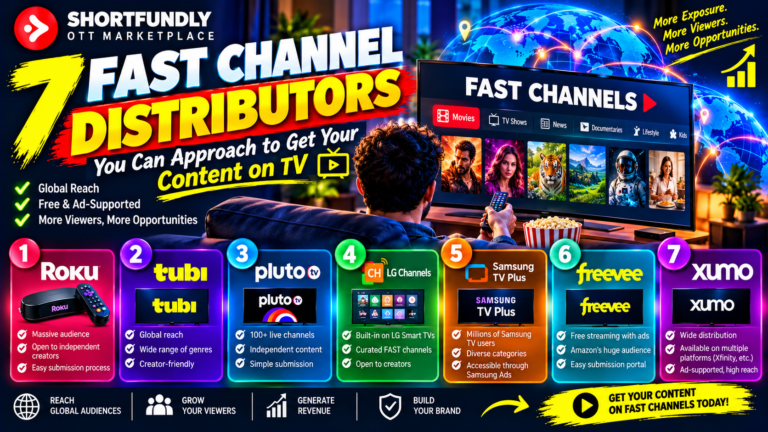
Also read: https://blog.shortfundly.com/uncategorized/fast-channel-distributors-tv/
Conclusion: Build a FAST Distribution Strategy, Not Just a Submission
The biggest change in modern television distribution is that independent filmmakers no longer have to view a traditional TV deal as the only path to television audiences.
FAST channels, connected TV, OTT distribution, AVOD, digital aggregators, and streaming platforms have created additional distribution opportunities.
But opportunity alone isn’t enough.
We need to prepare properly.
We need clear rights.
We need high-quality masters.
We need strong metadata.
We need subtitles.
We need professional artwork.
We need a clear audience.
We need a smart distribution pitch.
And, when we have enough content, we should consider whether our catalogue can support a FAST channel concept rather than simply licensing individual movies.
For filmmakers with smaller catalogues, an OTT distribution route can be a practical starting point. For creators with larger libraries, a channel strategy may eventually become more attractive.
The key is to think about our film as an intellectual property asset with multiple potential distribution windows, not as a one-time release.
A movie can have a festival life.
It can have a theatrical life.
It can have an OTT life.
It can have a television life.
It can have a FAST life.
It can reach regional audiences.
It can reach diaspora audiences.
And, where rights and commercial conditions allow, it can continue generating value long after its initial release.
That is why FAST channel distribution for independent films deserves serious consideration.
We don’t need to wait for the traditional television gatekeeper to decide whether our film belongs on TV.
We can prepare the content professionally, identify the right distribution partners, understand our rights, package the catalogue intelligently, and approach the connected-TV market with a clear commercial proposition.
The traditional TV deal may still be valuable.
But it no longer has to be the only door.