Table of Contents
Songs OTT Distribution gives independent artists an opportunity to make their music available through digital entertainment and streaming channels. However, a successful release involves much more than uploading an audio file. We need to prepare the final recording, verify ownership, organize metadata, create professional artwork, understand distribution agreements, and plan how listeners will discover the song.
A complete Songs OTT Distribution Checklist helps us manage these tasks in the right order. It reduces avoidable submission errors, supports a smoother review process, and gives us a clear plan for promoting the release.
Whether we are releasing a single, an album, an original soundtrack, or a video song, the preparation process should begin before we submit the content to a distributor. We should also review the current requirements of the selected service because technical specifications, accepted formats, licensing terms, and available platforms can vary.
This guide covers 15 essential steps to help independent musicians, singers, composers, producers, and music labels prepare their next release.
What Is a Songs OTT Distribution Checklist?
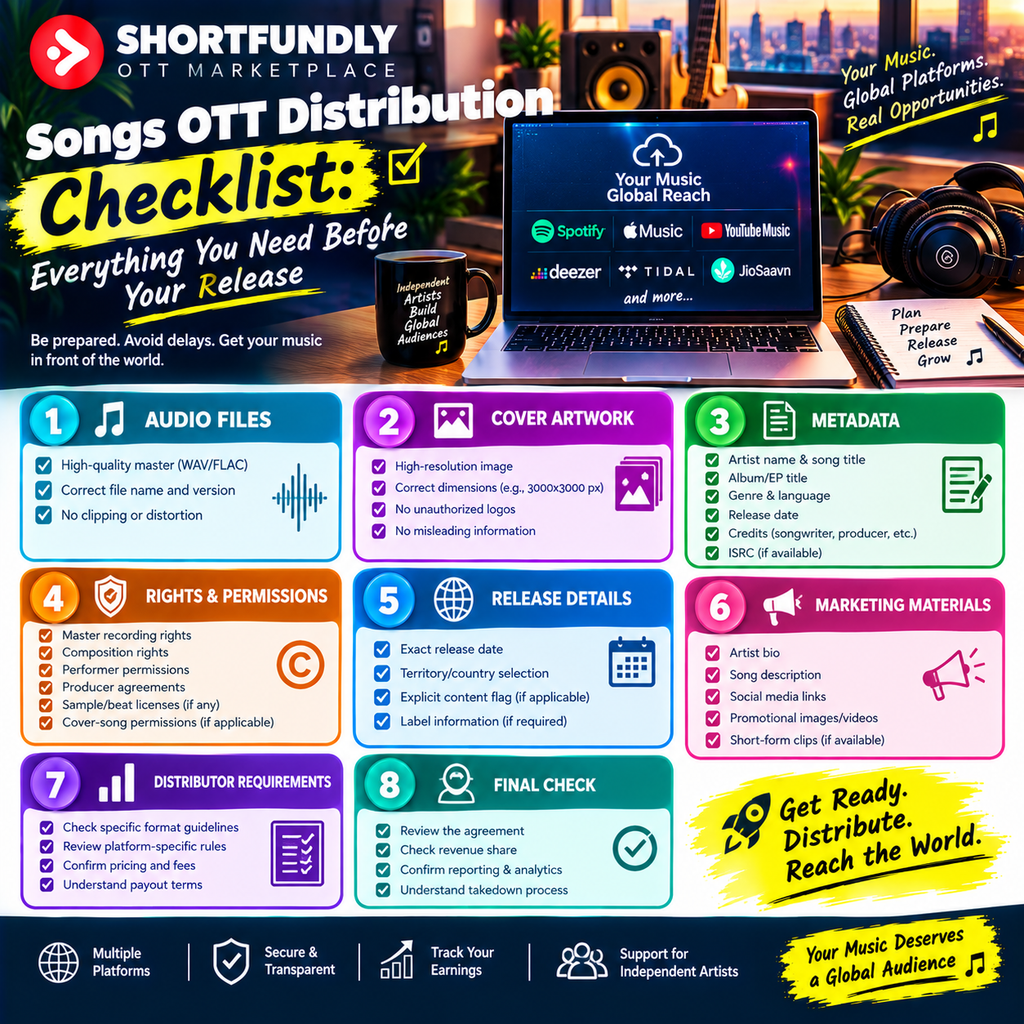
A Songs OTT Distribution Checklist is a practical list of the creative, technical, legal, and marketing tasks we should complete before submitting music for digital distribution.
The checklist helps us confirm that our release is complete and that the information supplied to the distributor is accurate.
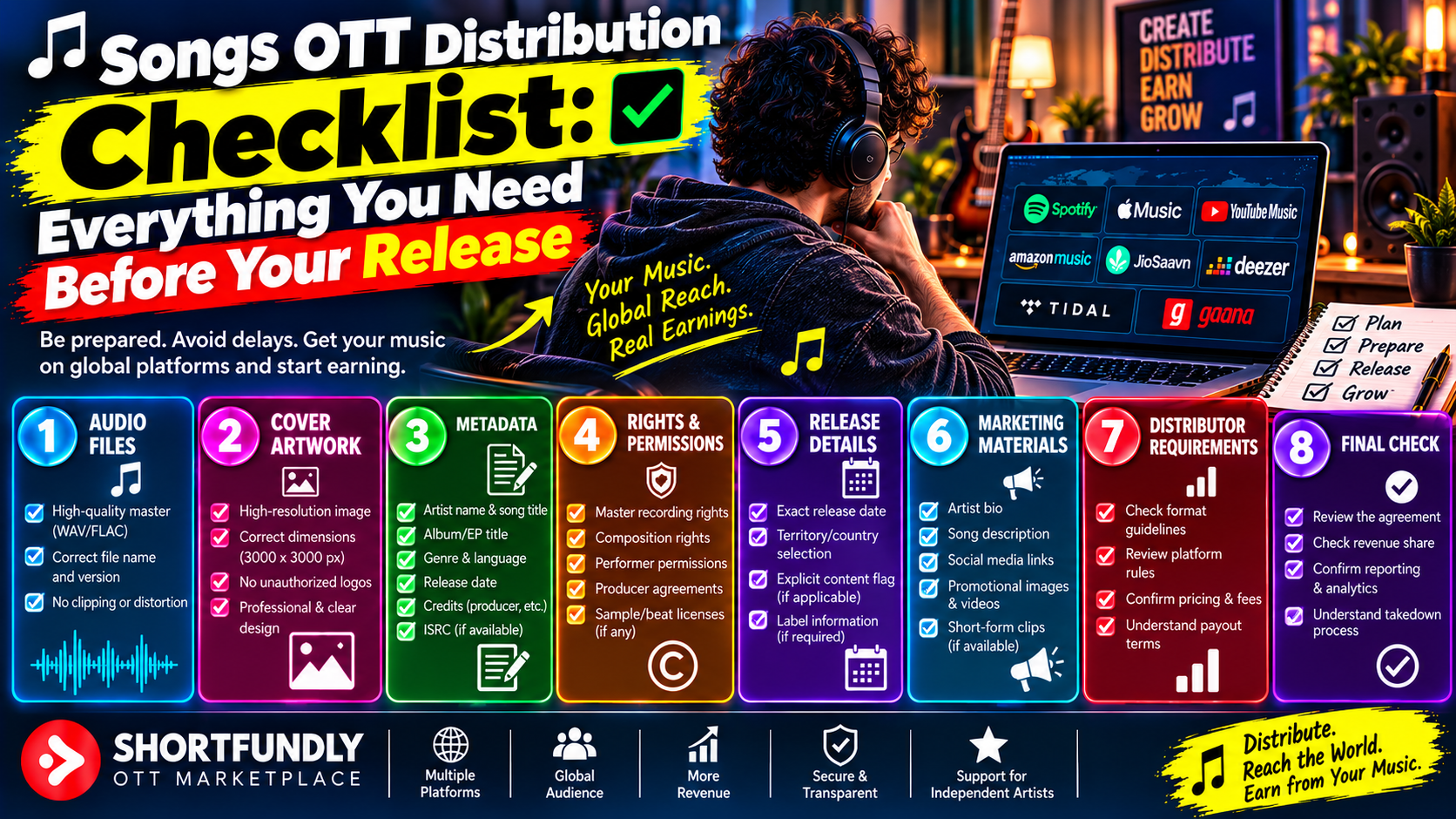
A typical checklist covers:
- Final audio and mastering
- Song title and artist information
- Cover artwork
- Metadata and contributor credits
- Copyright and licensing
- Release date and distribution territories
- Distributor selection
- Agreement and payment terms
- Promotional materials
- Post-release monitoring
The exact requirements depend on the distribution service and the type of content. An audio-only single may need different assets from a full music video or an audiovisual soundtrack.
Our objective is straightforward: prepare one complete, accurate release package before submission.
Why We Need a Songs OTT Distribution Checklist
A release can be creatively excellent and still encounter problems because of missing information or incomplete preparation.
For example, a distributor may need clarification about a featured artist, request a replacement artwork file, or ask us to confirm that we have permission to use a sample. These issues can delay the release or require us to revise our submission.
A structured checklist helps us:
- Reduce avoidable submission errors.
- Keep artist and contributor credits consistent.
- Confirm that we control the necessary rights.
- Prepare assets before the planned launch date.
- Compare distribution services more effectively.
- Plan promotional activities in advance.
- Maintain accurate records for future releases.
We should treat distribution preparation as part of the music production process, not as a last-minute administrative task.
The Complete 15-Point Songs OTT Distribution Checklist
| No. | Checklist Item | What We Need to Confirm |
|---|---|---|
| 1 | Final audio master | The recording is complete and approved |
| 2 | Audio quality | The file meets the distributor’s specifications |
| 3 | Song title | Spelling and formatting are correct |
| 4 | Artist details | Names and artist roles are consistent |
| 5 | Metadata | All required fields are complete |
| 6 | Cover artwork | Artwork meets current technical rules |
| 7 | Copyright ownership | We control the necessary rights |
| 8 | Third-party permissions | Samples, beats, and collaborations are cleared |
| 9 | Identifiers | Existing codes are accurate |
| 10 | Release date | The schedule allows time for processing |
| 11 | Distribution partner | The service suits our content and goals |
| 12 | Agreement terms | Rights, fees, and revenue terms are understood |
| 13 | Submission package | All required files and information are ready |
| 14 | Marketing campaign | Promotional content is prepared |
| 15 | Post-release review | We have a plan to check availability and results |
Let’s examine each item in detail.
1. Finalize the Master Audio
The first requirement is a final, approved master recording.
We should never submit a temporary mix or an unfinished demo simply because we want to meet a release date. Once the recording has been delivered, replacing it may require a formal update or a new submission, depending on the distributor’s process.
Before submission, we should listen to the complete master using reliable headphones, speakers, and—where practical—a mobile device. This helps us identify issues that may not be obvious in the production environment.
Our final listening check should cover:
- The beginning and ending of the track
- Vocal clarity
- Instrument balance
- Distortion or clipping
- Unwanted clicks and noises
- Abrupt edits
- Unintended silence
- Consistent playback
- Correct track version
We should also confirm that the master is the version approved by every relevant contributor.
Keep One Approved Master File
We should use clear filenames that distinguish the final master from earlier versions.
For example:
SongTitle_Final_Master.wavSongTitle_Instrumental_Master.wavSongTitle_Radio_Edit.wav
These names are examples for internal organization, not mandatory distributor formats. We should follow the actual file-naming and delivery instructions provided by the selected service.
2. Check the Audio Format and Technical Quality
A distributor may specify accepted file formats, sample rates, bit depths, channel configurations, file-size limits, or other technical requirements.
We should check these requirements before exporting the final file.
Do not assume that every distributor accepts the same audio specifications. A format accepted by one service may not be suitable for another.
Our technical review should confirm:
- The file format is accepted.
- The audio is complete and playable.
- The file contains the correct version.
- The export does not introduce unwanted distortion.
- The file meets the requested technical specifications.
- The recording has not been accidentally converted into a low-quality preview.
We should retain a high-quality master in our archive, even if the distributor requests a different delivery format.
For video songs, we must also check the video resolution, encoding, aspect ratio, audio synchronization, and other audiovisual delivery requirements specified by the distributor.
3. Confirm the Song Title and Release Name
The song title is a key part of the release’s identity.
We should confirm its spelling, capitalization, punctuation, language, and any subtitle or version information. The title must match the information used in our artwork, promotional materials, metadata, and release documentation wherever consistency is required.
We should check:
- Official song title
- Alternate title, if applicable
- Version name
- Language
- Featured title information
- Album or EP title
- Consistency across all submitted documents
If we are releasing a remix, live recording, acoustic version, or instrumental edition, we should identify it accurately.
We should avoid adding promotional phrases, unrelated keywords, or misleading descriptions to the title. A clear title makes the release easier to identify and manage.
4. Verify Artist Names and Contributor Credits
Artist information must be accurate and consistent.
We should confirm the primary artist name and the names of featured performers, composers, lyricists, producers, and other contributors where required.
If an artist already has an established profile on a digital service, we should use the correct artist identity and follow the distributor’s instructions for profile matching.
Our artist information checklist should include:
- Primary artist
- Featured artists
- Vocalists
- Composer
- Lyricist
- Music producer
- Remix artist, where applicable
- Record label, if applicable
- Other required contributors
We should also confirm the correct role for each person. A composer should not be incorrectly credited as a producer simply because both contributed to the project.
Before submission, we should share the final credits with the relevant collaborators and resolve any disagreements.
5. Complete the Music Metadata
Metadata is the information that identifies and describes a recording. It can help digital services display, categorize, match, and report on a release.
Incomplete or inconsistent metadata can create avoidable problems. A song may be associated with the wrong artist profile, display incorrect credits, or require corrections after delivery.
We should prepare a master metadata document containing the fields requested by our distributor.
| Metadata Field | What We Should Provide |
|---|---|
| Song title | Approved title |
| Primary artist | Correct artist name |
| Featured artist | Accurate credited name |
| Composer | Correct songwriting credit |
| Lyricist | Correct lyric-writing credit |
| Producer | Correct production credit |
| Language | Main language of the recording |
| Genre | Appropriate musical category |
| Release type | Single, EP, album, or applicable format |
| Release date | Intended launch date |
| Copyright information | Accurate ownership details |
| Explicit-content status | Correct classification |
| Track number | Correct order for multi-track releases |
| Identifier | Applicable code, where required |
The distributor’s current form should remain our final reference for mandatory fields.
Maintain a Single Source of Truth
We should store the approved metadata in one master document rather than maintaining several conflicting versions.
Whenever we update a title, credit, or release date, we should update the master document and check the corresponding submission information.
6. Prepare Professional Cover Artwork
Cover artwork is often the first visual element a listener associates with a release. It should be clear, relevant, and professionally prepared.
We should create artwork that reflects the identity of the song while meeting the distributor’s current specifications.
Before submission, check:
- Image dimensions
- File format
- File size
- Image quality
- Text readability
- Artist name
- Song title
- Ownership or usage permissions
- Compliance with content rules
Some services request square artwork, but we should confirm the exact dimensions and technical requirements rather than relying on a universal specification.
We should avoid blurry images, unnecessary text, misleading branding, and visual elements that we do not have permission to use.
If we use a designer, photographer, stock image, or AI-generated visual, we should check the applicable commercial-use terms and retain the relevant documentation.
For a music video, we should separately prepare any required poster, thumbnail, promotional still, or other visual asset.
7. Confirm Copyright Ownership
Copyright and ownership checks should be completed before we submit a song.
A recording may involve several different rights. The sound recording and the musical composition are not necessarily owned by the same person or company.
We should identify who owns or controls the relevant rights and whether we have permission to distribute the recording in the intended territories and through the intended channels.
Our rights review should cover:
- Master recording ownership
- Composition ownership
- Lyrics
- Samples
- Third-party recordings
- Licensed beats
- Featured performances
- Artwork
- Music video footage
- Other protected material
If several people contributed to the song, we should document the agreed ownership and revenue splits.
We should not assume that purchasing a beat, downloading a sample, or crediting the original creator automatically gives us every commercial right needed for distribution.
8. Clear Samples, Beats, and Third-Party Material
A song may contain material created by someone else. That can include a sample, loop, instrumental, vocal recording, or composition.
Before distribution, we should review the license or permission attached to each relevant element.
We need to establish whether the permission covers:
- Commercial distribution
- Streaming and digital delivery
- Music videos
- Monetization
- The intended territories
- The intended duration
- Required attribution
- Any usage restrictions
A license for personal use may not permit commercial release. Similarly, a royalty-free asset may still have conditions that apply to distribution or monetization.
We should keep copies of licenses, invoices, written permissions, and agreements.
If the rights are unclear, we should resolve the issue before submission rather than waiting for a claim or rejection.
9. Check ISRCs and Other Identifiers
An ISRC, or International Standard Recording Code, identifies a particular sound recording or music video recording.
If our release already has an ISRC, we should confirm that it belongs to the correct recording and has been entered accurately. We should not invent a code or reuse an identifier incorrectly.
Other identifiers may apply to releases, products, or catalog records, depending on the distributor and release type.
Before submitting, we should:
- Check whether an identifier is required.
- Confirm whether the recording already has one.
- Verify the code against our records.
- Avoid duplicate or incorrect assignments.
- Follow the distributor’s process for obtaining identifiers when needed.
The important point is accuracy. Identifiers should correspond to the correct recording or release.
10. Select a Realistic Release Date
We should choose a release date that gives us enough time to complete the submission and prepare the campaign.
There is no single lead time that works for every distributor or platform. Review, delivery, corrections, and scheduling can take different amounts of time.
We should work backward from the intended release date and include time for:
- Final mastering
- Artwork preparation
- Metadata review
- Rights verification
- Submission
- Content review
- Requested corrections
- Distribution processing
- Promotional preparation
We should avoid announcing a firm release date before confirming that the distributor’s process can support it.
For a major release, we should also plan for unexpected changes. A small amount of scheduling flexibility can prevent a last-minute scramble.
11. Choose the Right Songs OTT Distribution Partner
Selecting a distributor requires more than comparing prices.
We should evaluate whether the service accepts our content type, supports our intended distribution goals, and provides clear information about its process.
Important questions include:
- Does the service accept songs or video songs?
- Which platforms or distribution partners are available?
- Which territories are covered?
- What content requirements apply?
- What fees are charged?
- Is the agreement exclusive or non-exclusive?
- How long does the agreement last?
- How is revenue calculated?
- What reporting is available?
- What are the payout terms?
- How can content be removed or withdrawn?
We should also distinguish between a distributor’s own platform and third-party services it may work with. The phrase “OTT distribution” does not mean that every submission will automatically appear on every major streaming service.
We should verify the actual distribution scope in the current service terms.
12. Review the Distribution Agreement and Fees
Before accepting an agreement, we should read the terms carefully.
A low upfront fee does not necessarily mean the arrangement is the most suitable. We need to understand what we are paying for and what rights or obligations apply.
Our agreement review should cover:
| Term | What We Need to Understand |
|---|---|
| Fee | What we must pay and when |
| Taxes | Applicable taxes and charges |
| Rights | Which rights we grant |
| Exclusivity | Whether other distribution is allowed |
| Duration | How long the agreement remains active |
| Territories | Where the content may be distributed |
| Revenue | How income is calculated and shared |
| Payouts | Reporting and payment schedule |
| Removal | How withdrawal requests are handled |
| Approval | What happens if the content is rejected |
We should save a copy of the agreement and any related payment confirmation.
If a clause is unclear, we should ask the distributor for clarification before proceeding. For complex ownership or licensing arrangements, professional legal advice may be appropriate.
13. Prepare the Complete Submission Package
Once the creative, technical, and legal checks are complete, we can assemble the submission package.
Depending on the service and content type, this may include:
- Final audio file
- Video file, if applicable
- Cover artwork
- Song title
- Artist details
- Contributor credits
- Metadata
- Copyright information
- Rights documentation
- Identifiers
- Release date
- Content description
- Other required assets
We should compare the package against the distributor’s current submission form and requirements.
Before clicking submit, perform one final review:
Audio: Is this the correct final master?
Metadata: Are the names, titles, credits, and dates accurate?
Rights: Do we have the necessary permissions?
Artwork: Does the file meet the current specifications?
Agreement: Do we understand the terms?
Release plan: Is the schedule realistic?
If any answer is uncertain, we should resolve it before submission.
14. Build a Promotional Campaign Before Release
Distribution makes content available through the relevant delivery process. Promotion helps people discover it.
We should prepare the campaign before the release goes live, rather than beginning from scratch on launch day.
Useful promotional assets include:
- Teaser videos
- Short performance clips
- Lyric snippets
- Behind-the-scenes footage
- Artist introductions
- Cover artwork reveals
- Studio recordings
- Countdown graphics
- Press materials
- Short-form vertical videos
We should adapt the campaign to the song and the audience. A romantic single may benefit from lyric-led clips, while a high-energy track may work well with performance footage.
We should also prepare a clear destination for listeners, such as an official artist page or release page, where appropriate.
Use a Simple Release Timeline
| Time | Activity |
|---|---|
| 3–4 weeks before | Finalize assets and submit, allowing for the service’s timeline |
| 2 weeks before | Announce the release and share a teaser |
| 1 week before | Publish previews and behind-the-scenes content |
| Release day | Share the official release and relevant links |
| First week after | Publish clips, lyrics, and audience reactions |
| Following weeks | Review performance and continue promotion |
This is a planning example, not a guaranteed distribution schedule. We should adjust it to the service’s requirements and the release’s needs.
15. Check the Release After It Goes Live
Our work does not end when the distributor confirms delivery.
Once the release is available, we should verify that it appears correctly wherever it was scheduled to appear.
Check:
- Song title
- Artist name
- Cover artwork
- Track version
- Credits
- Audio playback
- Video playback, if applicable
- Release date
- Availability by territory
- Artist profile association
If we find an error, we should follow the distributor’s correction process.
We should also monitor the performance information made available to us. Depending on the platform and agreement, this may include streams, views, audience locations, engagement, revenue reports, or other metrics.
These details can help us understand which promotional activities are working and what we should improve for the next release.
Shortfundly Distribution: What Artists Should Check Before Submitting
Shortfundly Distribution is an option creators can explore for OTT-oriented content distribution. Its official distribution resources list supported content categories that include songs and video songs, alongside other forms of audiovisual content.
Before submitting a music project, we should review the current requirements and confirm that the service accepts our specific content type.
The process described in Shortfundly’s distribution guidance includes checking the applicable requirements, calculating the relevant fee, registering or signing in, entering content details, completing the required agreement and payment steps, submitting the content for review, and providing release assets if requested after approval.
We should keep in mind that submission does not guarantee acceptance, placement, or streaming. Availability can depend on content eligibility, rights, review, and the distribution partners available for the project.
Before proceeding, we should confirm:
- Whether our song or video song is eligible.
- Which distribution options are currently available.
- What technical assets are required.
- What fees and taxes apply.
- What the agreement says about rights and duration.
- Whether the agreement is exclusive or non-exclusive.
- How revenue is calculated.
- How reporting and payouts work.
- What happens if the content is not approved.
- How corrections or withdrawal requests are handled.
We should rely on the current terms presented during the submission process, rather than assuming that every project follows the same arrangement.
Artists can review the available information and submission process through the official Shortfundly Distribution website: https://distribution.shortfundly.com/
Common Songs OTT Distribution Mistakes to Avoid
Even experienced creators can overlook small but important details. We can reduce these risks by checking the release package carefully.
Submitting an Unfinished Master
We should submit only the approved version. A temporary mix can create quality problems and may require a replacement process.
Using Incorrect Artist Information
Inconsistent names can cause confusion. We should confirm the correct artist identity and credits before submission.
Ignoring Licensing Restrictions
A beat or sample may have usage limits. We should verify that our permissions cover the intended release.
Choosing a Release Date Too Soon
A date that leaves no time for review or corrections can put the entire campaign at risk.
Assuming Every OTT Platform Is Included
We should confirm the actual distribution partners and territories instead of relying on broad marketing language.
Overlooking Contract Terms
Fees, rights, duration, exclusivity, and revenue arrangements should be understood before we agree.
Promoting Only on Release Day
A single announcement may not be enough to build awareness. We should prepare content for the weeks before and after launch.
Final Pre-Submission Checklist
Use this quick checklist immediately before sending the release to a distributor.
Audio and Creative Assets
- Final master approved
- Audio file checked
- Correct version selected
- Artwork prepared
- Video assets prepared, if applicable
Metadata and Credits
- Song title verified
- Artist names confirmed
- Contributor roles checked
- Language and genre selected
- Release date confirmed
- Identifiers checked where applicable
Rights and Agreements
- Master rights confirmed
- Composition rights confirmed
- Samples and beats cleared
- Collaboration permissions documented
- Distribution terms reviewed
- Fees and payout terms understood
Release and Promotion
- Submission package complete
- Distributor requirements checked
- Promotional assets prepared
- Release schedule confirmed
- Post-release review planned
Frequently Asked Questions About Songs OTT Distribution
1. What do we need before submitting a song for OTT distribution?
We should prepare the final audio master, artwork, accurate metadata, artist and contributor credits, rights documentation, release information, and any other assets required by the distributor. We should also review the agreement and confirm the applicable technical specifications.
2. Can independent artists use Songs OTT Distribution without a record label?
Yes, some distribution services accept submissions from independent artists and creators. We should check each service’s eligibility rules, fees, content requirements, and agreement terms before submitting.
3. Does OTT distribution guarantee that our song will be accepted?
No. Submission is not the same as approval. A distributor may review the content, rights, technical quality, and eligibility before deciding whether it can proceed. We should never assume that submitting a song guarantees distribution or placement.
4. Do we need an ISRC before submitting music?
That depends on the distributor’s process. We should check whether an ISRC is required, whether the recording already has one, and how the service handles identifiers. We should never invent or incorrectly reuse a code.
5. Can we distribute a music video through Shortfundly Distribution?
Shortfundly’s published distribution resources list songs and video songs among supported content categories. We should confirm the current eligibility, technical requirements, agreement terms, and available distribution options for our particular project before submitting.
6. How early should we submit our song before release day?
There is no universal deadline. We should check the distributor’s current processing requirements and allow time for review, delivery, and corrections. We should also leave enough time to prepare the promotional campaign.
7. Can we change the song after submitting it?
Changes may require a correction, replacement, or new submission, depending on the distributor and the type of change. We should contact the service and follow its process rather than uploading a different version without confirmation.
8. What should we check in a music distribution agreement?
We should review fees, rights, exclusivity, duration, territories, revenue calculations, reporting, payout timing, removal procedures, and approval conditions. If a clause is unclear, we should ask for clarification before agreeing.
9. Does distribution automatically generate revenue?
No. Distribution can make eligible content available through supported channels, but income depends on the applicable commercial model, audience activity, rights, agreement, and other factors. We should avoid relying on guaranteed earnings claims.
10. What should we do after our song is released?
We should verify that the song appears correctly, check its audio and artwork, confirm the artist information, and monitor the performance data available to us. We should continue promoting the release and use the results to improve future campaigns.
Also read: https://blog.shortfundly.com/ott/monetize-songs-ott-revenue/
Conclusion: Prepare Every Release Before You Submit
A successful Songs OTT Distribution process begins with preparation. By checking the master recording, artwork, metadata, credits, rights, identifiers, release date, and distribution agreement, we can reduce avoidable errors and create a more professional release package.
We should also plan promotion before launch and review the release after it becomes available. Distribution, marketing, and rights management work best when they support one another.
For independent artists, the most useful approach is to turn this checklist into a repeatable process. We can use it for every single, album, soundtrack, or video song, adjusting it to the requirements of each distributor.
When considering Shortfundly Distribution, we should review the current submission instructions, content eligibility, fees, agreement, and available distribution partners before proceeding.
A well-prepared release gives our music a stronger foundation. With accurate information, clear rights, professional assets, and a realistic campaign, we can spend less time correcting avoidable mistakes and more time helping listeners discover our work.