Table of Contents
Introduction: How to Get Movies and TV Shows Onto FAST Channels
FAST channel distribution has created another route for filmmakers, television producers, studios, and independent content owners to reach streaming audiences.
FAST stands for Free Ad-Supported Streaming Television. Unlike a conventional subscription service, FAST generally provides free viewing supported by advertising. The viewing experience is also typically more similar to traditional television because audiences can tune into scheduled linear channels rather than selecting every title individually.
That difference is important.
If you own a movie or TV show, you can’t always treat FAST distribution as simply another video upload destination. A FAST channel needs content that fits its programming strategy, audience, technical standards, rights structure, and commercial model.
In other words, having a finished movie isn’t the same as having a FAST-ready movie.
You need to prepare your rights, masters, metadata, artwork, subtitles, promotional materials, and commercial information. You also need to identify the right distributors, aggregators, channel operators, or platform partners.
The good news is that the process can be broken down into manageable steps.
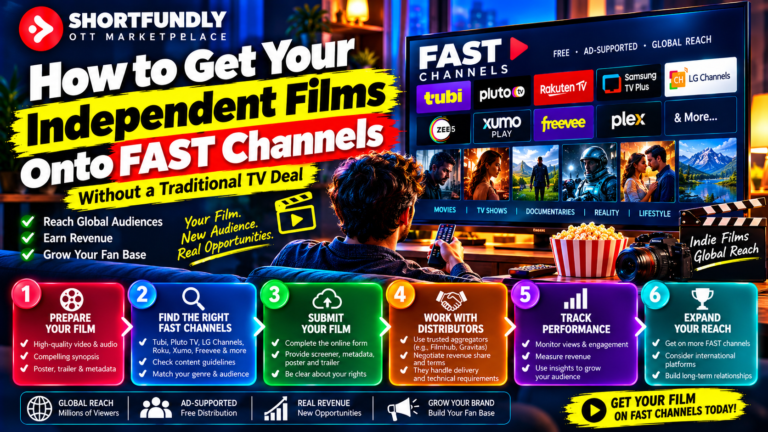
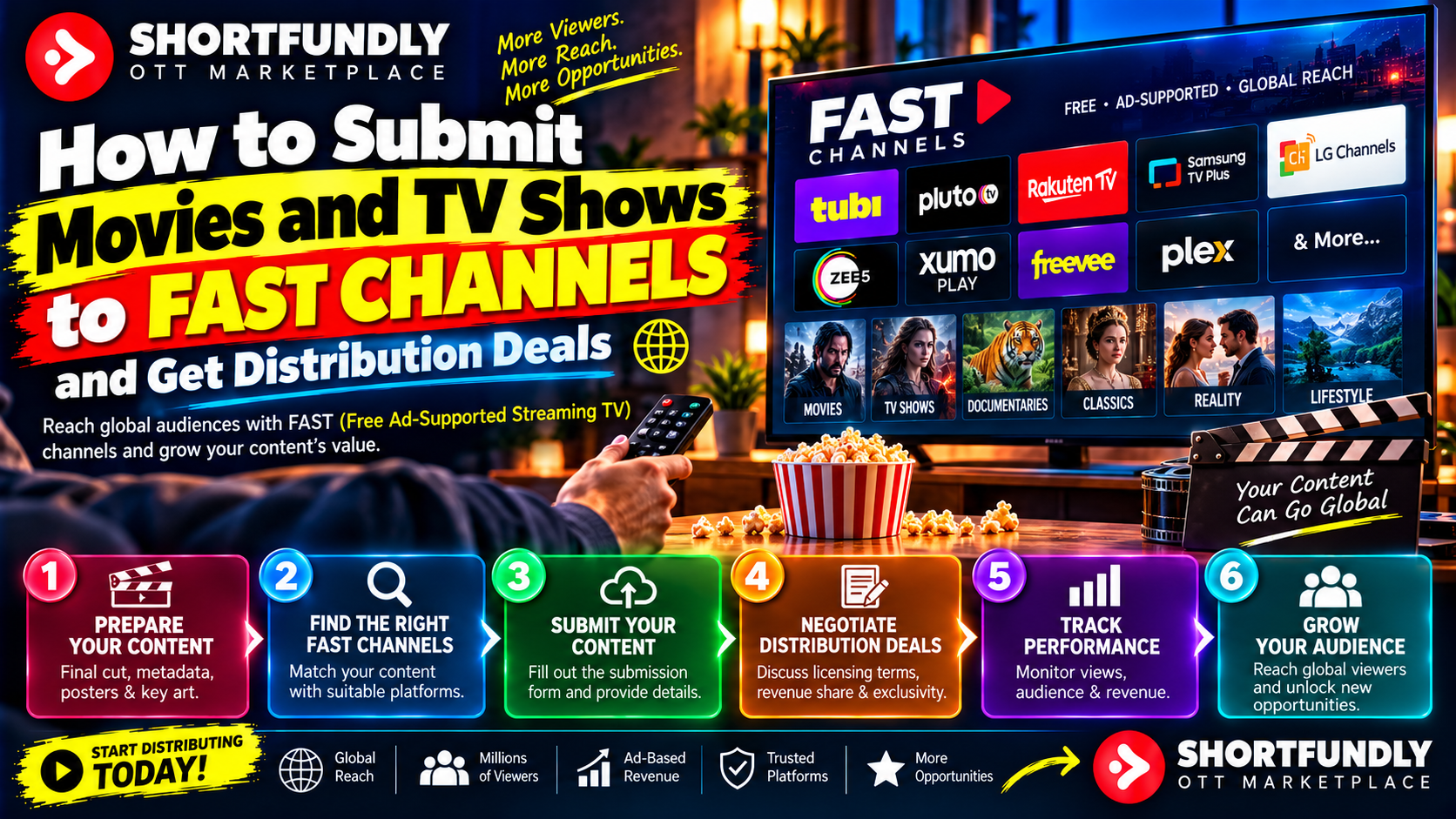
This guide explains 15 powerful steps to submit movies and TV shows to FAST channels and improve your chances of developing a distribution deal.
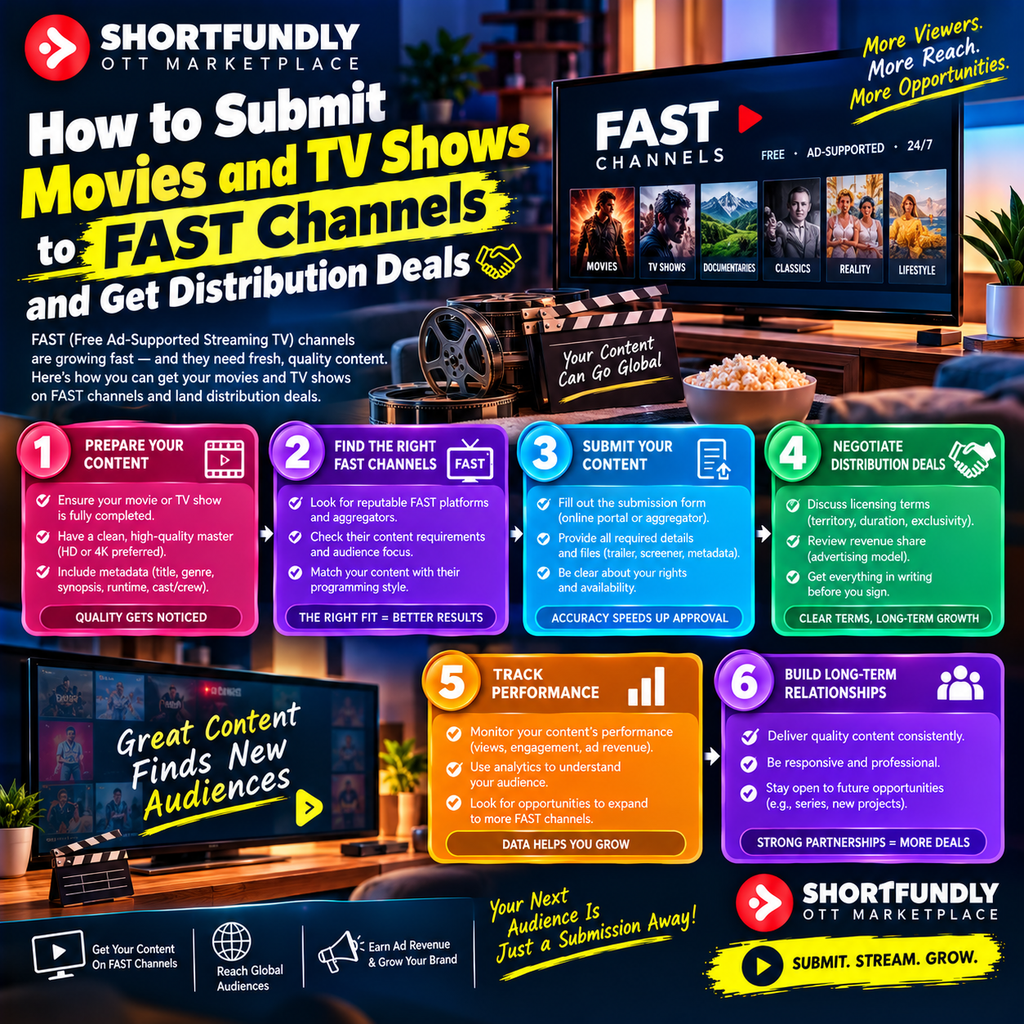
Complete 15-Step FAST Distribution Roadmap
| Step | Topic | Primary Goal |
|---|---|---|
| 1 | Understand FAST | Learn the distribution model |
| 2 | Evaluate Your Content | Identify suitable movies and shows |
| 3 | Audit Your Rights | Confirm distribution authority |
| 4 | Build Your Content Package | Organize essential assets |
| 5 | Prepare Technical Masters | Meet professional delivery standards |
| 6 | Create Metadata | Make titles easy to evaluate |
| 7 | Prepare Artwork | Improve presentation |
| 8 | Add Localization | Expand potential audience reach |
| 9 | Define Your Audience | Position the content |
| 10 | Research Partners | Find suitable FAST routes |
| 11 | Build a Pitch | Present the catalog professionally |
| 12 | Negotiate the Deal | Review rights and commercial terms |
| 13 | Submit and Deliver | Complete technical delivery |
| 14 | Support Programming | Make the content schedule-friendly |
| 15 | Monitor and Expand | Build a long-term strategy |
1. Understand the FAST Channel Business Model
Before submitting a movie or TV show, understand what you’re actually submitting it for.
FAST channels are generally free, ad-supported linear streaming channels. They can be delivered through smart TVs, connected-TV platforms, streaming devices, applications, and other internet-connected environments.
In 2026, FAST is also receiving increased regulatory attention in India. TRAI released a consultation paper on April 6, 2026, concerning a possible regulatory framework for Application-based Linear Television Distribution (ALTD) services, including FAST services. The consultation addressed issues involving application providers, broadcasters, content providers, and aggregators.
For a content owner, the most important distinction is between linear FAST programming and ordinary video-on-demand.
FAST
A viewer opens a channel and watches the program currently scheduled.
VOD
A viewer browses a catalog and chooses a particular title.
Why This Matters
A FAST channel operator needs enough content to keep a channel running.
That means a distributor may evaluate your content based on:
- Genre
- Runtime
- Audience
- Language
- Territory
- Rights
- Programming fit
- Technical quality
- Library depth
- Commercial potential
A single movie can still be valuable, but a strong library can provide more programming possibilities.
For example, imagine a producer owns:
- 15 regional movies
- 10 documentaries
- 20 short films
- 8 television specials
That catalog can potentially be positioned around particular audiences or themes.
The lesson is simple:
Don’t pitch only the file. Pitch the content opportunity.
2. Evaluate Whether Your Movie or TV Show Is FAST-Ready
Not every title is equally suitable for FAST distribution.
Before contacting a distributor, perform an honest content audit.
Ask:
- Is the video professionally finished?
- Are the rights clear?
- Is the content suitable for the intended audience?
- Is the runtime accurate?
- Are subtitles available?
- Is the audio clean?
- Is the artwork professional?
- Is metadata complete?
- Are promotional assets available?
- Can you prove ownership or licensing authority?
Content Evaluation Table
| Area | Question |
|---|---|
| Story | Is the content engaging? |
| Genre | Is the genre clearly identifiable? |
| Audience | Who is likely to watch it? |
| Runtime | Is the duration accurately documented? |
| Quality | Is the master professionally finished? |
| Rights | Are all necessary rights cleared? |
| Localization | Are subtitles or dubbing available? |
| Artwork | Is professional key art ready? |
| Metadata | Is all information complete? |
| Promotion | Is a trailer available? |
Don’t worry if your first audit reveals gaps.
That’s actually useful.
It tells you what needs to be fixed before approaching a distribution partner.
3. Audit Your Movie and TV Rights
Rights are one of the most important parts of any distribution deal.
A distributor needs to know that you have the authority to license or distribute the content under the proposed agreement.
For a movie, review:
- Copyright
- Story rights
- Screenplay rights
- Music rights
- Performance rights
- Distribution rights
- Territory rights
- Streaming rights
- Advertising-supported rights
- Promotional rights
- Subtitle rights
- Dubbing rights
- Archive footage rights
- Stock footage licenses
For TV shows, the rights audit can be even more detailed.
You may need to review rights for:
- Each episode
- Each season
- Music
- Guest appearances
- Archive footage
- Third-party clips
- International territories
- Promotional extracts
Build a Rights Matrix
| Right | Status |
|---|---|
| Copyright | Confirmed |
| Music | Cleared |
| Talent | Cleared |
| Streaming | Confirmed |
| FAST | Confirmed |
| Territory | Defined |
| Promotion | Confirmed |
| Subtitles | Available |
| Dubbing | Available/Not available |
If a right isn’t clear, don’t simply assume it’s covered.
A distributor may request supporting contracts later.
And that’s where missing paperwork can bring an otherwise promising deal to a screeching halt.
4. Build a Complete Content Submission Package
A professional content package makes your movie or TV show easier to evaluate.
Instead of sending scattered files through multiple messages, create a structured content folder.
Movie Submission Package
Include:
- Master video
- Audio master
- Trailer
- Poster
- Key art
- Synopsis
- Cast
- Crew
- Genre
- Runtime
- Language
- Subtitles
- Ratings information
- Rights information
- Contact details
TV Show Submission Package
Add:
- Series synopsis
- Season information
- Episode list
- Episode runtimes
- Episode descriptions
- Season artwork
- Episode artwork
- Trailer
- Cast and crew
- Language information
- Subtitle information
- Rights documentation
This organization demonstrates professionalism.
It also allows a distributor to understand your catalog quickly.
5. Prepare Professional Technical Masters
A FAST distribution deal can fail before it starts if your technical delivery isn’t acceptable.
Platforms and distributors can have detailed specifications for:
- Resolution
- Codec
- Frame rate
- Aspect ratio
- Bitrate
- Audio format
- Loudness
- Captions
- Subtitles
- File naming
- Artwork dimensions
- Delivery methods
Never rely on one universal technical standard.
Ask the receiving partner for its latest specification sheet.
For creators considering Shortfundly Distribution, its current public OTT information states that eligible video content should be in 4K or Full HD (1080p) and should include proper dubbing and DI, while additional delivery requirements may apply during submission.
This is a useful baseline for professional preparation, but FAST platforms can have their own technical requirements.
Technical QC Checklist
- Video plays correctly
- No corrupted frames
- Correct resolution
- Correct aspect ratio
- Audio is synchronized
- Audio levels are acceptable
- Subtitles are synchronized
- Captions are accurate
- No unwanted watermarks
- Opening and closing credits are correct
Always deliver the version requested by the distributor.
6. Create Accurate Metadata for Every Title
Metadata helps distributors understand your content.
It can also help with categorization, scheduling, search, recommendations, and presentation.
For every movie or TV show, prepare:
- Official title
- Alternate title
- Short synopsis
- Long synopsis
- Genre
- Subgenre
- Cast
- Crew
- Director
- Producer
- Writer
- Country
- Language
- Runtime
- Release year
- Content rating
- Keywords
- Subtitle languages
- Audio languages
For television, also provide:
- Season number
- Episode number
- Episode title
- Episode synopsis
- Episode runtime
Example of Strong Metadata
Title: The Last Monsoon
Genre: Drama / Mystery
Runtime: 112 minutes
Language: Tamil
Synopsis: A journalist returns to her coastal hometown after a decade away and uncovers a family secret connected to a mysterious disappearance.
That’s much more useful than a description packed with generic keywords.
Remember, metadata should be accurate first and SEO-friendly second.
7. Prepare Professional Artwork and Promotional Assets
A distributor doesn’t only evaluate the video.
They also evaluate the presentation.
Strong artwork can make your content easier to market and position.
Prepare:
- Main poster
- Landscape key art
- Thumbnail
- Banner
- Logo
- Trailer thumbnail
- Character images
- Episode artwork
- Promotional stills
- Social media assets
For a TV series, maintain consistent artwork across the entire season.
For a movie catalog, consider developing a visual style that makes your titles easy to identify.
Good Artwork Should
- Clearly display the title
- Match the genre
- Use high-quality imagery
- Avoid excessive text
- Be visually readable at small sizes
- Match the actual content
- Follow partner specifications
A polished visual package signals that you understand the business side of distribution.
8. Add Subtitles, Captions, and Localization
Localization can make your content more attractive to distributors serving multiple territories.
Consider:
- English subtitles
- Regional-language subtitles
- Closed captions
- Alternate audio
- Dubbing
- Translated metadata
- Localized promotional artwork
For example, a Malayalam movie with accurate English subtitles may have a broader potential audience than the same movie without subtitles.
Likewise, an English documentary with regional-language subtitles can become more accessible to viewers in additional markets.
Localization doesn’t guarantee a deal.
However, it can remove a barrier.
And in distribution, removing barriers is often half the battle.
9. Define Your Audience and Programming Niche
A distributor needs to understand who will watch your content.
Don’t simply say:
“This movie is for everyone.”
That’s usually too broad to be useful.
Instead, define:
- Age group
- Genre preference
- Language
- Region
- Viewing habits
- Content interests
- Cultural relevance
Possible FAST Niches
- Indian regional cinema
- Classic movies
- Independent films
- Horror
- Action
- Comedy
- Romance
- Documentaries
- Music
- Family entertainment
- Lifestyle
- Travel
- Food
- Faith-based programming
- Animation
- Youth entertainment
A niche doesn’t have to be tiny.
It simply needs to be clear.
A distributor can make better decisions when it understands exactly where your content fits.
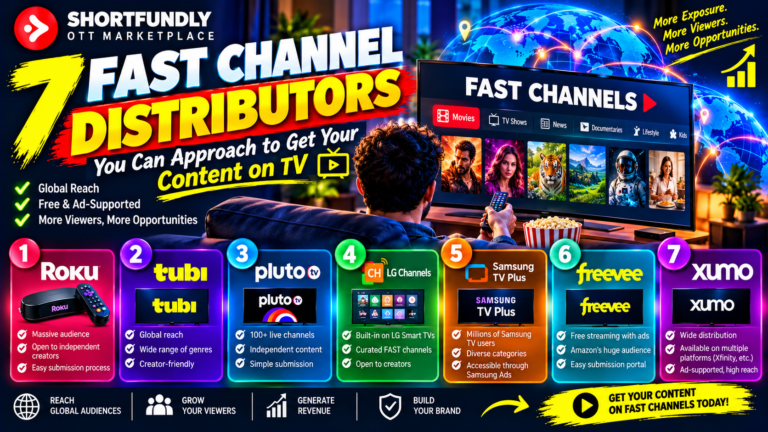
10. Research FAST Distribution Partners
Now we reach the practical question:
Where should you submit your content?
There are several possible routes.
Direct Platform Relationships
Some FAST operators may work directly with rights holders.
This can make sense for established producers with significant libraries and professional distribution teams.
Aggregators
Aggregators can help package content and deliver it to multiple platforms.
They may assist with:
- Metadata
- Technical delivery
- Rights documentation
- Platform submissions
- Channel operations
- Reporting
OTT Distribution Companies
An OTT distributor can provide another route for creators who don’t want to manage every technical and commercial step themselves.
Shortfundly Distribution is one option creators can consider for eligible OTT content. Its current public information says it distributes eligible short films, web series, movies, songs/video songs, documentaries, telefilms, pilot films, micro dramas, and other supported content through currently available distribution partners. Availability can vary according to content, duration, eligibility, licensing, and partner availability.
Shortfundly’s current public workflow includes content submission, review, required agreements and payment where applicable, release-asset upload after approval, distribution, and tracking of content and earnings.
However, there’s an important distinction:
OTT distribution is not automatically the same as guaranteed FAST-channel placement.
If your specific goal is a FAST channel deal, ask the distributor whether the FAST service you want is currently supported.
11. Build a Professional FAST Pitch Deck
Your pitch deck should make it easy for a distributor to answer:
Why should we distribute this content?
Keep it professional and concise.
Include These Sections
Company or Creator Profile
Explain who you are.
Content Overview
State how many movies, episodes, or hours are available.
Genre
Show your strongest categories.
Languages
List original and available localized languages.
Territories
Explain where rights are available.
Audience
Describe your target audience.
Performance
Include legitimate:
- Views
- Watch time
- Audience geography
- Subscribers
- Engagement
- Awards
- Festival selections
- Previous distribution
Technical Readiness
Mention whether masters, captions, subtitles, artwork, and metadata are ready.
Rights
Clearly state what rights are available.
Don’t exaggerate.
A transparent pitch is more credible than a flashy one filled with unsupported claims.
12. Negotiate the Distribution Deal Carefully
Getting an offer is exciting.
But don’t rush to sign.
Review the commercial agreement carefully.
Important terms include:
| Term | What to Ask |
|---|---|
| Territory | Where can the content appear? |
| Duration | How long does the deal last? |
| Exclusivity | Can you work with others? |
| Media Rights | Which formats are included? |
| FAST Rights | Are FAST rights specifically covered? |
| Advertising | Who manages monetization? |
| Revenue | How is income calculated? |
| Reporting | What data will you receive? |
| Payment | When are payouts made? |
| Promotion | How can your content be promoted? |
| Termination | When can the deal end? |
| Renewal | What happens after expiry? |
Watch for Broad Rights Clauses
Don’t assume that a contract saying “streaming rights” means every possible streaming format.
FAST, AVOD, SVOD, TVOD, mobile, connected TV, and other rights can have different commercial implications.
Also check whether the agreement allows sublicensing.
If you’re unsure about a major contract, professional legal review is worthwhile.
13. Submit Your Movie or TV Show Correctly
Once the commercial and content requirements are settled, it’s time for delivery.
Prepare the exact assets requested.
Typical Delivery Assets
- Video master
- Audio files
- Subtitle files
- Caption files
- Metadata
- Artwork
- Trailer
- Promotional images
- Rights documentation
- Ratings information
Then perform a final QC.
Submission Checklist
| Check | Complete? |
|---|---|
| Master video | ☐ |
| Audio | ☐ |
| Subtitles | ☐ |
| Captions | ☐ |
| Metadata | ☐ |
| Poster | ☐ |
| Key art | ☐ |
| Trailer | ☐ |
| Rights documents | ☐ |
| Content rating | ☐ |
| Contact details | ☐ |
Don’t send incomplete material and hope someone fixes it later.
A clean submission shows that you’re ready to operate professionally.
14. Make Your Content Programming-Friendly
FAST channels depend on programming.
That means your content should be useful within a schedule.
Consider:
- Runtime
- Genre
- Audience
- Language
- Seasonal relevance
- Content rating
- Thematic grouping
- Repeat value
- Library depth
For example, a movie library could support programming such as:
| Programming Block | Content |
|---|---|
| Morning | Family entertainment |
| Afternoon | Documentaries |
| Evening | Regional cinema |
| Prime Time | Popular movies |
| Late Night | Thriller/horror |
The actual schedule is determined by the channel operator.
Your job is to show that your catalog can contribute to a compelling viewing experience.
This is especially valuable when you have multiple related titles.
A distributor might see greater programming value in 30 compatible movies than in 30 completely unrelated titles.
15. Track Performance and Build More Distribution Deals
Distribution isn’t finished when the content goes live.
If your distributor or platform provides analytics, review them regularly.
Monitor:
- Viewership
- Watch time
- Geography
- Content performance
- Audience retention
- Channel performance
- Ad-related metrics where available
- Revenue
- Repeat viewing
Look for patterns.
Maybe your regional movies outperform your English titles.
Maybe documentaries work especially well in certain territories.
Maybe one genre consistently receives stronger engagement.
Use those insights when developing your next distribution pitch.
Build a Long-Term Content Strategy
Consider a combination of:
FAST + AVOD + VOD + YouTube + Social Media + Direct Audience
The goal isn’t to put everything everywhere.
The goal is to place the right content in the right distribution environment while respecting your contractual rights.
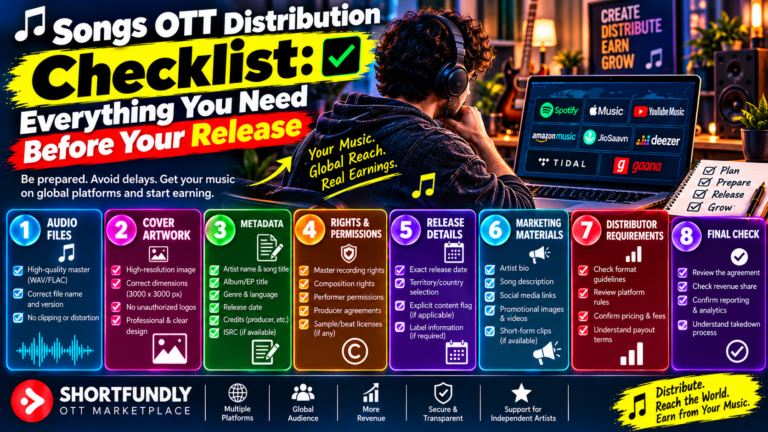
Movie and TV FAST Distribution Checklist
Before approaching a FAST distributor, make sure you’ve completed the following.
Content Checklist
- Final master available
- Runtime confirmed
- Genre identified
- Audience defined
- Catalog organized
Rights Checklist
- Copyright confirmed
- Music rights cleared
- Talent rights confirmed
- Distribution rights confirmed
- Territory rights confirmed
- FAST rights reviewed
- Promotional rights reviewed
Technical Checklist
- Video master
- Audio master
- Captions
- Subtitles
- Quality control
- Required delivery format
Metadata Checklist
- Title
- Synopsis
- Genre
- Cast
- Crew
- Runtime
- Language
- Release year
- Rating
- Keywords
Marketing Checklist
- Poster
- Key art
- Trailer
- Stills
- Promotional clips
- Social assets
Business Checklist
- Pitch deck
- Rights summary
- Territory strategy
- Commercial expectations
- Distribution partner shortlist
FAST vs OTT: What’s the Difference for Content Owners?
The terms FAST and OTT are often used together, but they aren’t identical.
OTT is a broad category covering video delivered over the internet.
FAST is a specific streaming model focused on free, advertising-supported linear channels.
| Feature | FAST | General OTT |
|---|---|---|
| Internet Delivery | Yes | Yes |
| Free Viewing | Usually | Not always |
| Advertising | Central to model | May or may not be used |
| Linear Channels | Core feature | Not required |
| On-Demand | Sometimes available | Common |
| Subscription | Usually not required | May be required |
| Programming | Very important | Depends on model |
| Content Discovery | Channel + recommendations | Search + recommendations |
Understanding this distinction will help you approach the right distribution partners.
Common Mistakes When Seeking FAST Distribution Deals
1. Pitching Before Clearing Rights
Don’t wait until a distributor asks for rights documents.
Prepare them early.
2. Sending Incomplete Metadata
A distributor shouldn’t have to chase you for basic information.
3. Ignoring Technical Specifications
Always follow the receiving partner’s current delivery requirements.
4. Using Weak Artwork
Professional content deserves professional presentation.
5. Having No Clear Audience
Explain who should watch the content and why.
6. Assuming FAST Means Automatic Monetization
Distribution creates an opportunity. It doesn’t guarantee a specific income level.
7. Confusing OTT Distribution With FAST Placement
Ask exactly which platforms and channels a distributor currently supports.
8. Signing Without Reviewing Exclusivity
An exclusive deal can affect your ability to distribute elsewhere.
9. Overlooking Localization
Subtitles and dubbing can make content more accessible across markets.
10. Stopping After Delivery
Continue monitoring performance and building your catalog.
How Shortfundly Distribution Can Fit Into Your Distribution Strategy
For independent filmmakers and creators, managing every stage of content distribution can be difficult.
That’s where an OTT distribution service can potentially simplify the workflow.
Shortfundly Distribution currently presents a distribution route for eligible creator content, including movies, web series, short films, documentaries, telefilms, pilot films, songs/video songs, and micro dramas. Its public information says available platforms can vary according to content, duration, eligibility, licensing, and current distribution availability.
Its current workflow includes calculating applicable fees, registering or signing in, adding content details, reviewing requirements, completing payment and agreement steps where required, submitting content for review, uploading release assets after approval, and tracking content and earnings.
This can be useful for creators who want a structured OTT distribution workflow.
However, if your goal is specifically to secure a FAST channel distribution deal, don’t make assumptions.
Ask the distribution provider:
- Is FAST distribution currently supported?
- Which FAST platforms are available?
- Which territories are supported?
- Is my movie or TV show eligible?
- What rights are required?
- Is the arrangement exclusive?
- What technical specifications apply?
- How are revenues calculated?
- What reporting is available?
- Are there separate licensing agreements after approval?
Shortfundly’s public information also states that its OTT agreement described in the submission requirements is non-exclusive for five years, while final streaming terms may be covered by a separate Content License Agreement after approval.
That makes it especially important to read the applicable agreement and confirm the exact rights for your particular distribution arrangement.
10 Questions to Ask a FAST Distributor Before Signing
Before agreeing to a distribution deal, ask these questions.
1. Which FAST channels do you currently distribute to?
Don’t settle for vague statements about a “global network.”
Ask for current, applicable partner information.
2. Is my title guaranteed to be placed?
The answer should clearly explain the difference between submission, acceptance, and placement.
3. What territories are included?
Territory can significantly affect the value of a deal.
4. Is the agreement exclusive?
This is one of the most important questions.
5. How long is the license?
Understand the start and end dates.
6. What rights am I granting?
Ask specifically about FAST, AVOD, VOD, mobile, connected TV, and other media rights.
7. How are earnings calculated?
Understand revenue share, licensing payments, guarantees, deductions, and reporting.
8. How often are reports provided?
Ask whether you’ll receive monthly, quarterly, or other reporting.
9. What technical assets are required?
Get the specifications in writing.
10. What happens if I want to remove the content?
Understand termination and takedown procedures before signing.
Frequently Asked Questions About FAST Movie and TV Distribution
1. How do I submit a movie to a FAST channel?
You can explore direct submissions, aggregators, or OTT distribution companies that work with FAST or connected-TV partners. Typically, you’ll need a professional master, metadata, artwork, rights documentation, subtitles or captions where applicable, and other delivery assets.
2. Can independent filmmakers get FAST distribution deals?
Yes, independent filmmakers can pursue FAST distribution. However, acceptance depends on the channel operator or distributor’s current content needs, rights requirements, technical standards, territories, and commercial model.
3. Can TV shows be distributed to FAST channels?
Yes. TV shows can be suitable for FAST programming, especially when they provide multiple episodes and support scheduled programming. A distributor may request complete season information, episode metadata, masters, artwork, and rights documentation.
4. What type of movies work well on FAST channels?
There isn’t one universal winning genre. FAST services can support movies across categories such as action, comedy, drama, horror, regional cinema, classics, independent films, and documentaries. The strongest fit depends on the channel’s audience and programming strategy.
5. Do I need a large audience to get a FAST deal?
Not necessarily. Existing audience data can strengthen a pitch, but distributors may also evaluate content quality, rights, genre, library depth, audience fit, technical readiness, and commercial potential.
6. What rights do I need for FAST distribution?
The required rights depend on the deal. They may include copyright, streaming, advertising-supported distribution, territory, music, talent, promotional, subtitle, and dubbing rights. Always review the specific agreement.
7. How much does FAST distribution cost?
There isn’t one universal price. Costs can include technical preparation, localization, aggregation, delivery, or distribution fees depending on the partner. For Shortfundly’s OTT distribution service, current fees vary by content type and duration, with the applicable amount shown through its pricing system.
8. Can I distribute the same movie on YouTube and FAST?
Potentially, but it depends on the rights and agreement. If you sign an exclusive FAST or streaming arrangement, it could restrict other distribution. Always review territory, media, exclusivity, and term before publishing elsewhere.
9. Is FAST the same as AVOD?
No. Both can involve advertising, but FAST generally refers to a linear, scheduled channel experience, while AVOD usually refers to advertising-supported on-demand video.
10. Can Shortfundly Distribution help with movie distribution?
Shortfundly currently offers OTT distribution for eligible content, including movies and TV-related formats such as web series and telefilms, through its currently available distribution partners.
If your specific objective is a FAST channel deal, confirm current FAST partner availability and eligibility before submission.
11. How long does it take to get a FAST distribution deal?
There is no universal timeline. The process can involve rights verification, content review, technical QC, contract negotiation, asset delivery, programming, and platform scheduling.
12. Is FAST distribution guaranteed after I submit my movie?
No. Submission is not the same as approval or placement. A distributor or platform may reject content or require additional information, and final availability can depend on current partner requirements and licensing.
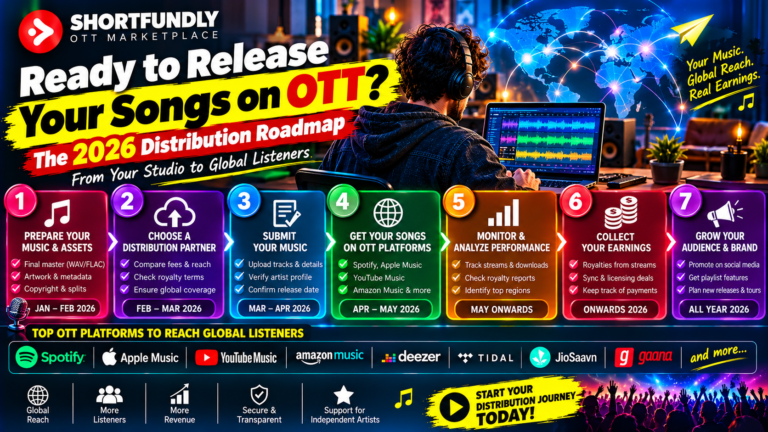
Also read: https://blog.shortfundly.com/ott/2026-ott-music-distribution/
Conclusion: Turn Your Movies and TV Shows Into Distribution Assets
Getting movies and TV shows onto FAST channels requires more than simply finding a submission form.
The strongest approach is systematic.
Step 1: Understand the FAST business model.
Step 2: Audit your content.
Step 3: Clear your rights.
Step 4: Prepare professional masters.
Step 5: Build accurate metadata.
Step 6: Create strong artwork.
Step 7: Localize your content.
Step 8: Define your audience.
Step 9: Research distributors.
Step 10: Build a compelling pitch.
Step 11: Review commercial terms.
Step 12: Submit the complete package.
Step 13: Support programming.
Step 14: Track performance.
Step 15: Use what you learn to build the next distribution opportunity.
FAST isn’t a magic button for instant success. It’s another distribution ecosystem, and success depends on content quality, rights, audience fit, programming value, commercial terms, technical readiness, and the strength of the distribution relationship.
For creators considering Shortfundly Distribution, the service can be one route to explore for eligible OTT content. Its current public information covers movies, web series, short films, documentaries, telefilms, pilot films, songs/video songs, and other supported formats, with availability dependent on the applicable distribution partners and content requirements.
For the broader Indian market, FAST is also an area receiving active regulatory consideration. TRAI’s 2026 consultation specifically addressed ALTD services, including FAST, and examined possible obligations involving application providers, broadcasters, content providers, and aggregators.
The smartest move is therefore not to chase every platform.
Instead, prepare your content professionally, understand your rights, identify the right audience, research suitable partners, and negotiate carefully.
When your movie or TV show is presented as a complete, rights-cleared, technically ready, commercially understandable content package, you’re no longer simply asking someone to “list a video.”
You’re presenting a distribution opportunity.
And that’s a much stronger place to start.