Table of Contents
Getting independent movies, TV shows, documentaries, web series, and other video content onto television no longer depends entirely on traditional broadcasters. FAST channel distribution has created another route for content owners to reach viewers through connected TVs, streaming platforms, smart-TV ecosystems, and ad-supported television services.
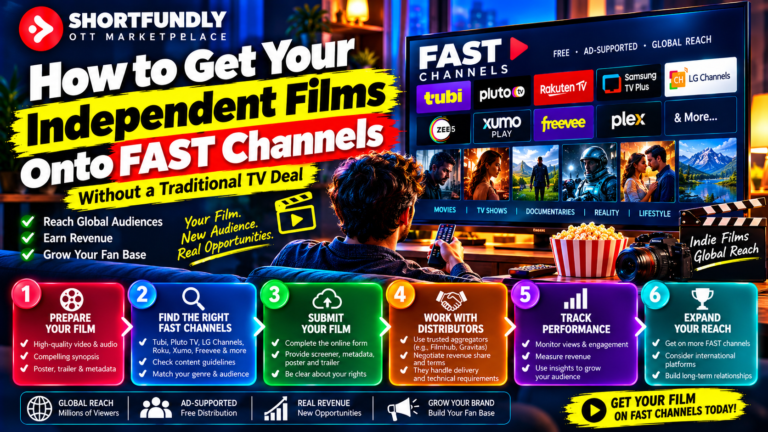
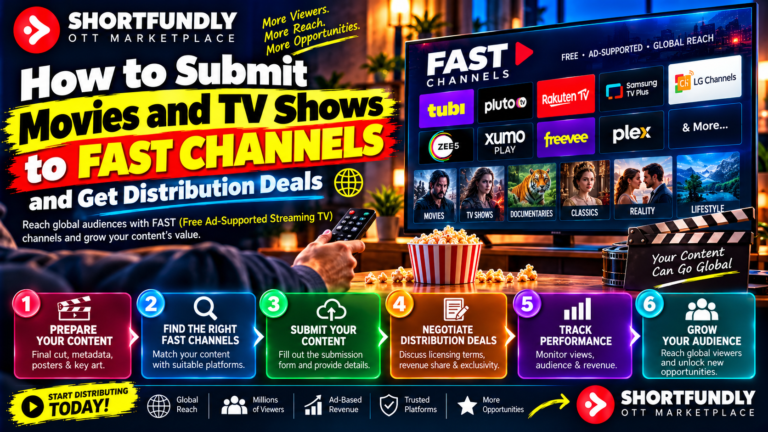
FAST stands for Free Ad-Supported Streaming Television. Instead of requiring viewers to pay a traditional subscription fee, FAST services generally provide linear-style programming supported by advertising. For content owners, this creates an opportunity to turn existing libraries into 24/7 channels, curated programming blocks, or licensed content packages.
However, getting content onto FAST platforms is not simply a matter of uploading a movie and waiting for viewers. We need to understand the difference between a FAST platform, FAST channel operator, technology provider, content distributor, aggregator, and OTT distribution partner.
That distinction matters because the company we approach can determine how our content is packaged, where it can be delivered, how rights are handled, how advertising is managed, and how revenue is reported.
The FAST ecosystem is also becoming increasingly structured. In India, the Telecom Regulatory Authority of India has been examining the regulatory framework around application-based linear television distribution and FAST services, reflecting the growing importance of this category.
For filmmakers, producers, independent studios, broadcasters, and content creators, this creates a compelling opportunity.
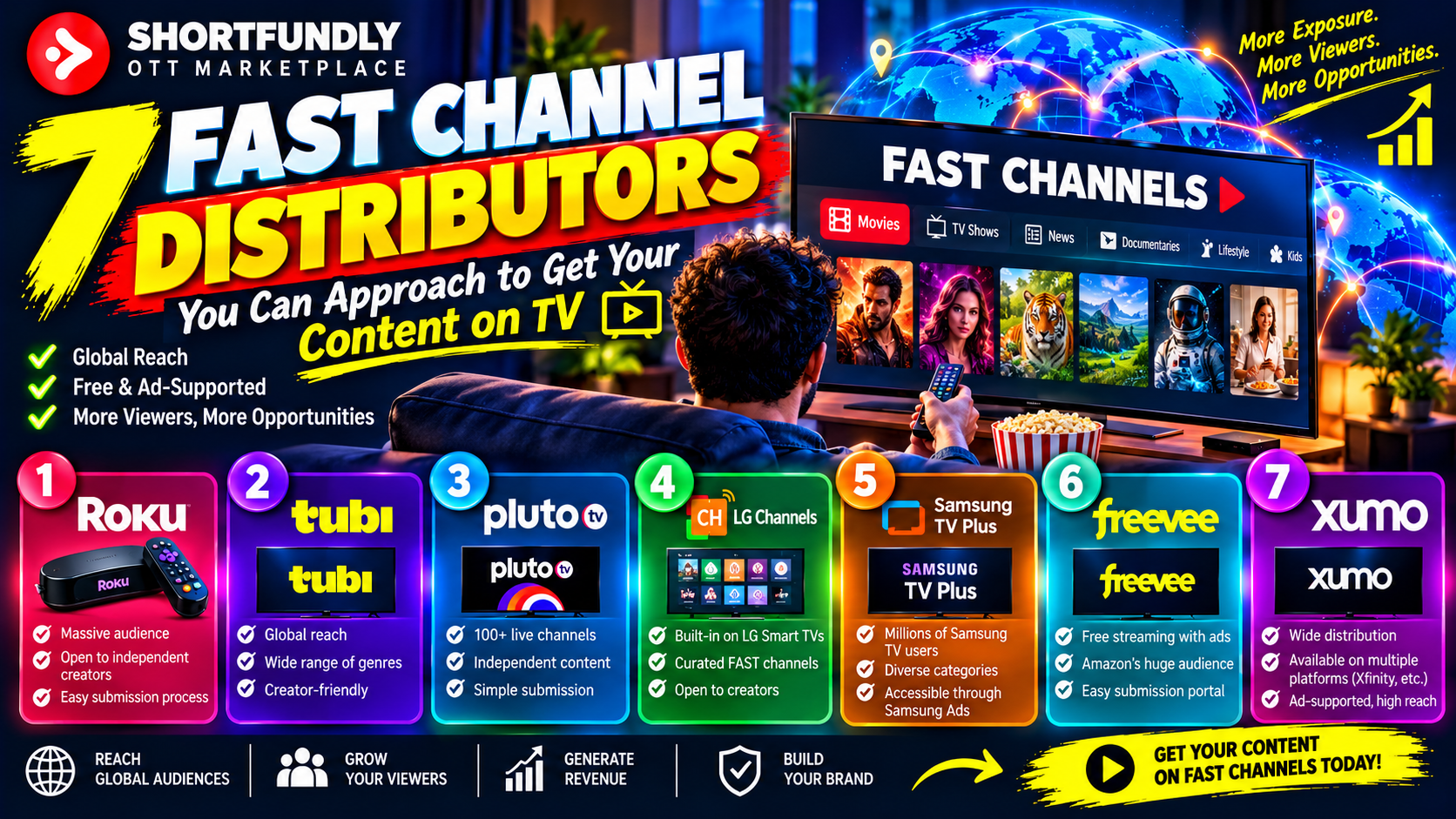
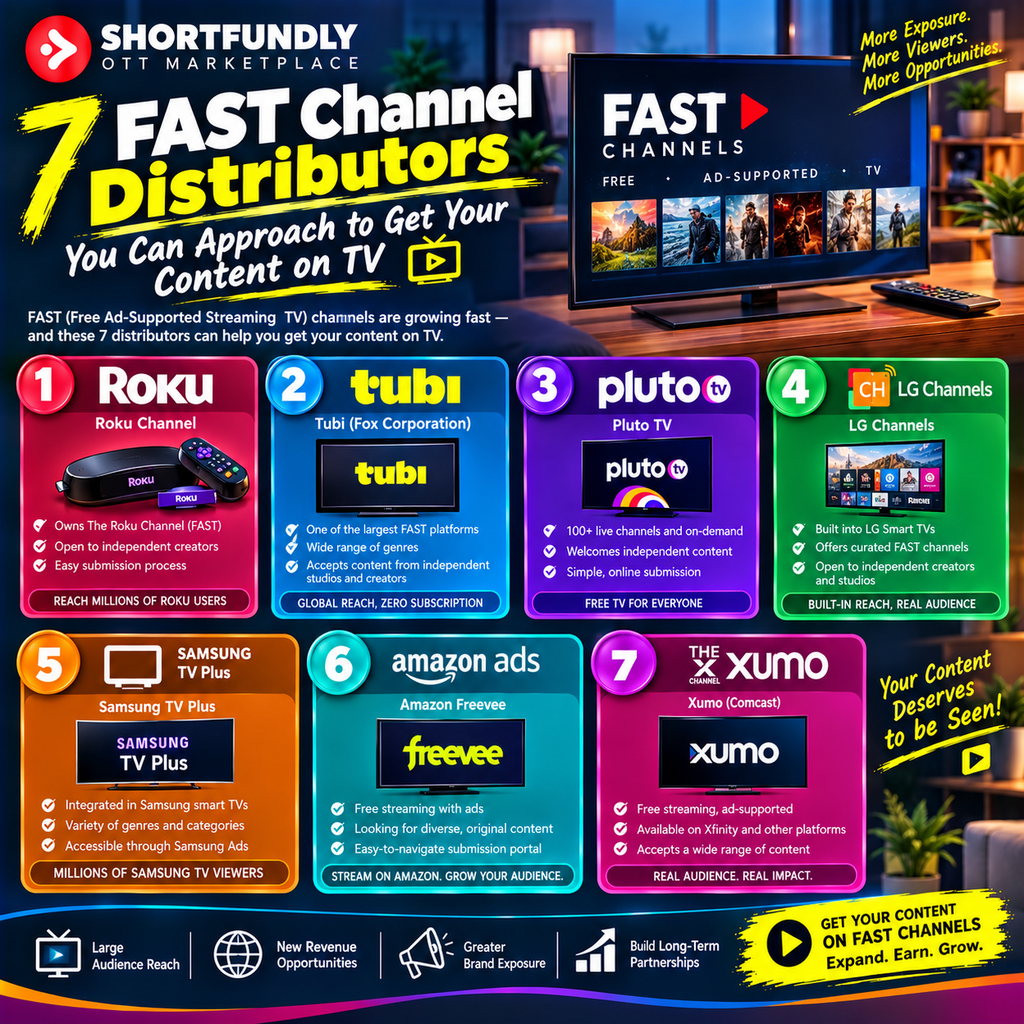
In this guide, we explore 7 FAST channel distributors and distribution partners we can approach to get content onto TV and connected-TV platforms, along with what each type of partner can offer, what materials we should prepare, and how to improve our chances of receiving a serious distribution discussion.
1. Amagi
Amagi is one of the major companies we can consider when our goal is to create, distribute, and monetize linear streaming channels across FAST and connected-TV ecosystems.
Amagi provides solutions covering channel creation, distribution, monetization, analytics, and content operations. Its public FAST offering also includes Amagi CONNECT, a marketplace designed to connect content owners with streaming platforms and facilitate distribution opportunities.
This makes Amagi particularly relevant when we are not simply trying to place one movie on one service but are considering a broader FAST channel strategy.
Why Consider Amagi?
The biggest advantage is the ecosystem approach.
Instead of treating FAST distribution as a single-platform submission, we can approach distribution as a structured business operation involving:
- Channel creation
- Content packaging
- Programming
- Metadata
- Distribution
- Advertising
- Analytics
- Rights management
- Revenue reporting
Amagi states that its CONNECT marketplace allows content owners to discover platforms, establish connections, negotiate deals, and distribute content. Its public information currently describes hundreds of channels and dozens of platform profiles within the marketplace.
For a production company with a sizeable catalogue, this can be especially useful.
What Content Should We Prepare?
We should prepare:
- Movie masters
- TV series episodes
- Episode metadata
- Synopses
- Genre information
- Cast and crew information
- Posters and artwork
- Closed captions
- Subtitles
- Rights information
- Territory information
- Programming availability
- Advertising suitability information
The stronger the metadata package, the easier it becomes for a distribution team to understand the commercial value of our catalogue.
2. Wurl
Wurl is another significant name in global FAST and connected-TV distribution.
Wurl’s Global FAST Pass is designed to help content publishers launch, distribute, and monetize FAST channels. Its public materials state that it can help content publishers distribute channels to major streaming platforms, while also supporting technical preparation, metadata, scheduling, advertising workflows, and reporting.
This makes Wurl particularly relevant when our objective is global FAST channel distribution rather than simply uploading individual VOD assets.
What Makes Wurl Different?
Wurl focuses heavily on the operational side of FAST.
A FAST channel needs more than video files.
It requires:
- Linear programming
- Scheduling
- EPG metadata
- Channel branding
- Content delivery
- Encoding
- Captioning
- DRM
- Ad insertion
- Inventory management
- Performance reporting
Wurl’s published materials also clarify an important point: Wurl does not itself negotiate every distribution agreement. Instead, it can connect parties and support the technical and operational processes once agreements are established.
That means we should approach Wurl with realistic expectations.
We should not simply ask, “Can you put my movie on TV?”
A better approach is:
“We own or control a catalogue that could support a FAST channel, and we are evaluating global CTV distribution opportunities. Can your team advise us on the appropriate distribution pathway?”
That frames the conversation around a business opportunity rather than a basic content upload request.
3. Frequency
Frequency combines FAST channel creation, programming, distribution, and monetization capabilities.
Its public platform information states that Frequency works with content owners, creators, and media brands to create and distribute streaming television channels. It also says its FAST distribution network is integrated with major FAST platforms.
This makes Frequency particularly interesting for producers who want to transform an existing catalogue into a linear streaming channel.
When Should We Approach Frequency?
Frequency can be relevant when we have:
- A substantial content library
- A recognizable genre
- A recurring programming concept
- Multiple episodes or titles
- A sports or lifestyle catalogue
- A niche audience
- A branded content proposition
For example, instead of submitting 30 unrelated films, we could develop a concept such as:
“24/7 Indian Independent Cinema”
or:
“Classic Regional Movies FAST Channel”
or:
“Independent Documentary Network.”
The channel concept gives the catalogue an identity.
Why Channel Identity Matters
FAST platforms need programming that viewers can understand quickly.
A channel with a clear proposition is easier to package than an enormous catalogue with no editorial direction.
We should therefore define:
- Channel name
- Target audience
- Primary genre
- Geographic audience
- Programming schedule
- Content volume
- Language
- Subtitle availability
- Content refresh strategy
- Advertising suitability
This can dramatically improve our pitch.
4. OTTera
OTTera provides an end-to-end OTT ecosystem covering application development, FAST channel creation, distribution, monetization, and analytics.
Its StreamBridge service is positioned as a distribution service connecting streaming applications, FAST channels, and on-demand content to global platforms. OTTera also provides FAST channel development and monetization services.
This makes OTTera particularly relevant for content owners who want to go beyond individual licensing and build a broader streaming business.
What Can We Use OTTera For?
Depending on the commercial arrangement, we can explore:
- FAST channel creation
- OTT application development
- Content distribution
- VOD distribution
- Monetization
- Audience analytics
- Global platform delivery
- Ad-supported streaming
The advantage is that we can potentially treat the content library as an entire streaming product.
For example, if we have 300 hours of regional films, documentaries, interviews, and series, we can explore whether the catalogue can support:
- A FAST channel
- An AVOD library
- A branded OTT service
- A hybrid FAST + VOD proposition
This is often more valuable than approaching each title separately.
5. FAST Channels TV
FAST Channels TV is particularly relevant for independent content owners because its public offering combines channel creation, playout, content sourcing, monetization, and distribution.
The company states that it works with content owners and OTT platforms and can transform licensed content into FAST channels and VOD assets before facilitating placement across OTT platforms.
Its current public website also describes a catalogue of FAST channels and VOD titles and positions the company as an end-to-end FAST technology, playout, monetization, and distribution provider.
Why This Can Be Useful for Independent Producers
Traditional television distribution can be difficult for smaller producers because our catalogue may not be large enough to attract major broadcasters.
FAST can provide another route.
FAST Channels TV has previously described working with content owners with smaller libraries and grouping or curating content into broader channel concepts.
That is important for independent filmmakers.
Suppose we have:
- 12 independent movies
- 20 documentaries
- 40 short films
- Several regional TV episodes
Individually, those titles may not constitute a traditional television network.
Together, however, they may form a compelling genre-focused FAST programming package.
6. Catvision India
For content owners specifically interested in India TV distribution, Catvision is a company worth investigating.
Catvision describes itself as a distribution partner for international broadcasters entering and expanding in India. Its current channel-distribution offering includes traditional television as well as FAST and streaming channels across broadband and mobile ecosystems.
The company also describes services covering market entry, regulatory approvals, broadcast licensing, distribution, carriage, cable, DTH, hospitality, and broadband.
Why India-Focused Distribution Matters
India is not one homogeneous television market.
We have:
- Hindi audiences
- Tamil audiences
- Telugu audiences
- Malayalam audiences
- Kannada audiences
- Bengali audiences
- Marathi audiences
- Gujarati audiences
- Punjabi audiences
- English-language audiences
- Regional diaspora audiences
Therefore, a distribution strategy should consider language and geography from the beginning.
A Tamil movie with strong cultural relevance, for example, may require a completely different distribution pitch from an English-language documentary.
What Should We Include in an India Distribution Pitch?
We should provide:
- Content language
- Subtitle languages
- Target states
- Existing audience data
- Television rights
- Digital rights
- FAST rights
- AVOD rights
- Territory availability
- Broadcast history
- Streaming history
- Technical specifications
- Content ratings
- Trailer
- Artwork
The more clearly we define the rights and market opportunity, the easier it becomes for a distributor to assess the project.
7. Shortfundly Distribution
Shortfundly Distribution is another route independent filmmakers and content creators can consider when their goal is broader OTT and television distribution.
Shortfundly’s current distribution portal describes support for content categories including short films, web series, movies, songs and video songs, documentaries, telefilms, pilot films, and micro dramas, with distribution through its currently available OTT and distribution partners.
This makes the service particularly relevant to creators who may not yet have the catalogue size required to build a traditional FAST channel.
Who Can Consider Shortfundly Distribution?
It can be considered by:
- Independent filmmakers
- Short-film creators
- Web-series producers
- Documentary filmmakers
- Music-video creators
- Digital creators
- Small production houses
- Regional content producers
The current submission workflow involves pricing, registration, content submission, agreement and payment steps, review, and release-asset delivery after approval. Platform availability can vary according to content, duration, eligibility, licensing, and current distribution partners.
That last point is important.
We should never assume that submitting a title automatically guarantees placement on a particular FAST service or television platform.
Distribution is subject to rights, content suitability, platform requirements, review, licensing, and available partnerships.
For independent creators, however, an established OTT distribution route can simplify some of the operational work involved in taking a finished title toward multiple distribution opportunities.
FAST Distributor vs FAST Platform: What Is the Difference?
One of the biggest mistakes content owners make is confusing a FAST platform with a FAST distributor.
A FAST platform is where viewers consume the channel.
A distributor or technology-enabled distribution partner helps us get the channel or content prepared and delivered to those platforms.
For example, a distribution workflow may involve:
Content Owner → FAST Distributor → CTV Platform → Viewer
But the actual ecosystem can be more complicated.
It may look like:
Producer → Aggregator → Channel Operator → FAST Platform → Smart TV → Viewer
or:
Content Owner → FAST Technology Partner → Channel → Multiple CTV Platforms → Advertisers → Revenue
Understanding this structure helps us approach the right company.
What Do FAST Channel Distributors Actually Do?
A professional FAST distribution partner can potentially assist with several parts of the process.
Content Ingestion
We provide the required master files, metadata, subtitles, captions, artwork, and other delivery assets.
Technical Preparation
Content may need to be transcoded, packaged, validated, captioned, encrypted, or otherwise prepared for specific platforms.
Channel Creation
A catalogue can be transformed into a linear programming schedule.
EPG Management
Electronic Program Guide information needs to be accurate because viewers use it to understand what is currently playing and what is coming next.
Distribution
The channel can then be delivered to supported streaming and connected-TV platforms.
Monetization
FAST channels generally rely heavily on advertising. Distribution partners may provide or integrate advertising technology and monetization services.
Analytics
Performance data can help us understand viewing behavior, content engagement, channel performance, and advertising results.
What Content Is Attractive to FAST Platforms?
Not every movie or TV show automatically makes a strong FAST proposition.
FAST platforms often benefit from content that can be programmed repeatedly without becoming difficult to understand.
Strong categories can include:
- Classic movies
- Action films
- Comedy
- Horror
- Crime
- Documentaries
- Lifestyle
- Travel
- Food
- Kids and family programming
- Regional entertainment
- Music
- Sports
- News
- Faith and devotional programming
- Reality programming
- Nostalgia television
However, genre alone is not enough.
The content should also have:
Clear rights + technical readiness + useful metadata + audience appeal + sufficient programming volume.
How Much Content Do We Need for a FAST Channel?
There is no universal number that guarantees approval.
The appropriate amount depends on:
- Channel format
- Program length
- Repeat frequency
- Genre
- Number of episodes
- Refresh rate
- Platform requirements
- Programming strategy
- Rights availability
A 24/7 channel built around 30-minute television episodes requires a different library from a channel focused on two-hour movies.
We should therefore think in terms of programming hours, not simply the number of titles.
A catalogue containing 100 short videos may still be less useful for a FAST channel than a smaller library containing hundreds of hours of professionally produced episodic programming.
What Rights Do We Need Before Approaching a Distributor?
Rights are one of the most important parts of a FAST distribution deal.
Before approaching a distributor, we should determine whether we control:
- Streaming rights
- FAST rights
- AVOD rights
- Television rights
- Digital rights
- International rights
- Regional rights
- Language rights
- Advertising-supported rights
- Promotional rights
We should also identify any existing exclusivity.
If a movie is already licensed exclusively to another streaming service, we may not have the legal authority to license it to a FAST distributor.
This is why rights documentation should be prepared before the commercial pitch.
What Materials Should We Send to FAST Distributors?
We should prepare a professional FAST content package.
A strong package can include:
| Asset | Purpose |
|---|---|
| Content catalogue | Shows what we control |
| Trailer or sizzle reel | Demonstrates quality |
| Posters | Supports channel presentation |
| Episode stills | Helps marketing and metadata |
| Synopsis | Explains the content |
| Genre | Supports programming decisions |
| Cast and crew | Establishes marketability |
| Runtime | Helps scheduling |
| Language | Defines audience |
| Subtitles | Supports localization |
| Rights grid | Establishes availability |
| Technical specifications | Supports delivery |
| Audience data | Demonstrates existing demand |
| Previous distribution | Provides market history |
A distributor should not have to spend hours asking basic questions about our catalogue.
How to Pitch a FAST Distributor
A strong FAST pitch should be short, specific, and commercially focused.
Instead of writing:
“We have many good movies. Please distribute them.”
we should communicate:
“We control a non-exclusive catalogue of 85 hours of Tamil independent films, including 22 feature titles and 40 short-form programs, with digital and FAST rights available across selected international territories.”
That immediately communicates:
- Volume
- Genre
- Language
- Rights
- Territory
- Commercial opportunity
Then we can explain the audience.
For example:
“The catalogue is designed for audiences interested in regional Indian cinema and diaspora entertainment.”
That is much more useful to a distributor than a generic description.
How to Make Our Content More Attractive
FAST distribution is ultimately a programming and audience business.
Therefore, we should package content strategically.
Create Genre Collections
Instead of sending a random list of titles, organize them into:
- Horror collection
- Comedy collection
- Regional cinema collection
- Classic cinema collection
- Documentary collection
- Kids collection
- Music collection
Build Channel Concepts
A channel concept could be:
Tamil Cinema Classics
Indian Independent Films
Global Documentary Network
Regional Music Television
South Indian Movie Network
The concept helps distributors understand how the content can be programmed.
Why Metadata Matters in FAST Distribution
Metadata is often underestimated.
A distributor needs accurate information to create:
- EPG listings
- Platform descriptions
- Search results
- Content recommendations
- Genre classifications
- Promotional materials
- Programming schedules
Our metadata should be consistent.
For every title, we should ideally have:
Title → Synopsis → Genre → Runtime → Language → Release Year → Cast → Director → Rating → Subtitle Information → Rights → Artwork
Poor metadata can make excellent content look unprofessional.
How FAST Distribution Can Create New Value From an Existing Catalogue
One of the biggest advantages of FAST is that we can potentially create additional commercial value from content that has already been produced.
A film may have previously earned revenue through:
- Theatrical release
- Television
- SVOD
- Transactional VOD
- YouTube
- DVD
- International licensing
If the applicable rights remain available, the same library may potentially support another distribution strategy.
FAST can therefore become part of a broader content lifecycle strategy.
Instead of viewing a film as a one-time product, we can view it as a long-term intellectual property asset with different windows and audiences.
FAST Distribution and Traditional TV Distribution
FAST does not necessarily replace traditional television.
The two models can complement each other.
| Traditional TV | FAST TV |
|---|---|
| Broadcast infrastructure | Internet delivery |
| Scheduled television | Linear streaming |
| Cable/DTH distribution | Connected-TV distribution |
| Traditional advertising | Digital advertising |
| Geographic carriage | Digital geographic availability |
| Traditional EPG | Digital EPG |
| Broadcaster-led | Platform/distributor ecosystem |
| Primarily TV households | Smart TVs, CTV and streaming devices |
The right strategy depends on the content and rights.
For some titles, traditional television may remain valuable.
For others, FAST can provide an additional digital distribution window.
FAST Distribution in India Is Becoming More Relevant
India’s FAST ecosystem is still developing, and the regulatory environment is evolving as well.
TRAI’s 2026 consultation paper examines the framework for application-based linear television distribution, including FAST services, and discusses questions around authorization, service provisioning, and responsibilities involving broadcasters, content providers, aggregators, and other participants.
For content owners, this means we should monitor the market carefully.
We should also avoid assuming that every FAST platform follows exactly the same commercial, technical, or regulatory process.
A distribution agreement should always specify:
- Territory
- Rights
- Term
- Exclusivity
- Revenue model
- Advertising responsibilities
- Reporting
- Payment
- Content takedown
- Renewals
- Marketing obligations
How FAST Distribution Deals Can Be Structured
FAST distribution agreements can use different commercial structures.
Common possibilities include:
Revenue Share
The platform or distributor generates advertising revenue and shares an agreed portion with the content owner.
Licensing Fee
The distributor or platform pays an agreed licensing fee for specified rights.
Minimum Guarantee
A contract may include a guaranteed payment subject to negotiated conditions.
Hybrid Structure
A deal may combine a fixed payment with revenue participation.
There is no single model that applies to every FAST deal.
Therefore, we should compare the complete commercial package, rather than focusing only on the headline percentage.
What Should We Ask Before Signing a FAST Distribution Agreement?
Before signing, we should ask:
- Which platforms will receive the content?
- Which territories are covered?
- Is the agreement exclusive?
- What rights are being licensed?
- How long is the term?
- Who controls advertising?
- How is revenue calculated?
- What expenses are deducted?
- How frequently are statements issued?
- When are payments made?
- Who handles metadata?
- Who handles technical delivery?
- Who pays for localization?
- Can we terminate the agreement?
- What happens after the term expires?
These questions can prevent misunderstandings later.
How to Choose the Right FAST Distributor
We should not choose a distributor simply because it claims broad reach.
Instead, we should evaluate the distributor using a practical scorecard.
| Factor | Questions to Ask |
|---|---|
| Reach | Which platforms can you actually deliver to? |
| Territory | Where can our content be distributed? |
| Content fit | Do you work with our genre? |
| Rights | What rights do you require? |
| Exclusivity | Is the deal exclusive? |
| Technology | Who handles delivery and technical preparation? |
| Monetization | How is advertising handled? |
| Reporting | What analytics will we receive? |
| Payments | How and when are revenues paid? |
| Support | Who manages platform issues? |
| Contract | What are the termination terms? |
| Reputation | Can we verify existing distribution relationships? |
This approach gives us a more realistic basis for selecting a partner.
10-Step FAST Channel Distribution Checklist
Before approaching any distributor, we should complete this checklist.
Step 1: Confirm Ownership
Verify that we control the necessary rights.
Step 2: Organize the Catalogue
Create a clean content spreadsheet.
Step 3: Prepare Masters
Keep high-quality source files ready.
Step 4: Prepare Subtitles
Create accurate subtitle and caption files where required.
Step 5: Create Metadata
Prepare professional title and episode information.
Step 6: Prepare Artwork
Create posters, thumbnails, channel logos, and promotional assets.
Step 7: Define the Audience
Identify geographic, language, demographic, and genre audiences.
Step 8: Create a FAST Concept
Explain how the catalogue can become a compelling channel.
Step 9: Approach Relevant Partners
Contact distributors whose capabilities match the content.
Step 10: Compare Agreements
Evaluate rights, territory, term, revenue, reporting, and exclusivity before signing.
Common Mistakes Content Owners Should Avoid
Sending an Unorganized Catalogue
A spreadsheet containing hundreds of unexplained filenames is not a professional pitch.
Ignoring Rights
Never assume that owning the movie automatically means we can license every type of digital or television right.
Pitching Individual Titles Without a Strategy
If we have enough content, a channel concept may create more value than a collection of unrelated titles.
Making Unrealistic Revenue Expectations
FAST monetization depends on audience, advertising demand, platform economics, geography, inventory, programming, and many other factors.
Ignoring Localization
Subtitles, dubbing, metadata localization, and regional artwork can significantly expand potential audiences.
Assuming Distribution Equals Guaranteed Viewership
Being listed on a platform does not automatically mean viewers will watch.
We still need:
- Strong programming
- Discoverable metadata
- Marketing
- Audience development
- Consistent content quality
- Regular programming refreshes
How We Can Use Shortfundly Distribution Alongside a FAST Strategy
For independent filmmakers, a FAST strategy does not necessarily have to begin with creating a full 24/7 channel.
We can first focus on getting individual titles into professional OTT distribution.
Shortfundly Distribution can be considered as one route for eligible short films, web series, movies, documentaries, telefilms, pilot films, micro dramas, songs, and other supported content. Its current public process includes content submission, review, agreement, release preparation, and distribution through currently available partners.
This can be useful when our catalogue is still developing.
For example:
Stage 1: Release individual titles through OTT distribution.
Stage 2: Build a recognizable genre or regional catalogue.
Stage 3: Track audience response.
Stage 4: Expand rights and content availability.
Stage 5: Explore FAST channel packaging.
This creates a more gradual path from independent content distribution to FAST channel development.
The Best Approach Is a Distribution Portfolio
We should not think of FAST distribution as a single application.
A stronger strategy is to build a distribution portfolio.
For example:
Shortfundly Distribution → independent OTT distribution
Amagi → FAST marketplace and professional channel distribution
Wurl → global CTV distribution infrastructure
Frequency → channel creation and FAST distribution
OTTera → OTT, FAST, app and distribution ecosystem
FAST Channels TV → channel creation, playout and distribution
Catvision India → India-focused television and streaming distribution
Each partner serves a different potential purpose.
The objective is not to contact all seven blindly.
The objective is to identify which partners are aligned with our content, rights, territory, catalogue size, and distribution goals.
Final FAST Distribution Strategy
Getting content on TV through FAST channels requires more than finding a distributor.
We need to build a professional content proposition.
The process should look like this:
1. Own the rights.
2. Organize the catalogue.
3. Prepare broadcast-quality masters.
4. Build accurate metadata.
5. Prepare subtitles and captions.
6. Define territories.
7. Create a clear audience proposition.
8. Develop a channel concept where appropriate.
9. Approach suitable FAST distribution partners.
10. Negotiate rights and commercial terms carefully.
11. Complete technical onboarding.
12. Monitor distribution and audience performance.
The most important lesson is that FAST channel distribution is a business partnership, not simply a content-upload process.
A distributor needs to understand why our content belongs on its network and why viewers will care.
When we approach the market with clear rights, strong content packaging, professional metadata, compelling programming concepts, and realistic commercial expectations, we give our catalogue a much stronger opportunity to enter the FAST ecosystem.
For filmmakers and independent producers, this is especially significant because a finished movie or series no longer has to depend on a single traditional route to reach television audiences.
With the right distribution strategy, existing content can potentially move across OTT, FAST, AVOD, connected TV, smart-TV ecosystems, and other digital television environments, creating more opportunities to extend the commercial life of our intellectual property.
Frequently Asked Questions About FAST Channel Distributors
1. What is a FAST channel distributor?
A FAST channel distributor helps content owners or channel operators prepare, deliver, and distribute linear streaming channels or programming to supported FAST and connected-TV platforms. Depending on the company, services may include channel creation, technical delivery, metadata, monetization, advertising, analytics, and platform connectivity.
2. Can independent filmmakers distribute movies through FAST channels?
Yes, independent filmmakers can explore FAST distribution, although suitability depends on the catalogue, rights, technical quality, audience potential, platform requirements, and the distributor’s acquisition strategy.
A single movie can sometimes be licensed as programming, while a larger catalogue may support a dedicated FAST channel.
3. Do we need hundreds of movies to launch a FAST channel?
Not necessarily. The required amount of content depends on the channel format, programming schedule, repeat frequency, runtime, genre, and platform requirements.
However, a stronger programming library generally gives us more flexibility.
4. What types of content work well on FAST?
Potentially attractive categories include movies, classic television, documentaries, lifestyle, sports, music, regional entertainment, kids programming, comedy, action, horror, and niche-interest content.
The important factor is not just genre but the combination of audience demand, rights availability, programming volume, quality, and commercial suitability.
5. Is FAST distribution the same as OTT distribution?
No.
OTT distribution is a broad term covering internet-based video distribution. FAST is a specific ad-supported, linear-style streaming model.
A content owner can use OTT distribution for VOD while also exploring FAST distribution for linear programming.
6. Can we distribute the same content on multiple platforms?
Possibly, but it depends on our licensing agreements.
If our agreement is non-exclusive, multiple distribution relationships may be possible. If the agreement is exclusive for particular territories or rights, additional licensing may not be permitted.
We should always review the rights clause before entering another distribution deal.
7. How do FAST channels make money?
FAST channels generally rely on advertising and can use different monetization arrangements.
Revenue can involve advertising sales, programmatic advertising, revenue sharing, licensing, or hybrid commercial structures. The actual economics depend on the platform, distributor, territory, audience, advertising inventory, and agreement.
8. Does getting on a FAST platform guarantee viewers?
No.
Distribution creates availability, but viewership depends on programming, discoverability, platform placement, audience demand, marketing, content quality, and other factors.
A strong distribution deal should therefore be combined with an audience-development strategy.
9. Should we approach FAST platforms directly or use a distributor?
It depends on our scale and capabilities.
A large media company with an experienced distribution team may pursue direct platform relationships.
Independent producers may benefit from working with a distributor or technology partner that can simplify technical delivery, channel operations, and platform relationships.
10. Can Shortfundly Distribution help independent creators?
Shortfundly’s current distribution service supports eligible content categories such as short films, web series, movies, documentaries, telefilms, pilot films, micro dramas, songs and video songs, subject to its current requirements, agreements, review, and available distribution partners.
It can therefore be considered as part of a broader OTT distribution strategy for independent content owners.
11. What should we send to a FAST distributor?
We should prepare a professional package containing content details, masters, metadata, artwork, subtitles, rights information, territory information, trailers, channel concepts, and audience information.
The objective is to make it easy for the distributor to evaluate our catalogue.
12. Is a FAST distribution deal always exclusive?
No. Commercial structures vary.
Some deals may be non-exclusive, while others may grant specific exclusive rights for particular territories, platforms, windows, or periods.
We should never assume the structure. It must be clearly stated in the agreement.
13. How long does FAST distribution take?
There is no universal timeline.
The process depends on:
- Rights clearance
- Technical readiness
- Distributor review
- Platform approval
- Metadata
- Localization
- Contract negotiation
- Channel creation
- Delivery requirements
A technically prepared catalogue with clean rights documentation can generally move through onboarding more efficiently than an unorganized library.
14. Which FAST distributor should we choose?
There is no single distributor that is right for every content owner.
Amagi may be relevant for professional channel distribution and FAST marketplace opportunities.
Wurl can be relevant for global CTV distribution and channel operations.
Frequency can be considered for channel creation and distribution.
OTTera offers a broader OTT and FAST ecosystem.
FAST Channels TV can be relevant for content owners seeking channel creation, playout, monetization, and distribution support.
Catvision can be relevant for India-focused television and streaming distribution.
Shortfundly Distribution can be considered by independent creators seeking broader OTT distribution for eligible content.
The right choice depends on our catalogue and rights rather than the name of the distributor alone.
Also read: https://blog.shortfundly.com/ott/2026-ott-music-distribution/
Conclusion
The rise of FAST channel distribution has created another important path for filmmakers, producers, studios, broadcasters, and independent content owners that want to reach television audiences through the internet.
The opportunity is broader than simply launching a channel.
We can use FAST and connected-TV distribution to extend the life of existing libraries, reach new audiences, experiment with niche programming, develop regional channels, create additional advertising opportunities, and build stronger relationships with streaming platforms.
The seven companies discussed in this guide—Amagi, Wurl, Frequency, OTTera, FAST Channels TV, Catvision India, and Shortfundly Distribution—represent different approaches to the modern television distribution ecosystem.
Our job as content owners is to identify the route that fits our catalogue.
If we have a large professional library, we can explore a dedicated FAST channel.
If we have a smaller catalogue, we can explore aggregation and broader OTT distribution.
If our focus is India, we can prioritize India-focused distribution relationships.
If our goal is international CTV reach, we can investigate global FAST distribution networks.
Above all, we should approach every distributor with clear rights, professional assets, strong metadata, a compelling content proposition, and a realistic commercial strategy.
That is how we turn finished content into a scalable distribution opportunity rather than simply uploading another video and hoping someone discovers it.