Table of Contents
Learn how to release songs on OTT platforms with this step-by-step guide covering music rights, audio quality, metadata, distribution, monetization, promotion, and analytics.
The way audiences discover and consume music has changed dramatically. Today, artists don’t have to depend only on physical albums, radio broadcasts, television, or traditional record labels to reach listeners. With the right OTT song distribution strategy, independent musicians can make their songs available to audiences across streaming platforms, digital services, video ecosystems, and regional markets.
However, getting a song onto OTT platforms involves more than uploading an MP3 file.
A successful release requires music rights, a professional audio master, accurate metadata, suitable artwork, distribution planning, platform selection, licensing information, promotion, and revenue tracking.
Whether we’re releasing a single, album, EP, devotional song, regional-language track, independent music project, or video song, the preparation process can determine how smoothly the release reaches digital platforms.
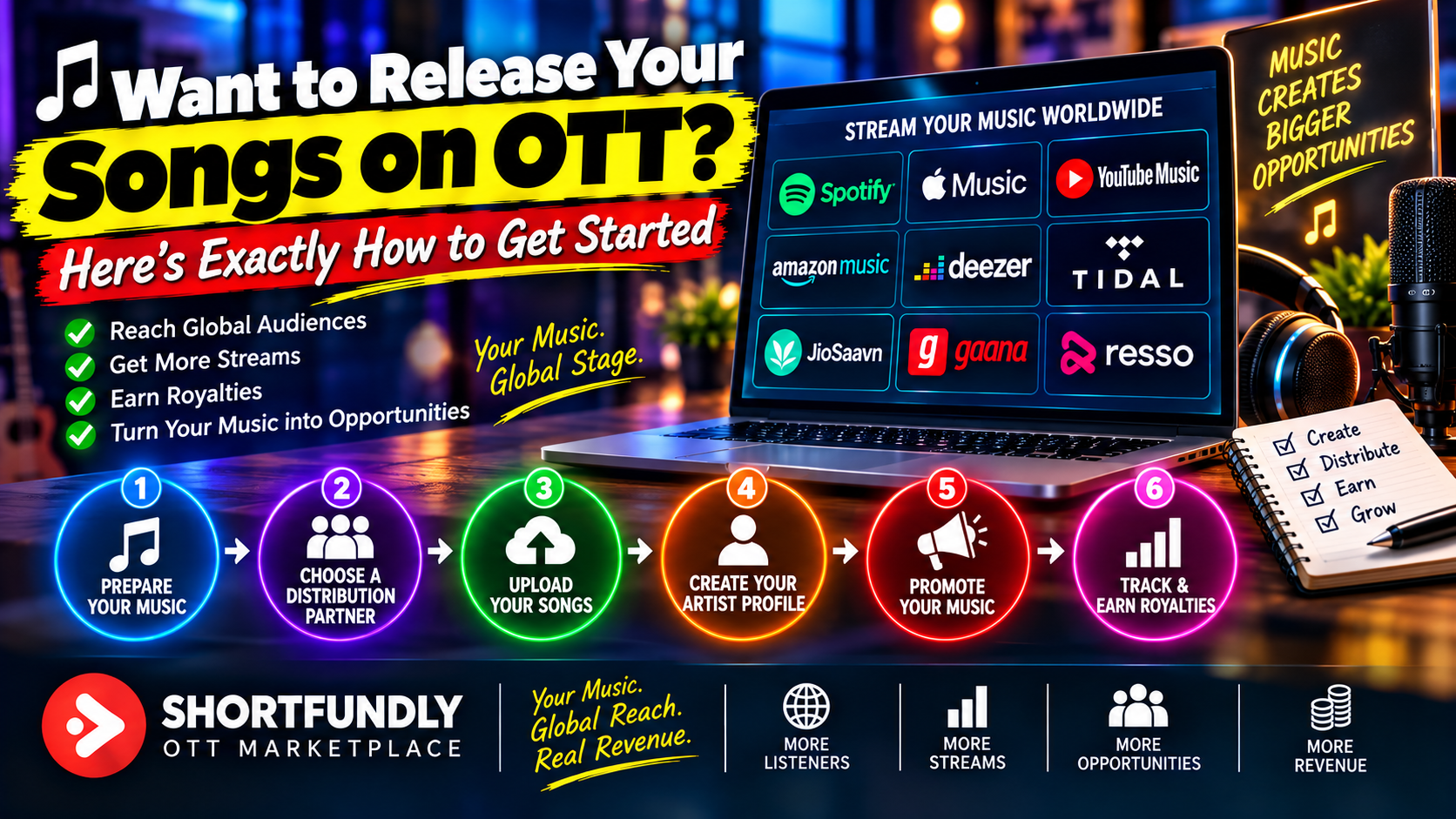
This guide explains how to release songs on OTT platforms, what we need before distribution, how music aggregators work, how to prepare a song for submission, how monetization works, and how to build a long-term digital music strategy.
What Does It Mean to Release a Song on OTT Platforms?
OTT music distribution refers to making music available through internet-based digital services rather than relying exclusively on traditional broadcast channels.
For a music creator, the ecosystem can include:
- Music streaming platforms
- Video streaming platforms
- Digital music stores
- Regional music applications
- Ad-supported streaming services
- Subscription platforms
- Social-video ecosystems
- OTT entertainment platforms
- Digital content marketplaces
The important point is that an artist usually doesn’t upload the same master separately to every major service.
Instead, a music distributor or digital aggregator can deliver the recording and its associated metadata to multiple platforms.
The distributor acts as an important link between the rights holder and digital services.
That makes choosing the right distribution route one of the first decisions we should make.
Why Should We Release Songs on OTT Platforms?
The biggest advantage of OTT distribution is audience accessibility.
A song released digitally can potentially be discovered by listeners far beyond the artist’s immediate geographic area.
For example, a Tamil song may attract listeners not only in Tamil Nadu but also in Singapore, Malaysia, Sri Lanka, the Middle East, Europe, North America, and other regions with Tamil-speaking communities.
Similarly, Hindi, Telugu, Malayalam, Kannada, Bengali, Punjabi, Marathi, and other regional-language songs can potentially reach international audiences.
Major Benefits of OTT Song Distribution
1. Wider audience reach
Digital platforms make music accessible across geographic boundaries.
2. Convenient listening
Listeners can access songs through smartphones, computers, smart TVs, cars, and other connected devices.
3. Multiple monetization opportunities
Depending on the platform and agreement, music can generate revenue through streaming, advertising, licensing, subscriptions, downloads, or other models.
4. Long-term catalog value
A properly distributed song can remain part of an artist’s catalog for years.
5. Audience analytics
Digital platforms can provide information about listeners, territories, engagement, and performance.
6. Independent artist opportunities
Artists don’t necessarily need a traditional record label to begin building a digital catalog.
7. International discovery
Regional music can reach diaspora communities and listeners interested in different languages and cultures.
Step 1: Make Sure You Own the Rights to Your Song
Before thinking about distribution, we should establish who owns the song and recording.
This is one of the most important steps in the entire process.
A song can involve several different rights.
Sound Recording Rights
These relate to the specific recorded version of the song.
Composition Rights
These relate to the underlying musical composition.
Lyrics Rights
The lyricist may have rights associated with the lyrics.
Performance Rights
Performers and musicians may have contractual or applicable rights.
Publishing Rights
The composition may also involve publishing administration and royalty arrangements.
If several people worked on the song, we should have clear documentation covering ownership and revenue splits.
For example, a song might involve:
- One composer
- One lyricist
- One singer
- One producer
- Multiple musicians
- A studio
- A record label
- A music publisher
Before distribution, we should know exactly who owns what.
Step 2: Check for Samples, Interpolations, and Third-Party Material
A common mistake is assuming that original vocals automatically mean the entire recording is legally ready for distribution.
If the song contains:
- Samples
- Third-party recordings
- Licensed beats
- Interpolations
- Stock audio
- Copyrighted lyrics
- Recreated portions of another composition
- Purchased production elements
we should verify the applicable permissions.
For example, purchasing a beat online doesn’t automatically mean every type of commercial exploitation is permitted.
The license may restrict:
- Streaming
- YouTube
- Television
- OTT
- Synchronization
- Commercial use
- Geographic territories
- Number of copies
- Monetization
The safest approach is to retain written documentation for every third-party element.
Step 3: Prepare a Professional Audio Master
The final master is the core asset being distributed.
We shouldn’t distribute a compressed file taken from WhatsApp, social media, or another platform.
Instead, we should provide the highest-quality approved master that meets the distributor’s technical requirements.
Depending on the distributor, requirements can include specifications for:
- WAV or other accepted formats
- Sample rate
- Bit depth
- Stereo configuration
- Audio quality
- File naming
- Loudness
- Track duration
The exact requirements vary, so we should always follow the current specifications provided by the distributor.
Before Uploading the Master
Listen to the entire track from beginning to end.
Check for:
- Clipping
- Distortion
- Unwanted noise
- Sudden volume changes
- Incorrect edits
- Missing sections
- Silence at the beginning
- Abrupt ending
- Wrong version
- Incorrect track length
A technical error discovered after submission can delay the release.
Step 4: Create Professional Cover Artwork
The artwork is another important part of a digital music release.
A listener may encounter the song first through a small thumbnail, playlist, artist profile, or search result.
The cover should therefore be:
- High quality
- Clear
- Legible
- Professionally designed
- Relevant to the song
- Free from unauthorized images
- Consistent with the artist’s branding
We should also check the distributor’s current artwork specifications before submission.
Avoid unnecessary text such as:
- Fake platform logos
- Misleading claims
- Excessive promotional language
- Unauthorized celebrity images
- Copyrighted photographs
- QR codes where prohibited
- URLs where prohibited
Good artwork makes the release look like a finished professional product rather than an unfinished upload.
Step 5: Prepare Accurate Song Metadata
Music metadata is one of the most important parts of OTT distribution.
Metadata tells platforms what the song is and who is responsible for it.
Typical metadata includes:
| Metadata | Information |
|---|---|
| Song title | Official title |
| Artist | Primary performing artist |
| Featured artist | Collaborating performer |
| Album | Album or EP name |
| Composer | Composition credit |
| Lyricist | Lyrics credit |
| Producer | Production credit |
| Genre | Music category |
| Language | Primary language |
| Release date | Planned release date |
| Copyright | Ownership information |
| ISRC | Recording identifier |
| Version | Original, remix, acoustic, live, etc. |
| Explicit status | Content classification |
We should check every field carefully before submitting.
A small spelling difference can sometimes create problems with artist profiles or catalog organization.
For example:
Arun Kumar
shouldn’t accidentally become:
Arun Kumer
or:
Arun K.
unless those are intentionally different artist identities.
Step 6: Obtain the Correct ISRC
An ISRC, or International Standard Recording Code, identifies a particular sound recording.
It can help with:
- Recording identification
- Catalog management
- Royalty administration
- Reporting
- Rights tracking
- Matching recordings across services
We should maintain an organized record of the ISRC assigned to every released recording.
This becomes especially important as the catalog grows.
An artist with one song may not notice catalog-management problems immediately. An artist with 100 songs absolutely will.
Step 7: Choose the Right OTT Music Distribution Partner
This is where the distribution strategy becomes practical.
A music distributor can help deliver recordings to multiple digital services and manage parts of the technical submission process.
Before choosing one, we should compare:
Platform Reach
Which services does the distributor currently deliver to?
Pricing
Does it charge:
- Per release?
- Annual fees?
- Monthly fees?
- Revenue share?
- Hybrid fees?
Rights
Does the artist retain ownership?
Is the arrangement exclusive or non-exclusive?
How long does the agreement last?
Reporting
Can we monitor:
- Streams?
- Revenue?
- Territories?
- Platform performance?
- Release status?
Payouts
We should understand:
- Payment schedule
- Minimum payout threshold
- Payment method
- Applicable deductions
- Currency conversion
- Revenue calculation
Customer Support
When something goes wrong, accessible support can save considerable time.
Step 8: Consider Shortfundly Distribution for Eligible Song and Video Song Content
Shortfundly Distribution is one option creators can evaluate when planning OTT distribution for eligible digital content.
Shortfundly’s current distribution information lists songs and video songs among its supported content types, alongside short films, web series, movies, documentaries, telefilms, pilot films, and micro dramas.
Its published workflow includes content submission, review, release-asset preparation after approval, distribution through currently available partners, and tracking of distribution and earnings.
For creators considering Shortfundly, the current eligibility, pricing, partner availability, agreement terms, and delivery requirements should be checked for the specific project before submission.
The service also describes revenue opportunities connected with ticket purchases and revenue-sharing arrangements, with the exact commercial terms depending on the applicable agreement.
Step 9: Decide Which Platforms Your Audience Actually Uses
We shouldn’t distribute blindly.
The best platform mix depends on our audience.
Ask:
- Where do our listeners live?
- What language is the song in?
- What genre is it?
- Are listeners mostly in India?
- Do we have a diaspora audience?
- Is the song intended for global audiences?
- Is video important to the release?
- Are regional streaming services relevant?
For Indian Regional Music
We may want to consider a combination of:
- Global music streaming services
- Indian music platforms
- Regional-language services
- YouTube
- YouTube Music
- Social-video ecosystems
- OTT distribution networks
For International Music
We can prioritize:
- Global streaming services
- International playlist opportunities
- Diaspora audiences
- International social media
- Music discovery platforms
- Digital licensing opportunities
The objective isn’t simply to have the longest platform list.
The objective is to reach the right audience.
Step 10: Decide Your Release Date
We should avoid submitting a major release at the last minute.
A professional release schedule might look like this:
4–6 Weeks Before Release
Finalize:
- Audio
- Artwork
- Metadata
- Rights
- Artist profile
- Promotional strategy
2–4 Weeks Before Release
Submit through the selected distributor and monitor delivery.
1–2 Weeks Before Release
Begin promotional activities.
Publish:
- Teasers
- Reels
- Shorts
- Posters
- Behind-the-scenes content
- Artist announcements
Release Week
Coordinate the launch across:
- Social media
- YouTube
- Streaming platforms
- Artist communities
- Influencers
- Press
- Websites
After Release
Monitor performance and continue promotion.
Step 11: Create a Music Promotion Strategy
Distribution and promotion aren’t the same thing.
Distribution makes the song available. Promotion helps people discover it.
We should therefore prepare promotional content around every major release.
Useful assets can include:
- Teaser videos
- Lyric clips
- Music videos
- Short-form videos
- Behind-the-scenes footage
- Artist interviews
- Studio footage
- Acoustic versions
- Live performances
- Quote graphics
- Press releases
- Influencer collaborations
For example, instead of promoting a song once on release day, we can create several short clips featuring different parts of the track.
This gives the release multiple opportunities to reach audiences.
Step 12: Optimize Your Artist Profile
The song isn’t the only thing listeners see.
They may also visit the artist profile.
We should make sure the profile contains:
- Consistent artist name
- Professional photograph
- Biography
- Genre information
- Social links where supported
- Correct catalog
- Consistent branding
A professional profile can make an independent artist appear more established.
It also makes it easier for listeners who discover one song to explore the rest of the catalog.
Step 13: Understand Music OTT Revenue Models
Music can generate revenue through several different channels.
Streaming Revenue
Revenue can be generated through listening activity under the platform’s applicable royalty system.
Advertising Revenue
Ad-supported services can generate revenue from advertising.
Subscription Revenue
Subscription services operate under their own commercial and royalty structures.
Digital Sales
Some digital services can support purchases or downloads.
Licensing
Songs can potentially be licensed for:
- Films
- Web series
- Advertisements
- Television
- Games
- Digital productions
- Other commercial uses
Video Monetization
A song can also generate value through monetized video content.
We should avoid assuming that every platform pays the same amount per stream.
Royalty calculations can depend on factors such as platform revenue, listener location, subscription type, rights ownership, contractual arrangements, and the distributor’s terms.
Step 14: Understand the Difference Between Master and Publishing Rights
One of the most important concepts in music monetization is the difference between the sound recording and the composition.
The master is the specific recording.
The composition is the underlying musical work.
For example:
A singer records a song composed by another person.
The singer may perform on the master.
The composer owns or controls rights in the composition according to the relevant agreement.
The lyricist may have separate rights in the lyrics.
A distributor handling the master does not necessarily administer every right associated with the underlying composition.
Therefore, we should keep separate documentation for:
- Master ownership
- Composition ownership
- Lyrics
- Publishing
- Performance rights
- Licensing
Step 15: Check Your Distribution Agreement Carefully
Before clicking “Accept,” read the agreement.
Important clauses include:
- Ownership
- License grant
- Exclusivity
- Territory
- Contract duration
- Renewal
- Revenue share
- Fees
- Payment terms
- Takedown procedure
- Content warranties
- Sub-licensing
- Promotional rights
- Termination
We should pay special attention to language that grants rights beyond what we actually intend to provide.
If we only want digital distribution, we should understand whether the agreement also covers television, synchronization, downloads, advertising, or other uses.
Step 16: Prepare for Content Quality Control
After submission, a distributor or platform may review the release.
The review can involve:
- Audio quality
- Artwork
- Metadata
- Rights
- Copyright information
- Content classification
- Technical specifications
- Duplicate content
- Artist information
Approval isn’t automatic.
A release can be delayed if information is missing or inconsistent.
That is why the earlier preparation steps matter.
Step 17: Track Your Song After Release
Once the song goes live, the job isn’t finished.
We should monitor available analytics.
Useful metrics can include:
- Streams
- Listeners
- Saves
- Shares
- Playlist additions
- Geographic distribution
- Audience growth
- Revenue
- Repeat listening
- Platform performance
Analytics can help answer practical questions.
For example:
Is the song performing better in Chennai or Bengaluru?
Are listeners coming from outside India?
Which promotional video generates the most engagement?
Which song in the catalog is attracting the most new listeners?
The answers can influence our next release.
How to Use Analytics to Improve Future Releases
Suppose one song receives most of its listeners from a particular country.
That information can influence future promotion.
We could:
- Create localized social content
- Collaborate with creators in that market
- Run targeted campaigns
- Release related songs
- Perform locally
- Build relationships with regional media
In other words, analytics shouldn’t simply sit inside a dashboard.
They should influence decisions.
Common Mistakes When Releasing Songs on OTT Platforms
1. Uploading the Wrong Audio File
Always check the final master before submission.
2. Ignoring Copyright
Make sure every element is legally cleared.
3. Incorrect Metadata
Double-check every name, credit, title, and identifier.
4. Choosing a Distributor Only Because It Is Cheap
Compare the complete commercial structure.
5. Ignoring Revenue Terms
Understand how much the distributor retains and how payments work.
6. Releasing Without Promotion
A digital release still needs audience development.
7. Waiting Until Release Day to Start Marketing
Build awareness before the song becomes available.
8. Forgetting Regional Audiences
Regional-language music can have valuable local and international audiences.
9. Not Keeping Agreements
Store all licenses, contracts, split sheets, and ownership records.
10. Expecting Instant Revenue
Streaming and distribution results can take time and vary significantly between releases.
OTT Song Release Checklist
Before submitting the song, we can use this checklist:
- Final audio master approved
- Copyright ownership confirmed
- Third-party material cleared
- Artist information verified
- Composer credit verified
- Lyricist credit verified
- Producer credit verified
- ISRC confirmed
- Cover artwork completed
- Metadata reviewed
- Language selected
- Genre selected
- Release date chosen
- Distributor selected
- Distribution agreement reviewed
- Revenue terms understood
- Promotional assets prepared
- Social-media campaign planned
- Analytics access confirmed
- Rights documents archived
How Much Does It Cost to Release a Song on OTT?
There isn’t one universal price.
The cost depends on the distribution provider and the services included.
Common models include:
Annual Subscription
A recurring payment provides access to distribution services.
Per-Release Fee
The artist pays for each single, EP, or album.
Revenue Share
The distributor retains an agreed percentage of eligible revenue.
Hybrid Pricing
The artist pays a fee and also agrees to a revenue percentage.
Additional Services
Some distributors may charge separately for:
- Marketing
- Playlist pitching
- Rights administration
- Content identification
- Premium support
- Label services
- Promotional campaigns
The cheapest option isn’t necessarily the lowest-cost option over several years.
For example, a distributor with a small upfront fee but a continuing revenue commission may have a very different financial outcome from a service with a larger upfront charge and no commission.
Can Independent Artists Release Songs on OTT Without a Record Label?
Yes, independent artists can use digital distribution services without necessarily signing a traditional record-label deal.
However, independence requires more attention to administration.
We should maintain our own records for:
- Rights
- Credits
- Contracts
- Revenue splits
- ISRCs
- Masters
- Artwork
- Release dates
- Distributor agreements
The advantage is greater control over the catalog.
The challenge is that we also have greater responsibility.
Can Regional-Language Songs Be Distributed Internationally?
Absolutely.
Digital platforms have made it possible for regional-language music to reach listeners around the world.
A Malayalam song can find listeners in the Gulf.
A Tamil song can reach audiences in Singapore and Malaysia.
A Punjabi song can connect with listeners in Canada and the United Kingdom.
A Telugu song can reach audiences outside India through diaspora communities.
This is why we shouldn’t automatically limit a regional song to one territory.
Instead, we should investigate where the target audience exists and build a distribution and marketing strategy around those markets.
How to Build a Long-Term OTT Music Catalog
One song can generate attention.
A catalog can build a career.
Instead of treating every release as a separate project, we should create a consistent release system.
For example:
Release 1 → Single
Release 2 → Collaboration
Release 3 → Regional-language single
Release 4 → Music video
Release 5 → EP
Release 6 → Acoustic version
This gives listeners more reasons to return to the artist profile.
It also creates more opportunities for promotion, discovery, licensing, and audience growth.
FAQs About Releasing Songs on OTT Platforms
1. Can I release my song on OTT platforms without a record label?
Yes. Independent artists can use digital distributors and aggregators to deliver music to eligible streaming and digital platforms.
2. What do I need before distributing a song?
At minimum, we should have a final master, appropriate artwork, accurate metadata, rights documentation, artist information, and any required recording identifiers.
3. How long does song distribution take?
There is no universal timeline. Distributor processing, quality checks, metadata corrections, platform processing, and release scheduling can all affect timing. It is safer to submit well before the intended release date.
4. Do I keep ownership of my song?
That depends on the distribution agreement. We should specifically check whether the distributor receives ownership, an exclusive license, or a non-exclusive distribution authorization.
5. Can I distribute a regional-language song internationally?
Yes. Digital distribution can make regional-language music available internationally, provided the relevant distributor and platform support the territories.
6. How can I make money from OTT music distribution?
Potential revenue sources include streaming royalties, advertising, licensing, digital sales, video monetization, and other commercial uses. The exact income depends on platform economics, rights ownership, contracts, audience activity, and distribution terms.
7. Is Shortfundly Distribution suitable for songs?
Shortfundly’s current public distribution information lists songs and video songs among its supported content types. Creators should check current eligibility, pricing, partner availability, and agreement terms for their specific release before submitting.
8. Do I need a large social-media following before distributing my song?
No. A large following isn’t necessarily a prerequisite for digital distribution. However, an audience-building strategy can help increase awareness after release.
9. Should I distribute my song to every available platform?
Not necessarily. We should prioritize platforms that match the target audience, language, territory, genre, and commercial goals.
10. What is the biggest mistake artists make when releasing songs online?
One of the most common problems is treating distribution as the entire release strategy. Distribution makes the song available, but promotion, branding, audience development, rights management, and analytics are also important.
Also read: https://blog.shortfundly.com/ott/telefilm-ott-distribution-3/
Final Thoughts: Start Your OTT Song Release the Right Way
Releasing a song on OTT platforms doesn’t have to be complicated when the process is organized from the beginning.
The essential workflow is straightforward:
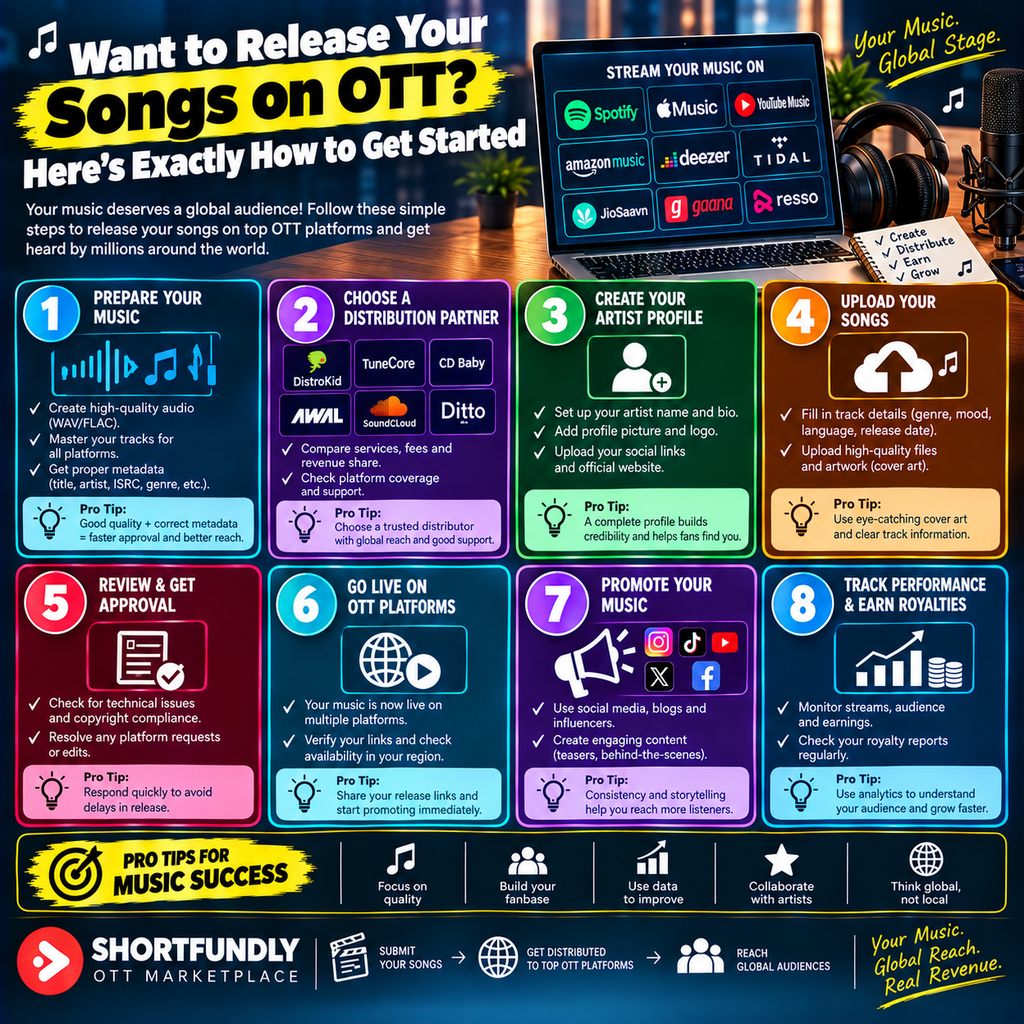
Secure the rights → finalize the master → prepare artwork → create accurate metadata → obtain identifiers → choose a distributor → submit the release → complete quality checks → promote the song → monitor analytics → manage revenue and rights.
The most important principle is preparation.
A technically polished song with accurate metadata and properly documented rights has a much stronger foundation for digital distribution than a rushed upload.
For independent artists, OTT song distribution also creates an opportunity to think beyond a single release. Every song can become part of a larger catalog, and every release can generate data that helps improve the next one.
Shortfundly Distribution can be considered as part of that strategy for eligible songs and video songs, particularly when creators are looking for an OTT-oriented distribution route. Current platform availability, pricing, eligibility, and agreement terms should always be checked before submission.
The digital music landscape continues to evolve, but the fundamentals remain clear: own your rights, protect your catalog, prepare professional assets, choose distribution carefully, promote consistently, and use data to make smarter release decisions.
With those foundations in place, we can turn a finished song into a properly prepared digital release and create more opportunities for listeners around the world to discover it.