Table of Contents
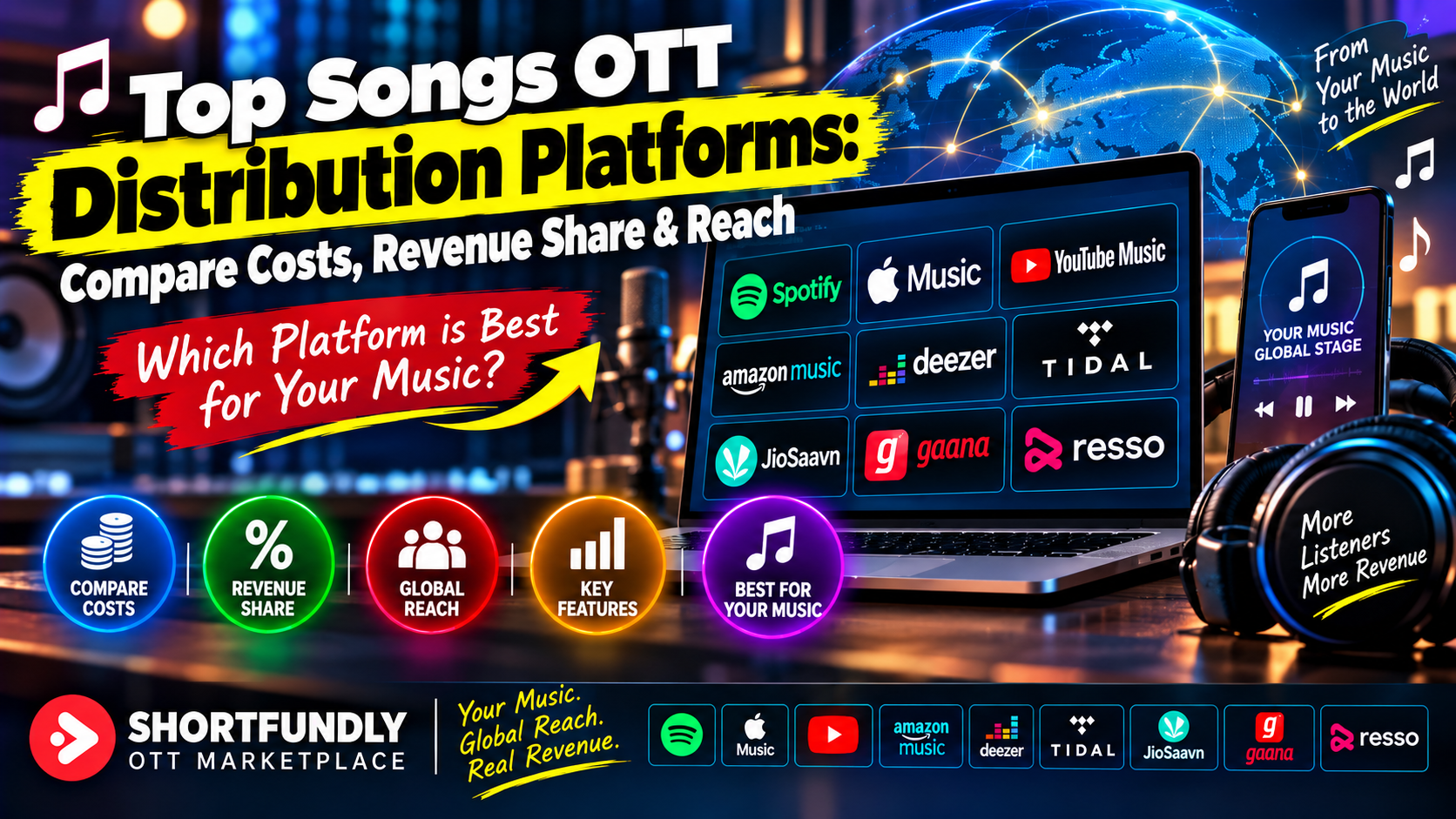
Songs OTT Distribution Platforms help artists reach global listeners. Compare distribution costs, revenue models, reach, metadata, analytics, and OTT strategies in 2026.
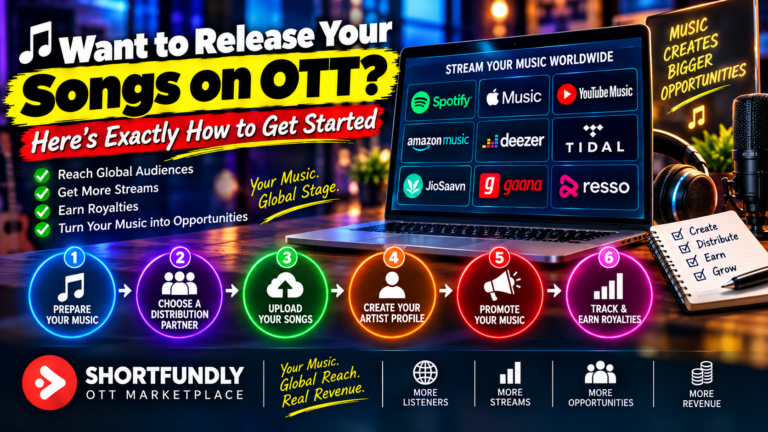
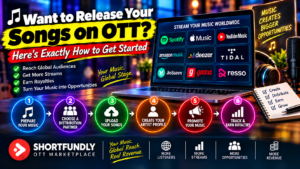
The growth of digital music has made songs OTT distribution platforms an important part of the modern music business. Independent artists, singers, composers, producers, labels, and rights holders can now distribute music to audiences across countries without relying entirely on traditional record-label structures.
But choosing where and how to distribute a song isn’t as simple as selecting a platform and uploading an audio file. The real decision involves distribution cost, revenue share, audience reach, rights ownership, metadata, analytics, release tools, playlist opportunities, and regional availability.
We also need to distinguish between a music streaming platform and a music distributor. Spotify, Apple Music, YouTube Music, and Amazon Music are destinations where audiences consume music. A distributor or aggregator is the intermediary that delivers the recording, metadata, rights information, and other assets to those services. YouTube’s own documentation explains that digital aggregators can prepare metadata, make DDEX deliveries, provide licensing and analytics support, and report earnings.
For independent creators, that distinction matters because the distributor’s pricing and revenue terms can be very different from the streaming service’s own royalty system.
In this guide, we’ll compare 11 major music distribution destinations and distribution options, explain how their economics work, examine global and regional reach, and show how we can build a practical release strategy in 2026.
Comprehensive Article Outline
| Section | Topic Covered |
|---|---|
| 1 | Understanding songs OTT distribution platforms |
| 2 | How music distribution actually works |
| 3 | Distribution platform comparison |
| 4 | Spotify |
| 5 | Apple Music |
| 6 | YouTube Music |
| 7 | Amazon Music |
| 8 | Regional and India-focused platforms |
| 9 | Distributor and aggregator costs |
| 10 | Revenue-share models |
| 11 | Global reach and audience discovery |
| 12 | Metadata and technical delivery |
| 13 | Analytics and artist tools |
| 14 | Rights and licensing |
| 15 | How Shortfundly Distribution fits into the ecosystem |
| 16 | How to choose the right distribution route |
| 17 | Release strategy |
| 18 | Common mistakes |
| 19 | Cost comparison framework |
| 20 | Revenue comparison framework |
| 21 | FAQs |
| 22 | Conclusion |
1. What Are Songs OTT Distribution Platforms?
Songs OTT distribution platforms are digital services through which listeners can access music over the internet rather than purchasing a physical copy or relying on traditional broadcast schedules.
The modern ecosystem includes:
- Music streaming services
- Video streaming platforms
- Ad-supported music services
- Subscription music services
- Regional streaming applications
- Digital music stores
- Social video platforms
- Connected-TV music environments
- Artist-focused digital services
However, an artist generally doesn’t negotiate separately with every platform.
Instead, a music distributor or aggregator can deliver recordings to multiple destinations. The distributor manages technical delivery and metadata, while the platforms provide the audience-facing streaming environment.
This distinction is crucial when comparing costs.
Streaming Platform Cost vs Distribution Cost
A common mistake is to ask, “How much does Spotify charge to upload a song?”
That isn’t usually the right question.
The more useful question is:
How much does our chosen distributor charge to deliver and administer the song across the platforms we want to reach?
Different distributors can use different commercial structures.
Some may charge:
- Annual subscriptions
- Per-release fees
- Per-album fees
- Percentage commissions
- Hybrid fees
- Service charges
- Optional marketing fees
YouTube’s official guidance confirms that music aggregators commonly use either flat fees or a percentage of royalties collected on behalf of creators.
Therefore, comparing distributors only by their headline price can be misleading.
A low upfront fee may come with a royalty commission, while a higher fee may allow the artist to retain more of the generated revenue.
2. How Music OTT Distribution Works in 2026
The process generally follows a straightforward chain:
Artist → Distributor/Aggregator → Streaming Platform → Listener → Royalty Reporting → Rights Holder
We first prepare the recording and establish that we have the required rights.
Then we prepare:
- Audio master
- Cover artwork
- Artist information
- Song title
- Composer details
- Lyricist details
- Producer information
- Copyright information
- Release date
- Genre
- Language
- ISRC
- Other identifiers
- Explicit-content information
The distributor then sends the release to selected services.
Amazon Music, for example, states that digital music is delivered to Amazon Music by distributors and licensed vendors, and it recommends that artists work with a distributor that meets their delivery requirements.
After delivery, the platform processes the release and makes it available according to its own technical, editorial, territorial, and commercial rules.
Revenue then flows from the platform to the appropriate rights holders and intermediaries.
Spotify explains that recording royalties generally flow to the rightsholder selected by the artist, such as a label or distributor, while publishing royalties follow a separate path involving publishers, performance-rights organizations, and mechanical agencies.
That means a song can generate different types of rights income, and we shouldn’t treat all music revenue as one single payment.
3. Top 11 Songs OTT Distribution Platforms to Consider in 2026
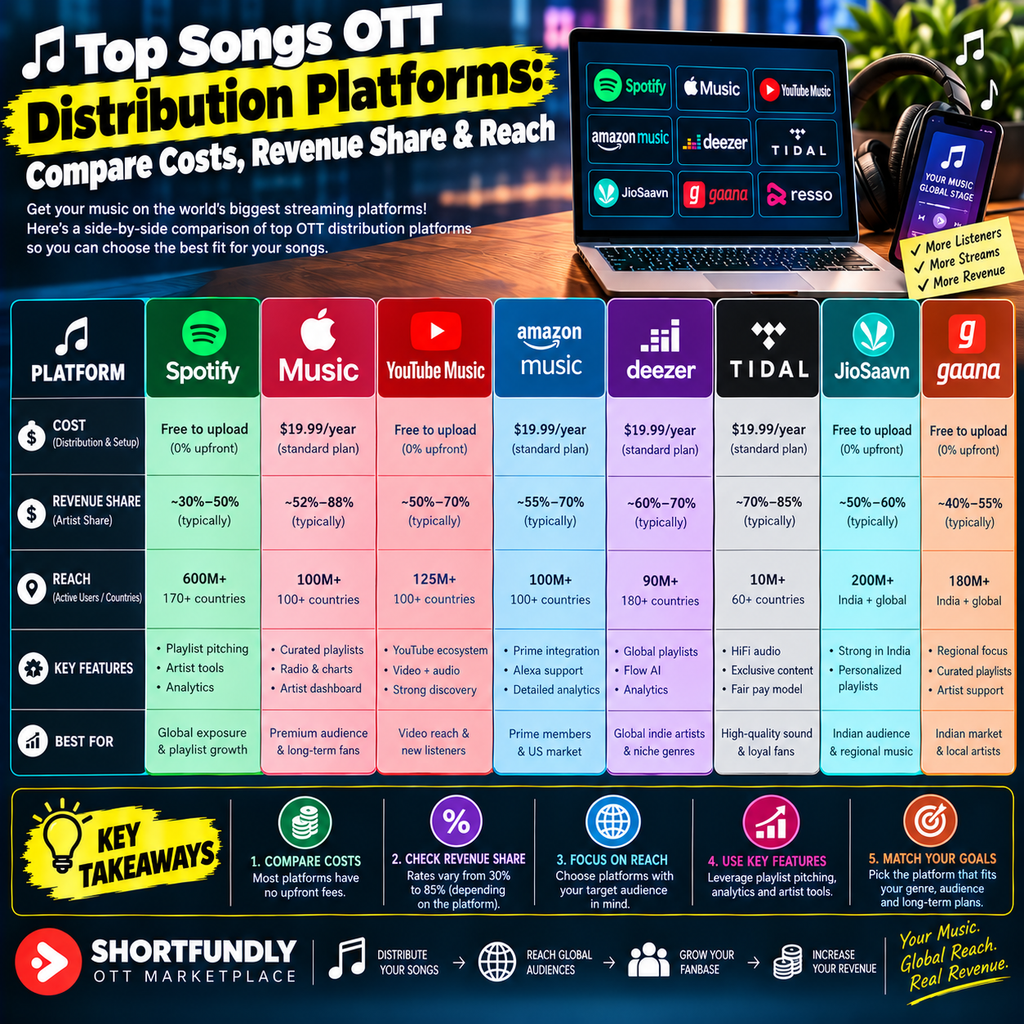
The following comparison focuses on audience reach, distribution accessibility, monetization structure, analytics, and strategic usefulness rather than claiming that one service is universally better than another.
| Platform / Route | Primary Strength | Cost to Artist | Revenue Model | Reach |
|---|---|---|---|---|
| Spotify | Global streaming and discovery | Usually distributor-dependent | Streamshare-based royalties | Global |
| Apple Music | Premium streaming ecosystem | Distributor-dependent | Rights-holder royalties | Global |
| YouTube Music | Music + video ecosystem | Distributor-dependent | Ads + Premium ecosystem | Global |
| Amazon Music | Streaming + Amazon ecosystem | Distributor-dependent | Usage-based royalties | Global |
| JioSaavn | Strong India/South Asia relevance | Distributor-dependent | Platform/licensing model | Regional + international |
| Gaana / regional services | Indian audience reach | Distributor-dependent | Platform-specific | India-focused |
| Deezer | International streaming | Distributor-dependent | Streamshare-based model | International |
| Regional OTT/music apps | Local-language discovery | Varies | Platform-specific | Regional |
| Digital music stores | Purchase/download opportunities | Distributor-dependent | Sales + licensing | International |
| Social music ecosystems | Discovery and virality | Varies | Platform-specific | Global |
| OTT distribution partners | Broader digital content delivery | Service-dependent | Agreement-based | Depends on network |
The table should be treated as a strategic comparison, not a fixed price list. Platform availability, distributor pricing, territories, and commercial terms can change.
4. Spotify: Global Reach and Streamshare Economics
Spotify remains one of the most important destinations for artists seeking international streaming exposure.
The platform’s royalty system is particularly important to understand because Spotify does not operate on a universal fixed “per-stream price.”
Spotify explains that royalties are calculated according to streamshare, meaning a rightsholder’s share of total eligible streams rather than a fixed amount assigned to every individual play.
That makes revenue forecasting more complicated, but it also means we shouldn’t use simplistic “one stream equals X amount” calculations when preparing a business plan.
Why Spotify Matters
Spotify offers:
- Global audience access
- Editorial playlists
- Algorithmic discovery
- Personalized recommendations
- Artist analytics
- Release promotion tools
- Regional audience insights
Spotify reported that it paid more than $11 billion to the music industry in 2025, while independent artists and labels accounted for roughly half of royalties according to its 2026 reporting.
For Indian creators, the platform is especially relevant.
Spotify reported that royalties generated by Indian artists increased 29% year over year in 2025, while more than 40% of royalties earned by Indian artists came from listeners outside India.
That makes Spotify particularly interesting for regional-language artists who want international listeners.
Cost Consideration
Spotify itself isn’t generally the party charging an independent artist a simple upload fee. Distribution is commonly handled through a label, distributor, or aggregator.
Therefore, we should compare the distributor’s fee and revenue terms, not assume Spotify itself sets the artist’s distribution price.
5. Apple Music: Premium Streaming and Worldwide Distribution
Apple Music is another major destination for professional music distribution.
Apple has stated that it pays the same headline royalty rate to labels regardless of whether they are major or independent, with its published royalty information historically describing a 52% headline rate to labels.
However, that figure shouldn’t be interpreted as a guaranteed amount an individual artist receives.
The artist’s actual income depends on the contractual chain between:
Apple Music → Label/Distributor → Artist/Rights Holders
If an artist has a label agreement, management agreement, publishing arrangement, or distributor commission, the final amount received by the artist can differ.
Apple Music Advantages
Apple Music can be useful for:
- Premium streaming audiences
- International distribution
- High-quality audio ecosystems
- Artist profile development
- Catalog distribution
- Music discovery
For an independent artist, Apple Music is often best approached as part of a multi-platform distribution strategy rather than as a standalone release destination.
6. YouTube Music: The Music and Video Connection
YouTube Music has a major advantage: it connects music consumption with the broader YouTube ecosystem.
YouTube states that music content can generate revenue through advertising on YouTube and through YouTube Music Premium.
That creates several opportunities.
A single song can potentially exist as:
- Official audio
- Art track
- Music video
- Lyric video
- Live performance
- Shorts content
- Behind-the-scenes video
- Interview content
Why YouTube Music Is Different
Unlike a traditional audio-only service, YouTube allows artists to build an audience through both music consumption and video discovery.
YouTube also offers Official Artist Channels that bring together an artist’s content and subscribers across relevant YouTube music surfaces.
This makes YouTube particularly valuable for artists who are comfortable creating visual content around their songs.
Distribution Requirement
Even if an artist uploads a music video independently, YouTube explains that audio files and metadata may still need to be delivered through a digital music distributor for the music to be fully published across YouTube and YouTube Music.
So, uploading a video and distributing the official recording aren’t necessarily the same process.
7. Amazon Music: Strong Ecosystem and Artist Analytics
Amazon Music is another important destination for digital music distribution.
Amazon states that digital music reaches its service through distributors and licensed vendors.
The platform also provides Amazon Music for Artists, which offers artist profiles, statistics, promotional tools, and release-related features.
Amazon Music for Artists allows artists and teams to:
- Claim artist profiles
- Review statistics
- Manage team access
- Pitch eligible new releases
- Promote music
- Understand audience activity
Amazon says eligible new music can be pitched for global curation and programming consideration, subject to its eligibility rules.
Revenue Model
Amazon explains that royalties are paid to rights holders based on usage in the relevant country and subscription tier, after which rights holders distribute payments according to their agreements with artists.
Again, the lesson is simple: platform royalty economics and distributor economics are separate questions.
8. JioSaavn and Regional Music Distribution in India
For Indian artists, global services aren’t the only consideration.
Regional platforms can be extremely important when a song is designed for audiences in:
- Tamil
- Telugu
- Hindi
- Malayalam
- Kannada
- Bengali
- Punjabi
- Marathi
- Gujarati
- Bhojpuri
- Other Indian languages
A regional strategy can sometimes generate stronger audience relevance than simply focusing on international platforms.
This is especially important for independent musicians producing songs for local cultural markets.
Why Regional Reach Matters
Regional-language music can benefit from:
- Local playlist discovery
- Language-specific searches
- Cultural relevance
- Regional influencers
- Local radio promotion
- Film and entertainment ecosystems
- Local social-media communities
Spotify’s 2026 India reporting provides evidence of growing international demand for Indian-language music, noting that major Indian languages contributed to royalty growth and that a substantial share of Indian artists’ royalties came from listeners outside India.
Therefore, regional music distribution and global distribution aren’t competing strategies.
They can work together.
9. Deezer and International Music Distribution
Deezer can also form part of an international music distribution strategy.
For artists, the key consideration isn’t simply whether a distributor delivers to Deezer.
We should examine:
- Territory coverage
- Royalty reporting
- Metadata support
- Release scheduling
- Artist-profile tools
- Distributor commissions
- Contract duration
The value of a platform depends heavily on where our listeners actually are.
If analytics show meaningful audience demand in a specific market, expanding distribution and promotion in that market may make more commercial sense than blindly adding every available platform.
10. What Does Music Distribution Cost?
This is where many comparisons go off the rails.
There isn’t one universal OTT music distribution cost.
Instead, there are several pricing models.
Model 1: Annual Subscription
We pay a recurring fee for access to distribution services.
Model 2: Per-Release Fee
We pay separately for each single, EP, or album.
Model 3: Revenue Share
The distributor collects revenue and retains an agreed percentage.
Model 4: Hybrid
We pay a service fee and also share a percentage of revenue.
Model 5: Premium Distribution
Higher-cost services may include additional support such as:
- Marketing
- Playlist pitching
- Rights administration
- Label services
- Account management
- Analytics
- Funding
- Release strategy
YouTube’s official documentation confirms that aggregator pricing can involve either flat fees or a percentage of royalties, with rates varying between providers.
The Real Cost Calculation
Instead of asking:
“Which distributor is cheapest?”
we should calculate:
Total distribution cost = upfront fees + recurring fees + royalty commission + optional services + administrative costs
That gives us a much more useful comparison.
11. Revenue Share: What Artists Actually Need to Compare
Revenue share is another area where misunderstandings are common.
A distributor might advertise that an artist keeps a certain percentage of revenue.
But we need to ask:
- Revenue from which platform?
- Gross or net revenue?
- Which territories?
- Which rights?
- Are taxes deducted?
- Are payment-processing charges deducted?
- Does the percentage apply to recording royalties only?
- Does publishing revenue remain separate?
- Are YouTube claims included?
- Are neighboring rights included?
Spotify explains that recording and publishing royalties are separate categories.
So a distribution agreement covering the sound recording doesn’t automatically mean it controls every possible right associated with the composition.
Example
Suppose a distributor retains 15% of eligible recording revenue.
If the recording generates ₹100,000 through the applicable revenue pool:
- Gross recording revenue: ₹100,000
- Distributor share: ₹15,000
- Remaining recording revenue: ₹85,000
But this doesn’t mean the songwriter automatically receives ₹85,000.
Other parties may have contractual or statutory claims.
That’s why revenue share percentages should never be viewed in isolation.
12. Global Reach vs Regional Reach
The best distribution strategy depends on the audience.
A Tamil independent song might have a strong audience in:
- Tamil Nadu
- Singapore
- Malaysia
- Sri Lanka
- Gulf countries
- Europe
- North America
A Punjabi song might attract audiences across India, Canada, the UK, Australia, and other markets.
Therefore, the distribution strategy should reflect listener geography, not just platform popularity.
Global Distribution Strategy
For international songs, prioritize:
- Major global streaming services
- International metadata
- English-language promotional assets
- International social media
- Playlist pitching
- Diaspora marketing
Regional Distribution Strategy
For regional songs, prioritize:
- Regional streaming services
- Local playlists
- Language-specific metadata
- Regional influencers
- Local press
- Cultural events
- Regional short-form video campaigns
The strongest approach is often a combination of both.
13. Metadata Is a Major Part of Distribution Quality
A great song can still experience distribution problems if its metadata is wrong.
We should carefully verify:
- Artist name
- Song title
- Album title
- Composer
- Lyricist
- Producer
- Language
- Genre
- Release date
- Copyright
- ISRC
- Version information
- Explicit-content status
Amazon notes that artist-profile and catalog corrections can depend on metadata delivered by the distributor through its delivery systems.
That illustrates why metadata isn’t just an administrative field.
It directly affects how music appears in digital catalogs.
Metadata Mistakes to Avoid
Avoid:
- Misspelled artist names
- Incorrect artist profiles
- Duplicate releases
- Wrong release dates
- Missing songwriter credits
- Incorrect language
- Unauthorized featured-artist names
- Incorrect version labels
Good metadata creates a cleaner catalog and reduces correction work later.
14. Audio Quality and Technical Delivery
Before distribution, we should prepare the highest-quality approved master available.
Important considerations include:
- File format
- Sample rate
- Bit depth
- Stereo configuration
- Mastering quality
- Loudness
- Clipping
- Silence at beginning/end
- Track duration
- Version labeling
The exact technical requirements vary by distributor and platform.
Therefore, we shouldn’t blindly follow specifications from an unrelated service.
Instead, we should use the current delivery requirements provided by our selected distributor.
15. How Shortfundly Distribution Fits Into the OTT Ecosystem
Shortfundly Distribution can be considered when evaluating OTT distribution options for songs and other digital entertainment content.
Shortfundly states that its distribution service supports content types including songs/video songs, short films, web series, movies, documentaries, telefilms, pilot films, and micro dramas. It also describes a workflow involving content submission, review, distribution through currently available partners, and tracking of content and earnings.
For creators, the important point is to evaluate the actual agreement and current partner availability for the specific release.
Shortfundly states that its current OTT distribution fees vary by content type and duration and that applicable GST is displayed through its pricing system.
Its public information also describes revenue through ticket purchases and revenue-sharing arrangements, with specific commercial terms depending on the applicable agreement.
That makes it important to distinguish OTT distribution for audiovisual content from conventional audio-only music aggregation.
For a song or video song, creators should confirm:
- Eligible content format
- Available partner platforms
- Current pricing
- Rights terms
- Revenue-share structure
- Delivery requirements
- Territory coverage
- Payout terms
Current availability should always be confirmed before submission because distribution networks can change.
16. How to Choose the Right Music Distribution Platform
We can evaluate a distributor using a simple scorecard.
| Factor | Question |
|---|---|
| Platform coverage | Does it deliver where our audience listens? |
| Price | What will we actually pay? |
| Commission | What percentage is retained? |
| Rights | Do we retain ownership? |
| Contract | Is the agreement exclusive? |
| Reporting | Can we understand our earnings? |
| Payouts | When and how are we paid? |
| Metadata | Does the service handle corrections? |
| Support | Can we get human assistance? |
| Analytics | What data is available? |
| Release tools | Can we schedule releases? |
| Marketing | Are promotional services included? |
We shouldn’t select a distributor solely because it has the lowest advertised fee.
A slightly more expensive service can make sense if it provides better delivery, support, reporting, or rights administration.
On the other hand, we shouldn’t pay for services we don’t need.
17. How to Build a Professional Song Release Strategy
A successful distribution process starts before release day.
30–45 Days Before Release
Prepare:
- Final master
- Artwork
- Metadata
- Rights documentation
- Artist biography
- Promotional assets
- Short-form videos
15–30 Days Before Release
Submit the song to the distributor.
Check:
- Delivery status
- Metadata
- Artist profile
- Release date
- Platform availability
7–14 Days Before Release
Begin promotional activity.
Publish:
- Teasers
- Artwork reveals
- Short clips
- Behind-the-scenes content
- Pre-release announcements
Release Week
Coordinate:
- Social posts
- Video uploads
- Artist messages
- Playlist pitching
- Influencer outreach
- Audience engagement
After Release
Monitor:
- Streams
- Listeners
- Saves
- Shares
- Playlist activity
- Geographic performance
- Revenue
The work doesn’t stop when the song becomes available.
18. How Analytics Improve Music Distribution Decisions
Analytics turn distribution from guesswork into a measurable process.
We can use performance data to answer questions such as:
- Which country produces the most listeners?
- Which city is growing fastest?
- Which language performs best?
- Which release generates the highest engagement?
- Which platform delivers the strongest audience?
- Which promotional campaign generated traffic?
- Which song deserves another promotional push?
Amazon Music for Artists, for example, provides artist and team access to statistics and other tools for understanding activity around an artist’s music.
We should compare data over time rather than reacting to a single day’s results.
19. Common Music Distribution Mistakes
Mistake 1: Choosing Based Only on Price
The cheapest distributor isn’t automatically the most economical.
Mistake 2: Ignoring Contract Terms
Ownership, exclusivity, duration, and takedown provisions matter.
Mistake 3: Using Poor Metadata
Catalog errors can become difficult to correct after multiple releases.
Mistake 4: Confusing Streams With Profit
High streaming volume doesn’t automatically equal high artist income.
Mistake 5: Ignoring Publishing
Recording rights and composition rights can generate separate income.
Mistake 6: Releasing Without Promotion
Distribution creates availability. Marketing creates awareness.
Mistake 7: Ignoring Regional Markets
Local-language audiences can be valuable growth markets.
Mistake 8: Uploading at the Last Minute
Technical corrections can take time.
Mistake 9: Assuming Every Platform Pays the Same Way
Royalty systems differ.
Mistake 10: Failing to Maintain Rights Records
Contracts, split sheets, licenses, and ownership documents should be organized.
20. Cost Comparison Framework for Songs OTT Distribution Platforms
Rather than publishing unreliable fixed prices, we can use a practical comparison model.
| Cost Category | Questions to Ask |
|---|---|
| Setup fee | Is there an initial charge? |
| Single release | Is each song charged separately? |
| Album release | Is album pricing different? |
| Annual fee | Is there a recurring subscription? |
| Revenue share | What percentage is retained? |
| Withdrawal fee | Are payouts subject to charges? |
| Marketing | Are promotional services extra? |
| Rights management | Is administration included? |
| Content ID | Is it included or separately charged? |
| Takedown | Is removal free or paid? |
| Territory | Are international territories included? |
This framework helps us calculate the true cost of distribution.
For example, a distributor charging ₹1,500 with no royalty commission may produce a different long-term outcome from a service charging no upfront fee but retaining 15% of revenue.
The correct choice depends on the artist’s expected catalog size and revenue.
21. Revenue Comparison Framework
Revenue should also be compared across multiple dimensions.
| Revenue Factor | What We Should Examine |
|---|---|
| Recording royalties | Income from the master |
| Publishing royalties | Income from composition |
| Performance royalties | Public-performance income |
| Mechanical royalties | Applicable reproduction rights |
| Video monetization | Advertising/Premium revenue |
| Licensing | Commercial licensing |
| Synchronization | Film/TV/video usage |
| Direct sales | Purchases where available |
| OTT licensing | Negotiated content deals |
| Brand partnerships | Commercial collaborations |
This broader view prevents us from reducing music monetization to streaming alone.
Spotify’s official royalty explanation is particularly useful here because it separates recording royalties from publishing royalties and explains the different paths those payments take.
22. FAQs About Songs OTT Distribution Platforms
1. What are the best songs OTT distribution platforms in 2026?
There isn’t one universal best platform for every artist. Spotify, Apple Music, YouTube Music, Amazon Music, regional streaming services, and other destinations serve different audiences and business models. The right combination depends on genre, language, territory, audience behavior, and distribution agreement.
2. How much does it cost to distribute a song?
The cost depends primarily on the distributor or aggregator rather than the streaming platform. Pricing may involve annual subscriptions, per-release fees, revenue sharing, or hybrid models. YouTube notes that aggregators commonly use flat fees or royalty percentages.
3. Do music streaming platforms pay a fixed amount per stream?
Not necessarily. Spotify explicitly states that it does not use a universal fixed per-stream rate and instead calculates royalties using streamshare.
4. Can independent artists distribute songs without a record label?
Yes. Independent artists can work with digital distributors and aggregators that deliver music to streaming services. Amazon Music, for example, lists multiple independent distribution options for artists.
5. Is YouTube Music different from YouTube?
Yes. YouTube and YouTube Music are connected but serve different consumption experiences. Music can generate revenue through advertising on YouTube, while YouTube Music Premium provides another revenue stream for music content.
6. Can Indian-language songs reach international audiences?
Yes. Digital distribution makes international access possible, and Spotify’s 2026 India reporting shows substantial overseas listening and royalty generation for Indian artists.
7. Should we distribute a song to every available platform?
Not automatically. Broad distribution can be useful, but we should prioritize platforms that match our target audience and commercial goals.
8. Does music distribution mean we lose ownership?
Not necessarily. Ownership depends on the agreement. We should carefully check whether a distributor receives ownership, an exclusive license, or a non-exclusive distribution authorization.
9. Can Shortfundly Distribution distribute songs?
Shortfundly publicly lists songs/video songs among supported content types and provides an OTT distribution workflow for eligible content. Availability, pricing, licensing, and partner coverage depend on the current submission process and agreement.
10. How long does music distribution take?
There isn’t one universal timeline. Distributor delivery schedules and platform processing times vary. Amazon Music says that once content is delivered to it, it makes every effort to have content live within 24 hours, although delays can occur.
11. What metadata is needed for music distribution?
Common fields include song title, artist name, album, composer, lyricist, producer, genre, language, release date, copyright information, and identifiers such as ISRC. Additional fields can depend on the distributor and destination platform.
12. Should we focus on global or regional platforms?
We should use audience data to decide. For a regional-language song, regional services and local promotion can be valuable, while global services can provide international and diaspora reach. In many cases, using both approaches creates a broader strategy.
Also read: https://blog.shortfundly.com/ott/telefilm-ott-distribution-3/
23. Final Conclusion: Building a Strong Songs OTT Distribution Strategy
The modern music business is no longer built around a single release channel.
A professional songs OTT distribution strategy combines multiple digital destinations, accurate metadata, rights administration, reliable distribution infrastructure, audience analytics, and targeted promotion.
Spotify offers massive international streaming reach and uses a streamshare-based royalty system. Apple Music provides a major premium streaming environment. YouTube Music combines audio discovery with the enormous YouTube video ecosystem. Amazon Music provides streaming access alongside artist analytics and promotional tools. Regional services can add important local-language reach.
The central lesson is that platform reach and distributor economics are different things.
When comparing distribution options, we should examine the complete financial picture:
Upfront cost + recurring cost + revenue share + rights terms + services + reporting + payout structure
We should also examine the audience picture:
Country + language + genre + listener behavior + platform usage + promotional opportunities
For independent creators, this approach is much more useful than simply asking which platform is “number one.”
A successful release starts with a high-quality master, accurate metadata, verified rights, professional artwork, and a carefully selected distribution route.
From there, we can build a release calendar, promote the song through multiple channels, monitor performance, and use analytics to guide future releases.
Shortfundly Distribution can also be evaluated where OTT delivery of eligible songs or video songs fits the project’s objectives. Its current public information describes support for songs/video songs and other entertainment formats, along with content review, distribution, and earnings-tracking workflows.
Most importantly, we should treat every song as an asset within a larger catalog rather than as a one-time upload.
When distribution, rights, promotion, analytics, and monetization work together, independent artists can build a stronger digital presence and create more opportunities for their music to travel across local, national, and international audiences.
For current distributor and platform requirements, creators should always verify the latest terms directly with the relevant service before committing rights or release dates.