Table of Contents
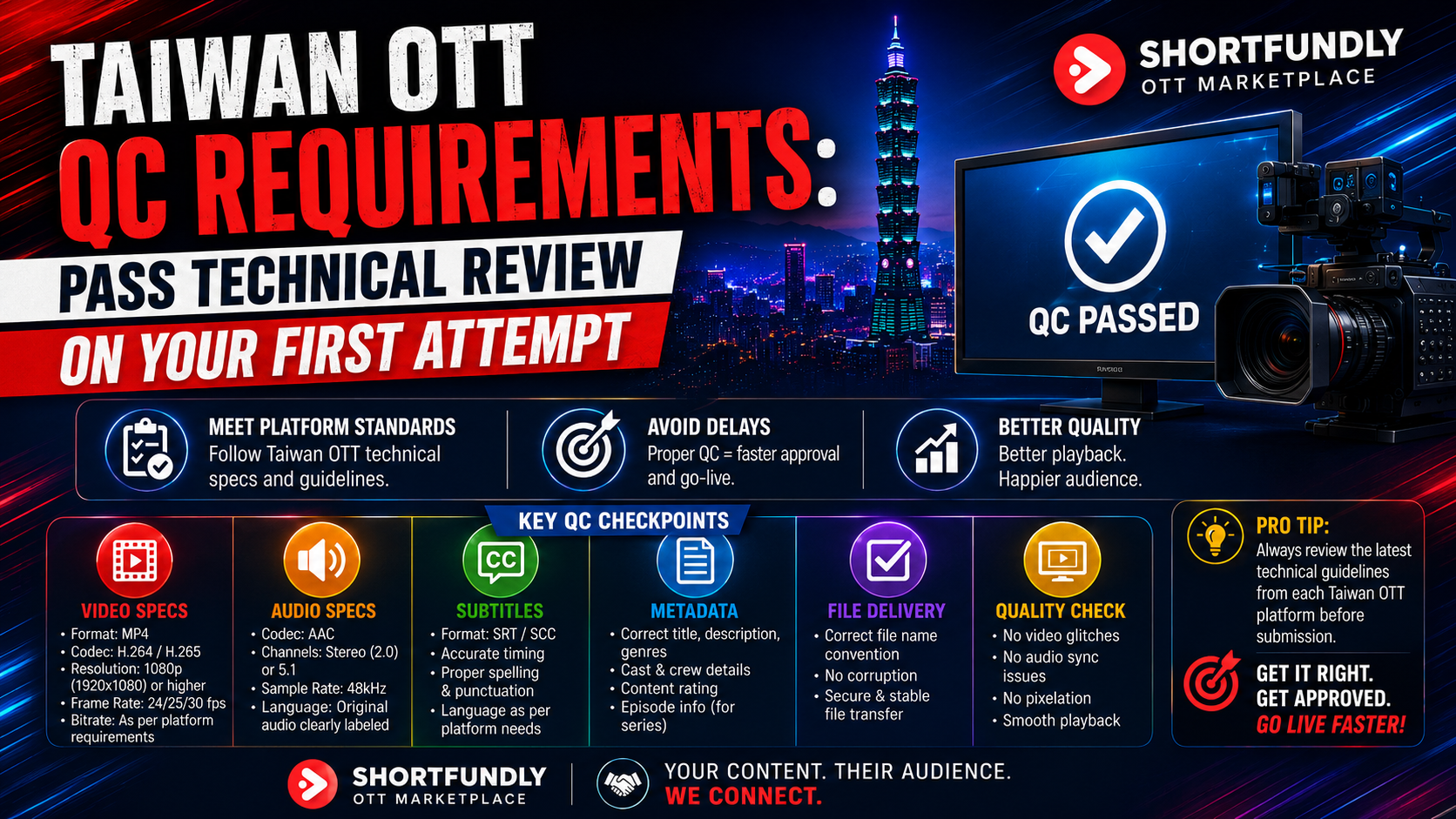
Learn the essential Taiwan OTT QC requirements for video, audio, subtitles, metadata, artwork, and delivery files. Follow this practical checklist to reduce technical rejections and prepare your film for OTT distribution through services such as Shortfundly Distribution.
Getting a film ready for Taiwan OTT distribution involves more than uploading a finished video. Streaming platforms and distribution partners need technically compliant files, accurate metadata, usable subtitles, clean audio, and professional artwork.
A strong production can still face delays when a master file contains technical errors. Therefore, we should treat quality control, or QC, as a dedicated stage of the distribution process.
This guide covers the major areas creators should review before submitting a film for Taiwan OTT distribution.
What Does OTT QC Mean?
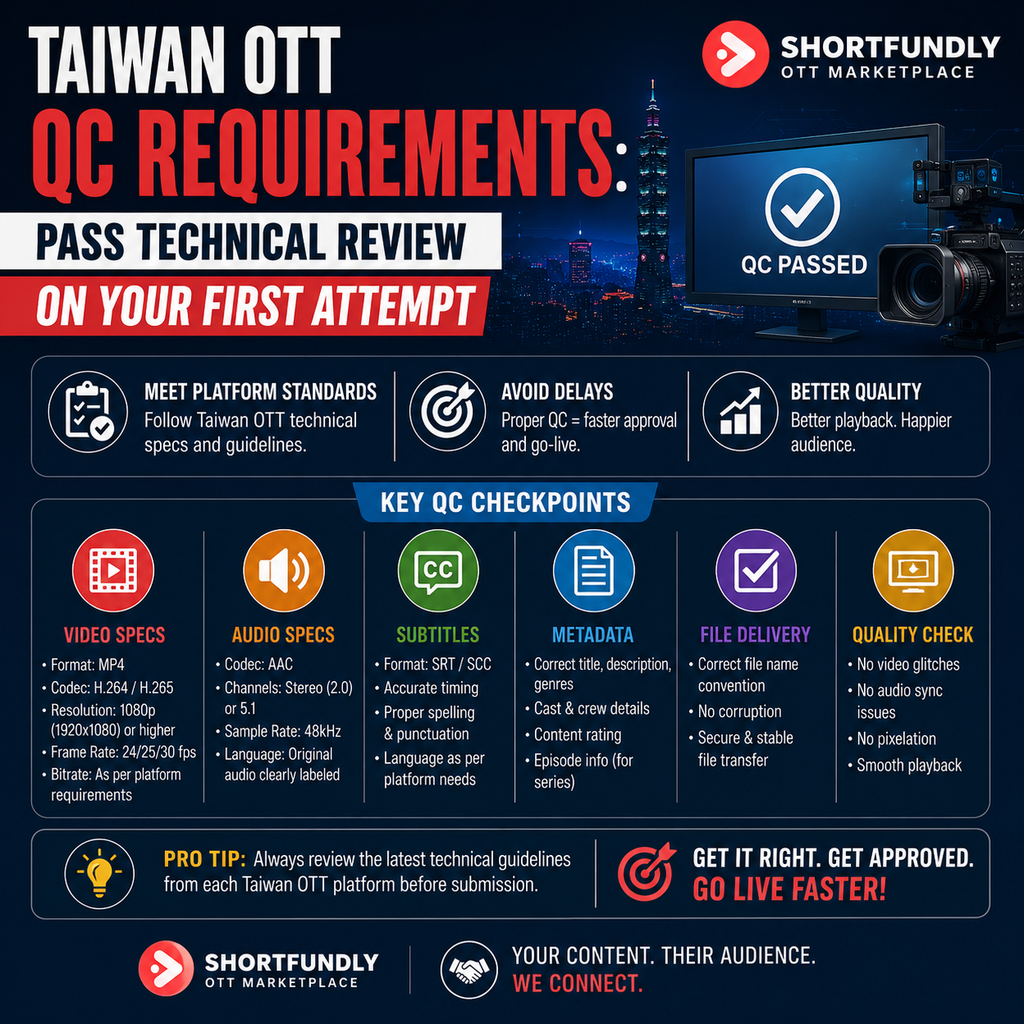
OTT quality control is the technical review performed before content reaches a streaming audience.
The review can cover several areas:
- Video quality
- Audio quality
- Subtitle accuracy
- Caption synchronization
- Metadata
- Artwork
- File specifications
- Content integrity
- Legal delivery materials
- Technical consistency
QC requirements can vary between platforms and distributors. Consequently, we should always confirm the latest delivery specifications with the intended buyer or distribution partner.
A useful approach is to prepare a professional master first. Then, we can create platform-specific versions from that approved master.
Taiwan OTT QC Requirements Checklist
Before submitting a film, we should inspect at least these areas:
| QC Area | What to Check |
|---|---|
| Video | Resolution, aspect ratio, frame rate |
| Picture | Focus, exposure, compression, artifacts |
| Audio | Levels, clarity, synchronization |
| Subtitles | Translation, timing, spelling |
| Captions | Completeness and synchronization |
| Metadata | Title, synopsis, cast, credits |
| Artwork | Dimensions, readability, branding |
| File | Codec, container, naming |
| Credits | Correct names and roles |
| Content | Missing frames or scenes |
| Language | Correct audio and subtitle tracks |
| Legal | Rights and clearances |
| Technical | Start, end, transitions |
| Versioning | Correct final master |
| Delivery | Platform-specific requirements |
The exact technical parameters should come from the platform or distributor because specifications can change.
1. Prepare the Correct Video Master
The video master forms the foundation of the entire OTT delivery package.
We should begin with the highest-quality source available. Avoid repeatedly exporting and recompressing the same file.
Every additional compression cycle can introduce unwanted artifacts.
Before delivery, we should confirm:
- Final resolution
- Aspect ratio
- Frame rate
- Codec
- Bitrate
- Color space
- Container format
- Progressive or interlaced structure
A professional master should also contain the complete program from beginning to end.
We should never assume that a file is correct simply because it plays on a laptop.
A file can play normally while still containing technical problems that become visible during professional QC.
2. Check Resolution and Aspect Ratio
Resolution and aspect ratio are among the first technical details we should verify.
The final picture should maintain the intended composition throughout the program.
For example, an incorrectly configured export can cause:
- Letterboxing
- Pillarboxing
- Cropping
- Stretching
- Distortion
- Incorrect framing
The picture should not suddenly change shape between scenes.
We should also inspect graphics and titles at the edges of the frame. Important information should remain comfortably within the visible picture area.
If the platform provides a specific resolution requirement, that specification should take priority over a generic delivery standard.
3. Verify Frame Rate and Motion
Frame-rate inconsistencies can create visible motion problems.
We should inspect the master for:
- Jerky movement
- Duplicate frames
- Missing frames
- Unwanted frame interpolation
- Incorrect conversions
- Audio drift
This is especially important when footage comes from multiple cameras.
A film might contain material captured at different frame rates. Therefore, the final master should be checked carefully after editing and export.
We should review fast-moving scenes, camera pans, titles, and transitions.
These areas often reveal problems more quickly than static shots.
4. Inspect Picture Quality Frame by Frame
Automated QC can identify certain problems. However, human viewing remains important.
We should watch the complete program before delivery.
Look for:
- Digital artifacts
- Frozen frames
- Black frames
- Flash frames
- Pixelation
- Banding
- Excessive noise
- Focus problems
- Incorrect exposure
- Color shifts
- Unwanted overlays
A short technical error can be surprisingly expensive if it forces a new delivery.
Therefore, the final master should be treated as a delivery asset rather than merely an editing export.
5. Check Audio Levels and Clarity
Good video cannot compensate for poor audio.
We should listen carefully to dialogue, music, effects, ambience, and transitions.
Common audio QC problems include:
- Clipped dialogue
- Distortion
- Excessive loudness
- Very low dialogue
- Sudden level changes
- Missing channels
- Incorrect channel mapping
- Background noise
- Audio dropouts
Dialogue should remain understandable throughout the program.
We should also check scenes with music or sound effects because dialogue can become difficult to understand when the mix is too dense.
6. Verify Audio-Video Synchronization
Lip-sync errors are immediately noticeable.
We should inspect dialogue-heavy scenes carefully and confirm that spoken words align with mouth movement.
Synchronization problems can occur during:
- Editing
- Frame-rate conversion
- Audio replacement
- Subtitle creation
- Final export
- Version preparation
Even a small sync problem can make an otherwise professional film feel unfinished.
Therefore, synchronization should be checked on the final exported master.
7. Review Subtitle Translation
For international OTT distribution, subtitles can be as important as the video master.
Taiwan-focused delivery may require localized language assets depending on the platform and target audience.
We should check every subtitle file for:
- Correct translation
- Spelling
- Grammar
- Timing
- Reading speed
- Line breaks
- Speaker identification
- Punctuation
- Names
- Place names
- Technical terms
Machine translation should receive human review.
Literal translations can produce awkward dialogue or incorrect meanings. A professional localization pass helps preserve the tone and intent of the original script.
8. Synchronize Subtitles Correctly
Accurate translation isn’t enough.
Subtitles must also appear and disappear at appropriate times.
We should check:
- Subtitle entry time.
- Subtitle exit time.
- Dialogue synchronization.
- Reading duration.
- Line length.
- Scene changes.
A subtitle that appears too early can reveal information before the character speaks.
A subtitle that remains too long can overlap the next line.
Therefore, subtitle timing should be reviewed against the final picture master.
9. Review Metadata Before Submission
Metadata helps platforms identify, categorize, and display content.
A typical OTT metadata package can include:
- Film title
- Alternate title
- Logline
- Synopsis
- Genre
- Language
- Country
- Release year
- Runtime
- Director
- Producer
- Cast
- Writers
- Production company
- Keywords
- Age rating
- Subtitle information
Metadata errors can create avoidable delays.
For example, the runtime in a metadata sheet should match the delivered master.
Similarly, names should remain consistent across the poster, metadata, credits, and other delivery documents.
10. Create Professional OTT Artwork
Artwork represents the film before the viewer presses play.
Therefore, posters and key art should remain sharp and readable at the required platform dimensions.
We should check:
- Correct dimensions
- High-quality source
- Title spelling
- Cast names
- Billing information
- Logos
- Typography
- Safe margins
- Image quality
Avoid adding unnecessary promotional claims.
Artwork should also remain legible when reduced to a small thumbnail.
A poster that looks impressive at full size may become unreadable on a streaming interface.
11. Check Opening and Closing Credits
Credits require careful QC.
We should compare the final master against the approved credit list.
Check:
- Names
- Spelling
- Roles
- Production companies
- Music credits
- Copyright notices
- Legal notices
- Distributor information
Credit mistakes can become difficult to correct after publication.
Therefore, final credits should receive a dedicated review before delivery.
12. Confirm the Final Runtime
Runtime should be consistent across the entire delivery package.
For example, if the video file runs for one hour, the metadata shouldn’t report a substantially different duration.
We should compare:
Final video runtime → Metadata runtime → Synopsis or catalog information
Any mismatch should be corrected before submission.
Runtime also matters when platforms organize programming, collections, or categories.
13. Use Consistent File Naming
Professional file naming makes delivery easier to manage.
A useful naming structure can include:
Title_Version_Language_Master_Date
For example:
FilmTitle_Final_English_Master_2026
Avoid confusing names such as:
final_final2_new_latest.mov
Version control becomes particularly important when multiple subtitle, audio, trailer, and artwork files exist.
We should maintain one clearly identified approved master.
14. Perform a Complete QC Screening
Before submitting, we should watch the entire film.
Don’t rely only on random spot checks.
A full QC screening should identify:
- Picture defects
- Audio problems
- Subtitle issues
- Missing scenes
- Incorrect edits
- Credit errors
- Technical interruptions
- Export problems
We can maintain a QC report containing:
| Timecode | Issue | Severity | Action |
|---|---|---|---|
| 00:14:32 | Audio distortion | High | Re-export |
| 00:27:11 | Subtitle timing | Medium | Retiming |
| 00:42:05 | Color shift | Medium | Regrade |
| 00:58:21 | Credit spelling | High | Correct |
This process makes the final approval stage far more organized.
15. Confirm Platform-Specific Delivery Requirements
There is no universal OTT specification that applies identically to every service.
Requirements may differ by:
- Platform
- Territory
- Distributor
- Content type
- Video resolution
- Audio configuration
- Subtitle language
- Artwork
- Delivery method
For that reason, creators should obtain the current technical delivery sheet before exporting the final package.
For independent filmmakers, a distribution partner can also help organize delivery requirements.
Services such as Shortfundly Distribution can be considered when planning OTT distribution for independent content.
Common Taiwan OTT QC Rejection Reasons
Many technical rejections come from relatively simple mistakes.
Incorrect Video Export
A creator may accidentally export the wrong resolution, frame rate, or codec.
Audio Problems
Clipping, silence, channel errors, and synchronization issues can stop approval.
Subtitle Errors
Incorrect timing, missing dialogue, spelling mistakes, and poor translations can require corrections.
Metadata Mismatches
The runtime, title, language, or credits may differ between submitted assets.
Poor Artwork
Low-resolution posters or incorrect dimensions can delay catalog preparation.
Incorrect Version
Submitting an outdated master can create confusion and additional review cycles.
How to Build a Professional OTT Delivery Package
A strong delivery package should be organized before submission.
A typical structure might look like this:
PROJECT_NAME/
│
├── MASTER/
│   └── Project_Final_Master
│
├── AUDIO/
│   ├── Main_Audio
│   └── Alternate_Audio
│
├── SUBTITLES/
│   ├── English
│   └── Localized_Version
│
├── ARTWORK/
│   ├── Poster
│   └── Key_Art
│
├── TRAILER/
│   └── Official_Trailer
│
├── METADATA/
│   └── Metadata_Sheet
│
└── DOCUMENTS/
    └── Rights_and_Clearances
The exact structure should follow the distributor’s delivery instructions.
OTT QC vs Creative Review
Technical QC isn’t the same as creative review.
Creative review focuses on storytelling, pacing, acting, visuals, and overall presentation.
Technical QC focuses on whether the delivered materials meet technical and operational requirements.
A project can pass creative review while failing technical QC.
Therefore, we should conduct both reviews independently.
How to Reduce Taiwan OTT Distribution Delays
Preparation is the simplest way to reduce avoidable delays.
We should follow a clear workflow:
Edit → Picture Lock → Audio Mix → Subtitles → Artwork → Metadata → QC → Final Export → Delivery
Avoid creating subtitles or artwork before the picture is locked.
Otherwise, later edits can make those assets inaccurate.
Likewise, metadata should be completed after the final runtime and credits are confirmed.
This workflow reduces unnecessary revisions.
Final Taiwan OTT QC Checklist
Before delivery, we should confirm every item below:
- Final master is approved.
- Resolution matches requirements.
- Aspect ratio is correct.
- Frame rate is correct.
- Picture contains no technical defects.
- Audio is clean.
- Audio channels are correct.
- Dialogue is synchronized.
- Subtitles are accurate.
- Subtitle timing is correct.
- Metadata matches the master.
- Runtime is correct.
- Credits are accurate.
- Artwork meets specifications.
- Trailer is final.
- File names are consistent.
- Correct version is being delivered.
- Rights documentation is available.
- Platform-specific requirements have been checked.
Frequently Asked Questions
What are Taiwan OTT QC requirements?
They are technical and delivery standards used to evaluate video, audio, subtitles, metadata, artwork, and related assets before streaming distribution.
Can a short film fail OTT QC?
Yes. Short films can fail QC because of audio defects, incorrect exports, subtitle errors, metadata problems, or other technical issues.
Are Taiwan OTT specifications the same for every platform?
No. Different platforms and distributors can use different delivery specifications.
Do subtitles need QC before OTT submission?
Yes. We should check both translation accuracy and synchronization before submitting localized subtitle files.
Does artwork affect OTT approval?
Artwork can affect catalog readiness. Incorrect dimensions, poor quality, or incorrect text may require replacement.
How can independent filmmakers avoid QC rejection?
We should perform a complete technical screening before submission. A detailed checklist can catch most avoidable delivery errors.
Should we use a distribution partner for Taiwan OTT?
A distribution partner may help organize technical delivery, metadata, localization, and platform submissions. However, the specific services depend on the agreement and distribution model.
When should OTT QC happen?
QC should happen after the picture, audio, subtitles, and other major assets are finalized. A final check should occur immediately before delivery.
Also read: https://blog.shortfundly.com/ott/film-distribution-taiwan-ott/
Conclusion: Prepare for QC Before You Submit
Successful Taiwan OTT distribution begins with a delivery package that is technically accurate, complete, and professionally organized.
We should never treat QC as a last-minute export check. Instead, it should be built into the post-production workflow.
The strongest approach is simple:
Lock the film. Verify the master. Check audio. Review subtitles. Confirm metadata. Prepare artwork. Perform complete QC. Then submit the correct version.
For independent filmmakers, this disciplined approach can reduce avoidable revisions and make OTT delivery much smoother.
Before submission, we can also review available distribution options through Shortfundly Distribution and confirm the current requirements for the intended OTT territories and platforms.