Table of Contents
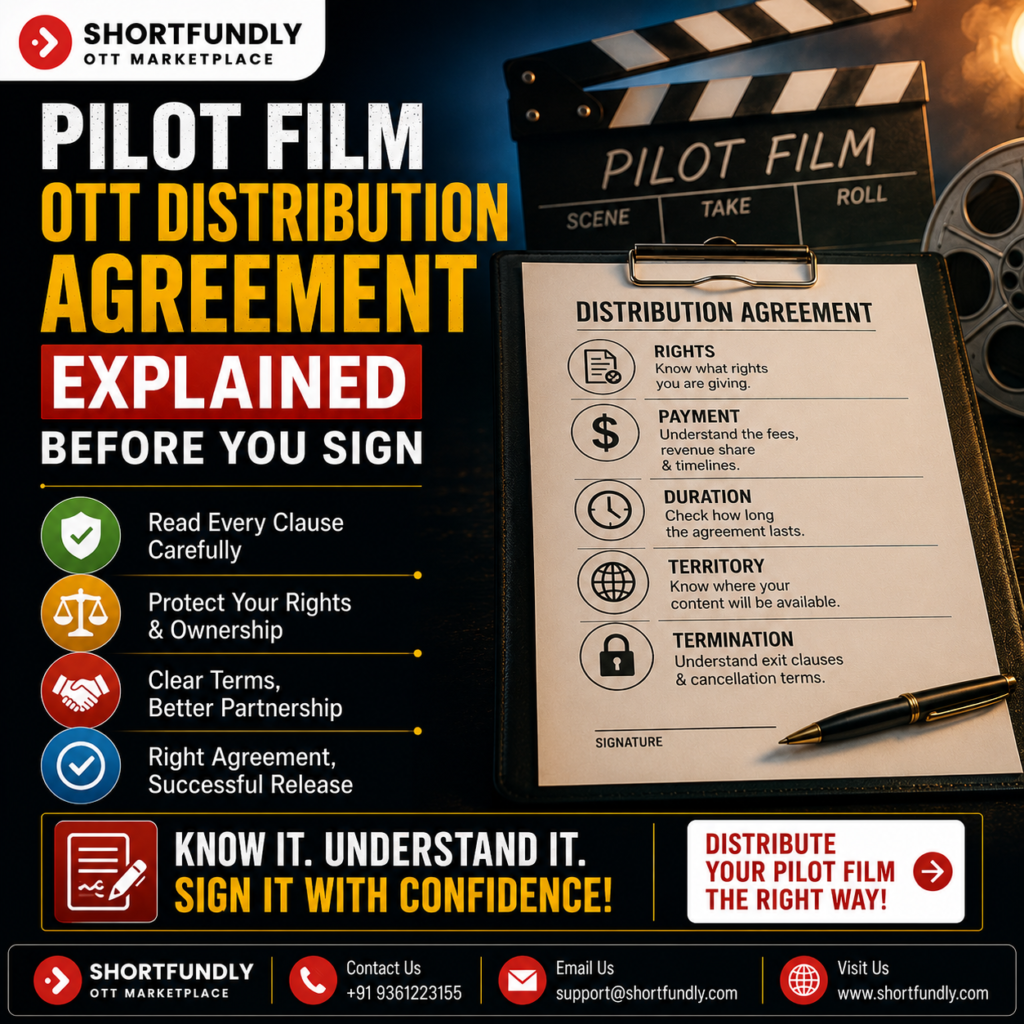
1. Understand Exactly Which Rights You Are Giving Away
The first major question is simple:
What rights are we actually licensing?
The word “distribution” can cover many different activities. A contract should identify the rights with enough precision to prevent confusion later.
For example, a distributor might receive the right to stream a pilot film online. That does not necessarily mean the distributor should receive television, theatrical, remake, merchandising, or adaptation rights.
We should therefore distinguish between individual rights.
Digital Streaming Rights
Digital streaming rights allow content to be made available through specified digital services.
However, the agreement should clarify whether the rights cover:
- Subscription streaming
- Advertising-supported streaming
- Transactional streaming
- Free streaming
- Mobile streaming
- Connected-TV services
The wording matters because different exploitation models can generate different commercial outcomes.
Television Rights
We should check whether television rights are included.
If the contract grants only digital rights, we may retain the ability to license television rights separately.
If television rights are included, however, that opportunity may no longer be available during the contract term.
Theatrical Rights
A digital distribution agreement shouldn’t automatically include theatrical rights unless the parties intentionally agree to that arrangement.
For independent filmmakers, preserving separate theatrical opportunities may be commercially valuable.
Remake and Adaptation Rights
These rights can be particularly important for original stories.
A remake right could allow another party to create a new version of the project. An adaptation right could cover transformation into another format.
These rights should never be granted casually.
2. Check Whether the OTT Distribution Deal Is Exclusive
Exclusivity is one of the most important clauses in any distribution agreement.
An exclusive agreement can prevent the producer from licensing the same rights to another distributor during the agreed period.
For example, suppose a producer grants exclusive digital rights for India.
During that period, the producer may be unable to license those same Indian digital rights elsewhere.
That restriction could be reasonable if the distributor offers strong market access. However, it could become restrictive if the distributor provides limited distribution activity.
Questions to Ask About Exclusivity
Before signing, we should ask:
- Is the agreement exclusive?
- Which rights are exclusive?
- Which territories are covered?
- Which platforms are covered?
- How long does exclusivity last?
- Does exclusivity apply to future episodes?
- Does exclusivity cover promotional content?
- What happens if the distributor doesn’t actively exploit the rights?
A narrowly defined exclusive license may be easier to manage than a broad exclusive grant.
Exclusive Does Not Always Mean Better
An exclusive deal can sound attractive because it may suggest stronger platform commitment.
However, exclusivity has an opportunity cost.
If another platform becomes interested later, an existing exclusive agreement may prevent us from accepting that opportunity.
Therefore, we should evaluate exclusivity based on the value being received in return.
3. Examine the Territory Clause Carefully
The territory clause defines where the distributor can exploit the pilot.
Common arrangements include:
- India
- South Asia
- Asia-Pacific
- North America
- Europe
- Worldwide
- Specific countries
A worldwide license is significantly broader than an India-only license.
We should therefore avoid accepting worldwide rights merely because the wording appears convenient.
Why Territory Matters
A pilot may have different commercial potential in different markets.
For example, an Indian-language project could have an audience in India, the Middle East, Southeast Asia, North America, and other regions.
If the distributor only has strong relationships in one territory, granting worldwide rights may not always be necessary.
Territory Questions
We should clarify:
Is the license worldwide?
Can the distributor sublicense internationally?
Are individual countries excluded?
Can the producer independently exploit excluded territories?
Does territory change automatically if a platform expands?
Clear territorial language can prevent disputes later.
4. Review the License Term
The term determines how long the distributor has the licensed rights.
A contract might specify a fixed period, such as several years.
The agreement should clearly identify:
- Start date
- End date
- Renewal period
- Renewal conditions
- Automatic renewal provisions
- Notice requirements
- Rights after expiration
Automatic Renewal Requires Attention
Automatic renewal clauses deserve special care.
A producer might believe that a deal expires naturally. However, an automatic renewal provision could extend the agreement unless notice is provided within a specific window.
For example, the contract could require notice several months before expiration.
Missing that deadline could extend the agreement.
Therefore, important renewal dates should be recorded in a calendar.
5. Understand the Revenue-Sharing Model
Revenue sharing is another major part of OTT distribution.
A revenue-share arrangement typically determines how income generated from exploitation of the film is divided.
However, the percentage alone isn’t enough.
A contract might say the producer receives a particular percentage of “net revenue.”
The critical question becomes:
What does net revenue mean?
Gross Revenue vs Net Revenue
Consider a simplified example.
Suppose a project generates $10,000 in gross revenue.
If the contract allows $2,000 in permitted deductions, the remaining $8,000 could represent the contractual revenue base.
A percentage applied to $8,000 produces a very different result from the same percentage applied to $10,000.
Therefore, we should identify:
- Gross receipts
- Permitted deductions
- Distributor commission
- Platform fees
- Taxes
- Payment-processing charges
- Marketing deductions
- Localization expenses
- Other recoverable costs
The contract should define these terms clearly.
Revenue Share Example
| Item | Example Amount |
| Gross receipts | $10,000 |
| Permitted deductions | $2,000 |
| Net receipts | $8,000 |
| Producer share | 70% |
| Producer revenue | $5,600 |
This is only an illustration.
Actual calculations depend entirely on the agreement.
6. Look for Hidden Distribution Fees
Some OTT distribution arrangements include fees beyond revenue sharing.
These may include:
- Setup fees
- Delivery fees
- Encoding fees
- Localization fees
- Subtitle fees
- Dubbing fees
- Artwork fees
- Marketing charges
- Administrative deductions
Not every agreement contains these charges.
However, we should never assume that the headline revenue split tells the complete financial story.
Ask for a Complete Fee Schedule
Before signing, we should request a written explanation of all deductions.
A useful question is:
“What costs can be deducted before calculating our revenue share?”
The answer should be consistent with the contract.
If the commercial discussion says one thing but the agreement permits broader deductions, the written contract deserves closer review.
7. Understand Minimum Guarantees and Upfront Payments
Some distribution agreements may include an upfront payment or minimum guarantee.
A minimum guarantee can provide greater financial certainty.
However, we should understand whether it is:
- Recoupable
- Non-recoupable
- An advance against future revenue
- Conditional
- Payable on signing
- Payable after delivery
- Payable after acceptance
For example, an advance against revenue isn’t necessarily additional income.
It may be recovered from future earnings before additional payments become payable.
The agreement should explain this clearly.
8. Review Marketing and Promotional Rights
Distribution agreements often include promotional rights.
These rights allow a distributor or platform to market the film.
They may include permission to use:
- Poster artwork
- Film stills
- Trailer footage
- Short clips
- Actor names
- Actor images
- Director name
- Producer name
- Film title
- Promotional excerpts
These permissions are usually necessary for marketing.
Nevertheless, we should ensure the language remains appropriate.
Promotional Clips
Some agreements permit distributors to create short promotional clips.
We should understand:
- Maximum clip duration
- Platforms where clips can appear
- Whether clips can remain online after the license ends
- Whether promotional footage can be edited
- Whether promotional materials can be reused
Clear terms reduce future misunderstandings.
9. Check Subtitle, Dubbing, and Localization Rights
International OTT distribution can involve localization.
This may include:
- Subtitles
- Closed captions
- Dubbing
- Translations
- Alternate artwork
- Localized metadata
A producer should know who controls these rights.
Who Pays for Localization?
The contract should clarify whether localization costs are:
- Paid by the distributor
- Paid by the producer
- Shared
- Deducted from revenue
This distinction can materially affect earnings.
For example, if dubbing expenses are deducted before revenue sharing, the producer’s effective revenue could be lower than expected.
10. Understand Sublicensing Rights
A distributor may want the ability to sublicense content to third parties.
That can be commercially useful.
However, the producer should understand the scope of that authority.
We should ask:
- Can the distributor sublicense?
- To which platforms?
- In which territories?
- For how long?
- Does sublicensing change the original license term?
- How is sublicensing revenue reported?
- Does the distributor remain responsible for accounting?
A broad sublicensing clause deserves careful review.
11. Examine Reporting and Accounting Requirements
Revenue is only useful if the producer can understand how it was calculated.
Therefore, reporting obligations are essential.
The agreement should identify:
- Reporting frequency
- Statement format
- Revenue information
- Deduction information
- Payment schedule
- Currency
- Tax deductions
- Audit rights
Monthly, Quarterly, or Annual Statements?
Different agreements may use different reporting cycles.
Quarterly statements can be practical for many digital arrangements. However, the appropriate schedule depends on the deal.
The key issue is transparency.
A producer should be able to understand how the reported amount was calculated.
12. Review Audit Rights
An audit clause can provide an important safeguard.
If revenue reports appear inconsistent, the producer may need the contractual ability to review supporting records.
An agreement may specify:
- When an audit can occur
- How much notice is required
- Who pays audit costs
- How discrepancies are handled
- How long records must be retained
Without clear audit provisions, challenging accounting discrepancies may become more difficult.
13. Understand Payment Terms
The agreement should specify exactly when payments become due.
We should check:
- Payment frequency
- Payment deadline
- Payment method
- Currency
- Bank charges
- Tax withholding
- Minimum payment thresholds
- Late-payment provisions
A contract that says revenue will be paid “periodically” may not provide enough clarity.
Specific payment schedules are preferable.
14. Examine Content Delivery Obligations
The distributor may require a specific delivery package.
Typical materials can include:
- Master video
- Trailer
- Poster
- Key art
- Stills
- Synopsis
- Metadata
- Subtitle files
- Caption files
- Cast details
- Crew details
- Rights documents
We should confirm who is responsible for preparing each asset.
Technical Rejection Can Delay Distribution
A project can face delays if the master doesn’t meet delivery specifications.
Therefore, we should confirm technical requirements before final export.
These requirements may cover resolution, frame rate, audio, subtitles, file format, and artwork.
15. Read the Termination Clause Before Signing
Many producers focus on how an agreement starts.
Fewer examine how it ends.
That can be a mistake.
The termination clause should be reviewed carefully.
It may cover:
- Breach
- Non-payment
- Failure to distribute
- Insolvency
- Rights disputes
- Regulatory issues
- Mutual termination
- Notice periods
- Cure periods
What Happens After Termination?
Termination isn’t the only question.
We should also ask:
When do rights return?
What happens to existing platform listings?
How long can promotional materials remain online?
What happens to unpaid revenue?
What happens to sublicenses already granted?
These provisions can be just as important as the termination trigger itself.
16. Confirm Rights Reversion
Rights reversion means rights return to the producer after a specified event.
This could happen after:
- License expiration
- Termination
- Distributor inactivity
- Failure to meet contractual obligations
A strong agreement should make the post-license position understandable.
If the contract ends, we should know exactly what rights return and when.
Inactivity Provisions
Some contracts may address situations where a distributor receives rights but doesn’t actively exploit the content.
If such provisions exist, we should understand the required performance threshold.
For example, the contract could define a period within which the distributor must make reasonable efforts to distribute the title.
17. Check Ownership of the Original Film
Licensing rights isn’t the same as transferring ownership.
A producer should determine whether the agreement:
- Licenses rights
- Assigns rights
- Transfers ownership
- Grants a limited exploitation right
The distinction can be extremely important.
If the producer retains ownership, the distributor may simply receive defined rights for a defined period.
If ownership is transferred, the consequences may be much broader.
Therefore, we should never rely on casual descriptions such as “distribution partnership.”
The actual contract language matters.
18. Review Moral Rights, Credits, and Attribution
Credits can matter greatly to filmmakers.
The agreement should identify how the project will be credited.
We should check:
- Director credit
- Producer credit
- Production company credit
- Cast credits
- Writer credit
- Composer credit
If promotional artwork is created by the distributor, we should also understand whether the producer can approve major changes to branding or title presentation.
19. Check Representations and Warranties
Distribution agreements often require the producer to make certain promises.
These may concern:
- Ownership
- Copyright
- Permissions
- Defamation
- Privacy
- Music rights
- Talent agreements
- Regulatory compliance
- Absence of third-party claims
These provisions can create significant obligations.
Therefore, we should make sure every representation is accurate.
We shouldn’t promise that we own rights we haven’t actually secured.
20. Understand Indemnification Obligations
An indemnity clause can allocate responsibility for certain claims or losses.
For example, the producer may agree to protect the distributor against claims arising from unauthorized content.
The exact wording matters.
We should understand:
- Which claims are covered
- Whether liability is limited
- Whether legal costs are included
- Whether notice is required
- Who controls the defense
- Whether there is a liability cap
Because indemnity provisions can have substantial financial consequences, professional legal review may be appropriate.
21. Look for Liability Caps and Limitations
A contract may limit the amount one party can be liable for.
This is known as a limitation of liability.
We should check:
- Maximum liability
- Excluded damages
- Exceptions
- Intellectual-property claims
- Confidentiality breaches
- Payment obligations
The commercial value of a distribution deal should be considered alongside the risks created by these provisions.
22. Check Confidentiality Provisions
A confidentiality clause can restrict disclosure of commercial information.
It may cover:
- Revenue
- Contract terms
- Platform information
- Business strategies
- Unreleased content
- Financial information
At the same time, producers may need to share certain information with lawyers, accountants, investors, or business partners.
The agreement should account for legitimate disclosures where appropriate.
23. Understand Governing Law and Dispute Resolution
A contract should identify which law governs the agreement.
It may also specify:
- Courts
- Arbitration
- Mediation
- Jurisdiction
- Dispute procedures
This clause can become particularly important when the producer and distributor operate in different countries.
We should understand where disputes would be handled before accepting the agreement.
24. Shortfundly Distribution and Contract Preparation
Independent creators considering Shortfundly distribution should approach distribution with the same level of preparation applied to production.
Before entering discussions, we should organize the project information and identify the rights we control.
A useful preparation file can include:
| Preparation Area | Materials |
| Creative | Pilot master, trailer, synopsis |
| Marketing | Poster, key art, stills |
| Metadata | Title, genre, runtime, language |
| Legal | Rights agreements, releases, licenses |
| Technical | Master specifications, subtitles |
| Commercial | Revenue expectations, rights strategy |
| Distribution | Target territories and platforms |
This preparation can make negotiations more efficient.
25. Questions to Ask Before Signing an OTT Distribution Agreement
Before signing, we should obtain clear answers to the following questions.
Rights
- Which rights are being licensed?
- Are rights exclusive?
- Is the license limited to digital distribution?
- Are television rights excluded?
- Are remake rights excluded?
- Are merchandising rights excluded?
Territory
- Which countries are covered?
- Is the agreement worldwide?
- Can territories be removed?
Term
- When does the license begin?
- When does it end?
- Is renewal automatic?
- What notice is required?
Revenue
- Is payment fixed or performance-based?
- What percentage belongs to the producer?
- How is revenue calculated?
- Which deductions are permitted?
Fees
- Is there an upfront fee?
- Are there delivery charges?
- Are localization costs deducted?
- Are marketing expenses recoverable?
Reporting
- How frequently are statements issued?
- Can the producer audit statements?
- How are discrepancies resolved?
Termination
- When can either party terminate?
- What happens after termination?
- When do rights return?
26. OTT Distribution Agreement Red Flags
Certain provisions deserve extra attention.
Broad Worldwide Rights
A worldwide grant may be unnecessary if the distributor has limited international reach.
Perpetual Rights
A perpetual license can create long-term restrictions.
Automatic Renewal
Automatic renewal can extend a contract unexpectedly.
Undefined Deductions
Unclear deductions make revenue difficult to predict.
Unlimited Promotional Rights
Broad promotional rights may deserve clarification.
No Clear Rights Reversion
If the contract doesn’t explain what happens after expiration, clarification is important.
Broad Sublicensing
A distributor’s ability to sublicense should be clearly defined.
One-Sided Termination
A contract that heavily favors one party deserves careful review.
Unclear Payment Dates
Vague payment language can create uncertainty.
27. How to Compare Two OTT Distribution Offers
The largest revenue percentage isn’t always the best deal.
We should compare the complete economic structure.
| Factor | Offer A | Offer B |
| Upfront payment | Higher | Lower |
| Revenue share | Lower | Higher |
| Distribution fee | Low | Higher |
| Territory | Regional | Worldwide |
| Exclusivity | Exclusive | Non-exclusive |
| License term | Longer | Shorter |
| Reporting | Quarterly | Monthly |
| Marketing | Included | Additional cost |
| Rights reversion | Clear | Unclear |
A higher revenue share may become less attractive if the distributor deducts substantial expenses.
Likewise, a smaller upfront payment could be worthwhile if the agreement provides broader transparent revenue participation.
The correct comparison is therefore based on total contractual value, not one percentage.
28. How to Negotiate Better Distribution Terms
Independent filmmakers can negotiate several aspects of an OTT agreement.
We can ask for:
- Narrower exclusivity
- Shorter initial terms
- Clear revenue definitions
- Defined deductions
- Regular reporting
- Audit rights
- Performance obligations
- Clear rights reversion
- Territory restrictions
- Approval over major branding changes
Focus on Clarity
Negotiation doesn’t always mean demanding a larger percentage.
Sometimes the most valuable improvement is clearer language.
A clearly defined 60% share can be more useful than a nominal 75% share with broad deductions.
29. Pilot Film Distribution Agreement Checklist
Before signing, we should complete a final contractual review.
- Parties are correctly identified
- Ownership is confirmed
- Licensed rights are clearly defined
- Territory is specified
- License term is specified
- Exclusivity is understood
- Sublicensing rights are clear
- Revenue calculation is defined
- Deductions are listed
- Fees are disclosed
- Payment dates are specified
- Reporting requirements are defined
- Audit rights are addressed
- Marketing rights are understood
- Localization rights are clear
- Delivery obligations are understood
- Termination rights are balanced
- Rights reversion is defined
- Liability provisions are reviewed
- Indemnities are understood
- Governing law is identified
- Dispute resolution is clear
Frequently Asked Questions About Pilot Film OTT Distribution Agreements
1. What is the most important clause in an OTT distribution agreement?
There isn’t one universal clause that matters most. Rights, territory, term, exclusivity, revenue, deductions, and termination should all be reviewed together.
2. Should an independent filmmaker accept an exclusive OTT distribution deal?
It depends on the commercial value and scope of the agreement. We should understand what opportunities exclusivity prevents before accepting it.
3. What does OTT revenue sharing mean?
Revenue sharing means the parties divide qualifying income according to a contractual formula. The agreement should define the revenue base and permitted deductions.
4. Can we retain ownership of our pilot film?
In many licensing structures, the producer can retain ownership while granting specific distribution rights. However, the actual contract determines the arrangement.
5. What is an OTT distribution license term?
The license term is the period during which the distributor has the agreed rights. It may be fixed or renewable.
6. What happens when the OTT distribution agreement expires?
The contract should specify what happens to the licensed rights, platform listings, promotional materials, sublicenses, and unpaid revenue.
7. Can a distributor sublicense our pilot?
It depends on the agreement. If sublicensing is permitted, the contract should define its scope and financial treatment.
8. Should we pay an upfront OTT distribution fee?
There is no universal answer. We should evaluate the complete cost structure, expected distribution value, rights granted, and revenue model.
9. Can we negotiate an OTT distribution agreement?
Yes. Commercial terms can often be negotiated before signing. Important legal provisions should be reviewed carefully.
10. Is Shortfundly distribution suitable for independent filmmakers?
Shortfundly distribution can be explored by independent creators seeking a structured route toward digital distribution. The appropriate arrangement depends on the project’s rights, content, market, and distribution objectives.
Also read: https://blog.shortfundly.com/ott/pilot-film-metadata-ott/
Final Thoughts: Read the Agreement Before You Sign
An OTT distribution agreement can become one of the most important documents associated with a pilot film.
A promising platform opportunity should never pressure us into accepting unclear contractual terms.
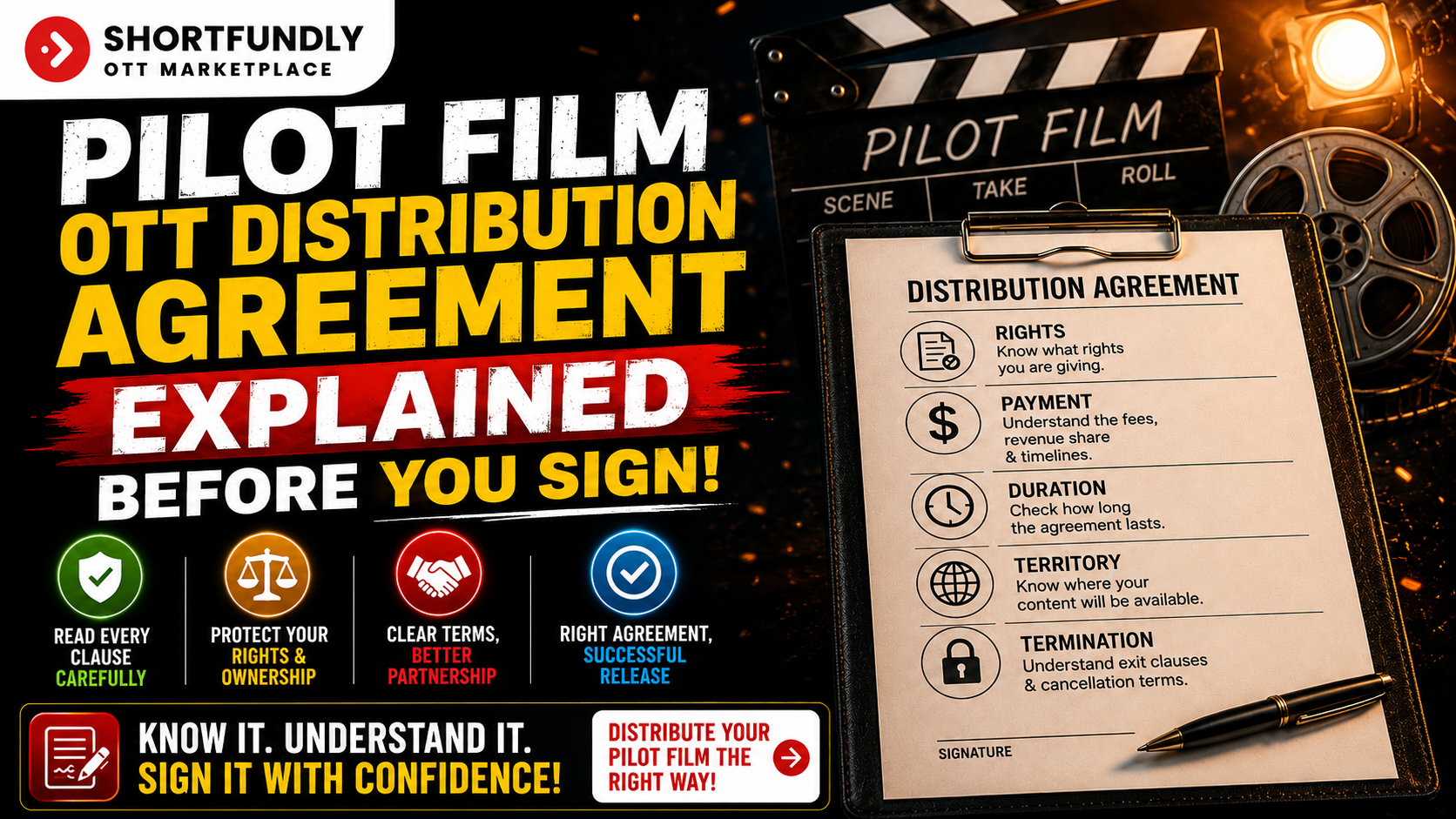
Before signing, we should know exactly what rights we are granting, where those rights apply, how long they last, whether they are exclusive, how revenue is calculated, which costs can be deducted, and when the rights return.
We should also examine reporting, payment, marketing, sublicensing, termination, liability, and dispute provisions.
For independent filmmakers, careful preparation can make distribution discussions more productive. It also helps ensure that the final agreement supports the project’s long-term commercial strategy.
Whether we are exploring direct platform opportunities or Shortfundly distribution, the strongest approach is straightforward: prepare the project professionally, understand the rights we own, review every major contractual term, and never sign a distribution agreement we don’t understand.
A well-negotiated agreement doesn’t merely put a pilot film on an OTT service. It creates a clearer framework for rights protection, revenue participation, audience growth, and long-term content ownership.