Table of Contents
Independent filmmakers often invest years in writing, shooting, editing, and promoting a movie, but finding the right audience after production can be challenging. Traditional theatrical distribution may be expensive, while streaming platform submissions can be competitive and difficult to navigate. Fortunately, the growth of Free Ad-Supported Streaming TV (FAST) channels has created new opportunities for independent movies to reach viewers.
If you want to get your indie movie on FAST channels, you need more than a finished film. You need a distribution strategy, clear licensing rights, professional delivery materials, audience positioning, and an understanding of how FAST channel operators select and schedule content.
FAST channels offer viewers free entertainment supported by advertising. Unlike subscription-based streaming services, viewers do not need to pay monthly subscription fees to access ad-supported programming. This makes FAST an attractive viewing option for audiences and a potential distribution opportunity for independent filmmakers.
In this guide, we will explain how to get an indie movie on FAST channels, how to prepare your film for distribution, how to find distribution opportunities, and how to position your independent film for streaming success.

What Are FAST Channels?
FAST stands for Free Ad-Supported Streaming Television. FAST channels operate like traditional television channels but are delivered through internet-connected devices, streaming applications, and smart TVs.
Viewers can access FAST channels without paying a subscription. Instead, the platform generates advertising revenue by displaying commercials during programming.
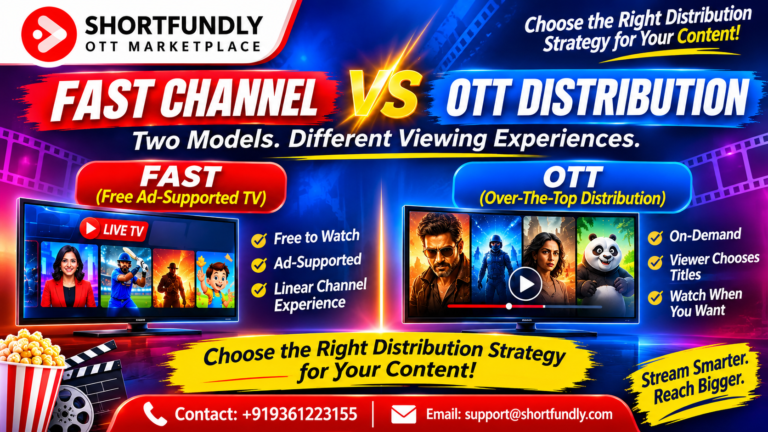
FAST services typically offer scheduled programming, including movies, television series, documentaries, lifestyle shows, entertainment, and niche content. Unlike traditional video-on-demand platforms where viewers select individual titles, FAST channels provide a linear viewing experience with programming arranged into a channel schedule.
For independent filmmakers, FAST distribution offers a potential way to make films available to streaming audiences through curated programming and ad-supported viewing.
Why FAST Channels Matter for Indie Filmmakers
FAST channels have become an additional distribution option for content owners looking to expand beyond theatrical, festival, DVD, and traditional OTT releases.
Some potential advantages include:
- Free audience access: Viewers can watch without purchasing a subscription.
- Additional distribution opportunities: Films can potentially reach audiences through streaming channel programming.
- Library monetization potential: Previously released movies may have additional distribution opportunities, subject to rights and platform requirements.
- Audience discovery: Viewers may discover independent films while browsing scheduled channels.
- International opportunities: Some distributors and channel operators acquire content for multiple territories.
- Long-term content value: An indie film may continue to attract viewers beyond its initial release window.
FAST distribution is not a guarantee of audience growth or earnings, but it can be an important part of a broader film distribution strategy.
11 Proven Steps to Get Your Indie Movie on FAST Channels
1. Identify the Right FAST Channel for Your Movie
The first step is finding FAST channels that match your film’s genre, audience, and storytelling style.
FAST channels are often organized around specific programming interests. Some focus on action, thriller, romance, comedy, classic cinema, documentaries, independent films, family entertainment, or regional content.
Before approaching a distributor or channel operator, research their programming.
Ask questions such as:
- Does the channel feature independent films?
- Does it accept movies from third-party content owners?
- Does it focus on a specific genre?
- Does it target a particular demographic?
- Does it acquire films internationally?
- Does it accept content through distribution partners?
- Is it currently seeking new film content?
A film that aligns with a channel’s programming strategy may be more relevant than a movie submitted without considering the channel’s audience.
2. Secure All Distribution Rights Before Submission
Rights management is one of the most important requirements for getting an indie movie on FAST channels.
Before submitting your movie to any distributor or channel, ensure that you have the necessary rights to distribute it through the intended streaming and advertising-supported platforms.
You should review the rights associated with:
- Film production and ownership
- Screenplay and story rights
- Music and soundtrack licenses
- Actor and performer agreements
- Archival footage
- Stock footage
- Artwork and promotional materials
- International distribution rights
- Streaming and digital exhibition rights
If your film includes copyrighted music, third-party footage, or licensed assets, verify whether those permissions cover FAST distribution and the intended territories.
Clear rights documentation can help reduce delays during distribution review and licensing negotiations.
3. Prepare a Professional Film Master
FAST distribution partners may have specific technical requirements for accepting content. A professionally prepared master helps ensure your movie can be reviewed, processed, and delivered according to the requirements of the relevant platform.
Depending on the distributor or channel, technical specifications may include:
- Full HD or 4K video resolution
- Supported video codecs and file formats
- Appropriate frame rate
- Correct aspect ratio
- Broadcast-quality audio
- Clean video without unwanted artifacts
- Consistent sound levels
- Proper color grading
- No unauthorized watermarks or promotional overlays
Do not assume that every FAST platform accepts the same file specifications. Confirm the technical requirements before preparing the final delivery.
If your indie movie was produced several years ago, consider reviewing the video and audio quality before submission. A clean master can make the film easier to evaluate and prepare for streaming.
4. Create an Attractive Film Pitch Package
A distribution pitch package helps distributors, acquisition teams, and channel operators understand your movie quickly.
Your film pitch should communicate its story, genre, audience, production quality, and commercial or programming potential.
Prepare the following materials:
| Pitch Material | Purpose |
|---|---|
| Film title | Identifies your movie |
| Logline | Summarizes the story in one or two sentences |
| Synopsis | Explains the narrative and major themes |
| Genre | Helps identify programming fit |
| Runtime | Supports scheduling and programming decisions |
| Release year | Provides film background |
| Cast and crew details | Highlights creative talent |
| Director’s profile | Establishes filmmaking experience |
| Film poster | Creates a recognizable visual identity |
| Trailer | Showcases the story and production quality |
| Film stills | Supports promotional and editorial use |
| Rights information | Clarifies territories and licensing availability |
A concise and professional pitch package can make your indie film easier to evaluate and help you communicate with potential distribution partners.
5. Build a Strong Film Metadata Sheet
Metadata is the descriptive information associated with your movie. It helps distributors, streaming platforms, content management systems, and programming teams organize, identify, and present your film.
Your metadata sheet should include:
- Official movie title
- Alternate title, if applicable
- Genre and subgenre
- Synopsis
- Detailed description
- Release year
- Runtime
- Language
- Country of production
- Director
- Main cast
- Production company
- Age rating or content classification, where applicable
- Subtitle availability
- Keywords and themes
- Rights availability
- Contact information
Accurate metadata is important for content discovery, catalog management, programming decisions, and potential audience targeting.
Avoid vague descriptions. Explain what makes your film distinctive, including its central conflict, genre appeal, audience relevance, and unique storytelling elements.
6. Develop a Trailer That Captures Attention
A trailer is one of the most important promotional assets for your indie movie.
Even when a distributor primarily evaluates the full film, a trailer can provide a quick overview of its storytelling, pacing, visual quality, tone, and audience appeal.
Your trailer should:
- Introduce the main characters.
- Establish the central conflict.
- Highlight compelling scenes.
- Communicate the film’s genre.
- Maintain engaging pacing.
- Use clear sound and dialogue.
- Avoid revealing major plot twists.
- End with a strong title presentation.
Keep your trailer focused on the film’s strongest moments. Avoid making it excessively long or including scenes that do not contribute to the story’s appeal.
A professionally edited trailer can also be useful for pitching your movie to distributors, promoting festival selections, and building awareness on social media.
7. Add Subtitles and Explore Localization Opportunities
Language accessibility can help expand the potential audience for your indie movie.
If your film is produced in a regional language, consider preparing accurate English subtitles. If you are targeting international distribution, additional subtitles may be valuable depending on the territories and platforms involved.
Localization may include:
- English subtitles
- Spanish subtitles
- French subtitles
- Portuguese subtitles
- Additional regional-language subtitles
- Dubbed audio tracks, where appropriate
- Localized film descriptions
- Translated promotional materials
Not every film requires multiple dubbed versions. Start by identifying the markets that match your movie’s genre, language, cultural context, and distribution opportunities.
Subtitles should be professionally timed, easy to read, grammatically correct, and synchronized with dialogue. Poor subtitle quality can negatively affect the viewing experience.
8. Research Film Distributors and FAST Content Aggregators
Independent filmmakers may not always be able to pitch their movies directly to FAST channel operators. Many channels work with content distributors, licensing companies, aggregators, or established acquisition partners.
These distribution intermediaries may help content owners with content evaluation, licensing, technical delivery, metadata, platform submission, and other distribution-related activities.
When researching a distributor, evaluate:
- Distribution experience
- Types of content accepted
- FAST-specific capabilities
- OTT distribution services
- Platform and channel availability
- Territory coverage
- Rights requirements
- Licensing terms
- Fees and revenue-sharing models
- Reporting transparency
- Content submission requirements
- Communication and support
Ask whether the distributor currently handles FAST channel distribution specifically. A company offering OTT distribution does not necessarily offer FAST channel placement.
Choose a partner based on your film’s requirements, current services, and the distribution opportunities available to your title.
9. Understand FAST Licensing and Revenue Models
FAST channels typically generate revenue through advertising. However, the way film owners participate in revenue depends on the licensing agreement, distribution arrangement, platform policies, and commercial terms.
Possible arrangements may include:
- Flat licensing fees
- Revenue-share agreements
- Advertising-based revenue participation
- Territory-based licensing
- Limited-term licensing
- Exclusive distribution agreements
- Non-exclusive distribution agreements
Not every FAST channel offers the same deal structure.
Before signing a contract, understand:
- Whether the agreement is exclusive or non-exclusive
- Which territories are covered
- How long the license lasts
- Whether the agreement covers FAST, AVOD, TVOD, or other digital formats
- Whether the distributor can sublicense the content
- How advertising revenue is calculated
- What deductions apply before revenue sharing
- How frequently payments are made
- Whether you receive performance reports
- How rights are returned after the agreement ends
Independent filmmakers should avoid signing agreements without understanding the rights being granted. Review the contract carefully and seek professional legal advice when necessary.
10. Submit Your Film and Follow the Distribution Workflow
Once your movie is ready, begin the submission process with distributors or content acquisition partners that accept independent films.
A typical submission workflow may include:
- Identify a relevant distribution partner.
- Review submission guidelines.
- Prepare your film master and promotional assets.
- Submit the film, synopsis, trailer, and metadata.
- Provide rights and ownership information.
- Complete the content evaluation process.
- Review licensing terms if an offer is made.
- Complete technical delivery requirements.
- Confirm release details and distribution territories.
- Track the release and performance where reporting is available.
Submitting a film does not guarantee acceptance or placement on a FAST channel. Selection depends on content suitability, rights availability, quality, programming needs, commercial considerations, and partner requirements.
Keep a record of submissions, communication, agreements, and release status to manage your film’s distribution journey professionally.
11. Promote Your Indie Movie After Distribution
Getting your movie distributed is an important milestone, but audience awareness remains essential.
Once your film becomes available through an approved channel or platform, promote it through your existing marketing channels where permitted.
Consider the following promotional activities:
- Share the release announcement on social media.
- Publish behind-the-scenes stories.
- Promote the director and cast.
- Create short video clips.
- Share the trailer.
- Update your film website.
- Engage with film communities.
- Use audience reviews and testimonials when authorized.
- Promote the film through your email newsletter.
- Collaborate with cast members on promotional campaigns.
Use the promotional materials and release links permitted by your distribution agreement. If the movie is scheduled on a linear FAST channel, share the channel and viewing details whenever they are officially available.
Consistent promotion can help build awareness and encourage viewers to discover your independent film.
What Types of Indie Movies Can Target FAST Channels?
FAST channels serve a wide range of audience interests, creating potential opportunities for different types of independent content.
| Indie Film Genre | Potential Programming Fit |
|---|---|
| Action movies | Action-focused and adventure channels |
| Thrillers | Suspense and crime programming |
| Romantic films | Romance and relationship-focused channels |
| Comedy movies | Comedy and entertainment channels |
| Horror movies | Horror and genre-focused programming |
| Documentaries | Documentary and factual channels |
| Family movies | Family-friendly programming |
| Sci-fi films | Science fiction and fantasy channels |
| Regional films | Language-specific or culturally focused channels |
| Classic indie movies | Nostalgia and classic film programming |
Programming fit is only one consideration. Rights, technical quality, content suitability, licensing terms, and channel acquisition requirements also influence whether a film can be selected.
How to Improve Your Indie Movie’s FAST Distribution Potential
Getting your movie on FAST channels requires preparation and a realistic distribution strategy. Here are some practical ways to improve your readiness.
Focus on Content Quality
A strong story, compelling characters, professional editing, and good sound quality can help your film stand out during evaluation.
Know Your Audience
Identify who is most likely to watch your movie. Consider age groups, genre interests, language, cultural relevance, and viewing preferences.
Prepare Your Assets in Advance
Keep your film master, trailer, poster, stills, subtitles, synopsis, and metadata organized in a professional folder.
Understand Your Rights
Make sure your licensing rights are clear and that you can legally distribute the movie through the channels and territories you are targeting.
Be Open to Distribution Opportunities
Explore different distributors, content aggregators, OTT services, FAST channel operators, and licensing opportunities. Confirm the exact services they offer instead of assuming every partner provides the same distribution options.
Track Your Film’s Performance
Where reporting is available, review viewership, streaming performance, revenue, territory information, and other relevant metrics. Use the information to improve future distribution and marketing decisions.
Get Your Indie Movie Distribution-Ready with Shortfundly Distribution
Independent filmmakers need a distribution strategy that helps them understand the available streaming opportunities and the steps involved in submitting their content.
Shortfundly Distribution offers an online distribution pathway for eligible content owners seeking OTT distribution opportunities. Independent filmmakers can explore its submission process, content requirements, pricing information, and distribution workflow.
If you have an indie movie ready for distribution, you can explore the available services at:
Shortfundly Distribution – Explore Film Distribution Opportunities
Before submitting your movie, review the current eligibility requirements, technical specifications, licensing agreements, pricing, and distribution partners. If your specific goal is FAST channel placement, contact Shortfundly to confirm whether FAST-specific distribution services, channel opportunities, territories, and commercial arrangements are currently available for your film.
The right distribution partner can help you understand your options, prepare your content, and navigate the submission process more efficiently.
Common Mistakes to Avoid When Getting an Indie Movie on FAST Channels
Independent filmmakers can improve their distribution readiness by avoiding these common mistakes.
- Submitting without rights clearance: Unresolved music, footage, or ownership rights can create distribution problems.
- Using poor-quality masters: Technical problems may affect content evaluation or delivery acceptance.
- Ignoring metadata: Incomplete descriptions, incorrect runtime, or missing language information can complicate catalog processing.
- Choosing the wrong distributor: Not every distributor specializes in FAST channel distribution.
- Overlooking contract details: Licensing terms may affect future distribution opportunities.
- Expecting guaranteed placement: Submission is not a guarantee of channel selection.
- Ignoring promotional opportunities: Distribution and marketing work best when coordinated.
- Failing to prepare subtitles: Language accessibility can matter for the audiences and territories being targeted.
Avoiding these mistakes can help you approach distribution more professionally and reduce unnecessary delays.
Frequently Asked Questions About Getting an Indie Movie on FAST Channels
1. How can I get my indie movie on FAST channels?
Start by preparing your film, clearing distribution rights, creating a professional pitch package, and researching FAST channel distributors or content aggregators. Submit your movie through partners that accept independent content and meet their licensing and technical requirements.
2. Can independent filmmakers submit movies directly to FAST channels?
Some FAST channel operators may accept direct submissions, while others work exclusively through distributors, aggregators, or acquisition partners. Check each channel’s submission policies before pitching.
3. Do FAST channels pay independent filmmakers?
Some distribution agreements provide licensing fees or revenue-sharing opportunities. Payment structures depend on the channel, distributor, agreement, advertising model, and content performance. Earnings are not guaranteed.
4. Is FAST distribution free for filmmakers?
Not necessarily. Distribution costs, processing fees, licensing arrangements, and revenue-share models vary by partner. Review the applicable terms before submitting your movie.
5. What format should my indie movie be in for FAST distribution?
Technical specifications vary. A distributor or channel may request Full HD or 4K video, specific codecs, audio formats, subtitles, artwork, and metadata. Always follow the delivery specifications provided by your distribution partner.
6. Can older independent movies get on FAST channels?
Older movies may be considered if they have clear rights, meet technical requirements, and match the channel’s programming needs. The film’s age alone does not determine distribution suitability.
7. Can regional-language indie movies get FAST distribution?
Regional-language movies may have opportunities through channels or platforms serving specific language communities. Subtitle availability, audience demand, territory rights, and programming requirements can influence suitability.
8. Does OTT distribution automatically include FAST channel distribution?
No. OTT is a broad term for internet-delivered video, while FAST is a specific free, ad-supported linear television model. A distributor may offer OTT distribution without offering FAST channel placement. Always confirm FAST-specific services.
Also read: https://blog.shortfundly.com/ott/content-fast-distribution/
Conclusion
Getting an indie movie on FAST channels can open additional distribution possibilities for independent filmmakers looking to reach streaming audiences. With the growth of free, ad-supported television, filmmakers have more distribution models to explore beyond theatrical releases and subscription-based streaming.
Success starts with preparing a quality film, securing the necessary rights, organizing metadata and promotional assets, researching suitable channels, and understanding the licensing and revenue terms. A strategic approach can help filmmakers identify suitable opportunities and manage their distribution journey more effectively.
If you are ready to explore streaming distribution for your independent film, visit Shortfundly Distribution to review its current services and submission requirements. Confirm FAST-specific availability and terms directly before proceeding.
Your independent movie deserves a well-planned distribution strategy. Explore the available opportunities, prepare your content professionally, and take the next step toward finding the right streaming audience.