Table of Contents
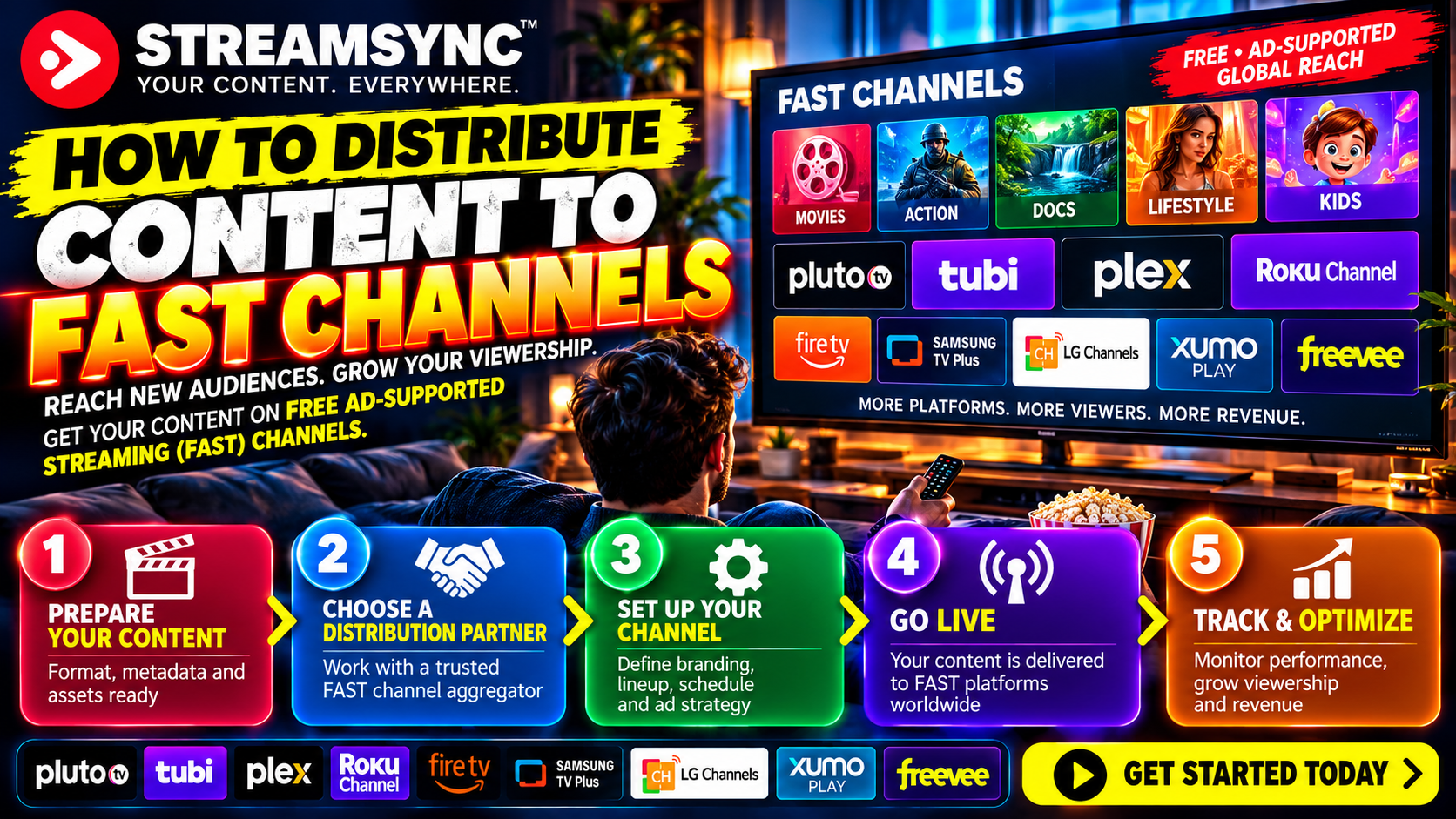
The streaming industry continues to create new opportunities for filmmakers, independent producers, television studios, and digital content owners. As audiences move toward internet-connected television services, Free Ad-Supported Streaming TV (FAST) has become an important distribution model for movies, documentaries, television series, and other video content.
For content owners, understanding how to distribute content to FAST channels can open new opportunities to reach audiences, explore licensing agreements, and generate revenue from existing productions.
Unlike subscription-based streaming services, FAST platforms generally allow viewers to watch programming without paying a monthly subscription fee. Instead, advertising supports the service’s business model. This approach gives viewers access to entertainment while creating potential commercial opportunities for content owners and distributors.
However, distributing content to FAST channels requires more than uploading a video. We need to prepare professional video assets, confirm distribution rights, create accurate metadata, identify suitable platforms, and understand the terms offered by distribution partners.
By following a structured approach, we can improve our content’s readiness for distribution and identify opportunities that align with our creative and commercial goals.
What Are FAST Channels and How Do They Work?
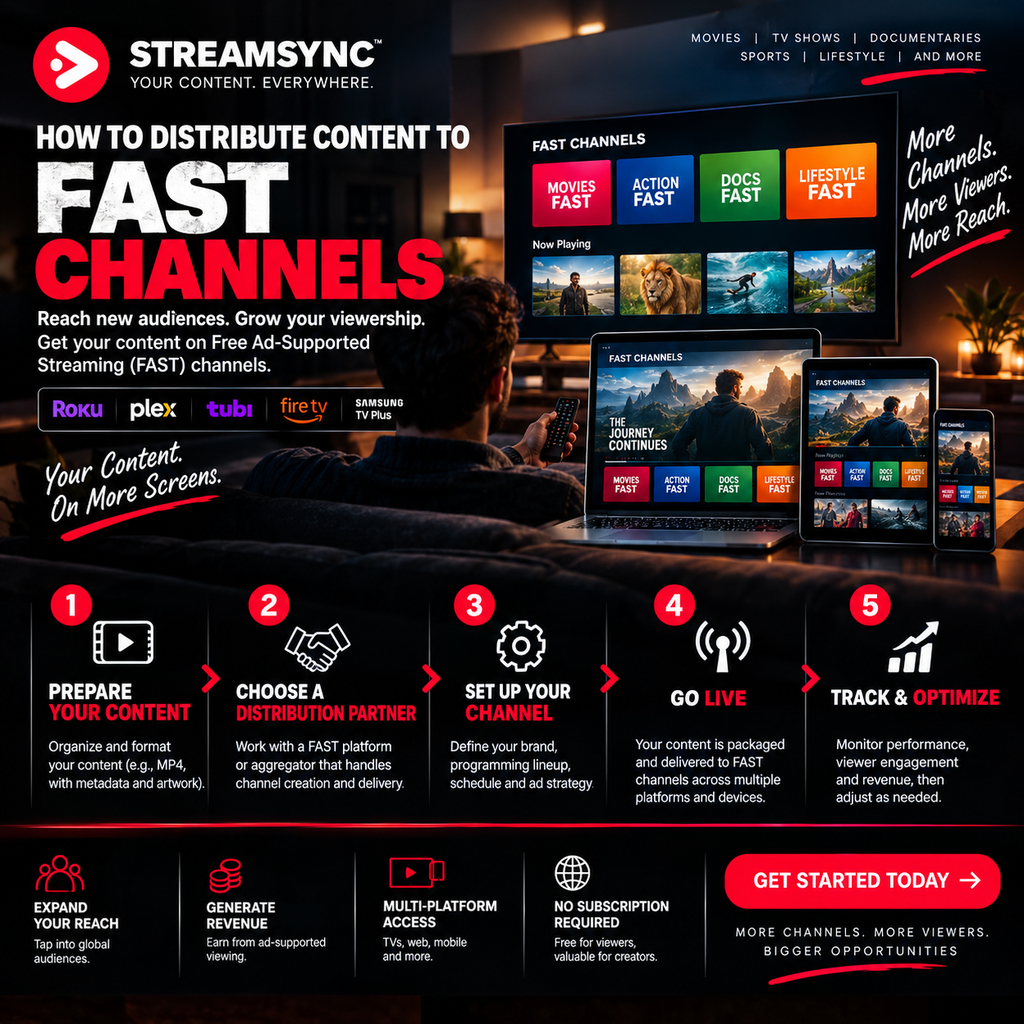
FAST stands for Free Ad-Supported Streaming TV. These services deliver television-style programming through internet-connected devices, including smart TVs, streaming devices, and supported mobile applications.
FAST channels often resemble traditional television channels because they offer scheduled programming. Depending on the service, viewers may also access on-demand movies and television episodes.
Examples of services in the FAST ecosystem include Pluto TV, Tubi, The Roku Channel, Samsung TV Plus, and Plex. Their availability, programming strategies, and content acquisition processes vary by region.
How FAST Channels Generate Revenue
FAST platforms generally generate revenue by displaying advertisements during programming. Advertising income helps support content acquisition, technology, distribution, and platform operations.
Content owners may receive compensation through licensing fees, advertising revenue shares, or other negotiated arrangements. The payment structure depends on the distributor, platform, territory, and agreement.
For example, a documentary producer might license a film to a distributor that works with eligible streaming services. Depending on the agreement, the documentary could become available to viewers through an appropriate channel or catalog.
FAST distribution doesn’t guarantee acceptance, audience reach, or revenue. Each opportunity depends on programming requirements, content quality, rights availability, and commercial terms.
FAST vs. Other Streaming Distribution Models
| Distribution model | How viewers access content | Typical revenue source |
|---|---|---|
| FAST | Free, scheduled streaming channels | Advertising |
| AVOD | Free, on-demand video | Advertising |
| SVOD | Subscription-based streaming | Subscription fees |
| TVOD | Individual rentals or purchases | Transaction payments |
Understanding these models helps us determine whether FAST distribution fits our content strategy or whether a combination of distribution channels may be more appropriate.
7 Essential Steps to Distribute Content to FAST Channels
1. Identify the Right FAST Platforms
The first step is to research platforms and distribution partners that match our content, audience, and geographic objectives.
Not every FAST service accepts submissions directly from individual filmmakers. Some acquire content through distributors, aggregators, production companies, studios, or established channel operators.
We should begin by identifying the types of viewers most likely to enjoy our content.
For example:
- Feature films: Independent cinema, action, comedy, thriller, and drama.
- Documentaries: History, nature, travel, science, and educational programming.
- Television series: Episodic drama, comedy, lifestyle, and entertainment.
- Regional content: Films and series produced in specific languages for particular audiences.
- Specialized programming: Content focused on hobbies, culture, food, fitness, or other defined interests.
We should then research each potential partner’s programming, regional availability, submission requirements, and acquisition policies.
Before approaching a distributor, we should ask whether it supports our content category, which territories it serves, and whether it can facilitate the type of distribution we want.
A focused shortlist is more useful than submitting content indiscriminately to every available service.
2. Prepare High-Quality Video Files
Professional video delivery is essential for streaming distribution. Even a compelling film may encounter delays if its master file fails technical checks.
FAST platforms and distributors can specify different delivery standards, so we should obtain the current requirements before preparing final files.
Common technical requirements may include:
- Accepted video codecs and file containers.
- Required resolution and frame rate.
- Appropriate aspect ratio.
- Clear and synchronized audio.
- Accurate runtime.
- Closed captions and subtitle files.
- Separate language versions, when required.
- Specific audio configurations.
We should check the final master for image defects, sound distortion, synchronization problems, and unintended black frames.
We should also preserve a high-quality master and maintain organized backup copies. If a distributor requests another version, a properly managed production archive makes it easier to prepare the correct file.
We shouldn’t assume that one video export will satisfy every streaming platform. Technical specifications should always come from the intended distribution partner.
3. Secure All Necessary Distribution Rights
Rights clearance is one of the most important parts of the content distribution process.
Before licensing a film or series, we need to confirm that we own or control the rights necessary for the intended distribution arrangement.
Depending on the project, this may include:
- Film and television distribution rights.
- Screenplay and underlying literary rights.
- Music synchronization and recording rights.
- Stock footage and archival material permissions.
- Artwork and photography licenses.
- Performer and contributor releases.
- Relevant location permissions.
We must also understand the territories, distribution formats, and time periods covered by our rights.
For example, a music license that permits use in a theatrical release may not automatically cover every streaming service or international market.
Distribution agreements may be exclusive or non-exclusive. An exclusive agreement can restrict our ability to license the same rights elsewhere, while a non-exclusive agreement may allow additional distribution, subject to its terms.
Before signing, we should review the agreement’s duration, territory, payment structure, termination provisions, and content removal procedures.
For significant commercial arrangements, consulting an entertainment lawyer can help us understand our obligations and protect our interests.
4. Create Professional Metadata and Promotional Assets
Metadata helps distributors identify, categorize, evaluate, and present our content.
A complete content package should contain accurate information about each title.
| Asset | Information to prepare |
|---|---|
| Title | Official title and approved alternate titles |
| Synopsis | Clear and accurate description |
| Genre | Primary and secondary categories |
| Runtime | Exact duration |
| Release year | Original release year |
| Language | Original language and available versions |
| Cast and crew | Verified names and roles |
| Artwork | Approved poster and promotional images |
| Rights information | Territories, term, and rights available |
| Accessibility | Available captions and subtitles |
We should also prepare a professional trailer or screener when requested.
The synopsis should explain the content clearly without making unsupported claims. Promotional artwork should meet the recipient’s specifications and represent the actual film or program.
For multilingual content, we should maintain separate, clearly labeled metadata and subtitle files where appropriate.
Accurate metadata supports an efficient review process and helps distribution partners understand how a title may fit their programming strategy.
5. Find a Suitable Distribution Partner
Working with a distribution partner can help us navigate the different processes involved in streaming delivery.
Depending on the company’s services, a distributor may provide content assessment, rights administration, technical preparation, metadata management, platform delivery, licensing support, or revenue reporting.
However, we should verify which services are actually included rather than assuming every distributor offers the same capabilities.
When evaluating a partner, we should consider its experience, target markets, transparency, contractual terms, and relevance to our content category.
We should also ask about:
- Submission eligibility and review procedures.
- Available distribution opportunities.
- Upfront costs and recurring fees.
- Revenue-sharing arrangements.
- Payment schedules and reporting.
- Rights and exclusivity requirements.
- Distribution timelines and termination rights.
A distribution partner can help us understand available options, but we should not assume that submitting a project guarantees placement on a particular platform.
Explore ShortFundly Distribution
For content owners researching distribution services, ShortFundly Distribution is a useful starting point for exploring the company’s offerings and determining whether they fit a particular project.
Before submitting content, we should review the information available on its website and confirm the current submission process, supported content types, service scope, and commercial terms directly with the company.
We should establish whether the specific FAST distribution opportunities we want are available, which territories may be supported, and what materials are required.
This approach helps us evaluate the service based on our actual needs rather than making assumptions about platform access or guaranteed results.
6. Submit a Professional Content Package
Once our files, rights, and metadata are ready, we can prepare the submission according to the recipient’s instructions.
A professional submission package may include:
- A concise project introduction.
- A synopsis and genre classification.
- A trailer or screener link.
- Technical specifications.
- Metadata and artwork.
- Rights documentation, when requested.
- Information about available territories and languages.
- Contact details for the authorized rights holder.
We should use clear file names and ensure that all viewing links work correctly.
Our pitch should explain what makes the project distinctive, who its intended audience is, and why it may fit the recipient’s programming.
If we have relevant awards, verified viewing figures, or previous distribution results, we can include them as supporting evidence.
We should avoid exaggerated claims about audience demand or commercial performance. A focused, accurate pitch demonstrates professionalism and makes it easier for a distributor to assess the project.
After submission, we should maintain a record of the date, recipient, materials supplied, and any follow-up requests.
7. Monitor Distribution Performance and Revenue
Distribution doesn’t end when a title becomes available. We should review performance and financial reporting whenever the relevant data is provided.
Depending on the agreement, useful metrics may include viewing hours, completed plays, audience reach, geographic availability, advertising impressions, and revenue statements.
We should understand how compensation is calculated and whether payments are based on advertising revenue, licensing fees, or another arrangement.
It’s also important to distinguish between gross revenue and the amount payable after applicable deductions.
For example, a distributor might deduct agreed expenses or retain a contractual share before paying the content owner. We should verify these calculations against our agreement and statements.
We can then compare actual results with our original objectives.
If our primary goal is international exposure, geographic reach may be an important measure. If our goal is revenue, we should examine actual payments, reporting transparency, and the commercial terms of the arrangement.
Performance analysis helps us make more informed decisions about future licensing opportunities and content investments.
How to Maximize the Value of FAST Channel Distribution
Match Content to the Intended Audience
Audience fit should guide our distribution decisions.
We should identify the strongest characteristics of each title and research channels that serve viewers with related interests.
A travel documentary, for instance, may suit a different programming strategy from a horror film or a children’s series.
A focused approach helps us present our content to partners that are more likely to consider it relevant.
Organize Our Content Library
If we own several titles, we should create a central catalog containing each project’s metadata, rights status, master-file location, artwork, and available language versions.
This makes it easier to identify missing assets, track submissions, and respond to requests from distributors.
For television series, we should also organize season information, episode numbers, runtimes, and episode descriptions.
Understand Contractual Restrictions
We should review every agreement before licensing content to another service.
Exclusivity clauses, territory restrictions, minimum terms, and rights limitations can affect future distribution opportunities.
Keeping an accurate rights schedule helps us determine which titles are available and which require further contractual review.
Promote Content Where Permitted
External promotion may help audiences discover a title after distribution.
Depending on the agreement, we can use trailers, social media posts, newsletters, interviews, and official announcements to communicate availability.
We should always use accurate links and follow any applicable promotional restrictions.
Although promotion cannot guarantee higher viewing figures, it can complement distribution by helping interested audiences learn where content is available.
Common Mistakes to Avoid When Distributing Content to FAST Channels
Several preventable mistakes can slow down the distribution process.
| Mistake | How to avoid it |
|---|---|
| Submitting to unsuitable platforms | Research eligibility and programming first |
| Sending technically incorrect files | Follow current delivery specifications |
| Ignoring rights clearance | Document all relevant permissions |
| Providing incomplete metadata | Prepare an accurate content catalog |
| Signing without reviewing terms | Examine fees, rights, and exclusivity |
| Assuming placement is guaranteed | Confirm the scope of the distribution service |
| Expecting immediate revenue | Establish realistic commercial expectations |
| Failing to track submissions | Maintain a distribution tracker |
We should treat every submission as a professional business process. Careful preparation and clear communication can reduce avoidable delays and help us evaluate opportunities more effectively.
Frequently Asked Questions About FAST Channel Distribution
1. How do we distribute content to FAST channels?
We should research suitable platforms, prepare technically compliant video files, secure distribution rights, organize metadata, and contact eligible distributors or channel operators. Before proceeding, we should review the contract and confirm the available distribution opportunities.
2. Can independent filmmakers submit movies to FAST platforms?
Yes, independent filmmakers may be able to distribute eligible movies through FAST services. However, some platforms work through selected distributors or channel operators rather than accepting direct submissions.
3. Does FAST distribution cost money?
Costs depend on the distributor and agreement. Some arrangements may include delivery fees, technical preparation expenses, administrative charges, or revenue sharing. We should request a clear explanation of all costs before signing.
4. How do FAST channels generate income for content owners?
Content owners may receive licensing fees, a share of advertising revenue, or other negotiated payments. The actual arrangement depends on the contract, platform, and distribution partner. Revenue is not guaranteed.
5. Can we distribute our content across multiple FAST platforms?
Potentially, yes. Our ability to distribute a title to multiple platforms depends on the rights we control and whether existing agreements contain exclusivity restrictions.
6. What content formats are required?
Requirements vary by recipient and may include specific video codecs, resolution, frame rate, audio settings, captions, subtitles, and metadata. We should obtain current specifications before preparing final delivery files.
7. How can ShortFundly Distribution support our distribution goals?
We can visit ShortFundly Distribution to explore its services and determine whether they fit our content and objectives. We should confirm current offerings, submission requirements, distribution opportunities, and contractual terms directly with the company.
Also read: https://blog.shortfundly.com/ott/fast-channel-aggregation/
Conclusion
Understanding how to distribute content to FAST channels helps us explore new opportunities for reaching streaming audiences and developing a broader content distribution strategy.
The process begins with selecting suitable platforms, preparing high-quality video files, securing distribution rights, and organizing professional metadata. We can then evaluate distribution partners, submit our content, review contractual terms, and monitor available performance and revenue information.
A successful approach requires careful preparation, realistic expectations, and a clear understanding of our rights and objectives.
To explore distribution options, visit ShortFundly Distribution and review the services currently available for your project.
By following these steps, we can make informed decisions, prepare stronger submissions, and explore opportunities within the growing FAST streaming ecosystem.