Table of Contents
Choosing the right FAST channel distribution partner can help filmmakers, independent producers, studios, and content owners reach audiences through the growing market for free, ad-supported streaming television. However, not every distribution company offers the same services. Some focus on traditional OTT delivery, others license individual films or catalogues, and some specialize in launching and operating complete linear streaming channels.
Before signing a distribution agreement, we need to understand exactly what a distributor can deliver, which platforms and territories are available, how revenue is calculated, and what rights we must grant. A strong distribution partnership should provide transparent terms, reliable reporting, clear technical requirements, and a realistic explanation of how our content may reach viewers.
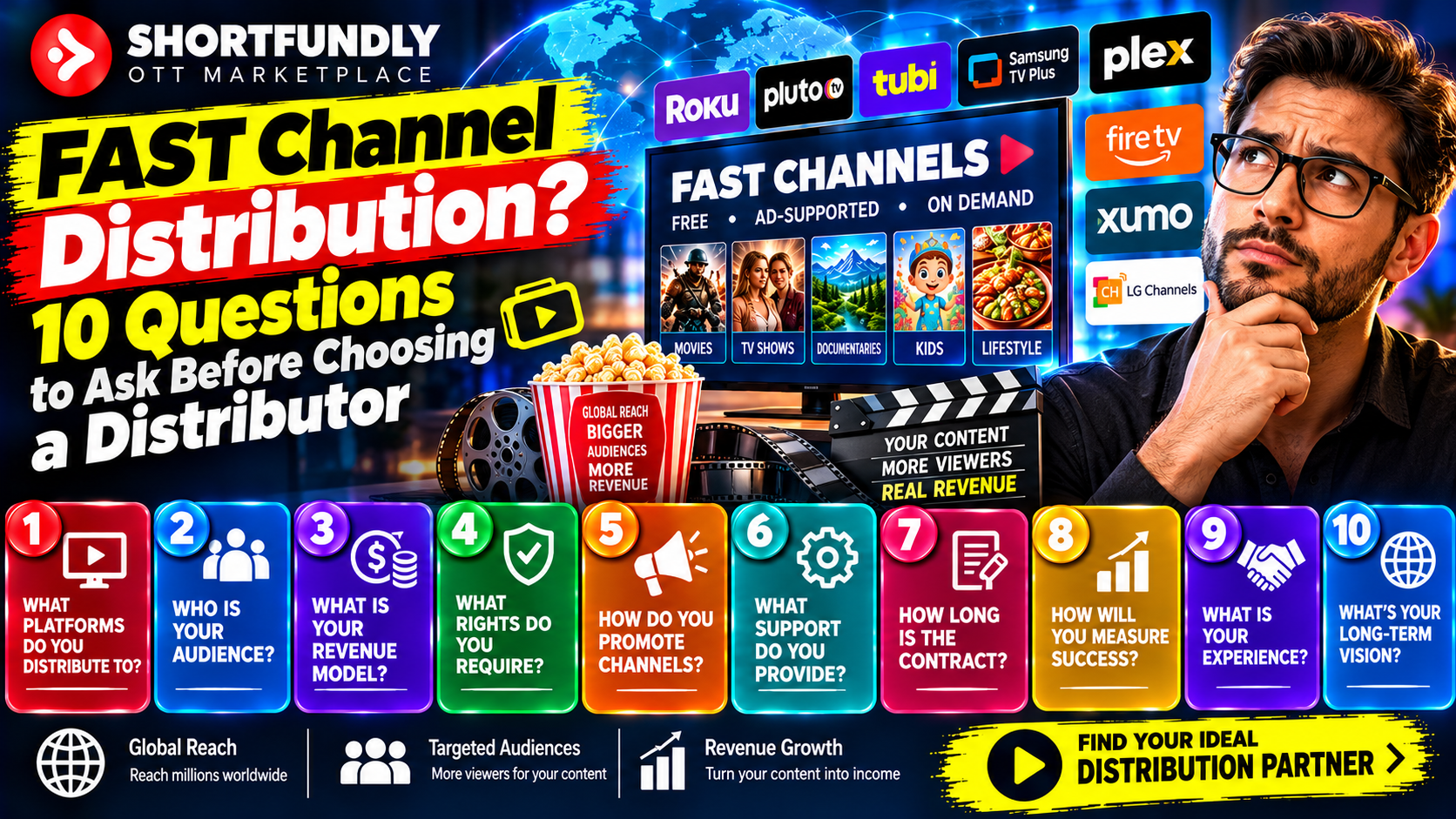
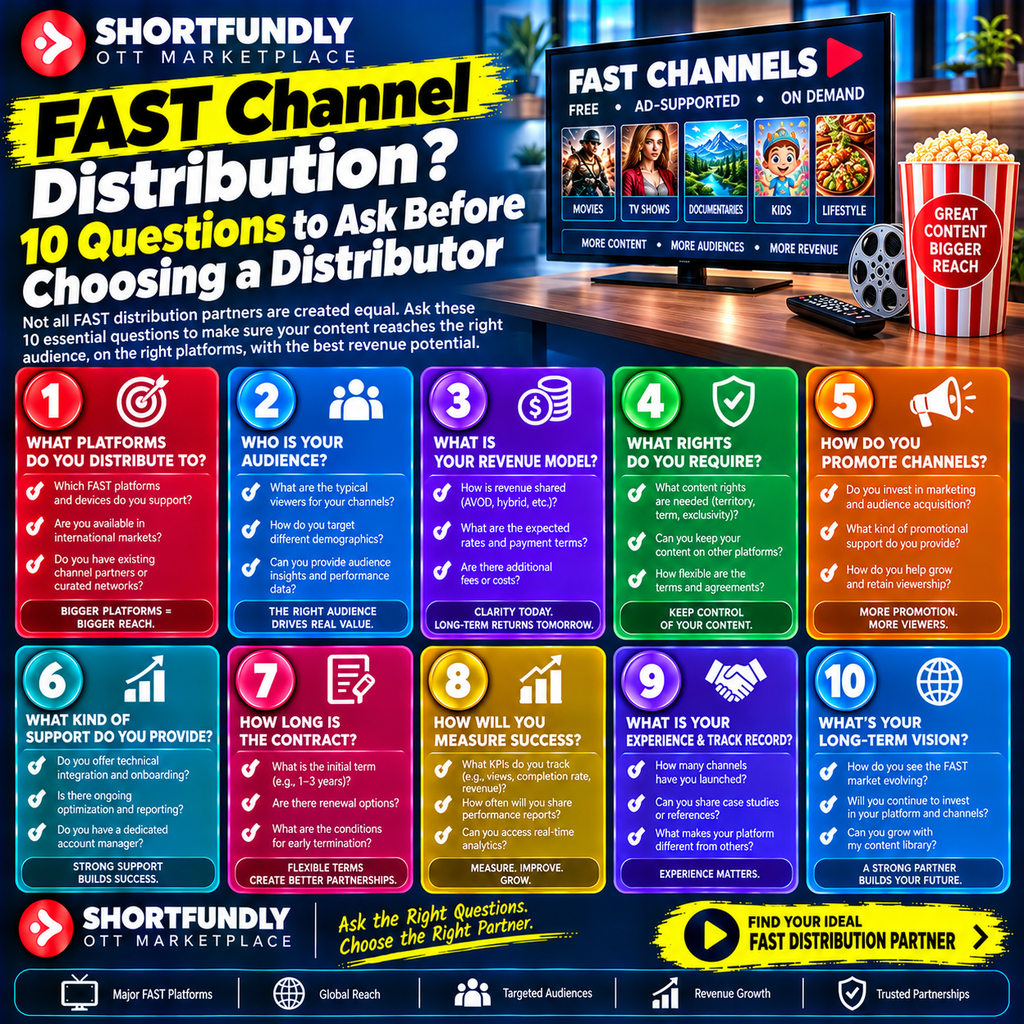
In this guide, we explore 10 essential questions to ask before choosing a FAST channel distributor, helping content owners evaluate potential partners, protect their intellectual property, and make informed distribution decisions.
What Is FAST Channel Distribution?
FAST stands for Free Ad-Supported Streaming Television. FAST services offer viewers free access to streaming content supported by advertising rather than a mandatory subscription fee. Many FAST services present content through scheduled, linear channels, similar to traditional television, while delivering the programming over the internet.
FAST distribution can involve several different business models:
- Individual-title distribution: A distributor delivers or licenses individual films, documentaries, episodes, or other programmes to potential streaming outlets.
- Catalogue distribution: A distributor represents a collection of titles, often negotiating opportunities for multiple pieces of content.
- FAST channel aggregation: A partner packages programming and coordinates delivery to one or more FAST services.
- Channel creation and management: A specialist helps develop, schedule, operate, and monetize a complete streaming channel.
These models are not interchangeable. A company that distributes films to subscription or transactional OTT services may not offer FAST channel placement, linear programming, or advertising-supported monetization. We should therefore confirm the precise service being offered before committing our content.
10 Questions to Ask Before Choosing a FAST Channel Distributor
1. Do You Specialize in FAST Distribution or General OTT Distribution?
Our first question should establish whether the distributor has a specific FAST distribution service. The term OTT distribution covers content delivered over the internet, including subscription video-on-demand, transactional video-on-demand, and advertising-supported services. However, not every OTT distribution agreement includes FAST platforms.
We should ask the distributor to explain its FAST-specific capabilities, including whether it handles linear channel delivery, on-demand licensing to ad-supported platforms, content aggregation, or complete channel operations.
We should also ask for examples of the distributor’s current services and clarify whether the company has direct platform relationships, works through aggregators, or relies on third-party partners.
Questions to ask:
- Which FAST services can you currently deliver content to?
- Do you distribute individual titles, complete catalogues, or entire channels?
- Do you manage linear scheduling and channel operations?
- Can you explain the difference between your FAST and general OTT offerings?
- What evidence can you provide of recent, relevant distribution activity?
A distributor should be able to explain its service scope without suggesting that every submitted title will automatically be accepted or placed.
2. Which FAST Platforms and Territories Can You Access?
Distribution opportunities depend on platform relationships, regional availability, content requirements, language, and licensing rights. A distributor may have access to certain services in North America but not in India, Europe, or other markets. Platform availability can also change over time.
We should request a clear overview of the platforms and territories the distributor can currently serve. We should distinguish between platforms where the company has established delivery arrangements and platforms where it merely intends to seek future opportunities.
Territory access is particularly important for independent filmmakers and producers with international ambitions. A film may be eligible for distribution in one country but unavailable in another because of existing licensing commitments, music rights, language restrictions, or regional platform policies.
Before signing, we should confirm:
- The names of currently accessible platforms, where disclosure is permitted.
- The countries and regions covered by the agreement.
- Supported languages, subtitles, and dubbing options.
- Whether distribution is direct or through third-party aggregators.
- Whether platform onboarding is subject to separate approval.
- Whether the distributor provides regional performance reporting.
We should avoid relying on vague promises of worldwide reach. Potential platform access is not the same as confirmed placement.
3. Do You Distribute Individual Titles, Catalogues, or Complete FAST Channels?
A distributor’s operating model determines the type of support we can expect. This question is especially important because individual film licensing and complete channel distribution require different workflows, rights, and technical resources.
For an individual title, the distributor may prepare delivery materials, pitch the film to potential outlets, negotiate licensing terms, and coordinate platform delivery.
For a catalogue, the distributor may evaluate multiple titles together and identify opportunities based on genre, audience, language, production quality, and available rights.
For a complete FAST channel, the scope may be broader. Services can include programming strategy, scheduling, metadata management, channel feeds, content rotation, ad-break coordination, technical monitoring, and reporting. Not every distributor provides all these services.
We should identify the exact deliverables included in the proposed arrangement and ask which responsibilities remain with us.
| Distribution model | Typical focus | What we should confirm |
|---|---|---|
| Individual-title distribution | Licensing or delivering specific films and programmes | Eligible platforms, title approval, fees, and rights |
| Catalogue distribution | Representing a collection of content | Catalogue requirements, packaging, and reporting |
| FAST aggregation | Preparing and delivering content to FAST services | Platform relationships, delivery scope, and acceptance |
| Full channel management | Operating a linear streaming channel | Scheduling, technology, advertising, maintenance, and costs |
This comparison helps us select a distributor whose services match our business objectives rather than paying for capabilities we do not need.
4. What Rights Do You Require, and How Long Will the Agreement Last?
Rights management is one of the most important parts of any distribution agreement. We should never assume that a distributor needs unrestricted control over our content simply because it is handling distribution.
The contract should specify the rights being granted, including whether they are exclusive or non-exclusive, the applicable territories, permitted platforms, languages, content formats, and duration.
We should also establish whether the agreement covers only FAST services or includes other forms of distribution, such as subscription streaming, transactional rentals, downloads, broadcast television, or physical media.
An exclusive agreement may limit our ability to work with other distributors during the contract period. A non-exclusive agreement may offer more flexibility, but it can still contain restrictions that affect competing deals or existing licences.
Our rights checklist should include:
- Exclusivity: Can we appoint other distributors for the same content?
- Territory: Which countries and regions are included?
- Platforms: Are rights limited to named FAST services or broader categories?
- Term: When does the agreement begin and end?
- Renewal: Does the contract renew automatically?
- Sublicensing: Can the distributor authorize third parties to exploit the content?
- Rights reversion: How and when do rights return to us?
- Removal: What happens when we request withdrawal or the agreement expires?
We should pay close attention to clauses that allow broad sublicensing, automatic renewals, or continued exploitation after termination. If a contract grants extensive rights, we should understand the commercial reason and obtain appropriate legal advice before signing.
5. How Will Revenue Be Generated and Shared?
FAST monetization commonly relies on advertising, but the commercial structure can vary significantly. Depending on the arrangement, a content owner may receive a licence fee, a share of advertising revenue, a negotiated minimum guarantee, or another agreed payment structure.
We should not assume that all FAST distributors calculate earnings in the same way. One agreement may specify a percentage of revenue received by the distributor, while another may calculate the content owner’s share after defined platform charges, third-party fees, or other deductions.
We need to understand the complete financial process from the point where advertising revenue is generated to the point where our share is paid.
Key commercial questions include:
- Is compensation based on a fixed licence fee, revenue share, minimum guarantee, or a combination?
- What does the revenue-share percentage apply to?
- Which deductions are permitted before our share is calculated?
- Are currency conversion fees, taxes, or third-party costs deducted?
- Is payment dependent on the distributor receiving funds from a platform?
- Is there a minimum payment threshold?
- How often are statements issued and payments made?
- Can we query or audit reported earnings?
A clear agreement should define financial terms in writing. We should request a sample revenue statement or a worked example that demonstrates how earnings are calculated. We should evaluate the actual payment formula, not just the headline percentage.
6. What Upfront Fees and Technical Costs Should We Expect?
Distribution can involve costs beyond the distributor’s main service fee. Depending on the agreement, additional expenses may include quality control, encoding, transcoding, subtitle creation, dubbing, artwork, metadata preparation, captioning, legal clearance, and asset storage.
Some providers charge an upfront fee, while others recover costs from revenue or charge for specific services. Neither structure should be judged in isolation. We should compare the complete cost of the service with the rights granted, the work performed, and the realistic distribution opportunities available.
We should ask for a written breakdown of every applicable charge and clarify whether fees are refundable if the content is rejected or no placement is secured.
Before committing, we should verify:
- The initial submission or onboarding fee, if any.
- Technical preparation and quality-control charges.
- Costs for subtitles, captions, dubbing, and localization.
- Artwork, metadata, and promotional asset requirements.
- Ongoing maintenance, storage, or channel-management fees.
- Charges associated with removal, replacement, or redelivery.
- Taxes and other applicable expenses.
A transparent distributor should explain which costs are mandatory, which are optional, and which are charged only if a service is requested. We should also confirm whether we retain ownership of any newly created artwork, localized materials, or other delivery assets.
7. What Technical Specifications and Content Assets Do You Require?
FAST platforms need content delivered in formats that meet their technical and editorial requirements. Requirements vary by service, so a distributor should provide a current delivery specification rather than relying on a generic checklist.
A submission package may include a high-quality video master, separate audio tracks, captions or subtitles, a synopsis, cast and crew details, genre information, a release year, runtime, language information, poster artwork, and still images. Some platforms may also require ratings information, content advisories, promotional trailers, or specific metadata fields.
We should ask whether the distributor conducts technical quality control and whether it will identify and help resolve delivery problems.
A practical preparation checklist includes:
- A final, high-quality video master in the required format.
- Audio tracks that meet the target platform’s specifications.
- Accurate title, runtime, language, and release information.
- Subtitles or closed captions where required.
- Poster artwork and promotional stills in the specified dimensions.
- A synopsis, genre, cast, crew, and production credits.
- A trailer or promotional clip where requested.
- Proof of ownership and relevant distribution rights.
- Music, talent, location, and other necessary clearances.
We should maintain a master asset library and a record of which version has been delivered to each partner. This can reduce delays when a platform requests a revised file or updated metadata.
8. How Will You Report Performance and Handle Payments?
Distribution is not complete when a title is delivered. We also need visibility into what happens afterward. Reporting helps us assess whether a distribution partnership is commercially useful and whether our content is reaching its intended audience.
Depending on the platform and agreement, reporting may include viewing hours, streams, impressions, advertising revenue, territory-level performance, channel engagement, or other available metrics. Not every FAST service supplies every metric, so we should confirm what information the distributor can actually obtain.
We should also ask how often reports are issued and how discrepancies are handled.
Our reporting questions should cover:
- How frequently will we receive performance statements?
- Which audience and monetization metrics are available?
- Will reports identify the platform and territory?
- How are late-arriving or corrected platform reports handled?
- What is the payment schedule?
- Is there a minimum payout threshold?
- Can we request clarification or supporting documentation?
- Who will be our contact for financial queries?
A dependable reporting process should establish clear expectations. If detailed audience analytics are unavailable from a particular platform, the distributor should explain that limitation instead of promising data it cannot access.
9. Who Is Responsible for Rights Clearance and Platform Compliance?
A content owner must have the necessary rights to distribute a film or programme in the intended territories and formats. A distributor may review the documentation, but we should never assume that the distributor’s acceptance of a submission automatically resolves every rights issue.
Music, stock footage, archive material, artwork, performances, underlying scripts, and other third-party elements can carry restrictions. A licence that permits theatrical exhibition or festival screenings may not automatically cover worldwide streaming, advertising-supported exploitation, or a specific term of distribution.
We should confirm who is responsible for checking clearances, collecting documentation, and responding to platform compliance requests.
We should also understand how the distributor handles content ratings, age restrictions, subtitles, accessibility, advertising policies, and local regulatory requirements. Some requirements may differ by territory or platform.
Before delivery, we should verify that:
- We own the content or have authority to grant the required rights.
- Music and third-party materials are cleared for the intended uses.
- Talent, location, and other necessary permissions are in place.
- Existing contracts do not conflict with the proposed agreement.
- Required ratings, captions, and content disclosures are available.
- The distributor has explained its compliance review process.
- Responsibility for claims, takedowns, and legal disputes is documented.
A clear division of responsibility helps protect both parties and reduces the risk of delays, takedowns, or disputes after release.
10. What Happens When the Agreement Expires or Is Terminated?
We should understand the end of the distribution relationship before it begins. The agreement should explain what happens when the contract expires, when either party terminates it, or when a platform removes a title.
A complete exit process should cover rights reversion, removal requests, outstanding payments, pending revenue statements, asset access, sublicensing arrangements, and the treatment of any existing platform licences.
We should ask whether the distributor can continue exploiting the content under licences granted before termination. Some platform arrangements may have separate terms, so we need to understand whether the distributor can withdraw the content immediately or whether an existing licence must run its course.
Important contract points include:
- The notice period required for termination.
- Conditions that allow early termination.
- Procedures and timelines for content removal.
- Rights reversion and restrictions on continued use.
- Settlement of unpaid revenue and final statements.
- Treatment of active sublicences.
- Access to our original files and delivery assets.
- The handling of disputes and outstanding obligations.
A fair exit clause reduces uncertainty and protects our ability to pursue future opportunities. We should avoid agreements that leave our rights, content availability, or outstanding payments unclear after the relationship ends.
How to Compare FAST Channel Distribution Companies
Once we have answers to these ten questions, we can compare distributors using a consistent evaluation framework. We should prioritize verifiable capabilities and contractual clarity rather than broad claims about reach or guaranteed income.
| Evaluation factor | What a strong distributor should provide | Warning sign |
|---|---|---|
| FAST expertise | Clear explanation of FAST-specific services | Treats all OTT and FAST services as identical |
| Platform access | Current, specific information about delivery options | Promises universal placement without evidence |
| Rights and contracts | Defined scope, term, territories, and exit clauses | Broad rights with unclear limitations |
| Revenue model | Written calculations, deductions, and payment terms | Vague revenue-share definitions |
| Technical delivery | Current specifications and asset requirements | No documented delivery process |
| Reporting | Defined reporting frequency and available metrics | Unclear statements or payment timelines |
| Compliance | Documented clearance and review responsibilities | Assumes all rights are automatically covered |
| Support | Named contacts and an issue-resolution process | No clear process for problems or disputes |
We can score each provider against these factors, request written responses, and compare the proposed terms side by side. This approach makes it easier to identify which company offers the best fit for our catalogue, budget, rights position, and long-term goals.
Red Flags to Watch for When Choosing a FAST Distributor
We should take additional care when a distributor makes claims that cannot be supported by clear documentation. Common warning signs include:
- Guaranteed placement: The distributor promises acceptance by a platform without explaining the approval process.
- Guaranteed earnings: Revenue is promised without a clearly defined commercial arrangement.
- Unclear rights: The agreement does not specify territories, platforms, exclusivity, or term.
- Hidden fees: Additional charges appear after the initial proposal.
- Vague platform access: The company cannot explain whether it has current delivery arrangements or merely intends to pursue them.
- Poor reporting terms: There is no defined schedule for statements or payments.
- Unclear termination: The contract does not explain rights reversion, removal, or outstanding revenue.
- Pressure to sign: We are discouraged from reviewing the agreement or seeking independent legal advice.
A professional distributor should be willing to discuss its capabilities, limitations, commercial terms, and workflow openly. We should request written answers and retain copies of the final agreement and supporting documentation.
How Shortfundly Distribution May Fit into Our Distribution Strategy
For filmmakers and content owners exploring digital distribution, Shortfundly Distribution provides a starting point for reviewing submission options and distribution services for eligible content.
Before proceeding, we should review the official portal to understand its current submission process, content requirements, applicable fees, and available distribution opportunities. The requirements and commercial terms may vary by content type, duration, eligibility, and current partner availability.
It is important to distinguish between general OTT distribution and confirmed FAST channel distribution. Submitting a film or programme through an OTT distribution service does not automatically mean that the title will be placed on a FAST platform or included in a linear FAST channel. We should ask Shortfundly directly whether FAST-specific distribution is currently available for our type of content, which platforms or partners may be relevant, and what rights and commercial terms would apply.
Before making a commitment, we should confirm:
- Whether our film, documentary, series, or other content type is eligible.
- Whether the service covers FAST distribution specifically or other OTT distribution options.
- Which territories and platforms may be available for our title.
- What fees, rights, and agreement terms apply.
- Whether platform acceptance is subject to a separate review.
- What reporting, monetization, and payment arrangements are available.
Reviewing the current terms directly with the provider helps us determine whether the service matches our distribution goals. We should base our decision on the actual service offered and the agreement provided, rather than assuming that every title or platform is covered.
Frequently Asked Questions About FAST Channel Distribution
What is the difference between FAST and OTT distribution?
OTT is a broad term for video delivered over the internet. It includes subscription services, transactional platforms, and advertising-supported services. FAST generally refers to free, ad-supported streaming television, often delivered through scheduled linear channels. FAST distribution is therefore one possible part of the wider OTT ecosystem, but a general OTT distribution agreement does not necessarily include FAST placement.
Can an independent filmmaker distribute a film through FAST platforms?
Potentially, yes. Eligibility depends on the film’s rights, technical quality, language, content category, platform requirements, and the distributor’s available relationships. We should confirm the relevant service’s current submission criteria and remember that platform approval is not automatic.
Does a FAST distributor guarantee placement on a streaming platform?
No universal guarantee should be assumed. A distributor may deliver or pitch a title, but the platform may conduct its own review and decide whether to accept it. Any specific placement commitment should be clearly documented in the agreement.
What materials are typically required for FAST distribution?
Common requirements include a high-quality video master, audio files, metadata, synopsis, poster artwork, stills, subtitles or captions where needed, and evidence of distribution rights. The exact specifications vary by platform and distributor, so we should request a current delivery checklist before preparing the package.
Should we choose an exclusive or non-exclusive distribution agreement?
The right choice depends on our commercial priorities, existing contracts, and the opportunities available. Exclusivity may be appropriate for a specific deal, but it can restrict our ability to appoint other partners. We should evaluate the precise scope, duration, territories, and platforms covered before granting exclusive rights.
How do FAST distributors make money?
Depending on the business model, revenue may come from advertising, content licensing, channel operations, aggregation services, or other contractual arrangements. A content owner’s compensation may be based on a licence fee, revenue share, minimum guarantee, or a combination. We should confirm the actual model and payment calculation in writing.
Is Shortfundly Distribution suitable for FAST channel distribution?
We should verify this directly with Shortfundly. Its official distribution portal is a starting point for reviewing available services and submission requirements, but we should not assume that general OTT distribution includes FAST channel placement. Ask whether FAST-specific opportunities are available for our content and request the current terms before proceeding.
Also read: https://blog.shortfundly.com/ott/film-library-fast-channels/
Conclusion: Choose a FAST Distributor with Clear Rights, Transparent Terms, and Verifiable Capabilities
Selecting a FAST channel distributor requires more than comparing company profiles or looking for the largest number of platform names. We need to understand the distributor’s actual FAST capabilities, platform access, territory coverage, rights requirements, fees, revenue model, technical workflow, reporting, compliance responsibilities, and termination process.
By asking these ten questions before signing, we can compare providers consistently, identify unclear terms early, and protect the long-term value of our content. We should prioritize partners that explain their services honestly, document their obligations, and provide realistic expectations about platform approval and monetization.
For content owners exploring distribution options, Shortfundly Distribution is one place to review current submission information and available services. We should confirm directly whether FAST-specific distribution is offered for our content and evaluate the current agreement before committing.
The best distribution partnership is one that aligns with our rights, budget, content catalogue, and business objectives while giving us a clear understanding of what the distributor will—and will not—deliver.