Table of Contents
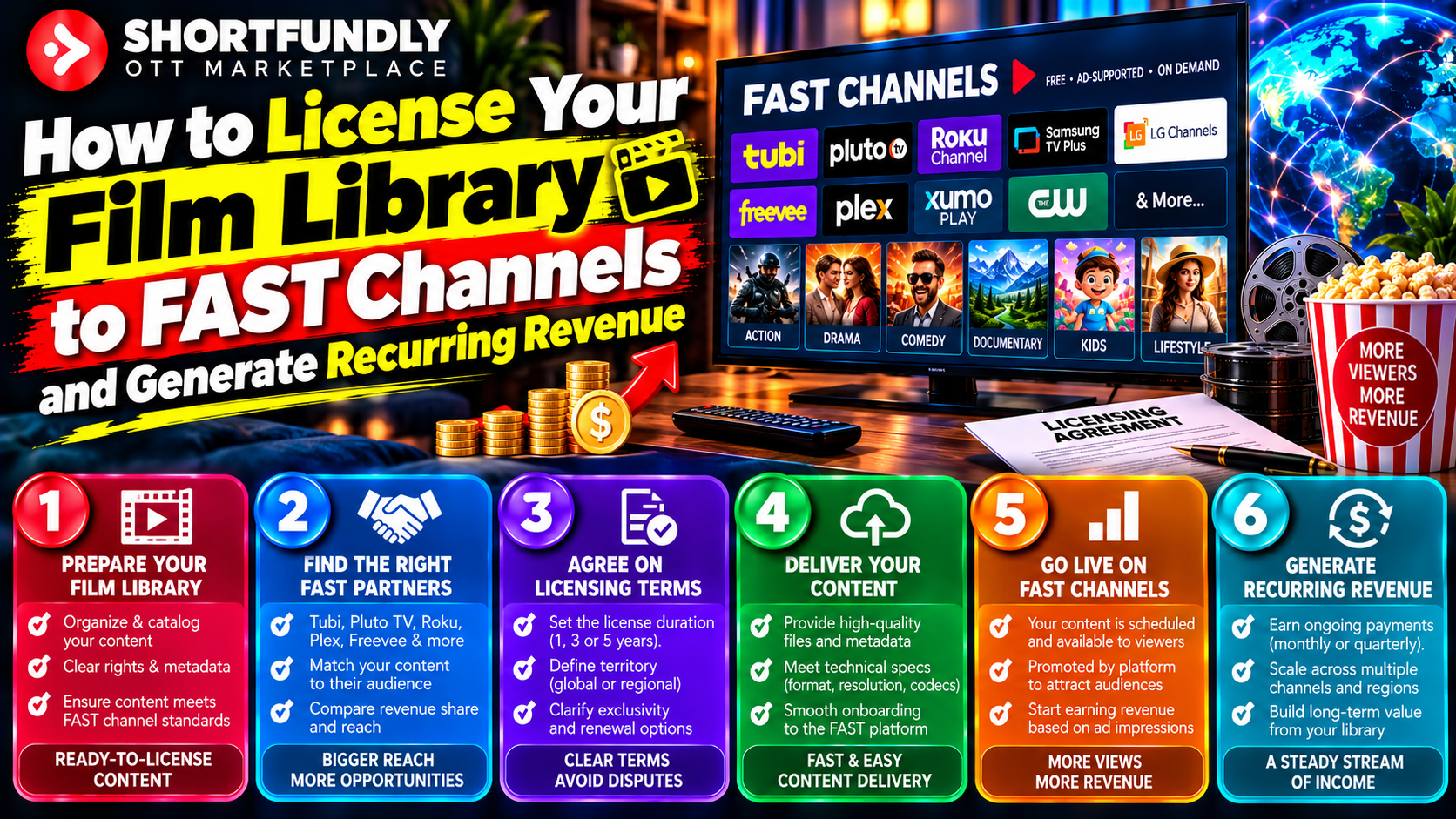
If you own a collection of feature films, short films, documentaries, television movies, or completed web series, your existing catalogue may offer more distribution opportunities than you realize. Even after a film’s initial theatrical, television, or streaming release, it may still have commercial value in other markets and distribution windows.
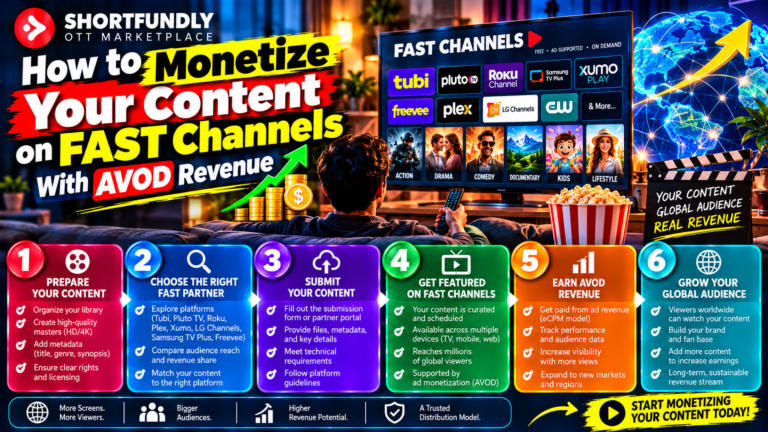
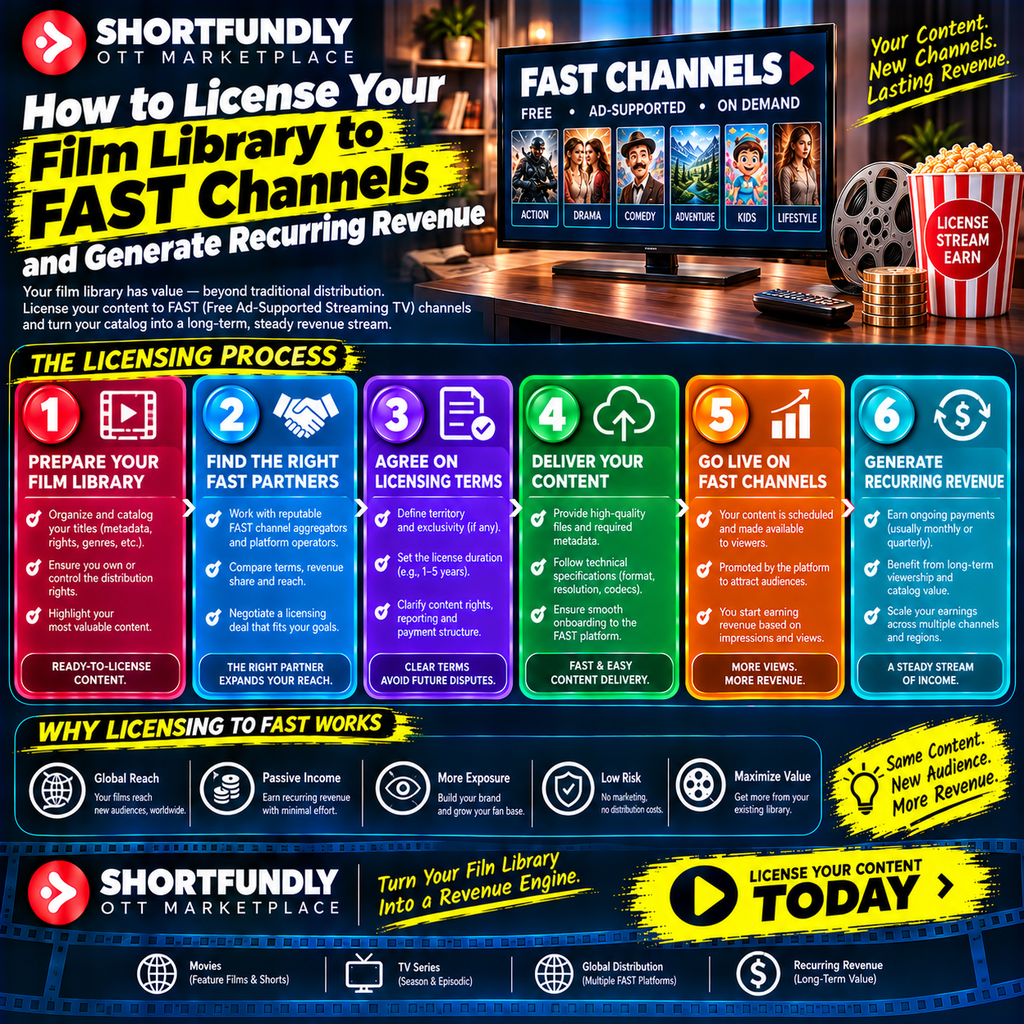
One opportunity worth exploring is FAST channel licensing. FAST stands for Free Ad-Supported Streaming Television. These services let viewers watch television-style programming for free, with advertising helping fund the service. Depending on the platform and licensing agreement, content owners may earn revenue from licensing fees, advertising-linked revenue shares, or other negotiated arrangements.
For filmmakers and independent studios, licensing a film library to FAST channels can help extend the commercial life of existing titles, introduce content to new audiences, and create additional income opportunities. However, revenue is not guaranteed. Results depend on the content, audience demand, platform availability, rights granted, commercial terms, and performance.
This guide explains how to prepare your library, approach suitable partners, negotiate licensing agreements, and build a practical strategy for FAST channel distribution and recurring revenue.
What Is FAST Channel Licensing?
FAST channel licensing is an arrangement in which a rights holder authorizes a channel operator, distributor, or other partner to use specified content for a defined purpose, territory, and period.
Unlike conventional video-on-demand services, where viewers choose individual titles, FAST channels often deliver scheduled programming through a continuous, television-style stream. A channel might focus on independent films, classic cinema, action movies, documentaries, regional-language entertainment, family programming, or a particular genre.
For example, a producer with a catalogue of independent thrillers could pitch those films to a channel specializing in suspense and crime. A documentary producer might approach a factual-entertainment channel seeking completed documentaries.
The content owner and licensee negotiate the rights, territories, term, exclusivity, delivery requirements, and commercial arrangement. Some deals cover individual films, while others involve a package or a larger catalogue.
The key benefit is the possibility of monetizing existing content again without producing an entirely new film. Whether a deal creates meaningful income depends on its terms and the actual performance or licensing value of the titles.
Why License Your Film Library to FAST Channels?
A completed film library represents an investment in production, talent, equipment, post-production, and marketing. FAST licensing may provide another route to recover some of that investment and extend the value of the content.
1. Extend the Commercial Life of Existing Films
A film does not necessarily lose its value after its first release. Older titles may appeal to new viewers when they become available through a suitable channel, genre collection, or territory.
FAST distribution can offer another potential window for eligible films, provided the new agreement does not conflict with existing licenses or exclusivity restrictions.
2. Reach Viewers Who Prefer Free Streaming
Some viewers prefer free, advertising-supported entertainment instead of paying for multiple subscriptions. FAST channels serve this audience by offering scheduled programming without a traditional subscription fee.
A film library with a clear genre, language, or audience focus may be attractive to operators looking to strengthen their programming.
3. Explore Revenue From Multiple Titles
A library can give a potential partner more programming options than a single film. Related titles may support themed collections, genre blocks, or a broader programming strategy.
For example, a studio with 20 documentaries could pitch a documentary package rather than sending each title separately. A producer with several regional-language films might present them as a catalogue with a defined audience.
The actual value of a package depends on quality, rights availability, demand, and the partner’s needs. A large catalogue is not automatically more valuable than a smaller collection of strong, well-positioned titles.
4. Explore Additional Distribution Windows
Depending on the rights you own and the terms of your existing contracts, a title may be suitable for FAST, advertising-supported video-on-demand, subscription video-on-demand, transactional video-on-demand, television, or other distribution models.
These options must be planned carefully. If one partner has exclusive rights, or if a contract contains holdbacks, you may not be free to license the same title elsewhere during the restricted period.
A thoughtful rights strategy can help you pursue new opportunities while protecting existing agreements.
Step 1: Audit Your Film Library Before Approaching Distributors
Before pitching your catalogue, create a complete inventory of the films and programs you own or are authorized to license.
A clear catalogue makes it easier for a potential distributor or FAST channel operator to assess your content quickly.
Include the following information for each title:
- Film or program title
- Content type, such as feature film, short film, documentary, or series
- Genre and intended audience
- Runtime or episode count
- Original language and available language versions
- Release year
- Synopsis and key cast or creator details
- Available video and audio masters
- Subtitle and dubbing availability
- Ownership and rights status
- Territories available for licensing
- Existing agreements and restrictions
- Promotional artwork, trailer, and stills
Create a Film Library Inventory
| Catalogue field | What to record | Why it matters |
|---|---|---|
| Title | Official title and alternate titles | Helps partners identify the content |
| Genre | Drama, thriller, comedy, documentary, and more | Supports channel and audience matching |
| Runtime | Total duration or episode length | Helps with programming and scheduling |
| Language | Original language and available versions | Shows potential audience and localization options |
| Rights status | Rights owned and restrictions | Helps establish whether the title can be licensed |
| Territory | Countries or regions available | Defines where a partner can distribute the film |
| Existing licenses | Current platforms, terms, and expiry dates | Helps prevent rights conflicts |
| Technical assets | Masters, audio tracks, subtitles, and artwork | Indicates delivery readiness |
Review the inventory regularly. Rights availability can change when agreements expire, territories are released, or new language versions become available.
Step 2: Confirm You Have the Correct Licensing Rights
Rights clearance is one of the most important parts of FAST channel licensing. Owning a film’s physical master or having helped produce it does not automatically mean you can grant every distribution right.
Before signing a deal, confirm that you have the authority to license the relevant content and all necessary underlying rights for the intended use.
Depending on the film, the rights review may cover:
- Screenplay and underlying literary material
- Music and sound recordings
- Performances and talent agreements
- Archival footage and third-party clips
- Artwork, photographs, and other visual assets
- Dubbed versions and translated subtitles
- Distribution and licensing rights in each territory
A film may be cleared for one type of distribution but not another. For example, an existing agreement might cover subscription streaming but say nothing clear about FAST distribution.
Review the wording of each agreement instead of assuming that general streaming rights cover every service.
Questions to Ask Before Licensing a Film
- Do I own or control the rights required for FAST distribution?
- Does any existing contract grant another party exclusive rights?
- Which territories are available?
- Are the rights limited by language, platform, or distribution format?
- Is the film cleared for advertising-supported use?
- Are music, archival footage, and other third-party elements properly cleared?
- When do existing agreements expire?
- Can I grant the proposed rights for the full requested term?
If ownership or clearance is unclear, seek advice from an entertainment lawyer or qualified rights professional before committing the title.
Step 3: Decide Which FAST Licensing Route Fits Your Library
There is no single distribution route that works for every film library. Your best approach depends on the number of titles you have, your rights position, technical readiness, and whether you want to manage distribution yourself.
Route A: License Directly to a FAST Channel Operator
A channel operator may license films or a catalogue that fits its programming strategy.
This route can work well when you understand your audience, have a focused library, and can identify channels whose genres and viewer profiles align with your content.
Start with a concise catalogue pitch rather than sending large video files without permission. Ask about the operator’s current content needs, territories, technical specifications, licensing process, and commercial model.
Route B: Work With a Distributor or Aggregator
A distributor or aggregator may help rights holders prepare and submit content to supported services. Depending on the provider, its services may include catalogue evaluation, technical validation, metadata preparation, rights documentation, content delivery, and reporting.
Before choosing a partner, ask:
- Which platforms or channel operators does it currently serve?
- Does it accept individual films, complete libraries, or both?
- Which genres, languages, and territories are relevant?
- What fees or revenue arrangements apply?
- Does it require exclusive rights?
- What reports will it provide?
- Does it handle FAST distribution specifically, or only other OTT services?
Do not assume that a company offering general OTT distribution also guarantees placement on FAST channels. Confirm FAST-specific services and platform availability in writing.
Route C: Explore a Catalogue Licensing Deal
A catalogue deal involves licensing multiple titles under one agreement or a group of related agreements.
This can simplify negotiations when a partner wants a substantial collection. It may also help a channel build a consistent programming identity.
However, do not license every title automatically. Consider separating your catalogue into groups based on genre, language, territory, rights availability, and expected value.
You may discover that some titles are better suited to FAST distribution while others are more appropriate for another platform or licensing window.
Route D: Consider Building Your Own FAST Channel
If you control a sufficiently large and coherent catalogue, you could explore creating a dedicated FAST channel rather than licensing all your titles to an existing operator.
This approach generally requires more operational planning. You may need to address channel branding, scheduling, playout technology, metadata, distribution partnerships, advertising integration, technical delivery, and ongoing programming.
A dedicated channel may offer more control, but it also creates additional costs and responsibilities. Evaluate the size and quality of your library, your operational capacity, and the likely distribution opportunities before choosing this route.
Step 4: Prepare Your Film Library for Professional Delivery
Even a strong film can be delayed or rejected if its technical assets are incomplete or fail a platform’s specifications.
Prepare a reliable delivery package for each title. Requirements vary by partner, so request the current technical delivery document before producing final files.
Common Delivery Assets
| Asset | Purpose |
|---|---|
| High-quality video master | Provides the source file for platform delivery |
| Approved audio tracks | Ensures dialogue, music, and effects are usable |
| Captions and subtitles | Supports accessibility and language needs |
| Dubbed audio | Makes content available to additional audiences when appropriate |
| Poster and key artwork | Supports catalogue presentation and promotion |
| Trailer or promotional clip | Helps partners evaluate and market the title |
| Synopsis and metadata | Gives viewers and programming teams useful information |
| Rights documentation | Demonstrates authority to license the content |
| Credits and content advisories | Supports accurate presentation and compliance |
Maintain organized file names and backups. Keep a record of the version, language, resolution, audio configuration, and delivery date for each master.
Do not assume every FAST service accepts the same formats. Follow the receiving partner’s specifications for resolution, codecs, frame rate, audio layout, subtitles, artwork dimensions, and delivery method.
Step 5: Make Your Catalogue Easy to Evaluate
A catalogue pitch should explain not only what your films are, but also why they may fit a particular channel.
Avoid sending a spreadsheet with titles alone. Add enough information for the recipient to understand the genre, audience, format, and licensing availability.
Write Clear Film Synopses
Create a short synopsis for each title. Focus on the premise, central conflict, subject, or distinctive viewing experience. Keep it accurate and avoid unsupported claims about awards, popularity, or audience performance.
For series, include episode count, episode duration, season information, and whether the series is complete.
Organize Titles Into Relevant Groups
Useful catalogue groupings may include:
- Independent drama
- Thriller and mystery
- Family entertainment
- Documentary and factual content
- Regional-language cinema
- Classic or library films
- Short films and curated collections
- Completed web series
The aim is not to force every film into a narrow category. It is to help a potential partner understand how the catalogue could support its programming goals.
Include Rights Availability in the Pitch
Clearly identify the rights you can offer. For example, a title might be available for non-exclusive FAST licensing in selected territories while remaining restricted elsewhere.
Never promise worldwide availability unless your rights actually cover it.
Step 6: Research the Right FAST Channels and Distribution Partners
Partner research can save time and help you avoid irrelevant submissions.
Build a shortlist of operators and distributors whose programming needs match your catalogue. Examine the genres they carry, their target markets, languages, platform presence, submission process, and licensing approach.
Do not rely only on a partner’s marketing claims. Ask for current information about the services it can reach and whether it is actively considering the type of content you offer.
FAST Partner Evaluation Checklist
| Evaluation area | Questions to ask |
|---|---|
| Content fit | Does the partner work with your genre, format, or language? |
| Platform access | Which FAST services can it currently deliver to? |
| Territory | Where can your titles be made available? |
| Deal structure | Is the offer a license fee, revenue share, or another arrangement? |
| Exclusivity | Will you retain the ability to license the film elsewhere? |
| Reporting | What performance and revenue information is available? |
| Fees | Are there setup, delivery, marketing, or ongoing charges? |
| Contract term | How long will the rights be granted? |
| Rights reversion | How and when do the rights return to you? |
| References | Can the partner explain its experience with similar content? |
Choose partners based on fit, transparency, and contractual terms—not just the size of the platform list.
Step 7: Build a Clear Licensing Proposal
Your proposal should make it easy for a potential partner to understand the content and the deal you are offering.
Start with a brief introduction to your company or production background. Then summarize the catalogue, identify the available titles, and explain why they may suit the partner’s audience.
Include:
- A catalogue overview
- A title list with genre, language, and runtime
- Short synopses and relevant trailers
- Available territories and languages
- Confirmation of rights availability
- Technical asset readiness
- Your preferred licensing structure, where appropriate
- Contact details and the next step
Be professional and concise. Avoid attaching large masters unless the partner requests them through an approved delivery process. A secure screener or catalogue link may be more appropriate during initial evaluation.
Example of a Catalogue Pitch
Subject: Film Library Available for FAST Licensing
Hello,
We represent a library of completed films and audiovisual content that may fit your FAST channel programming needs. Our catalogue includes titles across selected genres and languages, with title details, runtimes, synopses, and rights availability organized for review.
We would welcome the opportunity to learn more about your current content requirements, target territories, technical specifications, and licensing models.
Please let us know your preferred submission process and whether you are currently evaluating films or catalogue packages in these categories.
Thank you for your time.
Best regards,
[Name]
[Company]
[Contact Information]
Customize this message for each recipient. Mention specific titles or genres that genuinely match the partner’s programming rather than sending the same generic pitch to every company.
Step 8: Understand FAST Channel Revenue Models
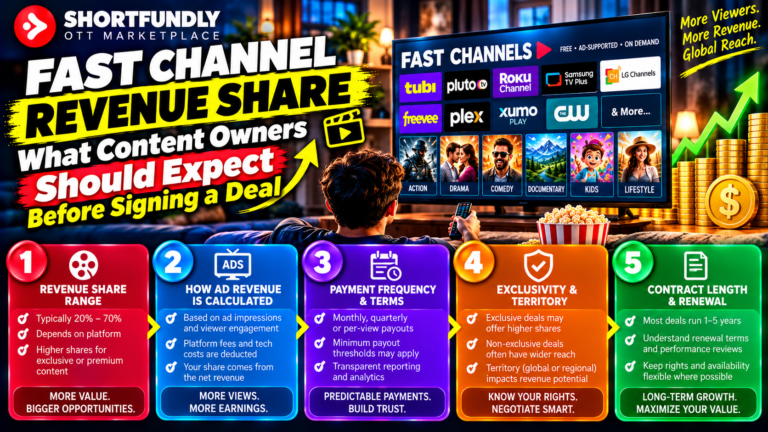
The commercial structure determines how your film library may generate income. There is no universal FAST licensing payment model, and terms vary across operators, distributors, territories, and titles.
Common structures include the following.
1. Fixed Licensing Fee
A licensee pays an agreed amount for the right to use a title or catalogue during a defined term.
Potential advantage: The payment amount and timing can be easier to understand if clearly stated in the contract.
What to check: The fee, payment milestones, rights granted, term, territory, exclusivity, and any conditions that must be satisfied before payment.
2. Advertising-Linked Revenue Share
Under a revenue-share arrangement, the rights holder receives an agreed share of revenue defined in the contract. The calculation may be connected to advertising receipts or another specified revenue basis.
Potential advantage: Income may increase if the content or channel performs well.
What to check: How revenue is defined, which costs can be deducted, whether revenue is calculated per title or across a catalogue, how reporting works, and when payment is due.
3. Minimum Guarantee Plus Revenue Share
Some licensing negotiations may include a minimum guarantee alongside a revenue-sharing arrangement. Whether this is available depends on the partner, content, market, and negotiating position.
Potential advantage: If properly structured, the guarantee can provide a defined payment component while allowing additional earnings under agreed conditions.
What to check: Whether the guarantee is recoupable, what revenues are used for recoupment, when it is payable, and how any additional share is calculated.
4. Catalogue or Package Licensing
A partner licenses several titles under a package arrangement. The contract may specify a total fee, title-level allocations, or another agreed commercial formula.
Potential advantage: It may reduce the effort involved in negotiating many individual title deals.
What to check: Whether every title must be delivered, how substitutions are handled, whether the partner can select titles, and what happens if some films fail technical or legal review.
Compare the Commercial Structures
| Model | Possible benefit | Important consideration |
|---|---|---|
| Fixed fee | Defined payment under agreed conditions | May limit additional upside if performance grows |
| Revenue share | Potential to participate in revenue growth | Earnings depend on the contractual formula and reported results |
| Minimum guarantee plus share | May combine a payment floor with additional participation | Recoupment and payment conditions must be clear |
| Catalogue package | Can simplify licensing across multiple titles | Individual title value and package-wide rights need careful review |
Do not evaluate an offer by its headline percentage alone. A smaller percentage of a clearly defined revenue base may be more valuable than a larger percentage of a vague or heavily reduced base.
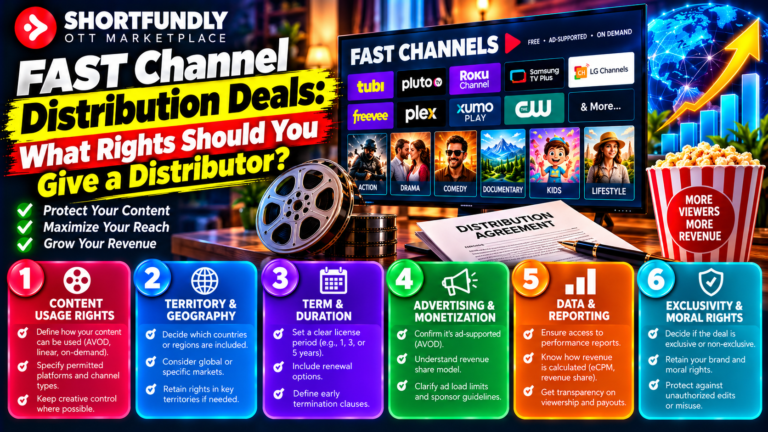
Step 9: Negotiate the Rights Before Signing
A licensing agreement should specify exactly what the partner can do with your film library.
Pay particular attention to the following terms.
Rights and Platforms
The agreement should define whether it covers FAST channels only or also includes other formats, such as on-demand streaming, television, mobile distribution, or physical media.
Do not grant broad rights simply because a partner requests them. Consider whether the proposed scope matches the commercial opportunity.
Territory and Language
List the countries or regions covered by the deal. Clarify whether dubbed versions, subtitles, and alternate edits are included.
If the partner wants worldwide rights, verify that you can grant them and consider whether a narrower initial territory would be more appropriate.
Exclusivity
An exclusive deal may prevent you from licensing the same content to other services during the term. A non-exclusive deal may provide more flexibility but could offer different commercial terms.
Ask what exclusivity applies to: the title, format, platform, language, territory, or all of them. Also check for holdbacks and restrictions that continue after the agreement ends.
Term and Renewal
Set a clear start date, end date, and renewal process. Avoid automatic renewals that make it difficult to reclaim your rights or negotiate new terms.
Sublicensing
If the distributor can sublicense your content to other parties, understand which partners may receive the rights and whether the distributor remains responsible for reporting and payment.
Reporting and Audit
Specify how often statements will be provided, what they must contain, how disputes can be raised, and whether you have the right to inspect relevant records.
Termination and Rights Reversion
The agreement should explain what happens when the term expires or the contract is terminated. Clarify when the licensee must stop using the content, remove it from relevant services where required, and return or delete materials.
Consider having an entertainment lawyer review the contract, especially when the agreement covers multiple territories, a large catalogue, long terms, or exclusive rights.
Step 10: Plan for Revenue Tracking and Catalogue Performance
A recurring revenue strategy needs consistent tracking. Do not rely only on the initial licensing announcement or a distributor’s general performance claims.
Maintain a record of every title submitted, accepted, rejected, delivered, licensed, and released. Record the platform or partner, territory, rights term, reporting period, and payment status.
Where available under the agreement, monitor:
- Revenue reported by title or catalogue
- Viewing hours or other performance metrics
- Territory and platform availability
- Permitted deductions and service fees
- Delivery and localization costs
- Payment dates and outstanding balances
- Contract renewal and expiry dates
Not every partner will provide the same analytics. Confirm the available reporting before signing.
Use the data to identify which genres, languages, or titles attract interest. That information can guide future pitches, technical investment, localization decisions, and negotiations.
Step 11: Build a Long-Term Licensing Strategy
FAST licensing works best as part of a broader content rights plan rather than a one-time transaction.
Create a calendar showing when each title becomes available for licensing, when existing contracts expire, and when renewal discussions should begin. This helps you avoid accidental rights conflicts and gives you time to prepare new proposals.
You can also group your catalogue by commercial opportunity:
- Titles ready for immediate licensing
- Titles that need updated masters or metadata
- Titles requiring rights clearance
- Titles with expiring agreements
- Titles suitable for localization
- Titles better suited to other distribution models
Review the strategy periodically. A title that was not suitable for one partner may fit another operator, territory, or programming concept later. At the same time, do not assume every title will secure a deal or earn recurring revenue.
How Shortfundly Distribution Can Fit Into Your Content Strategy
If you are a filmmaker or content owner exploring distribution beyond traditional release routes, Shortfundly Distribution is one option to consider for eligible content.
Shortfundly describes a submission process for supported formats, including short films, web series, movies, documentaries, telefilms, pilot films, and other content types listed in its current submission flow. The process includes reviewing requirements, submitting content for evaluation, completing the applicable agreement and payment steps, and tracking submission status and earnings.
You can review the current process through the official Shortfundly Distribution portal.
Before submitting, confirm the current content requirements, applicable fees, agreement terms, distribution partners, and available platforms. Most importantly, ask whether a specific FAST channel opportunity is available if your goal is FAST placement.
OTT distribution and FAST channel licensing are not the same thing. A general OTT submission does not guarantee that a film will be accepted by a FAST operator or placed on a FAST channel. Platform availability depends on eligibility, rights, review, licensing, and current distribution relationships.
For a rights holder, the practical approach is to treat Shortfundly as one potential distribution route while separately verifying any FAST-specific service or placement that you intend to pursue.
Common Mistakes to Avoid When Licensing a Film Library
Even a well-produced catalogue can face delays if the rights and delivery process is poorly managed. Avoid these common mistakes:
1. Assuming you own every required right. Check music, footage, underlying material, talent agreements, and existing distribution contracts.
2. Granting broad exclusivity without a clear benefit. Understand the restrictions and negotiate the scope, term, and territories carefully.
3. Treating every OTT opportunity as a FAST deal. Confirm the exact services and distribution formats covered by the agreement.
4. Sending incomplete technical assets. Prepare masters, subtitles, metadata, artwork, and rights documents according to the partner’s requirements.
5. Accepting unclear revenue definitions. Ensure the contract explains the payment formula, deductions, reporting, and payment schedule.
6. Ignoring expiry dates. Track the end of every license and the procedure for rights reversion.
7. Assuming revenue is guaranteed. Licensing may create income opportunities, but acceptance, placement, viewership, and earnings are not assured.
8. Failing to track performance. Maintain your own records and use available reporting to make better decisions about future licensing.
FAST Film Library Licensing Checklist
Use this checklist before contacting a potential FAST partner.
Rights Readiness
- Confirm ownership or authority to license each title.
- Review existing exclusive and non-exclusive agreements.
- Identify available territories, languages, and distribution formats.
- Confirm music, footage, and other required clearances.
- Record rights expiry dates and restrictions.
Catalogue Readiness
- Create an up-to-date title inventory.
- Write concise synopses and accurate metadata.
- Group titles by genre, language, format, or audience.
- Prepare secure screeners and relevant trailers.
- Organize posters, stills, subtitles, and masters.
Partner and Contract Readiness
- Verify the partner’s current FAST distribution capabilities.
- Understand its submission process and technical requirements.
- Compare fees and commercial models.
- Review exclusivity, territory, term, and sublicensing clauses.
- Confirm reporting, payment, termination, and rights reversion terms.
- Seek professional legal review when appropriate.
Ongoing Management
- Track every submission and license.
- Record reporting periods and payments.
- Review performance information when available.
- Set reminders for renewals and expiries.
- Reassess the catalogue and distribution strategy periodically.
Frequently Asked Questions
1. What does it mean to license a film library to FAST channels?
It means granting a FAST channel operator or distribution partner permission to use specified films under agreed conditions. The agreement typically defines the rights, territory, term, exclusivity, delivery obligations, and commercial arrangement.
2. Can independent filmmakers license films to FAST channels?
Potentially, yes. Independent filmmakers can explore opportunities if they control the necessary rights and meet the partner’s content, technical, and legal requirements. Acceptance is not guaranteed.
3. How do content owners earn revenue from FAST licensing?
Depending on the agreement, revenue may come from a fixed license fee, advertising-linked revenue share, a minimum guarantee, a catalogue fee, or a combination of arrangements. The payment structure varies by partner and deal.
4. Is FAST channel revenue guaranteed?
No. A licensing agreement may define payments, but revenue-share earnings can depend on performance and the contractual calculation. Some titles may not be accepted or placed, and not every arrangement includes a guarantee.
5. Is FAST licensing the same as OTT distribution?
No. OTT is a broad category of internet-delivered video services. FAST specifically refers to free, advertising-supported, television-style streaming. A general OTT distribution agreement does not automatically grant FAST placement.
6. Should I license my entire film library in one deal?
It depends on the catalogue and the offer. A package deal may simplify negotiations, but you should evaluate the rights, terms, and value of each title. Consider whether certain films should remain available for separate licensing opportunities.
7. Should I choose exclusive or non-exclusive licensing?
The choice depends on the commercial offer, distribution scope, and your long-term strategy. Exclusivity can restrict other opportunities, while non-exclusive licensing may preserve flexibility. Review the specific rights and restrictions before deciding.
8. What assets do I need to submit my films?
Common requirements include a high-quality video master, approved audio, subtitles or captions where needed, metadata, synopsis, artwork, trailers, and rights documentation. Always follow the partner’s current specifications.
9. Can I license a film to FAST channels in multiple countries?
Possibly, if your rights cover those territories and the partner can distribute there. Confirm the permitted countries, language rights, local requirements, and any existing territorial restrictions.
10. Can Shortfundly Distribution guarantee FAST channel placement?
Do not assume that it can. Shortfundly provides a submission process for eligible content through its currently available distribution partners, but general OTT distribution does not guarantee FAST channel placement. Confirm FAST-specific availability and terms directly before proceeding.
Final Thoughts: Build Long-Term Value From Your Film Catalogue
Licensing your film library to FAST channels can create another opportunity to distribute existing content and explore new income streams. A practical strategy combines accurate rights management, professional catalogue preparation, targeted partner research, careful contract negotiation, and consistent financial tracking.
Start with titles that have clear rights availability and complete technical assets. Identify partners whose programming needs align with your content, and compare licensing models based on the complete commercial terms.
You can also explore broader content distribution through Shortfundly Distribution by visiting the official portal at https://distribution.shortfundly.com/. Review its current submission requirements and distribution options, and confirm FAST-specific availability separately if FAST channel placement is your objective.
Ultimately, recurring revenue depends on the terms of your agreements, distribution access, audience demand, and the commercial performance of your content. By managing your catalogue carefully and protecting your rights, you can make better-informed decisions about how to extend the value of your film library.
Also read: https://blog.shortfundly.com/ott/fast-distribution-rights/
Conclusion: Turn Your Film Library Into a New Distribution Opportunity
Licensing your film library to FAST channels can provide another route to reach viewers and explore income from existing content. The strongest starting point is a clear understanding of your rights, an organized catalogue, professional delivery assets, and a carefully researched list of potential partners.
Before signing, compare the commercial models and review exclusivity, territories, term, sublicensing, reporting, payments, and rights reversion. Track the performance of licensed titles wherever reliable reporting is available, and use that information to improve your future distribution strategy.
You can also explore broader OTT distribution through Shortfundly Distribution, while confirming whether any specific FAST-related service or placement is available for your content.
A well-managed film library may create opportunities over time, but successful licensing depends on the quality and suitability of the content, clear rights, partner demand, and fair, transparent agreements. Treat each deal as part of a long-term rights strategy, not a guaranteed source of recurring income.