Table of Contents
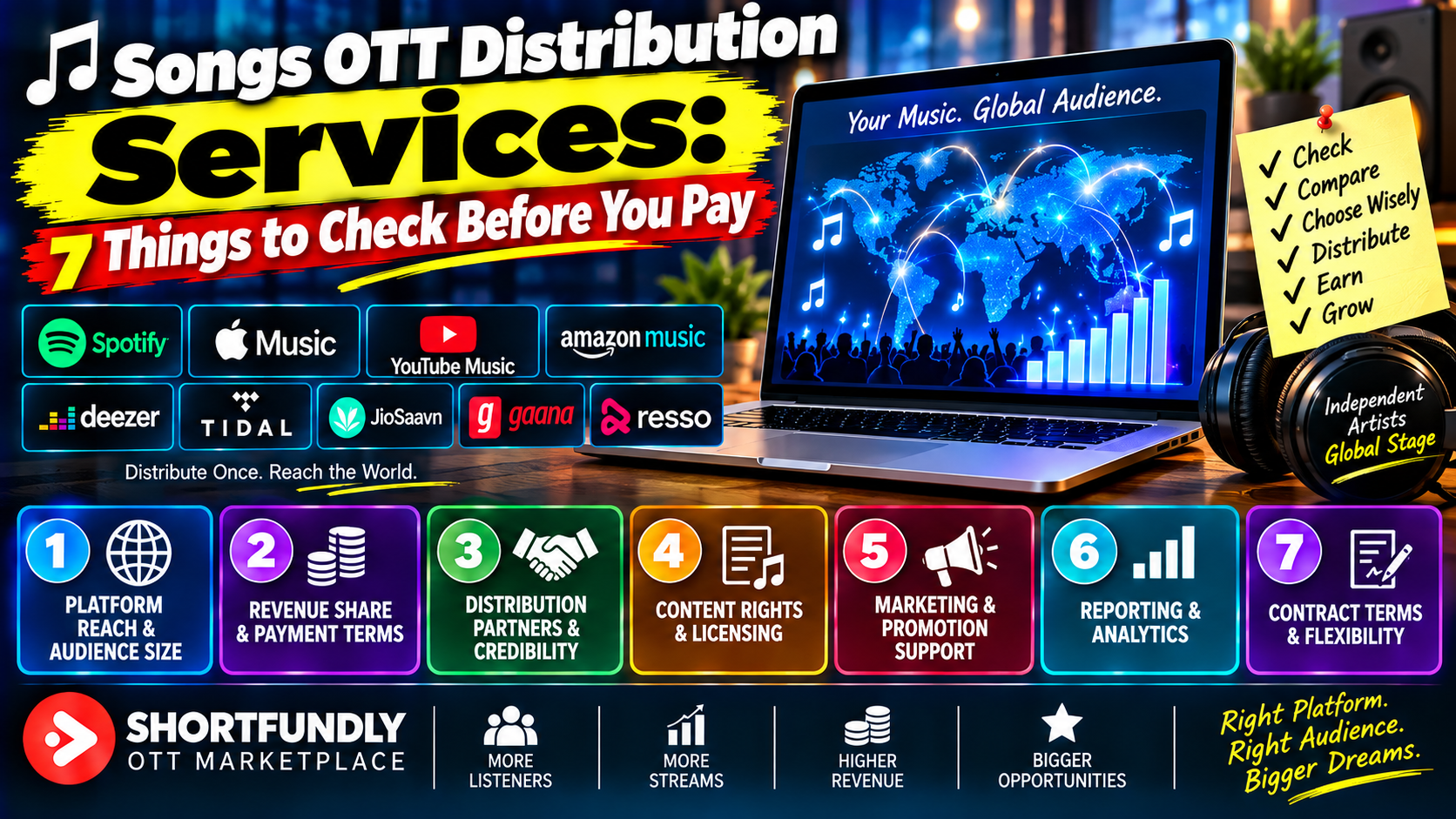
Songs OTT Distribution Services can help independent artists reach streaming platforms, manage releases, and collect royalties. Learn 7 important things to check before paying a distributor in 2026.
If you’re an independent artist, choosing the right Songs OTT Distribution Services can make releasing music much easier. The right service can help deliver your songs to streaming platforms, manage metadata, collect royalties, and expand your audience.
But here’s the catch: not every distribution service offers the same pricing, platform reach, rights terms, or support.
Before you pay for any service, you should know exactly what you’re getting.
1. Check Exactly Which Platforms You Get
The first thing to check with any Songs OTT Distribution Services provider is platform reach.
Don’t stop at a statement like “We distribute your music worldwide.”
Ask for the actual list of platforms.
Your audience might be on Spotify, Apple Music, YouTube Music, Amazon Music, Deezer, TIDAL, JioSaavn, Gaana, or other regional services.
The important question is:
Which platforms will actually receive my release?
Global Platforms vs Regional Platforms
Some artists focus mainly on international listeners. Others may have strong audiences in India, Southeast Asia, the Middle East, Africa, Europe, or other regions.
If you’re releasing Tamil, Telugu, Malayalam, Hindi, Bengali, Punjabi, or other regional music, regional availability can be especially important.
Ask These Questions
- Which platforms are included?
- Is YouTube Music included?
- Are regional music platforms included?
- Are international platforms included?
- Are all platforms included in the basic price?
- Are some services available only as paid extras?
- Can I choose specific territories?
Don’t assume “100+ platforms” means every important platform for your audience.
Reach should be relevant, not just large.
2. Understand the Full Cost Before You Pay
Price is one of the biggest factors artists consider, but the cheapest option isn’t always the lowest-cost option.
A distributor may advertise a low starting price but charge additional fees for certain services.
Look Beyond the Headline Price
Before paying, check whether the distributor charges:
- Per-song fees
- Album fees
- Annual subscription fees
- Setup fees
- Withdrawal fees
- Currency conversion fees
- Content ID fees
- Extra territory fees
- Premium support fees
- Takedown fees
- Additional delivery fees
You don’t want to discover unexpected charges after your release is already live.
Compare the Total Cost
If you’re releasing one song, a per-release model may make sense. If you’re releasing music every month, an annual plan could be easier to manage. If you’re comfortable sharing revenue in exchange for lower upfront costs, a commission model may be worth considering.
Don’t Pay Before Reading the Terms
Ask:
“I am releasing one single. What is my total cost from submission to distribution and payout?”
That question can reveal fees that aren’t obvious at first glance.
3. Check the Revenue Share and Payout Rules
Getting your song distributed is only half the job.
You also need to understand how you’ll get paid.
Different Songs OTT Distribution Services can use different revenue models.
Some may charge an upfront fee and let you retain most or all of the platform revenue. Others may take a percentage of your earnings.
Ask About Revenue Share
Before signing up, ask:
What percentage of my revenue do I keep?
Also ask:
- Is the percentage different by platform?
- Does the distributor take commission forever?
- Does the commission apply to all revenue?
- Does it apply to Content ID revenue?
- Are YouTube earnings handled separately?
- Are licensing revenues included?
- Are deductions taken before or after revenue sharing?
Understand Minimum Payouts
Some services may have minimum payout thresholds, payment schedules, or processing periods.
So don’t judge a service only by its advertised revenue share.
Look at the complete payout system.
4. Read the Rights and Contract Terms Carefully
Before using Songs OTT Distribution Services, understand exactly what rights you’re giving the distributor.
You should know whether the agreement is:
- Non-exclusive
- Exclusive
- Limited by territory
- Limited by platform
- Limited by time
- Renewable automatically
- Easy to cancel
Non-Exclusive vs Exclusive
A non-exclusive arrangement generally gives you more flexibility, subject to the actual agreement.
An exclusive arrangement can restrict where and how you distribute the same content.
Don’t assume a contract is non-exclusive just because the marketing page doesn’t mention exclusivity.
Read the agreement.
Check the Contract Duration
Look for phrases such as:
- 1-year term
- 3-year term
- 5-year term
- Automatically renewed
- Until terminated
- Perpetual rights
Also check territory and takedown rules before signing.
5. Check Technical and Metadata Requirements
You should prepare your release properly before submitting it.
Common requirements can include:
- WAV or FLAC audio
- High-quality artwork
- Artist name
- Song title
- Album or EP title
- Release date
- Genre
- Language
- Songwriter information
- Producer credits
- ISRC
- Copyright information
- Label information
- Explicit-content information
Exact specifications can vary by distributor and platform.
Why Metadata Matters
Metadata helps platforms understand who created the song, who performed it, who owns it, what language it uses, and which release it belongs to.
Incorrect metadata can lead to delays, incorrect credits, duplicate releases, or other problems.
Rights Are Essential
You should only distribute music you have the legal right to distribute.
This includes checking:
- Master recording rights
- Composition rights
- Performer permissions
- Producer agreements
- Sample licenses
- Beat licenses
- Cover-song permissions
6. Check Reporting, Analytics and Payout Transparency
Once your song is live, you’ll want to know what’s happening.
Look for information such as:
- Streams
- Downloads
- Platform
- Country
- Revenue
- Release
- Reporting period
- Payout status
Good reporting can help you understand where your listeners are coming from and which platforms are performing well.
A useful report should answer simple questions:
How many streams did I get?
Which platforms performed best?
Which countries listened the most?
How much money was generated?
When can I withdraw it?
7. Check Customer Support Before You Commit
You may not need support when everything goes smoothly.
But what happens when your release is rejected or your artist name appears incorrectly?
Check whether the distributor provides:
- Email support
- Ticket support
- Live chat
- Help center
- Account manager
- Technical support
- Rights support
Test Support Before Paying
Contact the company before purchasing.
Ask:
“I own an independent song and want to distribute it internationally. What files and rights documents do you require?”
Then see how clearly they respond.
Support is part of the product.
A Simple Comparison Checklist
| Question | What to Look For |
|---|---|
| Platform reach | Relevant global and regional platforms |
| Pricing | Clear total cost |
| Revenue share | Transparent percentage and deductions |
| Contract | Clear rights and duration |
| Technical specs | Simple, published requirements |
| Metadata | Accurate delivery information |
| Reporting | Streams and earnings visibility |
| Payouts | Clear threshold and schedule |
| Rights management | Proper copyright handling |
| Support | Responsive customer service |
| Takedown | Clear removal process |
| Territories | Countries clearly defined |
What You Should Prepare Before Paying
Create a small release folder containing:
Audio
- Final master
- WAV or FLAC file
- Correct file name
- Final version confirmation
Artwork
- High-resolution cover
- Correct dimensions
- No unauthorized logos
- No misleading information
Metadata
- Artist name
- Song title
- Album name
- Genre
- Language
- Release date
- Credits
- ISRC, where applicable
Rights Documents
- Ownership information
- Licenses
- Producer agreements
- Sample clearances
- Relevant permissions
Common Mistakes Artists Should Avoid
Don’t make these mistakes:
Choosing Based Only on Price
The cheapest distributor may not provide the reach, reporting, support, or rights flexibility you need.
Ignoring the Contract
Never skip the agreement because the signup process looks simple.
Uploading Poor Metadata
A small spelling mistake can create a bigger release problem later.
Assuming Distribution Guarantees Streams
Distribution puts your music into the delivery pipeline. It doesn’t automatically guarantee listeners, playlists, viral growth, or income.
Forgetting About Rights
If you don’t control the required rights, your release can face claims or restrictions.
Not Checking Payout Rules
Understand when and how you’ll actually receive money.
FAQs About Songs OTT Distribution Services
1. What are Songs OTT Distribution Services?
Songs OTT Distribution Services help artists deliver their music to streaming and digital music platforms. Depending on the provider, they may also handle metadata delivery, rights administration, reporting, and royalty collection.
2. Do independent artists need a record label?
Not necessarily. Independent artists can use music distributors to deliver releases to digital platforms without signing a traditional record-label deal.
3. How much do music distribution services cost?
There isn’t one universal price. Providers may charge per release, annually, through commission, or through a combination of fees.
4. Do distributors take a percentage of royalties?
Some do and some don’t. The exact arrangement depends on the provider and agreement.
5. Can I distribute the same song to multiple platforms?
Yes, distribution services are commonly used to deliver one release to multiple digital services. The exact platform list depends on the distributor and release eligibility.
6. What files do I need to distribute a song?
Common requirements include a high-quality audio master, cover artwork, metadata, credits, release information, and proof or confirmation of the necessary rights.
7. Can I remove my song later?
Usually, a distributor has a takedown or removal process, but the exact timing and conditions depend on the agreement.
8. How long does music distribution take?
Timing varies by distributor and platform. Some releases may move quickly, while others can require additional review or corrections.
9. Can I earn money from streaming platforms?
Yes, eligible music can generate revenue through applicable streaming and licensing arrangements. Earnings depend on factors such as streams, territory, platform, rights ownership, and your distribution agreement.
10. Is ShortFundly Distribution suitable for independent creators?
ShortFundly provides creator-focused distribution options for eligible content. Artists should check the current submission, pricing, eligibility, and partner information before proceeding.
Also read: https://blog.shortfundly.com/ott/telefilm-ott-distribution-3/
Final Thoughts
Choosing Songs OTT Distribution Services shouldn’t be a rushed decision.
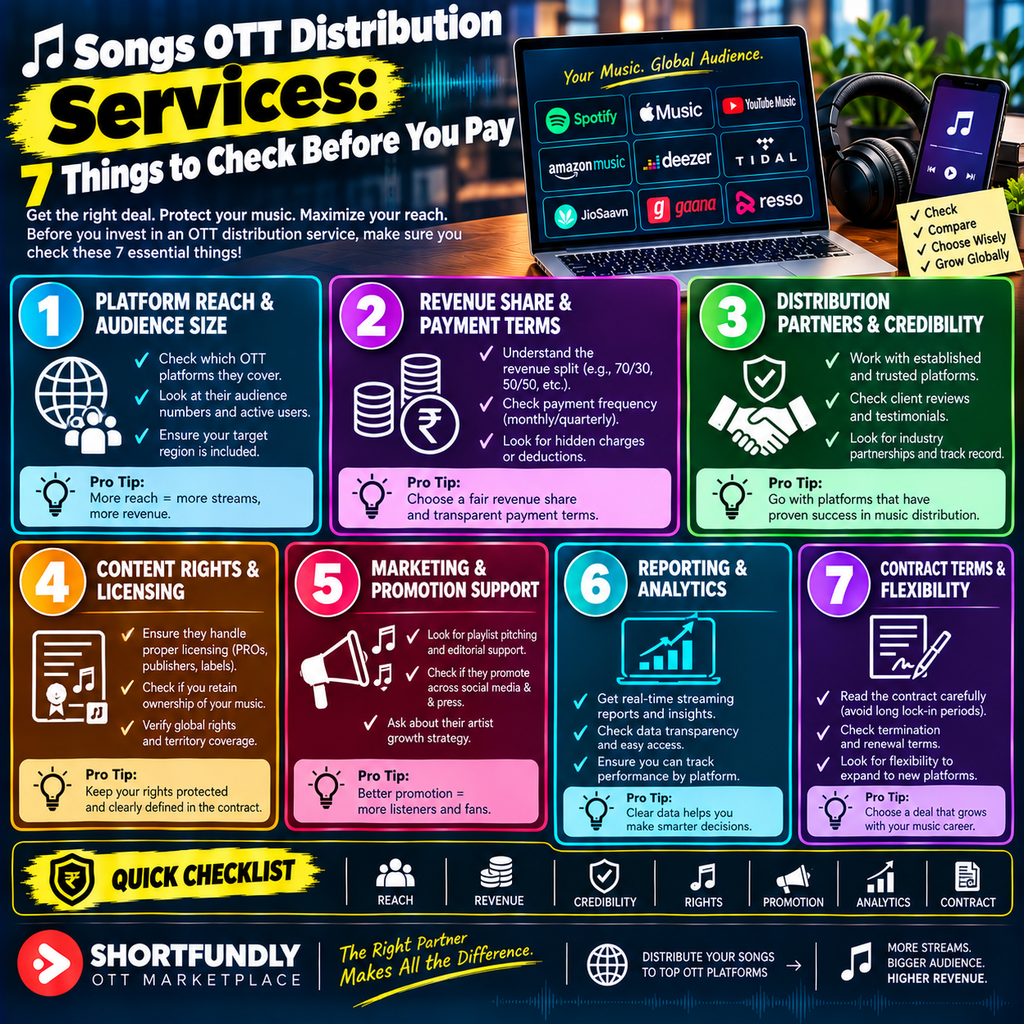
Before you pay, check these 7 things:
- Platform reach
- Total cost
- Revenue share
- Rights and contract
- Technical requirements
- Reporting and payouts
- Customer support
The goal isn’t simply to upload a song.
The goal is to release it properly, reach the right listeners, protect your rights, and build sustainable music income.