Table of Contents
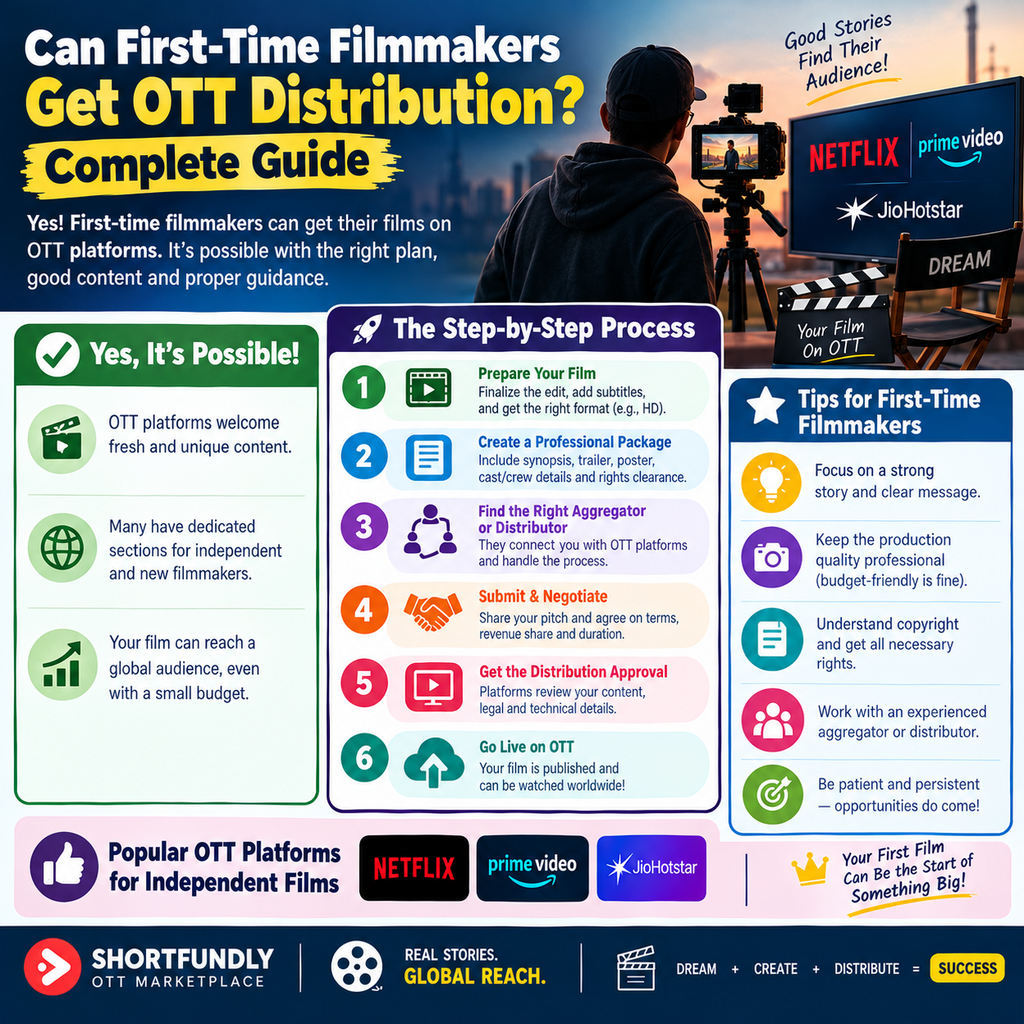
Yes, first-time filmmakers can get OTT distribution, provided their film meets the relevant platform, legal, technical, and commercial requirements. A filmmaker does not necessarily need a famous cast, a major production house, or years of industry experience to explore OTT distribution.
The OTT industry has created more opportunities for independent filmmakers, emerging directors, producers, and first-time creators to take their content to digital audiences. However, getting a film distributed is not simply a matter of uploading a video. We need to prepare the project professionally, establish ownership, create the required delivery materials, identify suitable OTT opportunities, and understand the terms of every distribution agreement.
For first-time filmmakers, the biggest advantage is preparation. A professionally packaged independent film can be easier to evaluate than a project with missing rights documents, incomplete metadata, poor technical quality, or unclear ownership.
Services such as Shortfundly Distribution can also be considered when an independent filmmaker wants to explore OTT distribution opportunities through a distribution network. Shortfundly’s current distribution information states that filmmakers and creators can submit eligible content, including movies, telefilms, pilot films, web series, documentaries, and other supported formats, subject to its requirements and review process.
What Is OTT Distribution for First-Time Filmmakers?
OTT distribution means making a film available to audiences through internet-based streaming services rather than relying only on traditional theatrical or television distribution.
For a first-time filmmaker, OTT distribution can provide another route from completed production to audience.
The general process is:
Complete the film → Secure rights → Prepare OTT assets → Find suitable platforms or distributors → Submit → Review → Licensing → Technical QC → Release → Track performance
The exact process differs between platforms and distributors.
Some OTT services acquire content directly. Others work through producers, sales agents, aggregators, or distribution companies. Therefore, a first-time filmmaker should not assume that one submission method will work for every platform.
Can First-Time Filmmakers Really Get Their Films on OTT Platforms?
Yes.
Being a first-time filmmaker is not, by itself, a reason that a film cannot be considered for OTT distribution.
However, platforms generally need to evaluate the content, rights, technical quality, audience potential, and commercial suitability of a project.
A first-time filmmaker should therefore focus on what can be controlled:
- Strong storytelling
- Professional production quality
- Clean audio
- High-quality video
- Clear copyright ownership
- Proper music licenses
- Complete metadata
- Professional poster and artwork
- Subtitles
- Trailer
- Accurate synopsis
- Legal documentation
- OTT-ready master files
Shortfundly’s current distribution guidance specifically says creators do not need a large following to start a submission, while also requiring rights ownership and compliance with current technical and agreement requirements.
Does a First-Time Filmmaker Need a Famous Actor?
Not necessarily.
A recognizable cast can help a project attract attention, but story quality and audience suitability can also matter.
Independent OTT content can succeed when it has a clear identity and targets an audience that is interested in its subject, genre, language, or storytelling style.
A first-time filmmaker can strengthen a submission by clearly presenting:
- The film’s genre
- Target audience
- Unique story concept
- Runtime
- Language
- Production quality
- Festival selections, if applicable
- Awards, if applicable
- Audience response, if available
- Cast and crew credentials
- Promotional materials
Instead of trying to appear like a large studio, we should present the film as a professionally completed content product with a clear audience proposition.
OTT Distribution Requirements for First-Time Filmmakers
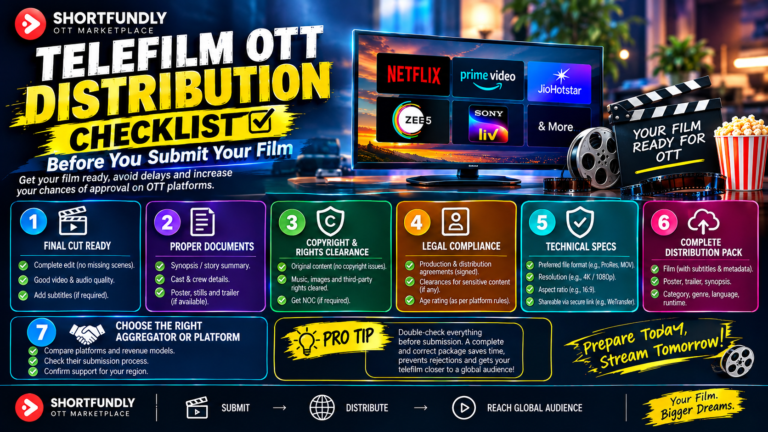
Before approaching an OTT platform, we should prepare a complete distribution package.
1. Completed Film Master
The first requirement is a final version of the film.
The master should be technically sound and free from avoidable problems such as:
- Audio clipping
- Missing dialogue
- Incorrect aspect ratio
- Visible editing errors
- Corrupted frames
- Unwanted watermarks
- Poor color correction
- Inconsistent audio levels
Shortfundly’s current OTT distribution guidance says content should be available in 4K or Full HD (1080p) and should include appropriate dubbing and DI, while additional delivery requirements may apply during submission.
2. Copyright and Ownership Proof
This is one of the most important requirements for independent filmmakers.
We should be able to demonstrate that we have the legal right to distribute the film.
Depending on the production, relevant documentation can include:
- Copyright ownership information
- Producer agreement
- Director agreement
- Screenplay rights
- Story rights
- Music licenses
- Composer agreement
- Artist agreements
- Location permissions
- Stock-footage licenses
- Distribution authorization
If someone else owns a particular component of the film, that right should be properly licensed.
3. Chain of Title
A chain of title establishes the legal history of ownership and rights associated with a film.
For an independent production, this may involve documentation covering the screenplay, underlying story, music, performances, production rights, and other intellectual property.
A platform or distributor may request documentation when evaluating a title.
We should organize these documents before submission rather than trying to locate them after a platform shows interest.
4. Music Rights
Music can become a major problem if rights are unclear.
We should verify rights for:
- Original songs
- Background music
- Songs used in scenes
- Instrumental tracks
- Sound effects
- Licensed music libraries
- Composer-created scores
Using a commercially released song without the required license can create serious distribution problems.
For an OTT submission, we should be able to demonstrate that the music can legally be streamed in the territories covered by the agreement.
What Kind of Films Can First-Time Filmmakers Submit?
There is no single format that works for every OTT platform.
Depending on the service, independent filmmakers may explore opportunities for:
- Feature films
- Short films
- Telefilms
- Documentaries
- Web series
- Pilot films
- Micro dramas
- Regional-language films
- Genre films
- Experimental films
Shortfundly’s current distribution portal lists short films, web series, movies, songs/video songs, documentaries, telefilms, pilot films, and micro dramas among supported content categories, although eligibility and availability depend on the current submission flow and distribution arrangements.
This is particularly relevant to first-time filmmakers because the project does not necessarily have to follow a conventional feature-film model.
How to Prepare a Film for OTT Distribution
Create an OTT Distribution Package
A professional package makes the project easier to evaluate.
We should prepare:
Film Assets
- Final master
- Trailer
- Teaser
- Clean promotional clips
- High-resolution stills
- Poster
- Thumbnail
- Behind-the-scenes photographs
Metadata
- Film title
- Alternate title
- Genre
- Language
- Runtime
- Release year
- Synopsis
- Short description
- Long description
- Director
- Producer
- Cast
- Crew
- Keywords
- Content rating
Localization
- English subtitles
- Regional subtitles
- Closed captions where required
- Dubbing tracks where commercially useful
The exact requirements should always be checked against the chosen OTT platform or distributor.
How to Choose the Right OTT Platform
First-time filmmakers often make one major mistake: choosing a platform simply because it is famous.
A better approach is to evaluate audience fit.
We should ask:
- Does the platform serve our target language?
- Does it acquire our genre?
- Does it accept independent films?
- Does it operate in our target territory?
- Does it accept submissions?
- Does it work with aggregators?
- What rights does it require?
- Is the agreement exclusive?
- What is the revenue model?
- How does reporting work?
- Does it provide promotional support?
A regional drama, for example, may have a stronger audience fit on a regional streaming service than on a global platform where independent content has limited visibility.
Direct OTT Submission vs OTT Distribution Partner
A first-time filmmaker generally has two broad routes.
Direct OTT Submission
With direct submission, we approach platforms ourselves.
Advantages can include:
- Direct communication
- Greater control
- Direct negotiations
- Potentially fewer intermediaries
However, the filmmaker may need to handle:
- Platform research
- Submission
- Rights documentation
- Metadata
- Technical delivery
- Negotiation
- QC
- Release scheduling
- Reporting
For someone new to distribution, this can become time-consuming.
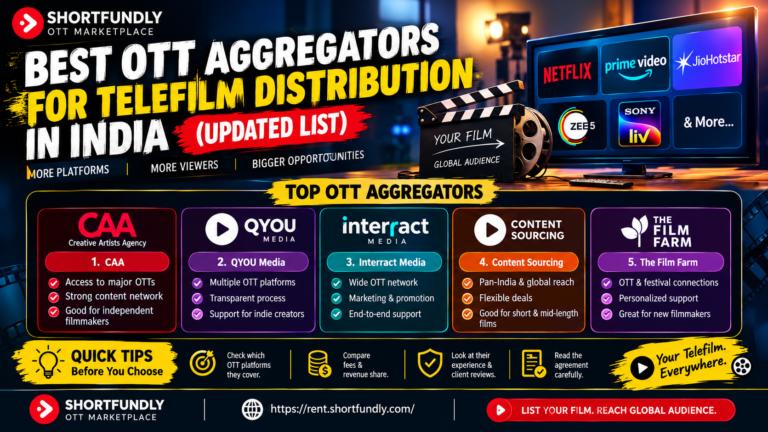
Working With an OTT Distributor or Aggregator
A distribution partner can potentially simplify the process.
Depending on the service, a distributor may assist with:
- Content submission
- Rights review
- Metadata
- Technical delivery
- Platform pitching
- Licensing
- Distribution
- Revenue reporting
- Payout management
Shortfundly’s current distribution portal describes a workflow involving content submission, review, release assets, distribution through currently available partners, and tracking of distribution and earnings. It also states that platform availability can vary according to content, duration, eligibility, licensing, and partner availability.
Consider Shortfundly Distribution
Shortfundly Distribution is one option first-time filmmakers can evaluate when exploring OTT distribution.
Its official distribution portal says it works with filmmakers and creators and supports multiple content categories, including movies, documentaries, telefilms, pilot films, web series, and short films. It also describes a distribution process involving submission, review, release assets, distribution partners, and earnings tracking.
Before entering any distribution agreement, we should review the current:
- Platform coverage
- Eligibility criteria
- Processing or distribution fees
- Rights requested
- Agreement duration
- Exclusivity
- Territories
- Revenue-sharing terms
- Payout conditions
- Removal terms
- Reporting system
Shortfundly’s current public information states that submission does not guarantee selection or streaming, and final availability depends on eligibility, review, licensing, and available distribution partners.
How Much Does OTT Distribution Cost?
There is no universal OTT distribution cost for first-time filmmakers.
The total expense can depend on:
- Film duration
- Distribution partner
- Platform
- Technical requirements
- Subtitle requirements
- Dubbing
- QC
- Marketing
- Artwork
- Licensing
- Territory
- Revenue model
Some platforms may acquire content through licensing arrangements, while other distribution services may charge processing or distribution fees.
Shortfundly’s current official distribution information says its fees vary by content type and duration and that applicable GST is shown through its pricing system.
We should therefore avoid relying on outdated third-party price lists. The current commercial terms should be checked directly before submitting a project.
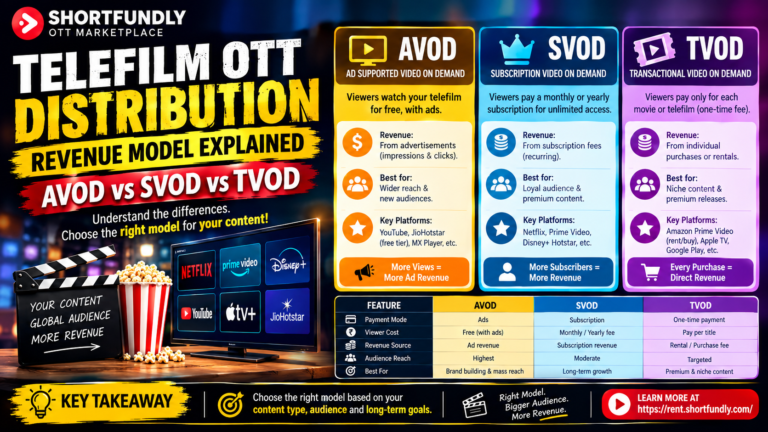
What Revenue Models Can First-Time Filmmakers Expect?
OTT revenue can be structured in several ways.
SVOD
Subscription Video on Demand generates revenue through subscription services.
The filmmaker may receive a licensing fee or an agreed revenue share depending on the contract.
AVOD
Advertising Video on Demand monetizes viewing through advertisements.
This model can be useful for films capable of generating substantial audience reach.
TVOD
Transactional Video on Demand allows users to rent or purchase content.
Revenue can be generated from individual transactions.
Licensing Fee
An OTT platform may offer a fixed licensing payment for specific rights, territory, language, and duration.
Revenue Share
A distributor or platform may share a percentage of defined revenues with the content owner.
The contract should clearly define gross revenue, deductions, net revenue, reporting, and payment terms.
How to Negotiate an OTT Distribution Agreement
First-time filmmakers should never sign a distribution agreement without understanding the rights being granted.
Important clauses include:
Territory
Where can the platform distribute the film?
Term
How long will the agreement remain active?
Exclusivity
Can the filmmaker distribute the film elsewhere?
Platforms
Which OTT services receive rights?
Languages
Which language versions are covered?
Revenue
How is revenue calculated?
Reporting
How often will performance and revenue reports be provided?
Payment
When and how will the filmmaker be paid?
Termination
Under what conditions can the agreement end?
Rights Reversion
What happens to the rights after the agreement expires?
These terms can have a greater long-term impact than the headline payment.
How to Improve Your Chances of OTT Approval
No distribution route can guarantee acceptance, but first-time filmmakers can improve their professional presentation.
Focus on Story Quality
A strong screenplay gives the project a clear identity.
The story should have:
- A compelling premise
- Clear characters
- Strong conflict
- Appropriate pacing
- A satisfying structure
- Consistent tone
Improve Production Quality
Low-budget does not have to mean low-quality.
We should prioritize:
- Clean dialogue
- Controlled lighting
- Good framing
- Consistent color
- Professional editing
- Appropriate sound design
Audio deserves particular attention because poor sound can immediately reduce perceived production quality.
Create a Strong Trailer
The trailer should communicate the film’s core appeal quickly.
We should avoid including every important plot point. Instead, the trailer should create curiosity without becoming confusing.
Prepare Professional Artwork
A poster is often one of the first visual assets used to evaluate a title.
It should clearly communicate:
- Film title
- Genre
- Tone
- Main characters
- Visual identity
Write a Strong Synopsis
The synopsis should explain the story without becoming unnecessarily long.
A useful synopsis should identify the protagonist, central conflict, stakes, and unique hook.
Do Film Festivals Help First-Time Filmmakers Get OTT Distribution?
Film festivals are not a mandatory requirement for OTT distribution, but festival recognition can strengthen a film’s professional profile.
If a film has:
- Official selections
- Awards
- Jury mentions
- Reviews
- Press coverage
- Audience awards
these achievements can be included in the pitch package.
However, we should not assume that festival selection automatically guarantees OTT acquisition.
The OTT buyer is still likely to evaluate the film’s audience potential, rights, technical quality, genre, and commercial suitability.
Can a Film Already on YouTube Get OTT Distribution?
Potentially, yes, depending on the platform and rights agreement.
The filmmaker should carefully review any existing YouTube arrangement and ensure that the proposed OTT agreement does not conflict with existing rights.
Shortfundly’s current information indicates that eligible content can be submitted subject to its applicable requirements and agreements, while older public material also discusses non-exclusive scenarios for content already available online. Because agreements and current policies can change, filmmakers should verify the current terms before submission.
Can First-Time Filmmakers Get International OTT Distribution?
Yes, potentially.
International OTT distribution requires additional preparation.
We should consider:
- International streaming rights
- Territory restrictions
- English subtitles
- Regional subtitles
- Dubbing
- Localized metadata
- International artwork
- Music rights
- Talent rights
- Technical delivery
- Tax and payment requirements
A film created for an Indian audience may still appeal to international viewers if its themes are understandable across cultures.
Strong subtitles can make a major difference.
Common Mistakes First-Time Filmmakers Should Avoid
1. Submitting an Unfinished Film
Do not submit a film that still requires major editing or sound work.
2. Ignoring Copyright
Every element should have a clear legal basis.
3. Using Unlicensed Music
Music rights can stop a distribution deal from moving forward.
4. Poor Audio
Viewers may tolerate modest visual limitations more easily than unintelligible dialogue.
5. Missing Subtitles
Subtitles can expand the potential audience beyond the original language.
6. Weak Metadata
Incomplete metadata can make the title harder to evaluate and discover.
7. Signing Without Reading
Never focus only on the payment amount. Understand the rights being granted.
8. Paying Without Checking the Current Terms
Distribution fees, platform availability, and agreements can change. Always verify the current terms directly with the distributor.
9. Expecting Instant Approval
OTT review can involve content evaluation, rights verification, technical review, licensing, and scheduling.
10. Assuming Distribution Means Guaranteed Views
Getting a film distributed does not automatically guarantee audience numbers or revenue.
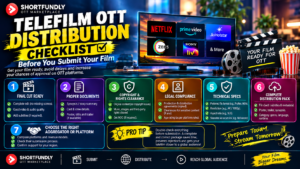
First-Time Filmmaker OTT Distribution Checklist
Before submitting a film, we can use this checklist.
Legal
- Copyright ownership confirmed
- Story rights confirmed
- Screenplay rights confirmed
- Music rights confirmed
- Artist agreements completed
- Location permissions secured
- Distribution rights available
Technical
- Final master completed
- High-quality video available
- Audio checked
- Color correction completed
- Subtitles prepared
- Trailer exported
- Promotional stills prepared
Metadata
- Title
- Synopsis
- Genre
- Language
- Runtime
- Cast
- Crew
- Director
- Producer
- Keywords
- Content rating
Commercial
- Revenue model understood
- Distribution fee checked
- Revenue share understood
- Territory reviewed
- Term reviewed
- Exclusivity reviewed
- Payment terms reviewed
- Termination clause reviewed
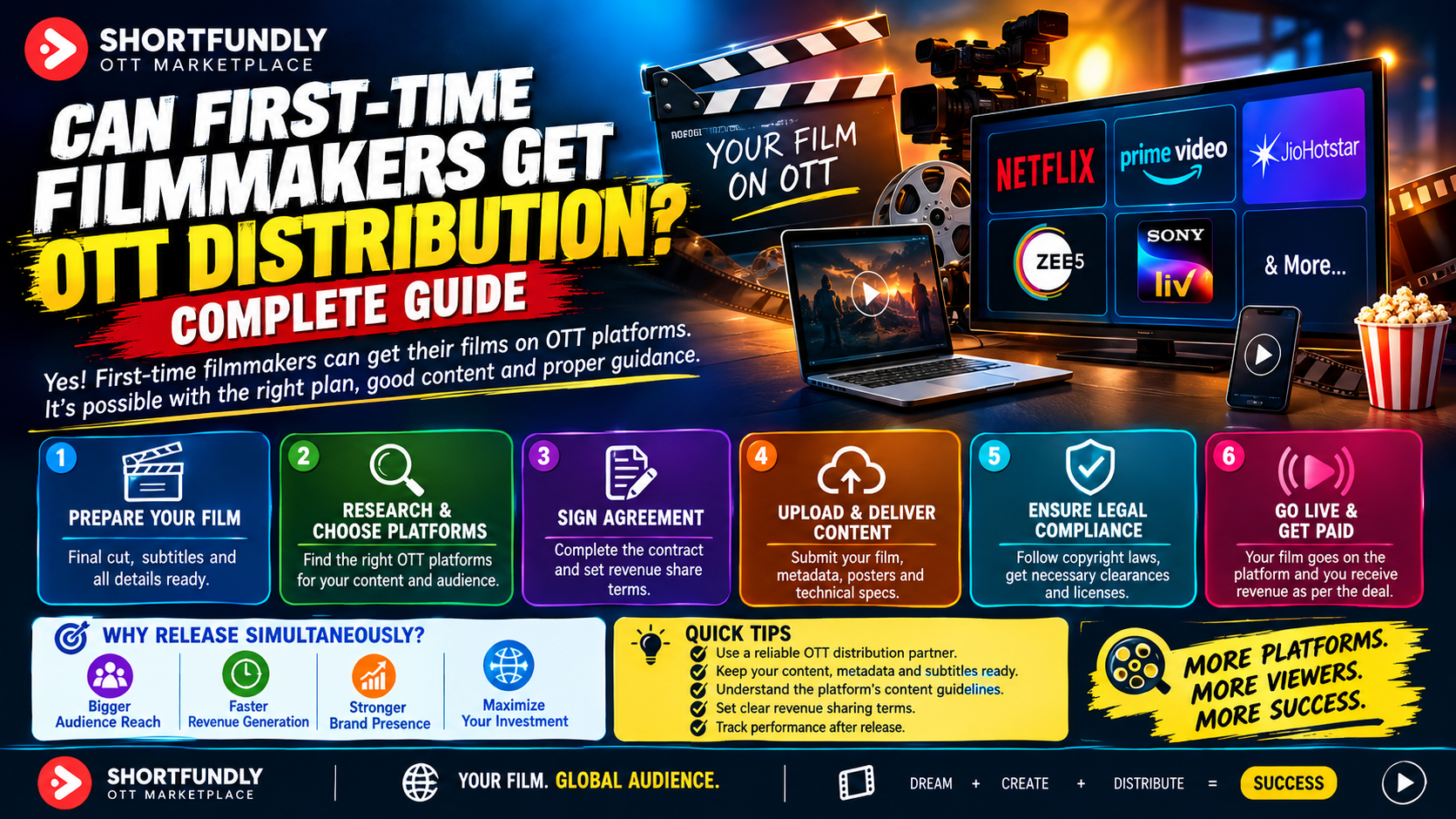
Step-by-Step OTT Distribution Process for a First-Time Filmmaker
The entire process can be organized into ten practical steps.
Step 1: Complete the Film
Lock the picture, sound, color, music, and final credits.
Step 2: Secure the Rights
Prepare documentation proving that the film can legally be distributed.
Step 3: Prepare OTT Masters
Create high-quality delivery files according to the relevant specifications.
Step 4: Create Subtitles
Prepare accurate subtitles and captions where appropriate.
Step 5: Prepare Metadata
Create professional descriptions, cast information, keywords, genre information, and other required data.
Step 6: Create Promotional Assets
Prepare the poster, trailer, thumbnail, stills, and social media materials.
Step 7: Research OTT Opportunities
Identify platforms and distribution partners that match the film.
Step 8: Compare Agreements
Review rights, territory, duration, exclusivity, fees, revenue, and reporting.
Step 9: Complete Submission and QC
Submit the project and respond to technical or content-related requests.
Step 10: Monitor the Release
Track availability, views, revenue, audience response, and reporting after launch.
Frequently Asked Questions
Can a first-time filmmaker get OTT distribution without industry contacts?
Yes. Industry contacts can help, but they are not the only route. Filmmakers can explore direct platform submissions, aggregators, distributors, and other legitimate acquisition channels.
Do OTT platforms require a filmmaker to have previous experience?
Not necessarily. The requirements vary by platform. A first-time filmmaker should focus on producing professionally finished content and maintaining complete rights and delivery documentation.
Can an independent filmmaker approach OTT platforms directly?
Yes, where a platform accepts direct submissions or provides an acquisition process. However, many services use different acquisition channels, so direct access is not universal.
Is an OTT distributor necessary?
No. A distributor is not always mandatory. However, a distribution partner can simplify platform outreach, technical delivery, rights administration, and reporting.
Can first-time filmmakers use Shortfundly Distribution?
Eligible filmmakers can evaluate Shortfundly Distribution as one potential OTT distribution route. Its current portal supports several content categories and describes a submission, review, asset-delivery, distribution, and earnings-tracking workflow.
Does OTT submission guarantee acceptance?
No. OTT submission does not guarantee approval, licensing, or streaming. Shortfundly’s current distribution guidance explicitly states that final availability depends on eligibility, licensing, review, and distribution-partner availability.
Can a low-budget film get OTT distribution?
Yes, potentially. Budget alone does not determine distribution suitability. Story quality, technical execution, rights, audience fit, and commercial potential are also important.
How long does OTT distribution take?
There is no universal timeline. The process can depend on content review, rights verification, technical QC, licensing, localization, and platform scheduling.
Should first-time filmmakers choose exclusive or non-exclusive distribution?
The answer depends on the project and commercial offer. We should compare the potential value of exclusivity against the broader reach and flexibility of non-exclusive distribution.
Also read: https://blog.shortfundly.com/ott/best-ott-aggregators-telefilm-2/
Conclusion
First-time filmmakers can get OTT distribution, and the process becomes much more manageable when the film is treated as a professional distribution product rather than simply a completed video.
The strongest starting point is a combination of good storytelling, production quality, clear rights, professional metadata, subtitles, technical masters, promotional assets, and a carefully reviewed distribution agreement.
We should also choose distribution opportunities based on audience fit instead of focusing only on the biggest OTT brand. A regional film, independent drama, documentary, telefilm, pilot, or short film can have different distribution opportunities depending on its audience and rights.
For filmmakers who want to explore an established distribution route, Shortfundly Distribution is one option to evaluate. Its current official information states that it accepts submissions from filmmakers and creators for supported content categories and provides a workflow covering submission, review, release assets, distribution through available partners, and earnings tracking.
The official distribution portal is available here:
Ultimately, first-time filmmakers do not need to wait for a major studio to begin exploring OTT distribution. With a legally cleared, technically polished, professionally packaged film and a carefully selected distribution strategy, an independent production can move from completion toward a wider digital audience.