Table of Contents
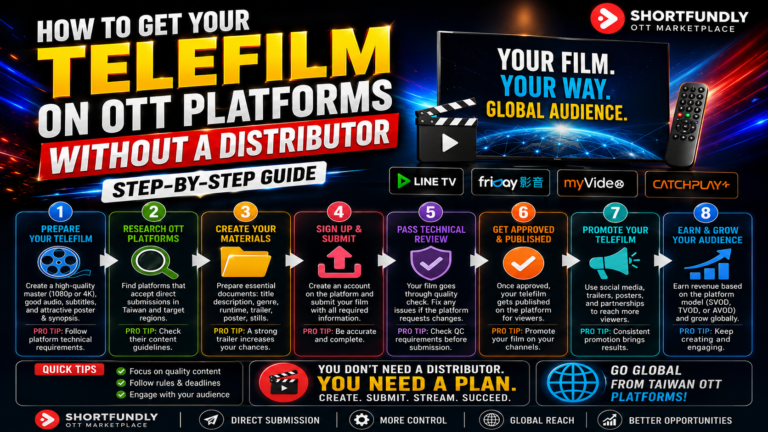
Releasing a film across Taiwan OTT platforms worldwide requires more than uploading a video file and waiting for a streaming service to approve it. A successful international OTT release depends on rights management, platform selection, localization, technical delivery, metadata, marketing, and a distribution strategy designed around the film’s target audience.
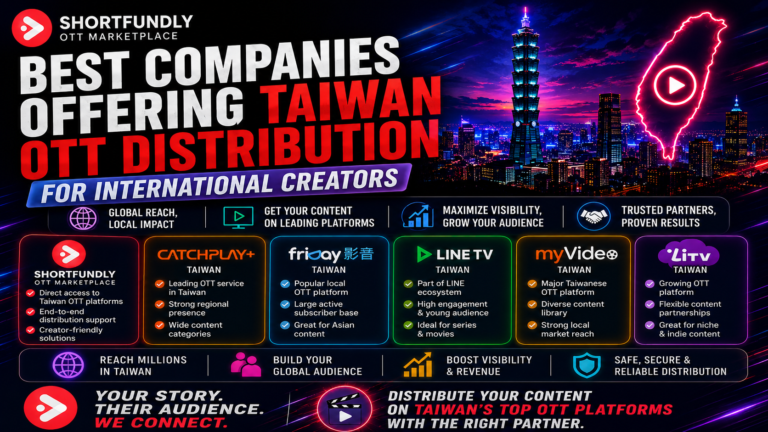
Taiwan has a diverse OTT ecosystem that includes international streaming services, telecom-backed platforms, local video services, and specialized content providers. Taiwan’s National Communications Commission identifies major OTT services and market categories including Netflix, Disney+, friDay Video, MyVideo, Hami Video, LiTV, CATCHPLAY, LINE TV, and other domestic and international services.
For filmmakers outside Taiwan, this creates an opportunity to use Taiwan as an important territory within a broader Asia-Pacific film distribution strategy.
What Is Taiwan OTT Film Distribution?
Taiwan OTT film distribution is the process of licensing and delivering a film to internet-based streaming services that make content available to audiences in Taiwan.
Depending on the agreement, a film may be distributed through:
- SVOD platforms
- AVOD platforms
- TVOD services
- Digital rental services
- Telecom streaming platforms
- Independent cinema platforms
- Specialized genre platforms
- Regional streaming services
- International OTT platforms
The distribution agreement determines where, how, and for how long viewers can access the film.
A filmmaker may license Taiwan streaming rights separately from theatrical, television, airline, educational, festival, or other international rights.
Why Should Filmmakers Target Taiwan OTT Platforms?
Taiwan is a mature digital entertainment market with a combination of international and domestic streaming services.
The NCC reported that Taiwan’s online video market generated approximately US$1.1 billion in 2024, with SVOD representing 47% of revenue, UGC video platforms 39%, and premium AVOD 14%. The same report identified Netflix, Disney+, friDay, MyVideo, Hami Video, iQIYI, and LINE TV among the major VOD brands.
Recent audience research also indicates substantial streaming adoption. A 2025 MIC survey reported that 72% of Taiwanese internet users had watched online streaming video, while 75% of streaming users had paid subscriptions.
For filmmakers, the opportunity is therefore not limited to one type of platform. We can build a Taiwan release strategy around several potential distribution channels.
Step 1: Confirm Your Taiwan Distribution Rights
Before approaching any Taiwan OTT platform, we need to establish that the film is legally available for licensing.
The first step should be a rights audit.
We should determine whether we control:
- Taiwan streaming rights
- Digital distribution rights
- Television rights
- Mobile rights
- Download rights
- Rental rights
- Advertising-supported rights
- Subtitling rights
- Dubbing rights
- Promotional rights
- Trailer rights
- Social-media promotional rights
If another distributor already controls Taiwan rights, a new OTT agreement could create a contractual conflict.
A rights matrix is useful for international releases:
| Territory | Medium | Rights | Exclusive | Start | End |
|---|---|---|---|---|---|
| Taiwan | OTT | Streaming | No | Date | Date |
| Japan | OTT | Streaming | Yes | Date | Date |
| Singapore | OTT | Streaming | No | Date | Date |
| Malaysia | OTT | Streaming | No | Date | Date |
This allows us to expand internationally without accidentally selling overlapping rights.
Step 2: Decide Whether Taiwan Should Be Exclusive
Exclusive Taiwan OTT distribution gives one distributor or platform exclusive streaming rights for a defined period.
A non-exclusive agreement allows the rights holder to potentially license the film to multiple services, subject to contractual restrictions.
We should consider:
- Territory
- Contract length
- Platform coverage
- Minimum guarantee
- Revenue share
- Marketing commitment
- Release commitment
- Rights reversion
- Renewal terms
- Termination conditions
A worldwide exclusive agreement should receive particular scrutiny.
If a distributor wants worldwide rights, we should determine whether the distributor actually has meaningful buyer relationships across every territory included in the contract.
For many independent filmmakers, territory-by-territory licensing can preserve greater flexibility.
Step 3: Identify the Right Taiwan OTT Platforms
There is no single “best” Taiwan OTT platform for every film.
Taiwan’s streaming ecosystem includes international services as well as domestic platforms operated by television companies, telecommunications companies, and emerging digital providers.
Potential categories include:
Major International Platforms
Services such as Netflix and Disney+ operate in Taiwan and have significant audience recognition. However, their acquisition processes and content requirements vary, and appearing on a platform should never be assumed to be possible through an unsolicited submission.
Telecom-Backed OTT Services
Taiwan has major telecom-linked streaming services including Hami Video, friDay Video, and MyVideo.
These platforms can be particularly relevant when a film fits their programming and commercial requirements.
Local and Emerging Platforms
Services such as LiTV, CATCHPLAY, LINE TV, and other local platforms form an important part of Taiwan’s OTT ecosystem.
Specialized Platforms
Genre-specific and audience-specific services can sometimes provide better positioning for independent films than attempting to compete directly for placement on the largest mainstream services.
Step 4: Prepare a Taiwan-Ready Film Master
The film should be technically ready before distribution begins.
We should maintain a high-quality master and prepare additional deliverables according to the confirmed specifications of the distributor or platform.
Potential technical requirements can include:
- High-resolution video
- Correct frame rate
- Approved codec
- Appropriate bitrate
- Correct aspect ratio
- Stereo or surround audio
- Proper audio levels
- Separate subtitle files
- Trailer
- Textless elements
- Clean master
- Artwork
- Promotional stills
We should never assume that one technical specification works for every OTT platform.
The safest approach is to keep a high-quality archival master and create platform-specific files after receiving the current delivery specification.
Step 5: Add Traditional Chinese Subtitles
For a Taiwan-focused release, Traditional Chinese subtitles should be treated as a core localization asset.
English dialogue may be understandable to international audiences, but localized subtitles make the film significantly more accessible to Taiwanese viewers.
We should ensure:
- Translation accuracy
- Natural Traditional Chinese
- Correct timing
- Character-name consistency
- Proper line breaks
- Correct punctuation
- Reading-speed compliance
- Dialogue completeness
- Subtitle QC
We should also retain the original-language dialogue and subtitle files separately.
For international distribution, it is useful to maintain a localization package containing:
Original master + dialogue list + English subtitles + Traditional Chinese subtitles + subtitle template + metadata.
This makes future territory expansion easier.
Step 6: Create Professional Taiwan OTT Metadata
Metadata determines how a title is presented to buyers, distributors, and audiences.
A professional package should contain:
Film Title
Use the official English title and any approved localized title.
Logline
One compelling sentence explaining the film’s central story or hook.
Short Synopsis
A concise description suitable for platform listings.
Long Synopsis
A more detailed version for distributors and buyers.
Genre
Select accurate primary and secondary genres.
Cast
List principal cast members with correct spellings.
Director
Include director information and relevant credentials.
Runtime
Provide the exact finished runtime.
Production Country
Clearly identify the film’s country or countries of production.
Language
List the original language and available localized versions.
Release Year
Use the correct official release year.
Keywords
Include relevant story, genre, theme, location, and audience keywords.
Strong metadata helps buyers understand the project quickly and makes the title easier to position.
Step 7: Prepare Professional Artwork
OTT platforms require visual assets to market films effectively.
We should prepare:
- Poster
- Key art
- Landscape artwork
- Thumbnail
- Background artwork
- Character artwork where relevant
- Promotional stills
- Trailer thumbnail
Artwork should be consistent with the film’s actual genre.
A comedy should not be presented like a thriller. A documentary should not look like a fictional action movie. The artwork should communicate the film’s positioning immediately.
Step 8: Prepare a Strong OTT Pitch
A professional Taiwan OTT pitch should be concise.
We should include:
Film title: Official title
Genre: Primary genre
Runtime: Exact duration
Country: Production territory
Language: Original language
Synopsis: Short commercial description
Audience: Target viewers
Unique selling point: Why the film stands out
Festival history: Relevant selections and awards
Localization: Traditional Chinese subtitles or dubbing
Rights: Taiwan rights available
Assets: Screener, trailer, poster, metadata, subtitles
Contact: Rights-holder or distributor information
The pitch should focus on platform fit rather than simply saying that the film is available.
Step 9: Use an OTT Distribution Partner
International filmmakers do not always have direct relationships with Taiwanese streaming platforms.
In this situation, an OTT distribution partner can help connect content with potential buyers and platforms.
Shortfundly Distribution is one service filmmakers can evaluate for OTT distribution. Its distribution portal promotes opportunities for distributing short films and other video content through OTT channels.
Before choosing any distribution company, we should review:
- Platform reach
- Territory coverage
- Rights requested
- Distribution fee
- Revenue share
- Contract term
- Exclusivity
- Localization support
- Technical delivery
- Marketing services
- Reporting
- Payment schedule
- Rights reversion
The appropriate distributor is the one whose commercial model and platform relationships match the film.
Step 10: Understand Taiwan OTT Revenue Models
There are several ways a film can generate OTT revenue.
Fixed Licensing Fee
The buyer pays an agreed amount for specified rights.
Revenue Share
The distributor and rights holder divide qualifying revenue according to the contract.
Minimum Guarantee
A distributor or buyer guarantees a minimum amount subject to the agreement.
TVOD
Viewers pay to rent or purchase the title.
SVOD
The film is licensed to a subscription-based platform.
AVOD
The title is monetized through advertising.
Hybrid Model
A deal can combine a fixed fee, minimum guarantee, and/or revenue share.
The contract should clearly explain whether the percentage applies to gross revenue, adjusted gross revenue, or net revenue after permitted deductions.
Step 11: Check Every Distribution Contract Carefully
Before signing, we should review the entire agreement rather than focusing only on the revenue percentage.
Important clauses include:
- Territory
- Rights granted
- Exclusivity
- Term
- Renewal
- Revenue definition
- Distribution commission
- Deductions
- Payment schedule
- Accounting statements
- Audit rights
- Sublicensing
- Localization
- Marketing
- Termination
- Rights reversion
If a contract grants worldwide rights, the definition of “worldwide” should be understood precisely.
A Taiwan OTT agreement should not unintentionally prevent us from licensing the film to another Asian territory.
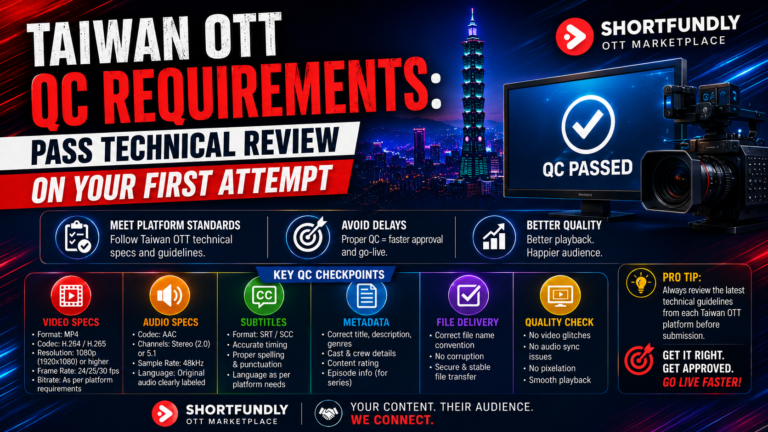
Step 12: Complete OTT Quality Control
Before delivery, we should perform technical and editorial QC.
Check:
- Video playback
- Audio synchronization
- Audio levels
- Subtitle synchronization
- Subtitle spelling
- Missing frames
- Black frames
- Encoding problems
- Aspect ratio
- Resolution
- Credits
- Logos
- End cards
- Metadata
- Artwork
We should watch the complete master after encoding rather than checking only the beginning and end.
A small technical problem can cause delivery rejection or additional processing.
Step 13: Build a Worldwide OTT Distribution Strategy
Taiwan should not necessarily be treated as an isolated market.
We can build a broader worldwide OTT distribution plan around Taiwan and other territories.
For example:
Phase 1 — Taiwan
Prepare Traditional Chinese subtitles and target Taiwan-focused platforms.
Phase 2 — Hong Kong and Macau
Adapt Chinese-language metadata and localization where appropriate.
Phase 3 — Southeast Asia
Evaluate Singapore, Malaysia, Indonesia, Thailand, and other markets according to audience fit.
Phase 4 — East Asia
Consider Japan and South Korea with market-specific subtitles and distribution partners.
Phase 5 — Global Markets
Expand into North America, Europe, Australia, and other territories where rights and audience demand support licensing.
This approach prevents us from giving away worldwide rights unnecessarily at the beginning of the distribution process.
Taiwan OTT Release Checklist
Before releasing a film, we should confirm the following:
Rights
- Taiwan rights available
- Digital rights confirmed
- Existing licenses reviewed
- Music rights cleared
- Talent rights cleared
- Third-party footage cleared
Localization
- Traditional Chinese subtitles completed
- English subtitles available
- Dialogue list prepared
- Subtitle QC completed
Technical
- Master completed
- Audio checked
- Video checked
- Platform specifications confirmed
- Trailer prepared
Metadata
- Title confirmed
- Logline completed
- Synopsis completed
- Genre confirmed
- Cast and crew verified
- Runtime verified
- Keywords prepared
Marketing
- Poster completed
- Key art prepared
- Promotional stills available
- Trailer thumbnail available
- Social assets prepared
Commercial
- Revenue model understood
- Distribution fee understood
- Revenue share defined
- Payment schedule confirmed
- Contract term reviewed
- Exclusivity reviewed
How Long Does a Taiwan OTT Film Release Take?
There is no universal release timeline.
The process can include:
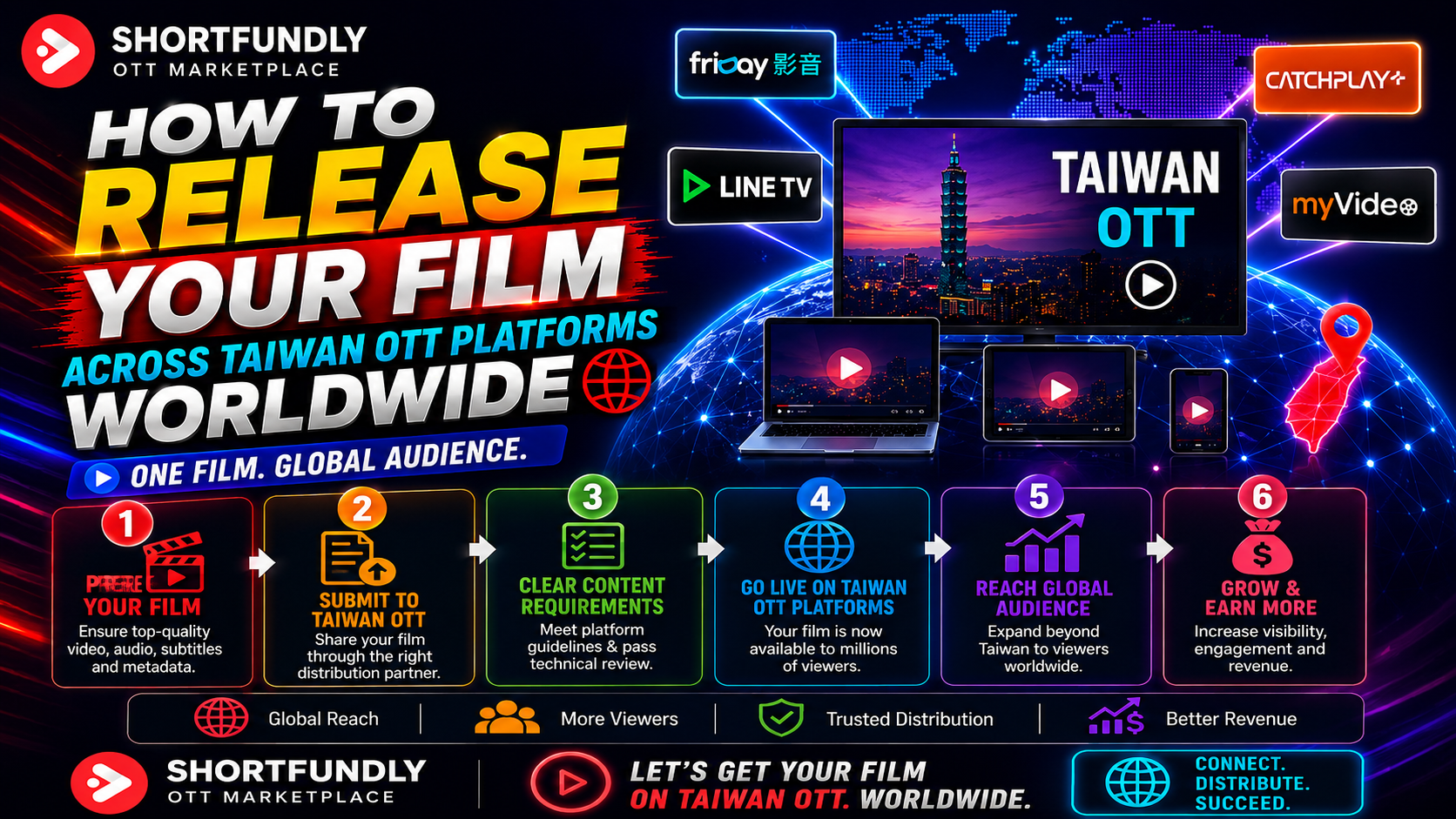
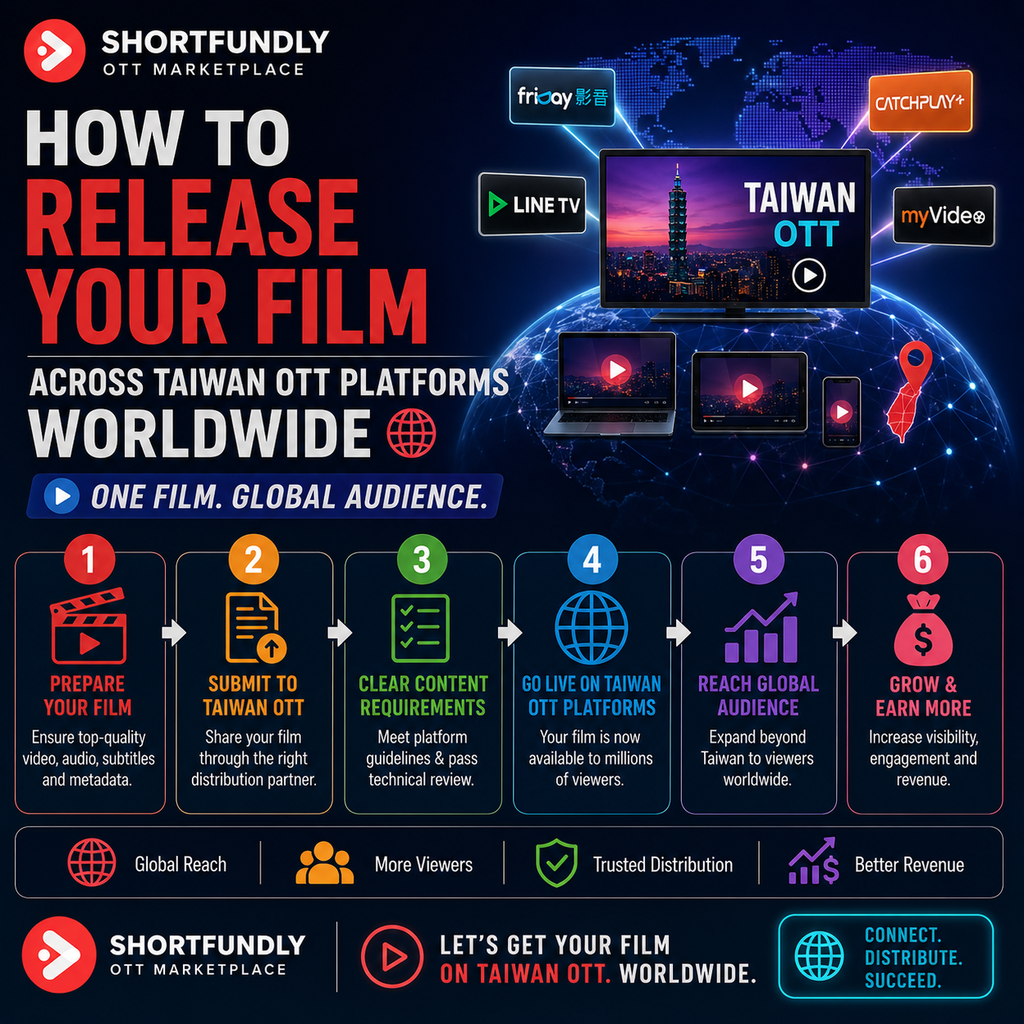
Preparation → Submission → Review → Rights Verification → Buyer Pitching → Negotiation → Contract → Localization → Technical Delivery → QC → Scheduling → Release
The preparation stage can be completed relatively quickly if all assets already exist. However, buyer review, negotiation, localization, QC, and scheduling may take substantially longer.
We should therefore distinguish between submission date and confirmed release date.
A distributor receiving a film does not necessarily mean that the film has been accepted by a specific OTT platform.
Can Short Films Be Released on Taiwan OTT Platforms?
Yes, depending on the platform’s programming strategy.
Short films can be positioned around:
- Independent cinema
- Festival films
- Emerging filmmakers
- Asian cinema
- Genre collections
- Cultural storytelling
- Experimental filmmaking
- Short-form entertainment
For short-film creators, the distribution package should emphasize the film’s strongest differentiator.
A concise runtime can be an advantage when positioned for audiences that consume short-form entertainment, but the project still needs professional packaging.
Can Documentaries Be Distributed Through Taiwan OTT?
Yes.
Documentaries may be suitable for platforms seeking:
- Cultural programming
- Asian stories
- History
- Travel
- Food
- Technology
- Society
- Arts
- Environmental subjects
- Human-interest stories
Documentary producers should pay particular attention to archival footage, music, photographs, interviews, trademarks, and third-party materials because these can affect the rights package.
How Can We Increase the Chances of OTT Placement?
We should focus on platform fit and distribution readiness.
The strongest preparation strategy includes:
- Identify the target Taiwanese audience.
- Research suitable platform categories.
- Confirm Taiwan rights.
- Prepare Traditional Chinese subtitles.
- Create professional metadata.
- Prepare high-quality artwork.
- Complete technical QC.
- Build a strong pitch.
- Work with appropriate distributors.
- Compare commercial agreements.
- Track submissions.
- Maintain a complete rights and revenue record.
The objective is not to send the same email to every streaming service.
The objective is to identify the services where the film has the strongest audience, genre, language, and commercial fit.
Common Mistakes to Avoid in Taiwan OTT Distribution
Submitting Without Rights Documentation
Buyers need confidence that the content can legally be licensed.
Using Poor Subtitles
Translation errors can reduce the professional quality of the entire package.
Ignoring Metadata
A strong film with weak metadata is difficult for buyers and platforms to position.
Granting Excessive Rights
Avoid granting worldwide exclusivity when a Taiwan-only deal would satisfy the commercial objective.
Ignoring Revenue Definitions
A percentage is meaningless without understanding the revenue base and permitted deductions.
Using the Same Pitch Everywhere
Different platforms serve different audiences. The pitch should reflect the intended platform.
Delivering Unchecked Masters
Technical errors can delay delivery and create unnecessary rework.
Expecting Immediate Release
Acceptance, contracting, technical delivery, QC, and scheduling are separate stages.
Frequently Asked Questions About Taiwan OTT Film Distribution
Can international filmmakers distribute films in Taiwan?
Yes. International filmmakers can pursue Taiwan distribution directly where platform submission policies permit it, or through distributors, sales agents, and other rights representatives.
Do we need Traditional Chinese subtitles?
For a Taiwan-focused release, Traditional Chinese subtitles are strongly recommended. Exact localization requirements depend on the platform and agreement.
Can short films be distributed in Taiwan?
Yes. Short films can be suitable for platforms and services that acquire independent or short-form content.
Can we release the same film in Taiwan and other countries?
Yes, provided the rights agreements are structured correctly. Territory-specific licensing can allow simultaneous international distribution.
Should Taiwan rights be sold separately?
In many situations, separate territory licensing can preserve flexibility. However, the best structure depends on the buyer, project, revenue potential, and distribution strategy.
How much does Taiwan OTT distribution cost?
There is no universal cost. Depending on the arrangement, expenses can include distribution fees, localization, mastering, QC, marketing, or commissions.
Is revenue sharing better than a fixed licensing fee?
Neither is automatically better. We should compare expected revenue, rights granted, contract duration, deductions, platform reach, and payment conditions.
Can a distribution company release a film worldwide?
Some distributors offer multi-territory or worldwide distribution, but the actual territories, platforms, rights, and commercial terms must be confirmed in the contract.
What should we prepare before approaching a Taiwan distributor?
At minimum, we should have a finished master, synopsis, logline, metadata, artwork, trailer where available, subtitles, rights documentation, and clear information about the rights being offered.
Also read: https://blog.shortfundly.com/uncategorized/taiwan-ott-qc-distribution/
Conclusion: Build Taiwan Into a Global OTT Release Strategy
Releasing a film across Taiwan OTT platforms worldwide requires a structured approach that combines local market understanding with international rights management.
Taiwan’s OTT market includes major international services, telecom-backed platforms, domestic streaming providers, and specialized digital services. Official Taiwanese communications-market reporting confirms the breadth of this ecosystem and the importance of both international and domestic OTT operators.
For filmmakers, the strongest approach is to prepare the film for professional delivery, secure the necessary rights, localize the content for Taiwanese audiences, create accurate metadata, identify suitable platforms, and negotiate distribution agreements carefully.
Traditional Chinese subtitles, professional artwork, accurate metadata, technical QC, clear rights, and a targeted buyer strategy can make the difference between an unprepared submission and a commercially credible OTT package.
Services such as Shortfundly Distribution can be evaluated as part of the distribution process, particularly when filmmakers want a distribution partner to help pursue OTT opportunities.
The broader goal should be bigger than simply obtaining one Taiwan streaming placement. By structuring territory rights carefully and maintaining professional localization and delivery assets, we can use Taiwan OTT distribution as one component of a worldwide digital film distribution strategy.