Table of Contents
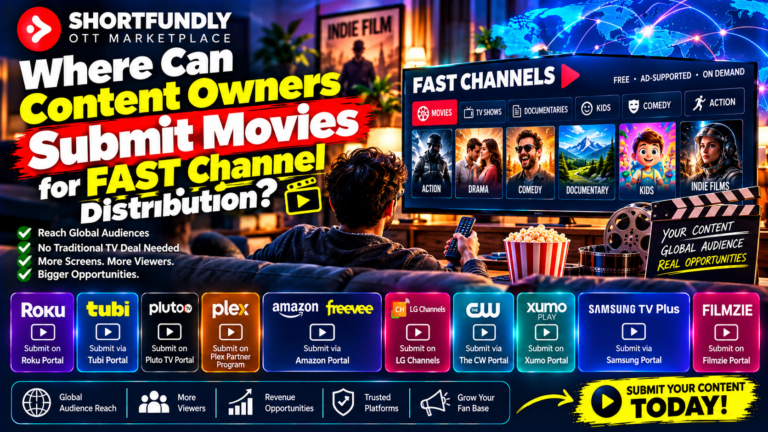
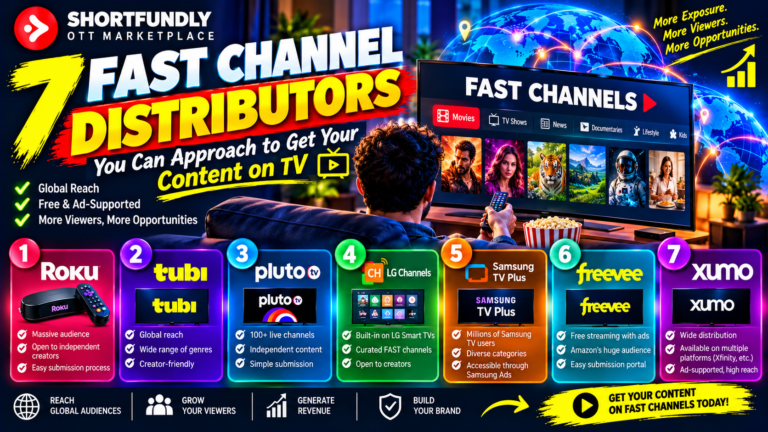
The growth of FAST channel distribution has created new opportunities for filmmakers, independent producers, studios, and content owners who want to reach streaming audiences. FAST, which stands for Free Ad-Supported Streaming Television, allows viewers to watch scheduled television-style programming without paying a traditional subscription fee. Advertising supports the service, while content owners may earn revenue through licensing or other negotiated arrangements.
For content owners, however, getting a movie, documentary, television series, or other program onto a FAST channel involves more than submitting a video file. Distributors and channel operators need to understand the content, verify the rights, evaluate technical quality, review metadata, and determine whether a title fits their programming strategy.
A strong submission package can help make this process more organized and professional. It can also reduce delays caused by missing documents, incorrect specifications, unclear ownership, or incomplete promotional materials.
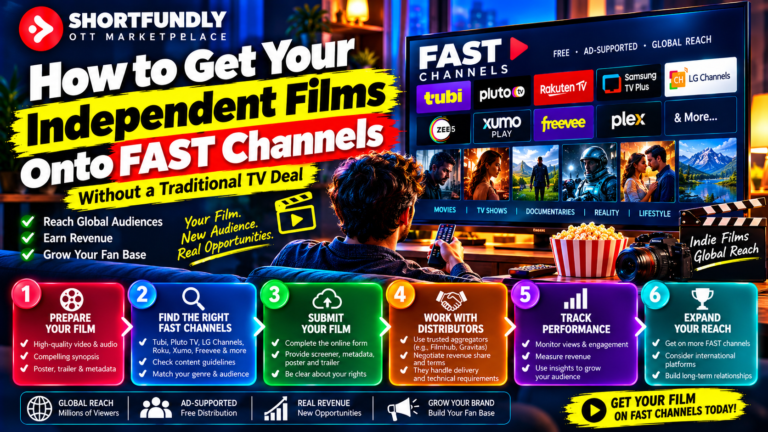
In this guide, we explain the 10 things content owners need before FAST channel submission, how to prepare a distribution-ready catalogue, what to check before signing a deal, and how to explore broader OTT distribution opportunities through services such as Shortfundly Distribution.
What Is FAST Channel Distribution?
FAST channel distribution is the process of making licensed content available through free, advertising-supported streaming television services. These services often operate on smart TVs, connected-TV devices, streaming applications, and other internet-enabled platforms.
Unlike a conventional subscription streaming service, a FAST service generally lets viewers watch programming without paying a recurring subscription fee. Many FAST channels use a scheduled, linear-style format, with programs arranged into a continuous viewing experience.
Content owners may distribute material such as:
- Independent feature films
- Short films
- Documentaries
- Television series
- Regional-language movies
- Lifestyle and entertainment programs
- Classic film libraries
- Genre-specific collections
- Other professionally produced video content
The exact content accepted depends on the channel, distributor, territory, technical requirements, and licensing arrangements.
It is also important to distinguish FAST distribution from general OTT distribution. A company may distribute content to video-on-demand platforms without offering access to a specific FAST channel. If your objective is to reach a particular FAST service, confirm that the distributor currently supports that route before signing an agreement.
Why Content Owners Should Prepare Before Submission
FAST distributors and channel operators evaluate more than storytelling or production quality. They also need to determine whether the content is legally available, technically deliverable, commercially suitable, and ready for programming.
An incomplete submission may lead to additional questions, technical corrections, or delays. A well-prepared package makes it easier to assess your content library and understand the rights available.
Preparation also helps you compare distribution offers more effectively. When you already know which territories you control, which assets are available, and what commercial terms you need, you can negotiate from a clearer position.
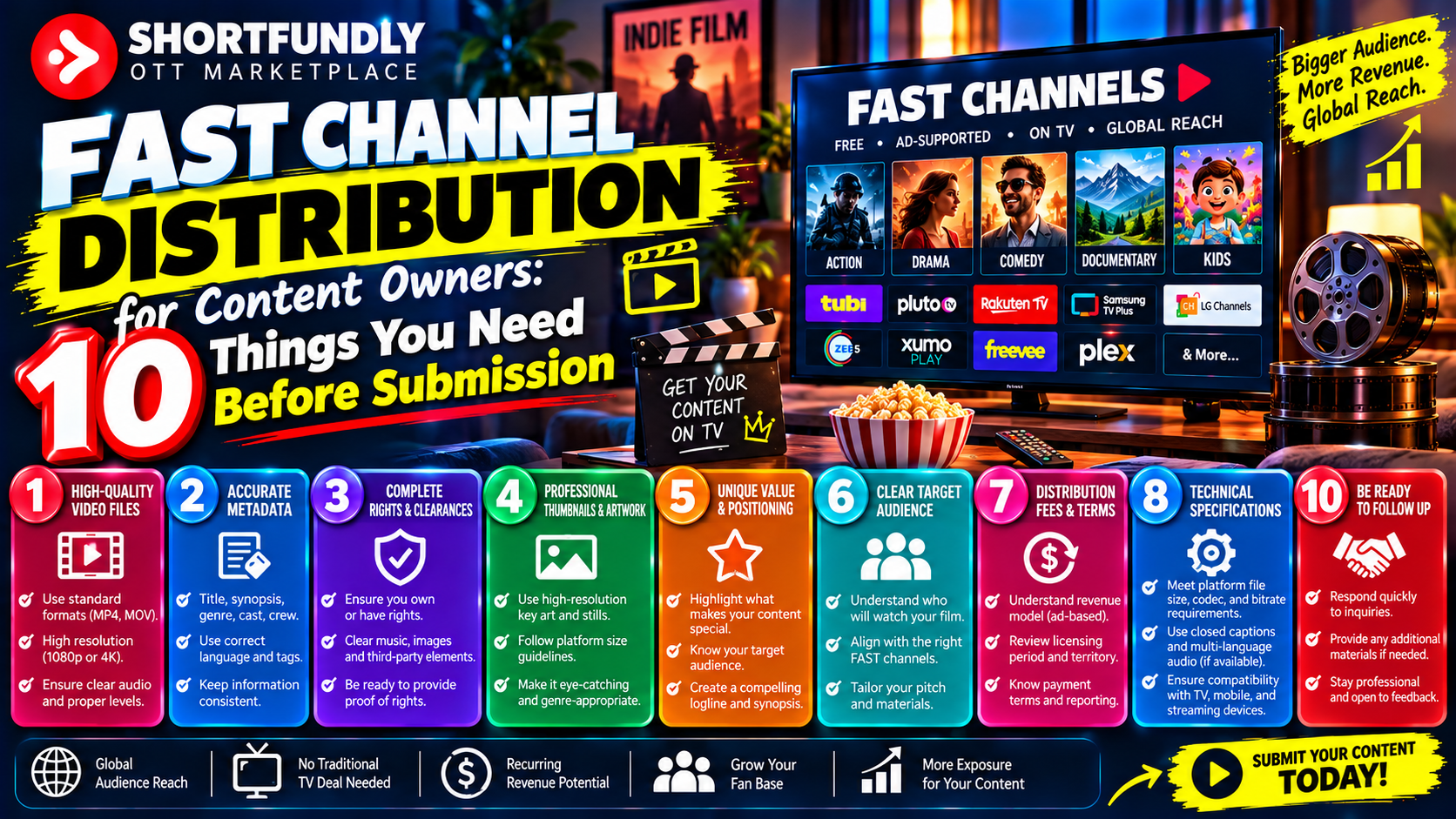
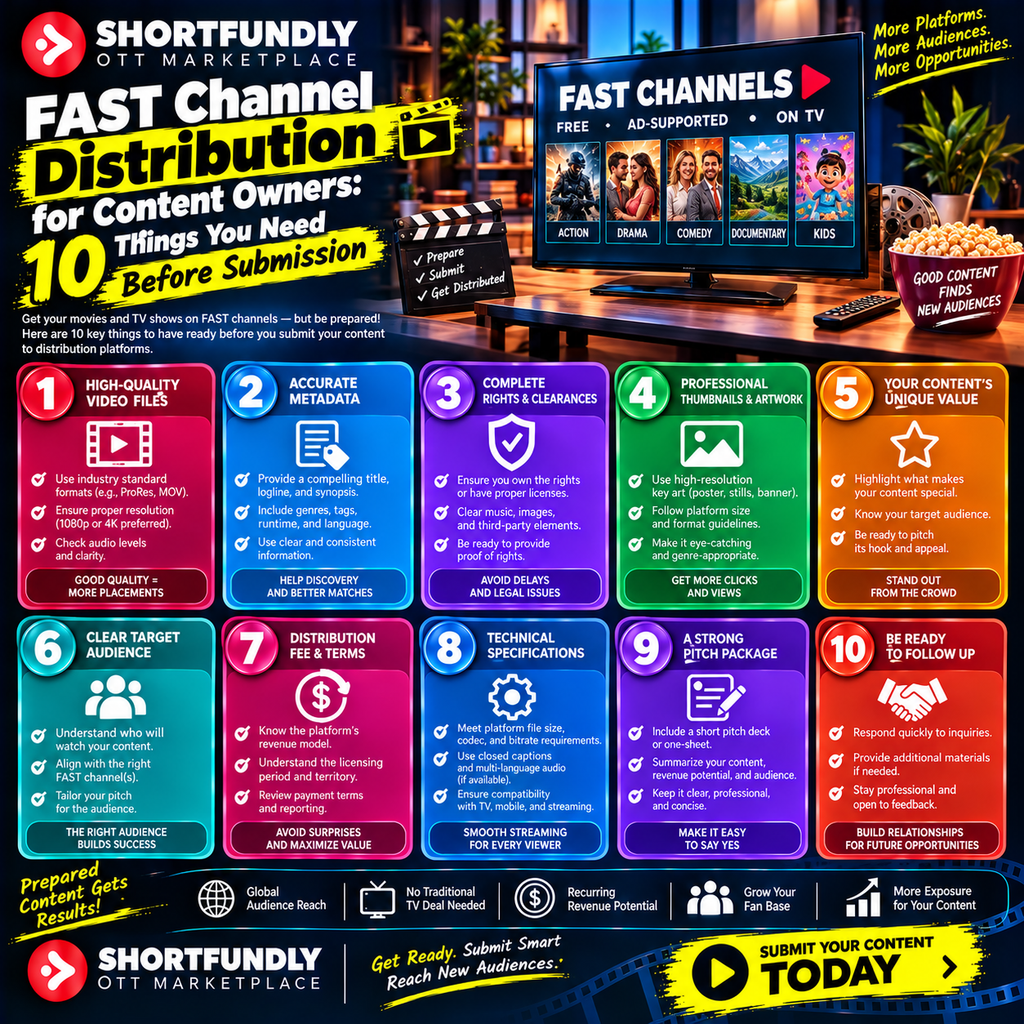
The following ten items form a practical pre-submission checklist.
1. Clear Content Ownership and Distribution Rights
The first requirement is to confirm that you have the legal authority to license the content for the proposed distribution model.
A professionally produced movie may include music, scripts, footage, performances, artwork, and other elements created or licensed by different parties. Owning the final video file does not automatically mean you control every right needed for distribution.
Before submitting, review the following:
- Copyright ownership: Identify the legal owner of the finished content.
- Producer and co-producer agreements: Confirm who can authorize distribution.
- Music clearances: Verify that songs, background music, and compositions are cleared for the intended uses.
- Cast and crew agreements: Check that the relevant permissions cover the proposed release.
- Underlying material: Confirm rights to scripts, books, stories, or adaptations.
- Third-party assets: Review licenses for archival footage, photographs, stock video, and other incorporated materials.
- Existing distribution contracts: Check for exclusivity, holdbacks, territory restrictions, or conflicting rights.
Prepare a rights summary that identifies the content, rights holder, available rights, territories, and any restrictions.
If you represent a catalogue of films from multiple producers, organize documentation separately for each title. Do not assume that one agreement covers an entire library unless it explicitly does.
Why this matters: Unclear ownership can prevent a distributor from licensing your content, even if the title is creatively suitable for the channel.
2. A Complete and Accurate Content Catalogue
If you own multiple titles, prepare a structured catalogue rather than sending an unorganized collection of links and files.
A catalogue allows distributors to understand the size, variety, and programming potential of your library. It also helps them identify titles that may fit specific channels or audience segments.
Your catalogue spreadsheet should include:
| Metadata field | Information to provide |
|---|---|
| Content title | Official title and any alternate title |
| Content type | Feature film, short film, series, documentary, or other format |
| Genre | Primary genre and relevant subgenres |
| Runtime | Accurate duration |
| Language | Original language and available versions |
| Release year | Year of original release |
| Synopsis | Concise description of the story or program |
| Country of production | Relevant production country or countries |
| Rights status | Rights available and any restrictions |
| Territories | Countries or regions available for licensing |
| Technical status | Master file and delivery readiness |
| Existing availability | Current platforms or licensing commitments, where relevant |
For a television series, include episode titles, episode runtimes, season information, and the total number of available episodes.
For a film library, group titles by genre, language, territory, or other useful categories.
Avoid exaggerated descriptions such as “guaranteed hit” or “world’s most popular film.” Clear, verifiable information helps distributors evaluate the catalogue more efficiently.
3. Broadcast-Ready Video and Audio Masters
A content owner should have a high-quality final master ready or know exactly what work remains before delivery.
A distributor may assess video resolution, frame rate, aspect ratio, codec, audio format, loudness, and file integrity. The precise requirements vary between partners and platforms.
Common technical delivery considerations include:
- High-quality video master
- Correct frame rate and aspect ratio
- Approved video codec and container
- Clean, synchronized audio
- Consistent dialogue levels
- Proper color grading
- Accurate opening and closing credits
- Correct subtitle and caption synchronization
- No unintended black frames or corrupted sections
- Correct file naming and version control
Do not assume that one technical specification applies to every FAST channel. Request the latest delivery specification from the intended distributor before exporting the final files.
Technical quality-control checklist
- The complete program plays without errors.
- The picture is consistent throughout.
- Dialogue and sound effects are clear.
- Audio and video remain synchronized.
- The final runtime matches the catalogue.
- The correct version and credits are included.
- Subtitles and captions have been checked.
- The master meets the recipient’s current requirements.
Keep a high-quality preservation master where possible, along with delivery versions created to meet individual partner specifications.
4. Accurate Metadata and Descriptive Information
Metadata is the information used to identify, categorize, manage, and present your content. It helps a distributor understand what a title is about and where it may fit within a programming strategy.
Missing or inconsistent metadata can create avoidable work during review and delivery.
For each title, prepare:
- Official title
- Alternate title, where applicable
- Logline
- Short synopsis
- Full synopsis
- Genre and subgenre
- Runtime
- Release year
- Original language
- Subtitle and dubbing languages
- Director and producer credits
- Main cast
- Country of production
- Content advisories or rating information, where required
- Relevant keywords
- Rights availability
Keep the logline short enough to communicate the central premise quickly. The synopsis should accurately describe the content without making claims that the program does not support.
For example, a regional-language mystery film should be clearly identified by its language, genre, and central premise. A generic description such as “an interesting movie for everyone” provides little value to a distributor.
Where a platform has a specific metadata template, use that template rather than creating an incompatible format.
Best practice: Maintain one master metadata document and use it to generate partner-specific versions. This helps reduce spelling errors, conflicting runtimes, and inconsistent credits.
5. Posters, Key Art, Stills, and Promotional Materials
Professional artwork helps distributors evaluate how your content may be presented to viewers. It can also support catalogue review, marketing, and eventual platform delivery.
Prepare promotional materials before submission rather than waiting until a partner asks for them.
Your package may include:
Main poster: A high-resolution image that clearly identifies the title and communicates its genre.
Landscape artwork: A version prepared for horizontal display where required.
Portrait artwork: A version designed for vertical or mobile-oriented placements where required.
Film stills: Clear images from the program that represent its visual style and subject.
Trailer: A concise promotional video that introduces the premise and tone.
Cast and crew information: Accurate credits and short biographies where useful.
Branding and logos: Relevant production-company or rights-holder logos in suitable formats.
Ask the distributor for the required dimensions, aspect ratios, file formats, and naming conventions. Different services may use different artwork specifications.
Check that all promotional materials are cleared for the intended use. If the artwork includes third-party photography, licensed fonts, or recognizable copyrighted elements, make sure you have the appropriate permissions.
Avoid low-resolution screenshots, promotional images with playback controls, or artwork that misrepresents the content.
6. Subtitles, Captions, and Localization Assets
Localization can help make content accessible to audiences who speak different languages or need accessibility support.
Depending on the distribution partner, you may need subtitles, closed captions, dubbed audio, or other language-specific assets.
Before submission, identify which versions are already available and which could realistically be prepared.
Check the following:
- Subtitle translation accuracy
- Spelling of names and locations
- Subtitle timing
- Readability and line breaks
- Consistency of terminology
- Audio and subtitle synchronization
- Caption accuracy
- Correct labeling of each language version
Subtitles should be reviewed by someone who understands the target language and the context of the dialogue. Automatic translation may be useful as a starting point, but it can introduce errors in humor, cultural references, idioms, and technical terminology.
Also verify that your agreements permit the creation and distribution of dubbed or subtitled versions.
Localization does not guarantee acceptance in a new territory, but it can improve the practical readiness of a title for consideration by partners serving multilingual audiences.
7. A Clear Audience and Programming Position
Distributors need to understand not only what your content is, but also which viewers might be interested in it.
A title’s genre, language, runtime, theme, and target audience can influence where it may fit. A catalogue of documentaries may suit a different programming strategy from a library of regional comedies or classic action films.
Prepare a short positioning statement for each title or collection.
For example:
This collection contains regional-language crime thrillers aimed at viewers who enjoy mystery-driven stories, investigative plots, and suspense-focused entertainment.
The statement should describe the content accurately. Avoid unsupported claims about viewership or guaranteed audience demand.
For a larger library, consider grouping titles into useful collections:
- Genre-based collections
- Regional-language collections
- Documentary libraries
- Family and general entertainment
- Classic or archival content
- Holiday or seasonal programming
- Collections organized by runtime or format
A coherent collection may offer more programming flexibility than an assortment of unrelated titles. However, a single strong film can still be worth submitting if it fits a distributor’s current needs.
8. Territory Availability and Existing Licensing Commitments
Content owners should know exactly where their rights are available before entering distribution discussions.
A movie might be available in one country but already licensed in another. It may be available for video-on-demand use while its television rights remain committed to a different partner.
Create a territory and rights matrix to avoid confusion.
| Territory | Rights status | Existing restrictions | Next action |
|---|---|---|---|
| Territory A | Available | None identified | Confirm partner requirements |
| Territory B | Licensed | Existing agreement applies | Review contract and expiry |
| Territory C | Under discussion | Negotiation pending | Confirm status before offering |
| Territory D | Unverified | Rights not yet confirmed | Complete rights review |
These entries are illustrative; your actual matrix should reflect your contracts.
When reviewing an offer, confirm whether it covers FAST, AVOD, SVOD, TVOD, traditional television, mobile distribution, or other forms of exploitation. Also clarify whether the rights are exclusive or non-exclusive.
Do not grant broad rights merely because a distributor offers access to one service. Make sure the scope of the license matches your business objectives.
If rights are shared among producers, broadcasters, sales agents, or other parties, resolve any approval requirements before making a commitment.
9. Commercial Terms, Revenue Reporting, and Contract Readiness
A distribution opportunity should be evaluated based on its full commercial terms, not just the promise of audience reach.
FAST distribution agreements can be structured in different ways. Depending on the arrangement, a content owner may receive a license fee, a share of eligible revenue, a minimum guarantee, or a combination of commercial terms.
There is no single payment model that applies to every FAST channel.
Before signing, understand the following:
- Revenue model: How is the content owner compensated?
- Revenue calculation: Which receipts are included in the calculation?
- Deductions: Which commissions, expenses, or other costs may be deducted?
- Reporting: What performance and financial reports will be provided?
- Payment schedule: When are statements and payments due?
- License term: How long does the agreement last?
- Exclusivity: Can you license the content elsewhere during the term?
- Territories: Which markets are included?
- Marketing responsibilities: Who supplies and pays for promotional materials?
- Termination and reversion: When can the agreement end, and how do rights return?
Ask how advertising revenue is measured if the deal depends on advertising-supported viewing. Determine whether the contract gives you access to performance data and whether you can audit or question reported amounts.
Avoid accepting a vague promise of “monetization” without a clear explanation of the payment structure.
If an agreement includes broad exclusivity, a long term, or substantial rights grants, consider obtaining legal advice before signing.
10. A Professional Pitch and Submission Package
Once the rights, masters, metadata, artwork, and commercial information are organized, prepare a focused pitch for the distributor.
A submission package should help the recipient understand your content without requiring multiple rounds of basic clarification.
Include the most relevant items:
- A brief introduction to the content owner or production company
- The title or catalogue being offered
- Genre, language, runtime, and release year
- A logline and concise synopsis
- Available territories and rights
- Technical and localization readiness
- A secure screener or preview link, if requested
- Artwork and trailer links
- Contact details
- Any specific questions about the partner’s current submission process
For a catalogue, include a clean spreadsheet and highlight the titles most relevant to the recipient’s programming strategy.
Sample FAST distribution pitch
Subject: Independent Content Catalogue for FAST Distribution Consideration
Hello Distribution Team,
We are seeking distribution opportunities for our independent content catalogue, which includes professionally completed titles with organized metadata, promotional assets, and documented rights availability.
We would welcome the opportunity to learn whether any of our titles fit your current FAST channel requirements. We can provide a catalogue overview, relevant screeners, technical information, and rights details for review.
Please let us know your current submission requirements, supported territories, technical specifications, and licensing process.
Thank you for your time and consideration.
Best regards,
[Name]
[Production Company or Rights Holder]
[Contact Information]
Personalize this message for each recipient. Confirm whether the company accepts direct submissions before sharing screeners or confidential materials.
How Shortfundly Distribution Fits Into Your Distribution Strategy
Content owners exploring distribution opportunities can also investigate broader OTT distribution routes. Shortfundly Distribution provides a submission process for eligible films and other supported content, allowing creators to present their work for review and potential distribution through its currently available partners.
The current Shortfundly submission workflow includes reviewing the applicable fee, registering or signing in, adding content details, reviewing the submission requirements, completing the required agreement and payment steps, and submitting the title for review. If a submission is approved, creators may be asked to provide release assets and can use available account tools to track distribution status and earnings.
Supported content categories listed by Shortfundly include short films, movies, web series, documentaries, telefilms, pilot films, songs and video songs, micro dramas, and other content types available through the submission process.
For independent producers and rights holders, this can be one option to consider when building a broader digital distribution strategy. Before submitting, review the current fees, technical requirements, agreement terms, and available distribution partners.
It is especially important to distinguish general OTT distribution from a specific FAST channel deal. Do not assume that submitting through an OTT distributor guarantees FAST placement. If your main objective is to reach a particular FAST channel, ask whether that service is currently supported and whether your content meets its licensing and technical requirements.
Common FAST Channel Submission Mistakes to Avoid
Even a strong content library can face unnecessary delays when its submission package is incomplete. Avoid these common problems.
Submitting Content Without Verifying Rights
A distributor needs to know that the person submitting a title has authority to license it. Resolve music, footage, underlying material, and existing agreement issues before submission.
Providing Inconsistent Metadata
Differences in runtime, title spelling, release year, or language can create confusion. Use a master catalogue and check all partner-specific documents against it.
Delivering the Wrong Technical Format
Do not export a file based on assumptions. Request the current specification sheet and complete quality control before delivery.
Using Poor Promotional Artwork
Low-resolution images or inconsistent artwork can weaken the presentation. Prepare professional materials and verify the required dimensions.
Overlooking Exclusivity
An agreement may limit your ability to license the content to other services. Understand the rights, term, territory, and restrictions before signing.
Expecting Guaranteed Placement
Submission and technical acceptance do not guarantee that a channel will schedule or stream your title. Ask about selection criteria, release decisions, and the partner’s actual role.
Ignoring Reporting and Payment Terms
Review the revenue calculation, deductions, statement schedule, payment conditions, and dispute procedures. A clear contract is more useful than an informal promise.
Final Pre-Submission Checklist for Content Owners
Use this checklist to confirm that your content is ready to present to a potential FAST distributor.
- Ownership and distribution rights verified
- Music, footage, and other third-party clearances checked
- Existing licensing restrictions documented
- Catalogue spreadsheet completed
- Final video and audio masters quality-checked
- Technical requirements confirmed with the partner
- Metadata checked for accuracy
- Posters, stills, and trailers prepared
- Subtitles and captions reviewed
- Target audience and programming fit described
- Territory availability confirmed
- Preferred commercial terms identified
- Secure screener prepared, if required
- Submission pitch personalized
- Agreement reviewed before signing
Frequently Asked Questions About FAST Channel Distribution
1. What does FAST channel distribution mean for content owners?
It means licensing or delivering content for use on free, advertising-supported streaming television services. The commercial arrangement and the actual distribution route depend on the channel, distributor, rights holder, and agreement.
2. What types of content can be submitted to FAST channels?
Depending on the service, content may include feature films, short films, documentaries, television programs, regional cinema, and genre-specific libraries. Each partner has its own programming criteria and acceptance requirements.
3. Do I need to own all the rights to submit content?
You need sufficient legal authority to submit and license the rights requested. If rights are shared or certain elements are licensed from third parties, you must confirm that the proposed distribution is permitted.
4. Do FAST distributors accept individual movies or only catalogues?
This varies. Some partners may consider individual titles, while others prioritize larger catalogues or particular types of programming. Check each partner’s current submission policy.
5. Which technical formats are required for FAST distribution?
There is no universal specification for every FAST channel. Requirements may cover resolution, frame rate, codec, audio, captions, subtitles, artwork, and file delivery. Request the receiving partner’s current technical specifications.
6. How do content owners earn money from FAST distribution?
Commercial arrangements vary and may involve licensing fees, revenue sharing, minimum guarantees, or other negotiated structures. Review the agreement to understand the calculation, deductions, reporting, and payment schedule.
7. Can I submit content through Shortfundly Distribution?
Shortfundly provides a submission workflow for eligible films and other supported content through its OTT distribution process. Review its current requirements, fees, agreement terms, and available distribution partners before proceeding.
8. Does OTT distribution guarantee placement on a FAST channel?
No. OTT distribution and FAST channel placement are not automatically the same. Confirm that the specific FAST service is included in the proposed arrangement and that your title is eligible for consideration.
9. Should I sign an exclusive FAST distribution deal?
That depends on the rights requested, territories, term, compensation, and your wider distribution strategy. Compare the potential benefits with the restrictions, and consider legal advice before granting broad or long-term exclusivity.
10. What should I do if my submission is rejected?
Ask whether the partner can share a reason or identify areas for improvement. Depending on the feedback, you may need to improve technical delivery, complete rights documentation, revise metadata, or approach a more suitable distributor. A rejection from one service does not mean the title is unsuitable for every distribution route.
Also read: https://blog.shortfundly.com/ott/independent-films-fast-channels/
Conclusion
FAST channel distribution for content owners starts with preparation. Before submitting, confirm your rights, organize your catalogue, prepare professional masters, complete metadata, create promotional assets, review localization, and understand the commercial terms you are prepared to accept.
These ten essentials help content owners present their work professionally and respond more efficiently to distributor requests. They also make it easier to compare potential partners and identify gaps before a submission reaches the review stage.
As you evaluate opportunities, remember that each FAST channel has its own requirements, and a submission does not guarantee placement or revenue. Verify current partners, technical specifications, licensing terms, and the precise distribution rights being offered.
Alongside direct FAST outreach, you can explore Shortfundly Distribution as a potential route for eligible content through its OTT distribution process. Review the current requirements and confirm the available services to determine whether they fit your objectives.
With a well-organized catalogue, clear rights, reliable technical assets, and a focused distribution strategy, content owners can take more informed steps toward bringing their films and programs to new streaming audiences.