Table of Contents
Introduction: Why Content Preparation Matters for FAST Distribution
Prepare content for FAST distribution is an important step for filmmakers, production companies, studios, television producers, and content owners who want to monetize their film and television libraries through Free Ad-Supported Streaming Television (FAST) channels. FAST platforms provide audiences with free, advertising-supported, television-style streaming experiences, creating opportunities for content owners to reach viewers through scheduled programming and curated channels.
However, successful FAST distribution requires more than having a completed film or series. Content must be properly organized, rights-cleared, technically prepared, metadata-enriched, quality-checked, and packaged according to the requirements of the distribution partner. A professional content package makes it easier for distributors and channel operators to evaluate titles and helps minimize delivery delays.
Whether we are preparing a single independent film, a collection of documentaries, a regional film library, or an entire television catalogue, a structured preparation process can make our content more distribution-ready.
In this comprehensive guide, we explore how to prepare content for FAST distribution, from rights management and technical specifications to metadata, subtitles, artwork, quality control, and distribution partner submissions.

What Does Preparing Content for FAST Distribution Mean?
Preparing content for FAST distribution involves organizing and delivering video programming, technical files, metadata, artwork, rights information, and supporting assets so that content can be evaluated and processed by FAST channel operators, aggregators, and streaming platforms.
FAST distribution is different from traditional film distribution because content may be incorporated into scheduled programming that operates continuously. Depending on the channel model, content may be organized into programming blocks, repeated schedules, themed collections, or genre-based lineups.
A professional FAST content package generally includes:
- Final, broadcast-quality video masters
- High-quality audio files or embedded audio tracks
- Accurate metadata and title information
- Subtitles and closed captions, where applicable
- Posters, thumbnails, and promotional artwork
- Content ratings and advisory information
- Documented distribution and streaming rights
- Technical specifications and quality-control records
The objective is to make the content technically deliverable, legally cleared, editorially suitable, and commercially presentable.
11 Essential Steps to Prepare Content for FAST Distribution
Why Organizing Film Content Effectively is a Game-Changer for Studios
Runway Gen-4.5 vs Sora 2 for Filmmakers 2026 | Blog Picasso IA
Studios | Work with us | Sky Group
7
1. Conduct a Complete Content Library Audit
The first step in preparing content for FAST distribution is to understand exactly what we own, what we can license, and what assets are available for every title.
A content library audit provides a centralized overview of the films, series, documentaries, short films, and other video assets available for distribution. It helps us identify titles with complete rights and delivery materials, as well as those requiring additional work.
We should create a catalogue inventory containing:
- Original title
- English title, if applicable
- Alternative titles
- Content type
- Genre
- Release year
- Running time
- Language
- Country of production
- Director
- Cast
- Synopsis
- Content rating
- Available territories
- Rights expiration dates
- Available video masters
- Audio versions
- Subtitle files
- Artwork availability
- Distribution status
A structured catalogue makes it easier to evaluate content for different channel themes and helps distributors review a library without repeatedly requesting basic information.
For large libraries, we can use spreadsheets, digital asset management systems, or content management platforms to track assets and rights systematically.
2. Verify FAST Distribution Rights
Film Contracts and Agreements to Protect Your Film – 2026 | FilmDaily.tv
Archival Footage in Documentaries: How to Legally Use Old Videos Without Getting Sued
7
Rights clearance is one of the most important steps before submitting content to FAST channels. A completed film does not automatically mean that all streaming or advertising-supported distribution rights are available.
We should review the contracts and documentation associated with each title to determine whether the content can be licensed for FAST distribution.
Important rights considerations include:
- FAST and free ad-supported streaming rights
- Linear streaming rights
- Digital distribution rights
- Territorial rights
- Language rights
- Advertising-supported usage
- Exclusivity restrictions
- Licence duration
- Promotional and marketing rights
- Music rights
- Third-party footage and archive rights
- Talent and performer agreements
Rights should be verified at the title level. A film may be cleared for distribution in one territory but restricted in another. Some contracts may permit on-demand streaming but exclude linear FAST channel exploitation.
We should maintain a rights matrix that clearly identifies which titles are available for FAST distribution, in which territories, and for what period.
This process helps prevent legal conflicts and gives distribution partners confidence that the content can be licensed appropriately.
3. Prepare High-Quality Video Masters
The video master is the primary asset used to deliver the film or programme to a streaming partner. A clean, technically consistent master is essential for professional distribution.
Before delivering a video file, we should confirm:
- Resolution and aspect ratio
- Frame rate
- Video codec
- Bitrate
- Colour space
- Picture quality
- Audio synchronization
- File integrity
- Correct opening and closing frames
- Absence of unintended black frames
- Absence of technical glitches
Many streaming services accept HD content, while some may support or require higher resolutions depending on the content and platform.
We should not assume that every FAST platform uses identical specifications. The distribution partner should provide the exact technical requirements, and the video master should be prepared accordingly.
If the original master is available, we should prioritize it over heavily compressed files downloaded from social media, video-sharing platforms, or other consumer services.
Professional mastering and quality control can reduce rejection risks and improve the overall viewing experience.
4. Optimize Audio Quality and Prepare Audio Tracks
Technical equipment – FABW | EN
CINEPHASE – Post-production Sound and Dubbing for Cinema, Platform and TV
Best Sound Mixing Studio Los Angeles & Re Recording Services
7
Audio quality is just as important as video quality in FAST distribution. Poor sound can negatively affect the viewing experience even when the video looks excellent.
We should check the following:
- Dialogue clarity
- Audio levels
- Loudness consistency
- Stereo or surround configuration
- Background noise
- Distortion
- Audio synchronization
- Channel mapping
- Music licensing
- Availability of alternate language tracks
Audio should be reviewed using appropriate monitoring equipment and technical standards specified by the distribution partner.
Where possible, we should preserve clean dialogue, music, and effects elements for future localization. Depending on the content and distribution requirements, a dialogue-free music and effects track may be useful for dubbing.
Preparing multiple language tracks can increase the content’s localization potential, but we should prioritize languages and territories based on actual distribution opportunities.
5. Create Accurate Metadata for Every Title
Vionlabs – AI-Powered Video Metadata & Content Discovery
Mediagenix Taps Semantic Intelligence to Accelerate Content Monetization | TV Tech
How to Create an Intelligent Cloud Media Archive | Dalet Blog
7
Metadata is the information that describes and identifies video content. Accurate metadata helps distributors understand what a title contains, organize programming, manage content assets, and support discovery across platforms.
Metadata should be consistent, complete, and factually correct.
| Metadata field | Information to provide |
|---|---|
| Title | Official title of the film or programme |
| Original title | Original-language title, if different |
| Synopsis | Clear description of the story or subject |
| Genre | Primary genre and relevant secondary genres |
| Release year | Original release or production year |
| Duration | Exact running time |
| Language | Original spoken language |
| Country | Production country |
| Director | Director’s name |
| Cast | Principal cast members |
| Rating | Applicable content rating or advisory |
| Keywords | Relevant search and discovery terms |
| Episode information | Season and episode details, where applicable |
Writing a Strong FAST Content Synopsis
A synopsis should communicate the content clearly and quickly. It should explain the premise, genre, main characters, central conflict, or documentary subject without unnecessary detail.
For films, a synopsis should be engaging while remaining accurate. For documentaries, it should explain the topic, central question, and value of the story. For television series, it should describe the overall concept and recurring format.
We should avoid keyword stuffing, exaggerated claims, misleading descriptions, and inconsistent genre labels.
Good metadata can make catalogue management easier and help the content reach audiences who are interested in the relevant genre, theme, or subject.
6. Prepare Subtitles and Closed Captions
Subtitles and captions can improve accessibility and support international distribution.
We should prepare and verify subtitle files for the languages required by our distribution strategy. Depending on the partner, subtitle delivery may require specific file formats, encoding, timing standards, and naming conventions.
Common subtitle and caption preparation considerations include:
- Accurate dialogue transcription
- Correct spelling and punctuation
- Proper timing
- Speaker identification where needed
- Music and sound descriptions for accessibility captions
- Language labels
- Consistent formatting
- Correct file encoding
- Synchronization with the final video master
Subtitles should be checked against the final video rather than an earlier edit. Even small editing changes can create synchronization problems.
For international FAST distribution, localization may involve translating titles, synopses, metadata, subtitles, promotional artwork, and other supporting materials. Dubbing may be required or beneficial for specific audiences.
We should prioritize localization based on the target territories, audience preferences, platform requirements, and available budgets.
7. Design Professional Posters, Thumbnails, and Artwork
Filmocracy: Is the Future of Indie Filmmaking “Gamified” Streaming? | No Film School
MoviePass Plans and Pricing – Watch Anywhere, Save More
French Movie Posters by Pixflow on Dribbble
6
Visual assets are important for content presentation. Posters, thumbnails, channel artwork, and promotional images help distributors identify titles and present them within platform interfaces.
For each film or programme, we should prepare:
- Main poster
- Landscape promotional image
- Thumbnail or key art
- Title logo, where available
- Cast or character artwork, where appropriate
- Channel branding, if applicable
- Additional promotional materials, where requested
Artwork should accurately represent the content and comply with platform specifications. We should avoid blurry images, distorted logos, excessive text, incorrect aspect ratios, and artwork containing unauthorized elements.
A consistent artwork library also helps maintain a professional presentation across different distribution partners.
8. Organize Content for Channel Programming
FAST channels generally depend on a continuous programming schedule, so content owners and channel operators need to understand how their titles fit into the channel’s programming strategy.
A library can be organized according to:
- Genre
- Language
- Region
- Audience age group
- Theme
- Release period
- Content duration
- Series or franchise
- Seasonal relevance
For example, a library containing crime films, action movies, and thrillers could support a genre-focused programming concept. A collection of travel documentaries could be organized into thematic blocks. A regional film library could support a channel built around language, culture, or cinema from a particular region.
We should ensure that the programming concept is consistent and that the library contains enough suitable content to support the planned schedule.
The content owner may provide a catalogue and programming suggestions, while the channel operator may determine the final schedule, rotation, and placement.
9. Complete Technical Quality Control Before Submission
The Digital Imaging Technician’s Tool Kit — Gear for the Job
Canon DP-V2730 27″ 4K HDR Reference Monitor – Hands-on Interview | CineD
96Hz | Professional Video Production in Hanoi
8
Quality control (QC) is the final technical and editorial review before delivery. It helps identify problems that may result in rejection, playback issues, or an unsatisfactory viewer experience.
We should review every title from beginning to end where possible.
Video QC checklist:
- Correct resolution and aspect ratio
- Consistent frame rate
- No unintended black frames
- No missing footage
- No visible encoding artifacts
- No accidental freeze frames
- No incorrect colour or exposure issues
- No unauthorized watermarks
- Correct opening and ending
- Final edit approved
Audio QC checklist:
- Dialogue is clear
- Audio is synchronized
- No unexpected silence
- No clipping or distortion
- Audio levels are consistent
- Correct audio channel configuration
- Music and sound rights are verified
Metadata and asset QC:
- Titles are accurate
- Synopsis matches the content
- Genres are correct
- Running time is accurate
- Artwork matches the title
- Subtitle files are synchronized
- Language information is complete
- Rights documentation is available
A quality-control report can be maintained for each title. This is particularly useful when preparing large libraries or working with multiple distribution partners.
10. Package Content According to Distribution Partner Specifications
Different FAST distributors, aggregators, channel operators, and platforms may have different delivery workflows.
We should obtain the partner’s content delivery specifications before exporting, uploading, or transferring files.
A typical delivery package may contain:
| Asset | Purpose |
|---|---|
| Video master | Final approved programme |
| Audio tracks | Original or alternate audio |
| Subtitles | Language and accessibility support |
| Metadata sheet | Title information and catalogue details |
| Artwork | Posters, thumbnails, and promotional images |
| Rights documentation | Rights availability and licensing details |
| QC report | Confirmation of technical and editorial checks |
| Promotional materials | Trailers, clips, or additional assets, if requested |
File naming should be consistent and easy to understand. We should avoid confusing filenames, unnecessary duplicates, missing version identifiers, and inconsistent asset relationships.
For example, a title may use a naming structure that includes the film identifier, asset type, language, and version. The exact naming format should follow the partner’s delivery requirements.
Organized packaging can simplify asset management and reduce repeated requests for missing information.
11. Select a Suitable FAST Distribution Partner and Submit the Content
Once the content library is prepared, we can approach appropriate distribution partners.
We should not send an incomplete catalogue without understanding the partner’s submission process. Instead, we should prepare a professional content package that communicates the library’s strengths, rights availability, technical readiness, and audience potential.
A FAST distribution submission may include:
- Company or rights-holder information
- Catalogue overview
- Film or programme list
- Title synopses
- Genres and languages
- Territory rights
- Content duration
- Available video masters
- Subtitle and localization information
- Artwork samples
- Rights documentation
- Contact details
- Relevant catalogue highlights
We should also prepare a concise catalogue pitch that explains why the content may be suitable for a particular channel, audience, or programming category.
For content owners exploring digital distribution opportunities, Shortfundly Distribution is a platform to review its current services and submission options.
Before proceeding, we should confirm whether FAST-specific distribution is currently available for the relevant content, supported platforms and territories, content eligibility, technical requirements, fees, revenue arrangements, and rights terms. General OTT distribution should not automatically be assumed to include FAST channel placement.
A well-prepared submission allows distribution partners to assess content more efficiently and helps us understand the next steps in the licensing or delivery process.
FAST Distribution Content Checklist: What Should We Prepare?
Before approaching a distributor or FAST channel operator, we should confirm that the essential assets and information are ready.
Content readiness checklist
Rights and legal
- FAST rights verified
- Territory availability confirmed
- Licence periods documented
- Music and third-party rights cleared
- Exclusivity restrictions reviewed
Technical assets
- Final video master available
- Audio reviewed
- Resolution and frame rate verified
- File integrity checked
- Technical specifications confirmed
Metadata and localization
- Title and synopsis finalized
- Genre and keywords assigned
- Cast and director information verified
- Language information completed
- Subtitle files reviewed
- Localization requirements assessed
Visual assets
- Posters prepared
- Thumbnails available
- Artwork meets specifications
- Promotional assets organized
Submission package
- Catalogue spreadsheet completed
- Rights summary prepared
- QC checklist completed
- Content pitch drafted
- Delivery requirements reviewed
This checklist can be adapted for individual films, episodic series, documentaries, regional cinema, or large content libraries.
How to Improve the Commercial Potential of Content Prepared for FAST Distribution
Preparing content for delivery is only one part of a successful distribution strategy. We should also consider how the library can be positioned, presented, and evaluated commercially.
Build a Strong Genre-Based Catalogue
Content should be organized so distributors can quickly identify suitable programming opportunities. A catalogue with clear genres, themes, languages, and audience categories is easier to evaluate than an unorganized collection of titles.
We can create curated collections such as:
- Action and adventure films
- Romantic movies
- Crime and thriller content
- Horror films
- Regional-language cinema
- Documentaries
- Family entertainment
- Classic films
- Short films
- Animation
Genre organization can help identify opportunities for themed channels and targeted programming.
Focus on Content Quality and Consistency
A large catalogue can provide programming flexibility, but content quality remains important. We should ensure that the titles we submit meet appropriate editorial, technical, and presentation standards.
A consistent quality-control process can help establish confidence in the library and reduce avoidable delivery issues.
Prepare Multiple Language Options Where Possible
Language availability can influence distribution opportunities in different markets. If we have subtitle files, alternate audio tracks, or localized metadata, we should document them clearly.
Localization should be prioritized based on realistic distribution opportunities rather than translating every title into every language without a defined strategy.
Maintain a Distribution-Ready Library
Content preparation should be an ongoing process rather than a one-time activity. As new films are completed, rights change, subtitle files are updated, or masters are replaced, the catalogue should be revised.
We should maintain a central asset repository with consistent version control and access permissions. This allows us to quickly respond to distribution partner requests and avoid delivering outdated files.
Evaluate Performance and Improve the Catalogue
After content is distributed, we should use available reporting to evaluate performance. Depending on the reporting arrangement, useful information may include viewing hours, audience engagement, title performance, territory-level activity, advertising metrics, and revenue.
Performance information can help us identify which genres, titles, languages, and content formats may be suitable for future distribution opportunities.
Common Mistakes to Avoid When Preparing Content for FAST Distribution
Even a strong film library can experience delays when content preparation is incomplete. We should avoid the following common mistakes.
1. Submitting Content Without Verifying FAST Rights
A content owner may have digital distribution rights but not the specific FAST rights required for scheduled, advertising-supported streaming. We should confirm the scope of the licence before submitting titles.
2. Delivering Low-Quality Video Masters
Compressed, incomplete, or incorrectly formatted masters can create technical problems. We should use approved masters and follow the delivery specifications provided by the partner.
3. Providing Incomplete Metadata
Missing synopses, incorrect running times, inconsistent genres, and incomplete language information can make catalogue evaluation more difficult.
4. Ignoring Subtitle Synchronization
Subtitle files should be reviewed against the final edit. Incorrect timing or missing dialogue can affect quality and viewer experience.
5. Using Inconsistent Artwork
Artwork should be clear, correctly sized, relevant to the title, and consistent with the required specifications. We should avoid using low-resolution images or unrelated promotional visuals.
6. Overlooking Music and Third-Party Rights
Music, archive footage, photographs, graphics, and other third-party elements may require additional clearances. These rights should be reviewed before licensing content.
7. Failing to Organize Files
Unstructured folders, unclear filenames, duplicate versions, and missing assets can slow down delivery. A standardized naming and asset-management process can prevent these problems.
8. Assuming Distribution Is Guaranteed
Preparing a complete package does not guarantee platform acceptance, channel placement, audience reach, or revenue. Content must still meet the distributor’s requirements and be evaluated according to the applicable commercial arrangement.
Frequently Asked Questions About Preparing Content for FAST Distribution
1. What content is suitable for FAST distribution?
FAST distribution can be suitable for feature films, documentaries, television series, animation, regional cinema, classic content, lifestyle programming, and other entertainment categories. Suitability depends on channel programming requirements, rights availability, technical quality, audience relevance, and the distribution partner’s selection criteria.
2. What video format is required for FAST distribution?
There is no universal delivery format for every FAST platform. Requirements may vary according to the distributor, aggregator, channel operator, or platform. Content owners should confirm the required resolution, frame rate, codec, bitrate, audio configuration, and file format before preparing the final master.
3. Do we need subtitles for FAST distribution?
Subtitles may be required by the distribution partner or may be recommended for accessibility and international distribution. We should prepare accurate, synchronized subtitles for relevant languages and follow the required file specifications.
4. Is metadata necessary for FAST channel distribution?
Yes. Metadata helps identify, categorize, manage, and present content. Accurate titles, synopses, genres, cast information, release years, durations, language details, and ratings can make catalogue management more efficient.
5. How do we know whether our content is ready for FAST distribution?
Content is more distribution-ready when rights are verified, video and audio masters are complete, metadata is accurate, artwork is available, subtitles are prepared where required, technical quality control is completed, and the delivery package follows partner specifications.
6. Can independent filmmakers prepare content for FAST distribution?
Yes. Independent filmmakers can prepare their films for FAST distribution by organizing their rights, final masters, metadata, artwork, subtitles, and supporting documents. They can then approach relevant channel operators or distributors to evaluate potential opportunities.
7. How many films are required to launch a FAST channel?
There is no universal number of films required for every FAST channel. The amount of content needed depends on channel duration, programming frequency, repetition strategy, genre, schedule, and operator requirements. A dedicated channel generally needs a suitable content volume to maintain continuous programming and viewer interest.
8. Can older films be prepared for FAST distribution?
Yes. Older films may be suitable for FAST distribution if the rights are available and the masters meet technical requirements. Catalogue films can be organized into genre-based, language-based, regional, or thematic programming.
We should also review restoration needs, music rights, archive clearances, metadata, and artwork before submission.
9. Is content localization necessary for international FAST distribution?
Localization depends on the target territories and platform requirements. It may include subtitles, dubbing, translated metadata, artwork, title descriptions, and content advisories.
We should identify priority territories and prepare the localization assets needed for those markets.
10. Can we distribute the same content to multiple FAST channels?
Potentially, yes. Content can be licensed to multiple channels or partners when the rights and agreements permit it. However, we should carefully review exclusivity, territory restrictions, licence periods, and other contractual obligations before distributing the same title through different services.
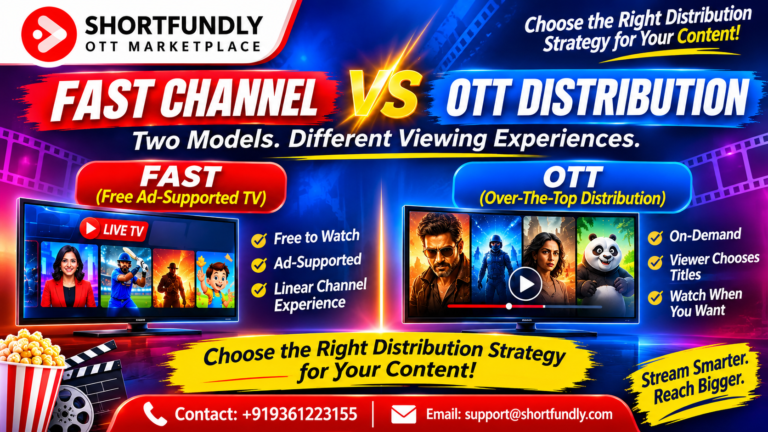
11. What is the difference between FAST content preparation and OTT content preparation?
Both require video masters, metadata, artwork, rights clearance, audio, subtitles, and technical quality control. FAST distribution may also involve additional channel-oriented requirements such as programming schedules, content rotation, channel branding, and linear delivery workflows.
OTT on-demand distribution generally focuses on individual titles within a catalogue, while FAST channel preparation may support continuous scheduled programming.
12. How can we submit content to a FAST distributor?
We should prepare a catalogue spreadsheet, content synopsis, genre and language information, rights details, technical specifications, artwork, video masters, and other assets required by the partner.
Before submitting, we should review the distributor’s submission process, confirm content eligibility, and understand the commercial and technical requirements.
Also read: https://blog.shortfundly.com/ott/fast-channel-ott-distribution/
Conclusion: Prepare Content Professionally for FAST Distribution
Preparing content for FAST distribution is a structured process that combines rights management, video mastering, audio quality, metadata, subtitles, artwork, programming organization, and technical quality control.
When we organize these elements properly, we make it easier for distributors and channel operators to evaluate our content, understand its potential, and process the materials required for distribution. A well-prepared catalogue can also reduce delivery delays, improve operational efficiency, and support future licensing opportunities.
The most effective approach is to begin with a complete library audit, verify rights, prepare high-quality masters, develop accurate metadata, create professional artwork, localize where appropriate, and complete quality control before submission. We should also maintain a centralized asset-management system and update our catalogue whenever rights or technical materials change.
For filmmakers, production companies, studios, and content owners, content preparation is a foundational part of the FAST distribution journey. By investing in organized, professional, and distribution-ready assets, we can position our film and television libraries for more structured distribution opportunities across the evolving streaming ecosystem.
Content owners exploring distribution services can visit Shortfundly Distribution to review its current offering and determine whether it aligns with their content catalogue and distribution objectives. We should confirm FAST-specific services, platform and territory availability, eligibility, technical requirements, fees, revenue arrangements, and rights terms directly.
A carefully prepared content library creates a stronger starting point for distribution conversations, helps streamline delivery, and allows us to approach potential opportunities with greater clarity and confidence.