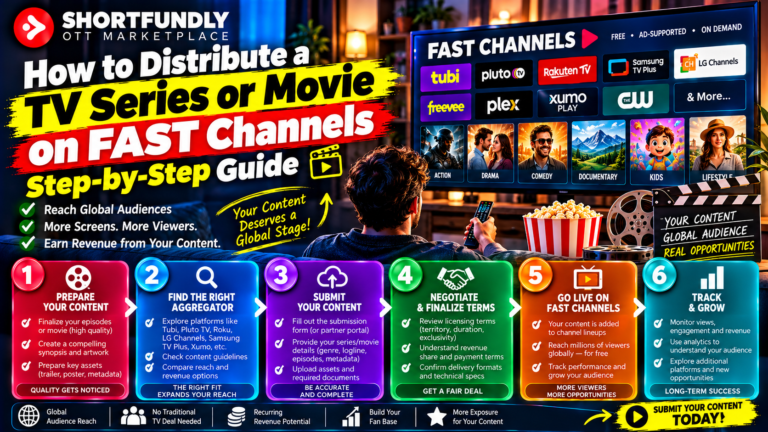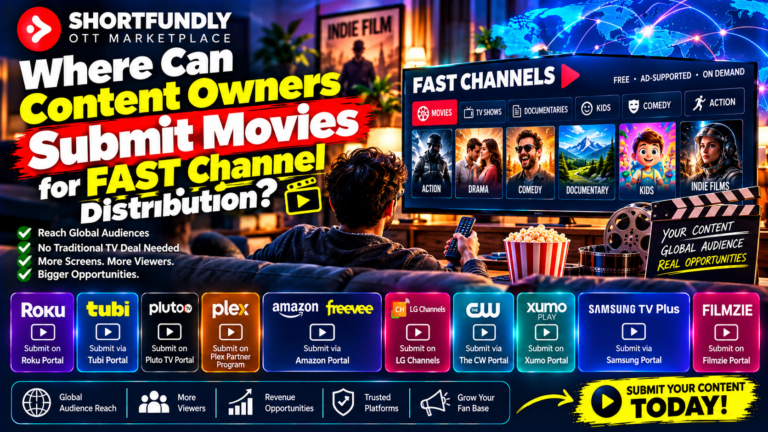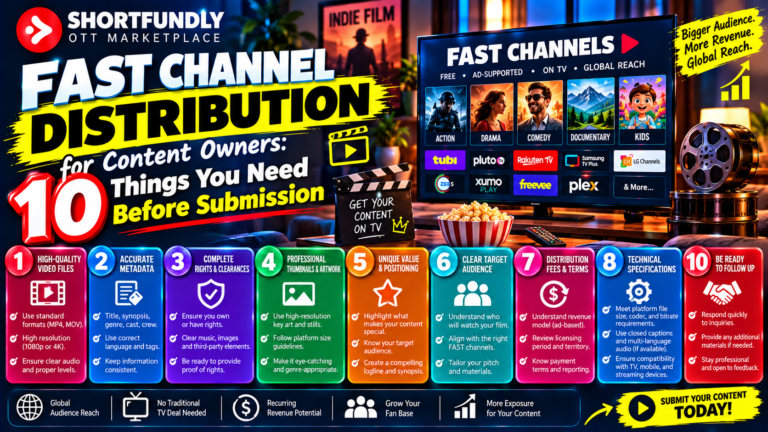
Table of Contents
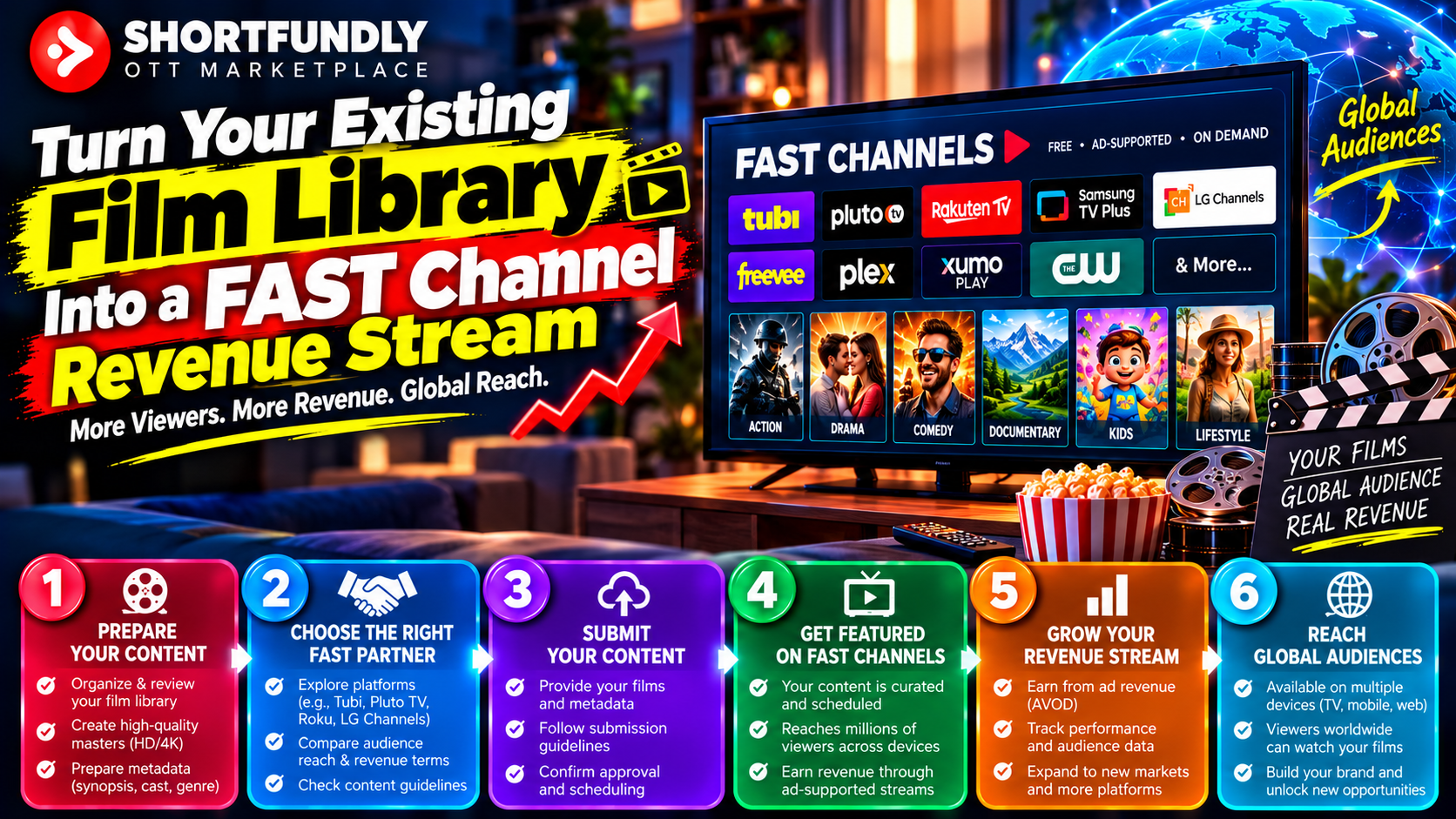
If you own a collection of feature films, short films, documentaries, television movies, or completed web series, you may already have a valuable distribution asset. The challenge is finding new ways to monetize that content after its initial release. One opportunity worth exploring is FAST channel distribution.
FAST stands for Free Ad-Supported Streaming Television. These services allow viewers to watch scheduled television-style programming without paying a traditional subscription fee. Instead, advertising helps support the service and may create revenue opportunities for content owners under suitable licensing or distribution agreements.
For filmmakers, production companies, and independent studios, FAST can provide another route to reach audiences and potentially generate income from existing titles. Rather than allowing completed films to remain inactive in a catalogue, rights holders can evaluate whether those titles fit a FAST channel, a curated programming package, or another streaming distribution opportunity.
However, turning a film library into a revenue stream requires more than uploading videos. You need clear rights, quality masters, accurate metadata, a suitable distribution partner, and a realistic monetization strategy.
This guide explains how to prepare your film library, explore FAST channel opportunities, and build a practical plan for long-term content monetization.
What Is FAST Channel Distribution?
FAST channels are streaming television channels that offer programming free to viewers and are generally funded through advertising. Unlike conventional video-on-demand services, where viewers select individual titles, FAST channels often operate on scheduled programming streams.
For example, a distributor might create a channel dedicated to independent cinema, classic films, regional-language movies, documentaries, action films, or family entertainment.
A content owner can potentially license eligible titles to a channel operator or work with a distribution partner that helps deliver content to suitable platforms. The exact arrangement depends on the partner, catalogue, rights, territories, and commercial agreement.
FAST vs. Other Film Distribution Models
| Distribution model | How viewers watch | Potential monetization |
|---|---|---|
| FAST | Free, scheduled, ad-supported programming | Advertising-related revenue under the applicable agreement |
| AVOD | Free video-on-demand titles supported by ads | Advertising revenue or revenue sharing |
| SVOD | Content included with a paid subscription | Licensing fees or subscription-related revenue arrangements |
| TVOD | Viewers pay to rent or purchase a title | Rental or purchase revenue sharing |
| Traditional television licensing | A broadcaster licenses content for a defined use | Negotiated license fees or other contract terms |
These models can complement one another when the rights agreements permit it. A film that has completed its initial theatrical or digital release may still have value in other windows, territories, or distribution formats.
Important: FAST distribution is not guaranteed simply because a film is available on an OTT platform. FAST placement requires a suitable channel or distribution opportunity and explicit rights covering the intended use.
Why Your Existing Film Library May Have Untapped Value
Producing a film requires significant creative effort, time, and money. Yet many films receive most of their attention during their initial launch and then become difficult to discover.
A well-managed film library can offer additional opportunities because the content has already been produced. You may not need to finance an entirely new production to explore another distribution window.
Here are several reasons to review your existing catalogue.
1. Extend the Commercial Life of Completed Films
A title does not necessarily lose all value after its first release. It may appeal to new audiences through curated channels, regional-language programming, genre-based collections, or international distribution.
FAST partners may be interested in films that complement their channel identity and help maintain a consistent programming schedule.
2. Package Multiple Titles Together
A single film may not meet a distributor’s volume requirements. However, a collection of films with a shared theme can be easier to present as a coherent catalogue.
For example, a producer with 30 independent thrillers could prepare a genre-focused package. A documentary producer might group films around history, travel, culture, or social issues.
A strong package helps a potential partner understand what the catalogue offers and how it could fit a programming strategy.
3. Explore New Audiences and Territories
A film originally released in one market may appeal to viewers elsewhere, especially when subtitles, dubbing, or localization are available.
International distribution depends on territorial rights, language support, platform availability, and local content requirements. Still, reviewing these possibilities can help you identify opportunities beyond the original release.
4. Build a More Diversified Distribution Strategy
Relying on one platform can limit your options. Where your agreements permit it, combining suitable distribution models may help you reach different audience segments.
For example, one title might be available through a transactional service while another licensing window supports ad-funded viewing. The rights, exclusivity, release dates, and platform rules must be checked before pursuing overlapping arrangements.
Step 1: Audit Your Existing Film Library
Before contacting distributors, understand exactly what you own and what you can offer.
Create a master catalogue containing every title you control or are authorized to represent. Include the film’s title, format, duration, genre, language, release year, production company, and current distribution status.
You should also record whether each title is a feature film, short film, documentary, telefilm, or episode of a series.
Film Library Audit Checklist
- List every completed title.
- Record runtime, genre, language, and release year.
- Identify the intended audience for each title.
- Confirm who owns the underlying intellectual property.
- Check existing streaming, television, and distribution agreements.
- Record available territories and permitted distribution formats.
- Identify titles with subtitles, dubbing, and alternate versions.
- Note which masters and promotional assets are available.
- Flag titles that require technical or legal updates.
This audit helps you distinguish content that is ready for submission from content that needs further preparation.
Step 2: Confirm Your Rights Before Pursuing FAST Distribution
Rights clearance is one of the most important parts of film monetization. Owning a physical copy of a film or having produced it does not automatically mean you hold every right needed for every distribution format.
Review the agreements associated with each title. Depending on the project, you may need to check rights covering the screenplay, underlying work, music, performances, archival footage, artwork, and other third-party materials.
Pay particular attention to existing agreements. A distributor, broadcaster, streaming service, or sales agent may already hold exclusive rights for a specific territory, language, period, or media format.
Rights Questions to Ask
| Question | Why it matters |
|---|---|
| Do I control the distribution rights? | You need authorization to license or distribute the title. |
| Are FAST rights included or available? | General streaming rights may not explicitly cover FAST. |
| Which territories are available? | A title may be cleared in some markets but restricted in others. |
| Is the agreement exclusive? | Existing exclusivity can prevent competing distribution deals. |
| Are music and footage rights cleared? | Unresolved third-party rights may block a release. |
| How long can the content be licensed? | The available term affects commercial planning. |
If a contract uses broad language such as “digital rights” or “streaming rights,” do not assume it automatically covers every FAST service. Ask for clarification and obtain professional legal advice where appropriate.
Step 3: Prepare Broadcast-Quality Content Masters
A distributor needs content that meets its technical and operational requirements. A film with an engaging story can still face delivery delays if its files are incomplete, damaged, poorly mastered, or inconsistent with the partner’s specifications.
Organize your available masters and check their quality before submission.
Common preparation tasks include:
- Providing a high-quality video master in the requested format.
- Checking image quality, aspect ratio, frame rate, and playback consistency.
- Ensuring dialogue is clear and audio levels are appropriate.
- Reviewing the film for technical errors, missing frames, or unwanted black sections.
- Preparing clean versions or alternate edits when required and legally permitted.
- Maintaining separate, clearly labeled files for different versions.
- Keeping backup copies of approved masters and delivery assets.
Do not assume every FAST distributor accepts the same resolution, codec, audio configuration, or delivery package. Request the technical specification sheet before performing expensive conversion or remastering work.
Step 4: Improve Metadata and Discoverability
Metadata helps distribution partners understand, classify, and present your content. It can also support search, scheduling, catalogue management, and audience discovery.
For every title, prepare a consistent metadata record.
Essential film metadata includes:
- Official title and alternate titles.
- Synopsis and extended description.
- Genre and subgenre.
- Runtime and original release year.
- Original language and available subtitle languages.
- Cast, director, producer, and production company.
- Age rating and relevant content advisories.
- Country of production and available territories.
- Rights availability and permitted distribution formats.
Descriptions should explain the premise clearly without misleading viewers or revealing unnecessary plot details. Avoid keyword stuffing, inaccurate genre labels, or exaggerated claims.
Consistent metadata also makes it easier to manage a large library. When several partners request similar information, you can deliver it from a central catalogue rather than rebuilding the package every time.
Step 5: Create Professional Artwork and Promotional Materials
A content library should be easy for distributors to evaluate visually. Strong artwork helps identify the genre, tone, and positioning of each title.
Prepare original key art, posters, thumbnails, and other materials requested by your prospective partner. Keep editable source files and high-resolution versions wherever possible.
Artwork should accurately represent the content and comply with the platform’s requirements. Check for readable typography, correct title spelling, suitable image quality, and any required credit information.
You may also prepare trailers, short promotional clips, stills, and cast or director biographies if requested.
Do not assume one poster size will work for every destination. A platform may require specific dimensions, aspect ratios, file types, or separate artwork for different languages.
Step 6: Find the Right FAST Distribution Route
Not every content owner needs to build and operate a FAST channel. There are several possible routes, depending on the size of your library, available budget, operational capacity, and rights.
Route A: License Titles to an Existing FAST Channel
A channel operator may license individual films or a package of titles for a defined period and territory.
This approach can suit rights holders who want to focus on producing content rather than running a channel. The operator’s requirements and commercial terms will determine whether the opportunity is appropriate.
Route B: Work With a FAST Aggregator
An aggregator may help package, validate, and deliver content to supported platforms. Services vary, but can include metadata preparation, technical delivery, rights documentation, platform submission, and reporting.
Ask which platforms the aggregator currently serves, whether it accepts your type of library, and whether it has experience with the territories and genres you are targeting.
Route C: Partner With a Channel Operator
Some operators seek content libraries to support a particular programming concept. Your catalogue may be relevant if it fills a genre, language, or audience gap.
If you want to create a dedicated channel, ask about programming requirements, channel operations, advertising arrangements, technical infrastructure, and who will handle platform relationships.
Route D: Explore Broader OTT Distribution
OTT distribution may be useful if your goal is to make eligible films available through streaming partners, even when a specific FAST opportunity has not been secured.
For example, Shortfundly Distribution offers a submission route for eligible short films, movies, web series, documentaries, and other supported content types. Its public information describes a process involving submission, review, applicable agreement and payment steps, release assets after approval, and distribution through currently available partners.
This may be an option to evaluate for your existing catalogue, depending on eligibility and commercial terms. However, OTT distribution does not automatically mean FAST channel placement. If FAST is your specific objective, confirm whether FAST rights and distribution opportunities are explicitly available for your titles.
Step 7: Build a Catalogue Pitch That Buyers Can Evaluate Quickly
A distributor is more likely to assess your library efficiently when you present it in a structured, professional format.
Create a concise catalogue pitch that explains what you own, why the content may suit the target audience, and what rights are available.
Include:
- A short catalogue overview: State how many titles you have and which genres, languages, and formats they cover.
- A title list: Provide runtime, year, language, genre, and a short synopsis for each film.
- Rights availability: Specify the territories, media rights, and licensing periods you can offer, subject to contract.
- Technical readiness: Explain which masters, subtitles, audio tracks, and artwork are available.
- Audience fit: Describe the themes or viewer groups that connect the titles.
- Viewing samples: Provide authorized screeners or secure preview links when requested.
- Contact information: Identify the person who can discuss rights and commercial terms.
Avoid sending enormous attachments or unrequested full-resolution files. Start with a clear catalogue sheet and follow the partner’s submission process.
Step 8: Understand the Revenue Model Before Signing
FAST monetization can involve several commercial structures. The right arrangement depends on the content, platform, distributor, audience, and contract.
Potential models include a licensing fee, revenue sharing linked to advertising or platform receipts, a minimum guarantee in suitable deals, or a broader catalogue licensing arrangement. Some agreements may combine more than one approach.
Do not assume that every FAST service pays per view or that every distributor offers the same revenue share.
Commercial Terms to Compare
| Contract term | What to confirm |
|---|---|
| Revenue calculation | Is payment based on gross receipts, net receipts, or another defined basis? |
| Distribution fee | Are there setup, delivery, or ongoing service charges? |
| Reporting | How often will viewing and revenue reports be provided? |
| Payment schedule | When are payments calculated and paid? |
| Deductions | Which taxes, fees, expenses, or adjustments may apply? |
| Exclusivity | Can you license the title to other services during the agreement? |
| Term and renewal | How long does the deal last, and how can it be renewed or ended? |
| Audit and records | What information can you request to verify statements? |
| Rights reversion | What happens to the rights when the agreement expires? |
Read the complete agreement, including definitions, schedules, and any platform-specific terms. A large audience claim is not a substitute for transparent reporting and clearly defined payment obligations.
Step 9: Localize Your Library for Additional Markets
Localization can make a catalogue accessible to viewers who do not speak the original language. Depending on the title and target territory, useful assets may include subtitles, dubbed audio, translated synopses, localized artwork, and accurate language metadata.
Prioritize localization based on the potential audience and the cost of preparing each version. You do not necessarily need to translate every title into every language before approaching a distributor.
Ensure subtitles are professionally reviewed and synchronized. Dubbing should preserve the meaning and tone of the original performance. Confirm that the necessary rights cover each version and that the distribution partner accepts the relevant language assets.
Step 10: Track Results and Improve Your Strategy
Submitting your library is only the beginning. Over time, evaluate which distribution routes are producing useful results and which titles attract interest.
Depending on the partner and reporting available, review metrics such as:
- Titles accepted and rejected.
- Territory and platform availability.
- Viewing hours or completed streams, where reported.
- Advertising or licensing revenue reported under the agreement.
- Delivery costs and other permitted deductions.
- Payment timing and outstanding balances.
- Performance differences across genres, languages, and territories.
FAST reporting may not provide every metric you want, so clarify reporting capabilities before signing. Keep your own records of submissions, agreements, delivery dates, versions, and payment statements.
Use the information to refine your catalogue pitch, prioritize technical improvements, and decide which titles to offer next.
Common Mistakes to Avoid
Content owners can lose time and money by treating distribution as a simple upload process. Avoid these common problems:
- Assuming every film qualifies for FAST: Channel operators have specific programming and technical needs.
- Confusing OTT with FAST: A VOD release does not establish a FAST placement.
- Ignoring rights restrictions: Existing exclusivity or uncleared music can delay or prevent distribution.
- Sending incomplete materials: Missing metadata, artwork, or masters creates extra work.
- Accepting unclear financial terms: Understand how revenue is calculated and when payment is due.
- Overlooking localization: Language and territory requirements may affect the catalogue’s suitability.
- Paying for unnecessary preparation: Get the technical specifications before commissioning conversions or new assets.
- Failing to track agreements: Record terms, renewal dates, territories, and rights granted for every title.
A disciplined process helps you evaluate opportunities without making unrealistic assumptions about acceptance, audience reach, or earnings.
Your Film Library Monetization Checklist
Use this checklist before contacting a distribution partner.
- Catalogue inventory completed.
- Ownership and distribution rights verified.
- FAST rights confirmed as available where applicable.
- Existing exclusivity and territory restrictions reviewed.
- Masters checked against technical requirements.
- Metadata and artwork prepared.
- Subtitles and dubbed versions documented.
- Catalogue pitch and authorized screeners ready.
- Potential distributors and channel operators researched.
- Fees, revenue model, reporting, and payment terms reviewed.
- Contract term, renewal, termination, and rights reversion understood.
- Submission and performance tracking process established.
Frequently Asked Questions
1. Can I earn money from films that were released years ago?
Potentially. Older films may still be suitable for licensing or other distribution opportunities if the rights are available and the content fits the partner’s needs. Earnings are not guaranteed.
2. Do I need hundreds of films to work with a FAST distributor?
Not always. Requirements differ by partner and opportunity. Some may consider individual titles or small packages, while others prioritize larger libraries that can support ongoing programming.
3. Does a FAST channel pay for every film it accepts?
Not necessarily. Compensation depends on the agreement. It may involve a licensing fee, revenue sharing, a minimum guarantee, or another commercial structure.
4. Can I distribute the same film through OTT and FAST services?
Possibly, if your agreements permit it. Review exclusivity, media rights, territories, release windows, and term restrictions before entering another deal.
5. Do my films need subtitles?
Requirements vary. Subtitles may be mandatory for some deliveries and optional for others. They can also make a film accessible to additional language audiences.
6. Can Shortfundly Distribution help monetize my existing film library?
Shortfundly Distribution accepts submissions for eligible content types through its OTT distribution workflow. Review the current eligibility criteria, fees, agreement terms, and partner availability before submitting. Ask specifically about FAST opportunities if your main objective is FAST channel placement.
7. Does Shortfundly guarantee placement on FAST channels?
You should not assume that it does. Its public information describes OTT distribution through currently available partners, subject to eligibility, review, licensing, and availability. Confirm FAST-specific placement and rights directly before making a decision.
8. What is the first step toward FAST distribution?
Start with a catalogue audit and rights review. Once you know what you can legally offer and which files are ready, you can approach suitable channel operators, aggregators, and distribution partners.
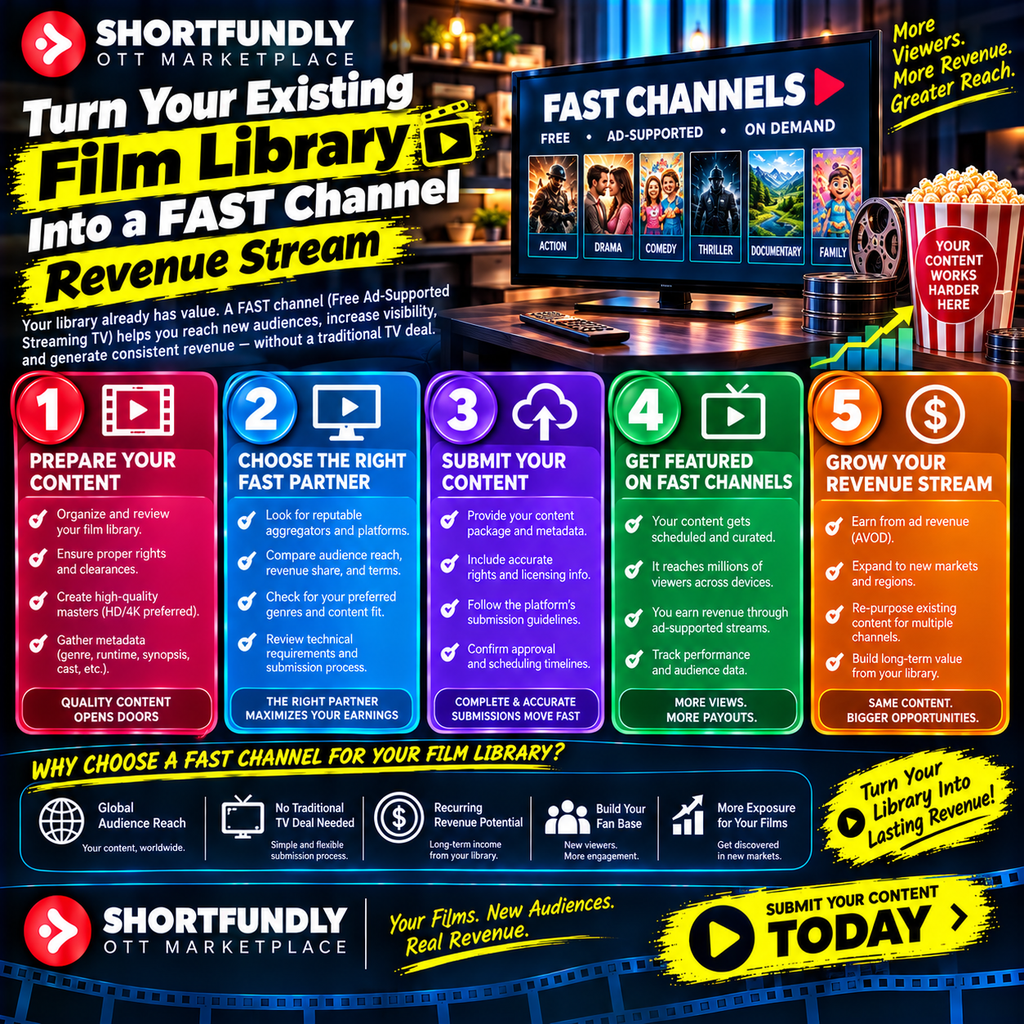
Turn Your Existing Film Library Into a FAST Channel Revenue Stream
Do you have a collection of movies, short films, documentaries, or web series waiting for new distribution opportunities? A FAST Channel can offer content owners another way to reach audiences and explore potential revenue from existing film libraries.
FAST stands for Free Ad-Supported Streaming Television. These channels allow viewers to watch content for free while advertising supports the service. For filmmakers, producers, and studios, FAST Channel distribution may create opportunities to extend the commercial life of completed films, reach new viewers, and explore additional licensing arrangements.
To prepare your film library, start by organizing your titles, verifying distribution rights, preparing high-quality video masters, and creating accurate metadata and promotional artwork. Next, research FAST channel operators and aggregators that accept content matching your genres, languages, and available territories.
You can also explore broader OTT distribution options through Shortfundly Distribution, which provides a submission process for eligible film and video content. Review its current requirements and partner availability, and confirm whether any specific FAST Channel placement is available. OTT distribution does not automatically guarantee FAST Channel distribution.
With the right preparation, clear licensing terms, and a suitable distribution partner, your existing film library may have further opportunities to reach audiences and generate revenue.
Also read: https://blog.shortfundly.com/ott/choose-fast-channel-aggregator/
Conclusion: Give Your Existing Films Another Distribution Opportunity
Your film library represents creative work, production investment, and stories that may still find new audiences. FAST channel distribution can be one route to explore for extending the commercial life of suitable titles, particularly when your catalogue aligns with a channel’s genre, language, and programming needs.
Start by organizing your catalogue, confirming your rights, preparing professional masters, and building accurate metadata. Then research distributors, compare commercial agreements, and track the results of each submission.
If you are also exploring broader OTT distribution, Shortfundly Distribution is one option to review for eligible content. Check the current submission requirements and available partners, and confirm any FAST-specific opportunity rather than assuming it is included.
A sustainable strategy focuses on clear rights, realistic financial expectations, strong delivery materials, and distribution partners whose capabilities match your goals. With careful preparation, your existing library can become a more active part of your long-term content business.