Table of Contents
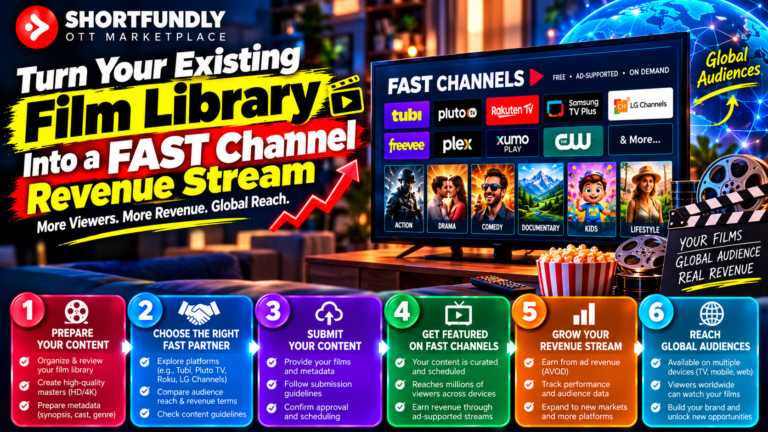
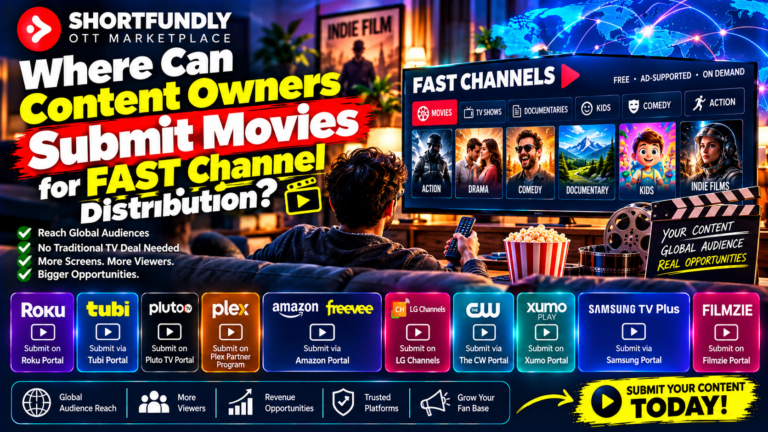
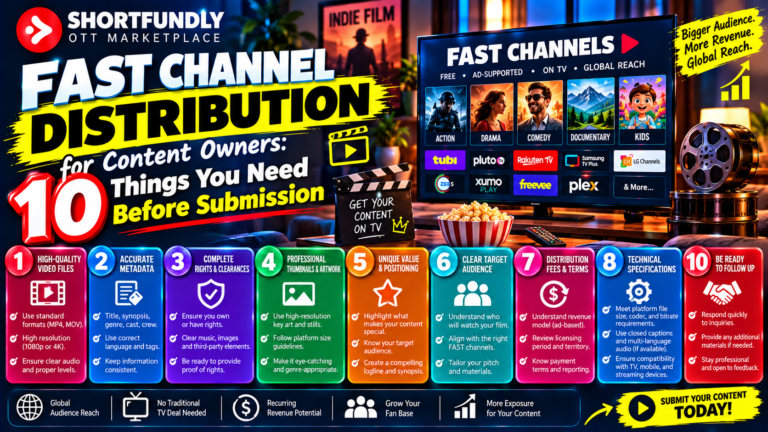
The rise of Free Ad-Supported Streaming TV (FAST) has created new opportunities for filmmakers, production companies, television studios, and independent content owners. Instead of relying only on traditional television networks or subscription-based streaming platforms, content owners can explore ways to reach viewers through free, advertising-supported streaming channels.
However, getting content onto FAST platforms can be challenging. You need to identify suitable distribution partners, prepare your media assets, confirm your licensing rights, meet technical requirements, and understand how revenue will be generated.
This is where FAST channel aggregators can help. The right aggregator may simplify delivery, connect your content with distribution opportunities, and support technical or operational tasks. But not every aggregator offers the same services, platform access, commercial terms, or level of support.
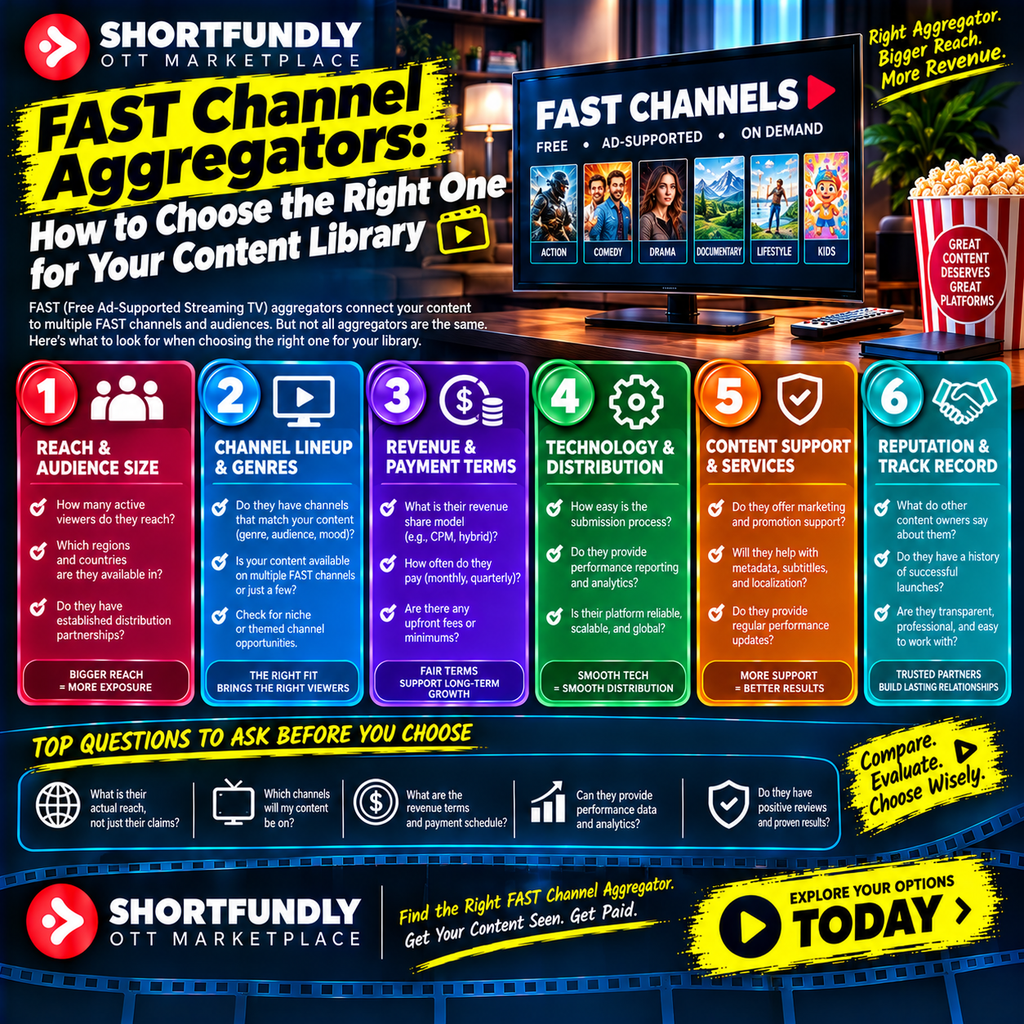
In this guide, you will learn how FAST channel aggregators work, what to look for when comparing providers, which questions to ask before signing an agreement, and how to prepare your content library for distribution.
1. What Is a FAST Channel Aggregator?
A FAST channel aggregator is a company or service that helps organize, package, deliver, or distribute streaming content to FAST platforms and other digital television services.
Depending on its business model, an aggregator may work with individual films, television episodes, complete content libraries, or fully developed linear channels. Some providers focus mainly on technical delivery, while others may also offer channel operations, advertising technology, platform relationships, reporting, and monetization support.
FAST channels are different from traditional video-on-demand services. On a FAST channel, viewers generally watch a scheduled stream of programming, similar to a television channel, without paying a subscription fee. Advertising helps fund the service.
What Services Can an Aggregator Provide?
A FAST channel aggregator may offer:
- Content packaging: Organizing movies, episodes, and other programming into a distribution-ready catalogue.
- Technical delivery: Preparing files, validating media assets, and delivering them in the required formats.
- Metadata management: Supplying titles, descriptions, genres, cast details, languages, and other information.
- Platform distribution: Submitting or delivering content to supported FAST services.
- Channel operations: Supporting playout, scheduling, electronic program guides, or other operational requirements.
- Advertising support: Helping manage ad insertion or advertising-related workflows.
- Performance reporting: Providing available audience, delivery, or revenue reports.
Not every aggregator provides every service. Before choosing a provider, identify exactly which parts of the distribution process you need help with.
2. Why Do Content Owners Need FAST Channel Aggregators?
Distributing a content library across streaming services can involve several different technical, legal, and commercial processes. Managing each relationship independently may require considerable time, especially for smaller studios and independent producers.
A suitable aggregator can reduce some of that workload by offering a central distribution workflow.
For example, a production company with 40 independent films might need to prepare technical files, create metadata, verify territory rights, and approach several potential distribution partners. An aggregator that supports those tasks could make the process more manageable.
The benefits depend on the provider and the agreement.
Key Benefits to Consider
Wider distribution opportunities: An aggregator with relevant platform relationships may help introduce eligible content to multiple services.
Simplified delivery: Technical guidance and centralized workflows can reduce repeated preparation work.
Better catalogue organization: Standardized metadata and asset management make a library easier to evaluate.
Potential monetization support: Some providers offer advertising technology, licensing arrangements, or revenue reporting.
Operational assistance: Providers that manage channel infrastructure may help content owners who do not have their own technical team.
Remember that working with an aggregator does not guarantee acceptance, placement, viewership, or earnings. Each platform has its own requirements and programming decisions.
3. Understand the Different Types of FAST Distribution Partners
Before comparing providers, understand what kind of company you are evaluating. The term “aggregator” is sometimes used broadly, even though companies may perform very different roles.
| Partner type | Primary role | Best suited for |
|---|---|---|
| Content aggregator | Packages and delivers eligible content to distribution partners | Rights holders with films or television programmes |
| FAST channel distributor | Helps distribute an existing channel to supported platforms | Channel owners seeking additional reach |
| Channel operator | Manages programming, playout, and potentially advertising workflows | Businesses operating a linear channel |
| Technology provider | Supplies infrastructure such as encoding, scheduling, or ad insertion | Teams needing technical capabilities |
| OTT distribution service | Helps distribute supported content through available streaming partners | Creators seeking digital distribution options |
| Direct platform partner | Acquires or onboards content or channels directly | Rights holders who meet the platform’s requirements |
Some companies combine several of these functions. Others specialize in only one.
The key is to compare the services actually included in the proposed agreement, rather than relying on the provider’s label.
4. Start by Evaluating Your Content Library
The right aggregator depends partly on the type and size of your catalogue.
A company with hundreds of hours of regional films may need a different partner from a filmmaker with one feature-length movie. Similarly, a documentary library may be more suitable for certain niche channels than a mixed catalogue with unrelated genres.
Before contacting aggregators, prepare a clear inventory.
What Should Your Content Inventory Include?
Record the following details for every title:
- Title and release year
- Content type, such as film, series, documentary, or short film
- Genre and intended audience
- Original language and available subtitle languages
- Runtime or episode duration
- Video and audio master availability
- Rights ownership and available territories
- Existing platform agreements
- Previous releases or audience performance, where available
- Promotional assets and technical readiness
Individual Titles or a Full Catalogue?
Some distribution partners consider individual films, while others may prioritize larger libraries or complete channels.
A larger catalogue can offer more programming options, but volume alone does not make a library attractive. Content quality, audience fit, rights availability, language, genre, and commercial potential all matter.
Present your strongest titles clearly and explain how they fit together. A well-organized catalogue is easier to evaluate than a large collection with incomplete information.
5. Check the Aggregator’s Actual Platform Relationships
One of the most important questions is where the aggregator can realistically distribute your content.
A provider may have relationships with selected smart-TV platforms, streaming applications, channel operators, telecom services, or other digital distribution partners. However, those relationships do not automatically mean every title will be accepted by every platform.
Ask the aggregator to explain its current distribution network.
Questions to Ask
- Which FAST platforms or channel operators do you currently support?
- Do you distribute individual titles, complete libraries, or fully formed channels?
- Are new content owners eligible to submit?
- Which genres and languages are currently being considered?
- Can you identify the platforms that may be relevant to my catalogue?
- Are there territorial restrictions?
- Does your service include platform pitching, or only technical delivery?
- How will I know which platforms have accepted or rejected my content?
Look for specific, verifiable answers rather than broad promises of worldwide reach.
A provider may have a large technical network but limited editorial access to certain platforms. Another may offer fewer destinations but stronger support for a specific genre or region.
Choose based on relevant distribution opportunities, not just the number of platforms mentioned in a sales presentation.
6. Evaluate Technical Delivery and Quality Control
Technical readiness is essential for professional streaming distribution. A platform may reject or delay a title if the video, audio, captions, or supporting assets do not meet its delivery specifications.
A reliable aggregator should explain what it can handle and what you must supply.
Important Technical Requirements
Depending on the receiving platform, requirements may include:
- Video resolution and approved codecs
- Frame rate and aspect ratio
- Audio format, channel layout, and loudness
- Video and audio synchronization
- Caption and subtitle formats
- File naming and delivery structure
- Poster artwork and promotional images
- Trailers and preview clips
- Quality-control reports
There is no single technical specification that applies to every FAST service. Request the current requirements before exporting or delivering final masters.
Questions About Quality Control
Ask whether the aggregator provides technical validation, file conversion, subtitle checks, audio review, or delivery troubleshooting.
Also clarify whether these services are included in the quoted price or charged separately.
A provider that identifies technical problems early can help reduce unnecessary delivery delays. However, the content owner should retain quality-controlled master files and maintain a clear record of all delivered versions.
7. Compare Metadata and Catalogue Management Tools
Metadata is the information used to identify, describe, categorize, and organize your content.
Accurate metadata helps distribution partners understand what a title contains and whether it fits their audiences or programming plans. Missing or inconsistent information can slow down evaluation and delivery.
Your aggregator should explain how it collects, validates, updates, and distributes metadata.
Essential Metadata Fields
| Metadata field | Why it matters |
|---|---|
| Title | Identifies the content accurately |
| Synopsis | Explains the story or subject |
| Genre | Helps categorize the title |
| Runtime | Supports scheduling and catalogue records |
| Language | Identifies original and available languages |
| Release year | Provides contextual information |
| Cast and crew | Supports discovery and catalogue accuracy |
| Age rating | Communicates applicable audience guidance |
| Territory rights | Helps prevent unauthorized distribution |
| Artwork | Supports presentation and platform requirements |
| Subtitle availability | Shows localization options |
Ask whether you can update metadata after delivery and how corrections are handled across partner platforms.
If you manage hundreds of titles, also ask whether the aggregator supports bulk uploads, catalogue exports, version tracking, or a centralized dashboard.
8. Understand the Revenue Model Before Signing
A strong distribution relationship needs a clear commercial structure. Never assume all FAST aggregators pay content owners in the same way.
Depending on the arrangement, a deal may involve advertising revenue sharing, a licensing fee, a minimum guarantee, a service fee, or a combination of these structures.
The correct model depends on the agreement, the content, the rights being licensed, and the provider’s role.
Common Commercial Models
Revenue sharing: The parties divide eligible revenue according to an agreed formula.
Licensing fee: The rights holder receives a negotiated payment for specified rights.
Minimum guarantee: The agreement provides for a defined minimum payment, subject to its contractual conditions.
Service fee: The provider charges for technical delivery, channel operations, or other services.
Hybrid arrangement: The contract combines different payment structures.
Compare the Complete Financial Terms
Do not compare providers using only a headline revenue percentage. Review the full calculation.
Ask:
- What revenue is included?
- Are platform, advertising, delivery, or other costs deducted?
- How is the rights holder’s share calculated?
- How often are statements issued?
- What is the payment schedule?
- Is there a minimum payment threshold?
- Are there setup, delivery, localization, or maintenance fees?
- What happens if revenue is disputed?
- Can I audit relevant statements or supporting records?
Request the answers in writing. Revenue expectations should be based on transparent terms, not guaranteed-viewership claims or unsupported income projections.
9. Review Rights, Exclusivity, and Territory Restrictions
Your content library may include films, music, footage, performances, scripts, artwork, and other protected material. Before submitting anything, confirm that you have the legal authority to grant the rights required for distribution.
This is especially important if you acquired the content from another producer or already licensed it to a streaming platform.
Rights Questions to Resolve
Territories: Can the aggregator distribute the content worldwide, or only in selected countries?
Rights type: Does the agreement cover streaming, advertising-supported distribution, linear channels, video-on-demand, or other uses?
Exclusivity: Can you continue licensing the content to other services?
Term: How long will the agreement remain active?
Renewal: Does it renew automatically, or require written consent?
Termination: Under what circumstances can either party end the agreement?
Existing contracts: Could the proposed deal conflict with current licensing arrangements?
Rights reversion: What happens to your content and materials when the agreement expires?
Read the complete agreement, including schedules and attachments. If the contract grants broad or long-term rights, consider obtaining advice from a qualified entertainment lawyer.
10. Assess Localization and International Distribution Support
If your goal is to reach viewers in multiple markets, localization may help make your library more accessible.
Localization can include subtitles, captions, translated metadata, dubbing, artwork adjustments, and other language-specific assets.
However, adding a language does not automatically make a title eligible for every territory. You must also have the necessary rights and meet the receiving platform’s requirements.
What to Ask Your Aggregator
- Which subtitle and dubbing services are available?
- Can the provider coordinate translation and quality review?
- Are localized titles and descriptions supported?
- Who approves translated dialogue and marketing materials?
- What are the costs per title or language?
- Who owns the resulting subtitle and dubbing assets?
- Can the same localized version be used with other distributors?
Start by identifying the markets most relevant to your content. You do not need to localize every title into every language immediately.
A focused strategy may be more cost-effective than investing in localization without evidence of distribution demand.
11. Investigate Reporting, Analytics, and Transparency
Distribution is not complete when your content is delivered. You also need to understand what happens afterward.
Depending on the provider and platform, reporting may include delivery status, accepted titles, available territories, audience activity, advertising revenue, or payment statements.
The exact information available can vary significantly.
What Good Reporting Should Clarify
- Which titles were submitted and accepted
- Where content has been made available, when this information is disclosed
- Which territories are covered
- What performance metrics are available
- How often reports are updated
- How revenue is calculated
- What deductions appear in statements
- How errors or disputes are handled
Ask for a sample report before signing. This helps you understand the level of detail you can expect.
If the aggregator does not provide audience analytics, find out whether it supplies financial reporting or distribution-status updates. Be cautious of providers that promise detailed performance information without explaining where that data comes from.
12. Compare Customer Support and Operational Reliability
A low-cost provider may appear attractive at first, but poor communication can create problems during delivery, contract changes, or payment disputes.
Evaluate the support model before committing your entire library.
Ask whether you will have a dedicated account manager, a technical support contact, a ticketing system, or a self-service dashboard.
You should also understand the provider’s process for handling:
- Failed file deliveries
- Metadata corrections
- Subtitle or audio issues
- Platform rejection
- Rights disputes
- Content takedown requests
- Delayed financial statements
- Contract renewals and termination
If possible, request references or examples of comparable distribution projects. Confirm that any claimed platform relationships and service capabilities are relevant to your own content.
13. Compare FAST Channel Aggregators Using a Practical Scorecard
Once you have shortlisted several providers, use a consistent scorecard to compare them.
The following framework can help your team make a more objective decision.
| Evaluation criterion | Suggested weight |
|---|---|
| Relevant platform relationships | 20% |
| Commercial terms and transparency | 20% |
| Rights flexibility and contract terms | 15% |
| Technical delivery and quality control | 15% |
| Catalogue and metadata support | 10% |
| Reporting and analytics | 10% |
| Customer support | 5% |
| Localization capabilities | 5% |
| Total | 100% |
Score each provider from 1 to 5 for every criterion, then calculate a weighted result.
These weights are illustrative, not industry standards. Change them to reflect your goals. For example, a multilingual studio may assign more weight to localization, while a small independent producer may prioritize transparent fees and rights flexibility.
Use the Scorecard Correctly
Do not award high scores simply because a provider claims to offer a service. Give higher scores when capabilities are clearly documented, commercially suitable, and relevant to your catalogue.
Also record unanswered questions. A provider with a promising score but unclear licensing terms may be a greater risk than a provider with a slightly lower score and a more transparent contract.
14. Consider Shortfundly Distribution for Eligible OTT Content
Content owners exploring digital distribution can also evaluate OTT distribution services as part of their wider strategy.
Shortfundly Distribution is one option to consider for eligible content. Its submission portal provides a workflow for supported content types, with requirements and distribution options depending on the title and the currently available partners.
You can review the current process and requirements through the Shortfundly Distribution portal.
Before submitting, check the eligible content categories, pricing, licensing terms, technical requirements, and the steps involved in review and release preparation.
Is OTT Distribution the Same as FAST Channel Distribution?
No. Although both involve internet-delivered content, they are not interchangeable.
OTT distribution can include on-demand films, series, and other video content. FAST distribution generally involves free, advertising-supported linear channels where programming is scheduled.
An OTT distributor may provide a useful route for eligible content, but that does not automatically mean a title will be placed on a particular FAST channel.
If your main objective is FAST distribution, ask Shortfundly or any other provider to confirm whether the specific FAST service, channel, territory, and rights arrangement you need are currently supported.
Treat this as a distribution-fit assessment, not a guarantee of FAST placement.
15. Watch for Common Red Flags When Choosing an Aggregator
A professional provider should be able to explain its services, commercial terms, rights requirements, and distribution process clearly.
Be cautious if you encounter any of the following warning signs.
Guaranteed Placement Without Clear Conditions
No aggregator can responsibly guarantee that every platform will accept every title unless a specific contractual commitment clearly states what is guaranteed.
Ask whether the promise refers to technical delivery, submission, platform acceptance, or actual availability to viewers.
Vague Platform Claims
Statements such as “available worldwide” may not explain which platforms are involved or where your content will actually appear.
Request specific details that can be verified.
Unclear Revenue Calculations
If a provider cannot explain deductions, payment schedules, and revenue reporting, do not rely on headline percentages alone.
Broad Rights With Little Transparency
Review any agreement that grants extensive exclusivity or broad rights without clearly defining the term, territories, permitted uses, and termination process.
Hidden Fees
Ask for a complete list of setup, delivery, localization, storage, maintenance, and other charges.
No Clear Support Process
You should know whom to contact when a delivery fails, metadata is incorrect, or a payment statement needs clarification.
Taking time to investigate these issues can help you avoid costly misunderstandings.
16. Prepare Your Content Library Before Submission
A well-prepared library makes it easier for potential partners to evaluate your content and understand its distribution potential.
Use this checklist before approaching an aggregator.
- Confirm ownership and distribution rights for each title.
- Review existing agreements and territory restrictions.
- Create a complete catalogue spreadsheet.
- Prepare final video and audio masters.
- Check technical quality and synchronization.
- Prepare accurate titles, synopses, genres, and runtimes.
- Gather cast, crew, language, and release information.
- Prepare approved posters, stills, and trailers.
- Check caption and subtitle availability.
- Document available rights by territory and platform type.
- Identify your preferred distribution markets.
- Prepare a concise company and catalogue presentation.
- Compare pricing, revenue terms, and service inclusions.
- Review the contract before granting rights.
- Keep records of all submitted assets and agreements.
You do not necessarily need every asset for the initial conversation. However, preparing these materials early will help you respond faster when a provider requests them.
17. Build a Long-Term Distribution Strategy
Choosing an aggregator should be part of a broader content strategy, not a one-time transaction.
Start by defining your goals. Do you want to license individual films, distribute an entire library, launch a branded channel, reach specific international audiences, or reduce the technical workload involved in streaming delivery?
Your answers will help determine which provider is appropriate.
Match Your Strategy to Your Library
If you own a small number of films, prioritize partners that evaluate individual titles and offer clear submission requirements.
If you own a large catalogue, focus on bulk metadata management, territory control, catalogue reporting, and efficient delivery workflows.
If you already operate a FAST channel, look for partners that explicitly support channel distribution, playout, scheduling, or other capabilities you need.
If you are exploring digital distribution for the first time, an OTT distribution service may be worth considering for eligible titles, provided its services match your objectives.
Review Performance and Improve Over Time
After distribution begins, review available reports, payment statements, and partner feedback. Track which types of content are accepted, where rights are being used, and which commercial arrangements meet your goals.
Use that information to improve future submissions and identify better-fitting partners.
Avoid granting broad rights to every title simply to maximize the number of distribution agreements. Each deal should support your overall strategy and preserve the flexibility you need.
Frequently Asked Questions
1. What is the main purpose of a FAST channel aggregator?
A FAST channel aggregator helps content owners package, deliver, or distribute content to supported streaming platforms and channel operators. Depending on the provider, it may also offer metadata management, technical services, channel operations, advertising support, and reporting.
2. How do I choose the best FAST channel aggregator?
Compare the provider’s relevant platform relationships, content requirements, technical services, rights terms, commercial model, reporting, and support. Choose the provider whose capabilities match your catalogue and business goals rather than relying on promotional claims alone.
3. Do FAST channel aggregators accept individual movies?
Some providers consider individual films, while others prioritize large catalogues or fully developed channels. Ask each aggregator about its current submission policy, supported genres, minimum catalogue requirements, and acceptance process.
4. How do FAST aggregators make money?
Commercial models vary. Providers may charge service fees, share advertising revenue, negotiate licensing arrangements, or combine several models. Read the contract to understand how revenue is calculated and what costs are deducted.
5. Do I need to own the content to submit it?
You need sufficient legal authority to submit and license the rights requested. If you are a producer, distributor, or representative rather than the copyright owner, make sure your agreements authorize the proposed distribution.
6. Can one aggregator distribute content to multiple FAST platforms?
Some aggregators offer access to multiple platforms, but coverage depends on their current relationships, the content, and the agreement. Ask which destinations are supported and whether distribution to each platform requires separate approval.
7. Does OTT distribution guarantee FAST channel placement?
No. OTT distribution does not automatically include FAST distribution or guarantee placement on a specific channel. Confirm the exact service, territory, licensing arrangement, and platform availability before proceeding.
8. Can Shortfundly Distribution help content owners?
Shortfundly Distribution provides a submission workflow for eligible content through its OTT distribution process. Content owners should review the current eligibility requirements, fees, agreement terms, and available partners. Those services should not be treated as a guarantee of FAST channel placement.
9. What rights should I review before signing a distribution deal?
Review the licensed uses, territories, term, exclusivity, revenue model, sublicensing permissions, reporting obligations, termination conditions, and rights reversion. Check existing agreements for conflicts and seek legal advice when needed.
10. How long does FAST distribution take?
There is no universal timeline. The process can depend on rights verification, content review, technical delivery, platform onboarding, scheduling, and approval. Ask the aggregator for a realistic estimate for your specific content and target platforms.
Also read: https://blog.shortfundly.com/ott/fast-channel-distribution/
Conclusion
Choosing the right FAST channel aggregator requires more than comparing provider names or counting the platforms they claim to reach. You need a partner whose services, rights terms, technical capabilities, commercial structure, and reporting fit your content library.
Start by auditing your catalogue, confirming your rights, preparing accurate metadata, and identifying your target audiences. Then compare potential partners using a consistent scorecard and review every agreement carefully.
For content owners exploring digital distribution, Shortfundly Distribution is one option to evaluate for eligible OTT content. Review its current requirements and confirm whether the specific distribution route you need is supported.
Most importantly, focus on verified capabilities, transparent agreements, and a distribution strategy that protects the long-term value of your content library.