Table of Contents
Independent filmmakers, production companies, film studios, and content owners are continually looking for new ways to distribute their movies and reach streaming audiences. One opportunity worth exploring is FAST channel distribution, a model that allows viewers to watch free, ad-supported streaming television through smart TVs, connected devices, and streaming applications.
FAST stands for Free Ad-Supported Streaming Television. Unlike subscription-based streaming services, FAST services generally provide programming without requiring viewers to pay a recurring subscription fee. Advertising supports the business model, while content owners may earn revenue through licensing agreements or other commercial arrangements.
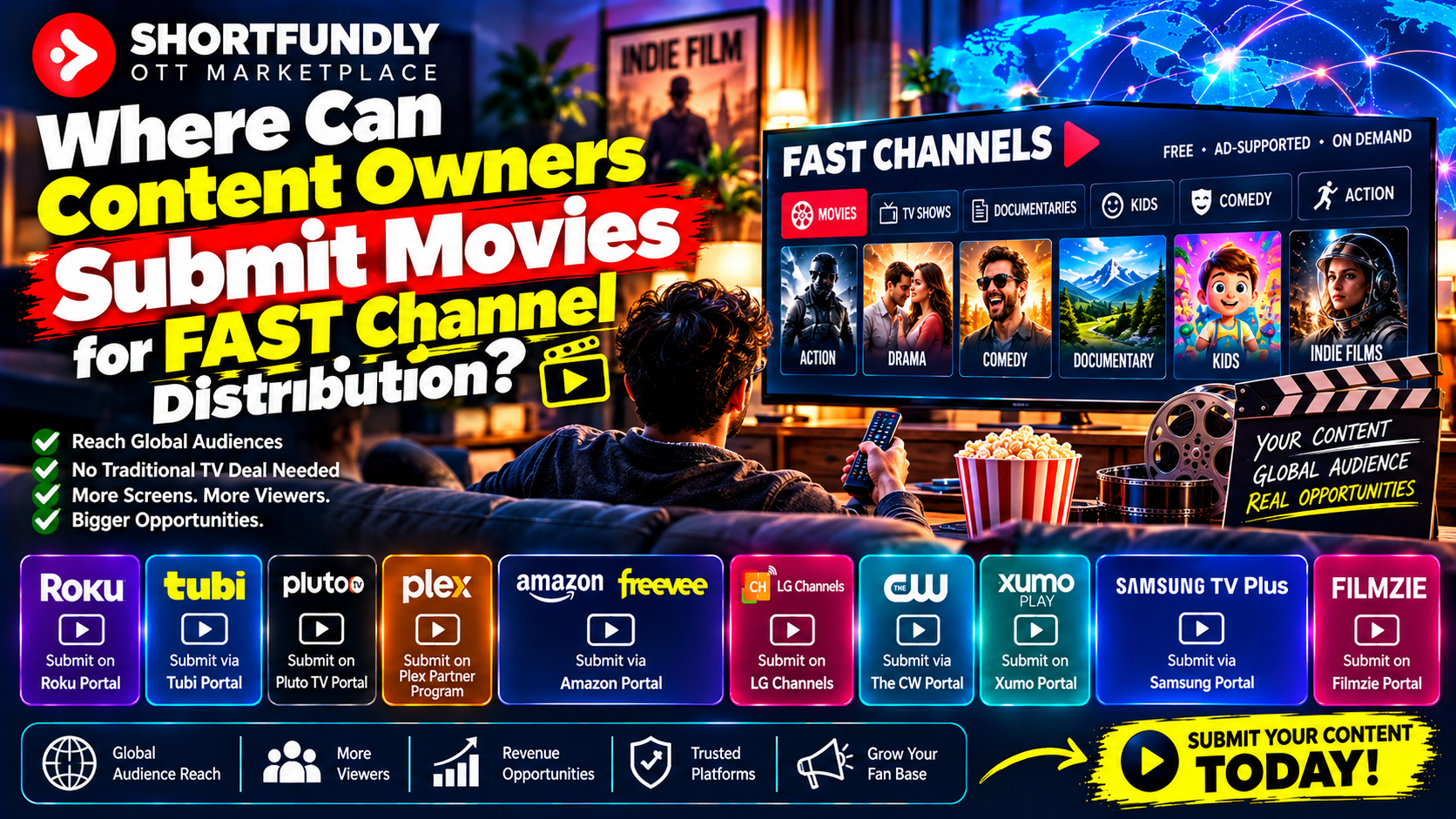
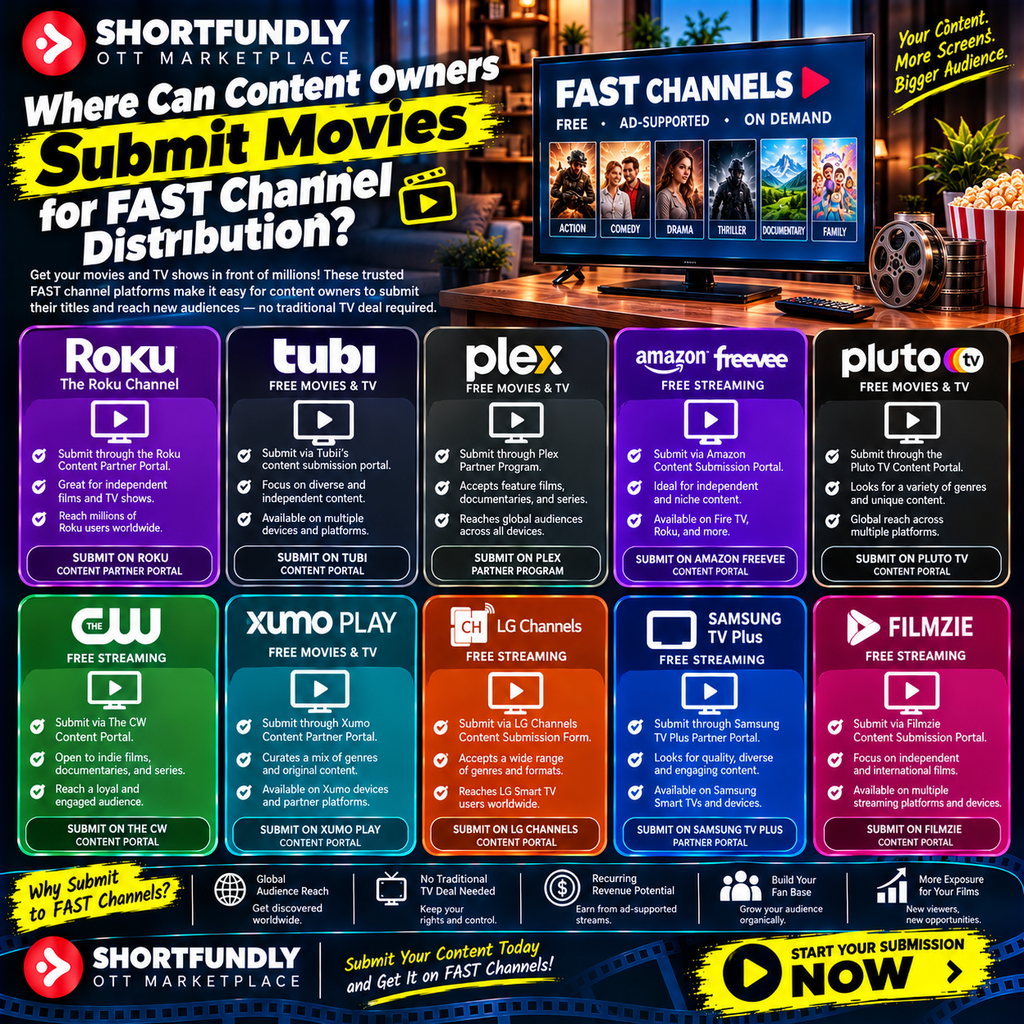
But an important question remains: Where can content owners submit movies for FAST channel distribution?
The answer depends on the type of content you own, your distribution rights, your target territories, and whether you want to license individual movies, distribute an entire catalogue, or launch a dedicated streaming channel.
In this guide, we explore the main places to submit movies for FAST distribution, how content aggregators and distribution partners work, what you need before applying, and how services such as Shortfundly Distribution can fit into a broader OTT distribution strategy.
What Is FAST Channel Distribution for Content Owners?
FAST channel distribution is the process of licensing or delivering movies, television programs, documentaries, and other video content to free, advertising-supported streaming television services.
Many FAST platforms provide scheduled programming similar to traditional television. Their channels may focus on specific genres, languages, audiences, or entertainment categories.
For example, a FAST service might feature classic movies, independent cinema, documentaries, regional-language entertainment, action films, or reality programming.
Content owners may participate in this ecosystem through several routes:
- Licensing an individual movie to a suitable channel or distributor
- Offering a catalogue of films to a content aggregator
- Partnering with a distributor that delivers content to connected-TV platforms
- Providing programming for an existing FAST channel
- Launching or operating a dedicated FAST channel through a suitable service provider
These options serve different needs. A filmmaker with one completed feature film may need a licensing partner, while a production company with hundreds of hours of programming may benefit from a catalogue-based distribution arrangement.
Important: Submitting a movie to an OTT distribution service does not automatically guarantee placement on a FAST channel. Always confirm which services the distributor supports and whether your particular title is eligible.
Where Can Content Owners Submit Movies for FAST Channel Distribution?
There are several places to start. The best choice depends on whether you own individual films, a larger content library, or a complete television channel.
1. FAST Channel Operators and Programming Teams
One possible route is to approach FAST channel operators directly.
These companies manage channels that deliver scheduled programming to viewers through connected TVs and streaming platforms. Some acquire licensed movies, while others work through aggregators, distributors, or established content suppliers.
To identify suitable operators, research channels that match your film’s genre, language, audience, and territory.
For example, a regional-language drama may be more relevant to a channel specializing in regional entertainment than to one focused exclusively on international documentaries.
Before sending your movie, investigate:
- Whether the channel accepts submissions from independent rights holders
- Whether it acquires individual films or prefers larger catalogues
- Which countries and platforms it serves
- Whether it requires exclusive or non-exclusive rights
- Which technical and promotional materials it needs
- Whether it offers licensing fees, revenue sharing, or another arrangement
Some channel operators do not accept unsolicited submissions. In that case, look for an approved aggregator or distribution partner rather than repeatedly contacting the programming team.
2. Content Aggregators
Content aggregators help organize, package, and deliver movies and television programs to digital platforms.
Depending on the company, their services may include technical quality control, metadata preparation, subtitle management, artwork delivery, rights administration, and platform delivery.
Aggregators can be useful when a content owner wants to reach multiple digital distribution outlets but does not have direct relationships with each platform.
However, aggregation does not guarantee that every submitted title will be accepted or placed on a FAST channel. Some aggregators focus on video-on-demand platforms, while others may offer access to selected television or FAST distribution partners.
When evaluating an aggregator, ask:
- Does the company currently support FAST distribution?
- Which channels or platforms can it deliver to?
- Does it accept individual movies or only catalogues?
- Which territories are available?
- What fees, commissions, or revenue-sharing terms apply?
- Who retains the rights to the content?
- How are reporting, payments, and takedown requests handled?
Choose a partner based on its actual distribution capabilities rather than a general promise of worldwide reach.
3. Dedicated FAST Channel Distribution Providers
Some companies specialize in helping channel owners, studios, and content businesses distribute or monetize television channels.
These providers may assist with channel delivery, platform onboarding, advertising technology, distribution planning, or connected-TV operations.
For example, SoFast has a channel-submission process that invites channel operators, studios, producers, and creators to present a channel for evaluation. Its process is relevant when the content owner is exploring distribution of a channel rather than simply submitting one standalone movie.
You can explore its published submission information here: SoFast channel distribution.
This distinction matters. A provider that evaluates entire channels may not accept an individual film for direct licensing.
If you own a substantial movie library, you could investigate whether creating a themed channel is commercially realistic. Before doing so, assess the volume of available content, programming costs, advertising opportunities, technical requirements, and expected operating expenses.
For a single movie, approaching an existing channel or a suitable content distributor may be the more practical first step.
4. OTT Distribution Services for Independent Filmmakers
Another route is to explore OTT distribution services that accept submissions from independent filmmakers and rights holders.
OTT stands for over-the-top distribution, which broadly refers to delivering video content over the internet rather than exclusively through traditional broadcast or cable systems.
Some OTT distribution services help eligible films reach their own streaming audiences or currently available distribution partners. This can be useful for independent creators who need a structured submission process.
However, OTT distribution and FAST distribution are not interchangeable. An OTT service may focus on video-on-demand releases instead of scheduled, advertising-supported television.
Before submitting, verify whether the provider supports:
- Individual movies and independent films
- Your particular language and genre
- The countries you want to target
- Third-party FAST channels, if required
- The licensing and revenue model you need
- Your preferred exclusivity arrangements
If the provider does not offer the FAST service you want, its OTT distribution option may still fit your wider release strategy, but it should not be treated as a guaranteed FAST placement.
5. Shortfundly Distribution
Shortfundly Distribution is an option content owners can explore when seeking an OTT distribution route for eligible movies and other supported content.
Shortfundly’s published distribution workflow allows creators to submit content details, review the applicable requirements, complete the relevant agreement and payment steps, and submit titles for review. Approved content may proceed through release preparation and distribution using the currently available partners and services.
Supported content categories listed in its distribution process include short films, movies, web series, documentaries, telefilms, pilot films, songs and video songs, micro dramas, and other content types available in the submission flow.
Content owners can review the submission process and available options through the official website:
Shortfundly Distribution: https://distribution.shortfundly.com/
How to approach Shortfundly Distribution
A practical starting process is to:
- Review the current content eligibility and submission requirements.
- Check the applicable fee for your content type and duration.
- Register or sign in and provide the requested content details.
- Review the applicable agreement and distribution terms.
- Complete the required submission steps.
- Wait for the content review and follow any additional instructions if approved.
- Track the submission and distribution status through the available account tools.
Before proceeding, confirm the current fees, technical specifications, licensing terms, and distribution partners.
If your main objective is FAST channel placement, specifically ask whether the relevant FAST service is currently available through the proposed arrangement. Shortfundly’s general OTT distribution process should not be assumed to guarantee placement on a particular FAST channel.
6. Digital Film Distributors and Sales Agents
Independent film distributors and sales agents may also be worth considering.
A film distributor may acquire or license content for defined territories, platforms, or release windows. A sales agent may represent a film to potential buyers and negotiate licensing opportunities on the rights holder’s behalf.
Some companies work across multiple distribution models, while others specialize in theatrical releases, television licensing, subscription streaming, or digital video-on-demand.
When approaching these companies, look for evidence that they work with your content category and have relationships relevant to your intended release.
Prepare a short pitch with:
- Film title and genre
- Logline and synopsis
- Runtime and language
- Release year
- Director and production details
- Available rights and territories
- Trailer or secure screener
- Technical delivery status
Ask whether the company actively licenses films to FAST channels or can introduce the title to partners that do.
Do not assume that every film sales agent handles FAST distribution simply because the company works in digital media.
7. Existing OTT Aggregator Networks for Google TV and Other Digital Platforms
Some established digital platforms provide information for film and television rights holders who want to make content available through their services.
For example, Google TV’s Movies and TV partner guidance explains how interested content owners can begin the process and identifies existing aggregators that can help deliver content. The guidance also makes clear that working with an existing aggregator is a preferred route for getting eligible content onto YouTube and Google TV.
You can review the official guidance here: Google TV and Movies and TV partner requirements.
This is an example of a digital distribution route, not confirmation that Google TV is a FAST channel or that a Google TV aggregator will place your movie on FAST services.
The lesson for content owners is to distinguish between the destination platform and the distributor’s actual delivery network. A partner may offer access to several digital outlets, but each outlet has its own requirements and selection process.
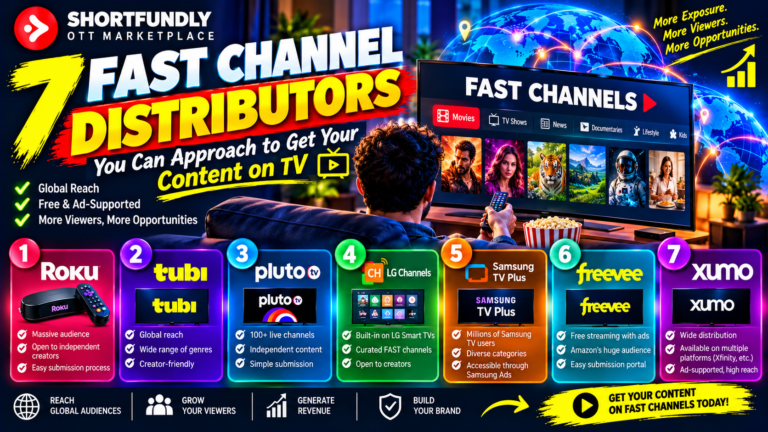
Comparison: Which Distribution Route Should You Choose?
The following table summarizes the main options and the types of content owners who may benefit from exploring them.
| Distribution route | Suitable for | What to confirm |
|---|---|---|
| FAST channel operators | Individual movies or catalogues that fit a channel’s programming | Submission policy, licensing terms, and content fit |
| Content aggregators | Rights holders seeking delivery to multiple digital platforms | Whether FAST delivery is included |
| FAST channel distribution providers | Owners planning to distribute an existing channel | Whether the provider handles channels or individual titles |
| OTT distribution services | Independent filmmakers seeking digital distribution | Available services, eligibility, and partner network |
| Shortfundly Distribution | Eligible films and other supported content seeking OTT distribution | Current fees, terms, partners, and FAST-specific availability |
| Film distributors and sales agents | Producers seeking licensing or sales representation | Territory coverage, commission, exclusivity, and FAST experience |
| Digital platform aggregators | Content owners targeting specific digital outlets | Supported platforms and delivery requirements |
There is no single route that is best for every film. The right choice depends on your rights, catalogue size, budget, audience, and release goals.
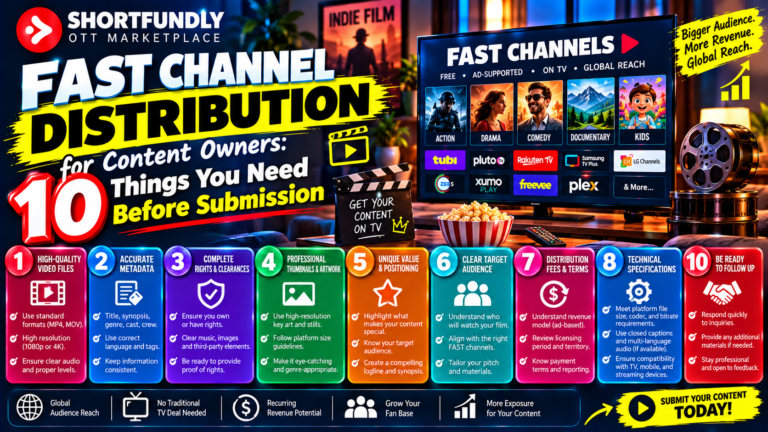
What Do You Need Before Submitting a Movie for FAST Distribution?
Before contacting a distributor, prepare a professional package that makes it easy to evaluate your content.
1. Proof of Rights Ownership
Confirm that you can legally license the movie for the proposed distribution. Resolve music, footage, screenplay, cast, and other third-party rights as needed.
2. Final Video and Audio Master
Prepare a complete, high-quality master. Request the distributor’s technical specifications instead of assuming every platform uses the same format.
3. Accurate Metadata
Include the official title, synopsis, genre, runtime, language, release year, credits, and other requested descriptive information.
4. Promotional Artwork
Prepare a high-resolution poster, promotional stills, and a trailer where appropriate. Check the distributor’s required dimensions and formats.
5. Subtitles and Captions
Make sure required language versions are accurate and synchronized. Confirm whether the recipient requires specific subtitle or caption formats.
6. Territory and Rights Information
Clearly identify which rights are available, in which territories, and for what period. Disclose any existing licensing restrictions.
7. Distribution Pitch
Create a concise presentation explaining what the movie is, who may watch it, and why it could fit the recipient’s programming strategy.
8. Commercial Expectations
Understand the difference between a license fee, revenue share, minimum guarantee, and other payment structures. Be prepared to discuss reporting, deductions, payment schedules, and rights reversion.
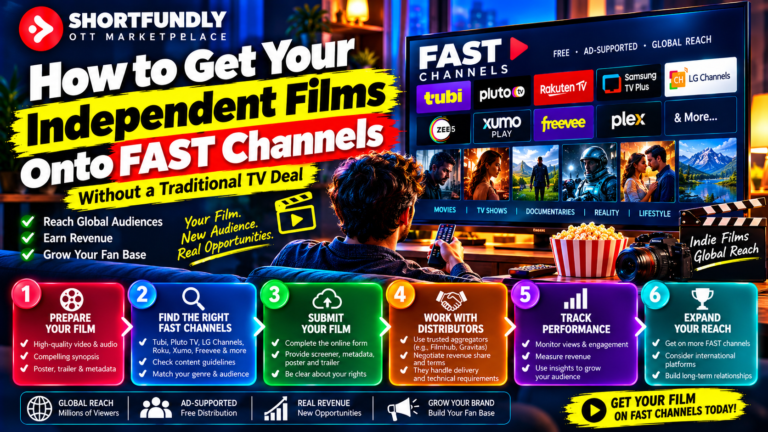
How to Submit Your Movie for FAST Channel Distribution: Step by Step
Once your materials are ready, follow a structured submission process.
Step 1: Define your objective. Decide whether you want to license one film, distribute a catalogue, or launch a channel.
Step 2: Research potential partners. Identify companies that accept your content type and currently support the distribution model you want.
Step 3: Verify submission requirements. Review eligibility, technical specifications, licensing conditions, and the required materials.
Step 4: Prepare the pitch. Summarize the movie, its genre, language, runtime, rights availability, and audience positioning.
Step 5: Submit the required materials. Follow the partner’s process and provide screeners or files through its requested method.
Step 6: Review the offer. If a partner is interested, examine the rights, territories, term, payment model, exclusivity, and termination conditions.
Step 7: Complete technical delivery. Provide the approved master, metadata, subtitles, artwork, and other assets required by the partner.
Step 8: Track the release. Keep records of delivery, approvals, release dates, statements, and contract expiry dates.
Remember that a complete submission does not guarantee acceptance, a licensing deal, or a specific release date. The distributor or platform must decide whether the title fits its requirements.
How Do Content Owners Earn Revenue From FAST Distribution?
The financial model depends on the platform and contract.
Some arrangements may pay a licensing fee for the right to use a movie. Others may provide revenue sharing or another negotiated commercial structure. Where advertising revenue is involved, the agreement should explain how the rights holder’s share is calculated and reported.
Before signing, ask:
- Is payment based on a license fee or revenue share?
- Which revenue sources are included?
- What costs or commissions may be deducted?
- How often are statements issued?
- When are payments due?
- Can the rights holder review or dispute reported figures?
- Does the agreement provide a minimum guarantee?
- What happens when the contract expires?
Do not rely on a universal per-view payment assumption. FAST services and distribution agreements differ, and earnings are not guaranteed.
A careful review of the financial terms helps you evaluate whether a distribution opportunity aligns with your objectives.
Common Mistakes to Avoid When Choosing a FAST Distributor
Assuming Every OTT Distributor Offers FAST Placement
Always verify the actual channel and platform relationships. General OTT distribution does not automatically include FAST distribution.
Submitting Without Clear Rights
Unresolved ownership or licensing issues can prevent a movie from being distributed. Prepare your documentation before pitching.
Sending Incomplete Materials
Missing metadata, artwork, subtitles, or technical assets can delay review. Use a checklist to prepare a complete package.
Ignoring Exclusivity
A contract may limit your ability to distribute the film elsewhere. Understand the rights granted, the territories covered, and the agreement period.
Choosing a Partner Based Only on Reach Claims
Ask which services are currently supported and how the company delivers content to them. Request written clarification rather than relying on broad marketing language.
Expecting Guaranteed Revenue
Distribution access does not guarantee views, advertising income, licensing fees, or a specific financial outcome. Review the commercial arrangement carefully.
Frequently Asked Questions
1. Where can I submit movies for FAST channel distribution?
You can explore FAST channel operators, content aggregators, dedicated FAST distribution providers, film distributors, and sales agents that work with FAST channels. OTT distribution services may also help with broader streaming distribution, but you should verify whether they support the specific FAST service you want.
2. Can independent filmmakers submit movies directly to FAST channels?
Some channel operators may consider direct submissions, while others work only through approved aggregators or established distributors. Check the channel’s current submission policy before sending your film.
3. Can I submit a single movie, or do I need a catalogue?
That depends on the partner. Some companies consider individual films, while others prefer a larger catalogue or an existing channel. Research the partner’s requirements before preparing your submission.
4. Does Shortfundly Distribution offer FAST channel distribution?
Shortfundly provides an OTT distribution submission process for eligible films and other supported content. Its current distribution partners and available services should be checked directly. Do not assume that every submission includes placement on a specific FAST channel.
5. What documents do I need to submit a movie?
Commonly requested materials include proof of rights, a final video master, metadata, synopsis, poster, promotional stills, trailer, subtitles, and other technical or legal documents. Requirements vary by partner.
6. Do FAST distributors charge submission fees?
Some distribution services may charge processing, delivery, or other fees, while other arrangements may use commissions or negotiated commercial terms. Confirm all charges and deductions before signing.
7. Can I distribute my movie on multiple platforms?
Potentially, yes. It depends on whether you control the required rights and whether your existing agreements include exclusivity or other restrictions. Review the terms before granting another license.
8. How long does FAST distribution take?
There is no universal timeline. Review, licensing, technical quality control, platform approval, and scheduling can all affect the process. Ask the partner for its current workflow and expected time frame.
9. Can documentaries and regional-language movies be submitted?
Potentially. Many distribution partners consider different genres and languages, but acceptance depends on the individual channel’s programming strategy, rights, technical standards, and territory requirements.
10. What is the best first step for a content owner?
Confirm your rights, prepare a professional content package, and identify partners that specifically support your intended distribution route. Then submit a focused pitch and carefully review any offer before signing.
Also read: https://blog.shortfundly.com/ott/fast-channel-distribution/
Conclusion: Choose the Right Route for Your Movie
Finding where to submit movies for FAST channel distribution begins with understanding your content and your objectives. Content owners can investigate FAST channel operators, content aggregators, dedicated channel distribution providers, film distributors, and OTT services that accept eligible submissions.
Each route offers a different potential benefit. Direct channel outreach may be suitable for a film that fits a specific programming strategy, while an aggregator may help rights holders access multiple digital outlets. Owners of substantial libraries may also explore channel-level distribution.
For independent filmmakers and producers, Shortfundly Distribution is another option to investigate for eligible content through its OTT distribution process. Review the current submission requirements, fees, licensing terms, and available partners to determine whether the service fits your goals.
Most importantly, confirm the exact distribution destination before committing your rights. A movie being accepted for OTT distribution does not automatically mean it will appear on a FAST channel.
With clear rights, professional delivery materials, accurate metadata, and a carefully selected distribution partner, content owners can approach the streaming marketplace with a more organized and informed strategy.