Table of Contents
Introduction: Your 2026 Songs OTT Distribution Roadmap Starts Here
If we’re ready to release our songs on OTT platforms in 2026, preparation matters just as much as the music itself. A strong recording can still face unnecessary delays if the master file, metadata, artwork, copyright information, release schedule, and distribution agreement aren’t ready.
That’s why a practical Songs OTT Distribution roadmap is so useful.
For independent singers, composers, producers, labels, and music creators, OTT distribution can provide another route to reach digital audiences. But distribution isn’t simply a matter of uploading a song and waiting for listeners. We need to build a release package that is technically sound, legally cleared, commercially practical, and easy for a distributor to review.
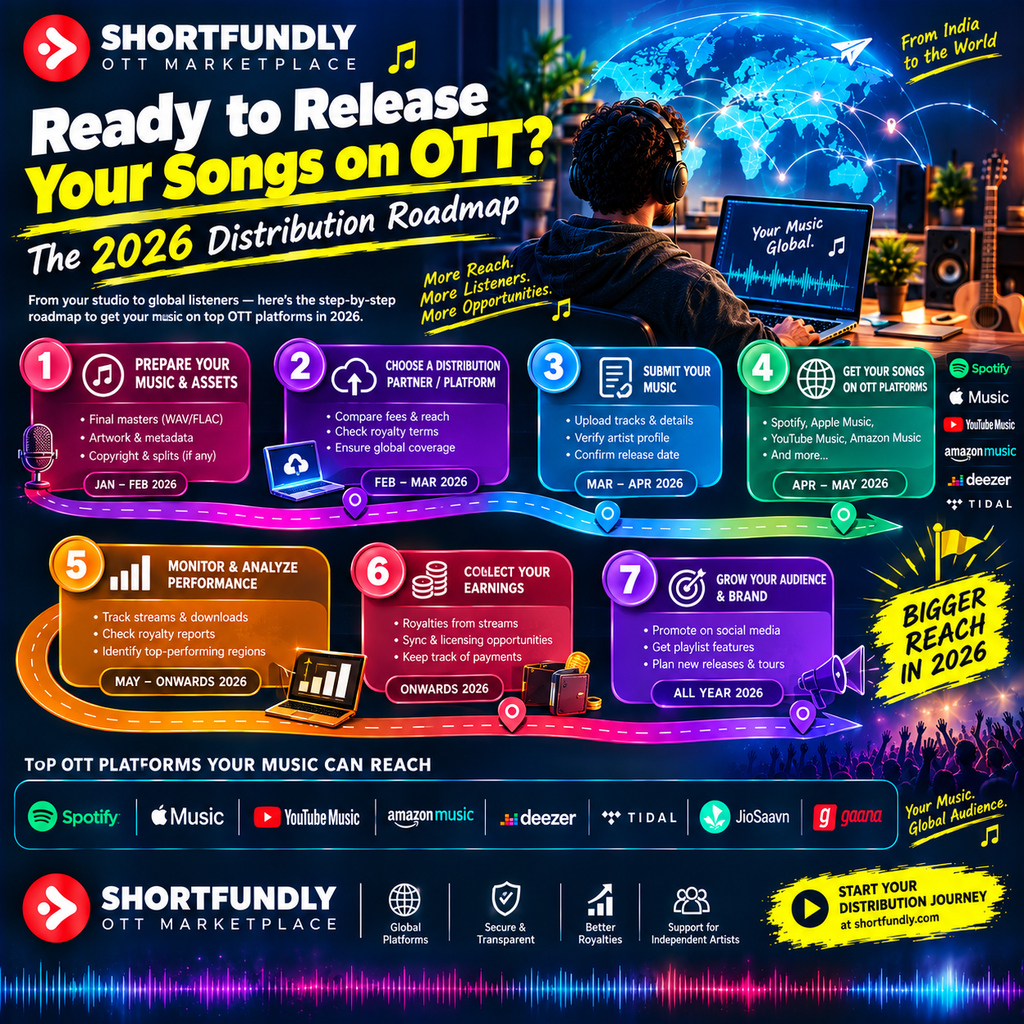
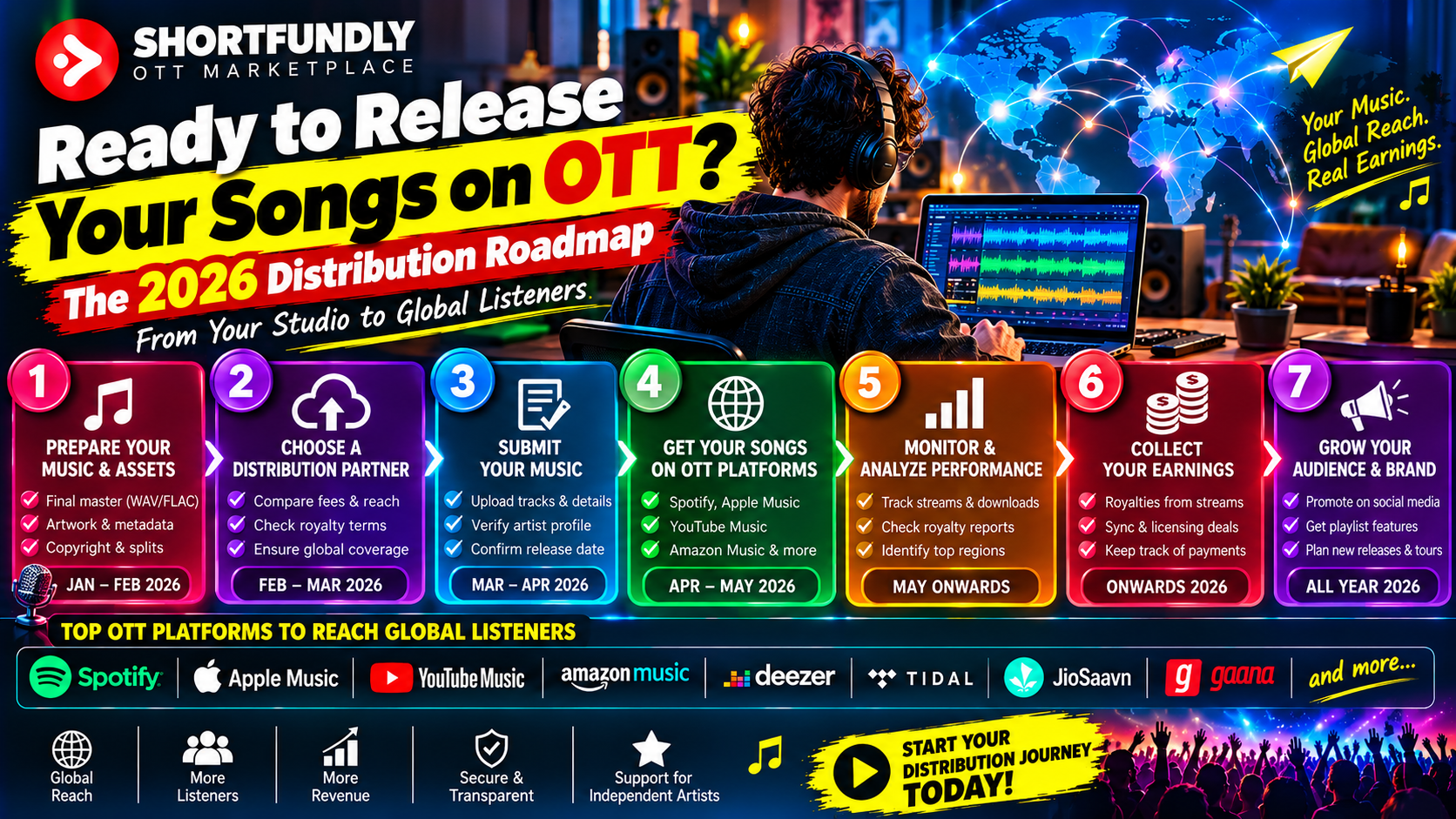
The 2026 approach should also be more strategic. We need to think about the complete journey:
Create → Clear Rights → Prepare Assets → Choose Distribution → Submit → Review → Release → Promote → Measure → Improve
This roadmap walks through that process step by step.
Important: Distribution availability, platform partnerships, technical specifications, fees, contracts, and monetization terms can change. We should always check the current requirements of the selected distributor before submission.
2026 Songs OTT Distribution: What Has Changed in the Way We Release Music?
Digital music distribution is no longer limited to major record labels. Independent artists can build audiences through a combination of streaming, video, social media, OTT-oriented distribution, direct fan engagement, live performances, licensing, and other digital channels.
At the same time, the release environment is becoming more competitive.
We aren’t competing only against other professional artists. We’re competing for attention against creators, influencers, podcasts, short-form videos, films, games, and millions of other pieces of entertainment.
That makes release preparation and audience strategy increasingly important.
YouTube, for example, continues to provide several monetization options for eligible creators, including Watch Page ads, Shorts Feed ads, YouTube Premium, memberships, Super Thanks, and other features. Current YPP eligibility requirements and monetization features vary by level and can change; YouTube has also announced further YPP changes beginning February 1, 2027.
The lesson for independent musicians is simple: we should build a distribution strategy that can adapt instead of depending on one platform or one revenue source.
The 2026 Songs OTT Distribution Roadmap
Step 1: Decide What We Are Actually Releasing
Before contacting a distributor, we need to define the exact product.
Are we releasing:
- A single?
- An EP?
- A full album?
- A music video?
- A video song?
- A live performance?
- An instrumental?
- A soundtrack?
- A remix?
- An acoustic version?
- A compilation?
This sounds obvious, but release classification can affect metadata, artwork, technical requirements, and distribution options.
A single, for example, may require a relatively simple delivery package. An album can involve multiple tracks, individual identifiers, track sequencing, multiple contributors, and additional metadata.
Build the Release Profile
We should document:
| Item | Information to Prepare |
|---|---|
| Release title | Final approved title |
| Primary artist | Official artist name |
| Featured artists | Correct credited names |
| Release type | Single, EP, album, video song, etc. |
| Language | Primary language |
| Genre | Appropriate genre |
| Release date | Planned launch date |
| Territory | Intended distribution territory |
| Content version | Original, remix, live, acoustic, etc. |
| Rights holder | Person/company controlling relevant rights |
This becomes the foundation for the rest of the process.
Step 2: Lock the Final Master
The final master should be completed before distribution.
We shouldn’t submit a rough mix simply because we’re excited to release the song. Once a song enters the distribution process, changing the underlying recording may require corrections, replacement procedures, or a new delivery.
Our final audio check should cover:
- Vocal clarity
- Instrument balance
- Noise
- Distortion
- Clipping
- Beginning and ending
- Unwanted silence
- Stereo image
- Correct song version
- Overall playback quality
We should also retain an archival copy of the highest-quality approved master.
Keep Versions Organized
We can use a simple internal structure:
Project/
├── Final_Master/
├── Artwork/
├── Metadata/
├── Rights/
├── Video/
├── Promotional/
└── Agreements/
This may seem basic, but it can save hours when we’re managing several releases.
Step 3: Confirm Every Right Before Distribution
This is one of the most important parts of the roadmap.
Before distributing a song, we should know exactly who owns or controls the relevant rights.
A recording may involve:
- Master rights
- Composition rights
- Lyrics
- Performance rights
- Publishing interests
- Sample rights
- Beat licenses
- Featured artist permissions
- Music-video rights
- Artwork rights
We shouldn’t assume that creating or purchasing something automatically gives us every commercial right.
For example, if our production uses a third-party beat, we need to confirm that its license permits the intended commercial distribution and monetization.
Likewise, if another vocalist appears on the recording, we should have appropriate permission and an agreed credit structure.
Our Rights Folder Should Include
- Producer agreements
- Beat licenses
- Sample licenses
- Split sheets
- Collaboration agreements
- Artwork licenses
- Video permissions
- Relevant copyright documentation
Good documentation isn’t glamorous, but it’s part of building a professional music catalog.
Step 4: Prepare Accurate Metadata
Music metadata is the information that describes and identifies a release.
We should prepare it carefully because inconsistent information can create problems during distribution and catalog management.
Our metadata can include:
- Song title
- Artist name
- Featured artist
- Composer
- Lyricist
- Producer
- Label
- Genre
- Language
- Release date
- Copyright information
- Explicit-content status
- Track number
- Recording identifier
- Album information
We should spell names consistently across the entire release package.
Why Metadata Deserves Attention
Imagine that our artist name appears one way on the artwork, another way in the distribution form, and a third way in promotional materials.
That inconsistency can create confusion.
We should therefore maintain one approved metadata document and use it as our source of truth.
Step 5: Prepare Professional Artwork
Our cover artwork is part of the release experience.
It should represent the song professionally while meeting the current technical requirements of the distributor and destination services.
Before submitting, we should check:
- Image resolution
- File format
- File size
- Artist name
- Song title
- Spelling
- Readability
- Ownership or licensing
- Content compliance
We should never use an image simply because it looks good on our phone.
It needs to work as an official release asset.
If a designer, photographer, stock image, or other third party contributed to the artwork, we should also confirm that the applicable usage rights allow commercial distribution.
Step 6: Confirm Recording Identifiers
Identifiers help the music industry distinguish one recording from another.
Where applicable, we should check the ISRC or other relevant identifiers associated with our recording.
If the song has previously been released, we shouldn’t casually create a new identity for the same recording. We should determine whether the existing recording identifier should remain associated with the recording.
For a completely new recording, we should follow the distributor’s current identifier process.
The key principle is accuracy, consistency, and proper record keeping.
Step 7: Choose the Right OTT Distribution Partner
Choosing a distributor should be based on our actual requirements.
We shouldn’t select a service solely because its headline price looks attractive.
Instead, we should compare:
| Factor | Questions to Ask |
|---|---|
| Content | Does the service accept our type of music content? |
| Reach | Which platforms or partners are available? |
| Territories | Where can the content be distributed? |
| Fees | What are the upfront and ongoing charges? |
| Rights | What rights are granted? |
| Exclusivity | Is the agreement exclusive or non-exclusive? |
| Duration | How long does the agreement last? |
| Revenue | How are earnings calculated? |
| Reporting | What performance information is available? |
| Payouts | How and when are creators paid? |
| Support | What help is available if something goes wrong? |
| Removal | What is the process for taking content down? |
We should read the actual agreement instead of relying only on promotional descriptions.
Step 8: Explore Shortfundly Distribution
Shortfundly Distribution is one option creators can consider when exploring OTT-oriented distribution.
The official Shortfundly Distribution platform currently presents distribution services for multiple types of creator content and includes songs and other audiovisual content among the content categories it supports.
Its current workflow describes steps such as checking pricing, registering or signing in, adding content details, reviewing requirements, completing applicable payment and agreement steps, submitting content for review, and—when approved—providing release assets for distribution through currently available partners.
That process means we should prepare our material before starting the submission.
What We Should Check With Shortfundly Distribution
Before submitting, we should review the current:
- Content eligibility
- Pricing
- Applicable taxes
- Technical requirements
- Agreement
- Rights terms
- Distribution partners
- Review process
- Revenue arrangements
- Payout conditions
- Release-asset requirements
We should also remember that submission does not automatically mean approval or streaming. Distribution availability can depend on eligibility, content review, licensing, and the partners available for the particular project.
The official portal is available here:
Step 9: Review the Distribution Agreement
Before accepting any agreement, we should understand what we’re signing.
At minimum, we should identify:
Rights Granted
What rights are we giving the distributor?
Territory
Which countries or regions are covered?
Duration
How long does the agreement remain active?
Exclusivity
Can we distribute the same content elsewhere?
Revenue
How is income calculated and shared?
Costs
Are there upfront fees, taxes, service charges, or other deductions?
Withdrawal
What happens if we later want to remove or transfer the content?
These questions are especially important when we’re building a catalog that we intend to exploit for many years.
Step 10: Set a Realistic Release Date
We shouldn’t choose a release date based solely on the day we finish mastering.
There may be time required for:
- Submission
- Content review
- Corrections
- Approval
- Delivery
- Platform processing
- Promotional preparation
The actual timeline varies by distributor and platform.
A better approach is to work backward.
Example
Target release: June 30
Before release:
- June 1: Final assets
- June 3: Rights and metadata check
- June 5: Distribution submission
- June 6–15: Review and corrections
- June 16–29: Promotion
- June 30: Launch
This is only a planning example. We should follow the actual processing timelines provided by our distributor.
Step 11: Create a Pre-Release Marketing Campaign
Distribution puts the release into a delivery system.
Marketing creates anticipation.
We should begin promotion before the song becomes available.
Our campaign can include:
- Song teaser
- Chorus preview
- Lyric snippet
- Studio footage
- Artist introduction
- Cover reveal
- Countdown
- Behind-the-scenes video
- Short-form clips
- Collaboration content
- Live performance preview
We don’t need an enormous budget.
We need consistency.
Turn One Song Into Many Content Pieces
A single three-minute song can become:
- One official music video
- One lyric video
- Five short clips
- One behind-the-scenes video
- One acoustic performance
- Several quote graphics
- Multiple social posts
- One artist-story video
This allows us to extend the life of the release.
Step 12: Use YouTube Alongside OTT Distribution
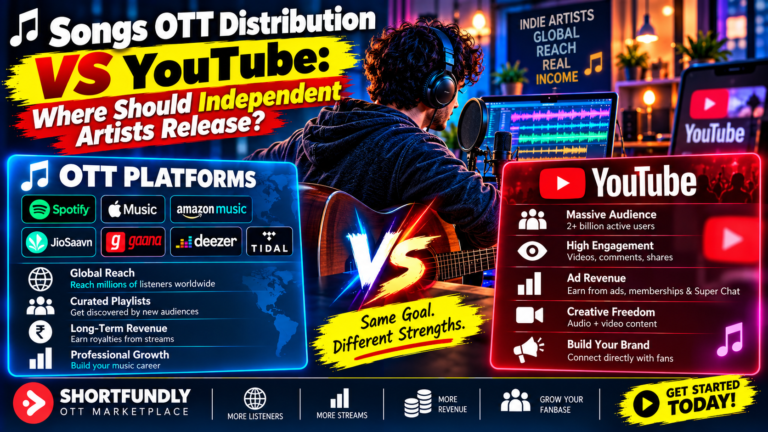
We shouldn’t automatically treat YouTube and OTT distribution as competing choices.
They can serve different purposes.
YouTube can support:
- Discovery
- Search
- Music videos
- Shorts
- Community building
- Fan engagement
- Advertising
- Memberships
- Super Thanks
- YouTube Premium revenue
YouTube’s current YPP structure provides multiple monetization options for eligible creators. The current higher eligibility threshold is 1,000 subscribers plus either 4,000 qualified public watch hours in the previous 12 months or 10 million qualified Shorts views in 90 days.
However, YouTube has announced changes beginning February 1, 2027, including updated YPP ad and Premium entry thresholds.
Therefore, when planning a 2026 release, we should use the current rules but check the official YouTube documentation again when planning future campaigns.
Step 13: Build a Multi-Channel Music Strategy
A modern independent artist shouldn’t think in terms of one platform.
We can build an ecosystem:
OTT Distribution + YouTube + Social Media + Streaming + Live Shows + Licensing + Direct Fan Relationships
Each channel can have a different job.
| Channel | Primary Role |
|---|---|
| OTT distribution | Digital content availability |
| YouTube | Discovery and video engagement |
| Short-form platforms | Awareness and viral reach |
| Streaming services | Music consumption |
| Social media | Community |
| Live events | Direct fan connection |
| Licensing | Commercial opportunities |
| Website | Owned artist destination |
| Email/community | Direct communication |
This approach gives us more than one way to reach an audience.
Step 14: Track Performance After Release
The release date isn’t the finish line.
It’s the beginning of the measurement stage.
We should monitor available data such as:
- Views
- Streams
- Watch time
- Audience retention
- Geography
- Engagement
- Traffic sources
- Follower growth
- Repeat listeners
- Revenue reports
YouTube itself recommends using Analytics to identify patterns in revenue, geography, traffic, and seasonal performance.
Ask Better Questions
Instead of asking:
“Did the song go viral?”
we should ask:
- Which audience discovered it?
- Which content generated the most engagement?
- Which country performed strongly?
- Which promotional clip produced the best response?
- Did listeners continue consuming our other songs?
- Which release strategy should we repeat?
Data becomes useful when it changes our next decision.
Step 15: Create a Repeatable Release System
The strongest artists don’t reinvent the process every time.
We can create a repeatable workflow.
Phase 1 — Creation
- Write
- Record
- Produce
- Mix
- Master
Phase 2 — Rights
- Confirm ownership
- Clear samples
- Document collaborators
- Review licenses
Phase 3 — Assets
- Artwork
- Metadata
- Video
- Promotional content
Phase 4 — Distribution
- Compare distributors
- Review agreement
- Submit
- Respond to corrections
- Confirm approval
Phase 5 — Marketing
- Tease
- Announce
- Launch
- Repurpose
- Engage
Phase 6 — Measurement
- Review analytics
- Track revenue
- Identify audience trends
- Improve the next release
This turns distribution from a one-time task into a repeatable music business system.
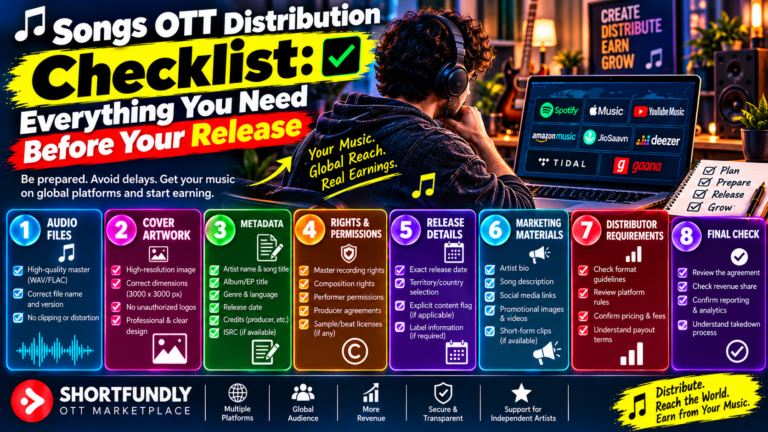
The 2026 Pre-Release Checklist for Songs OTT Distribution
Before we submit, let’s run one final audit.
Creative Checklist
- Final master approved
- Correct song version selected
- Mixing and mastering completed
- Music video finalized if applicable
- Lyrics reviewed
Metadata Checklist
- Song title correct
- Artist name correct
- Featured artists credited
- Composer credited
- Lyricist credited
- Producer credited
- Language selected
- Genre selected
- Release date confirmed
- Copyright information verified
Rights Checklist
- Master ownership confirmed
- Composition rights confirmed
- Beat license checked
- Sample permissions checked
- Featured artist agreement completed
- Artwork rights confirmed
- Video rights confirmed
Distribution Checklist
- Distributor compared
- Fees checked
- Agreement read
- Territory checked
- Exclusivity checked
- Revenue terms understood
- Payout terms understood
- Withdrawal terms understood
Marketing Checklist
- Cover reveal prepared
- Teaser prepared
- Short clips prepared
- Countdown planned
- Release announcement written
- Post-release content scheduled
Common Mistakes We Should Avoid in 2026
Mistake 1: Treating Distribution as Marketing
Distribution makes content available. It doesn’t automatically create demand.
We still need promotion.
Mistake 2: Releasing Without Rights Documentation
This can create serious problems when multiple people or third-party materials are involved.
Mistake 3: Using Inconsistent Metadata
A small spelling difference can create unnecessary catalog confusion.
Mistake 4: Choosing a Distributor Without Reading the Agreement
We should understand the commercial relationship before signing.
Mistake 5: Announcing a Release Too Early
If processing takes longer than expected, the promotional campaign can become confusing.
Mistake 6: Depending on One Platform
A diversified audience strategy is generally more resilient than relying on a single digital channel.
Mistake 7: Stopping Promotion After Release Day
A song has a much longer life than 24 hours.
Mistake 8: Chasing Views Without Studying Audience Quality
Numbers matter, but audience behavior can be even more useful for future planning.
How to Plan a 30-Day OTT Music Release
A simple 30-day plan can keep the campaign organized.
| Period | Main Activity |
|---|---|
| Days 1–5 | Final master and rights review |
| Days 6–8 | Metadata and artwork |
| Days 9–12 | Distributor selection and submission |
| Days 13–17 | Review and corrections |
| Days 18–21 | Teasers and announcements |
| Days 22–25 | Short-form promotion |
| Days 26–28 | Countdown campaign |
| Day 29 | Final release check |
| Day 30 | Release and launch promotion |
This schedule is flexible. The actual distribution timeline should always take priority.
How We Can Build a Long-Term OTT Music Catalog
One successful song is useful.
A catalog is more powerful.
Instead of thinking about each release as an isolated event, we can build a connected catalog of:
- Singles
- EPs
- Albums
- Music videos
- Live performances
- Acoustic recordings
- Remixes
- Instrumentals
- Soundtracks
- Collaborations
Every new release can introduce listeners to older releases.
That means our promotional efforts can compound over time.
For example, a listener who discovers a new single may then explore our previous album. Another listener may find the music video and then watch a live performance.
The catalog becomes an ecosystem.
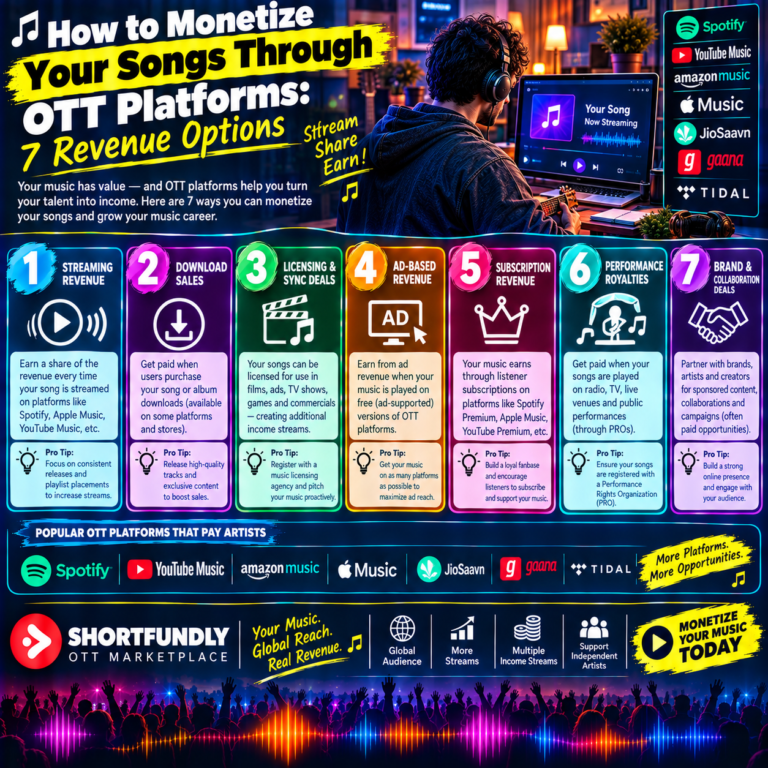
Revenue Planning for Independent Artists
We should be realistic about income.
No legitimate distribution strategy should be treated as a guaranteed income formula.
Revenue can depend on:
- Consumption
- Platform economics
- Audience geography
- Advertising
- Subscriptions
- Licensing
- Agreement terms
- Rights ownership
- Revenue-sharing arrangements
- Promotional performance
YouTube’s official earnings guidance specifically states that there are no guarantees about how much or whether a creator will be paid.
That principle applies broadly to digital music planning: we should create financial scenarios rather than rely on guaranteed numbers.
A Simple Revenue Framework
| Stage | Primary Goal |
|---|---|
| Early stage | Build audience |
| Growth stage | Increase recurring listeners |
| Expansion stage | Diversify revenue |
| Established stage | Develop catalog and licensing |
| Long-term stage | Build sustainable music business |
The first goal isn’t always immediate revenue.
Sometimes the most valuable result of a release is acquiring a loyal listener who stays for the next ten releases.
Frequently Asked Questions About Songs OTT Distribution
1. What is Songs OTT Distribution?
Songs OTT Distribution is the process of delivering songs or music-related audiovisual content through supported digital entertainment and OTT distribution channels. The exact platforms, territories, content types, and commercial terms depend on the distributor and applicable agreements.
2. Can independent artists release songs on OTT platforms?
Yes, independent artists can explore distribution services that accept creator submissions. The artist should check eligibility, technical requirements, licensing, fees, agreement terms, and available distribution partners before submitting.
3. Do we need a record label to distribute songs?
Not necessarily. Independent distribution can provide an alternative to traditional label-led release models. However, we remain responsible for understanding our rights, agreements, content quality, and promotional strategy.
4. Is Shortfundly Distribution suitable for songs?
Shortfundly’s current distribution platform includes songs and other digital content categories among the content it supports.
Whether it is suitable for a particular artist depends on the artist’s content, goals, budget, rights, agreement requirements, and the distribution options currently available.
5. Does Shortfundly Distribution guarantee OTT placement?
No. Submission should not be treated as a guarantee of selection, approval, or streaming. Current distribution availability can depend on content eligibility, licensing, review, and available distribution partners.
6. What should we prepare before submitting a song?
At minimum, we should prepare the final master, artwork, metadata, contributor information, rights documentation, release information, and any additional assets requested by the distributor.
7. Should we release a music video with our song?
A music video isn’t mandatory for every music release, but it can provide additional promotional opportunities. Video content can be used across YouTube, social platforms, and applicable audiovisual distribution channels.
8. Is YouTube part of an OTT music strategy?
YouTube can be an important part of a broader digital music strategy. Eligible creators can access multiple monetization features, including ads, YouTube Premium, memberships, Super Thanks, and other tools.
However, YouTube’s policies and eligibility requirements can change, so we should check its current official documentation.
9. How early should we submit our song?
We should submit early enough to allow for review, corrections, processing, and promotional preparation. There isn’t one universal processing period for every distributor.
10. Can we distribute the same music through multiple services?
That depends on the agreements involved. If a distribution agreement is non-exclusive, multiple distribution arrangements may be possible, but we must ensure that the agreements don’t conflict and that duplicate deliveries won’t create catalog problems.
11. What happens if our song is rejected?
We should review the reason for rejection and determine whether the issue concerns technical quality, rights, metadata, content eligibility, artwork, or another requirement. If corrections are permitted, we can address the issue and follow the distributor’s resubmission process.
12. How can we promote an OTT-distributed song?
We can combine short-form videos, YouTube content, social posts, teasers, artist stories, live performances, collaborations, playlists where applicable, and direct fan communication.
The key is to keep promoting the song after launch rather than treating release day as the end of the campaign.
13. Can OTT distribution make us successful immediately?
There is no guaranteed path to immediate success. Distribution is one part of a broader music strategy that includes quality, rights, audience building, promotion, consistency, and business planning.
14. What is the biggest mistake independent artists make?
One common mistake is treating distribution as the entire release strategy. We should think about content + rights + distribution + promotion + analytics + audience development as one connected system.
Also read: https://blog.shortfundly.com/ott/monetize-songs-ott-revenue/
Conclusion: Turn Your 2026 Song Release Into a Repeatable Roadmap
Being ready to release songs on OTT platforms in 2026 means being ready on several levels.
We need the right recording, accurate metadata, professional artwork, documented rights, suitable distribution agreement, realistic schedule, and a strong promotional plan.
We also need to understand that distribution isn’t the same as guaranteed exposure or guaranteed revenue.
Our strongest approach is to build a repeatable system:
Create the music → protect the rights → prepare the assets → choose the distributor → submit accurately → verify the release → promote consistently → measure results → improve the next release.
Shortfundly Distribution can be considered as one option for creators exploring OTT-oriented distribution, and its current platform provides information about content categories, submission steps, and distribution requirements.
At the same time, we should compare any distribution service against our own needs and read the current agreement carefully before committing.
The artists who build sustainable digital careers don’t treat each song as a one-day event. They build catalogs, audiences, systems, and relationships.
That’s the real 2026 Songs OTT Distribution roadmap: not simply getting a song online, but creating a professional release process that can be repeated, measured, and improved with every new track.