Table of Contents
Compare songs OTT distribution vs YouTube for independent artists, including reach, monetization, rights, distribution, promotion, costs, and revenue options.
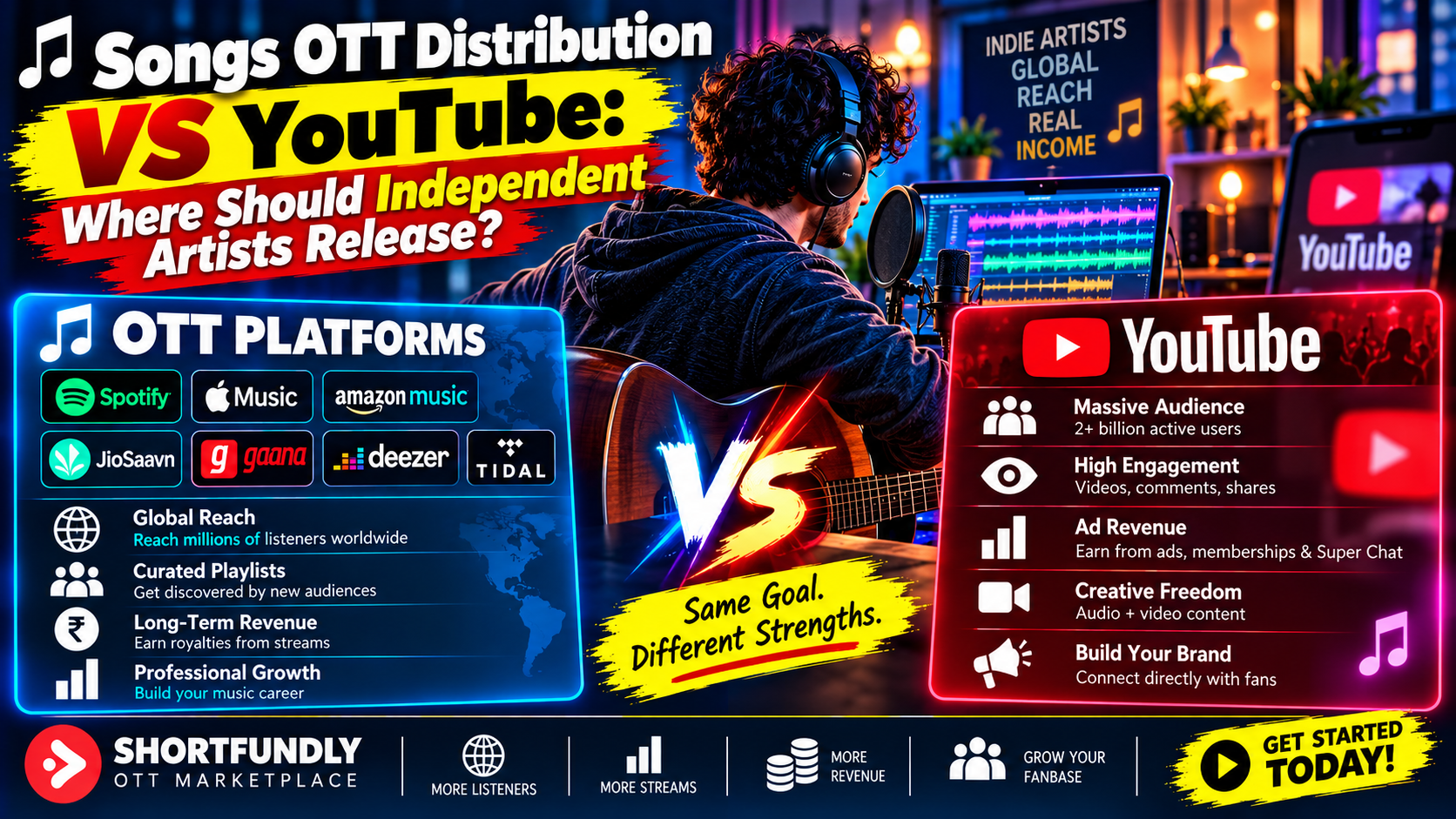
For independent musicians, choosing where to release a song can be just as important as creating the song itself. The debate around songs OTT distribution vs YouTube is especially relevant because the two approaches serve different purposes.
YouTube can give artists a powerful public channel for music videos, lyric videos, Shorts, live performances, and audience building. Its YouTube Partner Program can also provide several monetization features once a channel meets the applicable eligibility requirements.
OTT distribution, meanwhile, can provide a structured route for eligible content to reach streaming and distribution partners. Shortfundly Distribution, for example, currently lists songs and video songs among its supported content categories and provides a submission, review, distribution, and earnings-tracking workflow.
So, should an independent artist choose YouTube or OTT distribution?
The answer depends on your goals, rights, audience, monetization model, content format, release strategy, and long-term plans.
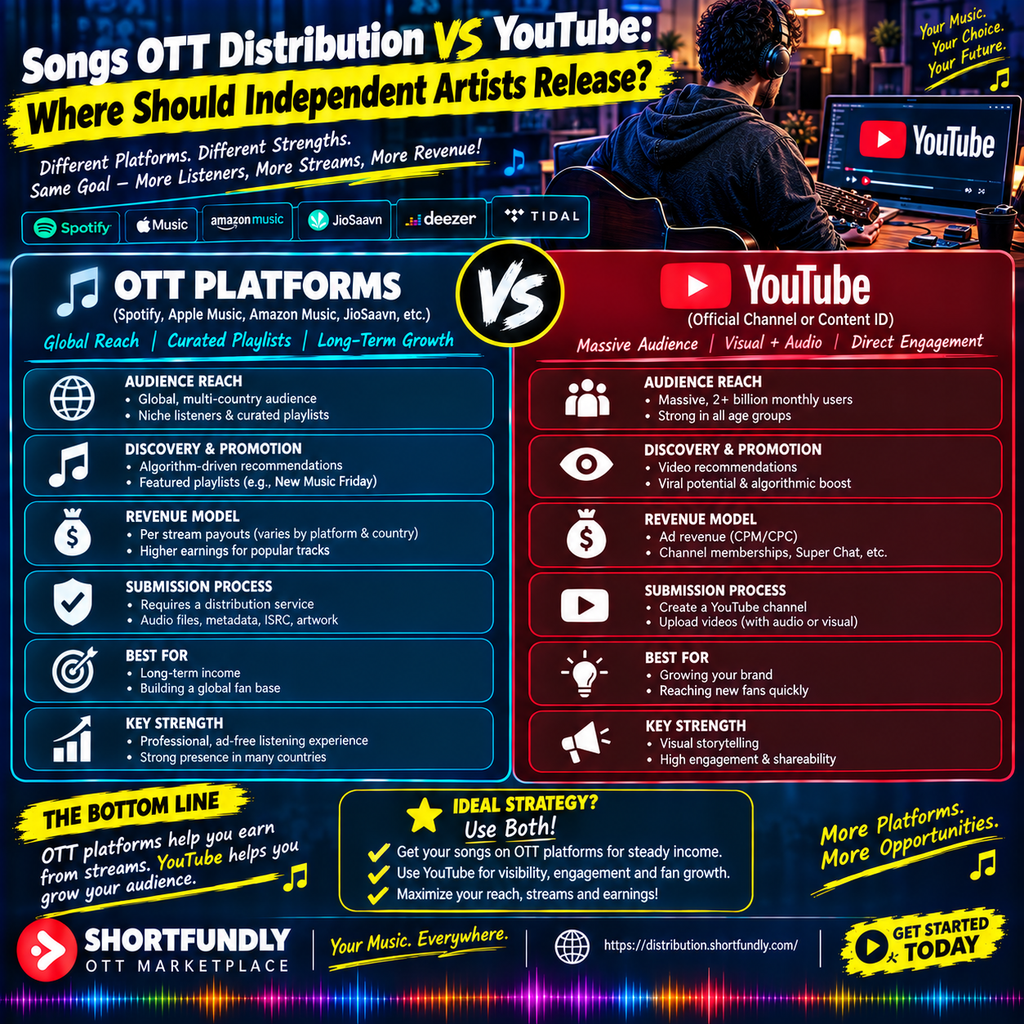
In many cases, the smartest approach isn’t treating YouTube and OTT distribution as direct substitutes. Instead, artists can understand what each channel does well and build a release strategy around their different strengths.
Comprehensive Outline
| Section | What You’ll Learn |
|---|---|
| 1. OTT Distribution vs YouTube | The fundamental difference |
| 2. Why the Choice Matters | Business considerations for independent artists |
| 3. YouTube for Independent Musicians | How YouTube works as a music channel |
| 4. OTT Song Distribution | How structured distribution works |
| 5. Difference #1 | Audience discovery |
| 6. Difference #2 | Monetization |
| 7. Difference #3 | Eligibility |
| 8. Difference #4 | Content formats |
| 9. Difference #5 | Rights and ownership |
| 10. Difference #6 | Distribution reach |
| 11. Difference #7 | Revenue reporting |
| 12. Difference #8 | Marketing |
| 13. Difference #9 | Release control |
| 14. Difference #10 | Costs |
| 15. Difference #11 | Long-term catalog strategy |
| 16. Shortfundly Distribution | How artists can consider OTT distribution |
| 17. YouTube Strategy | How to use YouTube effectively |
| 18. Combined Strategy | Using multiple channels |
| 19. Common Mistakes | Problems artists should avoid |
| 20. Release Checklist | Practical preparation |
| 21. FAQs | Common questions answered |
| 22. Conclusion | Building a sustainable music strategy |
1. Songs OTT Distribution vs YouTube: What’s the Real Difference?
The biggest difference is simple:
YouTube is primarily a platform where creators publish content and build audiences, while OTT distribution is a distribution pathway that can deliver eligible content to streaming or media partners.
That distinction matters.
An artist uploading a music video to YouTube is directly publishing the video to a YouTube channel.
An artist using an OTT distribution service is generally submitting content to a distributor, which then handles an applicable workflow involving review, agreements, release assets, and distribution to available partners.
These models can overlap, but they aren’t identical.
YouTube
YouTube gives artists a direct publishing environment.
You can upload:
- Official music videos
- Lyric videos
- Audio videos
- Shorts
- Live performances
- Interviews
- Behind-the-scenes footage
- Acoustic performances
- Music documentaries
If eligible and accepted into the YouTube Partner Program, creators can access monetization features such as Watch Page ads, Shorts Feed ads, memberships, Supers, Shopping, and YouTube Premium-related revenue.
OTT Distribution
OTT distribution is more structured.
A distribution service may collect content details, review the project, process agreements, prepare release assets, and distribute eligible content through available partners.
Shortfundly currently describes a workflow involving pricing, registration, content submission, review, release assets after approval, distribution through available partners, and tracking of distribution and earnings.
The Important Takeaway
You don’t necessarily have to think:
YouTube OR OTT
Instead, think:
YouTube FOR audience growth + OTT distribution FOR additional distribution opportunities
Whether that combination is appropriate depends on your rights, budget, content type, agreements, and release goals.
2. Why This Choice Matters for Independent Artists
Independent musicians often have limited budgets.
That means every release decision matters.
You may have spent money on:
- Recording
- Mixing
- Mastering
- Musicians
- Artwork
- Video production
- Promotion
- Distribution
- Public relations
If you put everything into one channel without understanding how that channel works, you could miss other opportunities.
For example, YouTube can be excellent for building a recognizable artist channel, but monetization depends on eligibility and policy compliance. Current YouTube guidance states that full YPP advertising monetization requires meeting the applicable requirements and passing review.
OTT distribution can offer another route for eligible content, but availability, approval, platform access, licensing, and revenue terms depend on the applicable distribution arrangement. Shortfundly explicitly states that submission does not guarantee approval or streaming.
So the decision should be based on the question:
What do I want this release to accomplish?
Do you want:
- More subscribers?
- More music-video views?
- More streaming opportunities?
- Regional reach?
- International exposure?
- Licensing opportunities?
- Direct revenue?
- A stronger catalog?
- Multiple distribution channels?
Your answer should shape your strategy.
3. YouTube for Independent Musicians
YouTube is one of the most flexible platforms available to independent artists.
Instead of publishing only the final song, musicians can turn one release into an entire content campaign.
One Song Can Become Many YouTube Videos
For example:
Original Song
↓
Official Music Video
↓
Lyric Video
↓
Acoustic Version
↓
Behind-the-Scenes Video
↓
Shorts
↓
Live Performance
↓
Artist Interview
This creates more opportunities for audience discovery.
YouTube Monetization
The YouTube Partner Program allows eligible creators to monetize content through several features.
According to current YouTube guidance, monetization options can include:
- Watch Page advertising
- Shorts Feed advertising
- YouTube Premium revenue
- Channel memberships
- Super Chat
- Super Stickers
- Super Thanks
- Shopping features where eligible
YouTube also makes clear that earnings aren’t guaranteed. Advertising revenue depends on factors such as viewers, ads, and the creator’s applicable agreement.
YouTube’s Strength
YouTube can be particularly useful for audience development.
An artist isn’t simply publishing a song.
They’re building a channel.
That channel can become a home for their entire music identity.
4. What Is Songs OTT Distribution?
Songs OTT distribution involves delivering eligible music or video-song content through a structured distribution process to available streaming or media partners.
The exact workflow differs by distributor.
With Shortfundly Distribution, songs and video songs are currently listed among supported content types. The platform’s published workflow includes submitting content, completing applicable requirements, undergoing review, and moving approved content into distribution through currently available partners.
Typical OTT Distribution Workflow
A simplified process looks like this:
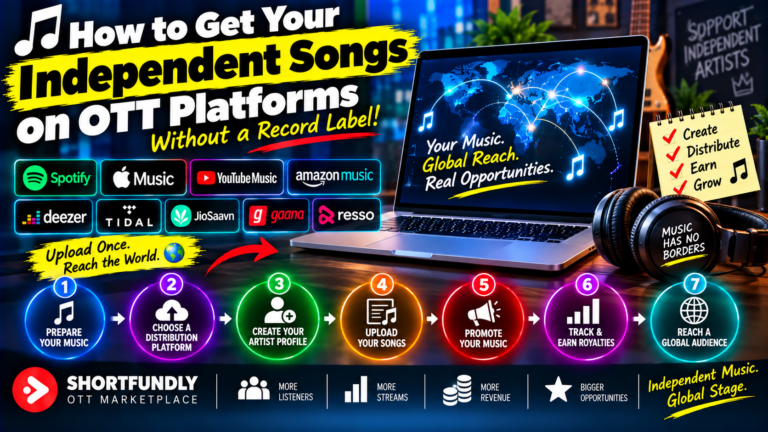
- Prepare the song or video song.
- Confirm rights.
- Prepare metadata.
- Prepare artwork and required assets.
- Check pricing and requirements.
- Register or sign in.
- Submit the content.
- Complete applicable payment and agreement steps.
- Wait for review.
- Provide additional release assets if approved.
- Distribution begins through applicable partners.
- Track status and earnings.
This is different from simply creating a YouTube channel and clicking “Upload.”
Why Artists Consider OTT Distribution
It can provide an additional path to:
- Streaming distribution
- OTT exposure
- Regional audiences
- International audiences
- Content licensing opportunities
- Revenue tracking
However, artists should verify the current partner availability and commercial terms before submission.
5. Difference #1: Audience Discovery
Audience discovery is one of the biggest differences between YouTube and OTT distribution.
YouTube
YouTube is designed around discovery.
Viewers can find music through:
- Search
- Recommendations
- Home feed
- Shorts
- Playlists
- Subscriptions
- External links
This means an unknown artist can potentially reach new viewers without already having a large fan base.
OTT Distribution
OTT distribution typically depends on the distribution partners that accept and carry the content.
The artist doesn’t necessarily control how prominently the song is displayed.
The distributor and platform determine the applicable placement and availability.
What This Means
If your immediate goal is building an audience, YouTube can be a valuable part of your strategy.
If your goal is expanding distribution beyond your own channel, OTT distribution can serve a different role.
Neither automatically guarantees an audience.
A great song still needs discovery.
6. Difference #2: Monetization Models
The money model can be very different.
YouTube
YouTube monetization can involve:
- Advertising
- Premium revenue
- Memberships
- Super Thanks
- Other eligible fan-funding features
- Shopping
Current YouTube guidance says eligible YPP partners can receive revenue from Watch Page ads, while specific monetization features have their own terms and eligibility requirements.
OTT Distribution
OTT distribution may involve different commercial arrangements depending on the distributor and partner.
Shortfundly currently describes creator earnings through ticket purchases and revenue-share arrangements associated with distribution, with specific terms depending on the applicable agreement.
Don’t Compare Revenue Using a Single Number
A common mistake is asking:
“Which pays more per stream?”
That isn’t a reliable way to compare the two.
Revenue can depend on:
- Platform
- Country
- Audience
- Subscription model
- Advertising
- Rights
- Agreement
- Distribution costs
- Revenue sharing
- Taxes
Instead, compare the whole commercial model.
7. Difference #3: Eligibility Requirements
YouTube monetization isn’t automatically available to every channel.
YouTube’s current YPP information says creators must meet applicable requirements, follow monetization policies, have the required account and security setup, and pass review. The currently published full advertising thresholds include 1,000 subscribers plus either 4,000 qualified public watch hours in the previous 12 months or 10 million qualified Shorts views in 90 days.
YouTube also has additional monetization features with their own requirements.
OTT Distribution
OTT distribution has a different kind of eligibility.
Creators generally need:
- Appropriate rights
- Suitable content
- Correct technical files
- Accurate metadata
- Required artwork
- Applicable agreements
- Compliance with distributor requirements
Shortfundly says creators don’t need a large following to start a submission, but content still needs to satisfy current eligibility, rights, technical, and agreement requirements.
The Difference
YouTube monetization asks:
“Does this channel qualify for monetization?”
OTT distribution asks:
“Does this content qualify for distribution under the applicable arrangement?”
Those are different questions.
8. Difference #4: Content Formats
YouTube is extremely flexible for content creation.
You can build an entire artist channel around one song.
YouTube Content Ideas
| Format | Purpose |
|---|---|
| Music Video | Main release |
| Lyric Video | Additional discovery |
| Shorts | Short-form reach |
| Acoustic Version | Fan engagement |
| Live Performance | Artist connection |
| BTS Video | Storytelling |
| Interview | Personal branding |
| Studio Session | Authenticity |
OTT distribution can focus more heavily on packaged content intended for streaming or media distribution.
For artists distributing video songs, this can be particularly relevant.
For audio-only music, the appropriate distribution route may differ depending on the service and current partner ecosystem.
Think Beyond One File
The best independent artists don’t treat a song as one file.
They treat it as a content property.
One song can produce weeks or months of content.
9. Difference #5: Rights and Ownership
Rights are important on both YouTube and OTT distribution.
Before releasing your song, understand:
- Who owns the master?
- Who owns the composition?
- Who owns the lyrics?
- Who owns the music video?
- Are samples licensed?
- Are performers contracted?
- Are distribution rights available?
YouTube’s monetization policies require creators to clear the rights necessary for monetized content. YouTube specifically notes that content containing third-party material, including unlicensed music, may not be eligible for monetization.
OTT distributors similarly need creators to have the rights required for distribution.
Keep Your Documentation
Maintain:
- Composer agreements
- Lyricist agreements
- Recording agreements
- Producer agreements
- Music licenses
- Distribution agreements
- Performer releases
This isn’t paperwork for paperwork’s sake.
It’s your protection.
10. Difference #6: Distribution Reach
YouTube gives you direct access to the YouTube ecosystem.
OTT distribution can potentially extend your content into additional distribution networks.
Shortfundly currently says it distributes eligible content through its available OTT and distribution partners, with platform availability varying according to content, duration, eligibility, licensing, and distribution availability.
YouTube’s Reach
YouTube offers:
- Global availability
- Search discovery
- Recommendations
- Shorts
- Playlists
- Subscriptions
- Creator communities
OTT Distribution’s Reach
Depending on the distributor and project, OTT distribution may provide access to:
- OTT services
- Streaming partners
- Television-related outlets
- Regional distribution
- Other digital media partners
The actual partner list matters.
Don’t choose a distributor solely because it says “global.”
Ask:
Which current partners are relevant to my content and audience?
That’s the useful question.
11. Difference #7: Revenue Reporting and Tracking
Independent artists need to know where money comes from.
YouTube provides creator analytics and revenue information through YouTube Studio for eligible monetized channels.
OTT distribution services can provide separate reporting tools.
Shortfundly says creators can use its tools to track distribution revenue and payouts.
Create Your Own Revenue Dashboard
Regardless of platform, keep your own records.
Track:
| Metric | YouTube | OTT Distribution |
|---|---|---|
| Views/streams | ✓ | Depending on partner |
| Revenue | ✓ | ✓ |
| Audience data | ✓ | Depends on partner |
| Platform information | YouTube | Distribution partners |
| Payment reports | YouTube/AdSense | Distributor |
| Content status | Channel | Distribution dashboard |
Your own spreadsheet makes it easier to understand the bigger picture.
12. Difference #8: Marketing Responsibilities
Neither YouTube nor OTT distribution eliminates the need for marketing.
This is where many independent artists get caught out.
They upload a song and wait.
Unfortunately, that’s rarely enough.
YouTube Marketing
You can promote:
- Shorts
- Teasers
- Music videos
- Community posts
- Collaborations
- Playlists
- Interviews
You can also send viewers directly to your YouTube channel.
OTT Marketing
If your song is distributed to OTT partners, you can still promote:
- The title
- Release announcement
- Platform availability
- Artist story
- Trailer
- Clips
- Social media posts
The Golden Rule
Distribution puts content somewhere. Marketing helps people find it.
You’ll need both.
13. Difference #9: Release Control
YouTube gives creators direct control over their channel uploads.
You decide:
- Upload timing
- Title
- Description
- Thumbnail
- Public/private status
- Video format
- Playlist placement
OTT distribution can involve more steps because the content passes through a distribution workflow.
There may be:
- Submission
- Review
- Approval
- Asset delivery
- Partner processing
- Release scheduling
This can take longer than uploading directly to your own channel.
But the trade-off is that the distribution service is handling part of the delivery process.
Which Model Fits?
If you want immediate publishing control, YouTube provides a direct publishing environment.
If you’re interested in structured distribution beyond your own channel, an OTT distributor can serve a different purpose.
14. Difference #10: Cost
YouTube doesn’t require an upfront distribution fee simply to create a channel and upload a video.
However, producing a professional music video can obviously cost money.
You may spend on:
- Production
- Editing
- Marketing
- Promotion
- Advertising
- Artwork
OTT distribution may involve processing or distribution fees.
Shortfundly states that its applicable OTT distribution fee varies by content type and duration, with GST shown in the live pricing calculation.
Compare Total Cost, Not Just Distribution Cost
Consider:
Production + Distribution + Marketing + Promotion + Rights Administration
A free upload isn’t necessarily a zero-cost release.
Likewise, a paid distribution service isn’t automatically expensive if it provides access to distribution opportunities that fit your strategy.
15. Difference #11: Long-Term Catalog Strategy
This is where independent artists should think bigger.
Don’t ask only:
“Where should I put this song?”
Ask:
“How do I build a valuable music catalog?”
Your catalog could include:
- Singles
- EPs
- Albums
- Music videos
- Acoustic versions
- Live performances
- Regional versions
- Remixes
- Instrumentals
YouTube as Your Artist Hub
YouTube can function as a public-facing content hub.
Fans can discover old songs while watching new releases.
OTT Distribution as an Additional Channel
OTT distribution can give eligible content another route into digital and streaming ecosystems.
Using multiple channels can reduce your dependence on a single discovery source.
16. How Shortfundly Distribution Fits Into an Independent Artist Strategy
Shortfundly Distribution is an option independent creators can investigate for eligible songs and video songs.
Its current published information lists songs / video songs among supported content types and describes a workflow involving pricing, submission, review, approval, release assets, distribution through available partners, and earnings tracking.
A creator considering the service should review:
- Current content eligibility
- Distribution fee
- Applicable GST
- Agreement terms
- Distribution scope
- Available partners
- Revenue-share arrangements
- Payout conditions
- Removal process
Shortfundly states that its OTT agreement described in the submission requirements is non-exclusive for five years, while final streaming terms can be covered by a separate content license agreement after approval.
That makes contract review important.
Don’t Assume Approval
Shortfundly also states that submission doesn’t guarantee approval or streaming.
That’s an important distinction.
A professional strategy should always separate:
Submission → Review → Approval → Distribution → Audience → Revenue
Each stage has its own uncertainty.
17. A Practical YouTube Strategy for Independent Artists
If YouTube is part of your release plan, don’t upload only the official video.
Build a campaign.
Week 1: Teaser
Publish:
- 15–30 second teaser
- Artwork
- Release announcement
Week 2: Main Release
Publish:
- Official music video
- Artist announcement
- Behind-the-scenes content
Week 3: Engagement
Publish:
- Shorts
- Acoustic clip
- Lyrics
- Fan reactions
Week 4: Long-Tail Content
Publish:
- Live version
- Studio performance
- Artist interview
- Story behind the song
This creates a longer content lifecycle.
18. A Practical OTT Distribution Strategy
For OTT distribution, preparation should start before submission.
Step 1: Clear Rights
Confirm ownership and licensing.
Step 2: Prepare the Master
Use a high-quality audio or video master appropriate to the submission requirements.
Step 3: Prepare Metadata
Keep artist, composer, lyricist, title, language, and copyright information consistent.
Step 4: Prepare Artwork
Create professional cover art and promotional assets.
Step 5: Check Pricing
Use the current distributor pricing system.
Step 6: Review the Agreement
Understand rights, duration, territories, revenue, and termination conditions.
Step 7: Submit
Complete the current submission workflow.
Step 8: Monitor
Track approval, distribution, and reported earnings.
19. Should Artists Use YouTube or OTT Distribution?
Instead of treating this as an absolute either/or decision, compare the purpose of each.
| Goal | YouTube | OTT Distribution |
|---|---|---|
| Build an artist channel | Strong fit | Different purpose |
| Publish music videos | Strong fit | Possible for eligible video content |
| Audience interaction | Strong fit | Depends on partner |
| Direct upload control | Strong fit | More structured workflow |
| YPP monetization | Available if eligible | Separate commercial model |
| Multi-partner distribution | Not its primary role | Core purpose |
| OTT exposure | Not the primary model | Core purpose |
| Short-form promotion | Strong fit | Usually not primary |
| Catalog discovery | Strong fit | Depends on partners |
| Distribution reporting | YouTube Studio | Distributor tools |
The table isn’t a ranking.
It’s a reminder that the platforms solve different problems.
20. The Hybrid Strategy: YouTube + OTT Distribution
For many independent artists, a hybrid strategy can make sense.
Consider a release structure such as:
Music Recording
↓
OTT / Digital Distribution
YouTube Music Video
YouTube Shorts
Social Media Promotion
Live Performance
This gives the song multiple opportunities to reach listeners.
Example
Suppose you’re releasing a Tamil independent single.
You could:
- Prepare the final master.
- Confirm rights.
- Submit eligible content through a distribution service.
- Release a music video on YouTube.
- Create five Shorts.
- Publish lyric content.
- Promote the song through Instagram and other social channels.
- Perform the song live.
- Monitor audience activity.
- Build the next release around the data.
Now your song isn’t relying on one channel.
21. Common Mistakes Independent Artists Should Avoid
Mistake 1: Choosing Based Only on “Free”
A free upload isn’t automatically the best commercial strategy.
Mistake 2: Assuming OTT Means Guaranteed Revenue
Distribution doesn’t guarantee audience demand or income.
Mistake 3: Ignoring YouTube Because You Use OTT
YouTube can still be valuable for audience development.
Mistake 4: Ignoring OTT Because You Have YouTube
Additional distribution can serve a different purpose.
Mistake 5: Using Unlicensed Music
Copyright problems can affect monetization and distribution.
Mistake 6: Poor Metadata
Incorrect credits can create rights and discovery problems.
Mistake 7: No Marketing
Uploading isn’t the same as promotion.
Mistake 8: Buying Artificial Engagement
Fake streams and views can undermine long-term performance.
Mistake 9: Not Reading Agreements
Know what rights you’re granting.
Mistake 10: Focusing on One Song
Build a catalog.
22. Independent Artist Release Checklist
Before releasing your next song, check the following.
Rights
- Master ownership is confirmed.
- Composition rights are confirmed.
- Lyrics are cleared.
- Samples are licensed.
- Collaborator agreements are documented.
Audio
- Final master is ready.
- Audio has been checked.
- Correct version is being delivered.
- File meets current distributor requirements.
YouTube
- Channel is branded.
- Thumbnail is ready.
- Description is prepared.
- Lyrics/credits are accurate.
- Shorts are planned.
- Release campaign is ready.
OTT
- Distribution eligibility is confirmed.
- Pricing is checked.
- Agreement is reviewed.
- Metadata is prepared.
- Required artwork is ready.
- Release assets are available.
Marketing
- Teaser is ready.
- Release announcement is ready.
- Social posts are scheduled.
- Post-release content is planned.
23. Frequently Asked Questions
1. Is YouTube better than OTT distribution for independent artists?
They serve different purposes. YouTube is particularly useful for direct publishing, audience building, video discovery, and eligible creator monetization. OTT distribution focuses on distributing eligible content through available streaming or media partners.
2. Can I release my song on YouTube and through OTT distribution?
Potentially, yes, provided your rights and agreements allow the relevant uses. Always check whether any distribution agreement creates restrictions on other releases or platforms.
3. Does YouTube pay artists directly for every view?
No. Monetization depends on eligibility, the applicable YouTube monetization features, advertising or other revenue sources, viewer activity, and the creator’s agreements. YouTube explicitly notes that there are no guarantees regarding how much or whether a creator will be paid.
4. Does Shortfundly distribute songs?
Shortfundly’s current published information lists songs and video songs among its supported content categories. Requirements and partner availability can change, so creators should check the current submission flow.
5. Do I need a large YouTube following before distributing my song?
No. You can publish music on YouTube without already having a large audience. YouTube monetization, however, has separate eligibility requirements.
Shortfundly also states that a large following isn’t required to start an OTT distribution submission, although content must meet applicable requirements.
6. Does OTT distribution guarantee that my song will be accepted?
No. Distribution services can review content before acceptance. Shortfundly specifically states that submission doesn’t guarantee selection, approval, or streaming.
7. Can YouTube be used for music promotion even if I use OTT distribution?
Yes. YouTube can be used for music videos, Shorts, interviews, performances, teasers, and other promotional content.
8. Which option is cheaper?
It depends on what you’re comparing. Uploading to YouTube doesn’t require a distribution fee for the channel itself, while OTT distribution may involve applicable processing or distribution fees. Production and marketing costs apply to both strategies.
9. Which option gives more control?
YouTube generally provides direct control over your own channel uploads. OTT distribution involves a structured submission and partner workflow, so some aspects of release timing and placement depend on the distributor and partner.
10. Should I release only the music video?
Not necessarily. Consider building multiple assets around the song, including Shorts, lyric videos, acoustic performances, behind-the-scenes clips, and live versions.
11. How should I choose an OTT distributor?
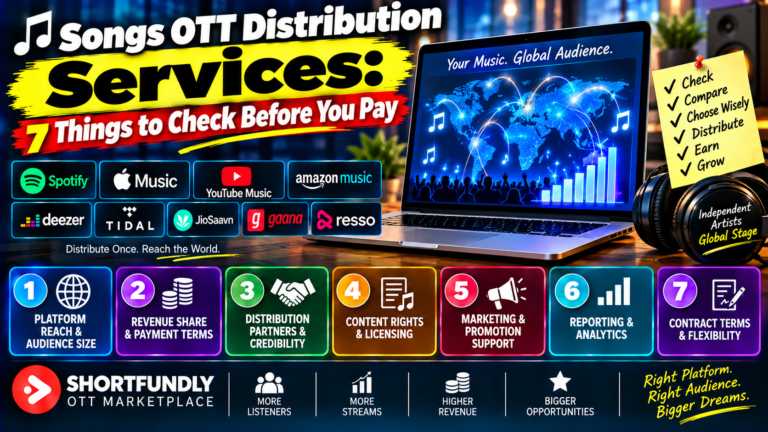
Compare supported content types, current partners, pricing, rights, agreement duration, exclusivity, revenue terms, reporting, payouts, and removal procedures. Always review the current agreement before submitting.
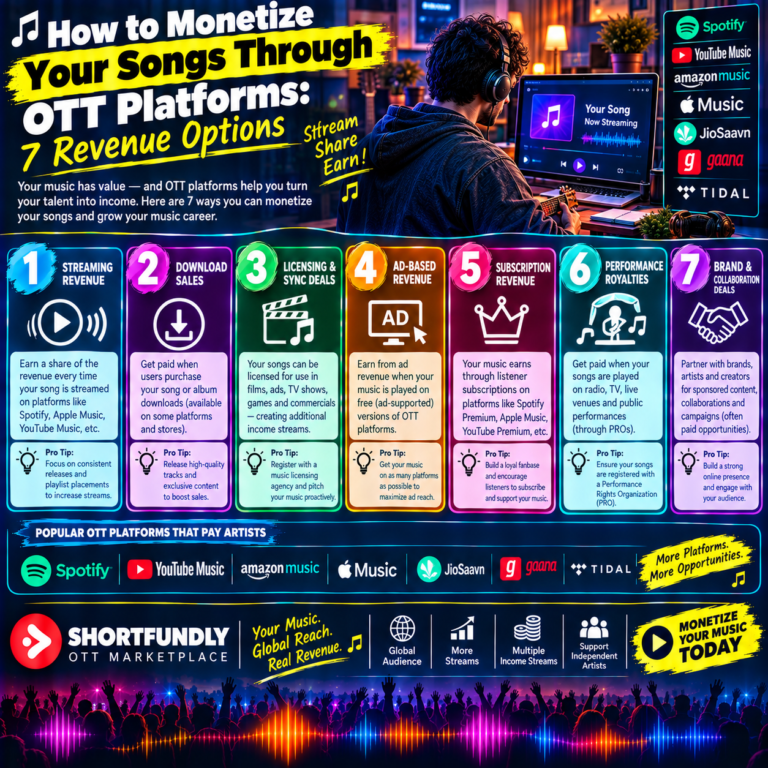
Also read: https://blog.shortfundly.com/ott/monetize-songs-ott-revenue/
24. Final Conclusion: YouTube and OTT Distribution Can Serve Different Jobs
The songs OTT distribution vs YouTube debate becomes much clearer when we stop treating the two channels as identical.
YouTube is a powerful publishing, discovery, audience-building, and creator-monetization environment.
OTT distribution is a structured distribution route that can help eligible content reach available streaming and media partners.
For an independent artist, the real question isn’t necessarily:
“Which one should I choose?”
A better question is:
“What role should each channel play in my music business?”
YouTube can help you build your public artist identity.
It can provide a home for music videos, Shorts, performances, interviews, and behind-the-scenes content.
OTT distribution can provide another route for eligible songs and video songs to reach distribution partners.
And a service such as Shortfundly Distribution can be considered as part of that broader strategy, subject to current eligibility, pricing, partner availability, and agreement terms.
The strongest independent release strategy can therefore look like this:
Create → Protect Rights → Distribute → Publish → Promote → Measure → Improve → Release Again
Don’t put all your hopes on one platform.
Build a catalog.
Build an audience.
Protect your intellectual property.
Track your revenue.
Understand your agreements.
Most importantly, keep releasing quality music.
The digital music business rewards consistency more than one-off excitement. Your first song might introduce you to an audience. Your next few releases can turn those listeners into fans. Over time, your catalog can become one of your most valuable creative and commercial assets.
YouTube and OTT distribution don’t have to compete for the same job.
Use each channel according to what it does best, and build your music strategy around the bigger picture.