Table of Contents
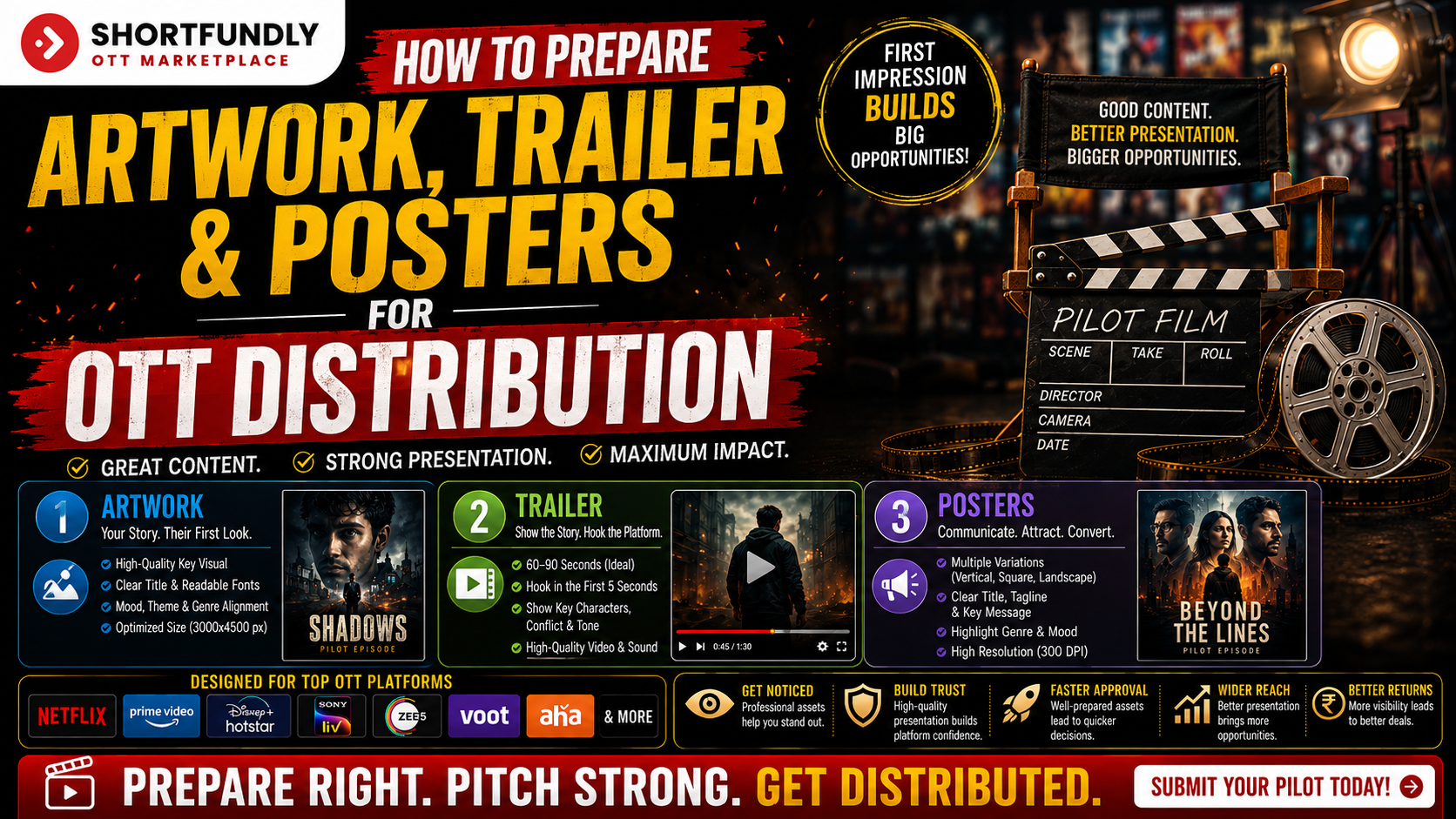
Preparing a film for OTT distribution involves much more than delivering the final video. Artwork, trailers, posters, thumbnails, banners, and promotional graphics play a major role in how audiences discover and judge a title. Strong visual assets can make an independent film look professional, market-ready, and suitable for digital platforms.
For filmmakers exploring Shortfundly Distribution, the preparation stage is an important part of the OTT delivery process. Shortfundly Distribution can help creators approach digital distribution with a more organized package of content and promotional materials.
Why OTT Artwork Matters
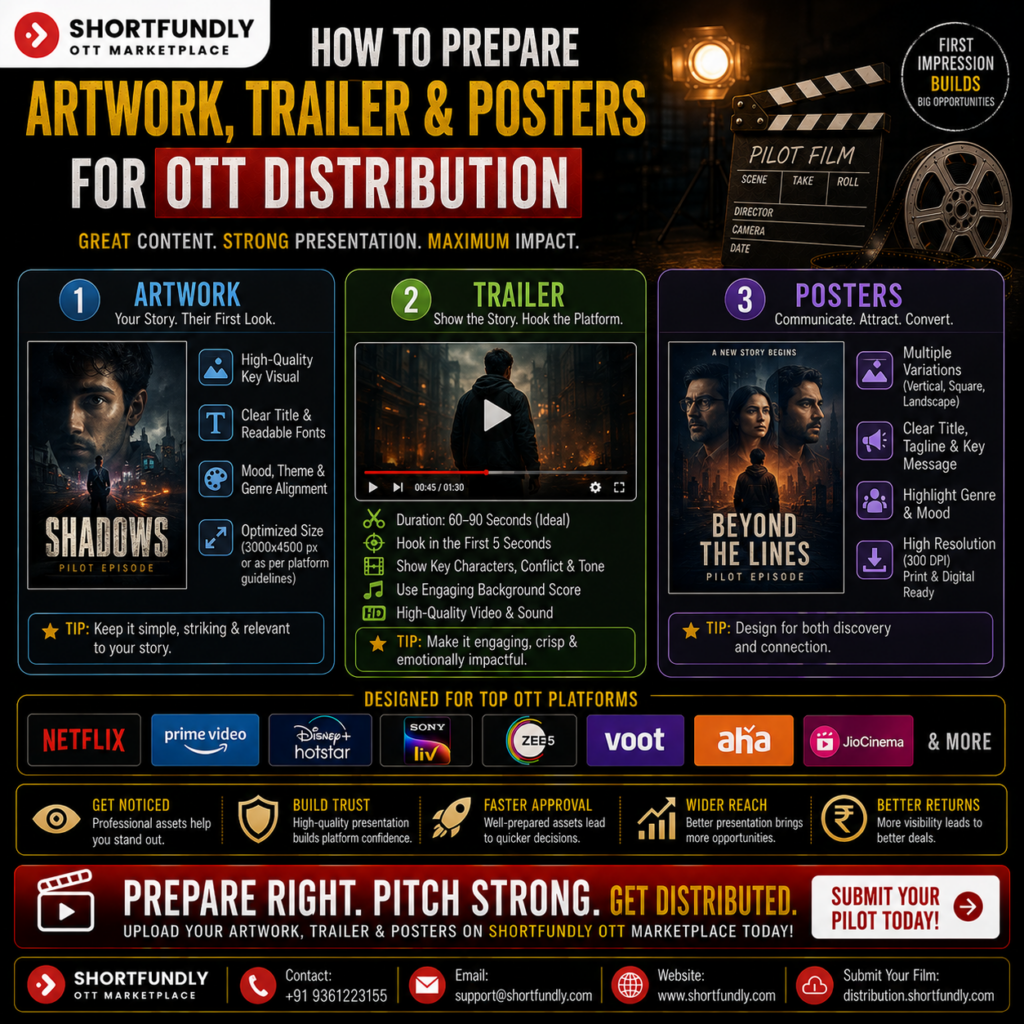
OTT platforms present thousands of films, series, documentaries, and short-form titles to viewers. The artwork is often the first thing audiences notice.
A viewer may see a poster before reading the synopsis. They may see a thumbnail before watching the trailer. Therefore, visual presentation needs to communicate the film’s identity quickly.
Good artwork should:
- Clearly identify the film title.
- Reflect the genre and tone.
- Make the main characters recognizable.
- Remain readable on mobile screens.
- Use professional typography.
- Avoid unnecessary visual clutter.
- Match the actual content of the film.
- Maintain consistent branding across promotional assets.
A strong poster doesn’t need to be complicated. In fact, simple designs often work better because they communicate the central idea immediately.
Prepare a Professional Main Poster
The main poster should function as the visual identity of the film. It should look professional across different screen sizes and promotional placements.
The poster can include the film title, lead cast, director, production information, tagline, and selected credits where appropriate.
However, every element should have a clear purpose. Too many names, logos, badges, and design effects can make the artwork difficult to understand.
Before final delivery, check the poster at both full size and thumbnail size. If the title becomes difficult to read when reduced, the design needs improvement.
Create Multiple Poster Variations
One poster may not be enough for a complete OTT marketing package.
We recommend preparing several variations while maintaining the same visual identity.
Possible versions include:
- Primary key art for the film’s main listing.
- Character-focused artwork for promotional campaigns.
- Landscape artwork for selected web placements.
- Portrait artwork for mobile-first promotion.
- Social media creatives for launch campaigns.
- Festival or award artwork when relevant.
- Quote-based promotional graphics for marketing.
These variations can save time later. Instead of redesigning the film’s visual identity for every campaign, we can adapt an established design system.
Design for Mobile-First Viewing
OTT audiences increasingly discover content through smartphones. Consequently, artwork should remain effective on small screens.
Large titles, strong contrast, and clear focal points are useful. Tiny credits and complex backgrounds may disappear on mobile devices.
We should ask one simple question during quality control:
Can a viewer understand what this title is within two or three seconds?
If the answer is no, the artwork may need to become simpler.
How to Prepare the OTT Trailer
The trailer is one of the most important promotional assets in an OTT distribution package.
A trailer should create interest without explaining the entire story. It needs to establish the film’s premise, tone, characters, conflict, and emotional appeal.
A useful trailer structure can include:
Opening Hook
The first few seconds should immediately create curiosity.
The opening could introduce a powerful image, unusual situation, emotional moment, dramatic question, or compelling line of dialogue.
Avoid spending too much time on slow introductions unless the film’s genre specifically requires it.
Story Setup
After the hook, the trailer should establish the basic situation.
Viewers should understand enough to become interested without receiving every important plot detail.
Rising Conflict
The middle section can introduce obstacles, tension, relationships, or unanswered questions.
This section should increase curiosity rather than resolve the story.
Emotional or Dramatic Peak
The final section should give audiences a reason to watch the complete film.
A strong emotional moment, unanswered question, visual reveal, or dramatic line can work effectively.
End Card
The trailer should conclude with clear title branding.
Depending on the distribution requirements, the end card may include the film title, release information, platform information, or relevant branding.
Keep the Trailer Short and Focused
A longer trailer isn’t automatically better.
For digital audiences, every second needs to earn its place. We should remove scenes that repeat information or slow the momentum.
The trailer should answer three questions:
- What is the film about?
- Why should viewers care?
- What makes the film worth watching?
If the trailer answers these questions clearly, it can perform its marketing role effectively.
Prepare a Clean Trailer Master
Before delivery, create a clean master version of the trailer.
Check the following:
- Video resolution.
- Aspect ratio.
- Frame rate.
- Audio synchronization.
- Dialogue clarity.
- Music levels.
- Subtitle accuracy.
- Text spelling.
- End-card information.
- Credits.
- Logos.
- Copyright notices.
The final trailer should not contain editing mistakes, temporary graphics, production watermarks, or unfinished elements.
Subtitle and Text Quality
Text appearing inside trailers and posters needs careful proofreading.
A single spelling mistake can make a professionally produced title appear unfinished.
Check:
Film title → Cast names → Director name → Production company → Release information → Platform information → Social handles
Names deserve particular attention. A misspelled actor or director name can create unnecessary problems during delivery and promotion.
Prepare Social Media Posters
Social media creatives can support OTT launches before and after release.
Instead of using the same poster everywhere, we can create campaign-specific graphics.
Examples include:
- “Coming Soon” artwork.
- Trailer announcement graphics.
- Release-day artwork.
- Character introductions.
- Behind-the-scenes posts.
- Director quotes.
- Audience review graphics.
- Streaming reminders.
- Episode announcements for series content.
These assets can be produced using the same color palette, fonts, imagery, and branding as the primary poster.
Consistency helps audiences recognize the title across different channels.
Create Strong Thumbnail Artwork
The thumbnail may become one of the most important discovery assets for digital content.
A thumbnail has limited space. Therefore, we should prioritize one strong image and a readable title.
Avoid filling the thumbnail with long descriptions.
A strong thumbnail usually has:
- One clear subject.
- Strong facial expression or visual action.
- Clear title treatment.
- High contrast.
- Minimal unnecessary text.
- Consistent branding.
The thumbnail should still make sense when displayed at a very small size.
Maintain Consistent Branding
The poster, trailer, thumbnail, banner, and social media creatives should look like they belong to the same film.
This can be achieved through consistent:
- Typography.
- Color palette.
- Character imagery.
- Logo placement.
- Title treatment.
- Photography style.
- Tagline usage.
Consistency creates a more professional presentation and prevents audiences from confusing promotional materials.
Avoid Misleading Artwork
Artwork should accurately represent the content.
For example, a serious drama shouldn’t use artwork that suggests it is a comedy simply because comedy posters may attract clicks. Likewise, a family film shouldn’t use imagery that creates expectations the film cannot satisfy.
Misleading artwork may generate initial curiosity, but it can also lead to poor audience satisfaction.
The strongest marketing asset creates curiosity while remaining honest about the viewing experience.
Prepare High-Quality Source Files
We should retain editable source files for all major artwork.
These can include:
- Photoshop files.
- Illustrator files.
- Layered design files.
- Original photographs.
- High-resolution logos.
- Typography information.
- Exported JPEG or PNG versions.
Keeping source files makes future revisions much easier.
For example, a platform may request a different aspect ratio or updated release date. Editable artwork allows the change to be made without rebuilding the entire design.
Check Copyright and Image Rights
Every image used in promotional artwork should have appropriate rights.
This includes:
- Actor photographs.
- Stock photographs.
- Illustrations.
- Fonts.
- Logos.
- Music-related imagery.
- Background textures.
- Third-party artwork.
We should maintain documentation for licensed assets whenever possible.
A distribution package becomes stronger when the producer can demonstrate that promotional materials are legally cleared.
Keep Trailer Music Properly Cleared
Music rights require special attention.
A filmmaker may have permission to use a track inside the film but still need to confirm whether that permission covers promotional trailers and marketing campaigns.
Trailer usage can involve separate rights depending on the agreement.
Before delivery, review music licenses and confirm that promotional use is covered.
Prepare a Complete Marketing Asset Folder
Instead of sending individual files through multiple messages, organize everything into a structured folder.
A practical structure could look like this:
FILM_TITLE/
│
├── POSTER/
│   ├── Main_Poster.jpg
│   ├── Main_Poster_HighRes.jpg
│   └── Social_Poster.jpg
│
├── TRAILER/
│   ├── Trailer_Master.mp4
│   └── Trailer_Captioned.mp4
│
├── THUMBNAILS/
│   ├── Thumbnail_01.jpg
│   └── Thumbnail_02.jpg
│
├── LOGOS/
│   └── Production_Logo.png
│
├── STILLS/
│   ├── Still_01.jpg
│   ├── Still_02.jpg
│   └── Still_03.jpg
│
└── CREDITS/
    └── Credits.txt
This structure makes the package easier to review and update.
Include High-Resolution Film Stills
Film stills provide additional promotional material for distribution and marketing.
Choose images that show:
- Lead characters.
- Important locations.
- Strong emotional moments.
- Cinematic compositions.
- Major story themes.
- Visually distinctive scenes.
Avoid screenshots taken from compressed video whenever possible. Original high-resolution stills usually provide a much stronger result.
Prepare a Director and Cast Image Set
Professional headshots can also support promotional campaigns.
If available, provide high-resolution images of:
- Director.
- Lead actors.
- Supporting actors.
- Producers.
- Other key creative personnel.
Each image should have an accurate file name.
For example:
Director_Name.jpg
Lead_Actor_Name.jpg
Clear naming reduces confusion during marketing and editorial preparation.
Build a Simple Metadata Package
Visual assets work alongside metadata.
A complete OTT package may include:
- Film title.
- Logline.
- Short synopsis.
- Long synopsis.
- Genre.
- Language.
- Country of production.
- Runtime.
- Release year.
- Director.
- Cast.
- Producer.
- Production company.
- Keywords.
- Content rating information.
- Subtitle information.
The artwork should match these details.
If the title appears differently across files, the distribution process can become unnecessarily complicated.
Final Quality-Control Checklist
Before submitting the package, we should conduct a complete review.
Artwork Checklist
- Film title is correct.
- Names are spelled correctly.
- Images are high resolution.
- Artwork represents the film accurately.
- No unauthorized images are included.
- Logos are correct.
- Text is readable on mobile screens.
- Required aspect ratios are available.
Trailer Checklist
- Trailer opens with a strong hook.
- Audio is clear.
- Dialogue is understandable.
- Music is properly cleared.
- Subtitles are accurate.
- No unfinished graphics remain.
- End card is correct.
- Final export has been reviewed from beginning to end.
Promotional Checklist
- Social media artwork is ready.
- Thumbnail options are available.
- High-resolution stills are included.
- Cast photographs are available.
- Director photograph is available.
- Production logo is included.
- Source files are safely stored.
Common Artwork Mistakes to Avoid
Several small mistakes can weaken an otherwise strong OTT package.
Using Low-Resolution Images
Blurry posters and compressed photographs immediately reduce perceived quality.
Adding Too Much Text
A poster isn’t a press release. Keep the visual message simple.
Using Unclear Fonts
Decorative fonts can look attractive but may become difficult to read on mobile devices.
Ignoring Aspect Ratios
Different platforms and placements may require different dimensions.
Forgetting Rights Clearance
Promotional assets can create rights problems just like the film itself.
Delivering Unorganized Files
A clean folder structure saves time and reduces mistakes.
How Shortfundly Distribution Fits Into the Process
For independent filmmakers, OTT distribution is easier to manage when the film arrives with a complete professional package.
Shortfundly Distribution can be considered as part of a filmmaker’s digital distribution strategy, particularly when the goal is to prepare content for wider OTT availability.
The strongest approach is to prepare the film, metadata, artwork, trailer, subtitles, and promotional materials before the submission stage. This reduces last-minute work and creates a more professional presentation.
The distribution package should tell one consistent story: the film is complete, rights are organized, technical assets are prepared, and the title is ready for digital audiences.
Also read: https://blog.shortfundly.com/ott/pitch-pilot-film-ott/
The Final OTT Artwork Strategy
Great artwork doesn’t replace a great film. However, it helps the right audience discover that film.
We should therefore treat promotional assets as part of the production process rather than an afterthought.
A professional OTT package combines strong key art, clear thumbnails, an engaging trailer, accurate metadata, high-quality stills, rights documentation, and organized delivery files.
When these elements work together, the film becomes easier to present, market, review, and distribute.
For independent creators, preparation is often the difference between simply having a finished film and having a distribution-ready title.
The goal is straightforward: make every asset clear, accurate, attractive, and technically prepared before submission. With a complete package and a focused distribution strategy, filmmakers can approach the OTT market with greater confidence and a stronger professional presentation.