Table of Contents
The growth of free, ad-supported streaming television has created new opportunities for filmmakers, production companies, and independent content owners. As viewers look for entertainment without additional subscription costs, FAST channel distributors play an important role in helping eligible content reach streaming services and potential audiences.
FAST stands for Free Ad-Supported Streaming TV. These services allow viewers to watch movies, television programs, and other video content for free, with advertising helping support the business model. For filmmakers, FAST distribution can provide another route to explore beyond theatrical releases and subscription-based streaming platforms.
However, distributing a film involves more than uploading a video. Content owners need to prepare professional media assets, confirm licensing rights, meet technical requirements, and identify distribution partners that suit their goals.
In this guide, we explain what FAST channel distributors do, how to evaluate distribution services, how to prepare content, and how Shortfundly Distribution may fit into your digital film distribution research.
What Do FAST Channel Distributors Actually Do?
FAST channel distributors help content owners, channel operators, and production companies explore ways to deliver programming to streaming services. Their responsibilities depend on their business model and distribution agreements.
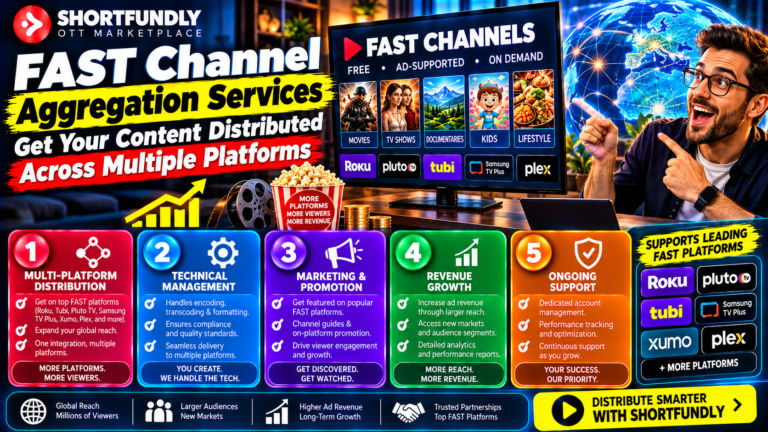
Some providers focus on distributing existing channels, while others help transform a video library into a scheduled FAST channel. Certain companies also offer technical infrastructure, advertising integrations, and performance reporting. For example, FAST Channels TV describes services covering channel distribution, licensing, channel creation, and streaming technology. 【turn535089search1】【turn535089search8】
Content Evaluation and Onboarding
Distributors may evaluate a film library or channel concept to determine whether it fits their supported destinations. They may request information about the content, target audience, language, rights, and available technical assets.
A clear catalog helps the distributor understand what is available and whether the content fits its current opportunities.
Technical Preparation and Quality Control
Streaming services can have different delivery requirements. Depending on the agreement, a distributor may help with video transcoding, audio checks, metadata, subtitles, artwork, and file validation.
We should confirm which technical services are included rather than assuming every distributor provides complete asset preparation.
Channel Creation and Programming
Some distributors help content owners create a linear channel from a library of eligible movies, series, or other programming. This can involve scheduling, channel branding, program information, and electronic program guide data.
A content owner with a large collection may explore whether a dedicated channel makes sense, while a filmmaker with a single title may be better suited to a film licensing or catalog distribution arrangement.
Platform Delivery and Monetization
Depending on the provider and contract, distribution can involve delivering content or channels to supported streaming destinations, coordinating advertising technology, and supplying performance reports.
FAST services generally rely on advertising, but the way revenue is shared with content owners varies. We should always review the commercial agreement and understand any fees, deductions, and payment conditions.
How to Choose the Right FAST Channel Distributor
Choosing a distribution partner is an important business decision. The right provider should match our content, rights, target markets, and commercial objectives.
We should evaluate the following factors before signing an agreement.
| Evaluation Factor | Questions to Ask |
|---|---|
| Platform access | Which services are currently supported? |
| Content eligibility | Does the provider accept our genre and format? |
| Territory coverage | In which countries can the content be distributed? |
| Technical support | Are quality control, metadata, and delivery included? |
| Commercial terms | Are there upfront fees, revenue shares, or deductions? |
| Rights and exclusivity | Which rights are granted, and for how long? |
| Reporting | What performance and revenue data will be provided? |
| Content management | How are updates, renewals, and takedown requests handled? |
We should also ask whether the provider distributes individual films, complete libraries, existing linear channels, or newly created FAST channels. These are different services, and a provider that specializes in one may not offer the others.
Avoid relying on broad claims about guaranteed platform access or income. The actual opportunities depend on platform relationships, rights availability, content suitability, and written agreements.
Prepare Your Content Before Approaching FAST Channel Distributors
Professional preparation can make our content easier to evaluate and help reduce avoidable delays.
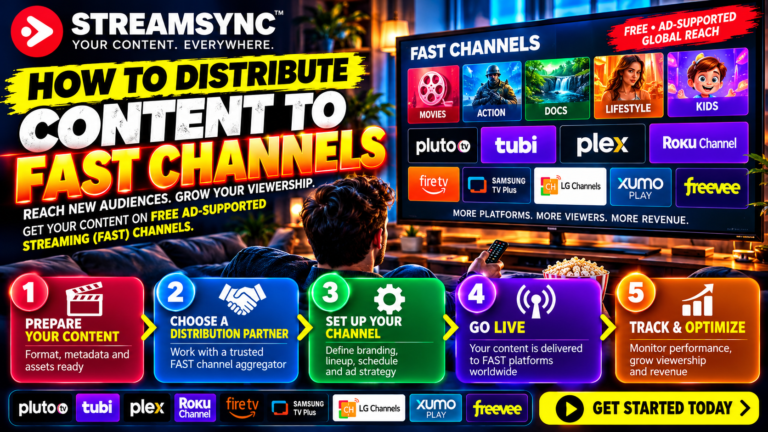
1. Organize Your Content Catalog
Create a list of all available titles and include:
- Film or program title
- Genre and language
- Runtime and release year
- Synopsis and production credits
- Available audio and subtitle versions
- Territories in which distribution rights are available
- Current licensing agreements
- Available artwork and trailers
A well-organized catalog helps us identify suitable opportunities and answer a distributor’s questions efficiently.
2. Confirm Your Rights
Before submitting a film, we should verify that we have the necessary rights for the intended distribution format and territories.
This may include music, scripts, performances, archival footage, and other third-party materials. We should also check existing exclusivity clauses and licensing windows to avoid conflicts.
3. Prepare Technical Assets
The distributor may require a high-quality master file, specific audio formats, subtitles, captions, posters, still images, and metadata.
We should follow the current specifications provided for the intended destination. A file accepted by one service may not automatically meet another service’s requirements.
4. Create Accurate Metadata
Metadata helps distributors and streaming services understand and organize content. We should provide accurate titles, descriptions, genres, credits, release years, and any other required information.
Our synopsis should clearly describe the film without exaggerated claims. Artwork should be professional, relevant, and cleared for distribution.
FAST Channel Distribution vs. Traditional OTT Distribution
FAST distribution is part of the broader internet-delivered television ecosystem, but it isn’t identical to every other OTT model.
FAST services generally provide free, advertising-supported viewing, often through scheduled linear channels. Other OTT services may rely on subscriptions, individual rentals or purchases, or advertising-supported on-demand catalogs.
This distinction matters when we review distribution offers. A provider may support general OTT distribution without offering access to a specific FAST channel or linear programming service.
Before signing, we should confirm the exact distribution rights covered by the agreement, including whether it includes linear FAST channels, on-demand distribution, advertising-supported video, and the relevant territories.
Explore Shortfundly Distribution
For independent filmmakers and content owners researching digital distribution opportunities, Shortfundly Distribution is a service worth exploring.
We should review its current offerings and confirm whether they match our content type and objectives. In particular, we should ask which platforms and territories are supported, what content is eligible, which technical and administrative services are included, and what commercial terms apply.
Questions worth asking include:
- Can our film, series, or content library be considered?
- Which distribution destinations are currently available?
- What rights and documentation are required?
- Are technical preparation and metadata support included?
- What fees or revenue-sharing terms apply?
- How are content availability and earnings reported?
- Are agreements exclusive or non-exclusive?
These details help us determine whether the service is suitable for our project. We should confirm platform access and FAST-specific capabilities directly rather than assuming every destination is included.
Visit Shortfundly Distribution to learn more about its current digital distribution services and explore potential options for your content.
Common Challenges When Working With FAST Channel Distributors
Even with a suitable partner, we should prepare for challenges that can affect distribution.
Platform acceptance: A distributor may submit content, but the receiving platform can still decline it. We should research eligibility and prepare complete materials.
Rights restrictions: Existing contracts may limit distribution by territory, format, or duration. Rights should be checked before making new commitments.
Technical delivery: Incorrect files, incomplete metadata, and subtitle errors can delay onboarding. A delivery checklist can help prevent avoidable problems.
Revenue uncertainty: Earnings depend on the agreement, advertising demand, viewing activity, and applicable deductions. We should avoid relying on unconfirmed income.
Discoverability: Publishing a title doesn’t guarantee a large audience. Genre fit, catalog placement, recommendations, and promotion may influence how many viewers find it.
A thoughtful distribution plan should account for these factors and include a process for tracking content status, rights, and performance.
Frequently Asked Questions
What is a FAST channel distributor?
A FAST channel distributor helps content owners or channel operators deliver eligible content or linear channels to supported free, ad-supported streaming destinations. Depending on the provider, services may include technical preparation, channel operations, delivery coordination, licensing, or monetization support.
Can independent filmmakers work with FAST channel distributors?
Yes, independent filmmakers can explore FAST distribution, subject to content eligibility, rights clearance, technical requirements, and available distribution routes. Acceptance depends on the relevant platform and agreement.
Do FAST channel distributors guarantee streaming platform placement?
No. A distributor may provide a delivery route or submit content for consideration, but platform acceptance and publication depend on the receiving service and the applicable agreements.
How do FAST channel distributors make money?
Their business models vary. Some may charge service fees, receive a share of revenue, negotiate licensing arrangements, or provide technology and channel operations. Content owners should review all costs and payment terms before signing.
What content can be distributed through FAST channels?
Depending on the channel and platform, eligible content may include feature films, documentaries, television series, classic movies, and genre-specific programming. Each distributor and destination has its own requirements.
How can we choose a reliable FAST distribution partner?
We should verify the provider’s supported platforms, territory coverage, service scope, fees, rights terms, reporting, and communication process. Written agreements should clearly define responsibilities and commercial expectations.
Also read: https://blog.shortfundly.com/ott/fast-channel-distribution-4/
Conclusion
FAST channel distributors can help filmmakers, studios, production companies, and content owners explore new routes to streaming audiences. By preparing content professionally, verifying rights, understanding platform requirements, and reviewing distribution agreements carefully, we can make more informed decisions about our digital distribution strategy.
The best partner is one whose services and commercial terms match our content and goals. Platform acceptance, audience reach, and revenue aren’t guaranteed, so we should evaluate each opportunity based on clear information and realistic expectations.
If we’re researching digital distribution services, Shortfundly Distribution is a resource to consider. Reviewing its current offerings and confirming the available distribution options can help us decide whether it fits our content strategy.